Melting and Magnetic Effect on Mixed Convective
Flow from a Vertical Plate Embedded in
Non-Darcy Porous Media with Aiding and Opposing
External Flow and Variable Temperature
Purna Chandra Barman1, Ashoke Das2 and Md. Rabiul Islam1, Mrityunjoy Ghosh4
1, 2
Department of Physics, Raiganj University, Raiganj-733 134, West Bengal, India
3
Department of Mathematics, Dinhata College, Cooch Behar-736101, West Bengal, India
Abstract: The problem of mixed convective melting along a vertical plate in a Newtonian fluid saturated non-Darcy porous medium in the presence of magnetic effects for aiding and opposing external flows with variable temperature is presented. The Similarity solutions for this problem are used to reduce the governing partial differential equations into a system of nonlinear ordinary partial differential equations and then are solved numerically using the fourth order Runge–Kutta method. The effects of different controlling parameters on melting and heat transfer are investigated and presented graphically obtaining velocity and temperature variation in melting region. It is obvious that the rate of heat transfer decreases as the magnetic parameter and melting parameter increases.
Keywords: Melting effect, Newtonian fluids, non-Darcy porous medium, mixed convection
I. NOMENCLATURE
Magnetic field strength
Cs specific heat of solid phase
Dimensionless stream function Acceleration due to gravity
ℎ Local heat transfer coefficient
Latent heat of melting of solid Permeability of the porous medium
F dimensionless Inertia parameter
C empirical constant
Thermal conductivity
Ha the Hartmann number
Melting parameter Local Nusselt Wall heat flux
Temperature in thermal boundary layer Temperature at the solid region Velocity in x-direction
Velocity in y- direction
Coordinate along the melting plate Coordinate normal to melting plate
η dimensionless similarity variable
A. Greek symbols
Thermal diffusivity
Viscosity of fluid Kinematic viscosity Density
Stream function Electrical conductivity Dimensionless temperature
B. Subscripts
Melting point
∞ Condition at infinity
II.INTRODUCTION
Convective heat transfer study in porous media in the presence of melting effect has gained some significant attention in recent years due to important application in permafrost melting, frozen ground thawing, casting and welding processes as well as phase change material. The mixed convection melting from a vertical plate embedded in porous medium studied by Gorla et al. (1999) [1]. He suggested that melting process analogous to mass injection or blowing processes. Epstein and Cho (1976) [2] examined melting rate over a vertical plate using Nusselt’s method to conclude the negligence of transient effects is possible if the thickness of the thermal boundary layer is smaller than melting solid. Shateyi et al. (2010) [3] analyzed the problem of magnetic field on mixed convection from vertical surface in porous medium with various effects of thermal radiation, hall currents, Soret and dufour.
Kazmierczaket al. (1986,1987) ([4], [5]) considered the velocity, temperature and Nusselt number from a flat plate embedded in
porous medium in case of steady natural convection considering in the melting region. The investigated numerical solution to free convection over a vertical plate saturated in a power-law fluid magnetic and double dispersion effects is analyzed by Srinivasacharya et al. (2013) [6]. Hassanien and Bakier (1991) [7] studied melting with mixed convection flow from a horizontal
flat plate embedded in a porous medium. Sparrow et al. (1977) [8] studied the heat transfer in the melting region of a non- porous
medium furnishing the information regarding the velocity, temperature fields and the heat transfer rate by applying finite difference method. The effect of melting on mixed convection flow from a vertical plate embedded in a Non-Newtonian fluid saturated non-Darcy porous medium in the presence of thermal dispersion -radiation is analyzed in aiding and opposing flow cases by Prasad et al.
(2014) [9]. .Pozovonkovet al. (1968) [10] also calculated the heat transfer rate near a melting surface in the same medium using
Karman-Pohlhausen scheme. Bakier (1997) [11] obtained the solution using analytical homotopy analysis for the case, aiding and opposing flow in a porous medium. He pointed out that in the liquid solid interface the melting phenomenon decreases the local Nusselt number. Obtaining similarity solution Cheng (1977) [12] studied the melting phenomenon for mixed convection over a flat plate. Epstein (1975) [13] analyzed the effect of melting of submerged bodies. HEMALATHA et al. (2015) [14] analyzed the effects of melting and solute dispersion on heat and mass transfer on non-Darcy mixed convective flow over a vertical plate. Madhavi et al. (2017) [15] presented melting phenomenon in the presence of heat absorption and heat generation coefficient with mixed convection flow and heat transfer in a saturated non-Darcy porous medium considering the effects of thermal dispersion, thermal radiation and applied magnetic field by taking Forcheimer extension in the flow equations. The effect of Magnetic and buoyancy on melting from a vertical plate embedded in saturated porous media is studied by Tashtoush [16]. He observed that the melting parameters increase with the decrease of temperature as well as Nusselt number at the solid liquid interface. The problems of melting effect on mixed convective heat transfer from a porous vertical plate with uniform wall temperature in the liquid-saturated porous medium with aiding and opposing external flows is numerically examined at steady state Cheng and Lin(2008) [17].
The main aim of the present investigation is to illustrate the melting effect with magnetic field from a vertical plate in a non Darcy porous medium for aiding and opposing external flows with variable temperature. The velocity and temperature profiles of various parameters under the influence of magnetic field with melting effect and the results so obtained are compared with relevant results in the existing literature and are found to be in good agreement in the absence of melting and magnetic effect.
III. MATHEMATICAL FORMULATION
Let us consider the free convection heat transfer from a vertical flat plate embedded in a non Darcyporous media saturated with Newtonian fluid. It is assumed that this plate constitutes the interface between the liquid and solid phases during melting inside the
porous matrix. The plate temperature, Tm , is the melting temperature of the material occupying the porous matrix, which is regarded
of the coordinate system is placed at the leading edge of the interface surface between the solid and liquidphases. x is the coordinate along the surface of the plate measured from the origin, and y isthe coordinate normal to the surface. u and v are the components of the non-Darcy velocity in thex and y directions, respectively, is shown in the fig. 1.
Fig.1. Schematic model and system of coordinates.
A magnetic field of strength B0 is applied in the y direction which is normal to the flow direction. The flow is steady, laminar and
two dimensional. The fluid and porous medium are in local thermal equilibrium and constant except density. The Boussiensq approximation is valid and the boundary layer approximation is applicable. The governing equation, namely the equation of continuity, momentum equation and energy equation for isotropic and homogeneous porous medium can be written as (see Bear [19] ):
+ = 0(1)
+ √ =∓ (2)
+ = + (3)
= ∞[1− ( − ∞)]
In the above equations, and are the component of darcian velocity along x and y direction, is the density, and are the
acceleration and electrical conductivity of the fluid respectively. = is the equivalent thermal diffusivity
The boundary conditions necessary to complete the problem formulation are:
= 0, → = ∞+ , = [ + ( − )] at = 0 (4)
= ∞, → ∞at →∞ (5)
Where and are the latent heat of solid and specific heat capacity of solid phase, respectively.Theboundary condition (4) refers that
the temperature on the plate is constant and thermal flux of heat conduction to the melting surface is equal to the sum of the melting heat and the heat required for raising the temperature of solid to its melting temperature [Epstein and Cho (1976)].
The stream function ( , )is chosen in such a way that the continuity equation automatically satisfied i.e.,
= and = − (6)
Introducing the following similarity transformation equation, the above system of partial differential equations (1-3) are transferred into the non-linear ordinary differential equations
= ∞
(7)
( ) =
( ∞)
(8)
( ) = ∞
Introducing Eqs. (7), (8), (9) intoEqs. (2) and (3), we obtain the following transformed governing equations:
(1 + ′) ′′+ = 0(10)
′′+ (1 +) ′− ′ + ′ = 0(11)
Where, = , Hartmann number, = ( ∞ )
Grashof number, = (∞ )
( ∞)
, melting parameter, = √ , inertia
parameter, = ∞
, Reynolds number, =
( ∞)
, Eckert number, = , Darcy number, buoyancy parameter, =
(∞ ) /
∞ / .
The forms of non linear differential are as follows:
′+ 2 ′= 0, = 0 = 0(12)
And ′→1, →1 →∞ (13)
Physical quantities of interest is the Nusselt number which aredefined as
= ′′ (14)
Further, is the heat transfer from the surface of the plate, and is given by
′′=− (15)
Using equation (13), equation (12) becomes
= / ′ (16)
IV. SOLUTION PROCEDURE
The Eq. (10) together with Eq. (11) is split into system of first order ordinary differential equations. Using boundary conditions (12) and (13) they are solved numerically by means of the fourth order Runge- Kutta method coupled with a shooting technique and by
giving appropriate initial guess values for ′(0). The solution, thus, obtained is matched with the given values at ′(∞)and (0). An
accuracy upto 4th decimal place is considered for convergence.
V. RESULTS AND DISCUSSION
In order to get clear insight on the physics of the problem, a parametric study is performed and the obtained numerical results are displayed with the help of graphical illustrations.
0 2 4 6 8
1.0 1.1 1.2 1.3 1.4 1.5 f'
Dim ensioless distance
M =0.0,1.4,2.0,3.0,8.0 ,10.0,20.0 G r/Re=3.0 , Ha=0.0, E c=0.1 ,Da=0.1,F =5.0
Aiding external flow
0 2 4 6 8
0.2 0.3 0.4 0.5 0.6 0.7 0.8 0.9 1.0
Gr/Re=3.0, Ha=0.0, Ec=0.1,Da=0.1,F=5.0 M=0.0,1.4,2.0,3.0,8.0,10.0,20.0
Opposing external flow
f'
Dimensionless distance
0 2 4 6 8 0.0 0.2 0.4 0.6 0.8 1.0
Aiding external flow
dimensioless distance
M=0.0,1.4,2.0,3.0,8.0,10.0,20.0
Gr/Re=3.0, Ha=0.0, Ec=0.1,Da=0.1,F=5.0
0 2 4 6 8
0.0 0.2 0.4 0.6 0.8 1.0 Dimensioless distance M=0.0,1.4,2.0,3.0,8.0,10.0,20.0
Gr/Re=3.0, Ha=0.0, Ec=0.1,Da=0.1,F=5.0 Opposing external flow
Fig.3. temperature profiles for different values of melting parameter with aiding and opposing flow.
0 2 4 6 8
1.0 1.1 1.2 1.3 1.4 Dimensioless distance
f' Aiding external flow
Ha=0.0,0.1,0.2,0.3,0.4,0.5. G r/Re=3.0, M =2.0, Ec=0.1,Da=0.1,F=5.0
0 2 4 6 8
0.3 0.4 0.5 0.6 0.7 0.8 0.9 1.0 Dimensioless distance f'
Opposing external flow
Ha=0.0,0.1,0.2,0.3,0.4,0.5.
Gr/Re=3.0, M=2.0, Ec=0.1,Da=0.1,F=5.0
Fig.4. velocity profiles for different values of magnetic parameter with aiding and opposing flow.
0 2 4 6 8
0.0 0.2 0.4 0.6 0.8 1.0 Dimensioless distance Ha=0.0,0.1,0.2,0.3,0.4,0.5.
Gr/Re=3.0, M=2.0, Ec=0.1,Da=0.1,F=5.0 Aiding external flow
0 2 4 6 8
0.0 0.2 0.4 0.6 0.8 1.0
Gr/Re=3.0, M=2.0, Ec=0.1,Da=0.1,F=5.0
Dimensioless distance
Opposing external flow Ha=0.0,0.1,0.2,0.3,0.4,0.5.
0 2 4 6 8 1 . 0
1 . 5 2 . 0 2 . 5 3 . 0 3 . 5 4 . 0
f'
D i m e n s i o n l e s s t e m p e r a t u r e
F = 0 . 0 , 1 . 0 , 3 . 0 , 5 . 0 , 1 0 . 0 , 2 0 . 0 M = 2
G r / R e = 3 , E c = 0 . 1 , D a = 0 . 1 , H a = 0 . 2 0 A i d i n g e x t e r n a l f l o w
Fig.6. velocity profiles for different values inertia parameter with aiding and opposing flow.
0 2 4 6 8
0 . 0 0 . 2 0 . 4 0 . 6 0 . 8 1 . 0
D im e n s io n l e s s t e m p e r a t u r e
F = 0 . 0 ,1 . 0 , 3 . 0 , 5 . 0 , 1 0 . 0 , 2 0 . 0
M = 2
G r / R e = 3 , E c = 0 . 1 , D a = 0 . 1 , H a = 0 . 2 0 A i d in g e x t e r n a l f lo w
Fig.7. temperature profiles for different values of inertia parameter with aiding and opposing flow.
The effects of melting on velocity profiles for aiding and opposing external flow are shown in fig. 2. It is clear from the figure that an increase in melting parameter leads to increase thevelocity profile and boundary layer thickness but this effect is found reverse for opposing external flow. From a physical point of view, this result may be attributed to the factthat convection heat transfer restrain from liquid saturated porous medium to the solid porousplate for aiding external flow. From fig.3 it is obvious that
the temperature profiles decreases with increase of melting parameter both in aiding and opposing external flows without magnetic field, in the case of buoyancy parameter (Gr/Re)=3, Eckert number (Ec)=0.10, Darcy number (Da)=0.1 and inertia parameter F=5. Fig. 4 illustrates the influence of the magnetic field on velocity profiles. It is noted that the velocity profile increases with the increase of magnetic parameter’s value in aiding flow cases and in the opposing flow case the velocity profile decreases with the increase of magnetic parameter. The temperature profiles for aiding and opposing flows are shown in Fig. 5 for different values of magnetic parameter. In aiding flow the increase in temperature is found for increases in magnetic parameter but in opposing flow case temperature decreases with an increase of magnetic parameter.
M Gr/Re Chamkha et.al
(2010)
Cheng and Lin (2007) Present Work
2.0 0.0 1.0000 1.0000 1.0000
1.4 2.4000 2.4000 2.4000
3.0 4.0000 4.0000 4.0000
8.0 9.0000 9.0000 9.0000
10.0 11.000 11.000 11.000
[image:7.612.166.423.286.437.2]TABLE 1.Comparison of f1(0) with values obtained by Chamkhaet al. (2010) and Cheng and Lin (2007) for Newtonian fluid (n = 1.0) with an aiding external flow for the case of M = 2.0
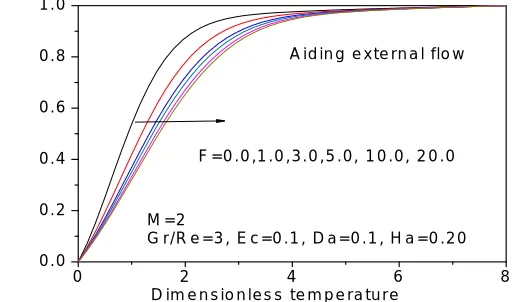
Fig. 6 depicts the effects inertia parameter on velocity profile. It is found that in aiding flow velocity decreases with increase of inertia parameter. From fig.7 it is obvious that temperature decreases with increase of inertia parameter.
0 2 4 6 8 10
0.0 0.1 0.2 0.3 0.4 0.5 0.6 0.7
N
u
/R
a
1
/2
Melting parameter Ha=0,0, 0.2, 0.4 Aiding flow
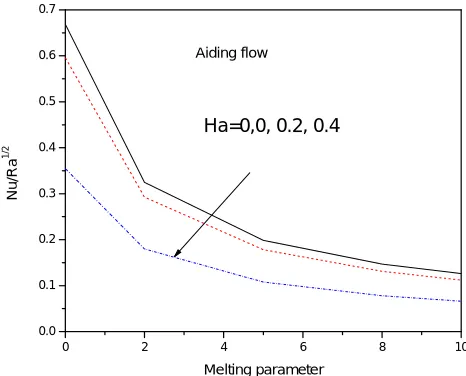
Fig.8. heat transfer rate for different values of magnetic parameter with aiding flow.
Fig. 8 illustrates the influence of the melting parameter and magnetic field onNusselt number. It is noted that the heat transfer rate decreases with the increase of magnetic parameter as well as melting parameter in aiding flow cases.
VI. CONCLUSION
The problem of mixed convective melting along a vertical plate in a Newtonian fluid saturated non-Darcy porous medium in the presence of magnetic effects for aiding and opposing external flows with variable temperature is presented. The Similarity solutions for this problemare used to reduce the governing partial differential equations into a system of nonlinear ordinary partial differential equations and then are solved numerically using the fourth order Runge–Kutta method. A boundary condition to account for melting is used at the interface between the solid and liquidphases. Graphical representation of results regarding the velocity and temperature distributionsas well as the Nusselt number were presented and discussedfor different melting parameters. The increment of velocity is observed at aiding flow but reverse phenomenon are seen in opposing flow. In temperature distribution temperature decreases both aiding and opposing flow. The heat transfer rate decreases with increases of melting parameter as well as magnetic field.
REFERENCES
[1] R.S.R. Gorla, M.A. Mansour, I.A. Hassanien, A.Y. Bakier, Mixed convection effect on melting from a vertical plate, Transp. Porous Media, vol. 36, pp. 245– 254, 1999
[2] M. Epstein, and D. H. Cho, Melting heat transfer in steady laminar flow over a flat plate”, ASME J. Heat Transfer, vol. 98, pp. 531–533, 1976
[3] S. Shateyi, S. S Motsa, and P. SibandaThe Effects of Thermal Radiation, Hall Currents, Soret, and Dufour on MHD Flow by Mixed Convection over a Vertical Surface in Porous Media, Hindawi Publishing Corporation Mathematical Problems in Engineering, vol.20, pp.627-475, 2010.
[4] M. Kazmierczak, D. Poulikakos, I. Pop, Melting from a flat plate embedded in a porous medium in the presence of steady natural convection, Numer. Heat Transfer, 10, pp. 571–581, 1986.
[5] M. Kazmierczak, D. Poulikakos, D. Sadowski, Melting of a vertical plate in porous medium controlled by forced convection of a dissimilar fluid, Int. Comm. Heat Mass Transfer, 14, pp. 507–517, 1987.
[6] D. Srinivasacharya and G. Swamy Reddy, “Mixed Convection Heat and Mass Transfer Over a Vertical Plate in a Power-Law Fluid-Saturated Porous Medium with Radiation and Chemical Reaction Effects”. Heat Transfer -Asian Research, vol. 42, no.6, pp.485- 499. Sep. 2013.
[7] I. A. Hassanienand A. Y.BakierEarth, Moon, Planets52, 51–63. 1991.
[image:8.612.180.413.161.349.2][9] J. S. R. Prasad, K. Hemalatha and B. D. C. N. Prasad, Mixed Convection Flow from Vertical Plate Embedded in Non-Newtonian Fluid Saturated Non- Darcy Porous Medium with Thermal Dispersion-Radiation and Melting Effects, Vol. 7, No. 3, pp. 385-394, 2014.
[10]Pozvonkov, F.M., Shurgalskii, E.F., and Akselrod, L.S., Heat transfer at a melting flat surface under conditions of forced convection and laminar boundary layer, Int. J. Heat Mass transfer,13, pp.957-962, 1968.
[11]A.Y. Bakier, Aiding and opposing mixed convection flow in melting from a vertical flat plate embedded in a porous medium, Transport in Porous Media, 29, pp. 127-139, 1997.
[12]P. Cheng, Combined free and forced convection flows about inclined surfaces in porous media, Int. J. Heat Mass Transfer, 20, pp. 807– 814, 1977 [13]M. Epstein., The Effect of Melting on Heat Transfer to Submerged Bodies, Letters in Heat and Mass Transfer, Vol. 2, pp. 97–104, 1975.
[14]K.Hemalatha, P. K Kameswaranand M. V. D. N. S.Madhavi, Mixed convective heat transfer from a vertical plate embedded in a saturated non-Darcy porous medium with concentration and melting effect, Vol. 40, Part 2, pp. 455–465, April 2015
[15]M.V.D.N.S.Madhavi, J.S. R. Prasad K.Hemalatha, MHD mixed convection flow from a vertical plate embedded in a saturated porous medium with melting and heat source or sink, vol. 7, issue 3, ( part -4), pp.47-58, march 2017
[16]B. Tashtoush, Magnetic and buoyancy effects on melting from a vertical plate embedded in saturated porous media, Energy Conversion and Management, 46, pp. 2566–2577, 2005.
[17]Cheng Wen T., Lin Chung H., Melting effect on mixed convective heat transfer with aidingand opposing external flows from the vertical plate in a liquid-saturated porous medium, International Journal of Heat and Mass Transfer, 50, pp. 3026–3034, 2007.
[18]A.J.Chamkha et al. Melting and radiation effects on mixed convection from a vertical surface embedded in a non-Newtonian fluid saturated non-Darcy porous medium for aiding and opposing external flows, Internal journal of the physical sciences, vol. 5(7), pp. 1212-1224. 2010.