5
X
October 2017
1919
©IJRASET (UGC Approved Journal): All Rights are Reserved
State-Of-The-Art Optimization Techniques for
Complex Machining Processes: A Review
Dipeshkumar Bansilal Trivedi1
1
Mechanical Engineering Department, Government Engineering College, Godhra, Gujarat, India
Abstract: The main objective in machining operation is to produce a product with high quality and competitive price. Machining of advance materials is an important topic in current researchers on manufacturing processes. To determine an optimum cutting parameters is the prime requirement in the machinability study of super alloys. To improve quality of machined surface, the cutting tool must have its ability to retain severe cutting conditions all the times. To keep tool in a good condition, parametric optimization of spindle speed, feed rate, tool geometry is on the top priority. The industry has a demand of new materials like super alloys which are hard in nature and are difficult to machine. Effective machining without compromise product surface quality by specific manufacturing processes showed a new direction to the industrial world. Many conventional and unconventional manufacturing processes are used by the industrial sectors like marine, nuclear, petrochemical, aerospace, medical etc. These processes are having many process parameters and to select particular parameter is very critical task as it has considerable impact on process performance. As the process parameters are in large, random selection of parameters will not give desired output. If the desired objectives are in a large number, then it is very crucial situation. The advance optimization techniques can handle such situation effectively for process parametric optimization. In this paper, advance optimization techniques of parametric optimization for complex manufacturing processes have been discussed.
Keywords: Electric discharge machining, drilling process, turning process, Optimization techniques
I. INTRODUCTION
A. Manufacturing processes and requirement of its modeling and optimization
In today’s scenario of manufacturing world, for getting quality products through effective machining with competitive price, it’s very essential to select the optimum machining parameters associated with that particular process [1]. Process modeling and optimization using specific algorithm is an effective way of eliminating problem by establishing the relationship between the performance of the processes and its control input parameters [2]. The traditional optimization techniques used to solve problem of machining processes are successful in some extent but slow at junction and take more computing time [3]. The fundamental machining processes are the base of any industry and it is account of a large volume of material removal. The demand for machining of intricate shape and complex geometry and difficult to machine materials with required tolerances and surface quality has turned in to a requirement of many conventional and unconventional machining processes. Performance of such processes are affected by many factors and any change in parameter can influence a process in a complex mode. Many variables are complex and stochastic in nature of the process, so for getting an optimum solution with advance manufacturing processes with skilled person also bit difficult. In the following session, detailed literature review on the parametric optimization has been described.
1920
©IJRASET (UGC Approved Journal): All Rights are Reserved
II. REVIEWOFCOMPLEXMACHININGPROCESSES
A. Parametric optimization of an electric discharge machining process
The EDM process for machining of difficult to machine materials like nickel and titanium alloy super alloys, various composites, high speed steel and ceramic materials is being used by modern industrial sector. The machine is now in its newer version called wire electric discharge machining and micro EDM to make process more efficient. It involves a large number of input parameters like discharge current, duty cycle, pulse-on time, pulse-off time, flushing pressure of dielectric fluid, polarity of electrode, were fed rate, wire tension, servo voltage etc. In the manufacturing industry, the parameter setting is generally adjusted by operator experience or by machine data handbook. Due to this, the optimum parameter setting is not achievable and cause reduction in production with poor quality of machined surface and higher cost. With the help of process parameter optimization, the production rate can be increased without compromise the quality of product along with reduced rejection rate so it will turn in to reduction is cost [1]. Kumar et al. [4] showed the importance of EDM process input parameters. The parameters have the significant influence on output responses such as material removal rate, surface roughness, tool wear etc. For getting success, the control over the setting of these parameters is extremely essential. The process has the objective function of maximization of MRR and simultaneously minimization of tool wear rate. If we can increase an intensity of current from low to high will significantly increase MRR but same time the surface roughness will also increase. Trial and error method to set these parameters may give good result for one objective at a time so production rate will be reduced with poor quality. Hence optimum parametric setting is required for the process by which contradictory objectives are satisfy. This is possible by choosing an appropriate technique of optimization. Also efforts should be made in the direction of getting a universal optimum solution.
It is evident that the researchers have done a lot of work in the direction of parametric optimization of EDM process. Most of them have adopted the Taguchi technique for getting optimum combination of parameters and to check their effect on the output responses. The advance optimization technique like genetic algorithm (GA) and its form like ABC, PSO, SA, etc. Some of them are combined application like use of ANN with Taguchi method which are used by researchers. It was noted that the process constraints were not considered in majority of the cases. Hence it is expected to study the effect of one input parameter on variety of output responses by considering all the parameters with process constraints with the help of mathematical modeling. Combined effect of various input parameters on the process response is also required to be studied simultaneously. More and consistent use of recent optimization techniques is also required specially to attempt multi-objective problems of EDM process. Table-I shows the literature review related to optimization of EDM process [1].
B. Parametric optimization of a drilling process
1921
©IJRASET (UGC Approved Journal): All Rights are Reserved
results. Many researchers have investigated and developed some techniques for modeling and optimization of drilling process. It is presented in a tabular form along with necessary details for understating in table number-II.
C. Parametric optimization of a turning process
1922
©IJRASET (UGC Approved Journal): All Rights are Reserved
1923
©IJRASET (UGC Approved Journal): All Rights are Reserved
[image:6.612.50.548.100.723.2]1924
©IJRASET (UGC Approved Journal): All Rights are Reserved
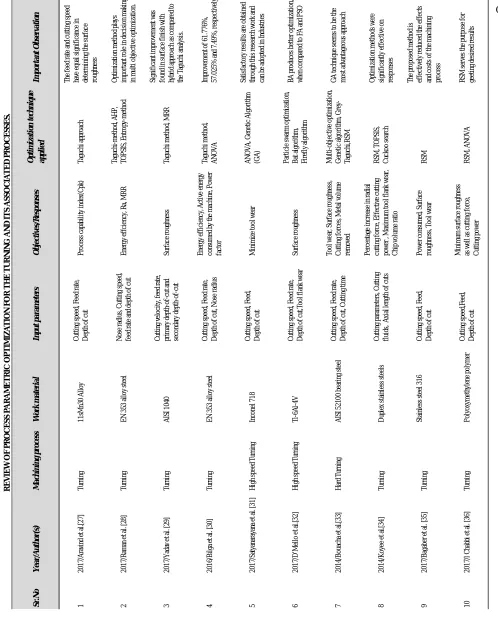
direction is the high speed machining which is drawing attention as it results in quality machined surface without any stresses generated in it. Artificial neural network (ANN),particle swarm optimization (PSO), bat algorithm (BA) and firefly algorithm (FA) have been used by researchers for getting better results in turning process [32]. In the manufacturing industry, the turning process is an important and used on large scale. The metal machining study involve with the tool types, work piece materials and setting of machine parameter. The turning process is growing fast from last several years for getting specific objectives. To achieve the objectives, selection of optimum parameters is most important. Turing process involves a large number of input variables like cutting speed, feed rate, depth of cut, tool material and types, geometry, cutting fluid, etc. and output variables like tool life, surface roughness, cutting zone temperature, energy utilization etc. Randomly selection of input parameters cannot give desired objectives. Each output response should be considered as a set of input variable [35]. Parametric optimization of cutting process is complex and requires depth understanding of machining and empirical notations related to tool life, surface finish, power consumption etc. [37]. A single objective optimization determines the value of a controllable parameter which gives the highest value of specific response like metal removal rate. For the machining process having complex nature, single objective optimization can’t have broader optimum cutting conditions. In this context various different conflicting objectives must be concurrently optimized [1]. The review mentioned in the table number-III is showing contribution of various authors related to optimization of turning process.
III.CONCLUSIONS
In this paper, the complex machining processes like electric discharge machining (EDM), turning process and drilling process are discussed with the reference to an application of state-of-the-art optimization techniques. The literature review related to parametric optimization of machining processes have been summarised. The input and output parameters, work material and advance optimization techniques used by researchers along with observations have been described. Following are some conclusions made on the basis of literature review.
A. The complex machining processes mentioned in this paper are having a lot of industrial applications and they are on demand in automotive sectors, medical, aerospace, and biomedical for manufacturing of parts with intricate and complex geometry.
B. Researchers have done work more on electric discharge machining compare to other machining processes. In EDM and related processes, the Taguchi method and RSM were used more for research work. Genetic algorithm (GA) and artificial neural network (ANN) were also used with some modifications.
C. Researches now have been started to use advance optimization techniques like teaching learning algorithm (TLBO). Research work on variety of materials had done in EDM, turning and drilling processes like ceramics, super alloys, hard materials, composites etc. A wide spectrum of scope is there in the field of optimization for the micro machining and nano finishing processes.
REFERENCES
[1] R. Venkata Rao & V. D. Kalyankar, “Optimization of modern machining processes using advanced optimization techniques: a review,” Int J Adv Manuf
Technol., 73:1159–1188, 2014.
[2] R V Rao, P J Pawar, “Modeling and optimization of process parameters of wire electrical discharge machining,” Proc. I Mech E Vol. 223 Part B: J. Engineering Manufacture 1431-1440, 2009.
[3] Doriana M. D Addona, Roberto Teti, “Genetic algorithm-based optimization of cutting parameters in turning processes,” Procedia CIRP 7, 323 – 328, 2013.
[4] Kumar S, Singh R, Singh TP, Sethi BL, “Surface modification by electrical discharge machining: a review,” J Mater Process Technol. 209:3675–3687, 2009.
[5] Lin YC, Tsao C C, Hsu CY, Hung S K, Wen DC, “Evaluation of the characteristics of the micro electrical discharge machining process using response surface
methodology based on the central composite design,” Int J Adv Manuf Technol. 62:1013–1023, 2012.
[6] Avijeet Satpathy, S Tripathy, N Pallavi Senapati, Mihir Kumar Brahma, “Optimization of EDM process parameters for AlSiC- 20% SiC reinforced metal matrix composite with multi response using TOPSIS,”Materials Today: Proceedings 4, 3043–3052, 2017.
[7] Yongfeng Guo & Guowei Zhang, Li Wang & Yehui Hu, “Optimization of parameters for EDM drilling of thermal-barrier-coated nickel super alloys using gray relational analysis method,” Int J Adv Manuf Technol. 83:1595–1605, 2016.
[8] Ushasta Aich, Simul Banerjee, “Application of teaching learning based optimization procedure for the development of SVM learned EDM process and its pseudo Pareto optimization,” Applied Soft Computing 39, 64–83, 2016.
[9] L. Selvarajan, C. Sathiya Narayanan & R. JeyaPaul, “Optimization of EDM Parameters on Machining Si3N4–TiN Composite for Improving Circularity,
Cylindricity, and Perpendicularity,” Materials and Manufacturing Processes, 31:4, 405-412, 2015.
[10] Maneswar Rahang & Promod Kumar Patowari, “Parametric Optimization for Selective Surface Modification in EDM Using Taguchi Analysis,” Materials and
Manufacturing Processes, 31:4, 422-43, 2016.
1925
©IJRASET (UGC Approved Journal): All Rights are Reserved
[12] Dong-Ha Lee, Navdeep Malhotra, Dong-Won Jung, “Multi Characteristic Optimization in Die Sinking EDM of En31 Tool Steel Using Utility Concept,” 8th
International Conference on Mechanical and Aerospace Engineering, 2017.
[13] Vijay Kumar Meena & Man Singh Azad & Suman Singh & Narinder Singh, “Micro-EDM multiple parameter optimization for Cp titanium,” Int J Adv Manuf
Technol. 89:897–904, 2017.
[14] Alaa M. Ubaid, Fikri T. Dweiri, Shukry H. Aghdeab, Laith Abdullah Al-Juboori, “Optimization of EDM Process Parameters with Fuzzy Logic for Stainless Steel 304 (ASTM A240),” Journal of Manufacturing Science and Engineering, accepted manuscript posted October 9, 2017.
[15] Raju B. Bhosle, S. B. Sharma, “Multi-performance optimization of micro-EDM drilling process of Inconel 600 alloy,” Materials Today: Proceedings 4, 1988–
1997, 2017.
[16] Chinmaya P. Mohanty, Siba Sankar Mahapatra, Manas Ranjan Singh, “An intelligent approach to optimize the EDM process parameters using utility concept and QPSO algorithm, Engineering Science and Technology, an International Journal 20, 552–562, 2017.
[17] M. Balaji, K. Venkata Rao, N. Mohan Rao, B.S.N. Murthy, “Optimization of drilling parameters for drilling of TI-6Al-4V based on surface roughness, flank wear and drill vibration,” Measurement 114, 332–339, 2018.
[18] Chunliang Kuo, Zhihao Li, Chihying Wang, “Multi-objective optimisation in vibration-assisted drilling of CFRP/Al Stacks,” Composite Structures 173, 196– 209, 2017.
[19] Aravind.S, K.Shunmugesh, Jibin Biju, Joshua K Vijaya, “Optimization of Micro-Drilling Parameters by Taguchi Grey Relational Analysis,” Materials Today:
Proceedings 4, 4188–4195, 2017.
[20] Norbert Geier, Tibor Szalay, “Optimization of process parameters for the orbital and conventional drilling of uni-directional carbon fiber-reinforced polymers (UD-CFRP),” Measurement 110, 319–334, 2017.
[21] Gurmeet Singh, Vivek Jain, Dheeraj Gupta, Aman Ghai, “Optimization of process parameters for drilled hole quality characteristics during cortical bone drilling using Taguchi method”, Journal of the mechanical behavior of biomedical materials 62, 355-365, 2016.
[22] Suman Chatterjee, Siba Sankar Mahapatra, Kumar Abhishek, “Simulation and optimization of machining parameters in drilling of titanium alloys,” Simulation
Modeling Practice and Theory 62, 31–48, 2016.
[23] Akhil K.T, K Shunmugesh, S Aravind, M Pramodkumar, “Optimization of Drilling Characteristics using Grey Relational Analysis (GRA) in Glass Fiber Reinforced Polymer (GFRP)”, Materials Today: Proceedings 4, 1812–1819, 2017.
[24] Ramazan Cakıroglu, Adem Acır, “Optimization of cutting parameters on drill bit temperature in drilling by Taguchi method,” Measurement 46, 3525–3531, 2013.
[25] K Shunmugesh, K Panneerselvam, “Grey Relational Analysis Based Optimization of Multiple Responses in Drilling of Carbon Fiber-Epoxy Composites,”
Materials Today: Proceedings 4, 2861–2870, 2017.
[26] N. Manikandan, S. Kumanan, C. Sathiyanarayanan, “Multiple performance optimization of electrochemical drilling of Inconel 625 using Taguchi based Grey Relational Analysis,” Engineering Science and Technology, an International Journal 20, 662–671, 2017.
[27] S Aravind, K Shunmugesh, K.T. Akhil, M Pramod kumar, “Process Capability Analysis and Optimization in Turning of 11sMn30 Alloy,” Materials Today:
Proceedings 4, 3608–3617, 2017.
[28] Raman Kumar, Paramjit Singh Bilga, Sehijpal Singh, “Multi objective optimization using different methods of assigning weights to energy consumption
responses, surface roughness and material removal rate during rough turning operation,” Journal of Cleaner Production 164, 45-57, 2017.
[29] Ravindra Nath Yadav, “A hybrid approach of Taguchi-Response Surface Methodology for modeling and optimization of Duplex Turning process,” Measurement 100, 131–138, 2017.
[30] Paramjit Singh Bilga, Sehijpal Singh, Raman Kumar, “Optimization of energy consumption response parameters for turning operation using Taguchi method,”
Journal of Cleaner Production 137, 1406-1417, 2016.
[31] B.Satyanarayana, M. Dileep Reddy, P Ruthvik Nitin, “Optimization of Controllable Turning Parameters for High Speed Dry Machining of Super Alloy: FEA and Experimentation,” Materials Today: Proceedings 4, 2203–2212, 2017.
[32] Grynal D’Melloa,b,∗, P. Srinivasa Paia,b, N.P. Puneet, “Optimization studies in high speed turning of Ti-6Al-4V,” Applied Soft Computing 51, 105–115, 2017.
[33] Khaider Bouacha, Mohamed Athmane Yallese, Samir Khamel, SalimBelhadi, “Analysis and optimization of hard turning operation using cubic boron nitride
tool,” Int. Journal of Refractory Metals and Hard Materials 45,160–178, 2014.
[34] Rastee D. Koyee, Uwe Heisel, Rocco Eisseler, Siegfried Schmauder, “Modeling and optimization of turning duplex stainless steels,” Journal of Manufacturing
Processes 16, 451–467, 2014.
[35] Salem Abdullah Bagaber, Ahmed Razlan Yusoff, “Multi-objective optimization of cutting parameters to minimize power consumption in dry turning of
stainless steel 316,” Journal of Cleaner Production 157,30-46, 2017.
[36] Amel Chabbi, Mohamed Athmane Yallese, Ikhlas Meddour, Mourad Nouioua, Tarek Mabrouki, François Girardin, “Predictive modeling and multi-response
optimization of technological parameters in turning of Polyoxymethylene polymer (POM C) using RSM and desirability function,” Measurement 95, 99–115, 2017.
[37] R. Venkata Rao, Advance modeling and optimization of manufacturing processes, International research and development, Springer-Verlag London Limited,