A SNS-INTEGRATED COLLABORATIVE LEARNING
SYSTEM TO SUPPORT PROGRAMMING LANGUAGE
LEARNING
1FANG-FANG CHUA,2KEK-LUN LIEW
1,2Faculty of Computing and Informatics, Multimedia University, MALAYSIA
E-mail: 1[email protected],2[email protected]
ABSTRACT
Today, using and accessing to Social Network Services (SNS) are part of our daily activities and have gained popularity to attract learners in the socialization engagement. This motivates the adoption of Social Network Services into collaborative learning environment which strongly encourage communication and interaction between learners. The engagement of learners to use the learning system is always a challenge to improve as they are easily distracted, lack of motivation and interest. The factors which contribute to the problems are mainly the availability of the learning resources, variety of the communication mode within the system, and also lack of real time interaction. With the implementation of Social Network Services (i.e. Facebook services and Twitter services) into collaborative learning environment, learners will feel motivated and engage more eagerly with the learning process as reflected from the heavy usage of social media recently. Real time communication and interaction are being promoted and learners can express and share real thoughts and feelings with the help of SNS while going through the learning process. In this proposed work, we design and implement a SNS-integrated collaborative learning system that allows learners to collaborate and learn anytime and anywhere. We have chosen the subject domain of learning programming language to realize our proposed solution.
Keywords: Social Network Services, collaborative learning, Facebook, communication, collaboration, interaction
1. INTRODUCTION
Nowadays, with the wide and heavy usage of internet by people, Social Network Services (SNS) are developed and to provide convenience to people around the world. Social Network Service is a medium for establishing social networks of people who are sharing common interests and activities. Social networking sites allow learners to share ideas, activities, events, and interests within their individual networks. Most of the available Social Network Services are web-based services and provide means for learners to interact in various ways, such as e-mail, discussion and instant messaging. Social Networking Services are rapidly changing the ways in which people use and engage with the Internet and with each other. According to [1], social media explores opportunities to add a new dimension to learning and knowledge processes and social networking sites allow students to connect formal and informal learning settings.
motivates the effort to integrate SNS in expanding its functionality and usage varieties.
With the integration of social network services in the collaborative learning environment, learners can communicate with each other anywhere and anytime as long as internet connection is available. There exists a practice that students and academicians in the universities and higher education are also picking up the adoption of social media to communicate and facilitate their class teaching or learning activities. [2] utilized Facebook as a learning resource in a graduate-level course for learners to share knowledge and experience. The findings show that Facebook is an easy-to-use social media for learners to leverage their social networking for knowledge sharing within the small group environment. Millennial Generation is significant users of social media as they are more engaged with the way on how information is shared among their peers or groups [3]. An online survey conducted by [4] shows that millennial participants reported higher positive collective self-esteem, social networking site use for peer communication, and social compensation. In this proposed work, we have designed and implemented a SNS-integrated collaborative learning system which allows learners to learn programming language in a group.
Programming subjects are among the core subjects for Information Technology (IT) and Computer Science (CS) undergraduate programs [5]. Learning computer programming is a difficult process as it is a multi-layered hierarchy of skills and students will be either overwhelmed or bored [6]. We have chosen Programming subject as our domain to realize the proposed work as they show higher failure rate among the students and also commonly served as Pre-requisite subject in the course. Thus, failure in these subjects will affect their study duration. [5] recommended that peer tutoring, pair/group programming and problem solving teaching strategies should be adapted to provide better opportunities for learners to interact with their peers. The proposed system design includes real time chatting and discussion; facilitating problem solving and brainstorming activities as well as allowing programming practice for editing, compiling and executing the programming codes.
2. RELATED WORK
[7] describes that collaborative learning is a situation in which two or more people learn or attempt to learn something together. According to
[8], collaborative learning is a student-centered, task-based, activity-based learning approach that provides several advantages to the student. It assists students to enhance communication, interpersonal and social skills. On the other hand, shared feedback as mentioned by [9] allows users to gather the most relevant knowledge provided to them and presents awareness information through the shared workspace. The awareness creation and coordination are playing important role for facilitating better collaboration environment [9]. Social network has becoming a very common platform for users to have better interaction, sharing culture and promotes brainstorming. The effort of integrating social network services into collaborative learning environment is able to improve the learning resources accessibility and classmate bonding.
Social Network Services has been adopted and used widely for the recent few years. According to [10], SNS can be broadly defined as internet or mobile-based social spaces designed to facilitate communication, collaboration, and content sharing across networks of contacts. Similarly, [11] states that Social Network Services can be described as a website or service where people talk to, or connect with other people with same interests by using network. [10] and [11] show that communication and interaction are greatly improved by using SNS. According to [12], there are many types of Social Network Services which are available; such as profile-based SNS, content-based SNS, Micro-blogging or presence updates, Multi-user virtual environment and etc. Social network sites have the great potential to facilitate interaction, communication, and collaboration, and as a result have been prominently featured in discussions which emphasizing on the use of technology to support and amplify educational endeavors [13].
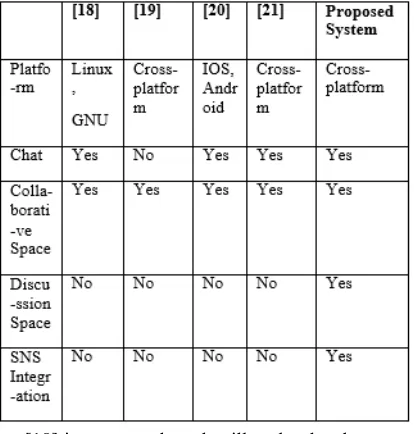
collaborate in the educational process; in addition to encourage the content or knowledge sharing among students. According to their case study‘s results findings, Facebook that has been used in education are accepted by teachers and students and it shows that functionality provided by Facebook is sufficient for providing an environment for learning purpose. [16] reported a positive experience in the use of social network services to increase engagement with the subject learning and to improve collaboration among students and teaching staffs. [17] revealed that majority of the respondents use Facebook approximately 30 minutes to 2 hours daily to share entertainment materials and discuss with their classmates on the course-related topics. This leads to the motivation of integrating SNS in collaborative learning system instead of only utilizing the SNS in order to achieve communication and interaction in an informal environment. As shown in Table 1, we review and compare the current existing collaborative learning systems, which are [18], [19], [20] and [21] with our proposed SNS-integrated collaborative learning system.
Table 1: Comparison of Existing Collaborative Learning Systems
[18] is a new web tool, still under development, is used to create environments of constant inter-communication, collective intelligence and knowledge sharing. [19] is a free mobile collaborative whiteboard which allows users to draw and chat in real time. [20] is a web-based collaborative writing software which enable group of any size to edit their ideas in a single text file. It provides a collaborative space for a group of users to edit the file at the same time. [21] is an
open-source easy-to-use web conferencing system. It is used for collaborative meeting, course review session and it supports sharing of slides, video, audio, whiteboard, private or public chat and desktops.
Most of the existing systems included in the comparison are mainly web-based systems and consists of collaboration and communication components. We have researched and included the features that are available in the existing collaborative learning systems as part of our user requirements elicitation process to reach the requirements. By reviewing the current existing collaborative learning system, it shows that most of the systems provide a flexible, creative and high adaptability system for learners. However, most of the collaborative learning systems require registration upon login to access and use the provided functionalities. Besides, most of the systems are not being integrated with SNS despite that there’s a shift of focus that learners prefer to use SNS for their learning purpose as shown in [13]. There is a need to determine how informal learning using SNS can be structured and leveraged for purposes of formal education [14]. Besides, with social networking, students can discover like-minded people and organize informal knowledge exchange for educational purposes [1]. We aim to improve based on all these limitations by incorporating the SNS integration approach in our collaborative learning system.
3. PROPOSED SOLUTION
information of learners (i.e. user profiles) will be retrieved from their Facebook account upon successful login. The major components in the proposed system are presented as follows:
3.1User and Group Management
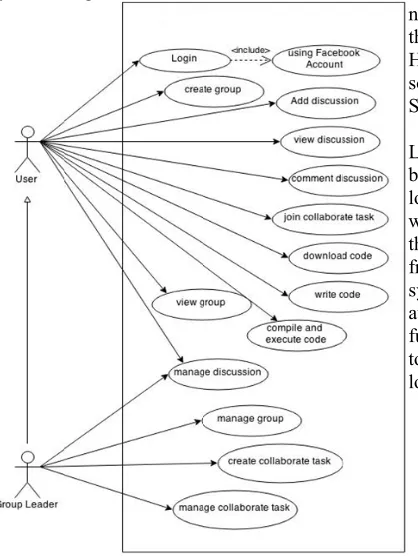
Learners are required to have a Facebook Account to login and use the function of the system. After successful login, learners are allowed to invoke the group functions such as creating a new group, changing a group name, deleting groups, adding new learners into the group and removing learners from a specific group. Learners are able to view group member list and the active (online) member(s) in the group. After creating and adding learners into a group, members in the group are allowed to add a discussion, view and comment to the discussion using the Facebook comments component. Group leaders are allowed to create and manage a collaborative task and also to manage the information of the collaborative task.
3.2 Collaborative Task
Group leaders are responsible for creating a collaborative task and allowing all members to join for collaborative activities and perform the assigned task simultaneously. Group leaders can configure the group information such as changing group name, adding new users to a group, and deleting members from a group or deleting discussions. The collaborative tasks will focus mainly on solving a C++ programming problem. The task will be itemized into a few to-do sub tasks to ease the problem solving. In the Collaborative Task page, members are allowed to edit and write programming code simultaneously in the code editor space.
Besides that, members are able to communicate using real-time chatting component in page during their collaboration activities. For the code compilation control flow, members are able to request for compiling the code. Once a member requests to compile the code, the editor space will become un-editable. Subsequently, all members are able to compile and execute the code and the result of the execution will be displayed in a new window. After completing the coding activities, members can download the code from the editor to their computer for reference or records with the file extension of .cpp format.
3.3 Social Network Services and API Integration
Facebook services are the main SNS to be integrated in our proposed system as it is one of the largest social networks which surpass 1 billion registered accounts. The main contribution of this integration is to improve the collaboration and communication between the learners in a sociable environment. Learners can log in to the system with their Facebook account with no registration needed
(implemented with
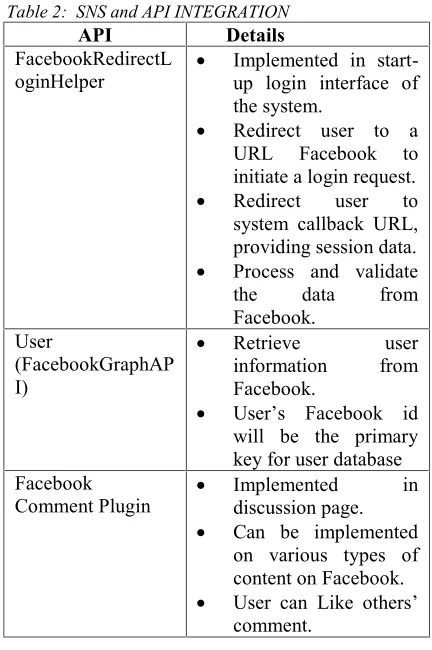
[image:4.612.310.526.415.740.2]API-FacebookRedirectLoginHelper). User’s information is retrieved from Facebook by using Facebook Graph API. Learners can write comments in the system by using Facebook Comment Plugin. While learners comment and reply in discussion, notifications can be viewed in their own Facebook page. Learners can also chat with other members in the collaborative task room using io.socket server API. Besides, learners can collaborate in collaborative task room using ace editor API and io.socket and view the active member list in group using io.socket server API as well. In summary, Table 2 reflects some of the SNS and APIs that have been integrated in our collaborative learning system to improve the learners’ engagement in learning process.
Table 2: SNS and API INTEGRATION
API Details
FacebookRedirectL
oginHelper Implemented in start-up login interface of the system.
Redirect user to a URL Facebook to initiate a login request.
Redirect user to system callback URL, providing session data.
Process and validate
the data from
Facebook. User
(FacebookGraphAP I)
Retrieve user
information from Facebook.
User’s Facebook id will be the primary key for user database Facebook
Comment Plugin Implemented discussion page. in
Can be implemented on various types of content on Facebook.
Io.socket Server
API Implemented in grouppage and collaborative task page.
While user is in the
group page or
collaborative task
page, user’s
information will be retrieved and shown in the active member list.
Once user left the
group page or
collaborative task
page, user’s
information will remove from the active member list.
ace editor API Implemented in
collaborative task page.
User can edit and write programming codes in collaborative task page.
[image:5.612.89.544.74.373.2]Figure 1 represents the Use Case Diagram which captures the interactions of users with the system and Figure 2 shows the Class Diagram of the system design.
Figure 1: Use Case Diagram
Figure 2: Class Diagram
4. SYSTEM DESIGN
Based on the proposed solution, we have used notepad++ and node.js for the development of the system and mongoDB server for database design and development. Node.js is a cross-platform runtime environment for server-side and networking applications. Programming languages that have been used for developing this system are HTML, Javaquery and Jquery. Figure 3-9 show some of the screenshots design of our proposed SNS-integrated collaborative learning system.
[image:5.612.109.318.443.721.2]Figure 3: Login Page
[image:6.612.315.527.158.333.2]Figure 4 represents the home page of the system and will be displayed upon successful login. In the Home page, a list of groups that learners involved in will be displayed in the middle of the page. Learners are able to view the group details by clicking on the name of the groups which they are interested to view and join. Besides that, learners are also allowed for creating a new group in this page to start a new discussion topic. The group creator’s name will be shown in the page too.
Figure 4: Home Page
Figure 5 represents the group page of the system and will be displayed after learners have selected a particular group as mentioned in Figure 4. A list of discussion (discussion trace) that has been created in the group will be displayed in the middle of the page. All members are allowed for adding new discussion and viewing discussion details. Group leaders are allowed to edit all the discussions in the group while members are only allowed for editing discussions that had been created by them. Besides, only group leaders are allowed to create and manage a collaborative task. All members are able to join the collaborative task session once collaborative task is being created. All the members’ Facebook profiles can be viewed by
clicking on their names on the member list display. At the top right of page displays active (online) members in group which are available whereas at the bottom right of page displays all the participated group members.
Figure 5: Group Page
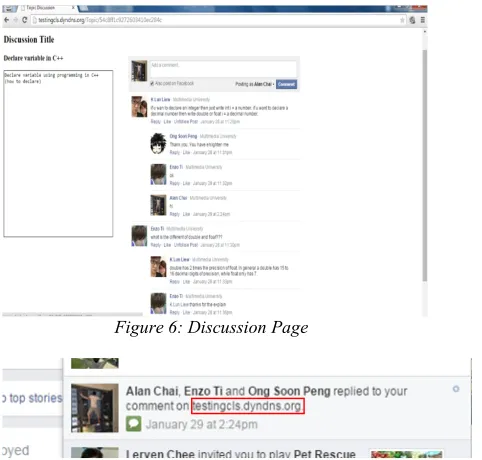
[image:6.612.89.300.382.544.2]Figure 6 shows the discussion page and will be displayed when learners view a discussion. In discussion page, members are allowed to comment and reply to other members’ comments. For instance, when ‘member A’ replies to ‘member B’’s comment, a notification will be sent to “member B”’s Facebook account and “member B” is able to view the notification (as shown in Figure 7). ‘Member B’ will redirect back to discussion page when he or she presses the notification alert. This encourages rich interaction between learners and thus, improves collaborative learning process.
Figure 6: Discussion Page
[image:6.612.312.553.489.719.2]Figure 8 shows collaborative task page that contains a real-time chat box which allows learners to chat while they performing collaborative activities. Besides that, there is a code editor space for learners to write and edit codes to solve the problem scenario given simultaneously. Upon completing the code writing, members are able to request for compiling and executing the code.
Figure 8: Collaborative Task Page
[image:7.612.90.536.107.391.2]Once a member requests for code compilation, the editor space will be un-editable and members can click on ‘Compile and Execute’ (as shown in Figure 9) to get the executed code output being displayed. Members are able to download the code from the system in .cpp format. Active learners will be shown on the top right side of the page. Room status (i.e. idle) will be shown on the right bottom of page. Learners can compile and run the code after they finish writing the code. A new window will be popped out and to display the output of the compiled code. Top of the page displays the assigned problem statements and collaborative tasks to be completed.
Figure 9: Compile and Execute Page
5. CONCLUSIONS
[image:7.612.91.417.198.395.2]analytics on our proposed system to derive and discover social connections among students and to understand their learning experience or behavior.
REFRENCES:
[1] Wodzicki, K., Schwämmlein, E., & Moskaliuk, J. (2012). “Actually, I Wanted to Learn”: Study-related knowledge exchange on social networking sites. The Internet and Higher Education,15(1), 9-14.
[2] Ractham, P., & Firpo, D. (2011, January). Using social networking technology to enhance learning in higher education: A case study using Facebook. InSystem Sciences (HICSS), 2011 44th Hawaii International Conference on(pp. 1-10). IEEE.
[3] Sago, B. (2010). The Influence of Social Media Message Sources on Millennial Generation Consumers. International Journal of Integrated Marketing Communications,2(2). [4] Barker, V. (2012). A generational comparison
of social networking site use: The influence of age and social identity. The International Journal of Aging and Human Development, 74(2), 163-187.
[5] Sarpong, K. A. M., Arthur, J. K., & Owusu, P. Y. (2013). Causes of Failure of Students in Computer Programming Courses: The Teacher–Learner Perspective. International Journal of Computer Applications, 77(12), 27-32.
[6] Moser, R. (1997, June). A fantasy adventure game as a learning environment: why learning to program is so difficult and what can be done about it. InACM SIGCSE Bulletin(Vol. 29, No. 3, pp. 114-116). ACM.
[7] Veletsianos, G., & Navarrete, C. (2012). Online social networks as formal learning environments: Learner experiences and activities. The International Review of Research in Open and Distance Learning, 13(1), 144-166.
[8] Dillenbourg, P. (1999). What do you mean by collaborative learning?. Collaborative-learning: Cognitive and Computational Approaches., 1-19.
[9] Dourish, P., & Bellotti, V. (1992, December). Awareness and coordination in shared workspaces. InProceedings of the 1992 ACM conference on Computer-supported cooperative work(pp. 107-114). ACM.
[10] Mcheick, H., & Karawash, A. (2012). Collaborate Social Network Services via Connectors. Procedia Computer Science, 10, 324-331.
[11] Ellison, N. B. (2007). Social network sites: Definition, history, and scholarship. Journal of Computer‐Mediated Communication, 13(1), 210-230.
[12] Childnet, D. (n.d.). Digizen - Social networking - Report - Ideas. Retrieved
October, 18, 2014, from
http://www.digizen.org/socialnetworking/idea s.aspx
[13] Greenhow, C., & Robelia, B. (2009). Old communication, new literacies: Social network sites as social learning resources. Journal of Computer‐Mediated Communication, 14(4), 1130-1161.
[14] Tsovaltzi, D., Puhl, T., Judele, R., & Weinberger, A. (2014). Group awareness support and argumentation scripts for individual preparation of arguments in Facebook.Computers & Education,76, 108-118.
[15] Gonçalves, V. (2010). Facebook in the learning process: a case study.
[16] Arquero, J. L., & Romero-Frías, E. (2013). Using social network sites in Higher Education: an experience in business studies. Innovations in Education and Teaching International,50(3), 238-249.
[17] Ab Rahim, N. Z., Abidin, S. N. Z., & Abidin, W. Z. (2015). The Habits of Social Networking Site (SNS) Use Among Postgraduate Students. Jurnal Teknologi, 76(1).
[18] Kune.ourproject.org, (n.d.). kune | A web tool to encourage collaboration, content sharing & free culture. Retrieved November 18, 2014, from http://kune.ourproject.org/
[19] Groupboard.com, (n.d.). Groupboard iPad/iPhone/Android Mobile Apps Frequently Asked Questions. Retrieved November 18,
2014, from
http://www.groupboard.com/support/mobile_f aq.shtml
[20] Mixedink.com, (n.d.). MixedInk - Free Collaborative Writing Tool. Retrieve
November 17, 2014 from
http://www.mixedink.com/