ISSN: 1992-8645 www.jatit.org E-ISSN: 1817-3195
STRUCTURED MEAN SHIFT METHOD AND ITS
APPLICATION ON IMAGE SEGMENTATION
1, 2WEICHU XIAO, 2BAOLONG GUO, 1WEIHONG CHEN
1 School of Communication and Electronic Engineering, Hunan City University, Yiyang 413002, Hunan,
China.
2 Institute of Intelligent Control and Image Engineering, Xidian University, Xi’an 710071, Shanxi, China.
ABSTRACT
It was found that the traditional Mean Shift algorithm segmentation often produces the connection channel, several categories between clusters can not be completely separated from the problem, an improved classification of the structured mean shift segmentation algorithm iterations to obtain the initial cluster in center on the basis of different bandwidth matrix stepwise clustering, resulting in a different class collection of cluster centers, and the establishment of a vested in the tree structure, ultimately through the attribution of the leaf nodes and the root node are classified in order to complete the image segmentation. Experiments show that the algorithm can better retain the image of local information, and has better applicability.
Keywords: Connection Channel, Image Segmentation, Structured Mean Shift, Traditional Mean Shift
1. INTRODUCTION
Mean shift is a non-parametric probability density estimation method. Parzen window probability density function defined finite iterative process to quickly find the data distribution mode (modes). Due to the simple in principle, without any pretreatment, the parameter the many advantages mean shift methods filtering, target eye tracking, image segmentation has been widely used in literature [1, 2].
Based on mean shift of image segmentation can be seen clustering of the feature space, the characteristic dimension of the selected space (including grayscale, color, gradient, etc.), different, mean shift method along the direction of probability density function of the gradient ascent to find local maximum vector with similar characteristics, which will be classified as a class, to achieve the purpose of segmentation mean shift correlation principle was first proposed by Fukunaga et al. [3], Cheng [4], Comaniciu, et al. [5] developed and successfully applied image filtering and segmentation. bandwidth to determine the nature of the nuclear function of the mean shift process [6], using local data to dynamically decided to generate the kernel function bandwidth of data-driven adaptive kernel function Arna1do [7] this method is applied to the segmentation of MR images, achieved good results with a similar, Jimenez, and so on [8], the combination of non-parametric segmentation and edge detection method to further
enhance the robustness of MR image segmentations ex. For symmetry inadequate processing of spatial characteristics of the structure, Wang et al. [9] and Chen Yunjie et al. [10] designed the kernel function of the opposite sex, get good results. According to the principle of the method, when the Parzen window near image edge tend to produce lower frequency of iteration and select merge in the segmentation process based on the a priori knowledge, Song et al. [2], a better solution to the division of Rene et al. [11] the image further divided into sub-images by clustering on different scales to obtain better segmentation results, Yang et al [12] and Zhang et al [13] algorithm for mean shift from a performance point of view is optimized.
The above study and optimization focused on the use of a priori information and the improvement of the kernel function, little the change mean shift segmentation principle, multiple iterations to achieve convergence to the sampled data through the kernel function, and then spatial and Range domain near the cluster center to merge and then split the study found that some do not meet the Gaussian ideal distribution of sampling data, the distribution of the feature vector itself has a lot of randomness, clustering results often produce large amounts of local minima, direct segmentation results are sometimes not ideal.
ISSN: 1992-8645 www.jatit.org E-ISSN: 1817-3195
not stop after multiple iterations to form a stable convergence point mean shift principle using for the cluster center, the bandwidth of kernel function iteration of the loop, until the final convergence. So you can automatically between the different classes collections of cluster centers to establish the attribution of the tree structure, the final leaf node the affiliation of the root partition.
Experimental results show that the algorithm can handle weak boundary information in the image, the segmentation to better retain the structural information of the feature space, the absence of to change mean shift algorithm principle, not only retains the original algorithm of advantages, but also has strong applicability, easy, and other optimization methods used in combination.
2. MEANSHFITSEGMENTATION
PRINCIPLE
The nature of mean shift split according to different criteria on the feature space clustering based sampling eigenvectors of the d-dimensional data collection Sd =
{
s kk, =1, 2,...}
, which, T
s
s=s sγ spatial domain vector ss for the 2-D Range domain vector xγ dimension is set to p ,
then d = +p 2 in the collection, the probability density function of the Parzen window estimate [5] is
( )
(
)
1 1 n
H H i
i
f x K x x
n =
=
∑
−)
(1)
In equation (1), the bandwidth matrix H by the bandwidth coefficient h to simplify, H=h I2 , while using the profile function k to express the
kernel function K x
( )
=k x( )
2 , then equation (1)can be expressed as
( )
21 n i h d i x x C
f x k
h nh = − =
∑
)(2)
By the separability of the kernel function, (2) can be expressed as
( )
2 2, 2
s r
s r
h h p s r
s r
C x x
K x k k
h h h h
=
(3)
Where, C is the normalized constant, 2
s h and p
r h ,
respectively, Airspace and Range domain bandwidth coefficient. Mean shift principle, to find
( )
h f x )
extreme value process can be directly
through the drift of the mean to complete [4-6], access to new features in each drift vector by the formula (4).
2 2
1
1 2 2
1
s s r r
n
j i j i
i i
i s r
j
s s r r
n
j i j i
i
i s r
y x y x
x g g
h h
y
y x y x
g g h h ω ω = + = − − = − −
∑
∑
(4)
Where, ωi is the weight coefficient,
( )
'( )
g x = −k x is called k in the shadow function.
The process of drift, for each feature vector xk, the point through several iterations to converge to different modes (and bandwidth function [6]), thus forming collection of cluster centers
{
, , 1, 2,...,}
d d k
C = c k= n .
After the pre-classification process, the initial feature vector based on the cluster center divided into n classes, then detection of Cd from the
airspace and Range domain, if any c ci, j∈C id, ≠ j
meet in the feature space in the same bounding sphere, similar characteristics, ci and c classified j
as a class [5].
{
| r r , s s ,}
d k i j r i j s
C = c c − >c h c − >c h i≠ j
(5)
After the above processing, the final form of d is split.
3. STRUCTUREDMEANSHIFT
ALGORITHM
3.1Algorithm Principles
Segmentation algorithm based on traditional mean shift principle, the sampling data Sd
collection of Cd after many iterations, formed after the convergence of the cluster center, and in accordance with their respective cluster centers, the initial classification, and was found after iteration convergence, due to the sampled data distribution any, many of the images generated by a collection of Cd is distributed in the feature space, filtering more is to play a role in smooth.
ISSN: 1992-8645 www.jatit.org E-ISSN: 1817-3195
extreme points often and is not well separated, so that according to equation (1) the principle of division, if h, clustering is along the poly class stretches, can not be classified; the other hand, if h smaller will produce over-segmentation.
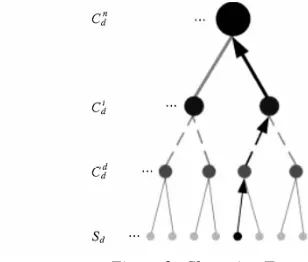
Shown in Figure 1, the iteration of Cd also contains the original sampled data probability density distribution of information, and therefore improve the algorithm considers with mean shift principle, repeated clustering of Cd, each iteration convergence to form a new cluster center of a collection of C idi, =1, 2,..., and eventually set the bandwidth of the matrix under the conditions of convergence, get of n
d
C , where n indicates the
number of structured clustering. in each mean shift process, the initial vector and convergence termination vector belonging to a different class the cluster center, and establish a structured relationship between them, which formed in the termination of the multi-level iterative sub-tree of the initial sampling data for the leaf nodes multiple pixels of the same root is ultimately attributable to a class, which Complete the split.
Figure 1: Compare Structured Mean Shift And Traditional Mean shift
3.2 The Initial Clustering and Repeated Clustering
According to different types of clustering data, the multistage mean shift iterative process can be divided into the initial cluster and repeat the two steps of the clustering process in which the initial clustering for the original sample data Sd , the
bandwidth parameter is set to 0
s h and 0
r
h , because
the process is the basis of the post-repeat clustering, in order to ensure that in the late clustering with sufficient local structural information, therefore 0
s h
and 0
r
h should not be set too large, the algorithm
similar to the one principle many times again and again generations, Sd 0
s
h and 0
r
h control smooth
resolution convergence of Cd.
Repeat the process of clustering is the Cd-based,
depending on hi =
{ }
h hri, si , the formation of adifferent class collection of cluster centers of C di
and eventually converge to C . In general, if dn
0
n≥ > ≥i j , then hri ≥hrj, hsi ≥hsj. At the same
time, repeat the clustering process, due to the new one set of cluster centers clustering results on a cluster center set, so the data size was shrinking trend, namely when there are n≥ > ≥i j 0 , then
i j
d d
C ≥C .
Repeat clusters, located adjacent to the two cluster centers collection i
d
C and i 1
d
C+ , then
{
}
1 1 1
,
i i i i i i
d d d d d d
C+ = c+ c c+ c ∈C , which is
mapped in c id cdi+1 C is sampled data, according di
to the formula (1) iteratively converge to cdi+1. The common used kernel function iteration Epanechnikov (Expressed in equation 6) and the Gaussian kernel (Expressed in equation 7).
( )
12 1(
2 1)
(
)
, 1,0, 1
T T
d E
T
c d x x x x
K x
x x −
+ − <
=
≥
(6)
( ) ( )
/ 2 1 22 exp
2
d N
K x = π − − x
(7)
In terms of convergence, due to the profile function in the multistage mean shift algorithms, the above kernel function is still monotonically decreasing non-negative convex function, so the basis similar to the proof of literature [5] shows that after a finite iteration can converge.
3.3 Classification of the Bandwidth Parameters
ISSN: 1992-8645 www.jatit.org E-ISSN: 1817-3195
according to a structured strategy to gradually merge.
3.4 Stop Conditions and Segmentation
In the classification mean shift segmentation algorithm, the final number of clusters C is dn
determined by sampling data Sd and bandwidth parameters array Bandwidth achieve convergence when the number of clusters does not change. That
the algorithm stop condition is
( )
i 1( )
id d
size C− =size C , where i 1
d
C− and i d
C ,
respectively, in the formation of 1's level and i-level set of cluster centers.
Mean shift the process of making the bottom of Vector Data drift to their respective cluster center position, so multistage mean shift algorithm in the iterative process to dynamically build a tree structure. Which each drift vector cid∈Cdi after the
iteration converges to the cid+1, the new vector cdi+1
belong to the cluster center i+1. Namely cid+1∈Cdi+1,
and cdi+1 is denoted by c 's father. So starting from id
[image:4.612.93.247.479.610.2]the initial data of the leaf nodes, constantly clustering until convergence to the root node, the final convergence of separate sub-trees of the tree is split the number of categories. Segmentation is the process of reverse back along the tree structure from the leaf node to the root node, attributable to the initial vector of the same root node is attributed to the same class.
Figure 2: Clustering Tree
3.5 Complexity Analysis
By the principle of structured mean shift algorithm known, due multiple mean shift clustering process, the new algorithm is clearly increased the number of iterations, but the study found that effectively reduces the bandwidth of the initial cluster parameters (the radius of the kernel
function), at the same time the number of samples clustering is progressively reduced, the classification method did not significantly increase computational complexity.
Set the initial sampling of the data sample size
( )
0 d
s =size S h (in order to facilitate discussion N
of the requirements in the target scale, where the set is hs =hr =hN) converge to get the segmentation results. The traditional mean shift method computational complexity is
(
0 d)
N
O s h m , where m
is the average number of iterations. In the classification algorithm, the set of i-level sample sizes is si, the bandwidth parameters h , the new i
algorithm computational complexity is
d i i i i
O s h m
∑
, m said the average number of iiterations of the ith level. In the new algorithm, relative to the target scale hN , the bandwidth parameters of other series with their exponentially between h qi N i− =hN−c ( c as the correction
parameter, q is the common ratio), the assumption
of Gaussian sample, the sample size s super linear i
decline [3], compared to the traditional algorithm, the new algorithm still has the advantage of computing performance.
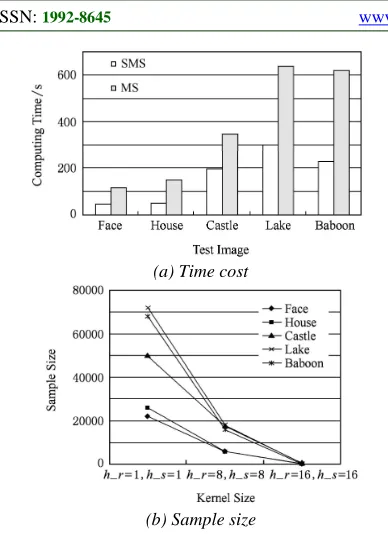
From the above, the radius of the kernel function used in the initial sample, the classification method, with the increase in the radius of the kernel function, the sample size and the rapid decline, so you can ensure that each level of clustering the computational complexity substantially reduced, thus makes the overall complexity does not increase as possible.
4. EXPERIMENTSANDRESULTS
ISSN: 1992-8645 www.jatit.org E-ISSN: 1817-3195
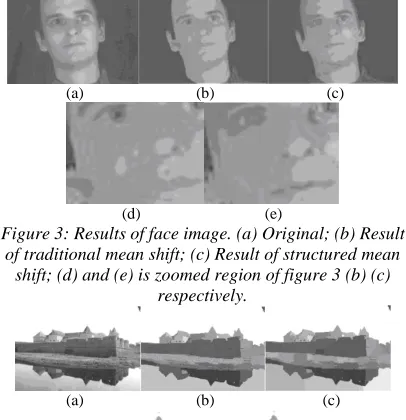
Face image according to the principle of the algorithm shown in Figure 1, Figure 3 shows the results of the experiment part of a different class clustering, the initial bandwidth hs =8 , hr =8 , after multistage mean shift process, and finally
20
s
h = , hr =20 scale conditions, the split image in Figure 3 (c) below. In the same circumstances, if the direct use of hs =20, hr =20 bandwidth split to get the results As shown in Figure 3 (b) according to the local details (Figure 3 (d) and Figure 3 (e) below) can be seen, in the same resolution scale, structured mean shift segmentation algorithm can be better preserved local structural information.
Traditional algorithms and new algorithms we use to experiment on a large number of images, part of the results in Figure 4 to Figure 7. Figure 4 (a) original image, Figure 4 (b) for the traditional mean shift split the results in Figure 4 (c) the results of the proposed algorithm, including the local area to zoom in, you can see cast1e in (Figure 4 (d) below), the new algorithm (Figure 4 (e) below) retaining walls openings in the house more in the window part (Figure 5 (e) below) retains the local structure information.
(a) (b) (c)
[image:5.612.323.522.78.203.2](d) (e)
Figure 3: Results of face image. (a) Original; (b) Result of traditional mean shift; (c) Result of structured mean
shift; (d) and (e) is zoomed region of figure 3 (b) (c) respectively.
(a) (b) (c)
(d) (e)
Figure 4: Results of Castle image. (a) Original; (b) Result of traditional mean shift; (c) Result of structured
mean shift; (d) and (e) is zoomed region of figure 4 (b) (c) respectively.
(a) (b) (c)
(d) (e)
Figure 5: Results of House image. (a) Original; (b) Result of traditional mean shift; (c) Result of structured
mean shift; (d) and (e) is zoomed region of figure 5 (b) (c) respectively.
[image:5.612.329.508.362.427.2](a) (b) (c)
Figure 6: Results of Lake image. (a) Original; (b) Result of traditional mean shift; (c) Result of structured mean
shift.
(a) (b) (c)
Figure 7: Results of Baboon image. (a) Original; (b) Result of traditional mean shift; (c) Result of structured
mean shift.
[image:5.612.96.295.404.516.2] [image:5.612.93.296.413.623.2] [image:5.612.100.293.559.682.2]ISSN: 1992-8645 www.jatit.org E-ISSN: 1817-3195
(a) Time cost
[image:6.612.94.288.73.340.2](b) Sample size
Figure 8: Performance comparison.
5. CONCLUSIONS
According to the principle of mean shift algorithm, by the constant iteration of the cluster centers, the paper gives a multi-level mean shift-based the image segmentation algorithm, the experiments show that the multi-scale clustering can better retain the local information. Experiment discovery algorithm min adequacies, it is worth the improvement. first part of the thin strip region segmentation is less than ideal, beams part of Figure 5, analysis of the cause of the problem lies in the mean shift nuclear function for the isotropic, the direction of the same weight in the center of mass transfer, and thus in a higher level of clustering, beams middle part closer to the ends of the solution of the problem requires the introduction of the heterosexual nuclear function, generated according to the local structure dynamic.
In addition, because the bandwidth matrix to determine the final segmentation results important parameters, according to the structure of the image itself automatically generate different bandwidth parameters in the various regional levels should be better able to dynamically determine the need to retain local information, in order to better segmentation. Therefore, segmentation based on multi-level mean shift the algorithm only gives a partition of the new ideas, need to be better refined
and improved, the above points less than the target where our further research.
REFERENCES:
[1] Tyagi A, Keck M, Davis J W, et al, “Kernel-based 3D tracking”, Proceedings of IEEE
Conference on Computer Vision and Pattern Recognition, IEEE Conference Publishing
Services, June 13-18, 2007, pp. 1-8.
[2] Song N, Gu I Y H, Cao Z, et al, “Enhanced spatial-range mean shift color image segmentation by using convergence frequency and position”, Proceedings of the 14th European Signal Processing Conference, August 25-29,
2006, pp. 19-28.
[3] Fukunaga K, Hostetler L, “The estimation of the gradient of a density function, with applications in pattern recognition”, IEEE Transactions on Information Theory, Vol. 21, No. 1, 1975, pp. 32-40.
[4] Cheng Y, “Mean shift, mode seeking, and clustering”, IEEE Transactions on Pattern Analysis and Machine Intelligence, Vol. 17, No. 8, 1995, pp. 790-799.
[5] Comaniciu D, Meer P, “Mean shift: A robust approach towards feature space analysis”, IEEE Trans on Pattern Analysis and Machine Intelligence, Vol. 24, No. 5, 2002, pp. 630-619. [6] Comaniciu D, “An algorithm for data-driven
bandwidth selection”, IEEE Transactions on Pattern Analysis and Machine Intelligence, Vol 25, No. 2, 2003, pp. 281-288.
[7] Arnaldo Mayer, Hayit Greenspan, “Segmentation of brain MRI by adaptive mean shift”, Proceedings of IEEE International
Symposium on Biomedical Imaging, IEEE
Conference Publishing Services, April 6-9, 2006, pp. 319-322.
[8] Jimenez, Juan R, Medina, Veronica, Yanez, Oscar, “Nonparametric MRI segmentation using mean shift and edge confidence maps”,
Proceedings of International Society for Optical Engineering Conference on Medical Imaging,
October, 14-16, 2003: 1433-1441.
[9] Wang Jue, Bo Thiesson, Xu Yingqing, et al, “Image and video segmentation by anisotropic kernel mean shift”, LNCS: Proceedings of the
8th European Conference on Computer Vision,
Springer Publishing Services, May 11-14, 2004, pp. 238-240.
ISSN: 1992-8645 www.jatit.org E-ISSN: 1817-3195
on adapt mean shift method”, Journal of Computer-Aided Design & Computer Graphics, Vol. 20, No. 1, 2008, pp. 55-60.
[11] Irene Gu, Vasile Gui, “Colour image segmentation using adaptive mean shift filters”,
Proceedings of the 18th IEEE International Conference on Image Processing, IEEE
Conference Publishing Services, September 11-14, 2011, pp. 726-729.
[12] Yang C, Duraiswami R, DeMenthon, et al. “Mean-shift analysis using quasi-Newton methods”, Proceeding of the 10th IEEE International Conference on Image Proceeding,
IEEE Conference Publishing Services, September 14-18, 2003, pp. 447-450.
[13] Zhang Kai, Jamesk T Kwok, Tang Ming, “Accelerated convergence using dynamic mean shift”, LNCS: Proceedings of the 9th European Conference on Computer Vision, Springer