365
WEB BASED EXPERT SYSTEM TO IDENTIFY TRUSTED
PARTNER FOR B2B COLLABORATION
1
NORSHAKIRAH AB.AZIZ
1
Universiti Tenaga Nasional, Information System Department of College Information Technology
E-mail: [email protected]
ABSTRACT
Web based expert system (ES) considered as a tool for decision making process. In the traditional supply chain, there is no standard or guideline created to evaluate or assess the potential trusted trading partner for collaboration purposes. If there is a request or a need for an evaluation, the team will be created and the assessment metric keeps changing according to the evaluation team and exposed to the bias issue. However, in web based ES, the experts’ knowledge and experience were encoded into ES and act as consultant to provide recommendation to the assessment and evaluation for finding a potential trusted partner. The automation in ES helps to ensure the assessment standard every time it needed. This study provide an identification method for selecting trusted trading partners using the e2gLite web based ES, based on e-supply chain trust model. Malaysian construction industry e-supply chain was chosen as domain for this study.
Keywords: Web based expert system, Expert System, e2gLite
1. INTRODUCTION
Advancement of IT in terms of infrastructure and technology in Malaysia has allowed Business to Business (B2B), to collaborate electronically. However, to identify the trusted partner for the collaboration is not an easy task, especially to ensure zero bias issue. Undeniable, there is inconsistency in assessment metric due to keep changing members in the evaluation team.
It has become a popular option for organizations to have an Expert System (ES) as it can ensure their business to still run smoothly even though the expert has left the organization. This is because the staff’s knowledge has already been captured in the ES. ES become important in SC organization as a tool for decision making process, especially for operation and inventory which can enhance productivity and cost savings [1]. Antony and Santhanam, defined knowledge base ES as:
… a system that uses stored knowledge of a specific problem to assist and provide support for the decision-making activities related to the specific problem context [2].
In the simple definition, ES is the computer system that stored human knowledge and programmed to imitate human problem solving. ES allow us to store human/expert knowledge in computer readable form, to retrieve and use the knowledge for decision making process [1, 3-7].
These become as famous option to organizations to ensure their business smoothly run because they may lost the staffs, but the knowledge.
2. WEB BASED ES DEVELOPMENT
Polach et al., [5], continues agreed by stated the ES as substitute of human experts that making the knowledge available at anywhere, anytime and to anyone that resulted the low cost compared to the human consultation. Undeniable, the availability issue is one of the reasons why human expert knowledge is stored in ES. Using knowledge based, all the knowledge of human expert can be stored in a system which can be access 24/7 without any difficulties and boundaries.
366 instant availability and wider accessibility advantages of the Internet encourage a knowledge base ES to be developed as a web based system that inherently portable and platform independent [12-14].
2.1 Knowledge base
Knowledge base has rapidly been adopted in many different areas [15] especially to store human knowledge in order to help the non experts to solve business problems. It offers a lot of benefits in helping the decision makers including enhancing productivity and cost savings. Typically, the success of an ES relies on the knowledge base that it used. A good knowledge base provides pertinent information in an efficient and easy-to-access format that allows users to make more informed decisions [16]. The knowledge stored would assist managers or executives by providing accurate and timely information for decision making. Knowledge base contains facts and knowledge about the firm’s goals and strategies.
As explained by Liebowitz [17], a knowledge base is comprised of domain facts, rules of thumb that are based on the experience of experts. It is not used to replace the experts, but rather to make their knowledge to be widely available and permanently stored in the computer. As for this study, in the conventional way, the selection of the SC business partner is usually made based on the potential for profit maximization.
A knowledge base is a centralized place that stores data, facts or information captured from the experts which are relevant to a specific application. It is not just helps in decision making but also can be used as a learning tool for new decision makers to understand the problem they faced [10, 18]. The ability to help decision makers is the most important goal of a knowledge base. Antony and Santhanam [2] considered knowledge base as a decision adding tools that can improve user’s decision process and outcomes. Information is central to decision making situations which involve uncertainty and complexity, while knowledge is associated with problems of ambiguity [10, 19].
To have better decision, managers or executives should consider the information and knowledge stored as references in the decision making process. Naturally, we made a decision based on our knowledge and experience in the past to encounter a certain problem and issue. We also may refer to certain information to analyse the problem and try to identify the root of the problem and search for the solution.
In study conducted by Wen [20], knowledge is stored in the form of rules or cases and used rules
base for real time online e-Commerce system called KIES while allows users to search and buy agriculture products via online. And a recent study of nutrition diagnosis by Chen et al.[6], used web based ES to help dietetics professional from Taiwan’s Department of Health, to provide high quality nutrition care to their patients. Hasan [21] on the other hand, developed a web based fuzzy ES to diagnose human diseases. The ES aims to improve quality of information exchange between health care professionals and patients. Basically, the above examples show us how important knowledge base and ES are in helping people to access to the expert knowledge via online or anywhere at any time without any boundaries and difficulties. Cost for an appointment or consultation can be avoided when using an ES.
2.2 Knowledge base creation and evaluation
The knowledge base creation and evaluation process for this study is presented as part of knowledge engineering which allows the e-Supply Chain Management (e-SCM) trust model developed to be accessible to non- experts through the development of an expert system prototype. The non-experts can perform at the level of skilled workers by tapping on the knowledge of the experts which are stored in the knowledge base of the ES. The knowledge base rules were later used in the web based ES prototype. The prototype was later tested to verify that the knowledge base is capable of producing the intended results as expected by the experts. The results were also compared to a manual based approach which is currently used by a Malaysian government body in determining partners in the Malaysian construction industry’s SC.
Undeniably, the selection decision on the supply chain partner is complex and need a careful analysis [18] which shows that the supply chain does need a tool for assisting the selection process. The knowledge base helps by offering real time information, and quick and accurate consultation for making business decisions. In developing the knowledge base, there were two steps taken in this study which are:-
Step 1: The process of acquiring experts’ knowledge and experience
367 collected. The cases and recommendations from focus group discussion (FGD) help in the knowledge base creation which at the end will be used as rules for an ES prototype.
Step 2: Encoding expert expertise as rules in a knowledge base
As stated previously, the FGD sessions provided the trust measurement details which are currently used in the conventional business partner performance evaluation. The measurements are known as attributes/inputs in the web based ES prototype. To create the knowledge base for the web based ES prototype, this study used forward chaining method which works from inputs towards inferring goal. The prototype will provide an appropriate recommendation (goal) to the problem based on the matching of the inputs to the rules stored in the ES. In order to formulate the trust values measurable parameters into knowledge base rules, the entire forward chaining system process for each trust values was designed [22].
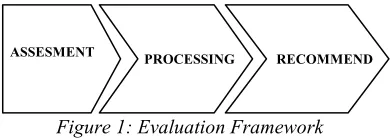
[image:3.612.98.293.434.503.2]The evaluation process starts with the gathering of facts/inputs for the assessment. The inputs are then matched to the knowledge base rules using forward chaining inference method. Lastly, the recommendation will be generated based on the inference result. Figure 1 shows the evaluation process framework created for the web based ES.
Figure 1: Evaluation Framework
For the assessment part, the questions were asked to the user using HTML and Java applet user interface and the responses submitted by the user will be processed according to the rules set in the system. The process is based on the ‘if-then’ rules which used knowledge base to support the decision making process by using “what if” or ‘IF(condition); THEN (action),’ statement for problem solving and decision making. The IF part lists a set of conditions in some logical combination, which if the rule is satisfied, the second part ‘THEN’ can be concluded and problem solving action taken. At the stage of the recommendation, there are three recommendation situation which is full acceptance; deny; and provisional acceptance.
For the knowledge base evaluation purposes, an expert who is the Director from the previous FGD’s group was identified as the pilot
user of the web based ES prototype. In the beginning of this phase, the user was given the explanation on the rules which have been set in the ES which helps the system to analyze the problem and provide the best solution. After that, he was asked to provide information of their three potential trading partners to be used as inputs for the testing of the ES prototype. After the inputs for one trading partner have been entered into the ES prototype and the recommended solution has been inferred, the solution was shown to the user for user acceptance. The process above was repeated for the other potential trading partners. Result from evaluation proess showed that user satisfied with the identification of trusted trading partner and this help them smoothen their vendor/tender evaluation process.
3. eg2Lite ES
For this study, an ES is developed using e2gLite ES for PC platforms that is known as the web based ES shell. There are a few researchers who have used e2gLite in their work. For instance, Khan et al. [12], used the ES software to develop an ES for diagnosis of diseases and pests in Pakistani wheat; Sarma et al. [23], used it for diagnosis of the disease in rice plant; Ticehurst [24] used it as a decision support tool for HIV post-exposure prophylaxis and N. and Putranto [25] used it in health detection system for pregnant woman.
This ES software is a Java applet which is embedded in a web page, and it can be downloaded freely from the web server by user's browser. The knowledge base for this ES shell consists of simple if- then rules. The Java applet allows the ES developer to load the knowledge base rules created and runs the system entirely on the browser. The e2gLite ES shell inference engine is able to perform both forward and backward chaining methods [24] when evaluating the knowledge base rules. In web base ES prototype, expert knowledge is stored in the ES shell. The knowledge stored in the ES acts as a consultant for the business and it is accessible anytime without any constraint and free from bias issue.
e2gLite consists of three files which are “e2gLite.jar”file; “.kb” file; and“.html” file. The user will see the web based interface which is designed to display all the questions for an evaluation. The prototype is a web-based solution that gives access to users using today’s popular Internet browser as a medium or platform such as Google Chrome and Internet Explorer. The prototype helps users to eliminate uncertainty through the trust model assessment. It allows for ASSESMENT
368 accurate and systematic assessment. Each trust values definition was also displayed in the interface to ensure user understands the evaluation or assessment goal as shown in Figure 2. To start the assessment the user needs to click the “start the consultation” button.
Figure 2: Web Based ES Interface (.html file)
If all the measurable parameters are fulfilled, then the company will be recommended as a trusted partner. Using the ES knowledge base prototype, the evaluation processes are according to the rules created. Finally the entire SC components can collaborate in one trustful B2B business environment. Basically, all the measurable parameters were stored as attributes in the web based ES prototype in the form of knowledge base rules. The web based ES prototype was developed purposely to help organization investigate which potential trading partner can be trusted for B2B Collaboration. Indirectly this model helps to automate the business partner evaluation process and the process is transparent from the conventional way. Generally the impact is based on the benefits to develop a trusted environment for B2B collaboration which only trusted partner is involved in the environment.
4. CONCLUSION
The ES prototype developed for this study is to allow the users to visualize how the final e-SCM trust model as the solution for the organization in finding the trusted partner for B2B Collaboration. Undeniably, the final e-SCM trust model that stored in the ES prototype offers more advantages rather than the conventional way.
In the traditional SC, there is no specific guideline used to select a potential B2B trusted partner. However, the proposed ES prototype provides specific guideline which use e-SCM trust model that stored in the form of ES rules. In addition, in traditional SC any assessment made usually undocumented and used very simple
assessment. There is no detail investigation on the every aspect of evaluation. Using the web based ES prototype, the automation and the highly complex assessment can provide trustful recommendation. This because the entire questions provided in the ES covered every aspect of business that important to B2B collaboration consideration.
Not limited to that, the ES prototype offers availability 24/7 which can be accessed anywhere at any time. It's also not limited to only one machine, but in the traditional assessment, the evaluation process is only available during office hours and depends on the personnel involved. If the responsible person is not available, then the assessment cannot be done or will be replaced by somebody else. So the results of one assessment to another are not consistent. However, using the ES prototype, the consultation is made based on the experts’ knowledge and experience stored and can be used anytime without human consultation. There is no issue on the absence of the experts.
REFRENCES:
[1] B. K. Mohanty and K. Passi, "Agent based e-commerce systems that react to buyers’ feedbacks – A fuzzy approach," International Journal of Approximate Reasoning, vol. 51, pp. 948-963, 2010.
[2] S. Antony and R. Santhanam, "Could the use of a knowledge-based system lead to implicit learning?," Decision Support Systems, vol. 43, pp. 141-151, 2007.
[3] Y. A. Wu and Y. Li, "Interorganisational trust in B2B commerce," Int. J. Netw. Virtual Organ., vol. 6, pp. 303-317, 2009.
[4] C. Saunders, Y. A. Wu, Y. Li, and S. Weisfeld, "Interorganizational trust in B2B relationships," in Proceedings of the 6th
international conference on Electronic
commerce, Delft, The Netherlands, 2004, pp. 272-279.
[5] P. Polach and V. Jirsik, "Expert system knowledge base creation and tuning support - NPS32 graphical addon," presented at the Inteligentní systémy pro praxi, AD&M, Ostrava, 2007.
[6] Y. Chen, C.-Y. Hsu, L. Liu, and S. Yang, "Constructing a nutrition diagnosis expert system," Expert Systems with Applications,
vol. 39, pp. 2132-2156, 2012.
369 students," Expert Systems with Applications,
vol. 38, pp. 8664-8672, 2011.
[8] K. C. Lee and S. Lee, "A causal knowledge-based expert system for planning an Internet-based stock trading system," Expert Systems with Applications, vol. 39, pp. 8626-8635, 2012.
[9] I. O. Folorunso, O. C. Abikoye, R. G. Jimoh, and K. S. Raji, "A Rule-Based Expert System for Mineral Identification," Journal of
Emerging Trends in Computing and
Information Sciences, vol. 3, pp. 205-210, 2012.
[10] J. Fagerberg, M. Fosaas, and K. Sapprasert, "Innovation: Exploring the knowledge base,"
Research Policy, vol. 41, pp. 1132-1153, 2012.
[11] M. Negnevitsky, Artificial Intelligence:A Guide to Intelligent Systems, Second ed. USA: Addison-Wesley, 2005.
[12] F. S. Khan, S. Razzaq, K. Irfan, F. Maqbool, A. Farid, I. Illahi, and T. u. amin, "Dr. Wheat: A Web-based Expert System for Diagnosis of Diseases and Pests in Pakistani Wheat," in
Proceedings of the World Congress on Engineering, London, U.K., 2008.
[13] B. Ruiz-Mezcua, A. Garcia-Crespo, J. L. Lopez-Cuadrado, and I. Gonzalez-Carrasco, "An expert system development tool for non AI experts," Expert Systems with Applications, vol. 38, pp. 597-609, 2011. [14] Y. Duan, J. S. Edwards, and M. X. Xu,
"Web-based expert systems: benefits and challenges," Information & Management, vol. 42, pp. 799-811, 2005. [15] D. Arnott and G. Pervan, "A critical analysis
of decision support systems research,"
Journal of Information Technology, vol. 20, pp. 67-87, 2005.
[16] F. M. Arain and L. S. Pheng, "A Framework for Developing a Knowledge-Based Decision Support System for Management of Variation Orders for Institutional Buildings," presented at the IT Conference, 2006.
[17] J. Liebowitz, "Knowledge-based/expert systems technology in life support systems,"
Kybernetes, vol. 26, pp. 555 - 573, 1997. [18] W.-K. Wang, W. Wen, W.-B. Chang, and
H.-C. Huang, "A knowledge-based decision support system for government vendor selection and bidding," in Proceedings of the 9th Joint Conference on Information Sciences (JCIS), Taiwan, 2006, pp. 1-5.
[19] K. Ergazakis and K. Metaxiotis, "The knowledge-based development agenda:a perspective for 2010-2020," VINE: The journal of information and knowledge management systems, vol. 41, pp. 358 - 377, 2011.
[20] W. Wen, "A knowledge-based intelligent electronic commerce system for selling agricultural products," Computers and Electronics in Agriculture, vol. 57, pp. 33-46, 2007.
[21] M. A. Hasan, K. M. Sher-E-Alam, and A. R. Chowdhury, "Human Disease Diagnosis Using a Fuzzy Expert System," Journal of Computing, vol. 2, pp. 66-70, 2010.
[22] N. Ab.Aziz, R. Ahmad, and P. D. D. Dominic, "Trust Model for e-Supply Chain Management (e-SCM) Business to Business (B2B) Collaboration," Australian Journal Basic & Applied Science, vol. 8, pp. 450-454, 2014.
[23] S. K. Sarma, K. R. Singh, and A. Singh, "An Expert System for diagnosis of diseases in Rice Plant," International Journal of Artificial Intelligence, vol. 1, pp. 26-31, 2010.
[24] R. Ticehurst, "The PEPsie Challenge: a home-grown decision support tool for HIV post-exposure prophylaxis " Health Care and Informatics Review Online, vol. 14, pp. 29-34, 2010.