IMPROVING LINK STABILITY OF MULTICASTING
ROUTING PROTOCOL IN MANETS
1ABDULMALEK AL-HEMYARI, 2MAHAMOD ISMAIL, 3ROSILAH HASSAN, 4SABRI SAEED
1,2,4Department of Electrical, Electronic and Systems Engineering, Faculty of Engineering,
Universiti Kebangsaan Malaysia, 43600 Bangi, Selangor, Malaysia
3School of Computer Science, Faculty of Information Science and Technology,
Universiti Kebangsaan Malaysia, 43600, Bangi, Selangor, Malaysia
E-mail: [email protected], [email protected], [email protected], [email protected]
ABSTRACT
Mobile Ad Hoc Networks (MANETs) are a set of mobile nodes collected in groups with no fixed infrastructure and self organized. MANETs suffers from many limitations such as scarce resources and unexpected dynamic architectural which makes finding the most stable route to transmit data packets a challenging task. Multicasting is designed to improve the group oriented applications. Several studies proposed multicast routing protocols in MANETs, most of which still lack route stability. In this paper we propose a new algorithm, Long Lifetime Multicast Routing Protocol (LLMRP), based on On-Demand Multicast Routing Protocol (ODMRP). The proposed algorithm modifies the route discovery process and data packets multicasting in original ODMRP to discover the most stable route. The main goal of our proposed mechanism is to increase the route lifetime and reduce the need for route maintenance mechanism, to decrease the control overhead and average end-to-end delay.
Keywords: Stable Route, MANET, Multicast Routing, ODMRP, LLMRP.
1.
INTRODUCTIONOver the last few years, wireless networks are well-known and trigger great interest from the public, as a result of rapid growth in the mobile equipments. It can be classified into two main different types: Infrastructure networks and Mobile Ad hoc networks. The communication between mobile nodes in infrastructure network will accommodate by established base station. Whereas, mobile ad hoc networks (MANETs) consist of autonomous mobile nodes that communicate with each other’s independently using the wireless medium, without utilizing any established set of base station. Mobile nodes in MANETs are self-configure and there is no centralized method to manage the communication between large numbers of individual mobile nodes. As a result of this, mobile nodes can act as a host and a router (i.e. all mobile nodes can be a sender or receiver as well as an intermediate node to forward the traffic). However, the communication between any two mobile nodes in MANETs must be among other intermediate node (multi-hop) when there are not in each other transmission rang. The topology of
MANETs may change continually and arbitrarily by cause of nodes mobility [1] [2] [3].
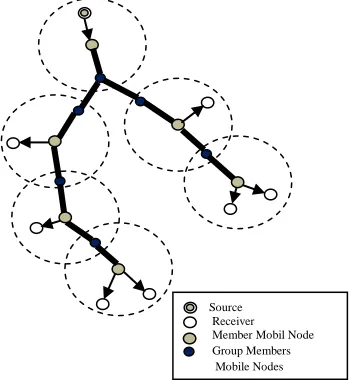
Group communication services are one of the essential attentions in MANETs. Multicasting is designed to improve effectiveness of group oriented applications in a wireless environment where bandwidth and network resources are very important factors [4] [5]. It carries a single data stream from one source to a group of receivers without transmitting duplicate copies over any single path as shown in Figure 1. The implement of multicasting within MANETs has many benefits includes: decrease the communication cost and utilizes the attendant of broadcasting properties in wireless transmission to make the wireless channel operates the highest efficiency. Moreover, multicasting maintains the resources by exploits channel bandwidth, reducing energy consumption and minimizes the nodes processing and transmission delay.
mobile nodes in the multicast group. It is bandwidth efficient because it decreases the number of packet copies required per network. The essential detriment in single path is link breakdown that is responsible forthe reconfiguration of the whole tree topology [5] [6]. As an example of a tree structure Multicast Ad hoc On-Demand Distance Vector protocol (MAODV) [7].
Figure 1. Data flow in Multicasting within MANETs
Mesh routing mechanism creates a mesh of routes to join all mobile nodes in the network. Mobile nodes mobility and routes breakdown are more resilient in this mechanism. The major drawback is that mesh mechanism rebroadcast various copies of same control packets, which resulting in increase control overhead and decrease packet delivery in a high mobility node environment. On-Demand Multicast Routing Protocol (ODMRP) [9] represents one of these mechanisms.
Accomplishment of robust and reliable multicast routing mechanism in MANETs is still challenging, due to dynamic nature of the network topology, high mobility of nodes and flooding mechanism [10]. Most of current multicast routing protocols in MANETs use flooding mechanism to fined routing link through the network, which result in more overhead, waste network resources and increase the cost of routing discovery and maintenance. In this paper we propose a new multicast routing mechanism for MANETs based on ODMRP. The goal of this proposed mechanism is to discover the most stable multicast route against the node mobility by modifying the mechanisms of route discovery and data forwarding.
2.
RELATED WORKThis section gives some related work of efficient route discovery and link stability based on the multicast routing Protocol in MANETs. In the last few years many researchers have proposed many mechanisms of multicast routing. ODMRO [9] proposed to decrease control overhead and improve scalability. The source node periodically broadcasts join query packets (JQ) to create and update multicast route and group membership. Receivers respond to JQ by sending join replay packets (JR) to its neighbours using backward learning. After that, data packets can transmit from a source to a group of multicast receivers via selected paths and forward groups. Under high mobility environment ODMRP achieve high packet delivery ratio. But, the main drawback of ODMRP grown is control overhead that produced from flooding mechanism especially in large-size networks.
Link Stability and Lifetime Prediction Based QoS Aware Routing for MANET (LSLP) [11] formulates the QoS aware routing problem by increasing the link stability and lifetime and decreasing the cost. The proposed algorithm chooses the best route depend on the stability of a link and lower cost lifetime prediction to minimize blocking probability along with QoS support. Blocking probability in this algorithm can be reduced up to 20% compared to other algorithms. LSLP improves the lifetime of a link in the network but the control overhead and the cost of link stability will be increase [12].
Enhancement ODMRP with Motion Adaptive Refresh (E-ODMRP) [13] is extension of ODMRP that treats their mobility environment by using the conditioned broadcasting mechanism. Each mobile node in the network computes the number of its neighbor’s mobile nodes and their distance and records this information into the table. The join query packets rebroadcast depends on the probability of computed table information’s. Simulation result present that the proposed mechanism reduced the control overhead by up to 50% and maintaining the packet delivery ratio as the prime ODMRP.
Link stability based multicast routing scheme in MANET (LSMRM) [6] proposed mesh mechanism that discovers the stable multicast route from source to destinations. Route request and route replay build a mesh multicast mechanism to aid of the routing information that saved in MRIC and some criterion of link stability that saved in LSD on every mobile node in MANET. Forwarding mobile
nodes that have higher values of link stability through its neighbors mobile nodes selected as stable forwarding node (SFN) that used to create the most stable routes in the network. Distance between neighbors mobile nodes, received power and bit error in the packet are the main parameters that used in this mechanism to determine the link stability. Simulation compares the LSMRM mechanism with ODMRP and EODMRP in term of the packet delivery ratio, packet delay and control overhead in a large number of mobile node environments. The proposed mechanism has significant improvement but the main drawback is the control overhead still high.
A link stability-based multicast routing protocol for wireless mobile ad hoc networks (LLMR) is presented in [14] that proposed a weighted multicast routing mechanism for mobile ad hoc network in which the mobility parameters are assumed to be random variables with unknown distribution. The target of the proposed mechanism is to discover the largest stable multicast route with the most time duration versus the mobility of nodes. Simulation has been performed to display the efficiency of this mechanism. The results display that the proposed algorithm is better than other algorithms in terms of control overhead, lifetime of multicast route, delay and packet delivery ratio.
In [2] limited flooding ODMRP algorithm proposed a framework of route discovery and route maintenance to improve the multicast routing mechanism by accurately managing flooding technique depending on delay characteristics of the contributing mobile node. In this mechanism the mobile node that fulfills the requirement of delay can broadcast the join query packet. The main delay parameters that will be considered in this mechanism are random channel access, random packet arrival and service process. Simulation result shows that the proposed mechanism provides higher performance in terms of control overhead, packet delivery ratio and end-to-end delay as comparing to RODMRP and ODMRP.
3.
PROPOSED ALGORITHMIn this section, we propose a stable multicast routing protocol for MANETs build on ODMRP. The proposed algorithm modifies the mechanism of route discovery and data transmitting to enhance the use of routes that consists of stable mobile nodes. The target of this algorithm is to improve the stability of route by increasing the route lifetime and reducing the need of route maintenance mechanism. This algorithm finds the most stable
route from multiple routes that build by the mesh mechanism to decrease the control overhead and end to end delay between the source and receivers. The main parameters in our proposed algorithm that responsible for like stability is the coverage area by each mobile node, distance between mobile nodes and overall packet delay.
3.1 Mobile Coverage Area and Distance between Neighboring Nodes
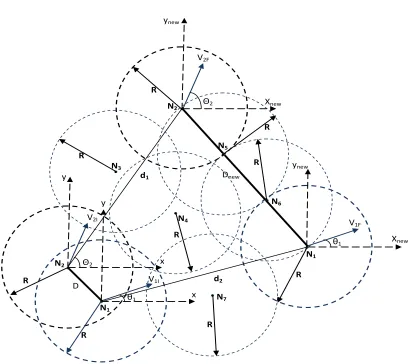
Assume two mobile nodes N1 and N2 within the
transmission rang R as shown in figure 2. Let the current coordinate for N1 is (x1, y1) and (x2, y2) be
that for N2. The distance between the mobile node
N1 and mobile node N2 is given by equation 1 as
shown below:
D(N1,N2) = (x1-x2)2+(y1-y2)2 (1)
Suppose N1 move in θ1 direction with v1
velocity and N2 move in θ2 direction with v2
velocity.
2π ≥ θ1, θ2≥ 0
After T period of time, N1 and N2 move a
distance d1 and d2, the new coordinate will be
(x1new, y1new) and (x2new, y2new) respectively. The
value of distance di is given by equations 2 as
shown below.
(ViI + ViF) * T
di = Vi* T = (2)
2
where ViI and ViF represent the initial and final
velocities of mobile nodes. The value of the new coordinates xinew and yinew are given by equations 3
and 4 respectively.
Xinew = xi+di * cosθi = xi + T (ViI* cosθi) (3)
Yinew = yi +di* sinθi = yi + T (ViI* sinθi) (4)
The distance between the mobile node N1 and
mobile node N2 in the new coordinate is given by
Equation 5 as shown below:
D(N1,N2)new = (x1new-x2new)2+(y1new-y2new)2
= [(x1-x2)+T(V1cosθ1-V2cosθ2)]2 + [(y1-y2) +
T(V1Fsinθ1-V2Fsinθ2)] 2
(5)
The prerequisite for connection between N1 and
Transmission range (R) ≥ distance between N1
and N2 (D(N1, N2))
So, depending on coverage area by each mobile node, the link stability between N1 and N2 after T
time period can calculate by next equation:
R
L.S(N1, N2) = (6)
D(N1,N2)new
In the free space propagation model, the maximum transmission range is calculated by equation 7 as shown below:
FSPL = 32.44 + 10 log (f) + 10 log (d ) (7) where FSPL represents the free space propagation loss required for error-free reception at receiver, f is the carrier wavelength in MHz and d is the largest linear dimension of the antenna in km.
In general, link stability between any neighboring nodes can be calculated by Equation 8.
R
L.S(Ni, Nj) = (8)
D(Ni, Nj)
According to coverage area and the distance between neighboring nodes, the route stability from source to receiver will be calculated through the following steps:
1. Find the minimum link stability (L.S) between neighbouring nodes along the certain route.
2. Replay the step 1 over all available routes from source to receiver.
3. Compare between all the selected values (minimum L.S) in each route, and the V1I
V2I
Θ2
θ1 N2
N1 y
y
x
x N2
N1
Xnew
Xnew
ynew
ynew
D
V2F
V1F
Dnew
N3
N4
N5
N6
N7 d1
d2
θ1
Θ2
R R
R R
R
R R
R
[image:4.612.93.506.114.478.2]R
maximum value will be the most stable route (R.S) value.
4. The route from the source to the receiver, which has this value, will be selected as the best stable route.
So, the route stability between source and receivers will be calculated depending on previous steps by the following equation:
R.S1 = Min L.S(i) (9)
where, h.c represents the maximum value of hope counts in the selected route.
3.2 Delay
Some applications are very sensitive for delay especially video data applications, because video data packet must to receive by all receivers in creation time with minimum delay. In [15] the packet should be transferred by multicast receiver before the maximum threshold of 250 ms to accommodate the delay requirement for high throughput applications. The overall delay between two neighboring nodes N1 and N2 can be calculated
through transmission delay (dt), queuing delay (dq)
and contention delay (dc) [2] as shown in the
equation 10:
d(N1,N2) = dt + dq +dc (10)
The transmission delay can be calculated from the following equation:
PktSize
dt = (11)
Bw
According to the M/M/1 queue model and the work done in [2] the queuing delay and contention delay calculated through equation 12:
k
dq + dc = (12)
μ
Note that k is the maximum queue size and μ is an exponential distribution of service times in the M/M/1 queue model.
So, the time delay in any hope between two neighboring nodes can be calculated through following equation:
PktSize k
t = + (13) Bw μ
As a result of this, next equation will calculate the overall delay between the source and receivers:
Max t(S,R) = ∑ ti (14)
where Max t(S, R) represents the maximum time delay between the source and receiver in the network.
According to the overall time delay between the source and receiver, the route stability can be calculated from equation 15 as shown below:
Max t(S, R)
R.S2 = (15)
di(S, R)
where ti(S, R) represents the time delay of certain
route between source and receiver. The route that has the maximum R.S2 value (minimum delay
between source and receiver) will be chosen as a most stable link.
3.3 Route stability function
To meet the requirements of proposed algorithm target by increasing the route lifetime and reducing the need for route maintenance mechanism, the overall route stability between source and receivers will be calculated through equation 9 and equation 15 as shown below in equation 16:
R.S = R.S1 + R.S2 (16)
The route that has the maximum R.S value will be chosen as the most stable route to carry the data packets from a source.
4.
PSEUDOCODE FOR LLMRP ALGORITHMPseudocode is a computer program that helps programmers in designing algorithms by using an artificial and informal language. In this section the operating principle of the proposed multicast routing algorithm described by using pseudocode which called LLMRP. It consists of a number of loops. Each loop begins when multicast session is requested by mobile source
node
.Input: Multicast mobile nodes (S: source, R: receiver), Multicast group G.
Auxiliary variables: Join-Query (JQ), Join-Replay (JR), Maximum transmission ring (R), Distance between neighbors nodes (D), Time To Live (TTL), Link stability between neighbors nodes (L.S), Hope
h.c i = 1
h.c
count (h.c), Overall delay between source and receiver (d).
Assumption:TransRangeR ≥ DisBwnNiborNodD Output: Most stable multicast route between source and receiver (R.S).
Begin: Algorithm when (DataPkt.Src) do
lookupRootTableforLnk(NxtHopDes); if ( Lnk (S-R)) then
SendDataPktbyFwdGrpNod(FwdGrpTable); else
BcastNewJQPkt;
GrpNodMembrRsvJQPkt; end if
if (MsgCachRsvDplctJQPkt) DiscrdJQpkt;
else
UpdateMsgCachBkwrdLrn; end if
if (!NxtHopDes(FwdGrpTable)) L.S = R / D;
d = dt + dq +dc ;
TTL -=1; H.C +=1; else if(TTL<=0) DiscrdJQpkt; else
UpdateMsgCach& FwdGrpTable(CurntNod); BcastNewJQPkt;
end if else
R.S1 = Min L.S(i)
R.S2 = Max(d) / Min(d)
R.S = R.S1 + R.S2
SendJRtoSbyMaxRS;
SendDataPktbyFwdGrpNodbyMaxRS(FwdGrpTabl e);
end if End
5.
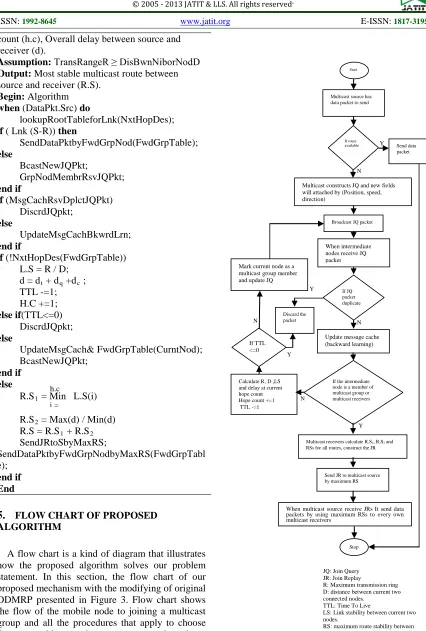
FLOW CHART OF PROPOSED ALGORITHM [image:6.612.93.519.61.692.2]A flow chart is a kind of diagram that illustrates how the proposed algorithm solves our problem statement. In this section, the flow chart of our proposed mechanism with the modifying of original ODMRP presented in Figure 3. Flow chart shows the flow of the mobile node to joining a multicast group and all the procedures that apply to choose the most stable route between source and receivers in the network.
Figure 3. The Flow Chart Of Proposed Algorithm Start
Multicast source has data packet to send
If route
available Send data packet
Multicast constructs JQ and new fields will attached by (Position, speed, direction)
Broadcast JQ packet
When intermediate nodes receive JQ packet
If JQ packet duplicate
Update message cache (backward learning)
If the intermediate node is a member of multicast group or multicast receivers
Multicast receivers calculate R.S1, R.S2 and
RSs for all routes, construct the JR
Send JR to multicast source by maximum RS
When multicast source receive JRs It send data packets by using maximum RSs to every own multicast receivers
Calculate R, D ,LS and delay at current hope count Hope count +=1 TTL -=1
If TTL <=0
Discard the packet
Mark current node as a multicast group member and update JQ
Stop
Y N
N
Y N N
Y
Y
JQ: Join Query JR: Join Replay
R: Maximum transmission ring D: distance between current two connected nodes.
TTL: Time To Live
LS: Link stability between current two nodes.
RS: maximum route stability between source and receiver.
h.c
6.
CONCLUSIONThe proposed multicast routing mechanism addressed many challenges in a MANET environment due to free random movement of mobile nodes. In this paper, a new stable multicast routing mechanism, Long Lifetime Multicast Routing Protocol (LLMRP
),
based on On-Demand Multicast routing Protocol proposed. The proposed mechanism finds the most stable route against route failure and mobile node movement by modifying the mechanism of route discovery and data multicasting. The main objective of this proposed mechanism is to extend the route lifetime and decrease the use of route maintenance mechanism to reduce end to end delay and control overhead. For the future work we would like to simulate our proposed mechanism by using network simulator NS-2 and evaluate the link stability of new mechanism relative to other multicast routing mechanisms..ACKNOWLEDGMENTS
The authors would express their appreciation to the support of this work under the Universiti Kebangsaan Malaysia grant number DPP-2013-006.
REFRENCES:
[1] Xiang, X., Wang, X., and Yang, Y., “Stateless Multicasting in mobil Ad Hoc Networks” IEEE Transactions on Computer, vol. 59, No. 8, August 2010, pp. 1076-1090.
[2] Kharraz, M. A., Sarbazi_Azad, H., and Zomaya A. Y., ”On-demand multicast routing protocol with efficient route discovery” Journal of Network and Computer Applications, vol. 35, 2012, pp. 942-950.
[3] S. Mohseni, R. Hassan, A. Patel and R. Razali, "Comparative review study of reactive and proactive routing protocols in MANETs," International Conference on Digital Ecosystems and Technologies (DEST), April 13-16, 2010, pp. 304-309.
[4] Kant, K., and Awasthi, L. K., “Stable Link Based Multicast Routing Scheme for MANET” , Computational Intelligence and Communication Networks (CICN), 2010, pp. 296 – 300.
[5] Xing, X., Wang, X., and Yang Y., Supporting Efficient and Scalable Multicasting over Mobile Ad Hoc Networks, IEEE Transactions on Mobile Computing, vol. 10, Issue 4, 2011, pp. 544-559.
[6] Biradar R., Manvi S., and Reddy M., “Link stability based multicast routing scheme in MANET”, Computer Networks, vol. 54 , 2010, pp. 1183–1196.
[7] Z. Ismail, and R. Hassan, "Performance of AODV routing protocol in Mobile Ad Hoc Network," International Symposium in Information Technology (ITSim), June 15-17, 2010, vol. 1, pp.1-5
[8] Royer, E. M., and Perkins, C. E., “Multicast Operation of the Ad Hoc On-Demand Distance Vector Routing Protocol”, Proceedings of ACM MOBICOM, August 1999, pp. 207–218.
[9] Lee S. J., Gerla M., and Chiang c. c., “On-Demand Multicast Routing Protocol “, Proceedings of the IEEE wireless communications and networking conference, 1999, pp. 1298–302, New Orleans, USA. [10] Alhemyari, A., Jumari, K., Ismail, M., and
Saeed, S.,“ A comparative Survey of Multicast Routing Protocol in MANETs” , International Conference on Computer & Information Science (ICCIS), 2012, pp. 830-835.
[11] Md., M. R., and Choong, S. H., “LSLP: Link Stability and Lifetime Prediction Based QoS Aware Routing for MANET”, proceeding of the joint conference on communication and information (JCCI), Phoenix Park, Korea, 2007, pp. 23-30.
[12] Rajashekhar, C. B, and Sunilkumar, S. M, “Review of multicast routing mechanisms in mobile ad hoc networks”, Journal of Network and Computer Applications, vol. 35, 2012, pp. 221-239.
[13] Soon, Y. Oh, Park, J. S., and Gerla, M., “E-ODMRP: enhancement ODMRP with motion adaptive refresh”, Journal of Parallel and Distributed System, vol. 64, No. 8, 2008, pp. 1044-1053.
[14] Javad, A. T, and Mohammad, R. M, “A link stability-based multicast routing protocol for wireless mobile ad hoc networks”, Journal of Network and Computer Applications, vol. 34, 2011, pp. 1429-1440.
[16] Sarma, N, and Nandi, S., “A Route Stability based Multipath QoS Routing (SMQR) in MANET”, Proceeding of the international conference on emerging trends in engineering and technology (ICETET), Nagpur, India, 2008, pp. 193-198.
[17] Begdillo, S. J., Mohamamdzadeh, H., Jamali, S., and Norouzi, A.,”Stable Route Selection in ODMRP with Energy Based Strategy”, Personal Indoor and Mobile Radio Communications (PIMRC), 2010, pp. 1741-1745.
[18] Su, W. Lee, S.J. and Gerla, M., “On-demand multicast routing protocol in multihop wireless mobile networks (ODMRP),” SpringerLink Mobile Networks and Applications, 2002, vol.7, pp.441–53.
[19] Rajendiran, M., and Srivatsa, S. K.,”Route efficient on demand multicast routing protocol with stability link for MANETs”, Indian Journal of Science and technology, vol. 5, No. 6, 2012, ISSN:0974-6846, pp.2866-2871. [20] C. Bettstetter, G. Resta and P. Santi. The node
distribution of the random waypoint mobility model for wirelees ad hoc networks. IEEE Transactions on Mobile Computing, 2003, vol. 3, pp. 257-269.
[21] T. Camp, J. Boleng and V. Davies, “A survey of mobility models for ad hoc network research”. Wireless Communication and Mobile Computing 2002;vol.2, pp.483–502.
[22] Saeed, S., Jumari, K., Ismail, M., Al-hemyari, A., , "Challenges and solutions of QoS provisioning for real time traffic in mobile ad hoc networks," Computer & InfK.,ormation Science (ICCIS), 2012 International Conference on , vol.2, no., pp.765-770.