PERFORMANCE COMPARISON OF DYNAMIC
MULTICAST GROUPS BASED ON MOBILITY SPEED
1USHA DEVI G, 2ANUSHA K, 3RAJYALAKSHMI GV
School of Information Technology and Engineering, VIT University, Vellore, Tamil Nadu, India,
1
,
2[email protected], 3[email protected]ABSTRACT
Mobile Ad-hoc Networks (MANETs) have group of mobile users over a shared medium that can also offer group communications. In group-oriented communications, multicasting plays an important role. The combination of multicast services with ad-hoc environment introduces new challenges towards security issues. Clustering is an effective technique for group communication. Cluster formation involves election of a node as cluster head and it controls other nodes in the newly formed cluster. The joining or association and leaving or dissociation of nodes to and from clusters disturbs the stability of the network topology. This paper analyses the effect of mobility in dynamic multicast clusters, in which nodes uses multicast ODMRP routing protocol to collect its neighbours to form clusters. Simulation results show the performance in terms of throughput and average end-end delay under various network conditions.
Keywords: Multicast Dynamic Groups, ODMRP, Group Communication, Throughput, Average End-End
Delay
1. INTRODUCTION
In an epoch of years, a group of people who communicate or make a conference in an interactive manner through the computers connected by networks at distance or discrete location are defined as group communication. From the evolution, secure group communication had gained a intensive.
Designing routing protocols are the challenging issue in large networks where the Ad-hoc network allows all wireless devices to communicate each other without involving any central access point. Performance degrades as soon as the number of nodes in the network increases and also it is very difficult to manage large ad-hoc networks.
MANET is a self configured wireless ad-hoc network and it has mobile routers connected via wireless links. Each node must forward traffic which is unrelated to it and it will function like a router. Nodes can move freely so that it may change its location from time to time. This dynamic mobility factor may degrade the performance of a network and it leads to
unnecessary usage of available bandwidth [1]. So to resolve the degradation, the multicast is economical.
Multicasting is a technique that can send data from one sender to many receivers [2]. It is a transmission of data to group of nodes using a unique multicast address. MANET supports multicast to reduces the bandwidth and energy cost. The multicast groups are clustered together to support the network and routing delay management [3].
In a dynamic environment, with some functionality used by the application are deployed with the unstable nature. So we outlined the multicasting formation process to overhead the mobility, flexibility related issues in the suggested few application such as Online chatting, video conferencing, online auctions with plenty of members involved in an organization.
1.1 Multicast Clusters
controller of their group [4]. It manages the intra-cluster communication among the child nodes, without any inter-cluster links. It improves the resource usage and reduces the update messages overhead. Therefore the multicast nodes forms clusters for secure multicast key distribution and overcome the security issues such as forward secrecy, backward secrecy, group confidentiality, collision freedom are required. Group confidentiality is ensured that only valid users could decrypt the multicast data. Rekeying is the process of updating and distributing keys to multicast group members. Each member holds keys to encrypt and decrypt the multicast data in secure multicast communication.
This correspondence is for multicast based Mobile Ad hoc Networks to analyze the effect of mobility and clustering approach is effectively done to increase the performance.
The Multicast based Mobile Ad hoc Networks by gaining the knowledge from the related works with the reference and outcomes. From the survey, they stipulate the Multicast routing protocol functionality along with the defect. To get to bottom of the work, we have followed the cluster formation in a dynamic nature. From the efficient inference the simulation are articulated with the various parameters.
2. RELATED WORK
Clustering of nodes is a technique which divides multicast group into sub-groups [5]. The related works on clustering approach deals with the routing protocol using table-driven approach. The multicast feature is added in Destination Sequenced Distance Vector protocol and it supports only the location dependent nodes. The instability environment deals with frequent node failures.
Destination Sequenced Distance Vector (DSDV) Routing Protocol is a table driven proactive routing protocol designed for mobile ad hoc networks. The routing table is updated periodically is a permanent storage. Optimized route selection is done here and it avoids routing loops. Each node has unique sequence number which is updated periodically and it is mainly used for intra cluster routing [6].
The multicast DSDV protocol gathers information about its neighbour nodes and each entry of nodes are recorded in the table for
multicast key distribution. The source node of each group collects its 1-hop neighbour information and elects the leader for that group. The table collects the lists of cluster heads of that environment. The proactive type of protocol is not suited for dynamic topology and it will not recover the cluster breakage when the node from one group rejoins into another group [7].
The proposal of this paper is to use the ODMRP Routing protocol to reduce the control information. The on-demand approach will overcome the node instability and also reducing the breakage of groups within the cluster. Simulation show the better results for various performance metrics under various criterions.
3. ON DEMAND MULTICAST ROUTING PROTOCOL
The On Demand Multicast Routing Protocol (ODMRP) is an on-demand mesh based protocol where a mesh is formed by a group of nodes known as forwarding nodes. These nodes forward the data packets between the source and destinations, and keep a message cache which helps in the detection of duplicate data and control packets.
In the Mesh establishing phase between the source and receivers, a JoinReq control packet is flooded by the sender periodically for the creation of mesh. The receivers respond to the request by sending a JoinReply through the shortest reverse path. Each intermediate node that receives the JoinReq packet stores the upstream node Identity before broadcasting the packet. The JoinReply packet consists of the Source Id and the Next hop ID. When an intermediate node receives a JoinReply packet, it sets a forwarding flag and thus becoming a member of the forwarding group of that multicast group.
4. CLUSTER FORMATION
Cluster formation plays a major role in the mobile environment which is dynamic in nature [8,9]. The mobility of nodes makes the cluster environment volatile. In this paper, the similar moving patterns of multicast nodes, available energy among them are considered to form the cluster efficiently. Based on these factors the stability of the cluster is achieved and also the processing cost is reduced.
4.1 Cluster Head Election
The steps for election of a head will be described as follows:
Step 1: Collect the multicast nodes from the
network.
Step 2: In each cluster, the nodes can broadcast
the messages to exchange their information. In the intra-cluster, the head node can be elected by considering the energy level of each node in their group.
Step 3: The cluster head with maximum energy
will process more number of child nodes. Based on the available energy of the head node, the number of child nodes can be restricting to handle them efficiently.
The basic idea of clustering scheme is to start with the collection of nodes having similar mobility pattern and to elect Local Heads (LHs) based on the available energy constraint possessed by a node. The elected LHs cover the group members having 2-hop neighbours of the group source until it covers all group members.
5. SIMULATION
The experiment has been conducted using QualNet simulator with the following simulation parameters under different test cases. It focuses on dynamic multicast group and the performance is evaluated with the parameters such as Throughput and Average End-End Delay under different network conditions [10].
5.1 Simulation Parameters
Terrain size: 1500 x 1500 Number of nodes: 50
Simulation duration: 300 s
Mobility model: Random Waypoint Model Mobility Speed: 1/10/20/30/40/50 mps Items to send: 100
Item size: 512 bytes Item Interval: 1s Number of sender: 1 Number of receivers: 10 Routing protocol: ODMRP Join Query Refresh Interval: 20s Forwarding Group Update Interval: 60s Default TTL value: 64
Cluster Timeout Interval: 10s
5.2 Performance Metrics
There are two important metrics taken to analyze the effect of mobility. (1) Throughput is the metric that gives the amount of data transferred per unit time. It is measured in bits per second. (2) Average End-End Delay is the time taken for a packet to be transmitted from source to the receiver across a network.
5.3 Test Cases
Table 1 shows test cases taken for the simulation without and with different mobility speeds.
Table 1. Test cases considered for the multicast group
Test Cases Properties
1 No Mobility
2 Mobility with Speed of 1 mps 3 Mobility with Speed of 10 mps 4 Mobility with Speed of 20 mps
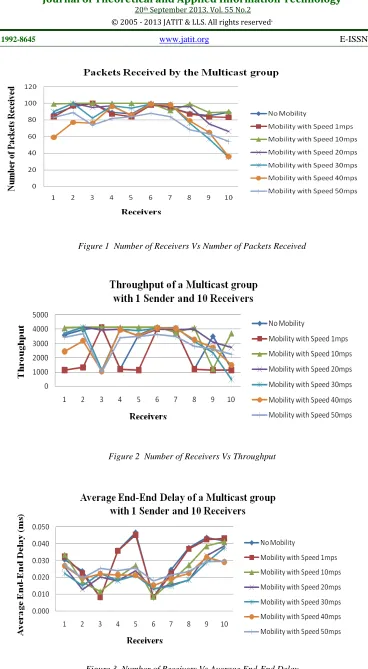
Figure 1 Number of Receivers Vs Number of Packets Received
Figure 2 Number of Receivers Vs Throughput
[image:4.612.126.460.471.688.2]5.4 Results
Figure 1 shows the graphical representation of number of packets received by the multicast group. All group members receive the number of packets based on the mobility speed, distance between multicast sender and the receiver within the stipulated time. If timeout, the session will be closed. It leads to higher loss in packets.
The throughput at the server is calculated as follows: If the session is complete,
throughput = (total bytes sent * 8) / (time last packet received - time first packet received),
where the times are in seconds. If the session is incomplete,
throughput = (total bytes sent * 8) / (simulation time - time first packet received),
where the times are in seconds. The throughput is affected due to the simulation time and mobility.
Figure 2 shows the graphical representation of throughput of a multicast group under various test cases.
The average end-to-end delay at the server is calculated as follows:
Average end-end delay = (Total of packet delays for all packets) / (Total packets received)
where packet-delay = (time when packet is received at the server - time when the packet is transmitted at the client). Figure 3 shows the graphical representation of average end-end delay of a multicast group under various test cases.
6. CONCLUSION
Major challenges in Mobile Ad-hoc Networks include higher throughput and lower end-end delay in a dynamic environment. This paper compares the network performance factors in a highly dynamic environment by using ODMRP protocol. On Demand Multicast Routing Protocol is uses mesh to form a group and table-driven approach to maintain the routing information. Simulation results show that the performance degradation in few nodes with respect to average end-end delay and throughput due to increase in path length for different mobility speeds.
The work is evaluated with the simulation parameters for achieving the efficiency of the performance deployed in a dynamic nature. Multicasting has employed with fixed members in a group in a limited speed.
The enhancement can be carried out by increasing more number of members in the group by varying the speed of the mobility of the nodes. The modelling can also be evaluated with the various security services.
REFERENCES
[1] Muthu ramalingam S., RajaRam R., Kothai Pethaperumal and Karthiga Devi V., “A Dynamic Clustering Algorithm for MANETs by modifying Weighted Clustering Algorithm with Mobility Prediction”, International Journal of Computer and Electrical Engineering,
Vol.2, No.4, 2010, pp.709-714.
[2] Alexandros Vasiliou and Anastasios A. Economides, “Evaluation of Multicasting Algorithms in MANETs”, World Academy of Science, Engineering and Technology,
Vol. 5, 2005, pp.94-97.
[3] PushpaLakshmi R., Vincent Antony Kumar, “Cluster Based Composite Key Management in Mobile Ad Hoc Networks”,
International Journal of Computer
Applications, Vol.4, No.7, 2010, pp.30-35.
[4] Usha Devi G, Wahida Banu RSD,” Simulation of Multicast Clusters Based on Hop factor in Mobile Ad-hoc Networks”, European
Journal of Scientific Research, Vol.75,
No.3, 2012, pp.458-464.
[5] Suganya Devi D. and Dr. G.Padmavathi, “Efficient Cluster Based Multicast Tree for Secure Multicast Communication for Mobile Ad Hoc Networks”, International Journal of Engineering Science and
Technology, Vol.2, No.5, 2010,
pp.1304-1310.
[6] Tyagi S.S. and Chauhan R.K., “Performance Analysis of Proactive and Reactive Routing Protocols for Ad hoc Networks,”
International Journal of Computer
Applications,Vol.1, No.14, 2010.
[7] Mohammed F. Al-Hunaity, Salam A. Najim and Ibrahiem M. El-Emary, ”A Comparative study between Various Protocols of MANET Networks”, American
Journal of Applied Sciences, Vol.4, No.9,
[8] Meenu Chawla, Jyoti Singhai and J L Rana, “Clustering in Mobile Ad-hoc Networks: A Review”, International Journal of Computer Science and Information Security (IJCSIS), Vol.8, No.2, 2010.
[9] Sharmila John Francis and Elijah Blessing Rajsingh, “Performance Analysis of Clustering Protocols in Mobile Ad hoc Networks”, Journal of Computer Science,
Vol.4, No.3, 2008, pp.192-204.
[10] Saravana Karthikeyan M., Angayarkanni K., and Sujatha S., “Throughput Enhancement in Scalable MANETs using Proactive and Reactive Routing Protocols”, Proceedings of International MultiConference of Engineers and Computer Scientists,
Singapore, Vol.2, 2010.
[11] Saravanakumar Muthusamy, Purusothaman thiagarajan, Lavanya Selvaraj, “ An enhanced and cost effective group key management for scheme for multicast networks”, Journal of computer Science, Vol.9, no.4, pp.477-487, 2013.
[12] Silpa S.Harnale, Gouri patil, “Efficient group key management for multicast groups”,
World Journal of science and Technology,