NCBEERP: A NEW CLUSTERING PROTOCOL FOR
IMPROVING ENERGY EFFICIENCY FOR WIRELESS
SENSOR NETWORKS
1K.MUTHUMAYIL,2S.MANIKANDAN, 3V.RAJAMANI
1
Associate Professor, PSNA College of Engg.&Tech., Dindigul, India 2
R.M.D.Engineering College., Chennai 3
Professor, Veltech Multitech Dr.Rangarajan Dr.Shankunthla Engg. College, Chennai
E-mail: [email protected], [email protected], [email protected]
ABSTRACT
The wide use of Wireless Sensor Networks (WSNs) is blocked by the extremely restricted energy demands of the singular sensor nodes. This is the motivation behind why a huge piece of the examination in WSNs concentrates on the advancement of energy effective steering protocols. In this paper, another convention called Novel Cluster Based Energy Efficient Routing Protocol (NCBEERP), which seeks after energy preservation through adjusted clustering, is proposed. NCBEERP models the system as a rout framework and, utilizing the node maintenance calculation, computes the mixes of nodes that might be picked as cluster heads and energize [improve the battery] the dead nodes with a specific end goal to enlarge the system lifetime. The execution assessment of NCBEERP is helped out through recreation tests, which display the adequacy of this convention as far as system energy proficiency against other well-known protocols
Keywords: Wireless Adhoc Networks; Energy Efficiency; Novel Clustering Approach; Clustering.
.
1. NOMENCLATURE
Symbols Description
NCBEER Novel Clustering Based Energy Efficient Routing
WSN Wireless Sensor Networks
Eamp Amplifying Energy
Eelec Electrical Circuit Energy
ETX Transmission Energy
ERX Receiving Energy
E Energy
BS Base Station
2. INTRODUCTION
Late mechanical developments have empowered the cheap extensive manufactures of sensor nodes, which, notwithstanding their generally little size, have especially exceptional sensing, preparing and correspondence abilities. A WSN comprises of spatially appropriated sensor nodes, which are interconnected without the utilization of any wires. In a WSN, sensor nodes sense the earth and utilize their correspondence segments within request to
transmit the sensed information over remote channels to different nodes and to an assigned sink point, alluded to as the Base Station (BS). BS gathers the information transmitted to it with a specific end goal to act either as a supervisory control processor or as a right to gain entrance point for a human interface or even as a door to different systems.
Through the community oriented utilization of countless nodes, a WSN can perform simultaneous information securing of existing conditions at different purposes of investment placed over wide zones. These days, WSNs, because of the various profits that their use offers, help an always developing mixed bag of provisions, including agribusiness, activity control, environment and living space checking, article following, flame location, observation and surveillance, home robotization, biomedical requisitions, stock control, machine disappointment judgment and energy administration.
remote correspondence, the earth sensing and the information transforming. Subsequently the greater part of the routing protocols in WSNs point essentially at the accomplishment of force protection. Since the vast majority of the steering protocols created for wired systems seek after the fulfillment of high caliber of Service (Qos), they are essentially uncalled for provision in WSNs. Consequently, numerous protocols have been proposed for information steering in sensor systems [8, 9 and 17].
The majority of the protocols use clusters keeping in mind the end goal to give energy productivity and to broaden the system lifetime. Each one bunch first chooses a node as the cluster head (CH), and after that, the nodes in every cluster send their information to their bunch head. The bunch head sends its information to the base station. This information exchange could be performed in two option ways. It is possible that straightforwardly, in the case in which the bunch head is found near the base station, or by means of middle of the road cluster heads. In this paper, a novel energy productive convention, named NCBEERP, is proposed. NCBEERP, in spite of other existing bunch based protocols that select an arbitrary node or the node with the higher energy at a specific time occasion as the new cluster head, recognizes the current and the assessed future remaining energy of the nodes, alongside the amount of adjusts that might be cluster heads, to expand the system lifetime. The system is demonstrated as a rout framework, and the Gaussian end calculation is utilized as a part of request to ascertain the mixtures of nodes that could be picked as bunch heads. The proposed convention permits new nodes to be added to the framework and consequently alters its conduct focused around the withering nodes and the sign to-commotion obstruction. What's more, node versatility is additionally taken care of.
For cluster remote sensor systems (WSNs, for example, LEACH [12], EEHC [15] and HEED [7], clustering calculations can viably enhance system adaptability and throughput. Utilizing clustering calculations, nodes are assembled into clusters, and inside each one cluster, a node with solid registering force is chosen as a cluster head (CH). CHs together structure a larger amount spine system. After a few recursive emphases, a clustering calculation builds a multilevel WSN structure. This structure encourages correspondence and empowers the limitation of data transfer capacity devouring system operations, for example, flooding just to the proposed clusters [5].
3. RELATED WORKS
Wireless Sensor Network (WSN) is a wireless network consisting of small nodes with sensing,
computation, and wireless communications
capabilities [16]. Routing in WSNs is a very
challenging problem due to the inherent
characteristics which differentiate such networks from other wireless networks such as ad hoc networks and cellular networks [10]. In WSN there are the routing protocols that minimize the used energy, extending subsequently the life span of the WSN [11]. Energy awareness is an essential in routing protocol design issue. Depending on the network structure, routing in WSNs can be divided into:
a) Flat-based routing
b) Hierarchical-based routing
c) Location-based routing
With the universal application of sensor networks, it is attracting more and more attentions to use the limited energy more efficiently and guarantee its normal work under unsafely environment. It is a complex problem about the establishment of routing which can resist the attack should have higher energy efficiency. Each sensor node deployed in such networks has a limited energy and it is subject to several attacks such as sinkhole and select forwarding, wormhole and spoofing attacks. This requires the development of secure and energy-efficient routing protocols to protect the network against such attacks. Even though several routing protocols have been proposed in the literature, a number of these protocols including ones proposed by Heizelman et al. [3], Intagagon wiwat et al. [1], Chiang et al. [14], El-semary and Azim [20], and Lindsey and Raghayendra [4] concentrate on energy utilization of the deployed sensors while other protocols such as the ones presented by Deng et al. [19] and Zhou et al. [13] are designed to protect the network against a specific type attack. Furthermore, protocols such as the ones developed by Zhang et al. [21] and by Younis et al. [18] detect compromised nodes and provide an optimization strategy to avoid unnecessary overhead, respectively.
of discovering the ideal result might be expanded. For this methodology, they have utilized a Status Table, which records and watches all the points of interest of the Fireflies conduct. A few conventions have been proposed prior to enhance the system lifetime utilizing improvement calculations. Firefly is a meta-heuristic methodology and the Energy productive bunching for remote sensor systems utilizing Firefly and Jumper Firefly calculations are mimicked in [22]. Sensor nodes deploying any of these protocols forward packets based on information collected from other sensor nodes. Consequently, the significance of this paper is to propose an NCBEERP for WSNs that has the following merits: (1) Energy Efficiency and (2) No data loss the associated wireless sensor network even while growing.
4. PROBLEM STATEMENT
In WSN one of the most factors improving the quality of service is Network life-time. The network life-time can be increased by saving the energy of each individual sensor nodes. The energy utilization by each sensor nodes is depends on the distance, number of multi-hop and size of the data transferred. In this paper a Novel Cluster based energy proficient steering convention is proposed for sparing the energy at the most extreme contrasting and the current protocols and the complete usefulness is given in the following segment.
5. PROPOSED APPROACH
In this area, a Novel Clustering Based Energy efficient Routing Protocol, named NCBEERP, is displayed. NCBEERP chooses cluster heads in the system utilizing a model, as the greater part of the at one time proposed protocols. Be that as it may, the fundamental contrast with different protocols is that this one uses a more effective component to select a node as the bunch head. This is performed by acknowledging the current and the evaluated future leftover energy of the nodes, alongside the amount of adjusts that they could be bunch heads, so as to boost the system lifetime. NCBEERP models the system and the energy used by the nodes as a rout framework and, utilizing the Gaussian end calculation, chooses the bunch leaders of the system. In Subsection 3.1, the energy model received in NCBEERP is exhibited, while in Subsection 3.2, the routing model of NCBEERP is depicted.
6. PROPOSED PROTOCOL
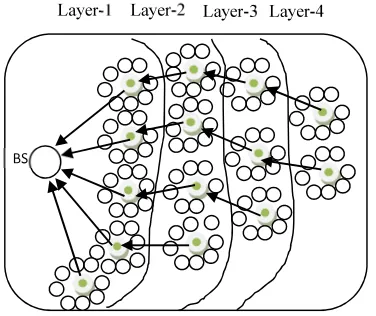
In NCBEERP, the BS is expected to have boundless energy deposits and correspondence power. It is likewise accepted that the BS is found at a settled position, either inside or far from the sensor field. The more drawn out the separation between the BS and the middle of the sensor field, the higher the energy use for each node transmitting to the BS. All the system nodes, which are thought to be placed inside the sensor field, are alterably gathered into clusters. One of the nodes inside every bunch is chosen to be the cluster leader of this cluster. Thusly, the amount of bunch heads is equivalent to the amount of clusters. The bunch heads, which are spotted close enough to the system base station, are alluded to as the first level cluster heads. These cluster heads are equipped for immediate transmission to the base station with sensible energy use. The bunch heads that are placed at more far off positions from the base station are recognized as second-, third-, and so forth level cluster heads. These bunch heads transmit information to the upper level cluster heads. Besides, to attain adjusted energy utilization and augment the system's lifetime, the race of the cluster heads is performed in turns.
7. ENERGY MODEL
At present, there is a lot of examination in the
territory of low-energy radios. Distinctive
suppositions about the radio attributes,
incorporating energy dissemination in the transmit and get modes, influence the execution of diverse protocols.
In this work, the energy model received is as takes
after: the radio disperses 50 nJ/bit (Eୣ୪ୣୡto run the
transmitter or beneficiary hardware and 100
pJ/bit/m2Eୟ୫୮ for the transmit intensifier [2].
The energy that a node disseminates for the radio
transmission Eଡ଼k, d of a message of k bits over a
separation d is because of running both the
transmitter hardware Eଡ଼ିୣ୪ୣୡk and the
transmitter enhancer ETX-amp(k, d) and is
communicated by the accompanying:
Eଡ଼k, d Eଡ଼ିୣ୪ୣୡk Eଡ଼ିୟ୫୮k, d Eୣ୪ୣୡ∙
k Eୟ୫୮∙ k ∙ dଶ---(1)
where Eୣ୪ୣୡ is the transmitter hardware scattering
for every bit equivalent to the comparing collector
hardware dispersal for every bit—and Eୟ୫୮ is the
transmit speaker dissemination for every bit for every square meter. Besides, by utilizing
multi-jump steering, Eଡ଼k, d is diminished when
the energy dispersed by a node for the gathering ERX(k) of a message of k bits is because of running
the recipient hardware ERX-elec(k) and is
communicated by the accompanying mathematical statement:
Eୖଡ଼k Eୖଡ଼ିୣ୪ୣୡk Eୣ୪ୣୡ∙ k ---(2)
The fundamental standard for NCBEERP is the head choice methodology. In this convention, with a specific end goal to choose a bunch head, the steering data and the energy used in the system are defined as a straight framework, the result of which is processed utilizing the Gaussian end calculation. Consequently, bunch heads are chosen as the nodes that minimize the aggregate energy utilization in the cluster. In the greater part of the protocols proposed as such, the node with the most astounding remaining energy in a cluster is chosen as the bunch head. This choice may prompt
inefficiencies, as could be seen by the
[image:4.595.90.278.462.620.2]accompanying case. Give us a chance to expect that node x in Figure 1 has higher remaining energy than alternate nodes fitting in with the same bunch. At that point, this node is chosen as the new bunch head. Be that as it may, this drives whatever is left of the nodes to send information in the inverse course to the base station, bringing about higher energy utilization.
Figure-1: The Network Model Adopted
Obviously, this is not an energy effective procedure, and it might be stayed away from by selecting bunch heads in a more energy proficient way. This is sought after by the proposed convention. The steps with a specific end goal to setup clusters and after that to choose cluster heads are the accompanying:
1. The BS makes a Time Division Multiple Access (TDMA) calendar and solicitations the nodes to promote themselves, a methodology like that of different protocols.
2. Every node shows a message to publicize its energy level and area to its neighbors. Taking into account this traded data, every node sets up a neighbor data table that records the energy level and the positions of its neighbors and sends this table alongside its relating data to its neighbors. This step is rehashed until the data of all the nodes in the system is sent to the BS, permitting the BS to have a worldwide learning of the system. At this step, all the nodes are bunch head hopefuls, and every node has a special ID that is likewise included in the traded table.
3. When the node commercial is finished, the BS runs the Gaussian disposal calculation and figures the amount of rounds at which each node could be a cluster head, attempting to boost the system lifetime. In the first venture of the cluster head choice, the BS picks the nodes closest to itself to be the large amount cluster heads. In addition, a portion of the nodes from which the BS has not
accepted any immediate ad message are
acknowledged to be low level cluster heads. The general number of nodes, which are allotted to be cluster heads, is 5% of the aggregate number of the nodes in the system, as this might be useful in attaining great execution in a homogeneous system with different parameter settings [10]. Different rates can likewise be utilized.
4. The BS shows the extraordinary Ids of the recently chose bunch heads, and their cluster parts and the nodes utilize this data to structure and enter a bunch. Along these lines, every node has the information of the amount of times that it might be a cluster head and the amount of times that it can't. The BS runs the Gaussian disposal calculation and registers the proper number of adjusts that the nodes might be cluster heads and sends this data to the nodes.
5. The more level cluster heads don't transmit specifically to the BS. They utilize the upper level bunch heads as middle repeaters of their information to the BS.
6. Each one cluster head makes a TDMA timetable and telecasts this calendar to the nodes in its bunch, to educate every node of the timeslot that it can transmit. Besides, the radio part of every node is permitted to be turned off at untouched periods, with the exception of throughout its transmission Layer-1
Layer-2
Layer-3 Layer-4
time. Along these lines, the energy dispersal of each individual sensor is respectably lessened.
7. At that point, the information transmission begins. The nodes, taking into account the assigned transmission time, send the information concerning the sensed occasions to their bunch head. The transmission force of each node is changed in accordance with the base important to achieve its next bounce neighbor. Along these lines, both the obstruction with different transmissions and the energy scattering are lessened.
8. Each more level bunch head totals the information and after that transmits the compacted information to the upper lever cluster heads until the information achieves the base station. A round of information transmission has been finished, and the convention proceeds from step 4 for the following round.
9. In the event that that there is a change in the system topology, because of either a change in a node position or in the aggregate dissemination of a node lingering energy, the BS utilizes again the Gaussian end calculation to focus the proper bunch head decision.
10. The execution of the convention is ended when all the nodes in the system use up energy.
8. NODE MAINTENANCE ALGORITHM
The Node Maintenance algorithm receives the dead nodes from each cluster after some round. If the node loses energy it will become a dead node and hence the number of nodes in the cluster decreases. The remaining number of nodes in the cluster will rejoin as a normal node into the nearest cluster in the same layer or from layer to layer moving towards the BS. The dead nodes are sent to a pool area for Node Maintenance. The dead nodes are recharged using an energy production system and send back to the network.
9. PSEUDO CODE FOR NCBEERP
1.
2.
3.
4.
5.
6.
!
7.
8. " # $ 1 //
9. " $ 1
10. '( ) '( *
+'(,
11.
12. '-.( ) '(
13. # // !
14. +, $ +, – +,
15. +, $ +, – +,
16. " # $ 1 //
17. " $ 1
18. $ /'/''((( //
19.
20. # // !
21. 0 '( ) _
22. )
'( //
23.
24. 0 '( )
25. #
26.
27.
28.
In the network , number of nodes can be
deployed in number of clusters with CH election
using Novel clustering approach. In
this , all the nodes in each clusters are
transmitting their data to the corresponding
within the cluster, the gather the data, aggregate
the data and to . Gathers the data from the
from appropriate cluster and aggregate the data
to . Once transmission over, the election
occur and check for the dead nodes and sending it to Maintenance phase.
10. PERFORMANCE EVALUATION OF
NCBEERP
building design acknowledged is the accompanying:
• An altered base station is spotted far from the sensor field.
• The sensor nodes are energy compelled with uniform starting energy distribution.
• Each node faculties the earth at an altered rate and dependably has information to send to the base station (information are sent if an occasion happens).
• The sensor nodes are thought to be stationary. Be that as it may, the convention can likewise help node versatility.
• The system is homogeneous, and all the nodes are proportional, i.e., they have the same figuring and correspondence limit.
• The system is area unconscious, i.e., the physical area of nodes is not known ahead of time.
• The transmitter can adjust its speaker force focused around the transmission separation.
The previously stated system structural planning is commonplace of various requisitions of progressive WSNs, for example, in environment and territory checking, observation and surveillance, home
robotization, biomedical provisions, article
following, activity control, fire discovery, stock control, agribusiness, machine disappointment finding and energy administration [11].
In a genuine provision of the proposed convention, it may be utilized within a flame observing framework in a set of structures where the sensors in each one building are assembled in the same cluster that send the information to the bunch of the following building.
The recreation was performed by creating a redid programming environment focused around TCL Programming Language. In all the recreation situations analyzed, 500 homogeneous nodes with a starting energy of 2 J were haphazardly scattered inside a 100 × 100 m2 sensor field. The base station was situated at point (0, 150), so it is no less than 100 m far from the closest node, and the parcels sent were 500 bytes. The energy utilization because of correspondence is figured utilizing the first request energy model depicted in the past subsection. We accept that every sensor node is fixed and produces one information parcel for every round to be transmitted to the BS. The sensor nodes were gathered into bunches comprising of bunch heads that send information to upper level
cluster heads keeping in mind the end goal to at last.
The following Figure shows the results obtained from the simulation. The performance of the NCBEERP is represented in terms of energy, throughput and delay. The remaining energy is calculated for any two nodes [node-1, node=45] after some rounds of simulation and shown in Figure-2. Each color indicates that the different energy utilization and remaining energy for node-1 and node-45.
Figure-2: Remaining Energy Comparison For Individual Nodes
From Figure-2 it says that the energy calculation
and energy taken at each stage is given as Ei- Initial
Energy, Es – Energy for Sending, Er– Energy for
receiving, Eid – Energy for idle, Et – Energy for
Transmission and Ec is the current energy. To
check the performance of the network due to NCBEERP a number of rounds the simulation was carried out and the energy is calculated. In each round the number of nodes will be changed and simulated.
Figure-3: Remaining Energy Calculation For Network
figured in each one phase of the hubs. Sample the node1 and node 45 introductory vitality is 100 joules, the vitality taken to send information at current time for node1 is 1.5995 and for hub 45 it is 1.7523, the accepting vitality is 0.30889 for node1 and 0.3183 for hub 45 and unmoving vitality is 0.2993 for node1 and 0.2976 for hub 45. This computation is carried out in system test system 2 remote PHY medium codes.
Figure-5a: Energy Efficiency of NCBEERP
The number of round is 10, where the number of nodes deployed in each round is 50, 100, 150, 200, and 250 up to 500. Assume that all the CH does the data gathering and aggregation to BS. This means all the nodes has a communication and lose some amount of energy.
Figure-5b: Efficiency Delay in NCBEERP
Currently the remaining energy of each node is computed and calculates for the entire network and compare with the existing. In all the rounds the network energy is more and life time is good under NCBEERP than the existing system. At the same time the throughput is also calculated for the entire network and both energy and throughput is shown Figue-5a and Figure-5b respectively. From the Figures3, 4 and 5 NCBEERP proved it is efficient than the existing approaches.
11. CONCLUSION
In this paper, NCBEERP, a vitality proficient convention for WSNs, was exhibited. NCBEERP
acknowledges the current and the assessed future lingering vitality of the hubs, alongside the amount of adjusts, that could be group heads with a specific end goal to augment the system lifetime. The convention figures the vitality devoured utilizing the Gaussian disposal calculation within request to minimize the general system vitality utilization at each and every round. In this way, it chooses as a bunch head the hub that minimizes the aggregate vitality utilization in the group and not the hub with the higher vitality left, as in numerous different conventions. NCBEERP additionally embraces a multi-jump steering plan to exchange intertwined information to the base station. Thusly, NCBEERP accomplishes generous vitality productivity, as demonstrated through recreation tests, which shows that NCBEERP outflanks a few beforehand proposed conventions, to be specific LEACH, PEGASIS and BCDCP.
12. LIMITATIONS
In this paper only energy efficiency is concentrated. But there are various factors can also be considered for improving the quality of service.
13. FUTURE ENHANCEMENT
For future enhancement, the number of dead nodes should be reduced and the research should concentrate on converting the dead nodes into live nodes.
REFERENCES
[1] C. Intagagonwiwat, R. Govindan, and D. Estrin,
Directed diffusion: a salable and robust communication paradigm for sensor networks, in Proceedings of the 6th ACM International Conference on Mobile Computing and Networks (Mobicom’00), Boston, MA, August 2000, 56–67.
[2] Heinzelman, W.; Chandrakasan, A.; Balakrishnan, H. Energy-Efficient Communication Protocol for Wireless Microsensor Networks. In Proceedings of the 33rd Hawaii International Conference on System Sciences, Hawaii, HI, USA, 2000; pp. 1–10.
[3] W. R. Heizelman, A. Chandrakasan, and H. Balakrishnan, Energy-efficient communication protocol for wireless micro sensor networks, in IEEE Proceedings of the Hawaii International Conference on System Sciences (HICSS), Washington DC, January 2000.
[5] W. B. Heinzelman, A. P. Chandrakasan, and H. Balakrishnan, “An application specific protocol architecture for wireless microsensor networks,”
IEEE Trans. Wireless Commun., vol. 1, no. 4, pp. 660–670,Oct. 2002.
[6] Jamal N. Al-Karaki, Ahmed E Kamal, " Routing Techniques in Wireless Sensor Network: A Survey", IEEE Wireless Communication December 2004.
[7] O. Younis and S. Fahmy, “HEED: A hybrid, energy-efficient, distributed clustering approach for Ad-Hoc sensor networks,” IEEE Trans. Mobile Comput., vol. 3, no. 4, pp. 366–379, Oct. 2004.
[8] Alemdar, A.; Ibnkahla, M. Wireless Sensor Networks: Applications and Challenges. InProceedings of the 9th International Symposium on Signal Processing and Its Applications,Sharjah, United Arab Emirates, 2007; pp. 1–7.
[9] Vidhyapriya, R.; Vanathi, P. Energy Aware Routing for Wireless Sensor Networks. In Proceedings of the International Conference on Signal Processing,
Communications andNetworking, Chennai, India, 2007; pp. 545–550.
[10] Q. Cao, T. Abdelzaher, T. He, and R. Kravets, "Cluster-Based Forwarding for Reliable End-to-End Delivery in Wireless Sensor Networks", IEEE Infocom'07, May 2007.
[11] A. K. Sadek, W. Su, and K. J. R. Liu "Multinode cooperative communications in wireless networks," IEEE Trans. Signal Processing, vol. 55, no. 1, pp. 341-355, 2007.
[12] S.-S. Chiang, C.-H. Huang, and K.-C. Chang, A minimum hop routing protocol for home security systems using wireless sensor networks, IEEE Transactions on Consumer Electronics, 53 (2007), 1483–1489.
[13] J. Zhou, C. Li, Q. Cao, and Y. Shen, “An intrusion-tolerant secure routing protocol with key exchange for wireless sensor networks”, in Proceeding of the 2008 IEEE International Conference on Information and Automation, Changsha, China, June 2008.
[14] S. Ganeriwal, L. K. Balzano, and M. B. Srivastava, “Reputation-based framework for high integrity sensor networks,” ACM Trans. Sensor Netw., vol. 4, no. 3, pp. 1–37, May 2008.
[15] D. Kumar, T. C. Aseri, and R. B. Patel, “EEHC: Energy efficient heterogeneous clustered scheme for wireless sensor networks,” Comput.Commun., vol. 32, no. 4, pp. 662–667, Apr. 2009.
[16] Jin, Z.; Ping, Y.; Wang, Z.; Ping, L.; Guang, L. A survey on position-based routing algorithms inwireless sensor networks. Algorithms 2009, 2, 158–182.
[17] Nikoletseas, S.; Spirakis, P.G. Probabilistic Distributed Algorithms for Energy Efficient Routing and Tracking in Wireless Sensor Networks.
Algorithms 2009, 2, 121–157.
[18] M. Younis, N. Krajewski, and O. Farrag, Adaptive security provision for increased energy efficiency in wireless sensor networks, in IEEE 34th Conference on Local Computer Networks (LCN 2009), Zurich, Switzerland, October 2009.
[19] H. Deng, X. Sun, B. Wang, and Y. Cao, Selective forwarding attack detection using watermark in WSNs, in IEEE ISECS International Colloquium on Computing, Communication, Control, and Management (ICCCM 2009), Sanya, August 2009.
[20] A. M. El-semary and M. M. A. Azim, Path energy weight: a global energy-aware routing protocol for wireless sensor networks, in Proceedings of IEEE Conference on IFIP Wireless Days 2010, Venice, Italy, October 2010.
[21] Y. Zhang, J. Yang, W. Li, L. Wang, and L. Jin, An authentication scheme for locating compromised sensor nodes in WSNs, Journal of Networks and Computer Applications, 33 (2010), 50–60.