Electromagnetically Induced Transparency Using a
Artificial Molecule in Circuit Quantum Electrodynamics
Hai-Chao Li, Guo-Qin Ge
School of Physics, Huazhong University of Science and Technology, Wuhan, China Email: [email protected], [email protected]
Received 2013
ABSTRACT
Electromagnetically induced transparency (EIT) having wide applications in quantum optics and nonlinear optics is explored ordinarily in various atomic systems. In this paper we present a theoretical study of EIT using supercon- duct-ing circuit with a V-type artificial molecule constructed by two Josephson charge qubits coupled each other through a large capacitor. In our theoretical model we make a steady state approximation and obtain the analytical expressions of the complex susceptibility for the artificial system via the density matrix formalism. The complex susceptibility has additional dependence on the qubit parameters and hence can be tuned to a certain extent.
Keywords: EIT; Artificial Molecule; Complex Susceptibility
1. Introduction
Electromagnetically induced transparency (EIT) [1,2] through quantum coherent effects has attracted consider- able interest due to its extensive applications in quantum optics and atomic physics. The first experimental dem- onstration of EIT was based on a Λ-type atomic system [3]. EIT has also been observed experimentally in the V- type [4] and cascade-type [5] energy level configurations. It’s of particular interest to indicate EIT how to appear via quantum interference in a V-type system because population trapping isn’t involved. In contrast to the usual weak probe regime, EIT can be realized in the strong probe regime [6], where population inversion is not cor- related with optical gain and the traditional correspond- dence between inversion and gain is not satisfied.
Circuit quantum electrodynamics(QED) [7,8], where transmission line resonator plays the role of cavity and superconducting qubit [9,10] behaves as artificial atom to replace the natural atom, has recently become a new test- bed for quantum optics. Compared with the conventional cavity QED with atomic gases, superconducting circuits as artificial quantum systems in solid-state devices have significant advantages, such as offering long coherence time to implement the quantum gate operations [11], huge tunability and controllability by external electromagnetic fields [12]. As an on-chip realization of cavity QED, circuit QED has reproduced many quantum optical phenomena, including Kerr and cross-Kerr nonlinearities [12,13], the Mollow Triplet [14], Autler-Townes effect [15], EIT [16, 17]. Further- more, circuit QED can be used to realize
ultrastrong coupling regime [18] previously inaccessible to atomic systems and explore novel optical phenomena emerging only in this regime.
Although have being extensively studied in traditional atomic systems, investigations of EIT phenomena in superconducting circuits based on mesoscopic Josephson junctions are still scarce. Recently experimental observa- tion of EIT has been reported by using a single artificial atom coupled to a 1D transmission line [16] and EIT can be utilized as a sensitive probe of decoherence in superconduc- ting circuits [19]. Besides, a nanomechanical resonator can provide additional auxiliary energy levels to a superconducting Cooper-pair box so that EIT can be realized in the system [20].
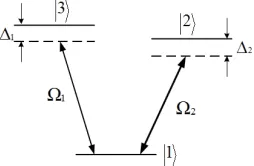
Motivated by these investigations, we propose a scheme to perform EIT employing V-type artificial molecule, which is constructed by two superconducting charge qubits coupled each other through a large capacitor. In our EIT scheme, a weak probe field with Rabi frequency 1
and frequency ω1 couples the 1 3 transition while
a strong control field with Rabi frequency 2 and frequency ω2 couples the 1 2 transition, as shown
in Figure 1.
Figure 1. Schematic illustration of EIT for the artificial molecule.
2. The Model of Artificial Molecule
Let us consider two interacting superconducting charge qubits which are electrostatically coupled to each other by a large capacitor Cm. Each charge qubit has a super- conducting quantum interference device (SQUID) ring geometry biased by an external flux and so the effective Josephson coupling energy can be varied from zero up to its maximum value. The Hamiltonian of coupled qubits reads
2 2
1 1 1 1 1 2 2 2
2 2 1 1 2 2
( ) cos (
cos ( )( )
c g J c g
J m g g
H E n n E E n n
E E n n n n
) (1)
The first four terms represent two independent qubits and the last term describes the interaction between the qubits due to the electrostatical coupling of the capacitor. EJ1 and EJ2 are the effective Josephson coupling energy
for the corresponding SQUID; β1 and β2 are the phases of
the SQUID; Ec1 and Ec2 are the effective Cooper-pair
charging energies for the qubits; ni and ngi for I = 1,2 are the number operator of excess Cooper-pairs on the island and the normalized gate induced charge; Em is the capa- citive coupling energy between the charge qubits.
Working in the vicinity of one degeneracy point (ngi∈ [0,1]), only two adjacent charge states 0 and 1 on the island are relevant while all other charge states, hav-ing a much higher energy, can be ignored [10]. In this case the Hamiltonian can be written as
1 2
1,2
2 1 1 2
1 1 1
2 2 4
1 1
2 2
zi zi Ji xi m z z
i
m z m z
H B E E
E E (2)
where Bzi = Eci(1–2ngi) for I = 1,2 are the difference of the electrostatic energy between the states 0 and 1 ,
z
and x are the Pauli matrices and δi = 1/2–ngi. Switching to the eigenbasis e and g of the qubits and exactly at the co-resonance point δi = 0, the Hamil-tonian takes the form
1 1 2 2 1 2
1 1 1
2 J z 2 J z 4 m x
H E E E x (3) To avoid confusion we introduce a second set of Pauli operator ρ acting on the eigenstates of qubits. Without
loss of generality, we assume that the two supercon- ducting charge qubits are identical (i.e., Ec1 = Ec2 = Ec, EJ1 = EJ2 = EJ). So the eigenvalues of coupled qubits are readily written as
1
2 2 2
3
2
1
2 2 2
1
4 1 (4 16 )
1 4 1 4
1 ( 16 )
4
m J
m
m J
m
E E E
E E
E E
E E E
(4)
with the corresponding eigenstates being
4 sin cos
1 3 2 1 2 2
1 cos sin
gg e ge eg ge eg e gg e
e
(5)
Here the parameter α satisfies the following relations
2 2 2
4
sin 2 cos 2
16 16
m J
m J m
E E
E E E E
2
J (6)
It is worthwhile to note that arbitrary transitions can not be allowed in the above four states due to selection rules for superconducting qubits. By calculating the ma- trix elements of ρx1 and ρx2 between the eigenstates, we
find that the transitions 1 4 and 2 3 are forbidden while the other transitions with nonzero matrix elements are allowed. choosing the three levels with low-est eigenenergies shown in Figure 1, we obtain the V- type artificial system.
3. Complex Susceptibility
EIT phenomenon of a closed three level system inter- acting with a weak probe field and a strong control field can be demonstrated by adopting the density matrix for- malism. In the eigenbasis of the qubits, the interaction Hamiltonian between the three-level artificial molecule and two semiclassical fields is expressed as (ħ = 1)
1 2
1 2
2 2 1 1
1 . .
2 i t i t
int
H e e g
e
e g H c
(7)
In the basis {1 , 2 and 3 } of the V-type artificial system and with the rotating-wave approximation, the interaction Hamiltonian is given by
1
2
1
2
1 1 cos 3 1
2 2
1
cos 2 1 . .
2
(
)
i t int i t H e e H c
In the interaction picture, the Hamiltonian of the sys- tem reads
1 2 1 2
1
3 3 2 2 3 1 2 1 . .
2
(
)
I
H H c (9)
where Δ1= ω31ω1 is the detuning of the probe field, Δ2 =
ω21ω2 is the detuning of the control field,
1 1cos 2
and 2 2cos 2.
We can select the frequencies of the fields so that the probe field ω1and the control field ω2 are near resonant
with the transitions 1 3 and 1 2 , respectively. In this case, other transitions can be ignored in our dis-cussion. The evolution of the system is governed by the set of density matrix equations of motion
1
2
*
33 3 33 1 13 31
*
22 2 22 2 12 21
31 31 1 31 1 11 33 2 32
21 21 21 2 11 22 1 23
*
32 32 1 32 2 31 1 12
11 22 33
2 2 2 2 ( ) ( ) 2 2 ( ) 2 2 ( ) 2 2 1 i i i i i i i i i i i i
(10)Here we further assume that the control field frequency
ωc matchs the level spacing between the states 2 and
1 , i.e. Δ2 = 0. In these equations we have introduced
phenomenologically the relaxation rates Γi (I =1,2,3) for the levels as well as the total dephasing rates γij = (Γi+Γi)/2+τφ including the relaxation and pure dephasing
processes. Since we are interested in the dispersion and absorption properties of the V-type artificial system, only first-order perturbation expansion of the equations of matrix elements are necessary. For the system we set[21]
(0) (0) (0) 2
33 22 11
2 2 0 2 2 B B B
B (11)
where B is the rate of pumping by the control field
2 2 21 1 2 B
(12) Taking into account the steady-state solution (i.e., all derivatives are set equal to zero), we have the first order matrix element
2 (0) (0)
2 11 22
(1) 1 (0)
31 11 32 1
21
1 2 2
31 1 32 1
( ) = ( ) 2 ( )( ) 4 i i i i
Combining the relation
2
0 1 2 31 31
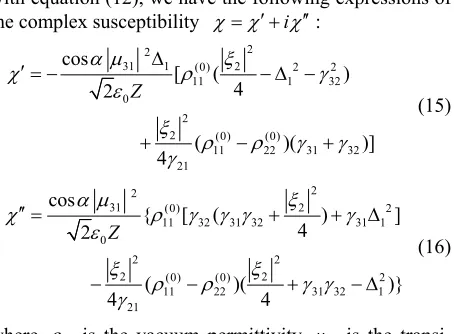
(14) with equation (12), we have the following expressions of the complex susceptibility i:
2 2
31 1 (0) 2 2 2
11 1 32
0 2
2 (0) (0)
11 22 31 32
21 cos [ ( ) 4 2 ( )( )] 4 Z (15) 2 2
31 (0) 2 2
11 32 31 32 31 1
0
2 2
2 (0) (0) 2 2
11 22 31 32 1
21 cos { [ ( ) ] 4 2 ( )( )} 4 4 Z (16)
where 0 is the vacuum permittivity, μ31 is the
transi-tion dipole moment and
2
2
2 3 2
31 32 1 31 1 32 1
( )
4
Z (17) It seems that the above expressions are similar to the susceptibilities of the conventional three level atomic systems, but here the complex susceptibility of the artificial molecule has additional dependence on the tunable Josephson coupling energy EJand the capacitive coupling strength Emthrough the parameter α and hence can be tuned to a certain extent.
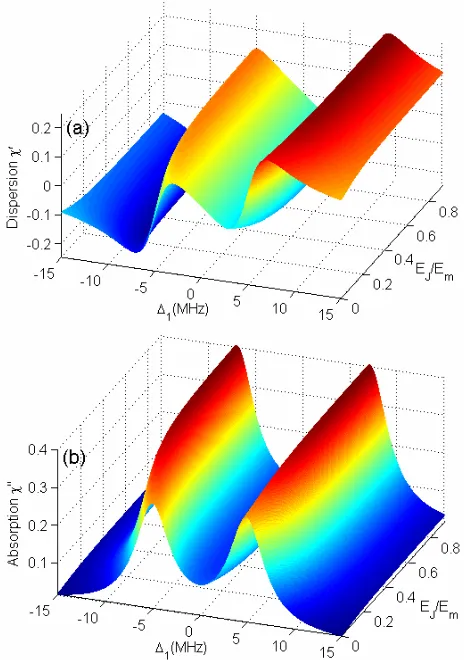
Figures 2(a) and (b) plot both the real and imaginary parts of the susceptibility χ as a function of the probe detuning Δ1 and the dimensionless ratio of the Josephson
coupling energy EJ to the interaction energy Em acco- rding to the equations (15) and (16). Figure 2 shows that the absorption profile is even symmetric and the disper- sion profile is odd about the zero probe detuning point Δ1
= 0. We can observe that the absorption is minimum at the zero point Δ1 = 0 and increases with the growth of
the Josephson coupling energy EJ, but the absorption value does not become large after the EJis increasedto a cer- tain value, as can be seen from Figure 2(b).
4 (13)
[image:3.595.313.540.131.298.2]Moreover, absorption coefficient can be dominated greatly by the control field strength Ωc, as depicted in Figure 3. From the drawing, we see that single absorp- tion peak appears in the regime of weak control field and indicates strong absorption to probe field. As the control power is increased, the doublet spacing of absorption curve increases and absorption value between the two peaks gradually tends to zero EIT, i.e. EIT effect arises in the higher control intensities.
4. Conclusions
Figure 2. Real part χ' and imaginary part χ" of the complex susceptibility versus the probe detuning Δ1 and the dimen- sionless ratio EJ/Em. Here parameters EJmax = 14.5GHz, Em = 15.7GHz, γ31 = γ21 = 2MHz, γ32 = 2.5MHz, Г2 = 1/0.7MHz, Ωc = 20MHz.
Figure 3. Absorption coefficient χ" as a function of the probe detuning Δ1 and the control field intensity Ωc (from 2 to 50 MHz). Parameters EJ = 14GHz, Em = 15.7GHz, γ31 = γ21 = 2MHz, γ32 = 2.5MHz, Г2 = 1/0.7MHz.
effect in a V-type artificial system derived from two cou- pled superconducting charge qubits. Using the density ma-
trix formalism, we obtain the analytical expressions of the complex susceptibility which have extra dependence on qubit parameters EJ and Em. As a result, EIT can be tuned to a certain extent by changing the Josephson cou-pling energy EJ compared with the conventional EIT phenomenon in the atomic systems where atomic pa-rameters are uaually fixed.
5. Acknowledgements
This work was supported in part by the National Natural Science Foundation of China under the Grant No. 11 274132 and the Nature Science Foundation of Hubei Province.
REFERENCES
[1] D. J. Fulton, S. Shepherd, R. R. Moseley, B. D. Sinclair, and M. H. Dunn, “Continuous-wave Electromagnetically Induced Transparency: a Comparison of V, Λ, and Cas-cade Systems,” Physical Review A, Vol. 52, No. 3, 1995, pp. 2302-2311. doi: 10.1103/PhysRevA.52.2302
[2] M. Fleischhauer, A. Imamoglu and J. P. Marangos, “Electromagnetically Induced Transparency: Optics in Coherent Media,” Reviews of Modern Physics, Vol. 77, No. 2, 2005, pp. 633-673.
doi:10.1103 /RevModPhys.77.633
[3] K. J. Boller, A. Imamoglu and S. E. Harris, “Observation of Electromagnetically Induced Transparency,” Physical Review Letters, Vol. 66, No. 20, 1991, pp. 2593-2596.
doi: 10.1103/PhysRevLett.66.2593
[4] A. Lazoudis, T. Kirova, E. H. Ahmed, P. Qi, J. Huenne- kens and A. M. Lyyra, “Electromagnetically Induced Tra- nsparency in an Open V-type Molecular System,” Physi- cal Review A, Vol. 83, No. 6, 2011, pp. 063419.
doi: 10.1103/PhysRevA.83.063419
[5] J. Gea-Banacloche, Y. Q. Li, S. Z. Jin and Min Xia, “Electromagnetically Induced Transparency in Ladder- type Inhomogeneously Broadened Media: Theory and Experiment,” Physical Review A, Vol. 51, No. 1, 1995, pp. 576-584. doi: 10.1103/PhysRevA.51.576
[6] S. Wielandy and A. L. Gaeta, “Investigation of electro- magnetically induced transparency in the strong probe re-gime,” Physical Review A, Vol. 58, No. 3, 1998, pp. 2500-2505. doi: 10.1103/PhysRevA.58.2500
[7] J. Q. You and F. Nori, “Atomic Physics and Quantum Optics Using Superconducting Circuits,” Nature, Vol. 474, No. 7353, 2011, pp. 589-597.
doi: 10.1038/nature10122
[8] S. M. Girvin, M. H. Devoret and R. J. Schoelkopf, “Cir-cuit QED and Engineering Charge-based Supercond- ucting Qubits,” Physica Scripta, Vol. 2009, No. T137, 2009, pp. 014012.
doi:10.1088/0031-8949/2009/T137/014012
[image:4.595.57.285.495.650.2][10] Y. A. Pashkin, O. Astafiev, T. Yamamoto, Y. Nakamura and J. S. Tsai, “Josephson Charge Qubits: a Brief Re-view,” Quantum Information Processing, Vol. 8, 2009, pp. 55-80. doi: 10.1007/s11128-009-0101-5
[11] B. C. Sanders, “Quantum Optics in Superconducting Circuits,” AIP Conference Proceedings, Vol. 1398, 2011, pp. 46-49. doi: 10.1063/1.3644209
[12] Y. Hu, G. Q. Ge, S. Chen, X. F. Yang and Y. L. Chen, “Cross-Kerr-effect Induced by Coupled Josephson Qubits in Circuit Quantum Electrodynamics,” Physical Review A, Vol. 84, No. 1, 2011, p. 012329.
doi: 10.1103/PhysRevA.84.012329
[13] S. Rebić, J. Twamley and G. J. Milburn, “Giant Kerr Nonlinearities in Circuit Quantum Electrodynamics,” Physical Review Letters, Vol. 103, No. 15, 2009, p. 150503. doi: 10.1103/PhysRevLett.103.150503
[14] O. Astafiev et al., “Resonance Fluorescence of a Single Artificial Atom,” Science, Vol. 327, No. 5967, 2010, pp. 840-843. doi: 10.1126/science.1181918
[15] M. A. Sillanpää et al., “Autler-Townes Effect in a Super-conducting Three-Level System,” Physical Review Let-ters, Vol. 103, No. 19, 2009, p. 193601.
doi: 10.1103/PhysRevLett.103.193601
[16] A. A. Abdumalikov, Jr., O. Astafiev, A. M. Zagoskin, Yu. A. Pashkin, Y. Nakamura and J. S. Tsai, “Electromag- netically Induced Transparency on a Single Artificial
Atom,” Physical Review Letters, Vol. 104, No. 19, 2010, p. 193601. doi: 10.1103/PhysRevLett.104.193601
[17] J. Joo, J. Bourassa, A. Blais and B. C. Sanders, “Electro- magnetically Induced Transparency with Amplification in Superconducting Circuits,” Physical Review Letters, Vol. 105, No. 7, 2010, p. 073601.
doi: 10.1103/PhysRevLett.105.073601
[18] T. Niemczyk et al., “Circuit Quantum Electrodynamics in the Ultrastrong-coupling Regime,” Nature Physics, Vol. 6, No. 10, 2010, pp. 772-776. doi: 10.1038/nphys1730
[19] K. V. R. M. Murali, Z. Dutton, W. D. Oliver, D. S. Crankshaw and T. P. Orlando, “Probing Decoherence with Electromagnetically Induced Transparency in Su-perconductive Quantum Circuits,” Physical Review Let-ters, Vol. 93, No. 8, 2004, pp. 087003.
doi: 10.1103/PhysRevLett.93.087003
[20] X. Z. Yuan, H. S. Goan, C. H. Lin, K. D. Zhu and Y. W. Jiang, “Nanomechanical-resonator-assisted Induced Tra- nsparency in a Cooper-pair Box System,” New Journal of Physics, Vol. 10, 2008, p. 095016.
doi: 10.1088/1367-2630/10/9/095016
[21] G. R. Welch, “Observation of V-Type Electromag- neti-cally Induced Transparency in a Sodium Atomic Beam,” Foundations of Physics, Vol.28, No. 4, 1998, pp. 621-638.