Study on the Impact of the Quality of Internal Control on
the Performance of M&A
Jianfei Leng, Pangjing Zhao
School of Business, Hohai University, Nanjing, China. Email: [email protected], [email protected]
Received April 20th, 2013; revised May 27th, 2013; accepted July 3rd, 2013
Copyright © 2013 JianfeiLeng,Pangjing Zhao. This is an open access article distributed under the Creative Commons Attribution License, which permits unrestricted use, distribution, and reproduction in any medium, provided the original work is properly cited.
ABSTRACT
In order to examine whether the internal control quality affects the M&A performance (stock market return and ac- counting return) of acquiring firms after the Chinese SOX (Sarbanes-Oxley Act) issued, we select 126 mergers and ac- quisitions (M&A) deals of Chinese non-financial listed companies on Shanghai and Shenzhen Stock Exchange in 2010 from the CSMAR (China Securities Market & Accounting Research) Database. And we use content analysis to con- struct a score to quantify the internal control quality of Chinese listed companies. We examine the relationship between the quality of internal controls and the performance of bidding firms with event study and multivariate regression analysis. Our results indicate that the internal control quality of acquirers is positively related to the accounting rates of firms. The higher quality of internal control means that acquirers with better internal control system would be more likely to benefit from M&A activities and create more value for the their own companies and shareholders. Another result is that investors on the stock market are more optimistic about M&A activity lauched by firms which enjoy higher ICQS (the Internal Control Quality Score).
Keywords: Internal Control; Mergers and Acquisitions; Accounting Study; Event Study
1. Introduction
M&A means that a company purchases all or part of an- other enterprise assets or equity to affect the control of the enterprise being acquired, to achieve its business ob- jectives like entering new markets, increasing market share, or diversifying their operations. Prior research sug- gests that results from mergers and acquisitions (M&A) are often disappointing compared with results predicted or expected. The majority of M&A activities even caused decline to the bidding companies’ performance. However, M&A is still one of important means for enterprises to optimize the allocation of resources and expand into a new industry rapidly. M&A have been occurring fre- quently in the market, some companies could benefit from M&A. Over the years, domestic and foreign aca- demics have done a lot of research on the performance of M&A with different research methods and angles. West- ern literatures have obtained similar results that M&A in general can make the target companies earn positively abnormal returns, but for the bidding companies, it is a little more difficult to benefit from mergers and acquisi- tions.
The entire M&A process is a complicated project, in- cluding looking for the target company, the decision making, developing the program of acquisitions, due diligence, and integration phase after takeover completed. Each stage will affect the performance of deals. Whether the decision of M&A is consistent with the long-term strategic objectives of the firm will play a key role on the performance of M&A. Un-strategic M&A tend to make the company fall into the plight of a long time. Rational decision-making and effective implementation of merg- ers and acquisitions will fundamentally guarantee the company to gain from mergers and acquisitions. The better internal control system tends to mean that firms enjoy stricter process of operational decision making.
vision. After the Sarbanes-Oxley Act, to strengthen in- ternal control is increasingly becoming an important me- thod of many countries to improve the level of corporate governance to enhance the ability of risk prevention of firms. While simultaneously, in recent years, academic research on internal control is becoming more and more popular.
Internal control has a significant effect on solving agency problem, strategic decision making, strategic ma- nagement and risk management which would affect per- formance of M&A. Shleifer A. (1990) [1] found that ma- nagers’ objectives driving M&A which might made an impact on corporate performance. Thomas Straub (2007) [2] in his book—Reasons for Frequent Failure in Merg- ers and Acquisitions—promoted an understanding of fac- tors underlying M&A performance in business research and scholarship to help managers in the decision making process. PeiLing Wang (2007) [3] thought that agency problem was one of reasons of bad performance of post- acquisitions among Chinese listed companies. Therefore, we assume that the quality of internal control would af- fect the performance of M&A.
We begin our analysis by examining between internal control quality and M&A performance. We use content analysis to measure the quality of internal control of ac- quirers. According to the COSO five elements of internal control, we calculate the Internal Control Quality Score (ICQS) to reflect the level of internal control based on the level of detail of relevant internal control information from public documents in 2010.
In May 2008, five departments such as China Securi- ties Regulatory Commission and the Ministry of Finance jointly issued the Basic Norms for Enterprise Internal Control, which required listed companies to comply with since the July 1, 2009. On the other hand, in order to ob- tain the financial data in the event year and the first year after the M&A, we select listed companies from the Shanghai Stock Exchange and Shenzhen Stock Exchange which completed M&A activity in 2010. Then we use multiple regression to test the collected data to test the relationship between internal control and the perform- ance of M&A.
After empirical research with multiple linear regres- sion model, we conclude that M&A performance is posi- tively associated with the quality of internal control. The acquirers with higher internal control quality will be more likely to effectively control the process of M&A and to make M&A activities become one of successful ways to achieve their long-term strategic objectives.
The remainder of this paper is organized as follow: Section 2 discusses prior research on the performance of M&A and the effects of internal control. Section 3 put forward our hypotheses. Section 4 describes the method of the study. Section 5 presents empirical results. Section
6 draws some conclusions.
2. Prior Research
2.1. Performance of M&A
M&A activities originated in the late 19th century. After that there have been six massive waves of mergers and acquisitions so far. While simultaneously, the number of research on the performance of M&A is also increasing.
Jensen, Ruback (1983) [4] investigates 13 successful mergers and acquisitions in the United States and found that targets would benefit 20% - 30% abnormal returns from the M&A cases, the acquirers, however, could gain only 4% of the equity premium. Gregg Jarrell and An- nette Poulsen (1989) [5] analyze more than 450 success- ful M&A deals between 1963 and 1986, discover that the average abnormal returns of targets could be more than 20%, but the acquirers’ return is not obvious, only 1.14%. Healy P.M., Palepu K.G., Ruback R.S. (1992) [6] exam- ine the post-acquisition performance for the 50 largest US mergers between 1979 and mid-1984 and they find that merged firms show significant improvements in as- set productivity relative to their industries.
2.2. Effects of Internal Control
In July 1978, a report of the Cohen Commission was to appeal the regulatory authorities to promote the enhance- ment of the supervision of the internal control. And in 1992 the Committee of Sponsoring Organizations of the Treadway Commission (COSO) developed the Internal Control-Integrated Framework to provide principles- based guidance for designing and implementing effective internal controls. After the passage of the Sarbanes-Ox- ley Act in July 2002, COSO issued the Enterprise Risk Management-Integrated Framework in 2004 in response to a need for principles-based guidance. In 2009, COSO issued the Guidance on Monitoring Internal Control Sys- tems designed to help organizations monitor the quality of their internal control systems. And there has been an increase in the number of studies on corporate internal control.
Ashbaugh-Skaife H., Collins D.W. (2008) [13] find that firms with internal control deficiencies have signifi- cantly higher idiosyncratic risk, systematic risk, and cost of equity. Doyle J.T., Ge W. (2007) [14] examine 705 firms that have disclosed at least one material weakness from August 2002 to November 2005 and find that the relation between weak internal controls and lower accru- als quality is driven by weakness disclosures. Altamuro J., Beatty A. (2010) [15] examine the financial reporting effects of FDICIA internal control provisions. Their re- sults suggest that internal control requirements increased loan-loss provision validity, earnings persistence and cash-flow predictability. Bargeron L.L., Lehn K.M., Zut- ter C.J. (2010) find that several provisions of SOX are likely to discourage risk-taking. Brochet (2010) [16] in- dicates that the SOX and regulatory actions may prompt the disclosures about insider transactions. Wanfu Li, Bin Lin and Lu Song (2011) [17] find that strengthening the construction of firms’ internal control is an important way to promote the investment efficiency.
Some other literatures, however, show that the SOX sometimes has an negative effects on firms’ performance. Patterson E.R., Smith J.R. (2007) [18] find that Sarbanes- Oxley does not necessarily induce higher levels of con- trol testing. The implementation of the internal control provisions increases the risk and cost of audit. Engel E., Hayes R.M., Wang X. (2007) [19] conclude that SOX has affected firms’ going-private decisions and Zhang I.X. (2007) [20] finds that the mandate of an internal control test results in significant cost savings. Gao F., Wu J.S., Zimmerman J. (2009) [21] indicate that SOX results in the unintended consequences that small com- panies have incentives to stay small to be exempted from costly regulations.
2.3. Comments on Prior Research
We can summarize that foreign scholars have done re-
search on M&A very early and from different aspects. Their conclusion is that acquired firms could gain from M&A in short term. But the results of the question that whether acquiring firms can benefit from M&A are somewhat mixed. As for the studies on internal control, the majority of authors find that the SOX and a sound internal control system will play a positive role in enter- prises operating activities though the implementation of the internal control provisions may increase the cost of audit. We can learn from the extant literature that the higher internal control quality will be more likely to im- prove the operating efficiency and effectively reduce the risk of investment.
3. Hypothesis
According to the foreign extant literature, there are two main factors leading to the poor performance of M&A. One reason is that the motivation of M&A is not strategic, and the other one is the risk of complex process of merg- ers and acquisitions. Amihud Y., Lev B. (1981) [22] in- dicate that managerial motive for conglomerate merger is to decrease their largely undiversifiable employment risk. Roll (1986) [23] argues that bidding firms may pay too much for their targets in the hubris context. Shleifer A., Vishny R.W. (1989) [24] find that managers can entrench themselves by making manager-specific investments that make it costly for shareholders to replace them. Morck R., Shleifer A., Vishny R.W. (1990) [25] conclude that ma- nagerial objectives may drive acquisitions that reduce bidding firms’ value. Xin Zhang (2003) [10] indicates that the flawed decision-making mechanism (hubris hypothe- sis and agency motives) can explain why purchasing companies lose value in M&A deals. Xingze Wu (2010) feels that the majority of Chinese M&A activities are not driven by strategic objectives and short of rational plan- ning process.
On the other hand, another factor impacting perform- ance is the complexity of the M&A process. Grubb T.M., Lamb R.B. (2001) [26] in their book indicate that the complexity leads 80 percent of mergers to fail. Gongrong Chen and Zhiqun Ai (2002) [27] believe that M&A is a high-risk investment activity and the risk exists in the whole process. Zhaoyang Xu (2005) [28] analyzes the risk originated from the four steps of the M&A process. Lei Chen (2007) [29] regards the whole process of M&A as a very complex project, she states that the more com- plex the operation is, the greater need to strengthen in- ternal control. Xuyong Xu (2009) [30] believes that cur- rently Chinese bidding companies are short of the aware- ness of risk assessment and risk management mechanism in the M&A process.
firms’ long-term goals. Obviously, the higher internal control quality means that firms can alleviate the risk to some extent brought by hubris hypothesis and agency problem. Even, higher internal control quality means in- formation about M&A could be kept from insider trader to prevent stock price fluctuating sharply.Yongmei Cui, Xuan Yu (2011) [31] and Xiaoying Lu (2011) [32] indi- cate that internal control is an effective means of risk ma- nagement. Therefore we assume that before and during the process of merger and acquisition, the risk assess- ment, systematic control activities and effective commu- nication in firms could alleviate unnecessary losses, even improve the performance of M&A.
Hypothesis 1: the long-term performance (accounting rates) is positively related to the internal control quality. This means that firms with higher quality of internal con- trol could create more value for their shareholders in the long term through the M&A activity.
Hypothesis 2: the short-term performance (CAR) is po- sitively associated with the internal control quality. This means that acquirers with higher quality of internal con- trol would gain more cumulative abnormal returns after announcements in the stock markets. Or in other words, stock investors prefer the acquisition activity launched by firms which own better internal control system.
4. Research Design
4.1. Sample
Our sample originate from the CSMAR (China Securities Market & Accounting Research) Mergers & Acquisitions Database including all nonfinancial Chinese listed firms (i.e., acquirers) on SZSE and SSE in the fiscal year of 2010 because we require financial reports to construct the Internal Control Quality Score (ICQS). We choose the year 2010 because prior that time Chinese listed firms were not subject to the additional reporting until Basic Norms for Enterprise Internal Control issued by five de- partments (i.e., China Securities Regulatory Commission and the Ministry of Finance and so on). The restriction results in an initial sample of 338 deals which are com- pleted. Then we remove 212 observations lacking the data to conduct our empirical tests. Finally, 126 observa- tions are used in our analysis.
The annual reports and data used in this paper are coming from CSMAR Mergers & Acquisitions Database (www.gtarsc.com), website of SZSE (www.szse.cn) and website of SSE (www.sse.com.cn). We use SPSS 18.0 to analyze data.
4.2. The Internal Control Quality Score (ICQS)
According to the prior literature (Hongxing Fang (2011) [33]; Xiaoyin Lu (2011) [32]), we use content analysis based on the firms’ financial reporting to develop a mea-
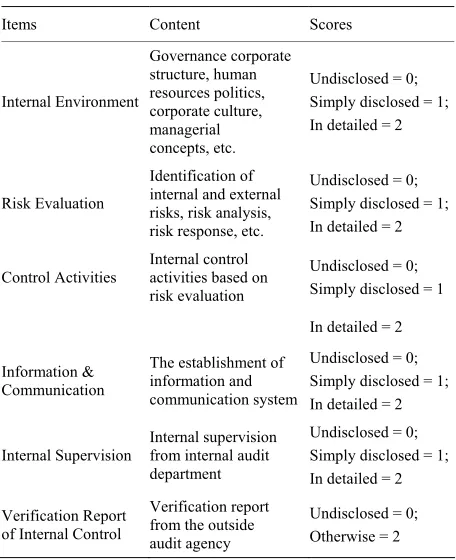
sure of ICQS to test our hypothesis. We design an eva- luation criterion (Table 1) to calculate the ICQS. And we
define ICQS according to the equation: ICQS = ICQ/ TICQ. ICQ means scores of every item of internal con- trol information disclosed in annual reports and TICQ means the maximum score (TICQ = 12).
4.3. The Performance of M&A
There is a rich literature on the performance of M&A drawn on two principal sources of statistical evidence: stock market returns (event study) and accounting rates of return derived from firms’ annual reports. The event study and accounting study are often used to measure the short-term and long-term performance of M&A respec- tively. We intend to conduct our analysis with both me- thods.
4.3.1. Accounting Study
Xiao Chen and Xiaoyue Chen (1999) [34] through em- pirical study conclude that despite the accounting rates of return are often manipulated, the substantive impact of events will eventually be exposed in the accounting state- ments in the long-term. According to prior research (Pa- lepu (1986) [35], Xin Zhang (2003) [10]), we use ROE and EPS to measure the performance of M&A.
[image:4.595.309.537.455.735.2]In order to eliminate the effects of macroeconomic en- vironment and industry changes as far as possible, we re- fer to the research method (Barber, Lyon (1996) [36])
Table 1. Evaluation criterion sheet.
Items Content Scores
Internal Environment
Governance corporate structure, human resources politics, corporate culture, managerial concepts, etc.
Undisclosed = 0; Simply disclosed = 1; In detailed = 2
Risk Evaluation
Identification of internal and external risks, risk analysis, risk response, etc.
Undisclosed = 0; Simply disclosed = 1; In detailed = 2
Control Activities
Internal control activities based on risk evaluation
Undisclosed = 0; Simply disclosed = 1
In detailed = 2
Information & Communication
The establishment of information and communication system
Undisclosed = 0; Simply disclosed = 1; In detailed = 2
Internal Supervision
Internal supervision from internal audit department
Undisclosed = 0; Simply disclosed = 1; In detailed = 2
Verification Report of Internal Control
Verification report from the outside audit agency
to provide a benchmark against which sample firms can be compared. The specific steps are as follows: 1) for each of firms in the samples we choose all other listed companies in the same industry as comparison group; 2) then we develop a control group matched sample firms to other similar-size firms on the basis of pre-event total assets (25% - 200%); 3) the third step of developing a control group that we consider matched sample firms to other firms with more similar pre-event performance, we regard the accounting rates (ROE) as the standard rate; 4) then the accounting rates of sample minus the accounting rates of control group respectively are the adjusted ac- counting rates to measure firms’ performance.
There are some other factors that can impact on the performance of M&A. Banz (1981) [37] finds that smal- ler-sized firms have had higher risk adjusted returns, on average, than larger firms. Ronggang Zhang (2006) [38] indicates that risk exists in the merging progress of fi- nancial leverage. Linghong Xie (2011) [39] concludes that the times of continuous M&A may affect the per- formance of M&A. Zhaohui Hu (2007) [40] discovers that the independent group has a positive impact on the performance of M&A, but not significant statistically.
In order to control for other factors related to the per- formance of M&A, we conduct a multivariate analysis by estimating the following logistic regression:
0 1 2 3
4 6
PE ICQS MSIZE LEV
TIMES IND
(1)
where PE is represented by adjusted ROE and adjusted EPS to indicate the performance of M&A. The variable ICQS is the Internal Control Quality Score used to indi- cate the quality of internal control of acquirers. The size of M&A (MSIZE) is computed as the ratio of the value of the transaction to the total assets prior to the deal. The second control is LEV means financial leverage meas- ured at the fiscal year end prior to the year in which the deal is announced. The third, TIMES, is the times of all the M&A deals during 2007-2009 three years. IND is the fourth control, measured as the number of directors in the firms’ independent group.
4.3.2. Event Study
We use event study to assess the short-term impact of M&A announcement on the value of a firm. The basic idea is to find the abnormal return which is the difference between the actual return of a security and the expected return. Then we sum all abnormal returns to calculate the Cumulative Abnormal Return (CAR) to investigate the stock market response to the firm’s M&A activity.
We use the market model to calculate the abnormal return and CAR. The market model is one of the bench- marks in measuring abnormal returns with daily data,
with adjustments of daily closing prices for stock divi- dends and splits. (Wong A., Cheung K.Y. (2009)) [41] The market model which indicates a linear relationship between stock returns and returns on a market portfolio. We follow the methodology used by Xiaoping Liu (2009) [12] that a maximum of 271 daily return observations are used for the period around the event. The estimation pe- riod is (−240, −41), and (−30, 30) is designated as the event period. The day t = 0 is the announcement day.
Abnormal returns are computed as the difference be- tween actual returns and estimated expected returns:
jt j j mt jt
R R (2)
jt
R is the daily rate of return on security j on day t and is the daily rate of return on market index on day t.
mt
j
R
is a constant term, j is a covariance be- tween Rjt and Rmt. jt is a model error term of se- curity j on day t. We use Equation (2) to calculate the
j
and j. The interval for the Equation (2) is [−240, −41].
Abnormal returns are computed as the difference be- tween actual returns and estimated expected returns:
jt jt j j mt
AR R R (3)
The interval for the Equation (3) is [−30, 30]. jt is the daily rate of return on security j over day t. j
R
and j
are estimated parametersjand j. jt is the estimated abnormal return for security j over day t.
AR
1
1 N
t j jt
AAR AR
N
(4)We use Equation (4) to calculate the average abnormal return. N is the number of firms with return data on day t.
In order to examine the cumulative effect of events, the cumulative average abnormal returns (CAR) are pro- duced.
30 30 1
1
CAR t t
t t t t
N jt j
AAR AR
N
(5)Then, we could examine whether there is a significant difference between CAR and 0. If the CAR is positive and statistically significant, then we could conclude that the firms’ shareholders benefit from the events in the stock market in the short-term. If the CAR is negative and statistically significant, then we could conclude that events could cause losses to shareholders in short-term.
5. Empirical Results
[image:6.595.55.539.358.552.2]5.1. Descriptive Statistics
Table 2 displays the descriptive statistics for the varia-
bles used in the empirical tests. The minimum of ICQS is 0, the maximum is 0.9167, the mean is 0.4557 and the standard deviation 0.2370, which means the internal con- trol quality of Chinese listed firms vary a lot and the av- erage level is not very high. The mean of ROE 0, ROE 1 and EPS 1 are all less than 1, except that EPS 0, which suggests that acquiring firms could not benefit from M&A. The minimum of MSIZE is 0.00008 and the maxi- mum is 0.5534, which shows that the scale of M&A in china vary a lot. The mean of LEV shows that the level of financial leverage of Chinese acquirers is slightly high. The minimum of times of M&A in recent three years is 0, and the maximum is 12, which indicates that most ac- quiring firms had merged or acquired before this time. The INDI shows that acquirers all own the independent director system.
5.2. Accounting Rates of Return
5.2.1. Correlation Analysis
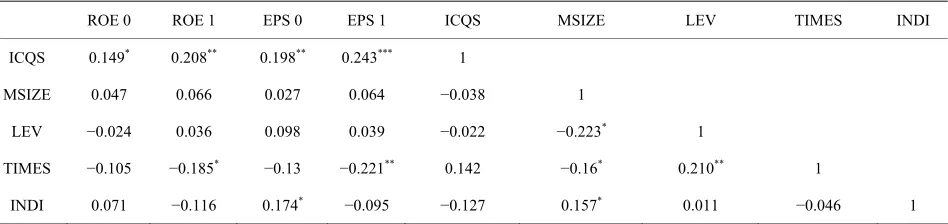
We use Pearson correlation coefficient to test collinearity between variables. Collinearity doesn’t exist if the corre- lation coefficient is less than 0.8. The Table 3 provides
the significant level and the correlations between vari- ables. To facilitate discussion, we focus on the correla- tion coefficients. ICQS is significantly positively corre- lated with ROE 0, ROE 1, EPS 0 and EPS 1, and nega- tively related to MSIZE, LEV and INDI, but not signifi- cant statistically. LEV is positively related with ROE 1, EPS 0 and EPS 1, but also not significant statistically. TIMES is negatively and significantly correlated with ROE 1 and EPS 1, which indicates that too many times of M&A may lead to decline in firms performance. INDI is positively and significantly related with EPS 0 at the 0.1 confidence level. These statistics indicate that it is important to control for these characteristics when exam- ing the relation between the acquirers’ performance of M&A and the internal control quality.
Table 2. Descriptive statistics.
Minimum Maximum Mean Std. Deviation
ICQS 0 0.9167 0.4557 0.2370
ROE 0 −−0.9441 1.2063 −0.00129 0.18595
ROE 1 −0.4615 0.9133 −0.00768 0.15325
EPS 0 −1.6928 2.048 0.00836 0.41567
EPS 1 −2.9055 1.289 −0.0700 0.51666
MSIZE 0.00008 0.5534 0.0503 0.092
LEV 0.0645 0.871 0.517 0.1805
TIMES 0 13 3.06 3.126
INDI 2 9 4.21 1.366
Valid N 126
[image:6.595.64.538.602.714.2]ROE 0, ROE 1, EPS 0 and EPS 1 mean adjusted ROE and EPS. ROE 0 and EPS 0 selected from the financial statements of the event year. ROE 1 and EPS 1 selected from the financial statements after a year of events.
Table 3. Correlation between vectors of values (Pearson).
ROE 0 ROE 1 EPS 0 EPS 1 ICQS MSIZE LEV TIMES INDI
ICQS 0.149* 0.208** 0.198** 0.243*** 1
MSIZE 0.047 0.066 0.027 0.064 −0.038 1
LEV −0.024 0.036 0.098 0.039 −0.022 −0.223* 1
TIMES −0.105 −0.185* −0.13 −0.221** 0.142 −0.16* 0.210** 1
INDI 0.071 −0.116 0.174* −0.095 −0.127 0.157* 0.011 −0.046 1
***Correlation is significant at the 0.01 level (2-tailed). **Correlation is significant at the 0.05 level (2-tailed). *Correlation is significant at the 0.10 level
2-tailed). (
5.2.2. Linear Regression Results
Table 4 presents the results of linear regression that ex-
amines the relation between the internal control quality and the performance of M&A (ROE 0, ROE 1, EPS 0 and EPS 1). The model 2, model 3 and model 4 are sta- tistically significant (F-value > 3). When adding control variables, in model 1 the ICQS is positively and signifi- cantly associated with ROE 0 at the 10% level, in model 2 is associated with ROE 1 at 5% level , and in model 3, model 4 are related with EPS 0 and EPS 1 at 1% level respectively. The significant positive coefficients on ICQS in four models support our hypothesis that acquir- ers with higher quality of internal control are more likely to benefit from M&A than others. In addition, we com- pared the coefficients of ICQS in four models and we found that the coefficient in model 2 is greater than that in model 1, also coefficient in model 4 is greater than that in model 3. We concluded that the impact on per- formance of M&A in second year was greater than the event year, indicating that acquirers with higher quality of internal control are more likely to enjoy strategic mo- tives to launch the M&A.
5.3. Stock Market Returns
Table 5 displays the result of cumulative abnormal re-
turn analysis. In the event period (−30, 30), total sample
obtains the CAR of −1.81%. ICQSj is the mean of ICQS and ICQ is the ICQS of sample j. ICQSj means firm j enjoys higher quality of internal control. The CAR of these sample is −0.53% for the period (−30, 30). On the contrary, the sample of ICQSj obtains the CAR of −2.87%. These CARs are all statistically significant at 1% level. We also analyzed abnormal re- turns during the pre-announcement period (−30, −3), an- nouncement period (−2, 2) and post-announcement pe- riod (3, 30) respectively.
Figure 1 shows the fluctuations of CAR of three kind
of samples. The line of ICQSj fluctuates smoothly at the top. The line in the middle is the fluctuations of CAR of total sample. The bottom line increases firstly and reaches a peak during the announcement period, then decreased rapidly until the last. Investors would be more likely to take advantage of M&A whose acquirers with lower internal control quality for speculation and lift share price, then sell stocks quickly after the event ends. Lower internal control quality means there are some de- fects existing in the management process. Insider trader is easier to get the message which is supposed to be se- cret. On the other hand, we concluded that the stock market is more optimistic about the performance of M&A launched by firms with higher internal control quality.
Table 4. Regression results.
Model 1 Model 2 Model 3 Model 4
Variables ROE 0 ROE 1 EPS 0 EPS 1
ICQS 0.14* (1.966) 0.15*** (2.653) 0.443*** (2.9) 0.604*** (3.225)
MSIZE 0.046 (0.243) 0.132 (0.878) 0.037 (0.092) 0.392 (0.791)
LEV 0.01 (0.107) 0.093 (1.214) 0.326 (1.584) 0.344 (1.361)
TIMES −0.007 (−1.342) −0.011** (−2.612) −0.025** (−2.084) −0.046*** (−3.173)
INDI 0.012 (0.93) −0.012 (−1.26) 0.059** (2.222) −0.032 (−0.991)
Adj_R2 0.007 0.077 0.085 0.111
F 1.171 3.074** 3.336*** 4.114***
Figures in brackets are t-value. ***Correlation is significant at the 0.01 level (2-tailed). **Correlation is significant at the 0.05 level (2-tailed). *Correlation is
[image:7.595.56.538.622.725.2]significant at the 0.10 level (2-tailed).
Table 5. Cumulative abnormal return analysis.
Total sample (n = 126) ICQSj (n = 57) ICQSj (n = 69)
Event period CAR% T-value CAR% T-value CAR% T-value
(−30, 30) −1.81 −18.53*** −0.53 −8.55*** −2.87 −19.09***
(−30, −3) −1.41 −11.87*** −0.31 −3.98*** −2.31 −12.1***
(−2, 2) −1.03 −13.84*** −0.4 −7.98*** −1.56 −9.89***
(3, 30) −2.34 −21.90*** −0.77 −8.40*** −3.65 −22.26***
Figure 1. CAR comparison.
6. Conclusions
Our study provides evidence that acquirers with higher quality of internal control would be more likely to benefit from M&A activities and create more value for the com- panies and its shareholders. First, we document that prior research on performance of M&A and the effects of in- ternal control. Second, we elaborate the possible impact of internal control on the performance of M&A and then we put forward our hypotheses. Third, we do research on 126 Chinese listed acquirers with accounting study and event study. Specifically, the result of accounting study indicates that the internal control quality is positively and significantly associated with accounting rates. The result of event study shows that the internal control quality also exist positive impact on acquirers’ share price.
Acquirers enjoying higher quality of internal control often means they operate with a healthy and systematic mechanism. Firms with better corporate culture, human resources, risk management, supervisory mechanism and communication are more likely to succeed in many ways including M&A activities. On the other hand, we con- clude that the stock market is more optimistic about the performance of M&A launched by firms with higher in- ternal control quality. These firms often give top priority to the interests of the company and the shareholders. Fu- ture research can explore how the quality of internal con- trol affects the performance of different kinds of M&A.
REFERENCES
[1] R. Morck, A. Shleifer and R. W. Vishny, “Do Managerial Objectives Drive Bad Acquisitions?” Journal of Finance, Vol. 45, No. 1, 1990, pp. 31-48.
doi:10.1111/j.1540-6261.1990.tb05079.x
[2] T. Straub and J. C. Jarillo, “Reasons for Frequent Failure in Mergers and Acquisitions: A Comprehensive Analy- sis,” Deutscher Universitäts-Verlag, Wiesbaden, 2007. doi:10.1007/978-3-8350-9637-0
[3] P. L. Wang, Y. H. Jin and J. J. Chang, “Analysis of M & A Activities on the Agency Costs of Listed Company in China,” Journal of Financial Research, No. 4, 2007, pp. 171-177.
[4] M. C. Jensen and R. S. Ruback, “The Market for Corpo-
rate Control: The Scientific Evidence,” Journal of Finan- cial Economics, Vol. 11, No. 1, 1983, pp. 5-50.
doi:10.1016/0304-405X(83)90004-1
[5] G. A. Jarrell and A. B. Poulsen, “The Returns to Acquir- ing Firms in Tender Offers: Evidence from Three Dec- ades,” Financial Management, Vol. 18, 1989, pp. 12-19.
doi:10.2307/3665645
[6] P. M. Healy, K. G. Palepu and R. S. Ruback, “Does Cor- porate Performance Improve after Mergers?” Journal of Financial Economics, Vol. 31, No. 2, 1992, pp. 135-175.
doi:10.1016/0304-405X(92)90002-F
[7] H. Q. Yuan, “Empirical Analysis of the Assets Reorgani- zation of Listed Companies,” Economic Management, Vol. 3, 1998, p. 024.
[8] G. F. Feng and L. J. Wu, “An Empirical Study of the M & A Performance of Chinese Listed Companies,” Eco- nomic Research Journal, No. 1, 2001, pp. 54-61.
[9] H. L. Wang, “Discussion on the Classification of the Re- search Methods of M & A Performance,” Modern Eco- nomic Science, No. 1, 2005, pp. 70-75.
[10] X. Zhang, “Do Mergers and Acquisitions Create Value: Evidence from Chinese Listed Companies,” Economic Research Journal, No. 6, 2003, pp. 20-29.
[11] T. Zhu, “Toward the Short and Long Run Share Price Performance of M & A for China Listed Companies,” Modern Economic Science, No. 3, 2006, pp. 31-39. [12] X. P. Liu, X. W. Huang and H. Y. Guo, “The Empirical
Study of Industry Life Cycle, the Types of M & A and the Performance of M & A,” Journal of Financial Research, No. 3, 2009, pp. 135-153.
[13] H. Ashbaugh-Skaife, D. W. Collins and R. Lafond, “The Effect of Sox Internal Control Deficiencies on Firm Risk and Cost of Equity,” Journal of Accounting Research, Vol. 47, No. 1, 2008, pp. 1-43.
doi:10.1111/j.1475-679X.2008.00315.x
[14] J. T. Doyle, W. Ge and S. McVay, “Accruals Quality and Internal Control over Financial Reporting,” The Ac- counting Review, Vol. 82, No. 5, 2007, pp. 1141-1170.
doi:10.2308/accr.2007.82.5.1141
[15] J. Altamuro and A. Beatty, “How Does Internal Control Regulation Affect Financial Reporting?” Journal of Ac- counting and Economics, Vol. 49, No. 1, 2010, pp. 58-74.
doi:10.1016/j.jacceco.2009.07.002
[16] F. Brochet, “Information Content of Insider Trades before and after the Sarbanes-Oxley Act,” The Accounting Re- view, Vol. 85, No. 2, 2010, pp. 419-446.
doi:10.2308/accr.2010.85.2.419
[17] W. F. Li, B. Lin and L. Song, “The Role Played by the Internal Control in Companies’ Investment: Is It a Pro- motion of Efficiency or a Repression Thereof?” Man- agement World, No. 2, 2011, pp. 81-99.
[18] E. R. Patterson and J. R. Smith, “The Effects of Sarbanes- Oxley on Auditing and Internal Control Strength,” The Accounting Review, Vol. 82, No. 2, 2007, pp. 427-455.
doi:10.2308/accr.2007.82.2.427
of Accounting and Economics, Vol. 44, No. 1, 2007, pp. 116-145. doi:10.1016/j.jacceco.2006.07.002
[20] I. X. Zhang, “Economic Consequences of the Sarbanes- Oxley Act of 2002,” Journal of Accounting and Econom- ics, Vol. 44, No. 1, 2007, pp. 74-115.
doi:10.1016/j.jacceco.2007.02.002
[21] F. Gao, J. S. Wu and J. Zimmerman, “Unintended Con- sequences of Granting Small Firms Exemptions from Se- curities Regulation: Evidence from the Sarbanes-Oxley Act,” Journal of Accounting Research, Vol. 47, No. 2, 2009, pp. 459-506.
doi:10.1111/j.1475-679X.2009.00319.x
[22] Y. Amihud and B. Lev, “Risk Reduction as a Managerial Motive for Conglomerate Mergers,” The Bell Journal of Economics, Vol. 12, No. 2, 1981, pp. 605-617.
doi:10.2307/3003575
[23] R. Roll, “The Hubris Hypothesis of Corporate Take- overs,” Journal of Business, Vol. 9, No. 2, 1986, pp. 197-216. doi:10.1086/296325
[24] A. Shleifer and R. W. Vishny, “Management Entrench- ment: The Case of Manager-Specific Investments,” Jour- nal of Financial Economics, Vol. 25, No. 1, 1989, pp. 123-139. doi:10.1016/0304-405X(89)90099-8
[25] R. Morck, A. Shleifer and R. W. Vishny, “Do Managerial objectives Drive Bad Acquisitions?” Journal of Finance, Vol. 45, No. 1, 1990, pp. 31-48.
doi:10.1111/j.1540-6261.1990.tb05079.x
[26] T. M. Grubb and R. B. Lamb, “Capitalize on Merger Chaos: SIX Ways to Profit from Your Competitors’ Con- solidation and Your Own,” Free Press, 2001.
[27] G. R. Chen and Z. Q. Ai, “Disscusion on the Financial Risk of M & A,” Enterprise Vitality, No. 2, 2002, pp. 69-71.
[28] Z. Y. Xu, “Systematic Features and Construction of Busi- ness M & A Risk Management Procedure,” Commercial Research, No. 10, 2005, pp. 70-73.
[29] L. Chen, “Analysis of the Internal Control of Mergers and Acquisitions,” Agricultural Economy, No. 7, 2007, pp. 78-79.
[30] X. Y. Xu, “The Research on M & A Value and Internal Control of Mergers and Acquisitions,” Beijing Jiaotong University, Beijing, 2009.
[31] Y. M. Cui and X. Yu, “Study on the Evaluation of Inter-
nal Control Based on the Process of Strategic M & A,” Accounting Research, No. 6, 2011, pp. 57-62.
[32] X. Y. Lu, “A Study on the Impact of Internal Control to the Performance of Mergers and Acquisitions of Listed Company,” Tianjin University, Tianjin, 2011.
[33] H. X. Fang and Y. N. Jin, “Can High Quality Internal Control Reduce Earnings Management? An Empirical Research Based on Voluntary Internal Control Audits Reporting,” Accounting Research, No. 8, 2011, pp. 53-60. [34] X. Chen, X. Y. Chen and Z. Liu, “Research on the Use- fulness of Earning Reports—Evidence from Shanghai and Shenzhen Stock Markets,” Economic Research Journal, Vol. 6, 1999, pp. 21-28.
[35] K. G. Palepu, “Predicting Takeover Targets: A Methodo- logical and Empirical Analysis,” Journal of Accounting and Economics, Vol. 8, No. 1, 1986, pp. 3-35.
doi:10.1016/0165-4101(86)90008-X
[36] B. M. Barber and J. D. Lyon, “Detecting Abnormal Oper- ating Performance: The Empirical Power and Specifica- tion of Test Statistics,” Journal of financial Economics, Vol. 41, No. 3, 1996, pp. 359-399.
doi:10.1016/0304-405X(96)84701-5
[37] R. W. Banz, “The Relationship between Return and Mar- ket Value of Common Stocks,” Journal of Financial Eco- nomics, Vol. 9, No. 1, 1981, pp. 3-18.
doi:10.1016/0304-405X(81)90018-0
[38] R. G. Zhang and R. R. Zhang, “Application of Financial Leverage in Enterprises M & A and Risks,” Journal of Chang’an University (Social Science Edition), Vol. 8, No. 2, 2006.
[39] L. H. Xie, S. C. Liu and Y. H. Qiu, “Impact of Learning Managers’ Over-Confidence in Serial M & A Perform- ances—Data from China’s Listed Companies,” Manage- ment Review, Vol. 23, No. 7, 2011, pp. 149-154.
[40] Z. H. Hu and Y. Xia, “Can Independent Directors In- crease the Bidding-Firm Shareholders’ Wealth—Data from of the Takeover Evidence China’s Listed Compa- nies,” Journal of Shanxi Finance and Economics Univer- sity, No. 4, 2007, pp. 78-84.