IJPSR (2019), Volume 10, Issue 10 (Research Article)
Received on 15 January 2019; received in revised form, 15 April 2019; accepted, 13 June 2019; published 01 October 2019
EFFECTS OF USING DIFFERENT LEVELS OF CHROMIUM PICOLINATE ON PERFORMANCE, SOME BLOOD BIOCHEMICAL AND INTESTINAL MORPHOLOGY AND MICROFLORA IN ROSS 308 BROILER CHICKS EXPOSED TO THE HEAT STRESS CONDITION
Omid Hamidi 1, Mohammad Chamani 1, Hasan Ghahri * 2, Ali Asghar Sadeghi 1 and Hassan Malekinejad 3 Department of Animal Science 1, Science and Research Branch, Islamic Azad University, Tehran, Iran. Department of Animal Science 2, College of Veterinary Medicine, Urmia Branch, Islamic Azad University, Urmia, Iran.
Department of Basic Sciences 3, Faculty of Veterinary Medicine, Urmia University, Urmia, Iran.
ABSTRACT: This study was aimed to investigate the effects of different levels of dietary chromium picolinate (CrPic) on performance, some blood biochemical and intestinal morphology and microflora in Ross 308 broiler chicks. A total of 240 broiler chickens Ross 308 strain, from 21 to 42 days old were used in a completely randomized design. All chickens consumed a diet based on the corn-soybean meal, and the treatments were control- (thermo-neutral) and control + (heat stress) with no add-on and the others with CrPic supplementation at levels 500, 1000 and 1500 ppb respectively. The blood serum samples were subjected to biochemical analysis for blood parameters. The histomorphometric examination was performed by light microscopy. The result showed that all the growth and feed intake and feed conversion ratio parameters were declined when the broilers fed the CrPic supplementation (P≤0.05). The serum glucose concentration decreased CrPic supplemented groups. As a result, revealed that the villus height and crypt depth in the ileum and jejunum. Ileal villus height of birds on CrPic groups was significantly taller than that of chicks on the control. The result of intestinal microbiota investigations suggested that feeding management regimens with CrPic could have a more profound impact on the gut microbiota of experimental chicks than to that of control birds. In conclusion, we could demonstrate that using of different levels of CrPic could have some beneficial effects on performance, some blood biochemical and intestinal morphology and microflora in Ross 308 broiler chicks exposed to the heat stress condition.
INTRODUCTION: Increase environmental
temperatures, especially with high humidity, can be devastating to commercial broilers. Nutritional modifications appear to be the much logical approach to overcome the environmental stress, especially heat stress in poultry industry 1.
QUICK RESPONSE CODE
DOI:
10.13040/IJPSR.0975-8232.10(10).4494-00
The article can be accessed online on
www.ijpsr.com
DOI link: http://dx.doi.org/10.13040/IJPSR.0975-8232.10(10).4494-00
Heat stress increases mineral and vitamin mobilization from tissues and their excretion, and it may exacerbate a marginal vitamin and mineral deficiency or an increased mineral and vitamin requirement 2.
Effect of some minerals and vitamin supplements such as chromium to lower the negative effects of heat stress is well documented 3, 4. It is well known that heat stress is one of the major stressors on poultry production, which produces a wide range of physiological changes. It increases circulating concentrations of corticosterone in broilers, and it is well reported that corticosterone reduces insulin
Keywords:
Blood biochemical, Broiler chicks, Chromium picolinate, Heat stress, Performance, Intestinal microflora
Correspondence to Author: Hasan Ghahri
Department of Animal Science, College of Veterinary Medicine, Urmia Branch, Islamic Azad University, Urmia, Iran.
sensitivity in broiler chicks 5, 6. Chromium (Cr) is a chemical element and atomic number 24 and is the first element in group 6. It is a steely grey, lustrous, hard and brittle metal 7. It has antioxidant effects, and its deficiency leads to disrupting carbohydrate and protein metabolism 8. Chromium was identified as an essential nutrient and accepted as a trace element for its roles in the action of insulin, a hormone critical to the metabolism and storage of carbohydrate, fat, and protein 9. Trivalent Cr is associated with the metabolism of nutrients in animals termed as “glucose tolerance factor” since Cr regulates the metabolic action of insulin 10. Some researchers suggested that supplementation of Cr at different levels in poultry improved feed intake and its efficiency. Samanta et al. reported that the 0.5 mg per kg of Cr to improve the feed intake and feed conversion ratio of broiler chickens
11
. Many studies supported that the Cr supplementation at a dose of 1500 ppb improved bird’s performance during heat stress condition significantly 12. Chromium has been utilized for weight gain, to improve feed conversion ratio, increase relative organ weight, muscle development, decrease cholesterol, increase high-density lipoprotein cholesterol (HDL), and improve nutrient digestion. Halder and Ghosh observed that serum glucose concentration significantly declined in the broiler supplemented with 0.5 and 1 mg Cr/kg diet compared to the control 11.
Moeini et al. concluded that using Cr reduces serum triglycerides and low-density lipoprotein cholesterol (LDL) and elevates serum HDL cholesterol heat-stressed broilers instead of 13. Ibrahim et al., observed that total blood lipid was significantly lowered in dietary Cr supplemented 14. Al-Sultan et al. reported Cr supplementation increased the serum concentration of calcium, phosphorous, and potassium and decreased the level of sodium 15. Amatya et al. found that Cu, Zn, Fe, and Mn retention was better when Cr was supplemented in the feed of broilers 16. The National Research Council has recommended chromium at 300 μg per kg in diets of lab animals
17
; however, currently, there are no NRC recommendations for chromium in poultry diets. Also few studies have been designed to compare the effectiveness of different levels of Cr and CrPic on the blood biochemical and intestinal microflora
of broiler chicks, Thus, the present study was aimed to investigate the effects of using different levels of CrPic on performance, some blood biochemical and intestinal microflora in Ross 308 broiler chicks exposed to the heat stress condition.
MATERIALS AND METHODS: All procedures
used in this experiment were approved by the Department of Animal Sciences, Faculty of Agriculture and Food industry, Tehran Science and Research Branch, Islamic Azad University, Tehran, Iran.
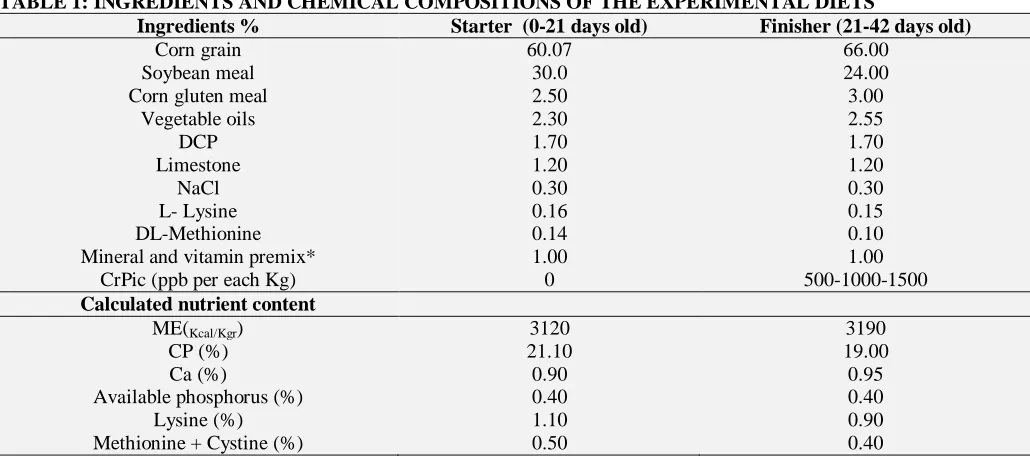
The Birds and the Diets: A total of 240 broiler chickens Ross 308 strain, from 21 to 42 days old were used in a completely randomized design. All chickens consumed a diet based on the corn-soybean meal, which provided as mash form was formulated based on NRC 17 Table 1. On day 21, the broiler chicks were weighed and, the birds with same weight allocated into 5 different groups with 4 replications and 12 birds each. The treatments were control- (thermo-neutral) and control + (heat stress) were fed with no additive, and other groups were fed 500; 1.000; or 1.500 ppb of chromium picolinate. The CrPic used in the current study was purchased from Sigma-Aldrich (C18H12CrN3O6),
Cat. no. C4124, CAS Number = 14639-25-9, USA. Diets and fresh water were provided ad libitum
during the experimental period. The birds in the control group were kept in comfort zone temperature (23 ± 1°C from 21 to 28 day and 21±1 °C from 28-42 days), and the heat stressed groups were kept under 36 ± 1 °C ambient temperature from 08:00 to 18:00 h. Additionally, the environmental temperature of the heat stressed birds was reduced to the equal to that of the control group.
Performance: During the experimental period, broilers performance was assessed for body weight gain, feed intake, feed conversion ratio, and feed efficiency ratio. The feed conversion ratio was calculated based on feed intake/gain for each replicate. At the end of the experimental period (42 days old), the birds were slaughtered by cervical dislocation method.
refrigerator at 4 °C. Also, the blood serum samples were subjected to biochemical analysis for blood parameters. Individual serum samples were analyzed for albumin and globulin by subtracting the obtained albumin level from the total protein and glucose, cholesterol by an automatic biochemical analyzer following the instructions of the corresponding reagent kit (Pars Azmoon Co., Teheran, Iran). Serum aspartate aminotransferase (AST) and alanine aminotransferase (ALT) were determined by Reitman and Frankel method 18. Histomorphometric Examination of Intestine: The histomorphometric examination was performed by light microscopy, and the measurement was done using public domain image analysis software (Image J, National Institute of Mental Health, Bethesda, MD, USA) and described by Rezaian 19.
Evaluation Intestinal Microflora: The internal organs were removed after slaughter. About 8 cm from the length of the ileum was sampled to determine the microbial population. Als, one g of ileum content was used to make 10-fold dilution using buffered peptone water, and then 0.1 ml of the appropriate ileum dilution was spread on Lactobacillus MRS Agar-Hi Media Laboratories to detect lactic acid bacteria (Lactobacillus) and VRBA (Violet Red Bile Agar) to detect
Escherichia coli (E. coli) form. The cultures of
[image:3.612.49.564.328.556.2]Lactobacillus and E. coli bacteria were made anaerobically form. The plates were incubated at 37.5 °C for 48 h. After counting the number of colonies in each plate, the number so obtained was multiplied by the inverse of the dilution and the result was stated as the number of colony forming unit (CFU) in 1 g of sample 20.
TABLE 1: INGREDIENTS AND CHEMICAL COMPOSITIONS OF THE EXPERIMENTAL DIETS
Ingredients % Starter (0-21 days old) Finisher (21-42 days old)
Corn grain 60.07 66.00
Soybean meal 30.0 24.00
Corn gluten meal 2.50 3.00
Vegetable oils 2.30 2.55
DCP 1.70 1.70
Limestone 1.20 1.20
NaCl 0.30 0.30
L- Lysine 0.16 0.15
DL-Methionine 0.14 0.10
Mineral and vitamin premix* 1.00 1.00
CrPic (ppb per each Kg) 0 500-1000-1500
Calculated nutrient content
ME(Kcal/Kgr) 3120 3190
CP (%) 21.10 19.00
Ca (%) 0.90 0.95
Available phosphorus (%) 0.40 0.40
Lysine (%) 1.10 0.90
Methionine + Cystine (%) 0.50 0.40
Supplied per kilogram of diet: trans-retinyl acetate, 25 mg; cholecalciferol, 6 mg; menadione, 1.2 mg; thiamine, 2.3 mg; riboflavin, 8 mg; nicotinamide, 42 mg; choline chloride, 400 mg; calcium pantothenate, 10 mg; pyridoxine HCl, 4 mg; biotin, 0.04 mg; folic acid, 1 mg; cobalamin, 0.012 mg; Fe (from ferrous sulfate), 82 mg; Cu (from copper sulfate), 7.5 mg; Mn (from manganese sulfate), 110 mg; Zn (from zinc oxide), 64 mg; I (from calcium iodate), 1.1 mg; Se (from sodium selenite), 0.28 mg.
Statistical Analysis: Data were collected and analyzed using the General Linear Model Procedure (GLM), and the comparison of means was made through Duncan multiple range tests by using SAS 9.1 software 21. The statistical model was:
Yij = µ + Ti + βj + εij
Whereas Yij is the individual observation, µ is the
overall mean, Ti is the effect of treatment, Ti is the
effect of blocks, and eij is the remainder effect.
RESULTS: The results of CrPic supplementation on performance of heat-stressed broilers are shown in Table 2.
TABLE 2: EFFECTS OF CRPIC SUPPLEMENTATION ON PERFORMANCE OF HEAT STRESSED BROILERS
Treatments FI (kg bird-1) BW (kg bird-1) FCR FER
Control (-) 0.148a* 0.075a 1.97b 0.50a
Control (+) 0.135bc 0.053c 2.55a 0.39c
CrPic (500) 0.139b 0.065b 2.14ab 0.46ab
CrPic (1000) 0.131cd 0.058bc 2.26ab 0.44b
CrPic (1500) 0.130cd 0.059bc 2.20ab 0.45b
SEM 0.001 0.015 0.040 0.012
*Means within a row with no common on the letter are significantly different (p<0.05).
The blood parameters (glucose, cholesterol, albumin, globulin, total protein, AST, and ALT) of bids serum values and contents are shown in Table 3. The serum glucose concentration decreased in broilers received CrPic supplements compared with other treatments. Slight and significant decreases were observed in cholesterol serum concentration
[image:4.612.49.565.300.393.2]of treated groups than controls while the mean serum albumin and globulin concentration was higher in the CrPic group compared with the controls group. Also, serum ASR and ALT level increased in broiler received CrPic supplements (p<0.05).
TABLE 3: EFFECTS OF CRPIC SUPPLEMENTATION ON SOME BLOOD BIOCHEMICAL OF HEAT STRESSED BROILERS
Treatments Glucose
(mg dl-1)
Cholesterol (mg dl-1)
Albumin (g dl-1)
Globulin (g dl-1)
Total protein ( g dl-1)
AST (IU dl-1)
ALT (IU dl-1)
Control (-) 221.5a* 139.1a 1.82b 2.90b 4.65c 45.24b 9.00b Control (+) 220.2a 138.2a 1.89b 3.00b 4.76b 45.39a 9.04a CrPic (500) 208.5ab 135.4ab 2.04ab 3.07ab 4.94ab 45.40a 9.02a CrPic (1000) 205.7b 133.2b 2.12a 3.24a 5.00a 45.61a 9.06a CrPic (1500) 204.1b 131.6b 2.35a 3.38a 5.21a 46.10a 9.08a
SEM 0.067 0.078 0.041 0.053 0.034 0.044 0.001
*Means within a row with no common on the letter are significantly different (p<0.05).
The morphological indices evaluated were the villus height and crypt depth in the ileum and jejunum. Ileal villus height of birds on CrPic groups was significantly taller than that of chicks
[image:4.612.52.567.503.586.2]on the control. The crypt depth in the jejunum was significantly affected by the dietary treatments. Ileal and jejunal morphology was affected more profoundly in CrPic groups than control groups.
TABLE 4: EFFECTS OF CRPIC SUPPLEMENTATION ON INTESTINAL MORPHOLOGY OF HEAT STRESSED BROILERS (µm)
Treatments Villus height (Ileum) Villus height (Jejunum) Crypt depth (Ileum) Crypt depth (Jejunum)
Control (-) 362.10c* 510.23a 86.30a 80.34c
Control (+) 365.14c 509.14a 82.21a 82.14c
CrPic (500) 400.10b 468.32b 76.14b 88.23b
CrPic (1000) 436.16a 460.25b 70.32bc 91.02a
CrPic (1500) 495.20a 429.12c 65.19c 94.26a
SEM 16.20 18.46 5.21 6.44
*Means within a row with no common on the letter are significantly different (p<0.05).
TABLE 5: EFFECTS OF CRPIC SUPPLEMENTATION
ON INTESTINAL MICROFLORA OF HEAT
STRESSED BROILERS
Treatments Escherichia coli
(log 10CFU g -1
)
Lactobacillus (log 10CFU g-1)
Control (-) 7.21a 7.86b
Control (+) 7.06a 7.92b
CrPic (500) 6.65b 8.11ab
CrPic (1000) 6.20bc 8.36a
CrPic (1500) 6.00c 8.55a
SEM 0.45 0.57
*Means within a row with no common on the letter are significantly different (p<0.05).
These results of Table 5 suggested that feeding management regimens with CrPic could have a more profound impact on the gut microbiota of experimental chicks than to that of control birds. The E. coli populations decreased and
Lactobacillus increased in CrPic supplemented groups significantly (P≤0.05).
weight, weight gain, feed conversion ratio and better feed efficiency ratio and this is an agreement with the reports of Sands and Smith 22. Toghyani et al., reported an increase in body weight gain and feed intake of broilers under heat stress conditions when supplemented with chromium picolinate 23. They mentioned that due to insulin-glucose can be utilized by body cells, and adequate amino acids enter the cells; therefore, the muscle can be built. Zhang et al. reported that CrPic improved FCR in broilers chicks 24. As a result, revealed form our study, there were significant differences (P≤0.05) in blood biochemical as affected by dietary supplementations comparing to their control counterparts.
Imik et al., documented free radical generation affects blood serum metabolites of plasma total protein, cholesterol, and glucose, which are manifested in bird’s adaptation response through decreased production performance and the birds health 25. Patil et al., who reported a decrease in serum total cholesterol, triglycerides, and increased serum HDL when broiler chickens were fed diet supplemented with chromium 26. Our observation in this study is in line with that Ezzat et al., result who reported that concentrations of blood serum glucose, triglyceride, and cholesterol were significantly higher whereas, levels of total protein and albumin were significantly lower in birds exposed to heat stress 27.
Chromium supplementation increases the biological activity of insulin which decreases adipocyte lipolysis by reducing the activities of adenylate cyclase and hormone-sensitive lipase; additionally, it can decrease triglycerides rich lipoprotein by increasing the lipoprotein lipase activity which in turn increases serum triglyceride clearance 28. It was hypothesized that increased glucose uptake should increase oxidation of glucose, which would be otherwise converted to fatty acids and stored as triglycerides in adipose tissues 29.
Sahin et al. observed that the addition of Cr picolinate caused a decrease in serum cortisol concentration 30. It has an impact on specific insulin binding in the liver of broilers. Cr is also required for normal functioning of the cells in the pancreas, preventing hyperresponsiveness of
insulin secretion to glucose stimulation, shown to be a protective factor against heart disease and achieving regression of cholesterol-induced arteriosclerosis 31.
Our results about serum blood glucose and cholesterol agreed with Hanafy 7, found that serum cholesterol levels of birds were decreased chromium supplementation. The difference in total protein among experimental groups was similar with the result of Sahin et al., who found that supplemental chromium had no effects on serum total protein levels in the blood of experimental broiler chicks 6. About the current study result, the jejunal villus height and ileal crypt depth were not affected by the heat stress as it was observed that birds on the control diet had taller jejunal villus height and deeper ileal crypts than birds on the chromium picolinate supplemented diets. Among the intestinal cells, the maximum reduction of 100% was observed with the upper villus cells and 72% with the middle villus cells while the reduction was the least 4% with the crypt cells since the most common route of entry of chromium is through drinking water and food 32.
Also, resistance to various antibiotics shown by the resident gut bacteria following chromium ingestion indicates that use of chromium as a nutritional supplement and micronutrient may provide significant protection to the gut microflora, particularly Lactobacillus, against some of the commonly used antibiotics 33. The stress has an important role in determining the extent and type of bacteria colonization. Some of the bacteria can modulate the expression of genes in host epithelial cells, thus creating a favorable habitat for themselves, and can prevent the growth of other bacteria introduced later. The result of this study is in line with the report of Sandikci et al., reported that heat stress could significantly modify intestinal histological parameters 34. The jejunal crypt depth values showed no differences. It could be that the chromium levels were suitable and high enough to alleviate the effect of heat stress on the parameters in question.
characteristics. Even though higher supplementation of CrPic caused significant lower values of total serum glucose and cholesterol. Additionally, in this study, the optimum inclusion levels of CrPic in broiler chicks for a better influence on the intestinal mucosa and microflora development were at the 1000 and 1500 ppb. Totally result of this study showed that the possibility of the potential use of CrPic for better results achievements compared to the control group.
ACKNOWLEDGEMENT: This research did not receive any specific grant from funding agencies in the public, commercial, or not-for-profit sectors, and also the authors declare that there's no one to acknowledge.
CONFLICT OF INTEREST: The authors declare
that they have no competing interests. REFERENCES:
1. Raza M, Deo C, Mandal AB, Tyagi P and Mir NA: Effect of dietary supplementation of selenium and vitamin E on growth performance and hematology of broiler chicken under heat stress. Nine 2018; 171: 176.
2. Khare A, Thorat G, Yadav V, Bhimte A and Purwar V: Role of mineral and vitamin in heat stress. Journal of Pharmacognosy and Phytochemistry 2018; 7(4): 229-31. 3. Johnson JS: Heat stress: impact on livestock well-being
and productivity and mitigation strategies to alleviate the negative effects. Animal Production Science 2018; 58(8): 1404-13.
4. Haq Z, Jain R, Mahajan A, Ganai IA, Khan N and Mudasir S: Dietary supplementation of chromium yeast alone and in combination with antioxidants for designing broiler meat. J Entomol Zool Stud 2018; 6(1): 766-70.
5. Sahin K, Kucok O and Sahin N: Effects of dietary chromium picolinate supplementation on performance and plasma concentrations of insulin and corticosterone in laying hens under low ambient temperature. J. Anim. Physiol. Anim Nutr 2001; 85: 142-47.
6. Sahin K, Sahin N, Onderci M, Gurs F and Cikim G: Optimal dietary concentration of chromium for alleviating the effect of heat stress on growth, carcass qualities and some serum metabolites of broiler chickens. Biological Trace Element Research 2002; 89: 53-64.
7. Hanafy MM: Influence of adding organic chromium in the diet on productive traitsserum constituents and immune status of bandarah laying hens and semen physical properties for cocks in the winter season. Egypt Poult Sci 2011; 31: 203-16.
8. Ali N, Akram M, Fahim A, Singh B and Imran M: Effect of dietary supplementation of vitamin E, zinc and chromium supplementation on growth performance and hematological characteristics of broiler chickens. Indian Journal of Animal Research 2018; 52(4).
9. Lukaski HC: Effects of chromium (III) as a nutritional supplement. The Nutritional Biochemistry of Chromium (III) 2019: 61-77.
10. Nielsen FH: Summary: The metabolism, nutritional essentiality, and clinical importance of chromium-clarity emerging after 60 years of research. The Nutritional Biochemistry of Chromium (III) 2019: 361-70.
11. Samanta S, Haldar S, Bahadur V and Ghosh TK: Chromium picolinate can ameliorate the negative effects of heat stress and enhance performance, carcass and meat traits in broiler chickens by reducing the circulatory cortisol level. J Sci Food Agric 2008; 88(5): 787-96. 12. Uyanik F, Atasever A, Ozdamar S and Aydin F: Effects of
dietary chromium chloride supplementation on performance, some serum parameters and immune response in broilers. Biol Trace Elem Res 2002; 90: 99-115.
13. Moeini MM, Bahrami A, Ghazi S and Targhibi MR: The effect of different concentrations of organic and inorganic chromium supplementation on production performance, carcass traits and some blood parameters of broiler chicken under heat stress condition. Biol Trace Elem Res 2011; 144: 715-24.
14. Ibrahim DK, Al-Mashhadani EH and Al-Bandr LK: Effect of supplementing different levels of chromium yeast to diet on broiler chickens on some physiological traits. Pak J Nutr 2010; 9(10): 942-949.
15. Al-Sultan S, Abdel-Raheem S, Abd-Allah S and Edris A: Alleviation of chronic heat stress in broilers by dietary supplementation of novel feed additive combinations. Slovenian Veterinary Research 2019; 56(S-22).
16. Amatya JL, Haldar S and Ghosh TK: Effects of chromium supplementation from inorganic and organic sources on nutrient utilization, mineral metabolism and meat quality in broiler chickens exposed to natural heat stress. Animal Science 2004; 79(2): 241-253.
17. NRC (National Research Council): Nutrition requirements of poultry. National Academy Press, Washington 1994. 18. Reitman S and Frankel S: A colorimetric method for the
determination of serum glutamic oxalacetic and glutamic pyruvic transaminases. American Journal of Clinical Pathology 1957; 28(1): 56-63.
19. Rezaian M: Modification of the fixation process in avian histologic sections. J Histotechnol 2006; 29: 123-27. 20. Downes FP and Ito K: Compendium of methods for the
microbiological examination of foods. American public health association Inc., Washington DC, USA 2001; 21. SAS Institute, SAS/STAT User’s Guide for Personal
Computers. Release 6.12 SAS Institute, Inc., Cary, N.C., USA 2001.
22. Sands JS and Smith MO: Broilers in heat stress conditions. Effects of dietary manganese proteinate or chromium picolinate supplementation. J Appl Poultry Res 1999; 8: 280-87.
23. Toghyani M, Shivazad M, Gheisari AA and Zarkesh SH: Performance, carcass traits and hematological parameters of heat-stressed broiler chicks in response to dietary levels of chromium picolinate. Int J Poult Sci 2006; 5(1): 65-69. 24. Zhang MH, Wang D, Du R, Zhang WH, Zhou SY and Xie
BX: Effect of dietary chromium levels on performance and serum traits of broilers under heat stress. Acta Zoonutrimenta Sinica 2002; 14: 54.
25. Imik H, Ozkanlar S, Kaynar O and Koc M: Effects of vitamin E, C, and α-lipoic acid supplementation on the serum glucose, lipid profile, and proteins in quails under heat stress. Bull Vet Inst Pulawy 2009; 53: 521-26. 26. Patil A, Palod J, Singh VS and Kumar A: Effect of graded
27. Ezzat W, Abdallah EA, Rizk AM, Ouda MMM and El-krim REA: The effect of chromium picolinate supplementation on immune response and heat shock proteins of laying hens under heat stress conditions. Egyptian Poultry Science Journal 2018; 38(1): 65-89. 28. Hartmann G and McEwen B: Insulin resistance and
polycystic ovary syndrome (PCOS): Part 2. Diet and Nutritional Medicine . Journal of the Australian Traditional-Medicine Society 2019; 25(1).
29. Bona E and Store NBJ: 10 heavy weights for weight management. Immunity 2019.
30. Sahin K, Kucok O and Sahin N: Effects of dietary chromium picolinate supplementation on performance and plasma concentrations of insulin and corticosterone in laying hens under low ambient temperature. J Anim Physiol Anim Nutr 2001; 85: 142-47.
31. Swaroop A, Bagchi M, Preuss HG, Zafra-Stone S, Ahmad T and Bagchi D: Benefits of chromium (III) complexes in animal and human health. The Nutritional Biochemistry of Chromium (III) 2019: 251-78.
32. Torok VA, Hughes RJ, Ophel-Keller K, Ali M and Macalpine R: Influence of different litter materials on cecal microbiota colonization in broiler chickens. Poult Sci 2009; 88: 2474-81.
33. Feng P, Ye Z, Kakade A, Virk A, Li X and Liu P: A review on gut remediation of selected environmental contaminants: possible roles of probiotics and gut microbiota. Nutrients 2019; 11(1): 22.
34. Sandikci M, Eren U, Onol AG and Kum S: The effect of heat stress and the use of Saccharomyces cerivisiae or (and) bacitracin zinc against heat stress on the intestinal mucosa in quails. Rev Med Vet 2004; 155: 552-56.
All © 2013 are reserved by International Journal of Pharmaceutical Sciences and Research. This Journal licensed under a Creative Commons Attribution-NonCommercial-ShareAlike 3.0 Unported License. This article can be downloaded to Android OS based mobile. Scan QR Code using Code/Bar Scanner from your mobile. (Scanners are available on Google Play store)
How to cite this article: