Journal of Chemical and Pharmaceutical Research, 2015, 7(9):860-867
Research Article
ISSN : 0975-7384
CODEN(USA) : JCPRC5
Optimization and validation of process for formulation of duloxetine
hydrochloride capsules
Lavudi Saida
1and P. Chaitanya Sravanthi
21
Center for Biotechnology, Institute for Science and Technology, JNTUH, Hyderabad, Telangana, India
2Dept. of Biopharmaceutical Technology, Institute for Science and Technology, JNTUH, Hyderabad, Telangana,
India
_____________________________________________________________________________________________
ABSTRACT
Process validation is a requirement of the current good manufacturing practices (cGMP) regulations for finished pharmaceuticals. Validation is defined as a documented program that provides a high degree of assurance that a specific process, method or system will constantly produce a result meeting pre-determined acceptance criteria. In this study formulation and development of capsules containing drug Duloxetine Anti-depressant drug belongs to Class-II Bio pharmaceutics Classification. Coating was done using sugar spheres and these pellets were filled in capsules. Validation of process for formulation of Duloxetine hydrochloride capsules were done. The objectives of this study were determine critical process parameters for coating and capsule filling operation, to establish boundary limits for critical process parameters which influence the product, process quality and performance and to evaluate coated pellets and filled capsules. This paper deals with the Process performance qualification of Duloxetine hydrochloride capsules 60mg, 30mg.During this stage, the process design is evaluated to determine if the process is capable of reproducible commercial manufacturing. Validation study will be initiated on 3 batches. During this study the process design will be evaluated to determine its capability to manufacture reproducible commercial batches of Duloxetine hydrochloride capsules 60mg, 30mg.The process understanding and process knowledge gained from the product developmental study, exhibit batch and process evaluation studies in the commercial batches will be leveraged. Data shall be generated during this study is used to establish documented evidence that the process is capable of manufacturing reproducible commercial batches and consistently deliver quality product.
Keywords: Process validation; Optimization; Duloxetine; Coating
_____________________________________________________________________________________________
INTRODUCTION
inspection, inprocess controls and targets for final product. The purpose is to monitor the online and off-line performance of the manufacturing process and then validate it. Even after the manufacturing process is validated, current good manufacturing practice also requires that a well-written procedure for process controls is established to monitor its performance. Validation mainly based on, FDA regulations describing current good manufacturing practice (cGMP) for finished pharmaceuticals are provided in 21 CFR parts 210 and 211. The cGMP regulations require that manufacturing processes be designed and controlled to assure that in-process materials and the finished product meet predetermined quality requirements and do so consistently and reliably. Process validation is required, in both general and specific terms, by the cGMP regulations [1].
Definitions:
European medicines agency Definition “The documented evidence that the process, operated within established
parameters, can perform effectively and reproducibly to produce a medicinal product meeting its predetermined specifications and quality attributes.”[4]
US FDA Definition “process validation is defined as the collection and evaluation of data, from the process design
stage through commercial production, which establishes scientific evidence that a process is capable of consistently delivering quality product.”[2]
ICH Definition “Process Validation (PV) is the documented evidence that the process, operated within established
parameters, can perform effectively and reproducibly to produce an intermediate or API meeting its predetermined specifications and quality attributes.”[6]
WHO Definition “Process validation is associated with the collection and evaluation of data, from the process
design stage through commercial production, which provides scientific evidence that a process is capable of consistently delivering a quality product. Process validation provides documented evidence that a process is capable of reliably and repeatedly rendering a product of the required quality. [6]”
Approach to Process Validation
Process validationis defined as the collection and evaluation of data, from the process design stage through
commercial production, which establishes scientific evidence that a process is capable of consistently delivering quality product. Process validation involves a series of activities taking place over the lifecycle of the product and process.
Process validation activities are in three stages.
Stage 1 – Process Design:
The commercial manufacturing process is defined during this stage based on knowledge gained through development and scale-up activities.
Stage 2 – Process Qualification:
During this stage, the process design is evaluated to determine if the process is capable of reproducible commercial manufacturing.
Stage 3 – Continued Process Verification:
Ongoing assurance is gained during routine production that the process remains in a state of control. [2]
Drug Profile:
Uses:
The main uses of duloxetine are in major depressive disorder, general anxiety disorder, urinary
incontinence, neuropathic pain, and fibromyalgia.
Duloxetine is recommended as a first line agent for the treatment of chemotherapy-induced neuropathy by the American Society for Clinical Oncology, as a first-line therapy for fibromyalgia in the presence of mood disorders by the German Interdisciplinary Association for Pain therapy, as a Grade B recommendation for the treatment of diabetic neuropathy by the American Association for Neurology and as a level A recommendation in certain neuropathic states by the European Federation of Neurological Societies.
A 2014 Cochrane review concluded that duloxetine is beneficial in the treatment of diabetic neuropathy and fibromyalgia but that more comparative studies with other medicines are needed. The medical journal Prescribe (based in France) concluded that duloxetine is no better than other available agents and has a greater risk of side effects. Thus they recommend against its general use.
EXPERIMENTAL SECTION
MATERIALS:
Manufacturing formula:
The quantities of various ingredients required for manufacturing the commercial batch are
a) Drug Loading
1. Sugar Spheres 2. Duloxetine 3. Hypromellose 4. Glycine 5. Purified Water
b) Sub Coating
1. Hypromellose 2. Sucrose 3. Talc
4. Purified Water
c) Enteric Coating
1. Hypromellose 2. Triethyl citrate 3. Talc
4. Isopropyl alcohol
5. Methylene chloride d) Lubrication
1. Talc
e) Capsule filling
METHOD&PROCESS FLOW:
Screening
1. Screen the ingredient 1 through # 24 mesh.(Passes to be collected) 2. Pass the material of above step through #35 mesh.(Retains to be collected)
Preparation of Drug Dispersion
1. With the help of steam, Heat the Purified water up to 60-70°C.
2. Stir the above step ingredient with the help of Pneumatic stirrer / Remi stirrer. Until vortex is formed. 3. Dissolve Hydroxypropyl methylcellulose until a clear solution is formed.
4. Allow to cool the above step solution to room temperature (30°C).
5. Dissolve Glycine in the above step with the help of Pneumatic stirrer / Remi stirrer. 6. Stir the solution until a clear solution is formed.
7. Add Duloxetine Hydrochloride USP into the above step with continuous stirring till the homogenous dispersion is formed.
Drying
(Fluid Bed Processor - 500 liters)
Dry the drug loaded pellets at temperature 40 ±3°C inlet air temperature, till LOD is Less than 2.0 %w/w at 105°C.
Screening
(Fluid Bed Processor - 500 liters)
1. Screen the pellets through # 18 mesh and collect the # 18 passes.
2. Pass the # 18 mesh pellets through # 24 mesh and collect the # 24 mesh retains.
Drug loading & Coating
(Fluid Bed Processor - 500 liters)
Load the screened Sugar spheres to FBP (500 liters bowl) and spray the drug dispersion and coating to be done at spray rate 35 – 200 gm/min/gun.
Preparation of Sub-Coating Dispersion
1. Take Purified water in a vessel stir the solution until a vortex is formed.
2. Add Hydroxypropyl methylcellulose into the above solution Avoid the formation of lumps and foam. 3. Add Sucrose into the above step stir till Sucrose goes into solution.
4. Add Talc to the above step Continue stirring till homogenous and uniform dispersion is formed.
Sub-Coating
(Fluid Bed Processor - 500 liters)
Load the drug loaded pellets to FBP 800 lts and spray the sub-coating dispersion and coating to be done at spray rate 40 - 200 gm/min/gun.
Drying
(Fluid Bed Processor - 500 liters)
Screening
(Fluid Bed Processor - 500 liters)
1. Screen the pellets through # 18 mesh and collect the # 18 passes.
2. Pass the # 18 mesh pellets through # 24 mesh and collect the # 24 mesh retains.
Preparation of Enteric Coating Dispersion
1. Take Isopropyl alcohol in a SS vessel stir the solution until a vortex is formed.
2. Add Hypromellose phthalate into the above step Avoid the formation of lumps and foam. 3. Add Methylene chloride into the above step stir till a clear solution is formed.
4. Add Triethyl Citrate to the above step Continue stirring till a clear solution is formed. 5.Take Isopropyl alcohol in SS vessel
6. Add Talc to the above step.
7. Pass the above solution through colloidal mill for 20 minutes.
8. Add step no 7 to step no 5 and stir for 45 minutes or till the uniform dispersion is formed.
Enteric Coating
(Fluid Bed Processor - 800 liters)
Load the Sub- coated pellet to FBP 800 lts and spray the Enteric coating dispersion and coating to be done at spray rate 40 - 200 gm/min/gun.
Drying
(Fluid Bed Processor - 800 liters)
Dry the enteric coated pellets at temperature 45 ±3°C inlet air temperature till LOD is Less than 2 %w/w at 105°C.
Screening
(Fluid Bed Processor - 500 liters)
1. Screen the pellets through # 16 mesh and collect the # 16 passes.
2. Pass the # 16 mesh pellets through # 24 mesh and collect the # 24 mesh retains.
Lubrication
(Fluid Bed Processor - 800 liters)
1.Load the Enteric coated pellet to FBP 800 lts 2.Add Talc to the above step
3. Fluidize the above step for 15 to 20 min.
Capsule filling
RESULTS AND DISCUSSION
[image:6.595.66.534.336.592.2]The following parameters were observed during the processing of these three process performance qualification Batches.
Table 1. Analytical Results of Common Drug Loaded Pellets and Sub coated pellets
Drug Loading Pellets Batch 1 Batch 2 Batch 3
In-process
test Specification limits Results Results Results
Description White to off-white spherical pellets Off-white spherical
pellets
White spherical pellets
White spherical pellets
LOD NMT 2.0% 0.5% w/w 0.2% w/w 0.4% w/w
Assay NLT 32.14 % w/w and NMT 39.28 % w/w of labeled amount of
Duloxetine 35.09 %w/w 35.62 %w/w 34.8 %w/w
Sub coated pellets In-process
test Specification limits Result Result Result
Description White to off-white spherical pellets Off-white spherical
pellets
White spherical pellets
White spherical pellets
LOD NMT 2.0% w/w 0.2 % w/w 1.2 % w/w 0.5% w/w
Assay NLT 25.22 % w/w and NMT 30.84 % w/w of labeled amount of Duloxetine 28.63 % w/w 28.08 % w/w 28.36% w/w
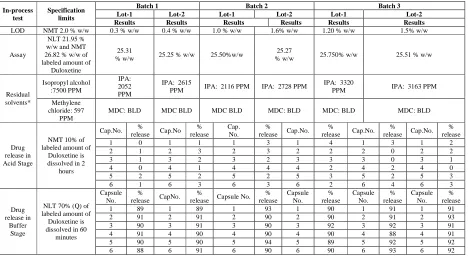
Table 2. Analytical Results of Enteric Coated Pellets
In-process test
Specification limits
Batch 1 Batch 2 Batch 3
Lot-1 Lot-2 Lot-1 Lot-2 Lot-1 Lot-2
Results Results Results Results Results Results
LOD NMT 2.0 % w/w 0.3 % w/w 0.4 % w/w 1.0 % w/w 1.6% w/w 1.20 % w/w 1.5% w/w
Assay
NLT 21.95 % w/w and NMT 26.82 % w/w of labeled amount of
Duloxetine
25.31
% w/w 25.25 % w/w 25.50%w/w
25.27
% w/w 25.750% w/w 25.51 % w/w
Residual solvents* Isopropyl alcohol :7500 PPM IPA: 2052 PPM
IPA: 2615
PPM IPA: 2116 PPM IPA: 2728 PPM
IPA: 3320
PPM IPA: 3163 PPM
Methylene chloride: 597
PPM
MDC: BLD MDC BLD MDC BLD MDC: BLD MDC: BLD MDC: BLD
Drug release in Acid Stage
NMT 10% of labeled amount of
Duloxetine is dissolved in 2
hours
Cap.No. %
release Cap.No % release
Cap. No.
%
release Cap.No. %
release Cap.No. %
release Cap.No. % release
1 0 1 1 1 3 1 4 1 3 1 2
2 1 2 3 2 3 2 2 2 0 2 2
3 1 3 2 3 2 3 3 3 0 3 1
4 0 4 1 4 4 4 2 4 2 4 0
5 2 5 2 5 2 5 3 5 2 5 3
6 1 6 3 6 3 6 2 6 4 6 3
Drug release in
Buffer Stage
NLT 70% (Q) of labeled amount of Duloxetine is dissolved in 60
minutes
Capsule No.
%
release CapNo. %
release Capsule No. % release Capsule No. % release Capsule No. % release Capsule No. % release
1 89 1 89 1 93 1 90 1 91 1 91
2 91 2 91 2 90 2 90 2 91 2 93
3 90 3 91 3 90 3 92 3 92 3 91
4 91 4 90 4 90 4 90 4 88 4 91
5 90 5 90 5 94 5 89 5 92 5 92
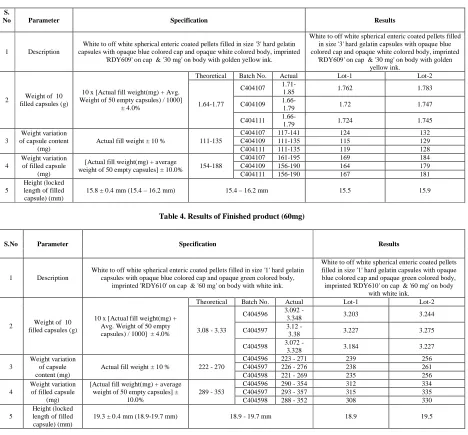
Table 3. Results of Finished product (30mg)
S.
No Parameter Specification Results
1 Description
White to off white spherical enteric coated pellets filled in size '3' hard gelatin capsules with opaque blue colored cap and opaque white colored body, imprinted
'RDY609' on cap & '30 mg' on body with golden yellow ink.
White to off white spherical enteric coated pellets filled in size '3' hard gelatin capsules with opaque blue colored cap and opaque white colored body, imprinted
'RDY609' on cap & '30 mg' on body with golden yellow ink.
2 Weight of 10 filled capsules (g)
10 x [Actual fill weight(mg) + Avg. Weight of 50 empty capsules) / 1000]
± 4.0%
Theoretical Batch No. Actual Lot-1 Lot-2
1.64-1.77
C404107
1.71-1.85 1.762 1.783
C404109
1.66-1.79 1.72 1.747
C404111
1.66-1.79 1.724 1.745
3
Weight variation of capsule content
(mg)
Actual fill weight ± 10 % 111-135
C404107 117-141 124 132
C404109 111-135 115 129
C404111 111-135 119 128
4
Weight variation of filled capsule
(mg)
[Actual fill weight(mg) + average
weight of 50 empty capsules] ± 10.0% 154-188
C404107 161-195 169 184
C404109 156-190 164 179
C404111 156-190 167 181
5
Height (locked length of filled capsule) (mm)
[image:7.595.66.534.116.551.2]15.8 ± 0.4 mm (15.4 – 16.2 mm) 15.4 – 16.2 mm 15.5 15.9
Table 4. Results of Finished product (60mg)
S.No Parameter Specification Results
1 Description
White to off white spherical enteric coated pellets filled in size '1' hard gelatin capsules with opaque blue colored cap and opaque green colored body,
imprinted 'RDY610' on cap & '60 mg' on body with white ink.
White to off white spherical enteric coated pellets filled in size '1' hard gelatin capsules with opaque blue colored cap and opaque green colored body, imprinted 'RDY610' on cap & '60 mg' on body
with white ink.
2 Weight of 10 filled capsules (g)
10 x [Actual fill weight(mg) + Avg. Weight of 50 empty capsules) / 1000] ± 4.0%
Theoretical Batch No. Actual Lot-1 Lot-2
3.08 - 3.33
C404596 3.092 -
3.348 3.203 3.244
C404597 3.12 - 3.38 3.227 3.275
C404598 3.072 -
3.328 3.184 3.227
3
Weight variation of capsule content (mg)
Actual fill weight ± 10 % 222 - 270
C404596 223 - 271 239 256
C404597 226 - 276 238 261
C404598 221 - 269 235 256
4
Weight variation of filled capsule
(mg)
[Actual fill weight(mg) + average weight of 50 empty capsules] ±
10.0%
289 - 353
C404596 290 - 354 312 334
C404597 293 - 357 315 335
C404598 288 - 352 308 330
5
Height (locked length of filled capsule) (mm)
19.3 ± 0.4 mm (18.9-19.7 mm) 18.9 - 19.7 mm 18.9 19.5
CONCLUSION
The process performance qualification study has been performed on three batches of Duloxetine hydrochloride capsules 60mg, 30mg. The observations were recorded, samples were analysed and the results found to meet the specifications in acceptance criteria. The method depicted the different process controls and variables to be monitored during the manufacturing process of a capsule dosage form and a comparative study was done on the three consecutive batches. The batch execution and results show that that all the established limits of critical process parameters are valid and within the limits and meets pre-determined specification and quality attributes. Hence it is concluded that the process for manufacturing of Duloxetine hydrochloride capsules 60mg, 30mg. is deemed validated.
REFERENCES
[1] Lunn MP, Hughes RA, Wiffen PJ, "Duloxetine for treating painful neuropathy, chronic pain or fibromyalgia", Rev 1, Cochrane Database System, London, 2014.
[2] U.S. Department of Health and Human Services Food and Drug Administration, Process Validation: General Principles and Practices, Revision 1, Office of Communications Division of Drug Information, USA, 2011.
[3] National Institute for Health and Clinical Excellence, Clinical guideline 96: Neuropathic pain, Issued: March 2010, pharmacological management, London, 2010.
[4] European Medicines Agency. Guideline on process validation for finished products, Rev1, Committee for Medicinal Products for Human Use, London, 2014.
[5] World Health Organization, Quality assurance of pharmaceuticals, 2nd Edition, World Health Organization,Geneva-Switzerland, 2007.