Ms. Vanitha C.
Dept of Pharmaceutical Analysis & Quality Assurance, Nalanda College of Pharmacy, Nalgonda, A.P. India Email: [email protected] Address for correspondence
Access this article online www.japer.in
Development and validation UPLC method for simultaneous
determination of Hydrochlorothiazide and Eprosartan
INTRODUCTION
Though high-performance liquid chromatography (HPLC) is a well-established reliable technique used in controlling the quality and consistency of active pharmaceutical ingredients (APIs) and dosage forms, it is often a slow technique because of the complexity of some of the samples, it could still be improved. Ultra-performance liquid chromatography (UPLC) is a new category of separation technique based upon well-established principles of liquid chromatography, which utilizes sub-2µm particles for stationary phase. These particles operate at elevated mobile phase linear velocities to affect dramatic increase in resolution, sensitivity and speed of analysis. Owing to its speed and sensitivity, this technique is gaining considerable attention in recent years for pharmaceutical and biomedical analysis. In the present work, this technology has been applied to the
method development and validation study of Eprosartan and Hydrochlorothiazide.
Hydrochlorothiazide (HCTZ) is a diuretic of the class of benzo-thiadiazine widely used in antihypertensive pharmaceutical formulations, alone or combination with other drugs. It decreases active sodium re-absorption and reduces peripheral vascular resistance. It is chemically
Known as 6-chloro-3, 4-dihydro-2H-1, 2, 4-benzothiadiazine-7-sulfonamide 1, 1-dioxide. HCTZ has been successfully used as single content or in association with other drugs in the treatment of hypertension. Its molecular weight is 297.7[1, 2]. The chemical structure of HCTZ is given in
Figure 1;
Eprosartan (EPRO) is an antihypertensive drug whose chemical name is 4-({2-butyl-5-[2-
Research Research Research
Research ArticleArticleArticleArticle
Background: The objective of the study was to develop UPLC method for the quantitative determination of Eprosartan and Hydrochlorothiazide and its validation. UPLC is a better technique than HPLC in terms of performance and speed, so it was selected. The method was developed using Waters Aquity BEH shield RP C18 (2.1 x 100mm, 1.7µm) column with mobile phase containing a mixture of Acetonitrile and
0.05MPhosphate buffer (pH 4.5) in the ratio of 35:65 at a flow rate of 0.4ml/min. The eluted compounds were monitored at 245 nm,
Results: The retention time of Hydrochlorothiazide and Eprosartan was found to be 0.902 min and 2.075 min respectively. The developed method was validated as per international conference on harmonization (ICH) guidelines with respect to linearity, limit of detection, limit of quantification, accuracy, precision and robustness. The precision was found to be within the limits. The linearity studies indicated the drug obeys Beer’s law and revealed the specified range of linearity for Hydrochlorothiazide was between 1.25-6.25µg/ml and for Eprosartan 25-125µg/ml. The robustness was observed from the insignificant variation in the analysis by changes in flow rate, mobile phase ratio.
Conclusion: The rapid gradient UPLC method developed for quantitative analysis of Eprosartan and Hydrochlorothiazide in pharmaceutical dosage forms is precise, accurate, linear, robust and specific.
Key words: UPLC, HPLC, Eprosartan and Hydrochlorothiazide, Method development and Validation.
ABSTRACT ABSTRACT ABSTRACT ABSTRACT Vanitha C.*, Bindu Pendota,
Alagar Raja M., David Banji, Pradeep Kumar P.
Department of Pharmaceutical Analysis & Quality Assurance, Nalanda college of Pharmacy, Nalgonda, Andhra Pradesh – 508001
J. Adv. Pharm. Edu. & Res.
carboxy-2-(thiophen-2-ylmethyl) eth-1-en-1-yl]-1H -imidazol-1-yl} methyl) benzoic acid. Its chemical structure is as given in figure2 below. It is a new antihypertensive drug and acts on the rennin-angiotensin system in two ways to decrease total peripheral resistance. Firstly, it blocks the binding of angiotensin II to AT1 receptors in vascular smooth muscle, causing vascular dilatation. This is followed by second step of inhibition of sympathetic nor-epinephrine production, which further reduces blood pressure [3, 4]
Presently, there is a combined pharmaceutical formulation of Eprosartan mesylate (600mg) and Hydrochlorothiazide (25 mg) in market with trade name (Teveten® HCT) for the treatment of edema and hypertension. Thus, there is a need for the development of appropriate analytical method for the simultaneous determination of these drugs in different formulations. Literature survey showed that various analytical methods have been reported for quantification of each of these drugs as individual or in combination with other hypertensive drugs.[5-16] But there is no UPLC method for these drugs.Thus, this paper reports a simple, precise andaccurate UPLC method for the simultaneous determination of HCTZ and EPRO in tablet dosage form.
MATERIAL AND METHODS
Chemicals and reagents
Active pharmaceutical ingredient standards and samples were supplied by Merck laboratories limited, Hyderabad, India. Commercially available Teveten HCT tablets, ABBVIE manufacturers used for the dosage form analysis. The HPLC grade acetonitrile and
analytical grade ortho phosphoric acid were purchased from Merck, Darmstadt, Germany. Water was prepared using Millipore Milli. Q Plus water purification system, Bedford, MA, USA.
UPLC apparatus and conditions
Chromatography was performed using a Ultra performance liquid chromatography equipped with Auto Sampler and PDA detector. The analytical column was BEH shield RP C18 (2.1 x 100mm,
1.7µm).Data acquisition and processing was performed using EMPOWER (2) software.
Chromatographic separation was achieved at ambient temperature using a mobile phase consisting of a mixture of Buffer solution (0.05 M potassium di-hydrogen orthophosphate): Acetonitrile in the ratio of 65:35. The pH of buffer was adjusted to 4.5 with Orthophosphoric acid. The mobile phase so prepared was filtered through vacuum filter and degassed by sonication. The mobile phase was prepared freshly, filtered, sonicated before use and delivered at a flow rate of 0.4 mL / min and the detection was achieved at 245nm. The injection volume was 1.5 μl.
Preparation of mobile phase
6.80 gm of Potassium dihydrogen ortho phosphate is dissolved in 1000 ml water and adjust the pH4.5 with Orthophosphoric acid.
Mix a mixture of above buffer 650 mL (65%) and 350 mL of Acetonitrile HPLC (35%) and degas in ultrasonic water bath for 5 minutes. Filter through 0.45 µ filter under vacuum filtration. This mobile phase used as diluent throughout the study.
Preparation of Standard solution
Accurately weigh and transfer 10 mg of Hydrochlorothiazide & Eprosartan working standard into a 100mL and 10ml clean dry volumetric flask add Diluent (mobile phase) and sonicate to dissolve it completely and make volume up to the mark with the same solvent. (Stock solution)
From the standard stock solution, pipette 0.2 ml & 0.5 ml of Hydrochlorothiazide & Eprosartan into a 10ml volumetric flask and dilute up to the mark with diluent.
Preparation of sample solution
Ten tablets were weighed and ground to a fine powder. Accurately weigh the powder equivalent to 10 mg of Hydrochlorothiazide & Eprosartan and transfer into a 100ml and 10ml clean dry volumetric flask and add Diluents. The solution was sonicated for 15 min, to ensure complete solubility of the drug. The excipients were separated by filtration. The mixture was then made up to the mark with diluents, thoroughly mixed and filtered through a 0.45-μm pore-size, injection filter.
Further pipette 0.2 ml& 0.5 ml of Hydrochlorothiazide & Eprosartan the above stock solution into a 10ml volumetric flask and dilute up to the mark with diluents.
Method validation
Method validation is the process used to confirm that the analytical procedure employed for a specific test is suitable for its intended use [19, 20]. The optimized chromatographic methods were validated according to the procedures described in International Conference on Harmonization of Technical Requirements for Registration of Pharmaceuticals for Human Use (ICH) guidelinesQ2(R1) in terms of accuracy, precision, linearity, limit of detection, limit of quantification, ruggedness and robustness etc. [21].
Precision
The repeatability of the related-substance method was checked by fivefold analysis of 3.75µg/ml HCTZ and 75 µg/ml of EPRO. The RSD (%) of peak area was calculated. Intermediate and intra-day variation was studied to determine intermediate precision of the proposed method.
Intra-day precision was determined by fivefold analysis of 3.75µg/ml HCTZ and 75 µg/ml of EPRO. The same protocol was followed for three different days to study intermediate variation (n = 15).
The precision of the assay was evaluated by performing five independent assays of a test sample of HCTZ and EPRO and comparison with a reference
standard. The RSD (%) of the five results was calculated.
Limit of detection (LOD) and quantification (LOQ)
The LOD and LOQ for HCTZ and EPRO were determined at a signal-to-noise ratio of 3:1 and 10:1, respectively, by injecting a series of dilute solutions with known concentrations.
Accuracy
The accuracy of an analytical procedure expresses the closeness of agreement between the true value and the value found. The accuracy of the assay method for HCTZ and EPRO was evaluated in triplicate at three concentrations, 1.85,3.7,5.55µg/ml for HCTZ and 37.5,75,112.5 µg/ml for EPRO and recovery was calculated for each added concentration.
Linearity
Detector response linearity for HCTZ and EPRO was assessed by injecting five separately prepared solutions covering the range 1.25-6.25µg/ml of HCTZ and 30-150µg/ml of EPRO. The correlation coefficients (R2), slopes and Y-intercepts of the calibration curve were determined.
Robustness
The robustness of an analytical procedure is a measure of its capacity to remain unaffected by small, but deliberate variations in method parameters and provides an indication of its reliability during normal usage.
To determine the robustness of the method the experimental conditions were deliberately changed. The resolution of HCTZ and EPRO were evaluated. The mobile phase flow rate was
RESULTS AND DISCUSSION
Method development and optimization
We intend to opt for a faster chromatographic technique UPLC, for the said study. An attempt was made to determine whether UPLC can reduce analysis times without compromising the resolution (Rs) and sensitivity.
Sample solutions were subjected to separation on a Waters Acquity RP C18 (2.1 x 100mm, 1.7µm) column
with Water, Methanol in the ratio of 50:50 (v/v) with isocratic flow. However verified with different ratios of other solutions like 0.05M phosphate buffer, Methanol, Acetonitrile; in view of possible interference study, attempts were also made by adjusting the mobile phase flow rate. After several preliminary investigatory chromatographic runs, on the basis of suitability (mass compatibility) for drug content estimation, because of rapid analysis is becoming increasingly important in pharmaceutical analysis to increase throughput, under the final stated experimental conditions described. System suitability parameters were evaluated for HCTZ and EPRO. Tailing factor for HCTZ and EPRO was found <1.2. The retention time of Hydrochlorothiazide and Eprosartan was found to be 0.902 min and 2.075 min respectively.
Fig. 3; Typical Chromatogram of Hydrochlorothiazide and Eprosartan
Method Validation
Precision
RSD (%) results of HCTZ and EPRO for intermediate precision (intra- and inter-day repeatability) are within 5.0%. These results confirmed that the method was highly precise and the results are shown in Table 1.
Limits of detection and quantification
The determined limit of detection, limit of quantification and precision at LOQ values for HCTZ and EPRO and the results are shown in Table 1.
Table 1: Precision, LOD, LOQ, Accuracy and Linearity data.
Parameter Hydrochlorothiazide Eprosartan
%RSD a)Intra-day precision b)Intermediate precision
(Ruggedness)
2 0.7
0.5 0.5
LOD(µg/ml) 0.005 0.042
LOQ(µg/ml) 0.136 0.142
% Recovery 99.37 99.47
Correlation coefficient
(R2) 0.99 0.99
Slope 42081 8826
Y-intercept 18994 37734
Accuracy
Recovery of HCTZ and EPRO from pharmaceutical dosage forms ranged from 98.51 to 100.84% and the results are shown in Table 1.
Linearity
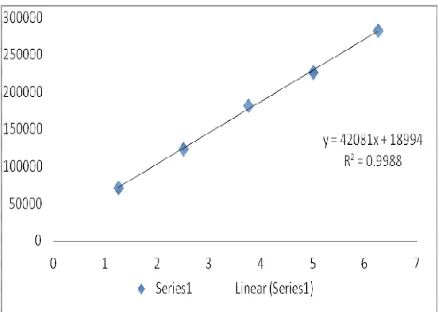
Linearity curves were plotted for 1.25-6.25 µg/mL of HCTZ (Fig. 4) and 30-150 µg/mL of EPR (Fig. 5). The
linearity of peak area responses versus concentration for HCTZ and EPRO was studied and correlation coefficient (R2), slopes and Y-intercepts and regression equation were determined and the results are shown in Table 1. The correlation coefficient was found to be 0.99, which confirmed the linear relationship between peak areas and concentrations. The results indicate very good linearity.
Figure 4: Linearity curve for Hydrochlorothiazide
Figure 5: Linearity curve for Eprosartan
Robustness
In all the deliberate varied chromatographic conditions (flow rate and change in organic composition in mobile phase), all analyte peaks were adequately resolved and elution orders remained unchanged and the results are shown in Table 2.
Table No 12: Robustness results
Parameter varied Retention time of Hydrochlorothiazide
Retention time of Eprosartan
Flow rate(ml/min)
a)0.36 1.025 2.145
b)0.44 0.824 1.859
change in Organic Composition in the Mobile Phase
a) 10% less b) 10% more
0.968 0.885
2.047 1.856
CONCLUSION
The rapid gradient RP-UPLC method developed for quantitative analysis of HCTZ and EPRO in pharmaceutical dosage forms is precise, accurate, linear, robust and specific. Satisfactory results were obtained from validation of the method. This method exhibited an excellent performance in terms of sensitivity and speed.
LIST OF ABBREVIATIONS
UPLC-Ultra Performance liquid chromatography HPLC-High performance liquid chromatography HCTZ-Hydrochlorothiazide
EPRO-Eprosartan
REFERENCES
1. The Merck Index – An Encyclopedia of chemicals,
Drugs, and biologicals, 14th edition, Merk Research
Laboratories, Whitehouse station, New Jersey, 2006,
pp 4785, 6836
2. The Merck Index – An Encyclopedia of chemicals,
Drugs, and biologicals, 23 rd edn, Merk Research
Laboratories, Whitehouse station, New Jersey, 2006,
pp 83
3. P. J. Blankestijn and H. Rupp. Cardiovascular &
Hematological Agents in Medicinal Chemistry, Clinical
Profile of Eprosartan: A Different Angiotensin II
Receptor Blocker. 2008, 6, 253-257.
4. William H. Frishman, Angela Cheng-Lai, James
Nawarskas. The Current Cardiovascular Drugs. 2007,
53.
5. Bhat LR, Godge RK, Vora AT, Damle MC. J Liq
Chromatogr & Related Tech 30 (2007) 3059-3067.
6. Sathe SR, Bari SB. Acta Chromatographica 19 (2007)
270-278.
7. Anandakumar K, Santhi DV,Jothieswari D,Subathrai
R,Vetrichelvan T, Indian Journal of Pharmaceutical
Sciences 73 (5)2011: 569-572.
8. Harsha U.Patel, Bhanubhai N.Suhagia, Chhaganbhai
N.Patel, Pharmaceutical methods April-June, 2011Vol
2, Issue 2,143-147.
9. A.B.N. Nageswara Rao, Ojeyemi M. Olabemiwo, V.
Jayathirtha Rao, J.V.L.N. Seshagiri Rao, Der Pharmacia
Lettre, 2011: 3 (5) 318-325.
10.Manishthimma Raju,Srikanth Gurrala, J. Venkateshwar
Rao, K.R.S. Sambasiva Rao, International Journal of
Pharmacy and Pharmaceutical Sciences ISSN-
0975-1491 Vol 3, Issue 2, 2011,191-194.
11.Anandakumar K, Vijaya Santhi D, Jayamariappan M,
International Journal of Pharmacy & Industrial
Research Vol – 01 Issue – 01 Jan - Mar 2011,22-27.
12.Varsha R. Galande, K. G. Baheti, S. Indraksha, and M. H.
Dehghan, Indian Journal of Pharmaceutical Sciences.
2012 Jan-Feb; 74(1): 18–23.
13.Bheru S.Malviya, Dr.Deepti jain, Prince shivhare,
Pramod hinnariya,Vidhi jain,International Journal of
Drug Discovery And Herbal Research (IJDDHR) 2(4):
Oct.-Dec.: (2012), 481-486
14.Fatma Hacıoglu and Armagan Onal, Journal of
Chromatographic Sciences (2012) 50 (8): 688-693.
Doi:10.1093/chromsci/bms037 first published online:
15.5 N. Delhiraj and S. Anbazhagan, Der Pharma Chemica,
2012, 4(6):2416-2421
16.Sharma M, Kothari C, Sherikar O, Mehta P, Journal of
Chromatographic Sciences 2012 Sep;50(8):680-687.
17.Reviewer guidance – Validation of chromatographic
methods, Center for drug evaluation and research
(CDER), November 1994.
18.United States Pharmacopeia, 29th ed., United States
Pharmaco- peial Convention, Inc, Twin brook Parkway,
Rockville, MD, USA, 2006, pp. 1623, 2675–2693, 3050–
3053, 3392–3394.
19.ICH harmonized tripartite guideline, Validation of
Analytical Procedures: Text and Methodology, Q2-R1,
2005.
How to cite this article: Vanitha . C*, Bindu Pendota, Alagar
Raja. M, David Banji, Development and validation UPLC
method for simultaneous determination of
Hydrochlorothiazide and Eprosartan; J. Adv. Pharm. Edu. & Res. 2013: 3(3): 171-176.