Supporting campus based teaching with
technology: webbased and groupware
Bell, F, Proctor, C and Jones, MC
Title
Supporting campus based teaching with technology: webbased and
groupware
Authors
Bell, F, Proctor, C and Jones, MC
Type
Monograph
URL
This version is available at: http://usir.salford.ac.uk/2110/
Published Date
1998
USIR is a digital collection of the research output of the University of Salford. Where copyright
permits, full text material held in the repository is made freely available online and can be read,
downloaded and copied for noncommercial private study or research purposes. Please check the
manuscript for any further copyright restrictions.
S
UPPORTING CAMPUS-
BASED TEACHING WITH TECHNOLOGY–
WEB
-
BASED&
GROUPWAREFrances Bell, Mark Jones, Chris Procter –
Information Systems Institute, University of Salford
Abstract
In the last decade, higher education institutions have had to come to grips with the increased pressures on staff and resources to deliver quality education programmes. Interest has focused on technology as a means of increasing the effectiveness and efficiency of course delivery in a context of diminishing resources. Here we consider two technologies - WWW and Lotus Notes - used to support campus-based delivery. The project described here is firmly within the current mass market - full-time, campus-based students - but also includes part-time students and touches upon alternative methods of delivery. The impact of the use of technology is considered from the staff, student and organisational perspectives.
Introduction
In this paper, we describe a project that explored the extent to which World Wide Web and groupware technologies could be used to improve support for teaching in a campus-based environment. The project was supported by the Teaching and Learning Quality Improvement Scheme (TLQIS) at the University of Salford and took place in the academic year 1997/98. Although concerned with the use of technologies, the emphasis of the project was placed on evaluation of the technologies in use in this particular context rather than their technical aspects per se.
The authors now work in the Information Systems Institute but the work covered was carried in the former Department of Computer and Mathematical Sciences (CMS). References to publication of course materials are in the past tense because, since faculty re-organisation in August 1999, none of the materials has been available in the form described here.
The Technology Context
Two technologies
The publication technologies used were Lotus Notes/Domino and the World Wide Web (WWW).
Lotus Notes is a groupware1 product, originally targeted at the corporate market. It has a client (for each user) and a server (administered centrally) that together provide a platform for messaging, collaboration, and Internet and intranet applications; and a Web and intranet application development tool (Lotus Notes Web site, 1999). In CMS, all full-time students and staff had access to Lotus Notes for email, the development facilities were used on specific modules(not part of this project) and there had been sporadic use (by staff and by students on modules) of the collaboration facilities. Lotus Notes had been used to create the departmental web site but there was no formal intranet in the department. An interesting feature of the Domino server is that its contents can be accessed via WWW (i.e. students at home could access published documents using a web browser). Although the content of a Domino server is organised into document databases, these documents are presented to WWW in HTML (Hyper Text Markup Language).
Where materials were published on WWW, the pages were developed in HTML.
Both of these resources could be accessed via a Web browser (e.g. Internet Explorer or Netscape), and the Notes resources could additionally be accessed via Notes client software.
In CMS all students should have had access to a Web browser and a Notes client via the University network. In addition, some students also had internet access from home, and a few students had Notes clients at home.
Publishing the materials
In this project, the emphasis was on the publication of existing materials (rather than content development) and the opportunities for on-line discussion.
Where Lotus Notes was used, course materials were placed in a Lotus Notes database. The creation of such a database is not a difficult task and we found that it could be conducted by any IT literate academic with brief initial training. The databases used were based upon templates provided with Lotus Notes. For publication the template used was specifically for Microsoft Office files (the source for most of the materials for the module in question): for discussion a template was used that supported threaded discussions (similar to the structure of Newsgroups).
Course materials were also placed on the World Wide Web using Microsoft tools, including FrontPage. These materials included lecture notes, assignments, exercises and solutions, a software tutorial demonstration using video, discussion area and on-line multiple choice questions. The Web site could be edited remotely using Microsoft’s Personal Web Server. The creation of these materials required knowledge of HTML, JavaScript and other Web tools, database design and human computer interface design. The design and development of these Web pages was therefore significantly more difficult than the publication of material in Lotus Notes and required expert technical support.
Method of Evaluation
Evaluation of the project was focused on students and staff concerned with a number of modules. The evaluation was conducted by means of questionnaire, focus groups and individual interviews. Staff communicated throughout the project period (in person and via email) and recorded their impressions as the project progressed.
Modules covered in this project
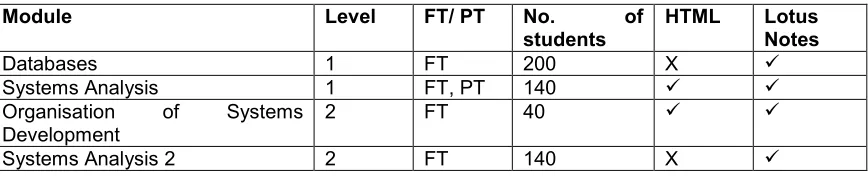
This project covered four modules (two level 1 and two level 2), delivered to full-time and part-time students in five deliveries. As can be seen from Table 1, the modules were taught to medium - large groups of students. Further details of the specific modules covered can be found in the report to TLQIS, 1998.
[image:3.595.89.523.600.688.2]The lecturers responsible for these modules shared an interest in exploring how technology might be used to improve the quality of campus-based teaching. They were, of course, keen to exploit any possible saving of time. They were not driven by a desire to use electronic (e.g. for publishing multi-media materials) rather than print media, and printed notes were provided for students as in previous years.
Table 1 - Modules covered by Project
Module Level FT/ PT No. of
students HTML Lotus Notes
Databases 1 FT 200 X '
Systems Analysis 1 FT, PT 140 ' '
Organisation of Systems
Development 2 FT 40 ' '
Systems Analysis 2 2 FT 140 X '
Supporting face to face teaching
The main use of Lotus Notes and WWW in this project is an example of informatics
Powerpoint slide shows, assignments (current and previous), exercises and solutions, software tutorial introduction and discussion area.
In a publication of previous work, two of the authors had already stated their intentions to extend the scope of the repository, and to facilitate collaborative learning.
" The objectives of future work would be to extend the information resource; and to facilitate collaborative learning. We wish to extend the use of informatics from our current home base
of lecturer-provided resources, to direct links to other in-house resources (e.g. past student work, other module archives) and also to the World Wide Web (WWW); and to indirect links in the traditional manner, i.e. references to print media. The current resources provided by the groupware emphasise the role of the teacher as information provider. The move to a wider information network will shift the emphasis to teacher as guide, Berge (1995)." Bell and Jones, 1997.
This project supported a stage in this development, and all three authors have continued to support their taught modules with published course materials.
Replacing classroom-based with on-line activities
Although the main use of technology was to directly support campus-based teaching, two modules also involved studies into the use of technology to replace face to face delivery for some elements of the module.
Seminar Discussions
An initial feasibility study was conducted into the replacement of classroom based seminars with on-line discussion groups for the Organisation of Systems Development module. A control group of 8 students was identified and these experienced a mixture of 4 classroom-based seminars and 4 on-line classroom-based seminars/discussion groups using Lotus Notes. Since participation in OSD seminars attracts marks, it is not surprising that most students participated in both the classroom and on-line seminars. A full analysis of their participation and involvement, contributions and opinions was conducted by an impartial observer who performed a comparison between the two modes of delivery/learning both through observation and a focus group interview. Access to the discussion group was restricted to those students and staff involved.
Results: the student view
Whilst we cannot claim that the size of the control group was statistically relevant, the views expressed by the students are valuable. Given a choice, some students opted for an on-line presentation firstly in order to avoid the nerves associated with a classroom presentation, and secondly for the opportunity to use ‘new’ technology. Others opted for a classroom presentation owing to lack of confidence in the technology. The following is a summary of the student views following the conclusion of the module:
• They were unable to state whether they preferred seminars on-line or in the classroom since they regarded the content as more important than the delivery.
• They were against the wholesale replacement of classroom seminars with on-line seminars, suggesting instead that a discussion database could be used as an additional resource for classroom seminars giving encouragement to those who lacked the confidence to participate in a classroom seminar.
• They were strongly in favour of any resources that could be provided for home use.
• They did not experience any technical problems at all in either reading from, or writing to, the on-line database for the seminars.
• There were slightly more student contributions to the on-line seminars, and less prompting from the lecturer.
Results: the staff view
• The students do not get the practice in oral presentations, which is valuable for them in their future careers (especially if they are nervous).
• There is no guarantee in an on-line seminar that the original presentation is the students’ own work, nor is there an opportunity to quiz the presenter on the spot.
• Taking part in on-line seminars of this sort is more time consuming for the staff member than a standard classroom based seminar whose duration is fixed.
• The on-line seminar simply does not allow for the same type of interaction as in a classroom, where for example, a student in the audience can be asked a direct question.
Conclusions
For these reasons given above, it was not intended that the classroom based seminars be replaced with on-line seminars, but rather to use a discussion database as an additional forum in which students can place comments following an oral presentation. This would increase the opportunity to participate to those students who are shy to express their point of view in the classroom, and allow more time for ideas to develop.
Discussion to support coursework
In the Systems Analysis 2 module, the second assignment encouraged use of a discussion area by means of attaching (a few) marks to reading and writing to the discussion database. Based on experience with on-line discussions in a previous module (where students had expressed a preference for discussion with students familiar to them), a private discussion area was set up for each cohort of students (with the exception of two small cohorts who shared a discussion area). This assignment was formative, intended to help the students develop a critique of the development method they had been studying, in preparation for their examination at the end of the semester.
Results: the student view
• time is a factor in student approval - both time to read and make contributions, and time
wasted by perceived slowness of the system
• some students resented the assessment of their contribution, feeling that they were forced to contribute
Results: the staff view
• there was a wide variation in usage of the discussion database by the different cohorts of students
• the lecturer found that the quality of interaction with students was improved (in the more active groups) but at the expense of her time
• discussion databases can suffer from being inactive (too few contributions to make a good discussion) or too active (too many contributions to deal with, and repetition)
Supporting team teaching
On one of the modules, Databases, a private staff resource was provided using Lotus Notes. The module lecturer used this resource to publish tutorial resources (e.g. solutions) to staff prior to students; to share assessment information and marks; and to raise queries about module materials and activities.
General Conclusions
Technical Aspects
WWW vs Lotus Notes
Whilst HTML allowed for more sophisticated and interesting on-line ideas to be tested and the Web is a universal standard, the overhead in terms of technical development and ongoing support is far greater than with Lotus Notes (given that Lotus Notes was already available and users administered within CMS)
Reliability
In order to be successful, resources need to be available when required, thus reliable, stable technology is essential. Users tend to focus their attentions on the relatively short periods of time when the technology has failed, and this may have a lasting effect on their individual perceptions and use of it. In parts of this project, it might be viewed that there was a much higher chance of failure due to the use of both Web and groupware technology with the same material. Using existing technology (e.g. an already-implemented email system) had a significant advantage over developing something new.
On-line submission of coursework was plagued by computer viruses in the files submitted and also students failing to follow instructions and submitting files which could not be read by staff. This method of submission was not popular with students, as perceptions of unreliability of the system led to anxiety as to whether the work had actually been received.
Compatibility
The degree of compatibility of different file formats contributes significantly to the effective use of the technology. Not all available resources could be published for this reason.
Organisational Aspects
Additionality
Careful consideration (based on organisational and personal norms, learning objectives and students’ situations) needs to be given to the extent to which on-line resources are used to complement existing (unchanged) delivery or replace existing delivery. Our experiences show that students prefer ‘additionality’, where additional facilities to those that would have otherwise been offered are provided via the technology rather than replacing face-to-face interaction.
Evolutionary development
We found we were most successful when the technology was used to support the traditional, time- and space-constrained activities by providing evolutionary resources. This is in contrast with courses delivered wholly on-line which tend to be characterised by a whole library of materials being published prior to the commencement of the programme of study.
Immediacy
On-line technology can offer significant advantages over traditional methods of information dissemination. Unlike paper-based materials, electronic documents can evolve, and the immediacy of the publication process is excellent for the public resolution of matters of fact, e.g. clarifying assignment issues, correcting lecture notes, etc. Collaborative work, e.g. writing documents or jointly assessing work, was considerably more convenient than it would have been without the support of groupware.
Ownership
One issue which ought to be considered (which was not addressed in this project) is the issue of who ‘owns’ contributions to public computer-mediated discussions.
Support
technical skills may be required. The support effort is made more complex by the distributed nature of collaborative systems, with many users accessing from home.
Personal Aspects
Perceived values
Students state their general approval of on-line materials used to complement and supplement face-to-face interaction in classes, rather than to replace traditional methods. There was a variation in frequency of use by students, and interestingly, many students perceive (or state that they perceive) that they have used the on-line resources more than they actually have. Greater student participation was observed in cases where the interaction was task-based, for example in clarifying issues relating to a piece of assessed work or where the interaction itself was being assessed. Otherwise, there is not the same perceived value in taking part.
Learning by onlooking
Some students manage to adapt to the new ‘paradigm’ of contributing to visible on-line discussion better than others. However, this should not necessarily be perceived as being a failure. If the resource works well, there will be no necessity for everyone to make a contribution, since the important issues will have been discussed already. The importance of ‘learning by onlooking’ should not be underestimated – a phenomenon sometimes referred to as ‘lurking’ in the Internet community. In addition, those who, through shyness or cultural differences, find it difficult to contribute to a ‘live’ face-to-face discussion, have the opportunity to formulate their contributions at their leisure before committing them to the open forum electronically.
Accessibility
There can be no absolute measure of quality of teaching and learning situations, but in this case staff perceive they have provided a better service through the use of the technology. This has been at the expense of staff time; the time taken to create, publish and maintain resources is not insignificant, particularly in the case of World Wide Web development. Further, when on-line communication is available from home, staff become more accessible, but some may perceive an obligation to be in touch constantly (including evenings and weekends). Where groupware was used as a work submission medium, this tended to place constraints on those assessing the material (e.g. relating to physical location, technical availability of the system, eye strain, etc.) and, in fact, much of the work was printed out from the system before being assessed!
Relationships
Experience has shown that on-line electronic communications technology of any kind, if not handled carefully, can damage relationships between those taking part. For example, students (or even colleagues) may perceive members of staff as being unhelpful or obstructive if they simply refer those asking questions in person to the electronic resource because the answer has already been published. A major benefit of having on-line discussion is sharing common problems and discussing issues. Those who did not see the benefit of posting their queries in such a forum initially are unlikely to appreciate being subsequently sent down this route by a member of staff.
A final thought
The ostensible purpose of the project was to compare WWW and Lotus Notes as technologies to support campus-based delivery but another valuable outcome was what was learned by the authors about the pros and cons of using technology in this context. The evolutionary approach adopted by the authors permitted controlled and limited experimentation with alternative methods of delivery. In our opinion, a more radical approach to changing delivery methods for campus-based courses should include rich evaluation of personal, technical and organisational aspects.
References
Aug 27 - 29, 1997, published in "Training and Education of Methodology Practitioners and Researchers", N Jayaratna, B Fitzgerald, T Wood-Harper and J-M Larrasquet (eds), Springer-Verlag, 1998.
Bell F., Jones M.C. ,Procter C., "Using the World Wide Web and Groupware to Improve Support for Campus-based teaching, Report to TLQIS University of Salford, July 1998 (available from E.D.U., University of Salford).
Berge Z, "Computer-Mediated Communications and the On-Line Classroom: Overview and Perspective", Hampton Press, USA.
Ellis C A, Gibbs S J and Rein G L, "Groupware: Some Issues and Experiences", Communications of the ACM, January 1991, Vol 34 No1.
Johansen R, "Leading Business Teams", Addison-Wesley, Reading, Mass, 1991 Lotus Notes Web Site, http://www.lotus.com, accessed 5 December 1999.