C O M M E N T
Crowdfunding genomics and bioinformatics
Pamela Cameron
1*, David W Corne
2, Christopher E Mason
3,4*and Jeffrey Rosenfeld
5,6*Online crowdfunding websites such as RocketHub, Indiegogo and Kickstarter have financed an increasingly eclectic variety of initiatives: multimillion dollar movie projects attached to big Hollywood names, music and book publishing, gadget development, a hoodie that lasts ten years. Controversially, one crowdfunding campaign aimed to raise funds for a drug dealer, who it was thought might be persuaded to hand over compromising video footage of a prominent politician in exchange for the cash.
Recently, a number of scientists have sought to use crowdfunding as a means to bypass traditional funding routes when budgeting for new projects. In doing so, they are expanding on the concept of citizen science from crowd participation to crowdfunding. As is the traditional crowdfunding method, these scientists hope to attract funding using two main incentives: (1) the de-sire by the funder to see the project get off the ground, and (2) the acknowledgement of donations with a range of rewards–some of significant monetary value. Donors also have the security of knowing that payment will only be taken once a project is fully funded, thereby reducing the risk of wasting money on a dud.
To start crowdfunding your own science, or to dis-cover projects to donate to, you can now even use a ded-icated crowdfunding website for scientific research, Microryza (https://www.microryza.com/), alongside the more general crowdfunding websites. Rather than re-ceive physical rewards, donors on Microryza gain exclu-sive access to updates on the progress of their funded research.
Here, three sets of scientists describe their experience of crowdfunding projects in the fields of genomics and bioinformatics: PathoMap (http://www.indiegogo.com/ projects/pathomap-mapping-nyc-s-microscopic-residents),
Genome Liberty (http://www.rockethub.com/projects/ 29313-genome-liberty-providing-individuals-direct-access-to-their-genes) and BiRA (http://www.rockethub.com/ projects/26688-a-free-and-open-biomedical-research-accelerator-bira).
PathoMap: crowdfunding a citizen science microbiome
Christopher Mason
What is PathoMap?
Ever wonder exactly what is on a subway railing or park bench? We do! Our goal is to promote awareness of the microorganisms present on common surfaces. By sam-pling at high traffic areas New Yorkers come in contact with every day, we will discover what species are present, potentially aiding disease prevention. We hope to see the entire urban microbiome sequenced and analyzed, to provide information to the public to help them know which areas are potentially problematic. We have established the PathoMap analysis system by collecting samples from high traffic areas in New York City for mi-crobial monitoring. Imagine getting an alert on your phone for areas of the city or subway with different pathogens or microbiomes - that is our goal.
Crowdfunding PathoMap
We have reached out to crowdfunding and citizen sci-ence because we need boots on the ground and rapid support to have enough simultaneous collections that can create a baseline database of the microbes normally present in public areas of a city. This is a project that, by definition, requires the coordinated efforts of many la-boratories and citizen scientists who want to contribute to broader scientific knowledge and also learn more about their own environment.
We have pitched a number of ‘perks’for people who contribute. This includes: a public thank you, a T-shirt, a tote bag, a pre-report on the subway near a person, and offers to sequence anyone’s home or to submit almost anything else for shotgun sequencing.
* Correspondence:[email protected];[email protected];
1Novo Science, Hatton Mains Cottages, Dalmahoy, Edinburgh, EH27 8EB, UK 3
Department of Physiology and Biophysics, Weill Cornell Medical College, 1305 York Ave, New York, NY 10065, USA
5
IST/Division of High Performance and Research Computing, University of Medicine & Dentistry of New Jersey, South Orange Avenue, Newark, NJ 07103, USA
Full list of author information is available at the end of the article
Sequencing the microbiome of a city
We have already collected multiple samples from all 468 subway stations in New York City! Now that the prelim-inary collections have taken place, we are focusing ef-forts on additional collections, sequencing and data analysis. Using next-generation sequencing technologies, specifically Illumina paired-end shotgun sequencing, we will examine the DNA found at the sites. The DNA is randomly broken into smaller fragments that are se-quenced to obtain base-pair reads. Several rounds of fragmentation and sequencing are implemented to get multiple overlapping reads for the target DNA. Open-source algorithms can then use the overlapping ends of different reads to assemble them into a continuous sequence.
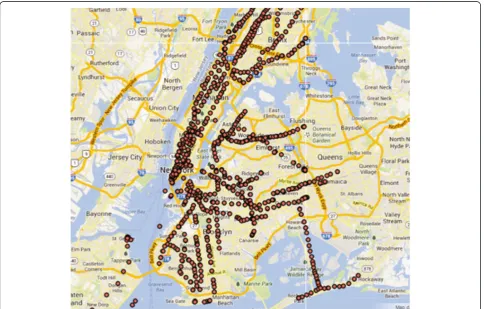
To date, we have completed the prototype collections, and begun to successfully purify, prep, and sequence DNA from samples of surfaces throughout the five bor-oughs (Figure 1). To view our current map of sample collection sites, visit http://www.pathomap.org/results/.
Ultimately, not only sample sites but the data them-selves will be projected onto a map of the New York City area, creating a method to detect and monitor trends of microbial spread.
We have developed a simple sample collection proto-col and are proto-collecting samples from subway stations and trains (stairwell railings, turnstiles, card kiosks and benches), parks (benches, garbage cans, gate handles), high traffic sites (Metro North Railroad, playgrounds, zoos, and many more), taxis, buses, and airports. We welcome all the areas of the city that anyone wants to collect, including novel collections of air samples that will be obtained from atop various buildings in Manhattan using automated air samplers partially funded by the Department of Homeland Security. This is part of an ongoing Mason Lab project, and it will also play a key role in data collection for PathoMap.
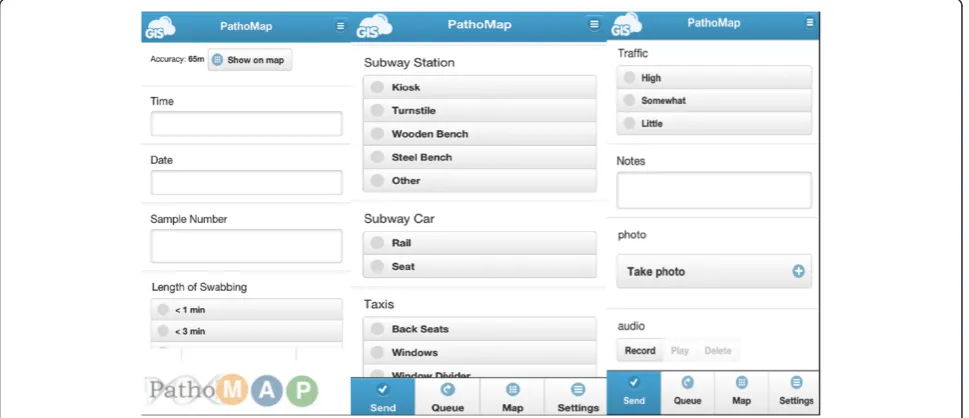
We are also collaborating with GIS Cloud, a platform for creating customized map-enabled apps, and have personalized the GIS Cloud Mobile Data Collection app to our needs so we can easily record locations of collec-tion sites while in the field (Figure 2).
[image:2.595.57.542.405.714.2]We are using next-generation sequencing technologies to characterize the species in samples. We have already used these statistical and integrative genomics methods through our own lab’s work on k-mer methods, and have also implemented additional methods such as the Livermore Metagenomic Analysis Toolkit (LMAT),
MetaPhlAn, The Visualization and Analysis of Micro-bial Population Structures (VAMPS), Quantitative In-sights Into Microbial Ecology (QIIME), MetaGenome Rapid Annotation using System Technology (MG-RAST) and FungiDB.
We anticipate that our project will result in an innova-tive method for city-level pathogen monitoring. Using our tools, we can quickly map the species found from NGS data into functional taxonomic groups. We antici-pate that rapid, continual sampling and analysis of these areas will create a pathogen map that can eventually serve as a model for threat detection.
Genome Liberty: a personalized genomics start-up Christopher Mason and Jeffrey Rosenfeld
What is Genome Liberty?
We were empowered to create a direct-to-consumer genetics company, Genome Liberty, from our work on the United States Supreme Court case concerning pat-ents on human genes. Up until the court’s decision in June, individual companies controlled the isolated DNA of almost all genes in your genome. The best known example is the BRCA1 gene for breast cancer, which was owned by Myriad Genetics. Any woman in America who wanted to get tested for that gene needed to pay Myriad’s monopolistic fee of upward of $3000, when many other clinical labs could have done it for $200. We helped to correct this injustice by adding testimony as an expert witness for the case, publishing a scientific paper [1] and writing an Op-Ed in theWashington Post [2] to try to convince the court of the problematic impli-cations of gene patents; the court ruled in our favor 9-0!
Crowdfunding Genome Liberty
We chose to begin funding the company through crowdfunding on RocketHub since it was a very rapid method to generate both excitement and cash to get the company off the ground. To date, we have raised $10,346 on the site to support the company from 64 funders, and we have also raised another $1,100 from several private donors who have seen the site and writ-ten checks to us. We created many‘goods’for people to order, including signed books, T-shirts, magnets, dinner with a geneticist, targeted DNA sequencing and whole genome sequencing. The dinner with a geneticist did get one taker!
The most surprising part of crowdfunding has been that some people still don’t have email addresses, so they were unable to make an account on the RocketHub site and therefore needed to write checks. The hardest part of crowdfunding is that some people are still confused about the ‘goods for cash’ aspect of the funding model, and in the end you still basically need to convince some-one to open up their wallet for your idea. It is hard to do this with just T-shirts, early ordering of tests, or even offers for whole genome sequencing, since some people would prefer to actually buy shares of the company or get equity. Fortunately, the work on the Jumpstart Our Business Startups Act in the United States Congress means that building simple cash as well as distributed equity for a company is a model that will be here to stay.
Personalized pharmacogenomics
[image:3.595.57.542.91.300.2]We offer a variety of genetic testing, analysis, and genomics services. The most popular choice for our
crowdfunders has been a pre-order of the $99 gene-drug interaction test, which can discern a person’s unique pharmacogenomics profile. There are clear genetic markers for many medications that indicate whether a person will respond properly, not respond, or even have extreme side effects. Markers are available for estrogen, codeine, Plavix, Nexium, Prilosec, Zocor, Dilantin, Coumadin, Haloperidol, Abilify, Celexa and hundreds of other drugs. Such tests are very rarely performed before a drug is prescribed but they offer distinct advantages and can dramatically improve the quality of medical care, as well as the efficacy of the drugs being used.
Previously, individuals had to rely primarily on their doctors to understand their health and to make proper medical decisions. As scientists and doctors have researched the molecular basis for disease and drug re-sponse, it has become increasingly clear that a one-size-fits-all framework for medicine is not in patients’ best interest. Accordingly, we are strong supporters of the participatory medicine paradigm, wherein patients and doctors work in concert to improve health care. Ultim-ately, we are all patients, and so learning to work with as much information as possible is not only a good deci-sion, it is also your genetic right.
BiRA: the free and open Biomedical Research Accelerator
Pamela Cameron and David Corne
What is BiRA?
BiRA has the potential to rapidly speed up all research. Imagine changing research fields or commencing a cross-disciplinary project for the first time? The volume of literature is just too great to be able to access more than a small proportion of existing published data and new scientific journals are popping up every month. Fur-thermore, the information we are looking for is often not readily accessible because it was published several years ago, is in a low impact journal or is a minor result in an article that strays from the initial key words en-tered. Thus, important information is overlooked and the experiments are repeated by different research groups, which is a waste of time and money.
The move toward Open Access publishing, although great for dissemination of research to a wide audience, is also set to make the problem worse, with ever increasing volumes of data being accumulated. We are publishing more than ever before, but the linking together of these ideas and data is just not happening. As a result, we are overlooking the key linchpins of common molecules, genes, pathways and mechanisms that could help us ap-proach biomedical research in a more targeted manner. To solve this problem, we need tools that can intelli-gently sort through the literature, based on certain key terms and phrases entered, then look for commonality
through various research fields and give perspective to those collated articles, before delivering it to a scientist for assessment of relevance. This is what BiRA has the potential to do: it could collate everything required for a particular literature review and provide the background to grant applications. In addition, it will be web-based, easy to use, free and open source.
Crowdfunding BiRA
Our project won’t lead to a product that can be com-mercialized and, for that reason, we would face difficul-ties in attracting traditional funding. Crowdfunding is still a relatively new phenomenon, and one that is rap-idly evolving, but the most successful projects are ones where the backers are funding a product that they then receive. In effect, a start-up company can obtain seed funding, advertise widely for zero cost and make their first few sales, all in one fell swoop!
It is probably fair to say, at least for the sciences, that the key to a successful campaign is more about public engagement than an appeal for funding, since we can’t easily match the products and gadgets given out by other projects (all rewards have to be paid for out of the money that we raise). Our BiRA project probably appeared a bit too esoteric to appeal to the masses, al-though we’ve tried to include some unusual rewards -3D printed models, poems, guided walks in the hills, math tuition and text analysis consultations.
We hope that our crowdfunding campaign will attract the attention of the general public who have an interest in science, but we also hope that fellow scientists and clinicians can see enough potential to consider funding it themselves. To this end, we have been writing a few poems on Twitter and Facebook, and we have also directly contacted scientists in the UK and clinicians in the US. So far, we have had wonderful responses, prais-ing the potential of our BiRA project, with scientists saying they would use it and that they hope we get the funding that we require. Unfortunately, that has not yet translated into those people contributing. We are up against that classic human phenomenon of bystander apathy, where everybody thinks someone else will fund a project, not realizing that the someone has to be them, if it is to stand a chance against the gadgets, herb gardens and phones available in other crowdfunding campaigns.
Popular Science
BiRA was one of two dozen crowdfunding projects se-lected by Popular Sciencemagazine for its #crowdgrant challenge (http://www.rockethub.com/projects/partner/ popularscience). We had hoped that the link with
959fdcbc-9de1-11e2-a941-a19bce7af755_print.html].
--30
and we were the only group located outside of the USA to be chosen out of 300 submitted projects, which we consider an achievement on its own. We continue to campaign for funding from the crowd and will most likely run another, more targeted, campaign soon.
Competing interests
PC and DWC declare that they have not received any financial or political gain as a result of writing this article, and confirm that they have no competing interests. CEM and JR are founders of the Genome Liberty Corporation.
Author details 1
Novo Science, Hatton Mains Cottages, Dalmahoy, Edinburgh, EH27 8EB, UK.
2School of Mathematical & Computer Sciences, Heriot-Watt University,
Edinburgh EH14 4AS, UK.3Department of Physiology and Biophysics, Weill Cornell Medical College, 1305 York Ave, New York, NY 10065, USA.4The HRH
Prince Alwaleed Bin Talal Bin Abdulaziz Alsaud Institute for Computational Biomedicine, Weill Cornell Medical College, 1305 York Ave, New York, NY 10065, USA.5IST/Division of High Performance and Research Computing, University of Medicine & Dentistry of New Jersey, South Orange Avenue, Newark, NJ 07103, USA.6American Museum of Natural History, Sackler Institute for Comparative Genomics, Central Park West, 79th Street, New York, NY 10024, USA.
References
1. Rosenfeld JA, Mason CE:Pervasive sequence patents cover the entire human genome.Genome Med2013,5:27.
2. The Supreme Court should invalidate the patent on human DNA.The Washington Post. April 6 2013 [http://www.washingtonpost.com/opinions/ the-supreme-court-should-invalidate-the-patent-on-human-dna/2013/04/05/
Cite this article as:Cameronet al.:Crowdfunding genomics and bioinformatics.Genome Biology 14:134.
Published: September 2013