ISSN 2250-3153
Performance Analysis of DSDV, AODV and ZRP Routing
Protocol of MANET and Enhancement in ZRP to
Improve its Throughput
ZishanHaider Y. Noorani
Computer Science, Kalol institute of Technology and Research Centre, Gandhinagar, India
Abstract- Mobile Ad-hoc network (MANET) is a
non-infrastructure, self-configurable and decentralized network of autonomous mobile nodes which are capable for communication over wireless links. Routing is the main part for any wireless network and same is for MANET. There are two approaches for routing in MANET one is Proactive and another is Reactive. Zone routing protocol is a hybrid protocol means that it uses Proactive approach in its inter-zone whereas Reactive approach in its intra-zone. This work revolves around enhancement in Zone routing protocol in the area of fast route reconfiguration and route acquisition delay.
Index Terms- MANET. DSDV, AODV, ZRP, SBZRP,
MDVZRP
I. INTRODUCTION
n Mobile ad-hoc network the topology is dynamic as nodes moves to and fro from a network very quickly and unpredictably. The key factor that determines how efficiently a multi-hop wireless network reacts to topology changes and node mobility is the routing algorithm. Many routing algorithms have been proposed for proactive and reactive approach and as well as for hybrid approach [1]. In proactive routing approach it continuously evaluates the path of the network, so whenever it needs to send the packets in the network the routes is already known and can send immediately. Reactive routing protocol invokes the route only when it is required. So route determination required more time as compared to proactive protocol. Because of larger delay and control traffic it is not applicable to the real-time system. Hybrid routing is the combination of proactive and reactive approach and it make use of proactive to determine the early routes in its internal zone whereas uses the reactive approach in its intra-zone, that is communicating between inter-zone of the network. ZRP uses the hybrid routing approach.
The performance comparison for all the approaches is presented in this paper. Routing protocol DSDV [2] is for proactive, AODV [3] is for reactive and ZRP [4] for Hybrid are well-known approaches in their respective domains. The parameter end-to-end delay and number of packets successfully routed are examined for each of the approaches and some enhancement is proposed for hybrid protocol ZRP so as to improve its performance. Finally the simulation results of protocols implemented on Network Simulator NS-2 are concluded here.
II. ROUTINGPROTOCOLSINMANET
Mobile Ad-hoc networks topology of the nodes in the network is dynamic so such networks do not assume all the nodes to be in the direct transmission range of each other. Hence these networks require specialized routing protocols that provide self-starting behavior. These protocols are classified as proactive and reactive.
A. Proactive Routing Protocols
In proactive routing, each node has the latest information of the routes to any node in the network. Here each node periodically transmits the routing information to its neighbor so as to build a global view of the network topology. Examples of this class of Ad Hoc routing protocols are the Destination Sequenced Distance Vector (DSDV) and the Optimized Link State Routing (OLSR) protocols. The Matter of concern is Bandwidth and power utilization is more as it need to broadcast the routing tables. As the number of nodes in the MANET increases, the size of the table will increase.
Destination-Sequence-Distance-Vector (DSDV) [1]:-
DSDV is proactive routing protocol. Each mobile node maintains a routing table that stores for all reachable destinations, the next-hop and number of next-hops to reach that destination and the sequence number assigned by the destination. This transmission takes place also in topology change cases. DSDV applies two types of routing updates: full dump or incremental update. Full dump carries the full table with all available routing information and this is suitable for fast changing networks. Incremental dump carries only the updated entries since last dump, which must fit in a packet and is suitable when network is stable. DSDV possesses routes availability to all destinations at all times, which involves much less delay in the route setup process. The use of sequence number distinguishes stale routes from new ones, where routes with higher sequence numbers are favorable. However, the updates due to broken links lead to a heavy control overhead during high mobility, proportional to the number of nodes in the network and therefore affecting scalability
B. Reactive Routing Protocols
In reactive routing protocols it constantly updates their route information with the latest route topology. Instead, when a source node wants to transmit a packet, it floods a query into the network to obtain the path to destination. Examples of Reactive routing protocols are the Ad Hoc on-demand Distance Vector Routing (AODV) and Dynamic Source Routing (DSR). The
matter of concern is the route to destination will have to be acquired just before communication begins due to which the latency period for most applications is likely to increase drastically.
Ad Hoc on Demand Distance Vector Routing (AODV)
[2]:- Ad Hoc On-Demand Distance Vector routing protocol is a
reactive protocol so it discovers routes when needed and are maintained only as long as they are necessary. Each node maintains sequence numbers and this number increases as it learns about the changes in the topology. This sequence number ensures that most recent route is selected whenever route discovery is initiated.
Routing in AODV is done in two steps i.e. the Route Discovery and Route Maintenance. When a node wants to send a packet to some destination node, it checks its table to find whether it has a route to the destination node or not. If it does, it forwards the packet to the next hop towards the destination and if the node doesn’t have valid route to the destination, it must initiate a route discovery process. The source node initiate a route request (RREQ) packet that contains the source node's IP address, current sequence number, destination's IP address and last known sequence number. The RREQ also contains a broadcast ID and this is incremented every time the source node initiates a RREQ. Thus, the broadcast ID and the source IP address uniquely identify a route request. Once the RREQ is created, the node broadcasts this packet and sets a timer to wait for a reply. When a node receives a RREQ, it first checks whether it has seen it before noting the source IP address and broadcast ID pair. If it has already seen a RREQ with the same source IP address and broadcast ID, it silently discards the packet. Else, it records this information and processes the packet. The node sets up a reverse route entry for the source node in its route table. This reverse route entry contains the source node's IP address and the IP address of the neighbor from which the RREQ was received. The destination node responds with a unicast route reply (RREP) packet to the source. If the node is not the destination node, it increments the RREQ's hop count by one and re-broadcasts this packet to its neighbors. If the RREQ is lost, the source node is allowed to re-broadcast a route discovery again. Once a route has been discovered for a given source/destination pair, it is maintained as long as needed by the source node. When a link breaks, a route error (RERR) message is sent to the affected source nodes whenever a packet tries to use the link.
III. THEZONEROUTINGPROTOCOL-SHORT
OVERVIEW
The behavior of purely proactive and reactive schemes suggests that what is needed is a protocol that initiates the route determination procedure on-demand, but at limited search cost.
The Zone Routing Protocol ZRP [3] is an example of such a
hybrid reactive/proactive scheme. On one hand, it limits the scope of the proactive procedure only to the node’s local neighborhood. As we shall see, the local routing information is referred to quite often in the operation of the ZRP, minimizing the waste associated with the purely proactive schemes. On the other hand, the search throughout the network, although it is
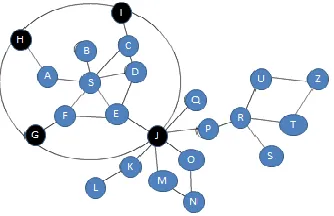
global, can be performed efficiently by querying selected nodes in the network, as opposed to querying all the network nodes. ZRP defines a routing zone for each node separately and the zones of neighboring nodes overlap with each other. Each zone has a radius R expressed in hops. Thus the nodes which are exactly at the distance R from the source node are peripheral node and the node which are at a distance less than R from source node are known as interior node. In below figure the source node S includes the nodes A, B, C, D, E, G, H, I, J and K in its routing zone and node K is the exterior node for node S. the node A, B, C, D and E are interior nodes whereas G, H, I, J and K are the peripheral node or border node.
Fig.1:- A routing zone of radius 2 hops
The formation of a routing zone requires a node to know about its neighbors. A neighbor is defined as nodes that are directly connected to another node. Identification of a node’s neighbors is done with the help of MAC-level Neighbor
Discovery Protocol (NDP). Such a protocol typically operates
through the periodic broadcasting of “hello” beacons. The reception (or quality of reception) of a “hello” beacon can be used to indicate the status of a connection to the beaconing neighbor.
The ZRP maintains routing zones through a proactive component called the IntrA Zone Routing Protocol (IARP) [5]. IARP maintains routes within the routing zone of source node and Reactive routing protocol Inter-Zone routing (IERP) [6] is responsible for acquiring routes to destinations that are located beyond the routing zone. The routes within the zone will always be available by using IARP and the routes outside the zone take the help of IERP. IERP uses IARP for the complete route between source node and destination node.
Border-cast resolution protocol (BRP) [7] is used by ZRP to direct the route request to peripheral nodes whenever the destination node is outside the zone of source node. Here it utilizes the IARP to construct the border-cast tree so that pruning can be easily done. Whenever the node receives the query packet for a node which is not available in its zone it forwards the query to all of its border node and they construct the border tree so that availability of destination node can be checked and if available routes is pruned back and if doesn’t find it in its zone it forwards the query to all of its border node.
ISSN 2250-3153
IERP forwards queries to its peripheral nodes through a border-cast delivery service provided by the BRP. The BRP keeps track of the peripheral nodes through up-to-date routing zone topology information provided by the IARP. The IERP also makes use of the IARP routing zone information to determine whether a queried for destination belongs to its routing zone.
Fig.2:- Architecture of ZRP
IV. COMPARISONBETWEENVARIOUS APPROACHES
An analytical performance comparison of some of the most important algorithm is presented, like Destination Sequenced distance Vector (DSDV), Ad-hoc on Demand Vector (AODV) and Zone Routing Protocol (ZRP). The performance regarding end-to-end delay and the number of packet successfully routed to their destination are examined. The other performance measuring criteria are as follows:-
i. Throughput:- It is defined as the total amount of data a
receiver receive from the sender divided by the time it takes for the receiver to get the last packet. The throughput is measured in bits per second [8].
ii. Average jitter: - Jitter is the variation in the time between packets arriving, caused by network congestion, timing drifts, or route changes. It should be less for a routing protocol to perform better.
iii. Average End-to-End Delay: - End to end delay
includes how long it a packet takes to travel from the source to the destination [9]. This includes all possible delays caused by buffering during caused by buffering during route discovery, queuing, retransmission delays and transfer time.
iv. Packet Delivery Ratio: - It is defined as the ratio of number packets received by the destination to the number of packets originated by the source. For better performance of a routing protocol, it should be better
[10].
DSDV AODV ZRP
Throughput Highest
more than
ZRP Lowest
Average Jitter Lowest High
Better than AODV
End to end delay Lowest
More than DSR Low
Packet Delivery
Ratio High Medium Low
Fig.3:- Comparison of various protocols
The ZRP approach has lowest throughput and we will try to improve it with proposed work.
V. PROPOSEDWORK
Selective Border-casting and Multi destination zone routing are the two approaches which have been used so as two reduce the number of packets flow in the network.
A. MDVZRP Approach:-
Multi destination zone routing (MDVZRP) reduces the route discovery to more than 3 times than a reactive protocol. If link is broken during route an alternative path will be used instead of using the local route repair as in some reactive protocol. It uses the full dump technique, in which the new node will receive the routing table from its nearest neighbors once they are joined with each other. Thus it will provide the entire network view than its zone only.
Fig.4:- Multiple routes to destination
In above example, the source node S has three alternative paths for the destination node Z and they are A, B and C respectively. All the available routes are mentioned in a table below:-
Sequence No.
Route Request
No. of Hops
Note 1 S-A-H-Z 3 CORRECT
3 S-A-C-D-H-Z
5 Same as 2nd and long route
4 S-C-D-H-Z 4 CORRECT
5 S-C-A-D-H-Z
5 Same as 4th and long route
6 S-C-A-H-Z 4 Possible but A-node joint
7 S-B-C-D-H-Z
5 C-Node joint 8
S-B-C-A-H-Z
6 C-Node joint 9
S-B-C-A-D-H-Z
6 C-Node joint and long route
Fig.5:- Various possible to destination
As shown in table, initially the node A will be used to send the packets via the path S-A-H-Z and if link is broken due to the mobility of node A, it will use the node C to send the packet via the path S-C-D-H-Z. Here if link C-D is broken than also it has an alternate path S-C-A-H-Z, so that local repair can be avoided.
B. SBZRP approach:-
Selective Border-casting zone routing (SBZRP) [11] reduces the load by limiting the number of control messages during the search of new route. When simple ZRP searches for a new route, the number of IERP packets will be increased due to which node buffer will be congested and will result in delay. When the mobility of node increases, route search failure becomes high so in the standard protocol the search will begin from the initial point whereas in SBZRP the route will be search form the point of failure of node. Thus the time is shorter due to which the delay will be less as compared to ZRP.
[image:4.612.34.537.57.213.2]In our example, source node S generates the IARP packet and broadcasts in its local routing zone, by using neighbor’s information, the central node updates its routing table. When the destination is outside the routing zone IERP will be initialize. Here, the source node S will send the request packet to its all border node G, H, I and J respectively. Here each node will check that whether the destination is available in its routing zone but will not find it so it will use border-cast tree and forward the packets to its border node.
Fig 6: - IERP packet transmission by node S
Destination Node
Source Node
Intermediate node
Packet Type
No. of Hops Z S Null REQ 2
Fig.7:- IERP Request packet format of node S
Now, J will broadcast the packet to its border node N, L, F, S, D and R respectively. Here each node will check that whether the destination is available in its routing zone or not and find it there, it will forward the packets and if it not then will forward the packets to its border node.
Fig.8:- IERP packet transmission by node J
Destination Node
Source Node
Intermediate node
Packet Type
[image:4.612.376.515.457.561.2]No. of Hops Z J Null REQ 2
Fig.9:- IERP Request packet format of node J.
Now, R will forward the packets to J and Z respectively and finds the border node as destination node Z.
Fig.10:- IERP packet transmission by node
Destination Node
Source Node
Intermediate node
Packet Type
[image:4.612.83.250.566.674.2]No. of Hops Z R Null REQ 2
Fig.11:- IERP Request packet format of node S.
[image:4.612.306.583.597.646.2]ISSN 2250-3153
inside the routing zone of J, as shown in the Figure, the previous recorded route information stored in the node J and R, the node J will generate the Reply packet to source S.
Fig.12:- a case when destination moves inside the zone.
Destination Node
Source Node
Intermediate node
Packet Type
No. of Hops Z S R,J REP 2
Fig.13:- IERP Reply packet format of node S.
In the case of destination which moves outside the zone of L as shown in the Figure, it has no route to destination which is required for the query source, and then a new search is started from the node R.
Fig.14:- a case when destination moves outside the zone.
Thus the numbers of route request packets are reduced, as the query begins from the node reporting the failure instead of beginning from source.
VI. WORKFLOWANDRESULT Algorithm 1: Main program
Begin
Initialize the nodes in network layer
Call ZRPInit
Call ZRP Router function
Call ZRP Finalize End.
Algorithm 2: ZRP Init
Begin
Initialize the nodes with ZRP initialization
If (IARP/IERP/MDVZRP/SBZRP) are running – Display error message –
Disable the initialization
Else
If (MDVZRP is enabled)
Register ZRP with MDVZRP
Call MDVZRP
Init – else
Register ZRP with IARP
Call standard IARP Init
Register ZRP with IERP
Call standard IERP Init
Register ZRP callback Functions
Initialize statistics variables
Stop End.
Algorithm 3: MDVZRP Init
Begin
Node enters MDVZRP Initialization
Initialize private data structure
Read zone radius
Initialize the routing table
Read user statistics
Schedule timer
Stop End.
Algorithm 4:ZRP Router function
Begin
If MDVZRP is initialized already then Call MDVZRP Router function
Else initialize standard IARP Router function
If packet is not routed then Call standard IERP router function
Stop; End.
Algorithm 5: MDVZRP Router function
Begin
Enter Router function
Check for route in the table
If route available Send packets to next layer
If error occurs display error message – Ask for retransmission
else
Find the routing information Update the routing table Stop
End.
Algorithm 6: ZRP Finalize
Begin
If node enters MDVZRP Initialization then call
o MDVZRP Final standard
If node enters SBZRP Initialization then call
o IARP/IERP/BRP Final standard
If node enters QCS Initialization then call
o IARP/IERP/QCS Final standard
Stop; End.
After implementing the modified ZRP it can be said that the performance of the network has been improved. Parameters like throughput, low overhead transmission and efficiency are measured below. Here, as shown in the figure below it can be said that with the enhancement in ZRP, throughput up to 25-30 nodes increases and then it slows down. But the most important thing is that though it slows down, it remains better than that of standard ZRP protocol.
VII. CONCLUSION
Initially the comparison between various routing protocols was done and it was concluded that Zone routing protocol is weak in the area of throughput. So few approaches were proposed and they solve the problem to some extent. The proposed structure provides us the view better than that of standard ZRP protocol. Here, we have tried to reduce the extra packet flow in the network by using the query detection method. This scheme allows us less control traffic than purely reactive route discovery, and with less delay than conventional AODV searching.
The approach MDVZRP and SBZRP reduces the no. of packets overhead in the network due to which the no. of packets received will be increased and so the performance will be
improved. By considering the other parameters we can do further modification in the currently updated protocol.
REFERENCES
[1] Elizabeth, Royer, Chai-Keong, Toh: A Review of Current Routing Protocols for Ad Hoc Mobile Wireless Networks, April 1999, IEEE Personal Communications
[2] Perkins, C. E., Bhagwat, P.: Highly Dynamic Destination-Sequenced Distance-Vector Routing (DSDV) for Mobile Computers, October 1994, Computer Communications, pp. 234-244
[3] Perkins, C. E., Royer, E. M.: Ad-hoc On-Demand Distance Vector Routing, February 1999, Proc. 2nd IEEE Workshop on Mobile Computer Systems and
Applications, pp. 90-100.
[4] Pearlman, Marc R., Haas, Zygmunt J.: Determining the Optimal Configuration for the Zone Routing Protocol, August 1999, IEEE Journal on Selected Areas in Communications, Vol. 17, No. 8.
[5] Haas, Zygmunt J., Pearlman, Marc R., Samar, P., Intrazone Routing Protocol (IARP), June 2001, IETF Internet Draft, draft-ietf-manet-iarp-01.txt
[6] Haas, Zygmunt J., Pearlman, Marc R., Samar, P., Intrazone Routing Protocol (IARP), June 2001, IETF Internet Draft, draft-ietf-manet-ierp-01.txt
[7] Haas, Zygmunt J., Pearlman, Marc R., Samar, P.: The Bordercast Resolution Protocol (BRP) for Ad Hoc Networks, June 2001, IETF Internet Draft, draft-ietf-manet-brp-01.txt
[8] U. T. Nguyen and X. Xiong, “Rate-adaptive Multicast in Mobile Adhoc Networks,” IEEE International Conference on Ad hocand Mobile Computing, Networking and Communications 2005 (WiMob 2005), Monreal, Canada, August 2005.
[9] David Oliver Jorg, “Performance Comparison of MANET Routing Protocols In Different Network Sizes”, Computer Science Project, Institute of Computer Science and Applied Mathematics, Computer Networks and Distributed Systems (RVS), University of Berne, Switzerland, 2003. [10] Jorjeta G.Jetcheva and David B. Johson, “A Performance Comparison of
On-Demand Multicast Routing Protocols for Ad Hoc Networks,” school of computer science, computer science department, Pittsburgh, December 15, 2004.
[11] M.N Sree Ranga Raju and Dr. Jitendranath Mungara,” Enhanced ZRP Protocol for Mobile Ad-hoc Networks”, International Journal of Wireless & Mobile Networks (IJWMN) Vol. 3, No. 4, August 2011.
AUTHORS
First Author – ZishanHaider Y. Noorani, Computer Science,