Multidrug Resistant and Extended Spectrum
beta-lactamase(ESBL) Isolates from different clinical
specimens
Pathak Jeny, Pokharel Nabaraj
Department of Microbiolgy, National College, Khusibu, Nepal
Abstract- Background: Multi drug resistant(MDR) and Extended Spectrum beta-lactamase(ESBL) producing strain are tremendously increasing and becoming worldwide problem. Therefore, detection of ESBL producing multidrug resistant pathogens has a great importance. This study was carried out with an objective to determine the status of MDR isolates and underlying ESBL from different clinical samples.
Materials and Methods: Clinical samples, which consists of pus, urine, blood, sputum, swabs, body fluids and stools , were included in the study. Samples were processed and identified as per routine laboratory protocol. ESBL screening and confirmation along with antimicrobial susceptibility was done according to the Clinical Laboratory Standards Institute(CLSI) guidelines.
Result: Of the 245 total isolates, 37.55% were MDR. The ESBL producing isolates were 22.04%. Klebsiella pneumoniae
was major ESBL producer.
Conclusion: This type of study should be continued and necessary to prevent the spread and emergence of resistance should be taken.
Index Terms- MDR, ESBL, Combined Disk Assay, Nepal.
I. INTRODUCTION
ne of the major medical advances of last century was the development of effective antibiotics. Antibiotics have always been considered as one of the wonder discoveries of 20th century but the real wonder is the rise of antibiotic resistance. The overuse of antibiotics have benefited extraordinary genetic capacities of microbes to develop multiple mechanism of resistant.
Most national and international organizations including WHO have recognized that systematic monitoring of resistance at local, national and international level is integral part of control strategy.10Use of broad spectrum antibiotics, in particular the third generation Cephalosporin in nosocomial infections have been linked to the emergence of antibiotic resistance and increase in treatment costs.2
Beta-lactam antibiotics are the cornerstone of the antibiotic treatment which act effectively against both gram positive and gram negative bacteria by inhibiting bacterial cell wall synthesis. However, bacteria have evolved sophisticated resistance mechanisms to combat the lethal effects of β-lactams and are all able to evade killing by Penicillins, Cephalosporins and Carbapenems and is often caused by an array of resistance
determinants including altered expression of outer membrane proteins and efflux pumps, along with an increasing arsenal of β-lactamases.15
Gram negative bacteria have β-lactamases as a major defense against beta-lactam antibiotics. Bacteria respond with a plethora of “new” β-lactamases including Extended spectrum beta-lactamases(ESBLs) that, with variable success, confer resistance to newer β-lactam antibiotics.9
ESBLs are plasmid mediated bacterial enzymes that confer resistance to penicillins(except temocillin), second and third generation Cephalosporins and Aztreonam(but not the Cephamycins or Carbapenems) by hydrolysis of these antibiotics, and are inhibited by β-lactamase inhibitors such as clavulanic acid.9 ESBL producing bacteria are typically associated with multidrug resistance thus resulting complicated antibacterial choice. Thus, infection due to ESBL producing bacteria can result in inevitable failure of treatment and increased cost in patients those receiving inappropriate antibiotic treatment.14The present study was conducted with an objective to find out prevalence of ESBL producing isolates and its antimicrobial resistance profile which could be helpful to plan a proper hospital infection control strategy to prevent the spread of these strains.
II. MATERIALS AND METHODS
This study was carried out in Janamaitri Hospital, Balaju, Kathmandu between April 2014 to September 2014.
Specimen size and Specimen types: A total of 1416 different samples including Urine(748), Blood(350), Sputum(127), HVS(80), Pus(56), Body fluids(34), Stool(14) and others(7) sent for routine culture and antibiotic susceptibility tests were processed during the study period.
Culture of the Specimens: Urine specimens were cultured by semi-quantitative culture technique. A loopful of well mixed uncentrifuged urine sample was inoculated onto Blood Agar(BA) and MacConkey Agar(MA) using sterile calibrated loop. The plates were incubated in ambient atmosphere at 37oC for 24 hours. Pus, Sputum, Body fluids, HVS and swabs were inoculated on BA and CA plates and were incubated at 5-10% CO2 enriched atmosphere whereas MA in ambient atmosphere at 37oC for 24 hours5.
Identification and Antibiotic Susceptibility Test:
Identification of significant isolates was done by standard microbiological techniques. Antibiotic susceptibility test was done by Kirby-Bauer disc diffusion method as recommended by Clinical and Laboratory Standard Institute(CLSI)6. The zone of
inhibition was measured and interpreted using the standard chart and organisms reported as sensitive, intermediate and resistant accordingly.
Criterion for Multidrug Resistance: In the present study, the defining criterion for an isolate to be Multidrug Resistant(MDR) was set as resistance to three or more drugs of different structural classes.8
Screening and Confirmatory test for ESBL production:
The test inoculum matching Mc Farland tube No. 0.5 turbidity was prepared and carpet cultured on Mueller Hinton Agar. The screening agents viz. Aztreonam(30mcg), Ceftriaxone(30mcg), Ceftazidime(30mcg) and Cefotaxime (30mcg) (Hi-media, India ) were placed onto the inoculated media and incubated at 37oC for 18-24 hours. Isolates showing Ceftazidime ≤22mm, Aztreonam ≤27mm, Cefotaxime ≤ 27mm and Ceftriaxone ≤ 25mm were suspected as possible ESBL producers6.
For the suspected isolates, Cefotaxime(30mcg) or Ceftazidime(30mcg) with or without clavulanate(10mcg) was used for phenotypic confirmation of the presence of ESBL as recommended by CLSI 2014 guidelines. A lawn culture of organism was made on MHA plate and discs were placed at an appropriate distance from each other and incubated aerobically overnight at 37oC. A difference in zone of inhibition of ≥5mm of either of Cephalosporin disks and their clavulanate containing disks indicate production of ESBL.
Data Analysis: All the information were entered in the worksheet of Statistical Package for Social Science(SPSS) Software (16.0) and analyzed accordingly.
III. RESULTS
[image:2.612.313.565.91.349.2]Of the total 1416 specimens, the highest growth was contributed by Pus(58.93%), followed by Sputum(22.83%), Body fluids(20.59%) and Urine(19.12%). Among the total isolates, 59(24.08%) were resistant to >3 drugs.
Table 1: Distribution of Samples along with Bacterial Growth
Specimen Total Growth No
growth
Positivity
Urine 748 143 605 19.12%
Blood 350 25 325 7.14%
Sputum 127 29 98 22.83%
High Vaginal Swab
80 7 73 8.75%
Body Fluids
34 7 27 20.59%
Pus 56 33 23 58.93%
Stool 14 0 14 0%
Others 7 1 6 14.29%
Total 1416 245 1171 17.30%
The highest degree of MDR pattern was observed in isolates from Urine(46.2%), HVS(42.9%) and Pus(33.3%) (p= 0.03).(Table 2)
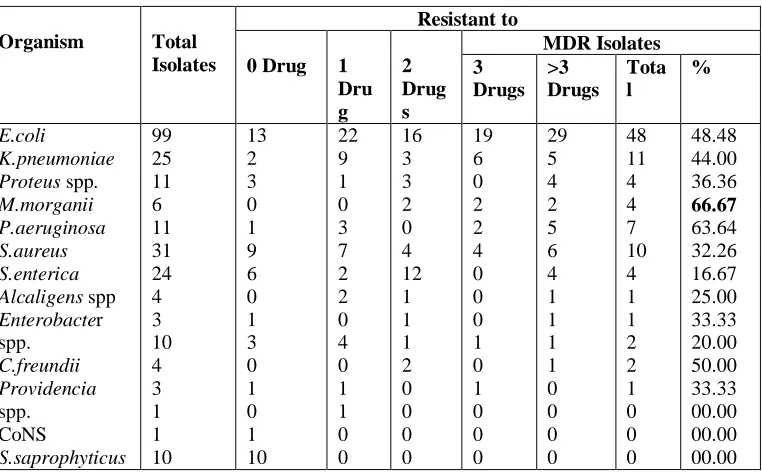
Altogether, 16 different bacterial species were isolates from different specimens processed with E.coli, 99(40.41%), S.aureus
31(12.65%), K.pneumoniae(10.20%) and S.enterica(9.80%) being the most frequently isolated species. Forty eight E.coli,11
K.pneumoniae and 10 S.aureus were the major contributor of
MDR bacterial strains
Table 2: Status of Anibiotic resistance among MDR isolates
Organism Total
Isolates
Resistant to
0 Drug 1
Dru g 2 Drug s MDR Isolates 3 Drugs >3 Drugs Tota l % E.coli K.pneumoniae
Proteus spp.
M.morganii P.aeruginosa S.aureus S.enterica
Alcaligens spp
[image:2.612.119.500.496.733.2]ISSN 2250-3153
S.pneumoniae S.pyogenes K.oxytoca
2 1 1 0 0 0 0 00.00
Total 245 51 53 45 35 59 95 40.25
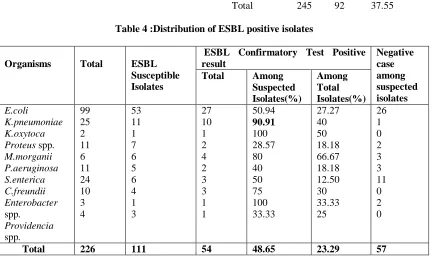
A hundred and eleven isolates were subjected to ESBL screening using Ceftriaxone(30mcg), Aztreonam(30mcg), Ceftazidime(30mcg) and Cefotaxime(30mcg). Out of these isolates, 54(22.04%) bacterial isolates were ESBL positive. Among the 54 ESBL positive isolates, K.pneumoniae i.e. 10/11(90.91%),M.morganii i.e. 4/6(66.67%) and E.coli
i.e. 27 /53 (50.94%) were predominant.(Table 4)
[image:3.612.118.503.73.122.2]Antimicrobial Susceptibility pattern of ESBL producing isolates showed 94.74% susceptibility to Imipenem but they were highly resistant towards third generation Cephalosporins.
Table 3: Distribution of MDR in different Clinical Specimens
Specimens Total Mdr
No.
% p-value
Urine 143 66 46.2
0.029
Blood 25 5 20
Sputum 29 5 17.2
Pus 33 11 33.3
Body fluids 7 2 28.6
HVS 7 3 42.9
Others 1 0 0.00
Total 245 92 37.55
Table 4 :Distribution of ESBL positive isolates
Organisms Total ESBL
Susceptible Isolates
ESBL Confirmatory Test Positive result
Negative case among suspected isolates
Total Among
Suspected Isolates(%)
Among Total Isolates(%) E.coli
K.pneumoniae K.oxytoca
Proteus spp.
M.morganii P.aeruginosa S.enterica C.freundii Enterobacter
spp.
Providencia
spp.
99 25 2 11 6 11 24 10 3 4
53 11 1 7 6 5 6 4 1 3
27 10 1 2 4 2 3 3 1 1
50.94
90.91
100 28.57 80 40 50 75 100 33.33
27.27 40 50 18.18 66.67 18.18 12.50 30 33.33 25
26 1 0 2 3 3 11 0 2 0
Total 226 111 54 48.65 23.29 57
IV. DISCUSSION
Emerging antimicrobial resistance is being major cause to failure of empirical therapy, therefore, knowledge of the local prevalence of pathogens and their antimicrobial sensitivity patterns is essential to support clinicians in their routine work. The infection due to ESBL producing bacteria can result in inevitable failure of treatment and increased cost in patients receiving inappropriate antibiotic treatment. In the present study, an attempt was made to understand the prevalence of multidrug resistant and ESBLs isolates. The study was based on laboratory findings and includes the patients attending outpatient and inpatient departments of Janamaitri Hospital during a period from April 2014 to September 2014.
Out of total samples, only 17.50% showed growth whereas growth rate was high among females. MDR was shown by 24.08% isolates. Higher prevalence of MDR isolates was from urine and pus whereas majorly outpatients were involved. MDR might be the result of unrational use of antibiotics. Self-prescription by patients and incomplete course of treatment are probable contributing factors.
[image:3.612.92.537.268.530.2]non MDR isolates were positive. K.pneumoniae was major ESBL producer followed by M.morganii and E.coli.(Table 4).
The prevalence of ESBL producing isolates varies geographically. Although the prevalence of ESBL is not known, it is clearly increasing. In many parts of world, 10-40% of strains
of K.pneumoniae and E.coli express ESBLs7.
Among different clinical specimens, 30.07% of ESBL isolates were from urine. Similarly, female showed more ESBL isolates. Agegroup of 0-15 and 75 above was found to be more susceptible to ESBL. This may be due to low immunity of this age group. Prevalence of ESBL among outpatients and inpatients were 75.9% and 24.1% respectively. This indicates the ESBL to be common in communities. ESBL producers may have spread through communities, especially those with poor hygienic and
sanitation condition, through fecal contamination of soil and water, since most patients with ESBL producers may have had their gastrointestinal tracts colonized for a long period of time by these organisms as was reported by Paterson and Bonomo(2005)12.
Antibiotic susceptibility tests of ESBL producing isolates demonstrated high drug resistance. Analysis showed leading susceptibility rates to Imipenem (94.44%), Amikacin(72.22%), Ciiprofloxacin(40.74%) and Cotrimoxazole(38.89%). High resistance rates were observed to Amoxycillin, Aztreonam, Cephalosporins and Gentamicin Table 5). Al –Zarouni et al demonstrated high resistance rates to Fluoroquinolones and Cephalosporins and higher susceptibility rates to Carbapenems and Amikacin1.
Table 5: Distribution of Antibiotic Resistivity of ESBL positive Isolates
Antibiotics Total
Sensitive
Resistant
N
%
N
%
Amikacin Amoxycillin Cefixime Ceftriaxone Ceftazidime Aztreonam Ciprofloxacin Cotrimoxazole Gentamicin Nalidixic Acid Nitrofurantoin Imipenem Cefotaxime
54 54 54 54 54 54 54 54 54 54 54 54 54
39 4 3 0 1 3 22 21 15 18 20 51 2
72.22 7.41 5.56 0.00 1.85 5.56 40.74 38.89 27.78 33.33 37.04 94.44 3.70
15 50 51 54 53 51 32 33 39 36 34 3 52
27.78 92.59 94.44 100 98.15 94.44 59.26 61.22 72.22 66.67 62.96 5.56 96.30
ACKNOWLEDGMENTS
The author would like to acknowledge all the staffs of Janamaitri Hospital and others who directly and indirectly contributed to the completion of this work.
REFERENCES
[1] Al-Zarouni M, Senok A, Rashid F, Al-Jesmi SM, Panigrahi D(2008). Prevalence and antimicrobial susceptibility pattern of extended spectrum beta-lactamase producing Enterobacteriaceae in the United Arab Emirates. Med Princ Pract 17: 32-36.
[2] Bou G, Cervero G, Dominguez Ma, Querda C and Martinez-Beltran J(2000). Characterization of nosocomial outbreak caused by a multiresistant Acinetobacter baumanii strain with a carbapenem hydrolyzing enzyme, high
level carbapenem resistance in A.. baumanii is not due solely to presence of β-lactamases. J Clin Microbiol; 38: 3299-3305.
[3] Bush K, Jacoby GA and Medeiros AA(1995). A functional classification scheme for β-lactamases and its correlation with molecular structure. Antimicrobial Agents and Chemotherapy 39: 1211-1233.
[4] Centers for Disease Control National Nosocomial Study Site Definition Manual(1999). Center for Disease Control, Atlanta GA.
[5] Cheesebrough M(2006). District Laboratory Practice in tropical Countries Part 2 Cambridge University Press.
[6] Clinical and Laboratory Standard Institute(2014). Performance standards for antimicrobials Susceptibility testing :24thinformational supplement(M100-S23).CLSI, Wayne PA, USA.
[7] Dahal RK, Koirala J, Khadka P, Pokhrel BM, Tuladhar NR(2005). The Status of Multidrug Resistant and Extended Spectrum beta-lactamase producing Salmonella isolates fron Blood Culture. J Nepal Assoc Med Lab Sci, 7: 24-9.
production among Irish Clinical Enterobacteriaceae from 2004 to 2008: an observational study .BMC Infectious Diseases. 12: 116.
[9] Jacoby GA, Munoz-Price LS(2005). The new β-lactamases. New England Journal of Medicine 352:380-391.
[10] Jafar M, Heiman S, Soheila B, Shaho M and Enayat K(2012). Extended Spectrum beta lactamases in Urinary Isolates of Escherichia coli in Five Iranian Hospitals. Asian J Pharm Clin Res, 5, Suppl 2 :35-36
[11] Khanfar HS, Bindayna KM, Senok AC, Batta GA(2009). Extended Spectrum beta-lactamases(ESBL) in Escherichia coli and Klebsiella pneumoniae: trends in the hospital and community settings. J Infect Dev Ctries 3(4):295-299.
[12] Paterson DL, Bonomo RA(2005). Extended spectrum beta-lactamases: a clinical update. Clin Microbial Rev 18:657-686.
[13] Pokhrel BM, Koirala J, Mishra SK, Dahal RK, Khadka P and Tuladhar NR(2006). Multidrug resistance and extended spectrum beta-lactamase producing strains causing lower respiratory tract and urinary tract infection. Journal of Institute of Medicine 8(3): 30-34.
[14] Poudyal S, Bhatta DR, Shakya G, Upadhyaya B, Dumre SP, BudaG and Kandel BP(2011). Extended spectrum β-lactamase producing multidrug resistant clinical bacterial isolates at National Public Health Laboratory, Nepal. Nepal Med Coll J; 13(1) :34-38.
[15] Subha A, Ananthan S(2002). Extended spectrum beta-lactamase(ESBL) mediated resistance to third generation Cephalosporins among Klebsiella pneumoniae in Chennai. Indian J med Microbiol; 20(2): 92-95.
[16] Thomson JM and Bonomo RA(2005). The threat of antibiotic resistance in Gram egative pathogenic bacteria: β-lactams in peril! Current Opinion in Microbiology 8: 518-524.
AUTHORS
First Author –Jeny Pathak, M.sc Microbiology, National College , Khusibun, Nepal.