Comparative Analysis of AES and DES security
Algorithms
Sumitra
Lecturer (Computer science)
Advanced Institute of Technology & Management, Palwal
Abstract - In recent years network security has become an important issue. Cryptography has been used to secure data and control access by sharing a private cryptographic key over different devices. Cryptography renders the message unintelligible to outsider by various transformations Data Cryptography is the scrambling of the content of data like text, image, audio and video to make it unreadable or unintelligible during transmission. Its main goal is to keep the data secure from unauthorized access.
Index Terms: AES, DES, Cryptography, Symmetric key, Asymmetric key, Encryption, Decryption
I. INTRODUCTION
he goal of cryptography is to make it possible for two people to exchange a message in such a way that other people cannot
understand the message. There is no end to the number of ways this can be done, but here we will be concerned with methods
of altering the text in such a way that the recipient can undo the alteration and discover the original text. The original text is usually called “clear text” and the encoded or altered text is called “cipher text”. The conversion from clear text to cipher text is called “encoding” or “enciphering”, and the opposite operation is called “decoding” or “deciphering”. Information is an asset that
has a value like any other asset. As an asset, information needs to be secured from attacks. Now-a-days security becomes an essential feature in almost all area of communication. While sending a message to a person over an insecure channel such as
internet we must provide confidentiality, integrity, authenticity and non-repudiation [1]. These are the four major security aspects
[2] or goals.
There are a number of encryption algorithms those can be broadly classified into two categories: Symmetric/Private key
encipherment and Asymmetric/Public key encipherment [3, 4]. The difference between these two is that to communicate with n
people private key cryptography requires (n£(n¡1))=2 number of keys as shown in the Figure 1.1 whereas; public key
cryptography requires only n number of key pairs (one private and one public key) .
Public key cryptography discovered nearly two decades ago has revolutionized the way for the people to communicate securely
and in an authenticated way [1]. Any message (text, binary ¯les, or documents) that are encrypted by using the public key can only
be decrypted by applying the same algorithm, but by using the matching private key. Any message that is encrypted by using the
private key can only be decrypted by using the matching public key. This means that you do not have to worry about passing
public keys over the Internet (the keys are supposed to be public). A problem with asymmetric encryption, however, is that it is
slower than symmetric encryption. It requires far more processing power to both encrypt and decrypt the content of the message.
II. Basics
Cryptography is where security engineering meets mathematics. It provides us with the tools that underlie most modern security protocols. It is probably the key enabling technology for protecting distributed systems, yet it is surprisingly hard to do right[5,6].
Cryptography has often been used to protect the wrong things, or used to protect them in the wrong way. We’ll see plenty more
examples when we start looking in detail at real applications. Unfortunately, the computer security and cryptology communities
backgrounds (computer science versus mathematics) and different research funding (governments have tried to promote computer
security research while suppressing cryptography).
Cryptography is a method of storing and transmitting data in a form that only those it is intended for can read and process[9,10]. It
is a science of protecting information by encoding it into an unreadable format. Cryptography is an effective way of protecting
sensitive information as it is stored on media or transmitted through network communication paths.
Cryptography is the science of using mathematics to encrypt and decrypt data. Cryptography enables you to store sensitive information or transmit it across insecure networks (like the Internet) so that it cannot be read by anyone except the intend ed
recipient. While cryptography is the science of securing data, cryptanalysis is the science[7]. Of analyzing and breaking secure
communication. Classical cryptanalysis involves an interesting combination of analytical reasoning, application of mathematical
tools, pattern finding, patience, determination, and luck. Cryptanalysts are also called attackers. Cryptology embraces both
cryptography and cryptanalysis.
III. Types of Cryptosystems
There are three types of cryptosystems: Symmetric key, Asymmetric key and Hash Functions. Symmetric key encryption uses one
key to encrypt and decrypt. Asymmetric key encryption uses two keys; when one key is used to encrypt, the other is used to
decrypt. Hash functions create a message digest via an algorithm and use no key.
(a) Symmetric key Encryption
Symmetric key (also called private key or secret key) cryptography uses the same key to encrypt and decrypt. The name “private key” derives from the need to keep the key private. A major challenge associated with symmetric key cryptosystems is the secure
distribution of keys. Common symmetric key encryption algorithms include DES (the Data Encryption Standard) and AES (the
Advanced Encryption Standard).
(b) Asymmetric Key Encryption
Asymmetric key encryption (also called public key encryption) uses two keys: a public and a private key. Data encrypted with one
key can be decrypted only with the other key. Whitfield Diffie and Martin Hellman first publicly described this approach in November 1976in New Directions in Cryptography, where they announced: “We stand today on the brink of a evolution in
cryptography.”
IV. Comparison of AES, DES
a) AES, DES analyzing time based on different file size using Entropy on machine1(Intel Dual core 2.4 Ghz Processor with 1
GB RAM )
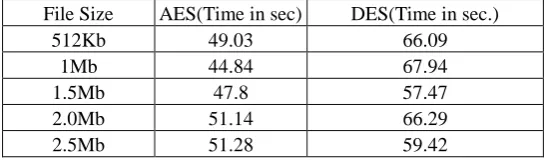
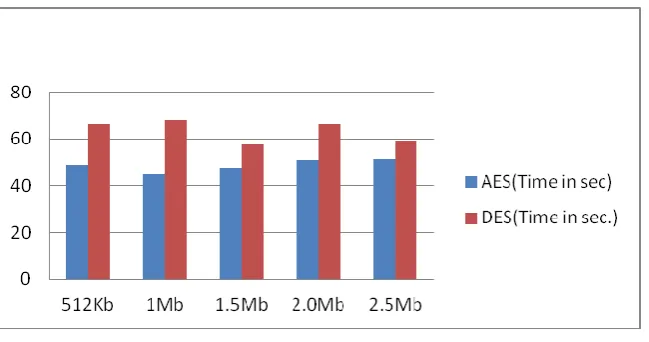
The time taken by AES, DES security algorithm on machine1 using entropy is shown below in the graph.This comparison is
done on machine1 with Intel Dual core 2.4 Ghz Processor with 1 GB RAM configuration.
File Size AES(Time in sec) DES(Time in sec.)
512Kb 49.03 66.09
1Mb 44.84 67.94
1.5Mb 47.8 57.47
2.0Mb 51.14 66.29
[image:2.595.161.436.680.760.2]2.5Mb 51.28 59.42
Fig. 5.1: Analyzing time based on entropy
b) AES, DES Analyzing time based on different file size using Known Plaintext on machine1(Intel Dual core 2.4 Ghz
Processor with 1 GB RAM)
A simulation test was carried out over various files of different size on machine1. This comparison is done on machine1 with
Intel Dual core 2.4 Ghz Processor with 1 GB RAM configuration.The result that was obtained is shown below in the graph.
File Size AES(Time in sec.) DES(Time in sec)
512Kb 24.68 34.64
1Mb 28.98 28.56
1.5Mb 23.38 30.47
2Mb 26.71 28.45
[image:3.595.110.458.333.537.2]2.5Mb 25.31 34.67
Table 5.2: Comparison based on known plaintext
Fig.5.2: Analyzing time based on known plaintext
C) AES, Analyzing time based on different file size using Entrophy on machine2(Intel core i3 processor with 2 GB RAM)
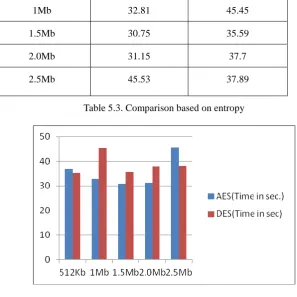
Here a machine with different configuration is used to carry out the time analysis between these algorithms. A number of files
with different sizes were fed into the simulation test. The result obtained after simulation are represented in the form of graph
below.
File Size AES(Time in sec.) DES(Time in sec)
[image:3.595.153.443.500.631.2]1Mb 32.81 45.45
1.5Mb 30.75 35.59
2.0Mb 31.15 37.7
[image:4.595.123.427.53.155.2]2.5Mb 45.53 37.89
[image:4.595.133.431.56.354.2]Table 5.3. Comparison based on entropy
Fig.5.3. Analyzing time based on entropy
d) AES,Des and SDES Analyzing time based on different file size using Known Plaintext on machine2(Intel core i3
processor with 2 GB RAM)
This graph has shown the time being utilized by AES, DES and SDES security algorithms on a machine2 using known plaintext. With the help of graph and table the comparison of AES, DES and SDES security algorithms is shown.
File Size AES DES
512Kb 18.5 21.02
1Mb 19 22.7
1.5Mb 20.52 21.35
2.0Mb 19.08 22.77
[image:4.595.166.431.614.778.2]2.5Mb 18.92 23.01
Fig.5.4: Analyzing time based on known plaintext
IV. CONCLUSION AND FUTURE SCOPE
From above work it is concluded that security is an important issue at present time .There are a no. of schemes are available for
security purpose This scheme is called cryptography. In cryptography we use key called public key and private key.With the help
of these keys we encrypt and decrypt the data fro make secure. Encrypted data is called ciphertext and decrypted data s called
plaintext. Cryptography is of two types : a) Symmetric b) asymmetric. In this paper two symmetric key security algorithms AES and DES are compared .Symmetric key algorithms are those algorithms which have same key for encryption and decryption. All
Also above work shows the performance of both algorithms .It is shown that both algorithms consume different times at different
machines. Different machines take different times for same algorithm over same data packet. From above explanation it is shown
that all algorithms have different speed. AES is more secure as compare to DES.
REFERENCES
[1] Yuliang Zheng. Digital signcryption or how to achieve cost(signature encryption) cost(signature) + cost(encryption). In CRYPTO '97: Proceedings of the 17th Annual International Cryptology Conference on Advances in Cryptology, pages 165{ 179, London, UK, 1997. Springer-Verlag.
[2] William Stallings. Cryptography and Network security: Principles and Practices. Prentice Hall Inc., second edition, 1999. [3] Paul C. van Oorschot Alfred J. Menezes and Scott A. Vanstone. Handbook of Applied Cryptography. CRC Press, 1996. [4] Behrouz A. Forouzan. Cryptography and Network Security. Tata McGraw-Hill, 2007.
[5] William J Caelli, Edward P Dawson, and Scott A Rea. Pki, elliptic curve cryptog-raphy, and digital signatures. Computers and Security, 18(1):47 { 66, 1999.}
[6] Lawrence C. Washington. ,Elliptic Curves: Number Theory and Cryptography.CRC Press, 2003.
[7] Surya A. E®endi R. Sutikno, S. An implementation of elgamal elliptic curves cryptosystems. pages 483 {486, Nov 1998.}
[8] G. JULIUS CAESAR , JOHN F. KENNEDY “Security Engineering: A Guide to Building Dependable Distributed Systems ,”pages 73. [9] \ CISSP All-in-One Certification Exam Guide,” 200075_ch08_HarrisX 11/30/01 10:22 AM Page 495”
[10] Phil Zimmermann ,An Introduction to Cryptography” The Basics of Cryptography”.
AUTHOR