2018 International Conference on Information, Electronic and Communication Engineering (IECE 2018) ISBN: 978-1-60595-585-8
Superresolution Elevation Angle Estimation in Multipath Environment
Using Passive Bistatic Radar
Pan-he HU
1,*, Qian ZHU
1, Zeng-ping CHEN
1,2and Qing-long BAO
11
Science and Technology on Automatic Target Recognition Laboratory, National University of Defense Technology, China
2
College of Information Engineering, Shenzhen University, China *Corresponding author
Keywords: Passive bistatic radar, Superresolution, Elevation angle estimation, Low signal-to-noise ratio, Limited snapshots, Iterative adaptive approach.
Abstract. Passive bistatic radar using uncooperative frequency agile phased array radar as transmitter brings many problems on the elevation angle estimation in the multipath environment, such as low signal-to-noise ratio(SNR), limited snapshots, poor resolution elevation angle estimation of closely spaced coherent signals. To solve that, a superresolution elevation angle estimation method is proposed in this paper. A sparse multipath signal model is reconstructed firstly and then the iterative adaptive approach is adopted to resolve the closely spaced coherent signals as well as obtain the elevation angle estimate. Simulation results confirm the effectiveness of the proposed method, and it still works well in the low SNR with limited snapshots.
Introduction
Passive bistatic radar(PBR) refers to the bistatic radar that exploits uncooperative illuminators of opportunity as the transmitter, which has attracted much attention in recent years. However, these researches mainly focus on civil illuminators, such as such FM radio[1], TV broadcasting[2], digital video broadcasting and digital audio broadcasting[3]. At present, it has been demonstrated that meterwave frequency agile phased array radars offer flexible beam scanning, improved detection probability, and higher sensitivity for stealth targets[4]. The use of frequency agile phased array radar as transmitter can extend the range of available illuminators of opportunity, while it also poses many challenges in PBR signal processing: 1) the frequency agility technology degrades the performance of long time integration algorithms, and hence the signal-to-noise ratio (SNR) is low, 2) the phased array technology make the space synchronization become difficult, thus the number of snapshots is limited. Especially, the direct signal of target and its multipath signal are coherent and always closely spaced in the mainlobe due to serious multipath propagation in the meterwave band. Thus, the elevation angle estimation of PBR in multipath environment can be summarized as resolution and estimation of the closely spaced coherent signals in the low SNR and limited snapshots.
multipath signal model is reconstructed. Secondly, the IAA algorithm is adopted to resolve the closely spaced coherent signals, and finally the elevation angle estimate is obtained. Simulation results prove the better behavior of the proposed method in the low SNR with limited snapshots.
Signal Model
[image:2.595.145.456.280.451.2]The constitution of the PBR system and multipath reflection are shown in Figure 1. In the dashed line box, the PBR system is consist of a surveillance antenna, a reference antenna and a receiver. The reference antenna points to the exploited illuminator to receive the transmitting signal, and the surveillance antenna is directed to the target to receive target signal. Particularly in multipath environment, as shown in the solid line box, the received signal is a mixture of the direct signal of target and its multipath signal, and both of which always lie inside the mainlobe of the surveillance antenna. Meanwhile, a meterwave band frequency agile phased array radar is exploited as uncooperative illuminator for PBR.
Figure 1. Constitution of PBR and multipath reflection.
For simplicity, we assume a moving target with the range Rd and height ht , and the signal model with multipath reflection can be expressed as
2 /
( ) d( ) r( ) ( ) (d) j R ( )r ( ) ( )
x t x t x t n t a e a s t n t (1)
where d is the target elevation angle and r is the reflection angle. a(d) and a( )r are the steering vector of the direct signal x td( ) and multipath signal x tr( ) , respectively. s t( ) is the envelop of the received signal and n t( ) is the additive Gaussian noise. R R1R2Rd is the geometric path length difference between the direct and the reflected paths, which is clearly analyzed in [9]. is the wavelength. is the reflection coefficient, which is expressed as
0
=
D s (2) where D is the divergence factor, s is scattering factor.0 is the Fresnel reflection coefficient, which can be derived as[10]
2
0 2
sin( ) cos ( )
sin( ) cos ( )
b
g g
b
g g
(3)
0 0
= 60
j (4) where 0 is the relative dielectric constant and 0 is the conductivity.
As we all known that the multipath effect in the meterwave band is very serious. The reflection coefficient changes with different range and height, and is almost equal to 1 in the low elevation angle area. In this situation, the direct signal and its multipath signal are coherent and spaced closely in the mainlobe or even half mainlobe, which bring many difficulties in resolving them and may yield a wrong elevation angle estimate.
Proposed Method
[image:3.595.200.391.262.384.2]In this section, an IAA-based superresolution method is proposed for PBR to address the problems encountered in the elevation angle estimation in multipath environment. Firstly, the surveillance antenna of PBR system is directed to an observation area to receive the target signal.
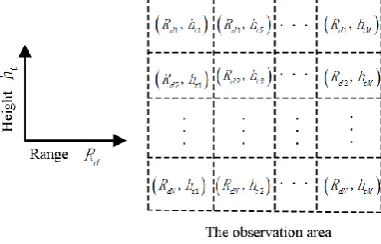
Figure 2. The range-height units divided in observation area.
In order to clearly depict the multipath signal model, the observation area is divided into range-height unit, which is shown in Figure 2. With the divided range-height unit, we can computed the theoretical elevation angle and reflection angle, and the multipath reflection coefficient based on (1)-(4). Then, the IAA algorithm is applied for PBR system to achieve superresolution elevation angle estimation. Without loss of generality, we assume Ksignals, from angles k, k1, ,K impinging
on a uniform linear array (ULA), which is composed of M sensors and separated by a distance d. Herein, the signal model can be rewritten as
1
( ) ( ) ( ) ( ) ( ) ( ) ( ) , 1, ,
K
k k p
k
t s t t s t t t N
x a n A ρ n (5)
where Np stands for the number of snapshots, =
1, ,
T K
ρ contains the information of reflection coefficient, A( )=
a( ),1 , (aK)
is the steering matrix and a(k)represents the steering vector of thek-th signal
1 2 sin( )
1
( )1, , , , e k
T
M j d
k
a (6) where superscript T represents matrix transpose.
Afterwards, the covariance matrix of the received signal can be expressed as
21
( ) ( ) ( ) ( ) ( )
K
H H H
k k k k k M M k
H H
E t t P a a I
R x x
AρPρ A
(7)
where superscript H denotes matrix conjugate transpose. A and P represent the reconstructed steering matrix and signal power matrix, and which can be rewritten as
( ),1 , (K), M
( ),1 , (K), (K1), , (K M )
2
blkdiag ,
M
P P I (9) where 2
M
is the noise power, IM is MM identity matrix, P is a diagonal K K matrix whose diagonal value 2
1
1
( ) ( )
Npk k
t p
P s t
N represents the corresponding signal power at each angle.
Then, we define the noise covariance matrix as
( ) ( ) ( ) H( ) H k P k k k k k
Q R a a (10) Here, the weight least square cost function can be expressed as
1 2 ( ) 1 1 1 ( ) ( ) ( ) ( ) ( ) ( ) ( ) ( ) ( ) ( ) k K
k k k k
K
H
k k k k k k k
k
x n s n
x n s n x n s n
Q aa Q a (11)
The IAA algorithm takes an iterative approach to minimize Eq.(11) and obtains the estimated values of s tk( )
1 1
( ) ( )
ˆ ( ) ( )
( ) ( ) ( )
H H k k k
k H H
k k k k k s t t
a Q x
a Q a (12)
Hence, using the matrix inversion lemma to yield
1 1
( )
ˆ ( ) ( )
( ) ( )
H H k k
k H H
k k k k s t t
a R x
a R a (13)
It is worthy note that the matrix P and Rare updated from the previous iteration instead of the receiveddata, thus the IAA algorithm is not sensitive to the number of snapshots, and can work well even in presence of limited snapshots. The termination condition of the iteration is that the relative error ˆ( ) ˆ( 1)
( ) ( )
i i-k k
s t s t of the i-th iteration is smaller than a specified threshold.
Finally, based on the above derivation, the elevation angle and multipath reflection angle can be jointly resolved and estimated by searching peaks in the beamwidth of mainlobe.
0 0
0 0
ˆ = arg max ˆ( ) , , +0.5
ˆ = arg max ˆ( ) , -0.5 , d r P P (14)
where 0 is the direction of the mainlobe, is the beamwidth of mainlobe and can be computed as
0
2 arcsin( sin )
Md (15)
Simulation Results
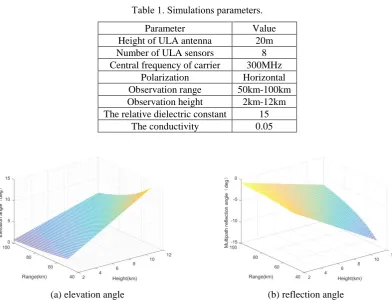
Table 1. Simulations parameters.
Parameter Value
Height of ULA antenna 20m
Number of ULA sensors 8
Central frequency of carrier 300MHz Polarization Horizontal Observation range 50km-100km Observation height 2km-12km The relative dielectric constant 15
The conductivity 0.05
[image:5.595.99.487.398.544.2]
(a) elevation angle (b) reflection angle Figure 3. The theoretical angle versus different range-height unit.
(a) amplitude (b) phase
Figure 4. The reflection coefficient versus different range-height unit.
Superresolution Performance in Mainlobe
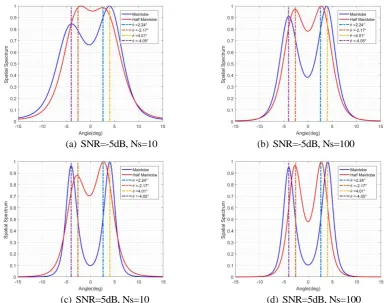
The resolution performance of proposed method is investigated with the direct signal and multipath signal, which are coherent and lie inside the mainlobe and half mainlobe, respectively. The mainlobe of the surveillance antenna is pointed to o
0=0
, and hence the beamwidth of mainlobe is computed as o
=12.75
. In the experiment, the SNR is set as -5dB and 5dB, the number of snapshots is set as 10 and 100. Here, we consider two moving targets located at the range-height unit of 80km, 4km and
100km,8km, and the multipath reflection coefficient can be easily computed as 0.3837 + 0.9017i and
0.9482 + 0.1836i. The elevation angle and the reflection angle are computed as
4.01 , 4.05o o
and
o o
(a) SNR=-5dB, Ns=10 (b) SNR=-5dB, Ns=100
[image:6.595.101.489.78.381.2]
(c) SNR=5dB, Ns=10 (d) SNR=5dB, Ns=100 Figure 5. Resolution in mainlobe and half mainlobe.
Estimation Performance of Elevation Angle
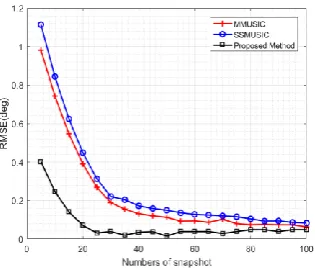
The elevation angle estimation performance of the proposed method is examined with respect to the SNR and the number of snapshots compared with spatial smoothing MUSIC (SSMUSIC) algorithm[5], and the modified MUSIC (MMUSIC)[6]. The performance is tested by the root mean square error (RMSE), which is defined as
21
ˆ RMSE (1 ) ( )
L d dl
[image:7.595.344.502.86.221.2]
Figure 6. The RMSE of elevation angle estimation versus SNR.
Figure 7. The RMSE of elevation angle estimation versus number of snapshots.
Summary
This paper presents an IAA-based superresolution method for PBR to address the problems of elevation angle estimation in multipath environment, in which a meterwave frequency agile and phased array radar is exploited as uncooperative transmitter. The sparse multipath signal model is reconstructed and thus the IAA-based superresolution method is proposed to jointly resolve and estimate the direct signal and multipath signal, which are coherent and closely spaced in the mainlobe. Numerical simulation results provide the proof that the proposed method can achieve a better performance in elevation angle estimation over the existing high resolution algorithms, and can be a viable solution for PBR system engineering. Furthermore, the study of the real-time PBR signal processing algorithm is the future work.
Acknowledgement
This work was supported by the National Natural Science Foundation of China under Grant 61401489.
References
[1] Howland P E, Maksimiuk D, Reitsma G. FM radio based bistatic radar. IEE Proc. Radar Sonar and Navigation, 152(2005) 107-115.
[2] Griffiths H D, Long N R W. Television based bistatic radar, IEE Proceedings. Communications, Radar and Signal Processing, 133(1986) 649-657.
[3] Coleman C J, Yardley H. Passive bistatic radar based on target illuminations by digital audio broadcasting. IET Radar Sonar, Navigation, 2(2008) 366-375.
[4] Wu J Q, Jin X. Some issues in the development of metric surveillance radar. IEEE International Conf. on Radar, (2013) 6-10.
[5] Pillai S U, Kwon B H. Forward/Backward spatial smoothing techniques for coherent signal identification. IEEE Trans. acoust. speech signal proc., 37(1989) 8-15.
[6] Kundu D. Modified MUSIC algorithm for estimating DOA of signals. Signal Processing, 48(1996) 85-90.
[8] Barcelo M, Vicario J L, et al. A reduced complexity approach to IAA beamforming for efficient DOA estimation of coherent sources. Eurasip Journal on Advances in Signal Proc., (2011) 1-16.
[9] Ahn S, Yang E, Chun J, et al. Low angle tracking using iterative multipath cancellation in sea surface environment. IEEE Radar Conference. (2010)1156-1160.