Tree-Adjunct Grammatical Evolution
Eoin Murphy, Michael O’Neill, Edgar Galv´an-L´opez and Anthony Brabazon
Abstract— In this paper we investigate the application of tree-adjunct grammars to grammatical evolution. The standard type of grammar used by grammatical evolution, context-free grammars, produce a subset of the languages that tree-adjunct grammars can produce, making tree-adjunct grammars, ex-pressively, more powerful. In this study we shed some light on the effects of tree-adjunct grammars on grammatical evolution, or tree-adjunct grammatical evolution. We perform an analytic comparison of the performance of both setups, i.e., grammatical evolution and tree-adjunct grammatical evolution, across a number of classic genetic programming benchmarking prob-lems. The results firmly indicate that tree-adjunct grammatical evolution has a better overall performance (measured in terms of finding the global optima).
I. INTRODUCTION
Grammatical evolution (GE) [21], [2], since its inception, has had much success. A large proportion of this success can be attributed to how easily GE can be extended. Many different grammars have been explored with GE, includ-ing shape grammars[22], attribute grammars[1] and logic grammars[14]. In this paper we explore the utility of tree-adjunct grammars (TAGs) in GE.
The goal of this study is to introduce tree-adjunct gram-matical evolution (TAGE), which extends standard GE by incorporating TAGs in its operation. We show how the incorporation of TAGs in GE translates into a more effective GE to find solutions on a number of problems with very different landscape features.
As outlined in [13], the set of languages produced by context-free grammars (CFGs), known as context-free lan-guages (CFLs), are strictly included in the set of lanlan-guages produced by TAGs, known as tree-adjunct languages (TALs), which in turn are strictly included in indexed languages, which are finally strictly included in context-sensitive lan-guages. Consequently, this indicates that TAGs are the next step for GE in terms of choice of grammar type.
The rest of the paper is structured as follows. A brief overview of GE and it’s genotype to phenotype mapping process is given in the following section, including an introduction into TAGs. The approach taken in this study to utilise TAGs in GE is outlined in Section III. The paper continues by describing the experimental setup in Section IV. The results and discussion are presented in Section V, before closing with some conclusions and future work in Section VI.
Eoin Murphy, Natural Computing Research and Applications Group, University College Dublin, Ireland. [email protected]
Michael O’Neill, Natural Computing Research and Applications Group, University College Dublin, Ireland. [email protected]
Edgar Galv´an-L ´opez, Natural Computing Research and Applications Group, University College Dublin, Ireland. [email protected]
Anthony Brabazon, Natural Computing Research and Applications Group, University College Dublin, Ireland. [email protected]
II. BACKGROUND
A. Grammatical Evolution
GE is a grammar-based approach to genetic programming (GP) [15], [24]. GE combines principles from genetics and molecular biology, the genotype to phenotype mapping, with the representational power of formal grammars, the ability to change the behaviour of the algorithm by simply changing the structure of the grammar. The grammar, a CFG which is usually written in Backus-Naur form, can be easily modified to output programs of an arbitrary language, something that is not a trivial task in other forms of GP. In addition to this, GE’s genotype to phenotype mapping means that search operators can be applied to the genotype (usually an integer or binary chromosome), as well as the ability to apply standard GP search operations to the phenotype as well, therefore extending the search capabilities of standard GP.
1) Genotype to Phenotype Map: GE’s genotype to
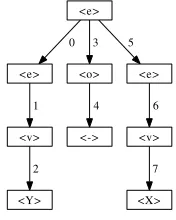
phe-notype mapping constructs a derivation tree using a chromo-some and a grammar; it operates as follows (see Figure 1 for the grammar and chromosome used for this example): Mapping begins with the start symbol, usually the first symbol declared in the grammar,<e>. The first codon (or integer value) is read from the chromosome, in this case it is the value 12. The number of production rules for the start symbol are counted,2,<e><o><e>and<v>. Which rule to choose is decided according to the mapping function i mod c, where i is the value of the codon read from the chromosome and c is the number of choices available, e.g, 12 mod 2 = 0, therefore we chose the zero-th rule and<e>is expanded to<e><o><e>. This expansion forms a partial derivation tree with the start symbol as the root, attaching each of the new symbols as child nodes of this root. The next symbol to expand is the first non-terminal leaf node discovered while traversing the tree in a depth first manner. However, it should be noted that there is on-going study into variations on the method used to choose which node to expand next [18], [19]. In standard GE this will be the left-most<e>in the tree. The next codon is read and has a value of 3, expanding this <e>to <v> and growing the tree further. The next symbol is the<v>previously expanded and the next codon has a value of7,7 mod 2 = 1, so the rule at index 1,Y, is chosen, and so on.
This continues until either there are no more non-terminal leaf nodes left to expand, or until there are no codons left to read, i.e., the end of the chromosome has been reached. If there are no codons left to read and derivation is not com-plete, with non-terminal leaf nodes still in the derivation tree, derivation can proceed in one of a few different manners. For example, assign a bad fitness to the individual, so it is highly
Grammar:
<e> ::= <e> <o> <e> | <v> <o> ::= + |
-<v> ::= X | Y
[image:2.612.309.561.54.169.2]Chromosome: 12,3,7,15,9,10,14
Fig. 1. Example context-free grammar and integer chromosome.
<e>
<e> 0
<o> 3
<e> 5
<v> 1
<-> 4
<v> 6
<Y> 2
<X> 7
Fig. 2. GE derivation tree - The nodes are labeled with symbols from the
grammar and the edges are labeled with the order of expansion.
unlikely that this individual will survive the selection process to the next generation. Another approach can be the use of wrapping. The chromosome maybe reused for a predefined number of times or wrappings. If after the wrapping limit is reached and we still have an invalid individual, we could then assign it a bad fitness.
It should be noted that other approaches might be em-ployed, such as choosing only those rules which produce terminals from the grammar when a specific derivation tree depth [4] or number of wrappings has been reached. Ensuring that the individuals are valid, i.e., they have no non-terminal leaf nodes. The complete derivation tree for this example is shown in Figure 2.
B. Tree-Adjunct Grammars
TAGs, which were introduced first in [12], are a tree gen-erating system. Originally making use of only one compo-sition operation, adjunction, TAGs have since been renamed as tree-adjoining grammars and extended to use a second composition operation, substitution. TAGs have been utilised with much success (see [11], [16] and more recently [13]). In particular, in the field of GP in the form of TAG3P [6], [7], [9], [17], [5], [8]. It should be noted that TAGs (only adjunction) and tree-adjoining grammars (substitution also) are, formally, as powerful as each other, that is to say, they produce the same set of languages [6]. The inclusion of substitution allows for a more compact formalism, i.e., less trees [13].
This paper is concerned primarily with the original def-inition of TAGs as outlined in [12], with adjunction as the only composition operation. With this in mind, married with the clearer definition of tree-adjoining grammars presented in [13], we present the following definition of TAGs. A TAG is defined by a quintuple(T , N, I, A, S)where:
1) T is a finite set of terminal symbols;
2) N is a finite set of non-terminal symbols:T∩N =∅; 3) S is the start symbol:S∈N;
<v>
X <e>
(a) α0
<e>
<e> <o> <e>*
<v>
-Y
(b)β7
<v>
X <e>
<e> <o> <e>
<v>
-Y
(c) Derived Tree
Fig. 3. Composition operation: Adjunction.β7 is adjoined toα0 atα0’s
root node, or address0.
4) I is a finite set of finite trees. The trees in I are calledinitial trees(orαtrees). An initial tree has the following properties:
• the root node of the tree is labelled withS; • the interior nodes are labeled with non-terminal
symbols;
• the leaf nodes, or the nodes along the frontier are labeled with terminal symbols;
5) Ais a finite set of finite trees. The trees inAare called
auxiliary trees (orβ trees). An auxiliary tree has the
following properties:
• the interior nodes are labeled with non-terminal symbols;
• the leaf nodes, or the nodes along the frontier are all labeled with terminal symbols apart from one node; this node is labeled with the same non-terminal symbol as the root node and is known as the foot node; the convention outlined in [13] is followed and foot nodes are marked with an asterisk (*).
An initial tree is meant to represent a minimal non-recursive structure or derivation tree produced by the grammar, i.e., it contains no recursive non-terminal symbols. Inversely, an auxiliary tree of type X represents a minimal recursive structure, which allows recursion upon the non-terminal X during derivation [16]. The set of initial trees and the set of auxiliary trees together form the set ofelementary trees,E; whereI∩A=∅ andI∪A=E.
During derivation, composition operations are used to join elementary trees together. The adjunction operation takes an initial or derived tree a, creating a new derived tree, d by combiningawith an auxiliary tree,b. A subtree,cis selected froma. The type of the subtree (the symbol at its root), X, is used to select an auxiliary tree,b, of the same type.c is removed temporarily froma.bis then attached toaas a sub-tree in place ofcandcis attached tobby replacingc’s root withb’s foot node (Figure 3 depicts this idea). An example of TAG derivation is provided in Section III.
III. TREE-ADJUNCTGRAMMATICALEVOLUTION
[image:2.612.130.218.132.242.2]produced by CFGs [13]. Unlike CFGs, TAGs can also gen-erate some context-sensitive languages [6], [13]. In addition to this, it has been shown that for every CFG there is a TAG that is both weakly and strongly equivalent to it[10]. A grammar is weakly equivalent to another if it can produce the same language as the other, whereas a grammar is strongly equivalent only if it can represent each of the words in that language using the same structures as the other, i.e., derivation trees.
In order to incorporate the power of TAGs into GE, TAGE was developed. A number of steps were to be taken in order to achieve this. The first was to translate current CFGs used by GE into TAGs which could be used by TAGE. Secondly, an algorithm for derivation had to be developed in order to successfully map from genotype to phenotype using a TAG.
A. CFG to TAG
There is a special type of TAG called a lexicalised TAG (LTAG). A lexicalised grammar has two defining properties: • it consists of a finite set of structures, each with at least
one terminal symbol, known as the anchor;
• it has at least one operation for composing the structures together.
The TAGs referenced in this study are LTAGs since all the leaf nodes of the elementary trees are labeled with terminal symbols (apart from the foot nodes). The phrases TAGs and LTAGs will be inter-changeable throughout the remainder of this paper and will both represent lexicalised tree-adjunct grammars.
In [13], Joshi and Schabes state that for a “finitely
ambiguous CFG1 which does not generate the empty string,
there is a lexicalised tree-adjunct grammar generating the
same language and tree set as that CFG”. Joshi and Schabes
also provided an algorithm for generating such a TAG. This algorithm is outlined below.
Take a finitely ambiguous CFG,G={N, T, P, S}, where: N is the set of non-terminal symbols;T is the set of terminal symbols;P is the set of production rules; andS is the start symbol. Construct a directed graph, g, from G, where the nodes of the graph are labeled with symbols from N and the edges of the graph are labeled with the productions from P which map between them. Then find the set of minimal cycles,c, in the graph such that they contain no other cycles within them. The productions in P must then be divided into two separate sets; R is the set of recursive productions (a production is recursive if it is part of a cycle, ci); and N R is the set of non-recursive productions in the grammar.
Using S as the root node, create the set of all possible derivation trees using only the productions in N R. This is the set of initial trees, I. Then create A, the set of auxiliary tree, as an empty set. A=∅.
For each nodenj, in each of the cyclesci, if there is a tree in I∪A that contains a node which has the same label as nj, create the set of all possible derivation trees, using only
1A grammar is said to befinitely ambiguousif all finite length sentences
produced by that grammar cannot be analysed in an infinite number of ways.
Algorithm 1 Generating a TAG from a CFG
Require: G={N, T, P, S} g=createDiGraph(G); c=f indBaseCycles(g);
R=getRecursiveP roductions(P, g); N R=P−R;
I=generateInitialT rees(S, N R); A=∅
for all ci inc do for all nj inci do
E=I∪A;
ifa tree inEhas a node labeled the same asnj then
A=A∪generateAuxiliaryT rees(nj, ci, N R)
end if end for end for
the productions inN R and the current cycle, where thenj is the root node, and the leaf node which has the same label, as the foot node. Add this set of trees toA. See Algorithm 1 for a summary of this algorithm.
An example of a TAG produced by Algorithm 1 can be seen in Figure 4, and was generated from the CFG shown in Figure 1.
B. Derivation in TAGE
Derivation in TAGE is different from derivation in GE in that it is a two step process, first a derivation tree is formed, and from that the derived tree is produced. The derivation tree is different to that of standard GE, as it is a tree where each node itself is representative of an elementary tree. The edges of this derivation tree are labeled with node addresses. These addresses lead to nodes in the elementary trees which label the tail nodes of the edges. It is on these nodes that composition operations are to be applied using the trees represented by the head nodes of the edges. The derived tree in TAGE is the same as standard GE’s derivation tree. It is the tree of symbols resulting from the composition operations listed in the derivation tree. Examples of both types of trees can be seen in Figure 5.
The derivation tree in TAGE, the tree of trees, is important when dealing with TAGs if you intend to do any operations on the tree itself. For example, sub-tree crossover on the de-rived tree could result in altering an elementary tree, the most basic structure in a TAG. These operations should instead be used on the derivation tree, allowing whole elementary trees to be moved.
1) Example Derivation: An example of derivation in
TAGE follows. It is similar to the algorithm used in [7]. Given the TAG G, where
<e>
<v>
X
(a)α0
<e>
<v>
Y
(b)α1
<e>
<e>* <o> <e>
+ <v>
X
(c)β0
<e>
<e>* <o> <e>
+ <v>
Y
(d)β1
<e>
<e>* <o> <e>
- <v>
X
(e)β2
<e>
<e>* <o> <e>
- <v>
Y
(f)β3
<e>
<e> <o> <e>*
+ <v>
X
(g)β4
<e>
<e> <o> <e>*
-<v>
X
(h)β5
<e>
<e> <o> <e>*
+ <v>
Y
(i) β6
<e>
<e> <o> <e>*
-<v>
Y
[image:4.612.55.555.51.144.2](j)β7
Fig. 4. I (α) and A (β) sets of the TAG produced from the CFG shown in Figure 1 using Algorithm 1 described previously.
function as GE, i mod c. From I, the set of αtrees, 12 mod 2 = 0, the zero-th tree is chosen, α0, and set as the root node of tree, t, the derivation tree, see Figure 5(a).
Next we enter the main stage of the algorithm. A location to perform adjunction must be chosen. The setNis created of the adjunctable addresses2 available within all nodes(trees) contained within t. In this case N = {α00}, so a codon is read and an address is selected from N,2 mod 1 = 0 indicates which address to choose, N[0]. Adjunction will be performed atα00, or index0of treeα0,<e>. An auxiliary tree is now chosen from the set of trees inA that are of the typel, i.e., the label of their root node isl, where lis the label of the node adjunction is being performed at. In this case l = <e>. Since there are 8 such trees in A,3 mod 8 = 3, β3 is chosen. This is added to t as a child of the tree being adjoining to, labeling the edge with the address 0, see Figure 5(b). The adjunctable addresses in β3 will be added toN on the next pass of the algorithm. This process, the main part of the algorithm, is repeated until all remaining codons have been read. The resulting derivation and derived trees from each stage of this process can be seen in Figure 5. If the end of the chromosome is reached mid-execution, the operation is aborted and the individual is marked as valid since the derived tree has no non-terminal leaf nodes and the resulting program can always be evaluated.
IV. EXPERIMENTALSETUP
The focus of this study is to compare the performance of standard GE to TAGE, and to analyse the results in order to discover whether TAGs affect the ability of GE to find correct solutions.
The GEVA v1.1 software [20] was used to conduct the experiments for this study. It was extended to allow the use of TAGs. The evolutionary parameters adopted for all the benchmark problems described below are presented in Table I. A short initial chromosome length was selected (15 was a randomly selected value) due to TAGE’s use of the entire chromosome during derivation, unlike standard GE where the amount of the chromosome used varies. This provides TAGE with the ability to attempt to find short solutions to the problems if they exist. Each run was evolved for 200 generations, enabling longer solutions to be explored
2An adjunctable address in a tree is the breadth first traversal index of a
node labeled with a non-terminal symbol, of which there is an auxiliary tree of that type, and that there is currently no auxiliary tree already adjoined to the tree at that index
TABLE I
GEPARAMETERS ADOPTED FOR EACH OF THE BENCHMARK PROBLEMS.
Parameter Value
Generations 200
Population Size 100
Initialisation Random
Initial Chromosome Size 15
Max Chromosome Wraps 0
Replacement Strategy Generational
Elitism 10 Individuals
Selection Operation Tournament
Tournament Size 3
One Point Crossover Probability 0.9
Integer Mutation Probability 0.02
if needed through chromosome growth by means of single-point crossover. Wrapping, as described in Section II-A, was disabled for all experiments.
A. Benchmark Problems
Standard GE was compared to TAGE using five classic benchmark problems taken from specialised GP literature. 100 independent runs were performed for each of the problems listed below using each setup. The CFGs used in standard GE and in TAGE to generate TAGs for each problem are shown in Figure 6.
Even-5-parity: This problem attempts to evolve the
five input even-parity boolean function, in which the best fitness is obtained when the correct output is returned for each of the25 test cases.
Santa Fe ant trail: In this problem a control program
is evolved to control the movements of an artificial ant on a 32x32 toroidal grid. The ant has use of several operations to collect 89 pieces of food located along a broken trail: foodAhead(), enabling the ant to check if there is food in the tile directly facing it, as well as right(), left() and move(). The latter three operations consume one unit of energy.
Symbolic Regression: The objective is to evolve the
<e>
<v>
X
(a) The initial treeα0.
<v>
X <e>
<e> <o> <e>
<v>
-Y
(b)β7adjoined toα0 at address 0.
<v>
X <e>
<v> <o>
-<e>
Y
<e>
<e> <o> <e>
+ <v>
Y
(c) β1adjoined toβ7 at address 0.
<v>
X <e>
<e> <o> <e>
<v> + <v>
Y
<o>
-<e>
Y
<e>
<e> <o> <e>
+ <v>
Y
[image:5.612.327.540.413.571.2](d)β6adjoined toβ7 at address 1.
Fig. 5. The derivation tree and corresponding derived tree at each stage of derivation in TAGE. The shaded areas indicate the new content added to the
tree at each step.
Six Multiplexer:This classic GP boolean function problem in
which evolution attempts to find correct two input and four output line boolean function. A perfect solution generates the correct output for a given input for all 64 test cases. Fitness is measured by how many test cases generate correct outputs.
Max: This problem, as described in [3], aims to evolve a tree whose growth is constrained by a depth limit, that when the tree’s phenotype is executed, returns the largest value possible. A function set of addition and multiplication operators are used as well as a terminal set of {0.5}. A max tree depth of 8 was used for the purposes of these experiments.
V. RESULTS ANDDISCUSSION
A. Performance
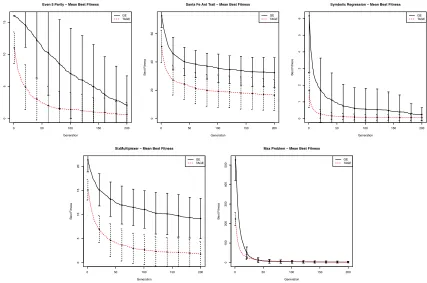
Compared to standard GE, TAGE performs better at find-ing the global optimum. Table II shows that for four out of the five problems tested TAGE finds more solutions than GE which achieve perfect fitness values across the 100 runs. This is reinforced by the fact that the mean best fitness at the final generation in each case is lower for TAGE than GE3. This is reflected in Figure 7, plotting the mean best
fitness values at each generation. TAGE repeatedly shows an ability to find fitter solutions in fewer generations than GE, effectively searching the solution space more efficiently.
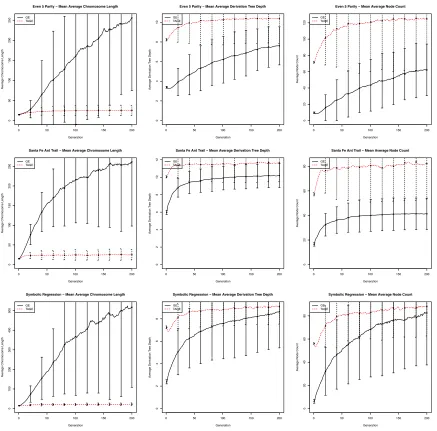
TAGE fails to improve upon the results found by GE for the Max problem. The plots in Figure 9 show a repeated trend across the Even-5 parity, Santa Fe Ant Trail and Symbolic Regression problems, the Six Multiplexer problem
3It is important to point out that GEVA minimises, so the lower the fitness,
the better.
TABLE II
ACOMPARISON OF RESULTS OBTAINED BYGEANDTAGEACROSS THE FIVE BENCHMARK PROBLEMS- THE BEST AND AVERAGE FITNESS VALUES AVERAGED ACROSS100RUNS FOR THE FINAL GENERATION. THE NUMBERS IN BOLD INDICATE THE BEST PERFORMANCE IN TERMS
OF FINDING THE GLOBAL OPTIMUM.
Best Fitness Average Fitness Successes
Mean (SD) Mean (SD) (/100)
Even-5
GE 2.08 (4.57) 6.15 (3.58) 79
TAGE 0.64 (1.90) 13.12 (0.67) 88
Santa Fe
GE 32.42 (10.59) 42.13 (9.76) 3
TAGE 16.53 (10.99) 69.32 (3.96) 12
Sym.Reg.
GE 0.253 (0.394) 8.700 (13.689) 44
TAGE 0.054 (0.171) 29.053 (9.145) 76
6 Multi.
GE 9.14 (4.19) 11.65 (3.69) 6
TAGE 1.77 (2.66) 16.87 (1.83) 63
Max
GE 2.31 (4.22) 199.88 (125.46) 0
TAGE 2.04 (1.52) 579.79 (335.25) 0
was omitted due to space restictions. The derived trees produced by TAGE are consistently deeper and larger in size than the derivation trees produced by GE. It is believed that larger trees are more likely to find a better solution [23]. The equivalent plots for the Max problem, shown in Figure 8, display the opposite of this trend, with deeper and larger trees being produced by GE than those produced by TAGE. With respect to this, it is not surprising that a similar increase in performance was not seen for the Max problem as was for the other four problems.
Even-5 parity grammar: Santa Fe ant trail grammar: Max grammar: <prog> ::= <expr> <prog> ::= <code> <prog> ::= <expr>
<expr> ::= <expr> <op> <expr> <code> ::= <line> | <code> <line> <expr> ::= <op> <expr> <expr> | ( <expr> <op> <expr> ) <line> ::= <condition> | <op> | <var>
| <var> <condition> ::= if(food\_ahead()==1) <op> ::= + | * | <pre-op> ( <var> ) { <opcode> } <var> ::= 0.5
<pre-op> ::= not else
<op> ::= "|" | & | ˆ { <opcode> }
<var> ::= d0 | d1 | d2 | d3 | d4 <op> ::= left(); | right(); | move(); <opcode> ::= <op> | <opcode> <op>
Symbolic Regression grammar: Six Multiplexer grammar:
<expr> ::= ( <op> <expr> <expr> ) <B> ::= (<B>) &&(<B>)
| <var> | (<B>) "||"(<B>)
<op> ::= + | - | * | !(<B>)
<var> ::= x0 | 1.0 | (<B>) ? (<B>) : (<B>)
| a0 | a1 | d0| d1 | d2 | d3
Fig. 6. Grammars in Backus-Naur form used for all the benchmark problems.
space. Operations applied to the genotype in TAGE, such as crossover and mutation, affect larger changes in the resulting phenotype than in GE, since the building blocks employed by TAGE, elementary trees, are larger than those employed by GE, individual symbols. As a result of this, TAGE allows access to new kinds of tree transformations that are not readily available with standard GE. This is evident when examining the mean average fitness values in Table II. The values for TAGE are much larger than those of GE, and in contrast to GE, they are much further away from their respective mean best fitness values. This indicates that while GE begins to converge when a local optimum is found, TAGE promotes diversity, and as such, deters convergence.
B. Chromosome Length
A common problem with GE is that while the number of codons used for derivation can remain quite small, the length of the chromosome, i.e., the total number of codons in the chromosome, can grow uncontrollably. This can sometimes cause applications to run out of memory. An unforeseen result of TAGE is that the chromosome length does not grow as it does in standard GE. This can be seen in the chromosome length plots in Figure 8 and Figure 9. One argument for why this occurs is that derivation in GE might only use a certain percentage of the chromosome, whereas derivation in TAGE uses the entire chromosome. As a result of this, every operation on the chromosome that affects its length has an effect on the fitness of that individual in TAGE, but in standard GE this might not always be the case. If the fitness of an individual is adversely affected by the operation in TAGE, then evolution might discard this new individual, preserving the original chromosome length. In standard GE if the fitness is not affected, i.e., the operation only affects an unused section of the chromosome, then this individual will survive on to the next generation where the probability that a chromosome lengthening operation that will not affect fitness is increased.
C. Limitations
As a result of making use of adjunction as the only com-position operation, it was discovered that TAGE could not
operate on complex grammars. During the translation process from CFG to TAG, the number of elementary trees grows exponentially with the complexity of the CFG, due to all possible derivations being explored, see Algorithm 1. With the introduction of substitution as a composition operation, this limitation could be overcome, since it allows for a much more compact grammar.
VI. CONCLUSIONS
This study presents a new form of GE called TAGE, which adopts TAGs in place of CFGs. It demonstrates that the use of TAGs in GE has a beneficial effect on GE’s ability to move through the solution search space and to find successful solutions.
In [7], [17] TAGs were found to have a positive effect on the performance of GP, results which are shown by this study to carry over into the field of GE, with interesting results and properties of its own, such as minimal growth of the chromosome, and the increase of connectivity of the search space which helps TAGE maintain diversity.
Plans for future work include continuing this study by ex-tending TAGE to work with tree-adjoining grammars and the substitution composition operation, allowing more complex grammars and problems to be explored, and to investigate further the implications of using TAGs in GE and for what reasons they perform better than CFGs in GE.
ACKNOWLEDGMENTS
This research is based upon works supported by the Science Foundation Ireland under Grant No. 08/IN.1/I1868.
REFERENCES
[1] R. Cleary. Extending Grammatical Evolution with Attribute Gram-mars: An Application to Knapsack Problems, M.Sc. Thesis, University Of Limerick, 2005.
[2] I. Dempsey, M. O’Neill, and A. Brabazon. Foundations in
Gram-matical Evolution for Dynamic Environments, 1st edition. Springer,
2009.
[3] C. Gathercole and P. Ross. An adverse interaction between crossover
and restricted tree depth in genetic programming. InGECCO ’96:
Proceedings of the First Annual Conference on Genetic Programming,
0 50 100 150 200
05
1
0
1
5
Even 5 Parity − Mean Best Fitness
Generation
Best Fitness
GE TAGE
0 50 100 150 200
02
0
4
0
6
0
Santa Fe Ant Trail − Mean Best Fitness
Generation
Best Fitness
GE TAGE
0 50 100 150 200
0123456
Symbolic Regression − Mean Best Fitness
Generation
Best Fitness
GE TAGE
0 50 100 150 200
0
5
10
15
20
SixMultiplexer − Mean Best Fitness
Generation
Best Fitness
GE TAGE
0 50 100 150 200
0
100
200
300
400
500
Max Problem − Mean Best Fitness
Generation
Best Fitness
[image:7.612.90.517.58.341.2]GE TAGE
Fig. 7. Mean best fitness plots (minimising) across 100 runs at each generation with error bars of one standard deviation - From left-right, top-bottom:
Even-5 parity, Santa Fe Ant Trail, Symbolic Regression, Six Multiplexer and Max.
0 50 100 150 200
0
500
1000
1500
2000
2500
Max Problem − Mean Average Chromosome Length
Generation
A
v
er
age Chromosome Length
GE TAGE
0 50 100 150 200
02468
1
0
Max Problem − Mean Average Derivation Tree Depth
Generation
A
v
er
age Der
iv
ation T
ree Depth
GE TAGE
0 50 100 150 200
0
50
100
150
200
Max Problem − Mean Average Node Count
Generation
A
v
er
age Node Count
GE TAGE
Fig. 8. Chromosome length, derivation tree depth and derivation tree size plots for the Max problem.
[4] M. Hemberg and U. OReilly. Extending Grammatical Evolution to
Evolve Digital Surfaces with Genr8. InGenetic Programming, pages
299–308. Springer Berlin / Heidelberg, 2004.
[5] N. Hoai. A Flexible Representation for Genetic Programming: Lessons from Natural Language Processing, PhD Thesis, University of New South Wales, 2004.
[6] N. Hoai and R. McKay. A framework for tree adjunct grammar guided genetic programming. pages 93–99. ADFA, 2001.
[7] N. Hoai, R. McKay, and D. Essam. Some experimental results with
tree adjunct grammar guided genetic programming. Lecture notes in
computer science, pages 228–237, 2002.
[8] N. Hoai, R. McKay, and D. Essam. Representation and structural
difficulty in genetic programming.IEEE Transactions on Evolutionary
Computation, 10(2):157–166, April 2006.
[9] N. Hoai, R. McKay, D. Essam, and R. Chau. Solving the symbolic regression problem with tree-adjunct grammar guided genetic
pro-gramming: the comparative results.Proceedings of the 2002 Congress
on Evolutionary Computation. CEC’02 (Cat. No.02TH8600), pages
1326–1331, 2002.
[10] A. Joshi. Tree adjoining grammars: How much context-sensitivity is
required to provide reasonable structural descriptions, chapter 6, pages
205–250. Cambridge University Press, New York, 1985.
[11] A. Joshi. An Introduction to Tree Adjoining Grammars. In
Mathemat-ics of Language, pages 87–114, Amsterdam, 1987. John Benjamins.
[12] A. Joshi, L. Levy, and M. Takahashi. Tree adjunct grammars.Journal
of Computer and System Sciences, 10(1):136–163, 1975.
[13] A. Joshi and Y. Schabes. Tree-Adjoining Grammars. Handbook of
Formal Languages, Beyond Words, 3:69–123, 1997.
[14] M. Keijzer, C. Ryan, M. O’Neill, M. Cattolico, and V. Babovic.
Adap-tive Logic Programming. InGenetic and Evolutionary Computation
Conference, 2001.
[15] J. Koza. Genetic Programming. MIT Press, 1992.
[16] A. Kroch and A. Joshi. The Linguistic Relevance of Tree Adjoining Grammar, Technical Report, University Of Pennsylvania, 1985.
[image:7.612.87.518.388.528.2]0 50 100 150 200
0
50
100
150
200
250
Even 5 Parity − Mean Average Chromosome Length
Generation
A
v
er
age Chromosome Length
GE TAGE
0 50 100 150 200
02468
1
0
Even 5 Parity − Mean Average Derivation Tree Depth
Generation
A
v
er
age Der
iv
ation T
ree Depth
GE TAGE
0 50 100 150 200
0
20
40
60
80
100
120
Even 5 Parity − Mean Average Node Count
Generation
A
v
er
age Node Count
GE TAGE
0 50 100 150 200
0
50
100
150
200
250
Santa Fe Ant Trail − Mean Average Chromosome Length
Generation
A
v
er
age Chromosome Length
GE TAGE
0 50 100 150 200
02468
1
0
1
2
Santa Fe Ant Trail − Mean Average Derivation Tree Depth
Generation
A
v
er
age Der
iv
ation T
ree Depth
GE TAGE
0 50 100 150 200
0
2
04
06
08
0
Santa Fe Ant Trail − Mean Average Node Count
Generation
A
v
er
age Node Count
GE TAGE
0 50 100 150 200
0
100
200
300
400
500
Symbolic Regression − Mean Average Chromosome Length
Generation
A
v
er
age Chromosome Length
GE TAGE
0 50 100 150 200
02468
Symbolic Regression − Mean Average Derivation Tree Depth
Generation
A
v
er
age Der
iv
ation T
ree Depth
GE TAGE
0 50 100 150 200
0
2
04
06
08
0
Symbolic Regression − Mean Average Node Count
Generation
A
v
er
age Node Count
[image:8.612.85.522.56.487.2]GE TAGE
Fig. 9. From left-right: chromosome length, derivation tree depth and derivation tree size plots for the Even Five Parity, Santa Fe Ant Trail and Symbolic
Regression problems (top-bottom). Plots for the Six Multiplexer problem were omitted due to space restrictions, but displayed similar trends to those above.
language bias, and genetic programming. InGenetic Programming,
pages 335–344. Springer, 2003.
[18] M. O’Neill, A. Brabazon, M. Nicolau, S. Garraghy, and P. Keenan.
πGrammatical Evolution. InGenetic and Evolutionary Computation
GECCO 2004, pages 617–629. Springer Berlin / Heidelberg, 2004.
[19] M. O’Neill, D. Fagan, E. Galvan, A. Brabazon, and S. McGarraghy. An analysis of Genotype-Phenotype Maps in Grammatical Evolution.
InEuroGP 2010, 2010.
[20] M. O’Neill, E. Hemberg, C. Gilligan, E. Bartley, J. McDermott,
and A. Brabazon. GEVA: Grammatical Evolution in Java. ACM
SIGEVOlution, 3(2):17–23, 2008.
[21] M. O’Neill and C. Ryan. Grammatical Evolution: Evolutionary
Automatic Programming in an Arbitrary Language. 2003.
[22] M. O’Neill, J. Swafford, J. McDermott, J. Byrne, A. Brabazon,
E. Shotton, C. McNally, and M. Hemberg. Shape grammars and
grammatical evolution for evolutionary design. In Genetic And
Evolutionary Computation Conference, 2009.
[23] R. Poli, W. Langdon, and S. Dignum. On the limiting distribution of program sizes in tree-based genetic programming. In M. Ebner, M. O’Neill, A. Ek´art, L. Vanneschi, and A. Esparcia-Alc´azar, editors, Proceedings of the 10th European Conference on Genetic
Program-ming, pages 193 – 204, Valencia, Spain, 2007. Springer.
[24] R. Poli, W. Langdon, and N. McPhee. A Field Guide To Genetic