Munich Personal RePEc Archive
Generalized Maximum Entropy
estimation of discrete sequential move
games of perfect information
Wang, Yafeng and Graham, Brett
The Wang Yanan Institute for Studies in Economics (WISE)
20 December 2009
Generalized Maximum Entropy Estimation of Discrete
Sequential Move Games of Perfect Information
∗
Yafeng Wang
and
Brett Graham
†Wang Yanan Institute for Studies in Economics (WISE)
Xiamen University
December 7, 2010
Abstract
We propose a data-constrained generalized maximum entropy estimator for discrete sequential move games of perfect information. Unlike most other work on the estimation of complete information games, the method we proposed is data constrained and requires no simulation or assumptions about the distribution of random preference shocks. We formulate the GME estimation as a (convex) mixed-integer nonlinear optimization prob-lem which can be easily impprob-lemented on optimization software with high-level interfaces such as GAMS. The model is identified with only weak scale and location normalizations. Monte Carlo evidence demonstrates that the estimator can perform well in moderately size samples. As an application we study the location choice of German siblings using the German Ageing Survey.
Keywords: Game-Theoretic Econometric Models, Sequential-Move Game,
General-ized Maximum Entropy, Mixed-Integer Nonlinear Programming.
JEL Classification Numbers: C01, C13, C35, C51, C72.
∗First version: Dec. 2009.
1
Introduction
This paper focuses on the estimation of discrete sequential-move games of complete
in-formation. The estimation of complete information sequential-move games have received
less attention than their incomplete information counterparts 1
. since they involve
mul-tidimensional integrals which incorporates a higher degree of computational complexity.
Recently, Bajari, Hong, and Ryan (2010) have provided a simulation-based estimator for
static complete information discrete games based on importance sampling. Estimation of
the general class of sequential-move (extensive form) games has been quite limited2
.
To the best of our knowledge, Maruyama (2009) is the only existing methodology
for estimating such games. This estimator is a modified version of the GHK simulator
(Geweke (1989, 1991), Hajivassiliou and McFadden (1998) and Keane (1990, 1994)) and
is essentially a maximum simulated likelihood (MSL) estimator. As is well known, MSL
is biased for any fixed number of simulations (e.g. Lee, 1995). In order to obtain √T
consistent estimators, one needs to increase the number of draws S so that √S
T → ∞.
Such an estimator requires large scale simulation making its computational burden high.
It also requires that the random preference shocks are normally distributed making its
scope for application limited.
We overcome these computational and theoretical constraints by using the generalized
maximum entropy (GME) approach3
.
Our data-constrained GME estimator is obtained by maximizing the
entropy-information function of Shannon (1948) subject to the model property constraints (such
as equilibrium conditions). Due to the structure of perfect information sequential-move
1
Studies of incomplete information simultaneous-move games (normal form) and dynamic games include (Bajari, Hong, Krainer, and Nekipelov,2010;Aguirregabiria and Mira,2007)
2
Berry(1992),Mazzeo(2002) andSchmidt-Dengler(2006) estimate some simplified sequential-move games with special game structures.
3
The GME principle was introduced by Golan, Judge, and Miller (1996), which is based on the classic maximum entropy (ME) approach of Jaynes (1957a,b). Further econometric studies us-ing the GME approach include (Golan, Judge, and Miller, 1996; Mittelhammer and Cardell, 1997;
game, the equilibrium conditions (specifically sub-game perfection) contain logical
connec-tions between the endogenous variables. The resulting constrained optimization problem
can be viewed as a mixed-integer nonlinear optimization problem, since the logical
state-ments can be reinterpreted as binary variables (Williams,1985). The problem can then be
solved with an efficient algorithm such as Branch and Bound (BB), Outer-Approximation
(OA) and or OA based Branch-and-Cut (B-Hyb). As shown below, with a linear payoff
function, our GME problem becomes a convex MINLP, which can be exactly solved by
many existing algorithms (Bonami, Kilinc, and Linderoth 2009).
Our approach makes several contributions to the literature on estimating game
theo-retic models of complete (perfect) information. First, by using the data constraints instead
of moment constraints we avoid the problems associated with multidimensional integrals
which makes the computational burden of our approach acceptable for most applications.
Although we focus on the sequential-move game, our approach can be extended to static
game of complete information 4
. Second, our approach makes no assumption about the
distributional form of random preference shocks. In contrast, existing estimators for
gen-eral complete information games, such as Bajari, Hong, and Ryan (2010) for the static
case and Maruyama (2009) for the sequential-move case require more restrictive
assump-tions. Bajari, Hong, and Ryan (2010) requires that the form of the distribution function
should be known. Maruyama (2009) requires that the distribution function should be
normal. Third, we reformulate the estimation problem as a MINLP since there are logical
connections between the endogenous variables under the equilibrium conditions. To the
best of our knowledge, our estimator is the first one to make use of MINLP in
economet-ric estimation problems5
. Our Monte Carlo results show the validity of this estimation
procedure, which can be extended to other estimation problem where logical statements
4
Golan, Karp, and Perloff(1998,2000) also make use of the GME to estimate the static game. Their constraints are moment based since they deal with the incomplete information case.
5
arise.
The greatest shortcoming of our approach is that it is difficult if not impossible to
construct the large sample properties of our estimators. As argued bySu and Judd(2008),
in order to compute standard errors, we need to formulate the exact Hessian matrix
of the objective function with respect to the structural parameters. Such work seems
difficult within the MINLP framework. However, since our Monte Carlo simulations
show consistency and asymptotic normality of the proposed estimator, we use the paired
bootstrap method to construct standard errors. Following the arguments of Horowitz
(1997,1998,2001), Campbell and Hill (2001) and Su and Judd(2008), this method may
consistently estimate the distribution of our estimator.
The paper is organized as follows. In section 2 we outline the general discrete
sequential-move game to be estimated and formulate its equilibrium conditions. A simple
2×2×2 sequential entry game which will be used for expositional purposes is described.
A briefly reviews of maximum entropy, generalized maximum entropy estimation and
(convex) mixed-integer nonlinear programming are presented in section 3. We discuss the
identification issue from the nature of the game structure and equilibrium conditions in
section 4. Our GME estimation for the discrete sequential-move game of perfect
infor-mation is also presented. Monte Carlo simulations are conducted in section 5. Section 6
concludes the paper.
2
The Model
There areT independent repetitions of a sequential-move game of perfect information. In
each game there arei= 1, ..., N players. Since we study sequential-move games of perfect
information we assume that player i chooses ai from the finite set of actions Ai after
observingi−1 actions. DefineA=×iAi and leta= (a1, ..., aN) denote a generic element
where R is the real line. We will sometimes drop the subscript t for simplicity when no
ambiguity would arise.
Following Bresnahan and Reiss (1990, 1991), assume that the vNM utility of playeri
can be written as:
ui(a, x, ǫi;θ) =fi(x, a;θ) +ǫi(a) (1)
wherea ∈AN. In Equation (1), player i’s vNM utility from outcome ais the sum of two
terms. The first term fi(x, a;θ) is a function which depends on outcome a, the vector of
actions taken by all of the players,x, the players’ characteristics and some other variables
which influence utility, and parametersθ, covariatesxare observed by the econometrician.
The second termǫi(a), is a random preference shock which reflects the information about
utility that is common knowledge to the players but not observed by the econometrician.
UnlikeMaruyama(2009), here the preference shocks depend on the entire vector of actions
a, not just the actions taken by player i. As argued by Bajari, Hong, and Ryan (2010),
this is a more general setting. For example, in a simple entry game, the unobserved
information about one player’s payoff to the econometrician may not only vary across
his own actions but also across the actions of other players. ǫi(a) are assumed to be
independent or have some known dependence. Let ǫi denote the vector of the individual
shocksǫi(a) andǫdenote the vector of all shocks. We will discuss more about the structure
of ǫi in the identification and estimation section.
A strategy for player i is a mapping from Ai−1
to Ai, where Ai = ×j≤iAj. The
equilibrium concept corresponding to sequential-move games of perfect information,
sub-game perfection (SPE), is a strategy profile in which every player expects no gain from
Formally, an action profile, aSP E = (aSP E
1 , ..., aSP Ei , ..., aSP EN ), is an SPE if
ui(aSP E, x, ǫi;θ)−ui(aSP E<i , ai, a∗>i(a SP E
<i , ai), x, ǫi;θ)≥0 (2)
for all i= 1, ..., N and all ai 6=aSP Ei ,
where a∗
>i(a≤i) is an action profile resulting from the subgame that starts from player
i+ 1 given the decisions of the preceding players, a≤i and where each player in the
sub-game uses the same strategy that generated the action profile aSP E. These equilibrium
conditions are defined recursively and the solution can be easily calculated by the
back-ward induction for any given set of parametersθ, observed covariates,x, and unobserved
shocks ǫ. Kuhn’s theorem ensures the existence to solutions of the inequality system (2),
and thus ensures that every finite sequential move game of perfect information has an
SPE. As noted by Berry and Tamer (2007), dealing with multiple equilibria complicates
the identification problem. Fortunately, every finite sequential-move game with perfect
information in which no player is indifferent between any two outcomes has a unique
sub-game perfect equilibrium (Osborne and Rubinstein (1994)). Since ǫi(a) has an atomless
distribution in our econometric model, we can ignore the indifference case.
Given this structure of the discrete choice sequential-move game, our task is to estimate
and draw an inference about the parameters of the payoff functions, θ, given a set of
observed action profilesao, some covariates which effect the payoffs, x, and an exogenous
decision order. Note that the actual payoff levels are latent variables.
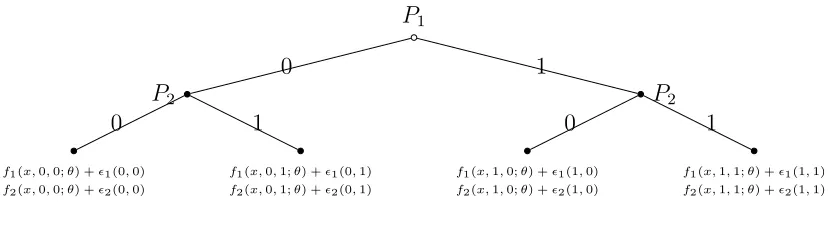
For the purpose of exposition, we provide a simple sequential entry game as an
ex-ample. There are two players who act as potential entrants in each of T markets. The
structure of this entry game is illustrated in figure a with payoffsu1 and u2 as defined in
P1
P2
f1(x,0,0;θ) +ǫ1(0,0)
f2(x,0,0;θ) +ǫ2(0,0)
0
f1(x,0,1;θ) +ǫ1(0,1)
f2(x,0,1;θ) +ǫ2(0,1)
1 0
P2
f1(x,1,0;θ) +ǫ1(1,0)
f2(x,1,0;θ) +ǫ2(1,0)
0
f1(x,1,1;θ) +ǫ1(1,1)
f2(x,1,1;θ) +ǫ2(1,1)
[image:8.595.99.513.130.246.2]1 1
Figure a: A simple entry game
to be an equilibrium outcome, we require the following three equilibrium conditions:
u1(x,0,0, ǫ1(0,0);θ)> u1(x,1,0, ǫ1(1,0);θ) if u2(x,1,0, ǫ2(1,0);θ)> u2(x,1,1, ǫ2(1,1);θ)
u1(x,0,0, ǫ1(0,0);θ)> u1(x,1,1, ǫ1(1,1);θ) if u2(x,1,0, ǫ2(1,0);θ)≤u2(x,1,1, ǫ2(1,1);θ)
u2(x,0,0, ǫ2(0,0);θ)≤u2(x,0,1, ǫ2(0,1);θ)
(3)
The equilibrium conditions required for the other three action profiles to be equilibrium
outcomes can be formulated similarly. Since the econometrician only observes the
equi-librium outcomes but not strategies, the equiequi-librium conditions can be viewed as logical
statements that are conditional on the off equilibrium path choices, which are unobserved
by the econometrician. We make use of MINLP to handle such logical statements.
3
Preliminary
We start by providing some background to the GME approach. Also, since our GME
estimator is obtained via a (convex) MINLP, we also provide a review of the MINLP
problem.
3.1
A Basic Review of GME
measure the uncertainty (state of knowledge) we have about the occurrence of a
collec-tion of events. Let x be a random variable with possible outcomes xs, s = 1,2, . . . , n,
with probabilities αs such that
P
sαs = 1. Shannon (1948) defined the entropy of the
distribution α= (α1, ...αn)′, as
H ≡ −X
s
αslnαs (4)
where 0 ln 0 ≡ 0. To recover the unknown probabilities α that characterize a given
data set,Jaynes(1957a,b) proposed maximizing entropy, subject to the available
sample-moment information and adding up constraints on the probabilities.
Within the classic ME framework, the observed moments are assumed to be exact.
To extend this approach to the problem with noise, the GME approach (developed by
Golan, Judge, and Miller (1996)) generalizes the ME approach by using a dual objective
(precision and prediction) function. We illustrate the GME approach via a linear model:
Y =Xβ+ε (5)
where Y is an N ×1 dependent variable vector, X is an N ×K matrix of explanatory
variables, β is a K×1 a vector of parameters, and ε is an N ×1 vector of disturbance
terms. The GME estimator of β in this general linear model is derived in the following
manner. First, ˆp= (ˆp′
problem:
max
p′ k,w′i
−
K
X
k=1
p′kln(pk)− N
X
i=1
ωi′ln(ωi) (6)
s.t. Y =XZp+V ω
1′pk = 1, ∀k
1′ω
i = 1, ∀i
pk>[0], ωi >0. ∀i, k.
Z and V are K ×KM and N ×N J matrices of support points for the β and ε vectors,
defined respectively, as:
Z =
z1′ 0 ... 0
0 z2′ ... 0
. . ... .
0 0 ... zK′
and V =
v1′ 0 ... 0
0 v2′ ... 0
. . ... .
0 0 . vN′ .
(7)
The M ×1 vector zk = (zk1, ...zkM)′ is such thatzk1 < zk2 ≤...≤zkM and it is assumed
that βk ∈ (zk1, zkM) for each k
6
. The vector vi = (vi1, ...viJ)′ is such that vi1 < vi2 ≤
... ≤ viJ and it is assumed that εi ∈ (vi1, viJ) for each i. Typically, each vi1 and
viJ will be uniformly and symmetrically distributed about zero and have the same J
dimensions. The actual bounds used for a given problem depend on the observed sample
as well as any available conceptual or empirical information7
. pk = (pk1, ...pkM)′ and
6
This parameter support is based on prior information or economic theory, for example, we might specify boundaries ofzk1= 0 andzkM = 1 when estimating the marginal propensity to consume. Without
any available prior information, we can specifyzk to be symmetric around zero, with large negative and
positive boundaries, for example,zk1=−zkM =−106.
7
ωi = (ωi1, ...ωiJ)′ are non-negative weight vectors that sum to unity. The GME estimator
is then given by ˆβ =Zpˆ. Golan, Judge, and Miller(1996) has a rigorous discussion of this
approach and applies it to a rich scopes of econometric problems, such as dynamic models,
model selection and discrete choice-censored problems. Mittelhammer and Cardell(1997)
establish consistency and asymptotic normality results for the GME estimator under
general regularity conditions.
3.2
A Basic Review of MINLP
Our GME estimator for the sequential-move game is essentially obtained by solving a
generalized disjunctive programming problem, which can be reformulated as an MINLP
problem. Here we provide a basic review of the general structure and of existing available
algorithms for solving MINLP problems. A simple algebraic representation of an MINLP
problem is as follows:
min
{x,y} Z =f(x, y) (8)
s.t. gj(x, y)≤0, j ∈J
x∈X, y ∈Y
wheref(·) andg(·) are differentiable functions,J is the index set of inequalities, andxand
y are continuous and discrete variables, respectively. In most applications the discrete
set Y is restricted to be binary. When both f(·) and g(·) are both convex functions,
this becomes a convex MINLP problem, which can be exactly solved via most existing
algorithms 8
. We take the technique of solving an MINLP problem as given.
(Golan, Judge, and Perloff 1997)
8
4
Estimation
In this section we first detail the assumptions required for our estimation method. We
then describe the estimator in detail before discussing its limitations and extensions.
4.1
Assumptions
We require three assumptions in order to use our estimation method. The first is
associated with the structure of the game tree, the second is associated with the ordinality
of utility, and the third is associated with the distributional properties pf the errors terms.
Assumption 1 (Exogenous Decision Order) The decision order of agents in the
sequential-move game is exogenous and known to the econometrician.
Although the exact decision order of agents is rarely observed, to estimate
sequential-move games we must assume a specific decision order.
Assumption 2 (Scale and Location Normalizations) The payoff of one action for
each player are fixed at a known constant.
From the equilibrium condition (2), any affine transformation of the payoffs does not
perturb the set of equilibria, so scale and location normalizations are necessary. The
scale normalization is subsumed in the following assumption about the distribution of
the error terms. Bajari, Hong, and Ryan (2010) argue that this restriction is similar to
the argument that we can normalize the mean utility from the outside good equal to a
constant, usually zero, in a standard discrete choice model.
P1
P2
0 0
0
0
θx+g(0,1) +ǫ2(0,1)
1 0
P2
θx+g(1,0) +ǫ1(1,0)
0 0
θx+g(1,1) +ǫ1(1,1)
θx+g(1,1) +ǫ2(1,1)
[image:13.595.103.506.130.324.2]1 1
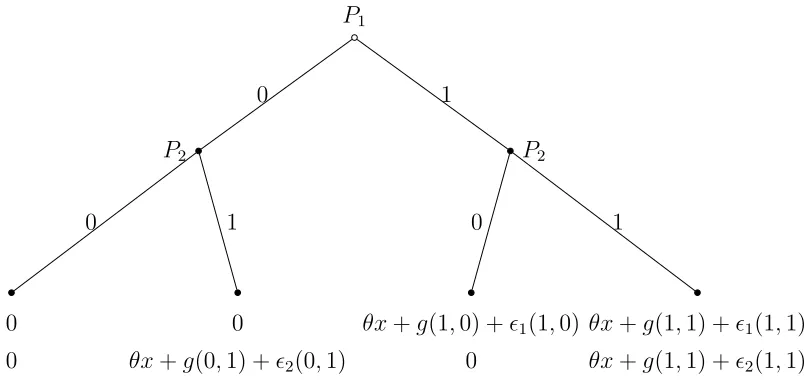
Figure b: A Reformulated Entry Game
Assumption 3 (Regularity Conditions of Random Shocks) The random
prefer-ence shocks ǫit(a) are i.i.d, are independent of state variables, and have zero mean
and finite variance, i.e. E(ǫit(a)) = 0, E(xǫit(a)) = 0,and V ar(ǫit(a))<∞.
Thei.i.d assumption is stronger than is required for our GME estimation. Any known
heteroskedasticity and dependence among random shocks can be handled within the our
framework. We will discuss this further after presenting our estimator. Our GME
esti-mator is semiparametric in the sense that it does not impose any parametric assumption
on the random shocks.
For the purpose of exposition, we apply GME estimation under assumption 1 to 3 to
the simple entry game which was introduced in section 2. We assume that utility takes
the form:
ui(x, a, ǫi;θ) = 1(ai = 1){θx+δg(a) +ǫi(a)} (9)
The location normalization sets the utility from out of the market to 0 and scale
normalization sets the parameter δ to 1 9
. The equilibrium conditions for action profile
(0,0) to be an SPE outcomes are:
Player1: 0> θx+g(1,0) +ǫ1(1,0) if 0> θx+g(1,1) +ǫ2(1,1)
0> θx+g(1,1) +ǫ1(1,1) if 0≤θx+g(1,1) +ǫ2(1,1)
Player2: 0> θx+g(0,1) +ǫ2(0,1)
(10)
The equilibrium conditions required for the other outcomes can be similarly derived.
4.2
The Estimator
In order to use the GME framework, we need to specify the support space Z for θ
and the support space v1, v2, v3, v4 for ǫ1(1,0), ǫ1(1,1), ǫ2(0,1) and ǫ2(1,1) respectively.
Without loss of generality, all are M × 1 vectors and v1 = v2 = v3 = v4 = v. The
corresponding probabilities are defined aspθ, ω1
t, ω
2
t, ω
3
t, ω
4
t such that:
θ =
M
X
m=1
pθmzm (11)
ǫ1t(1,0) = M
X
m=1
ω1
tmv,ǫ1t(1,1) = M
X
m=1
ω2
tmv, ǫ2t(0,1) = M
X
m=1
ω3
tmv, ǫ2t(1,1) = M
X
m=1
ω4
tmv (12)
The entropy-information function H is defined as
H=−
M
X
m=1
pθmln(pθm)−
T X t=1 M X m=1 ω1
tmln(ω
1
tm)− T X t=1 M X m=1 ω2
tmln(ω
2
tm) (13)
− T X t=1 M X m=1
ω3tmln(ω3tm)−
T X t=1 M X m=1
ωtm4 ln(ωtm4 )
9
Our GME estimator is obtained from the estimated probabilities which are the solution
to the following problem:
max {pθ
m,ωtm1 ,ω2tm,ω3tm,ωtm4 }
H subject to the corresponding constraints: (14)
If ao
t = (0,0)
0>PM
m=1p
θ
mzmxt+g(1,0) +PMm=1ω 1
tmvm if 0>PMm=1p
θ
mzmxt+g(1,1) +PMm=1ω 4
tmvm
0>PM
m=1p
θ
mzmxt+g(1,1) +
PM
m=1ω 2
tmvm if 0≤
PM
m=1p
θ
mzmxt+g(1,1) +
PM
m=1ω 4
tmvm
0>PM
m=1p
θ
mzmxt+g(0,1) +PMm=1ω 3
tmvm
(15)
If ao
t = (0,1)
0>PM
m=1p
θ
mzmxt+g(1,0) +PMm=1ω 1
tmvm if 0>PMm=1p
θ
mzmxt+g(1,1) +PMm=1ω 4
tmvm
0>PM
m=1p
θ
mzmxt+g(1,1) +PMm=1ω 2
tmvm if 0≤PMm=1p
θ
mzmxt+g(1,1) +PMm=1ω 4
tmvm
PM
m=1p
θ
mzmxt+g(0,1) +
PM
m=1ω 3
tmvm ≥0
(16)
If ao
t = (1,0)
PM
m=1p
θ
mzmxt+g(1,0) +
PM
m=1ω 1
tmvm ≥0
0>PM
m=1p
θ
mzmxt+g(1,1) +PMm=1ω 4
tmvm
(17)
If aot = (1,1)
PM
m=1p
θ
mzmxt+g(1,1) +PMm=1ω 2
tmvm ≥0
PM m=1p
θ
mzmxt+g(1,1) +
PM m=1ω
4
tmvm ≥0
and the normalization-additivity constraints:
PM
m=1p
θ m = 1
PM m=1ω
i
tm = 1,∀t∈T, ∀i∈ {1,2,3,4}
pθ m, ω
1
tm, ω
2
tm, ω
3
tm, ω
4
tm >0;∀t ∈T, m∈M
(19)
Note that for each repetition of the game, there is a unique equilibrium. Thus, the
constraints for each market are one of the four possible constraints listed in equations
(15) to (18). Our GME estimator of the structural parameterθ is
ˆ
θGM E = M
X
m=1
ˆ
pθmzm (20)
For this simple game, constraints (15) and (16) contain logical if-then statements
between endogenous variables. This programming is called disjunctive programming,
which can be reformulated as an MINLP. For example, consider the logical statements:
y1 <0 if x <0; y2 <0 ifx≥0 (21)
By introducing a zeroor one variable q, the statement (21) can be restated as:
x−K(1−q)<0; x+Kq ≥0; y1 < K(1−q); y2 < Kq; q={0,1}, (22)
where K is a positive variable which exceeds the bound of |x|, |y1| and |y2|. Such
re-formulations are discussed extensively in Williams (1985) and Raman and Grossmann
By introducing such a binary variable K, our GME method can be reformulated as:
max {pθ
m,ω1tm,ω2tm,ωtm3 ,ωtm4 ,qt}
H s.t. (23)
If aot = (0,0)
PM
m=1p
θ
mzmxt+g(1,1) +
PM
m=1ω 4
tmvm ≥ −Kqt
PM
m=1p
θ
mzmxt+g(1,1) +PMm=1ω 4
tmvm < K(1−qt)
PM
m=1p
θ
mzmxt+g(1,0) +
PM
m=1ω 1
tmvm < K(1−qt)
PM
m=1p
θ
mzmxt+g(1,1) +PMm=1ω 2
tmvm < Kqt
0>PM
m=1p
θ
mzmxt+g(0,1) +PMm=1ω 3
tmvm
if ao
t = (0,1)
PM
m=1p
θ
mzmxt+g(1,1) +PMm=1ω 4
tmvm ≥ −Kqt
PM
m=1p
θ
mzmxt+g(1,1) +
PM
m=1ω 4
tmvm < K(1−qt)
PM
m=1p
θ
mzmxt+g(1,0) +PMm=1ω 1
tmvm < K(1−qt)
PM
m=1p
θ
mzmxt+g(1,1) +PMm=1ω 2
tmvm < Kqt
PM
m=1p
θ
mzmxt+g(0,1) +
PM
m=1ω 3
tmvm≥0
and equation (17), (18)
normalization-additvity constraints equation (19)
qt∈ {0,1}
This optimization, which can be solved via MINLP techniques, yields the estimated
Thus the estimated ˆθ can be recovered from the original reparameterization:
ˆ
θGM E = M
X
m=1
ˆ
pθmzm (24)
Note that if the payoff function is linear in all covariates, x, then the optimization
problem becomes a convex MINLP, since the objective entropy function is always concave.
For the game which has additional players, actions, or stages, the estimation can be easily
extended to involve more constraints.
The GME estimator proposed above essentially is a MPEC style estimator, as argued
by Su and Judd (2008), implementing asymptotic inference methods is more complex
within the MPEC framework. Computing standard errors requires the computation of
the Hessian of the objective function with respect to the structural parameters θ. Such
work seems hard due to the non-smoothness of our GME estimation.
Horowitz (1997, 1998, 2001) explains how some non-smooth estimators can be
smoothed in a way that greatly simplifies the analysis of their asymptotic distributional
properties. Smoothing our GME estimator is also possible since for most cases we can
reformulate the MINLP problem into a nonlinear programming (NLP) with
complemen-tarity constraints (MPCC). Chen and Mangasarian (1996) provides a class of smoothing
functions for nonlinear and mixed complementarity problems.
Alternatively, some recently derived resampling methods can deal with such
nonreg-ular estimators. Zeng and Lin (2008) suggests some efficient resampling procedures for
non-smooth estimators based on asymptotic expansion via empirical process arguments.
Andrews and Guggenberger(2009) also provides some efficient Hybrid and Size-Corrected
subsampling methods. We will investigate these alternative methods for inference within
our GME estimation framework in future work.
As noted above, our framework can deal with a wide range of random shock structures
considered by Maruyama (2009). Consider the simple entry game in figure.2, where the
random preference shock for player i in market t is specified as:
ǫit(a) =ωit(a) +ηi (25)
The market specific shock ηi and idiosyncratic preference shock ωit(a) are both
indepen-dently distributed across players (entrants) and markets. We can individually estimate
ωit(a) and ηi instead ofǫit(a), using an additive entropy objective function.
5
Monte Carlo
To demonstrate the performance of our estimator in small samples, we conducted two
Monte Carlo experiments using the simple sequential entry game introduced in section 2.
There are two players and each player has the following profit function:
ui(x, a, ǫi;θ) = 1(ai = 1){θ1x1+θ2xi2−θ3xi3+ǫi(a)} (26)
We definex1 ∼N(10,1), xi2 ∼N(1,1),and xi3 = 9(N(a)−1), whereN(a) is the number
of entrants from an action profilea. In the first experiment, the idiosyncratic error terms,
ǫit(a), are drawn from the standard normal distribution. In the second experiment, ǫit(a)
are drawn from the uniform distribution [−1,1].
As discussed previously, our model requires both scale and location normalizations, so
we assume that θ3 = 1 and the payoffs from not entering are zero. Thus our game has
two unknown parameters: θ1 and θ2. We generated 10000 samples of size t= 25,50,100,
and 200 to assess the finite sample properties of our estimator. The true parameter vector
values were chosen as θ1 = 1 and θ2 = −1. The parameter estimates are presented in
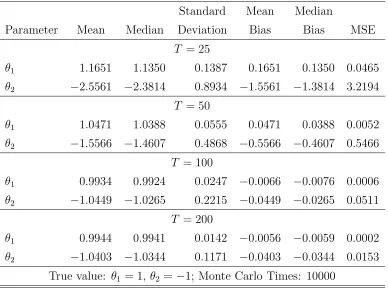
Table I: Monte Carlo Results for Normal Shocks
Standard Mean Median
Parameter Mean Median Deviation Bias Bias MSE
T = 25
θ1 1.1651 1.1350 0.1387 0.1651 0.1350 0.0465
θ2 −2.5561 −2.3814 0.8934 −1.5561 −1.3814 3.2194
T = 50
θ1 1.0471 1.0388 0.0555 0.0471 0.0388 0.0052
θ2 −1.5566 −1.4607 0.4868 −0.5566 −0.4607 0.5466
T = 100
θ1 0.9934 0.9924 0.0247 −0.0066 −0.0076 0.0006
θ2 −1.0449 −1.0265 0.2215 −0.0449 −0.0265 0.0511
T = 200
θ1 0.9944 0.9941 0.0142 −0.0056 −0.0059 0.0002
θ2 −1.0403 −1.0344 0.1171 −0.0403 −0.0344 0.0153
True value: θ1 = 1, θ2 =−1; Monte Carlo Times: 10000
cand d.
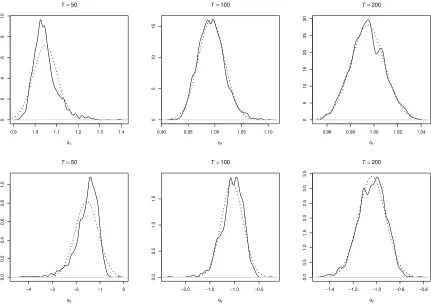
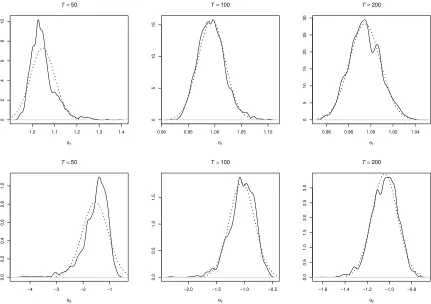
The results are encouraging even in smaller samples sizes; the payoff parameters are
estimated close to their true values, and as the sample size increases, the estimates become
more precise. Parameter θ1 is estimated more precisely. This is mainly because θ1 has a
larger influence over equilibrium thanθ2, since θ1 interacts with a covariate with a higher
mean than θ2 does. In an extremely small sample, the variation in θ2 may not generate
sufficient variation in equilibrium to be estimated precisely but this problem disappears
as the sample size becomes larger.
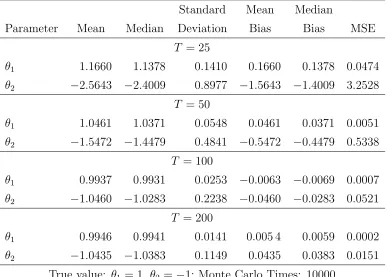
The second simulation shows that our GME estimator can handle non-normal errors.
The empirical distributions of the parameter estimates shown in figures 3 and 4 also show
Table II: Monte Carlo Results for Uniform Shocks
Standard Mean Median
Parameter Mean Median Deviation Bias Bias MSE
T = 25
θ1 1.1660 1.1378 0.1410 0.1660 0.1378 0.0474
θ2 −2.5643 −2.4009 0.8977 −1.5643 −1.4009 3.2528
T = 50
θ1 1.0461 1.0371 0.0548 0.0461 0.0371 0.0051
θ2 −1.5472 −1.4479 0.4841 −0.5472 −0.4479 0.5338
T = 100
θ1 0.9937 0.9931 0.0253 −0.0063 −0.0069 0.0007
θ2 −1.0460 −1.0283 0.2238 −0.0460 −0.0283 0.0521
T = 200
θ1 0.9946 0.9941 0.0141 0.005 4 0.0059 0.0002
θ2 −1.0435 −1.0383 0.1149 0.0435 0.0383 0.0151
0.9 1.0 1.1 1.2 1.3 1.4
0
2
4
6
8
10
T=50
θ1
0.90 0.95 1.00 1.05 1.10
0
5
10
15
T=100
θ1
0.96 0.98 1.00 1.02 1.04
0
5
10
15
20
25
30
T=200
θ1
−4 −3 −2 −1 0
0.0
0.2
0.4
0.6
0.8
1.0
T=50
θ2
−2.0 −1.5 −1.0 −0.5
0.0
0.5
1.0
1.5
T=100
θ2
−1.4 −1.2 −1.0 −0.8 −0.6
0.0
0.5
1.0
1.5
2.0
2.5
3.0
3.5
T=200
[image:22.595.91.522.284.588.2]θ2
1.0 1.1 1.2 1.3 1.4
0
2
4
6
8
10
T=50
θ1
0.90 0.95 1.00 1.05 1.10
0
5
10
15
T=100
θ1
0.96 0.98 1.00 1.02 1.04
0
5
10
15
20
25
30
T=200
θ1
−4 −3 −2 −1
0.0
0.2
0.4
0.6
0.8
1.0
T=50
θ2
−2.0 −1.5 −1.0 −0.5
0.0
0.5
1.0
1.5
T=100
θ2
−1.6 −1.4 −1.2 −1.0 −0.8
0.0
0.5
1.0
1.5
2.0
2.5
3.0
T=200
[image:23.595.91.522.284.588.2]θ2
6
Conclusion
In this paper, we developed a data-constrained GME estimator for the discrete
sequential-move game of perfect information. By directly using the data-constraints which are
im-plied by the equilibrium conditions, we avoid the multidimensional integration which
always makes such estimation intractable. Moreover, in contrast to existing estimators
for general complete information games, our GME estimator requires no parametric
as-sumption about the distribution of the random shocks. We formulate the estimation as
a (convex) mixed-integer nonlinear optimization problem. The estimation can be easily
implemented on optimization software with high-level interfaces such as GAMS or AMPL.
The model is identified with only weak scale and location normalizations. Monte Carlo
evidence demonstrates that the estimator can perform well in moderately sized samples.
References
Aguirregabiria, V., and P. Mira (2007): “Sequential Estimation of Dynamic
Dis-crete Games,” Econometrica, 75, 1–53.
Andrews, D. W. K., and P. Guggenberger (2009): “Hybrid and Size-Corrected
Subsampling Methods,” Econometrica, 77(3), 721–762.
Bajari, P., H. Hong, J. Krainer, and D. Nekipelov (2010): “Estimating Static
Models of Strategic Interactions,” Journal of Business and Economic Statistics.
Bajari, P., H. Hong,and S. Ryan(2010): “Identification and Estimation of a Discrete
Game of Complete Information,” Econometrica.
Berry, S., and E. Tamer (2007): “Identification in Models of Oligopoly Entry,” in
Advanced in Economics and Econometrics: Theory and Application, vol. II, chap. 2, pp. 46–85. Cambridge University Press.
Berry, S. T. (1992): “Estimation of a Model of Entry in the Airline Industry,”
Bonami, P., M. Kilinc, and J. Linderoth (2009): “Algorithms and Software for Convex Mixed Integer Nonlinear Programs,” Discussion paper, University of Wisconsin Madison.
Bresnahan, T. F., and P. C. Reiss (1990): “Entry in Monopoly Markets,”Review of
Economic Studies, 57, 531–553.
(1991): “Empirical models of Discrete Games,” Journal of Econometrics, 48, 57–81.
Campbell, R. C.,andR. C. Hill(2001): “Maximum Entropy Estimation in Economic
Models with Linear Inequality Restrictions,” Working Paper.
Chen, C., and O. L. Mangasarian (1996): “A Class of Smoothing Functions for
Nonlinear and Mixed Complementarity Problems,” Computational Optimization and Applications, 5(2), 97–138.
Golan, A., G. Judge, and J. Miller (1996): Maximum Entropy Econometrics:
Ro-bust Estimation with Limited Data. John Wiley & Sons, New York.
Golan, A., G. Judge, and J. Perloff (1997): “Estimation and Inference with
Cen-sored and Ordered Multinomial Response Data,” Journal of Econometrics, 79(1), 23– 51.
Golan, A., L. S. Karp, and J. Perloff (1998): “Estimating a Mixed Strategy:
United and American Airlines,” Working Paper.
Golan, A., L. S. Karp, and J. M. Perloff (2000): “Estimating Coke’s and Pepsi’s
Price and Advertising Strategies,” Journal of Business and Economic Statistics, 18(4), 398–409.
Golan, A., J. M. Perloff, and E. Z. Shen (2000): “Estimating a Demand System
with Nonnegativity Constraints: Mexican Meat Demand,” Working Paper.
Horowitz, J. L. (1997): “Bootstrap Methods in Econometrics: Theory and Numerical
Performance,” inAdvances in Economics and Econometrics: Theory and Applications: Seventh World Congress, ed. by D. M. Kreps, and K. F. Wallis, vol. III, chap. 7, pp. 188–222. Cambridge University Press.
Horowitz, J. L. (1998): “Bootstrap Methods for Median Regression Models,”
(2001): “The Bootstrap,” in Handbook of Econometrics, ed. by J. Heckman,and
E. Leamer, vol. 5, pp. 3159–3228. Elsevier Science, The Netherlands.
Jaynes, E. T. (1957a): “Information Theory and Statistical Mechanics,” Physics
Re-views, 106, 620–630.
(1957b): “Information Theory and Statistical Mechanics, II,” Physics Reviews, 108, 171–190.
Jouneau-Sion, F., and O. Torres (2006): “MMC techniques for limited dependent
variables models: Implementation by the branch-and-bound algorithm,” Journal of Econometrics, 133(2), 479–512.
Lee, L. (1995): “Asymptotic Bias in Simulated Maximum Likelihood Estimation of
Discrete Choice Models,” Econometric Theory, 11(3), 437 – 483.
Maruyama, S.(2009): “Estimating Sequential-move Games by a Recursive Conditioning
Simulator,” Working Paper.
Mazzeo, M. J. (2002): “Product Choice and Oligopoly Market Structure,” RAND
Journal of Economics, 33(2), 221–242.
Mittelhammer, R. C., and N. S. Cardell (1997): “The Data-Constrained GME
Estimator of the GLM: Asymptotic Theory and Inference,” Working Paper.
Osborne, M. J., and A. Rubinstein (1994): A Course in Game Theory. The MIT
Press.
Raman, R., and I. E. Grossmann (1991): “Relationship Between MILP Modelling
and Logical Inference for Chemical Process Synthesis,” Computers and Chemical En-gineering, 15(2), 73–84.
Schmidt-Dengler, P. (2006): “The Timing of New Technology Adoption: The Case
of MRI,” Working Paper.
Shannon, C. E. (1948): “A Mathematical Theory of Communication,” Bell System
Technical Journal, 27, 379–423.
Su, C.-L., and K. L. Judd (2008): “Constrained Optimization Approaches to
Williams, H. P. (1985): Model Building in Mathematical Programming. John Wiley & Sons, New York.
Zeng, and Lin(2008): “Efficient Resampling Methods for Nonsmooth Estimating