http://dx.doi.org/10.4236/jamp.2016.46119
A Numerical Method for Nonlinear
Singularly Perturbed Multi-Point
Boundary Value Problem
Musa Çakır, Derya Arslan
Department of Mathematics, Faculty of Science, University of Yuzuncu Yil, Van, Turkey
Received 25 April 2016; accepted 26 June 2016; published 29 June 2016 Copyright © 2016 by authors and Scientific Research Publishing Inc.
This work is licensed under the Creative Commons Attribution International License (CC BY).
http://creativecommons.org/licenses/by/4.0/
Abstract
We consider a uniform finite difference method for nonlinear singularly perturbed multi-point
boundary value problem on Shishkin mesh. The problem is discretized using integral identities, interpolating quadrature rules, exponential basis functions and remainder terms in integral form.
We show that this method is the first order convergent in the discrete maximum norm for original
problem (independent of the perturbation parameter ε). To illustrate the theoretical results, we solve
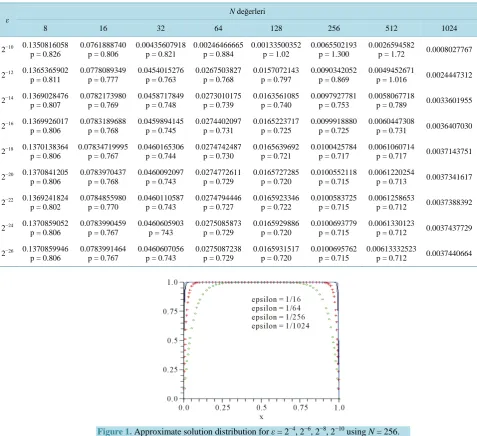
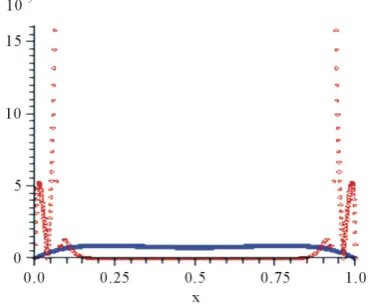
test problem and we also give the error distributions in the solution in Table 1 and Figures 1-3.
Keywords
Singular Perturbation,Fitted Finite Difference Method, Shishkin Mesh, Nonlocal Boundary Condition, Uniform Convergence
1. Introduction
In this paper we shall consider singularly perturbed multi-point nonlinear problem
( )
2
, 0, 0 1,
u f x u x
ε
′′− + = ≤ ≤ (1)
( )
0 0u = (2)
( )
( )
1( )
0
0 1
1
1 d
m
i i m
i
k u k u s k + u x x d
=
=
∑
+∫
+ (3)( )
1(
[ ]
)
( )
( )
0
, 0,1 , f , 0, i 0,1 , 1, , , 0
f x u C xR x u s i m k
u α
∂
∈ ≥ > ∈ = ≥
where, 0<
ε
1 is small perturbation parameter. The solution u(x) has boundary layers at x=0,x=1. Singularly perturbed differential equations arise many applications such as, fluid mechanics, chemical-reactor theory,the Navier-Stokes equations of fluid flow at high Reynolds number, control theory, electrical networks, and other physical models. In recent years, singularly perturbed differential equations were studied by many au-thors in various fields of applied mathematics and engineering. For examples, Cziegis [1] studied the numerical solution of singularly pertürbed nonlocal problem. Cziegis [2] analyzed the difference schemes for problems with nonlocal conditions. Bakhvalov [3] investigated on optimization of methods for solving boundary-value problems in the presence of a boundary layer. Amiraliyev and Çakır [4] applied the difference method on a Shishkin mesh to the singularly perturbed three-point boundary value problem. Amiraliyev and Çakır [5] re-searched a uniformily convergent difference scheme for singularly perturbed problem with convective term end zeroth order reduced equation. Amiraliyev and Çakır [6] studied numerical solution of the singularly perturbed problem with nonlocal boundary condition. Amiraliyev and Duru [7] estimated a note on a parameterized singu-lar perturbation problem. Amiraliyev and Erdoğan [8] studied uniform method for singularly perturbed delay differential equations. Amiraliyeva, Erdoğan and Amiraliyev [9] applied a uniform numerical method for deal-ing with a sdeal-ingularly perturbed delay initial value problem. Adzic and Ovcin [10] studied nonlinear spp with nonlocal boundary conditions and spectral approximation. Amiraliyev, Amiraliyeva and Kudu [11] applied a numerical treatment for singularly perturbed differential equations with integral boundary condition. Herceg [12]studied the numerical solution of a singularly perturbed nonlocal problem. Herceg [13] researched solving a nonlocal singularly perturbed problem by splines in tension. Çakır [14] studied uniform second-order difference method for a singularly perturbed three-point boundary value problem. Geng [15] applied a numerical algorithm for nonlinear multi-point boundary value problems.
In this study we present uniformly convergent difference scheme on an equidistant mesh for the numerical solution of the problem (1)-(3). The difference scheme is constructed by the method integral identities with the use exponential basis functions and interpolating quadrature rules with the weight and remainder terms in integral form [5]-[7]. In Section 2, the asymptotic estimations of the problem (1)-(3) are established. The differ-ence scheme constructed on Shishkin mesh for numerical solution (1)-(3) is presented in Section 3 and in Sec-tion 4. We prove that the method is first-order convergent in the discrete maximum norm. In SecSec-tion 5, a nu-merical example is considered. The results show that the uniform finite difference method on Shishkin mesh is more powerful method than other methods for nonlinear singularly perturbed multi-point boundary value prob-lem.
2. The Continuous Problem
In this section, we describe some properties of the solution of (1) with Lemma 2.1. we use g ∞ for the conti-nuous maximum norm on the [0, 1], where g x
( )
is any continuous function.Lemma 2.1.
Let
( )
1(
[ ]
)
, 0,1
f x u ∈C xR and f
( )
x u,u
∂
∂ is uniformly bounded in u x
( )
. We assume that( )
1( )
0
0 1 0
1
d m
i i m
i
k w s k + u x x k
=
+ <
∑
∫
(4)where w0
( )
x ≥ w x( )
,( ) ( )
20
w a x w x
ε
′′− + = (5)
( )
0 0,( )
1 1w = w = (6)
solution of this problem.
So, the solution of the Equation (1) satisfies the inequalities
( )
C[ ]0,1 0u x ≤C (7)
and
( )
1 ( )11 e e , 0 1
x x
u x C x
α α
ε ε
ε
− − −
′ ≤ + + < <
where, C0 and C are constants independent of ε.
Proof. We rewrite the Equation (1). Hence, we use intermediate value theorem for f x u
( )
, ,( )
,( )
, 0(
)
, , , 0 1
0
f x u f x f
x u
u u ϑ ϑ γ γ
− ∂
= = < <
− ∂
( )
,( ) ( ) (
, 0 f ,)
( ) ( ) ( )
f x u f x u x x F x a x u x
u ϑ
∂
= + = − +
∂
where a x
( ) ( )
,F x are sufficiently smooth on[ ] [ ]
0,1 , 0,1 xR and(
,)
( )
0, -intermediate value.f
x a x
u ϑ α ϑ
∂
= ≥ >
∂
Consequently, we obtain the following linear equation,
( ) ( )
( )
2.
u a x u x F x
ε
′′− + = (9)
Now, let u
( )
1 =λ according to the Equation (3). We can write the solution of the Equation (9) as follows( )
( )
( )
u x =v x +λw x (10)
( ) ( )
( )
2v a x v x F x
ε
′′− + = (11)
( )
0 0,( )
1 0v = v = (12)
where v x
( )
is solution of the Equations (11), (12). First, we prove the estimate v x( )
,( )
( )
( )
11
0 1 .
v x ≤ v +v +α− F ∞ ≤C (13)
Second, we prove the estimate w x
( )
,( )
( )
( )
10 1 0 1.
w x ≤ w + w +α− ∞ ≤ (14)
According to the Equation (4), λ is a finite number. Then, from the Equations (13), (14) we have the following inequality
( )
( )
( )
1u x ≤ v x +λ w x ≤C +λ
( )
0u x ≤C (15)
we now prove the estimate the Equation (8).
If u′′
( )
x is pulled from the Equation (9), we obtain( )
2( ) ( ) ( )
1
u x F x a x u x
ε
−
′′ = − (16)
and from the Equation (16)
( )
2( ) ( ) ( )
21
.
C u x F x a x u x
ε ε
′′ ≤ − ≤ (17)
Now, we take derivative of the Equation (9) and if it called u x′
( )
=v0( )
x , the Equation (9) takes the form with boundary condition( ) ( )
( )
2
0 0
v a x v x x
ε
′′− + = ∅ (18)
( )
0 0( )
0 0,( )
1 0( )
1 1.u′ =v = u′ =v = (19)
Now, we proceed with the estimation of ∅
( ) ( ) ( )
x u, ′ 0 ,u′ 1 , respectively, from the Equation (7)( )
x F′( )
x a x u x′( ) ( )
C1.We use the following relation for g∈C2
[ ]
0,1 ,( )
( )
( )
0(
)
( )
d , ,g g t
g x β T x t g t t x
α
β α β α β α β
β α β α
− −
′ = − − − ′′ < < <
−
∫
− (21)where
(
)
0
1, 0
0, 0
x t
T x t
x t
− >
− = − <
the Equation (21) with the values g x
( )
=u x( )
,α=0,β ε= ,x=0 and from the Equations (7)-(17)( )
0 u( ) ( )
u 0 0( )
d C.u
ε
εu t tε
ε
−
′ ≤ +
∫
′′ ≤ (22)In a similar manner, the Equation (21) with the values g x
( )
=u x( )
,α = −1 ε β, =1,x=1 and from the Equa-tions (7)-(17)( )
( ) (
)
1( )
1
1 1
1 u u d C.
u u t t
ε
ε
ε
−ε
− −
′ ≤ +
∫
′′ ≤ (23)We write the solution of the Equations (18), (19) in the form,
( )
( )
( )
0 1 2
v x =v x +v x
where v x v1
( ) ( )
, 2 x are respectively the solution of the following problems,( ) ( ) ( )
( )
2
1 1
v x a x v x x
ε
′′− + = ∅ (24)
( )
( )
( )
1 0 0, 1 1 1 0
v = u′ =v = (25)
( ) ( ) ( )
22 2 0
v x a x v x
ε
′′− + = (26)
( )
( )
( )
( )
2 0 0(0) , 1 2 1 0 1 .
v = v u′ =v = v
According to the maximum principle in the Equations (24), (25), we can the following Barrier function,
( )
( )
1( )
1 x v x1 x .
ψ α−
∞
= + ∅
This Barrier function provides the conditions of the maximum principle and
( )
1 .
v x ≤C
In a similar manner, according to the maximum principle in the Equation (26), we can write
( )
( )
2
v x ≤θ x
where θ
( )
x is the solution of the following problem with constant coefficient,( )
( )
2
0
x x
ε
θ
α
θ
− ′′ + = (27)
( )
0 0( )
0 ,( )
1 0( )
1C C
v v
θ θ
ε ε
= ≤ = ≤ (28)
where a x
( )
≥ >α 0 and the solution of θ( )
x as follows,( )
( )
( )1 ( )1( )
0 0 e e 0 1 e e
e e
x x x x
v v
x
α α α α
ε ε ε ε
α α
ε ε
θ
− − − −
−
− + −
=
− +
(29)
( )
e e ( )1 . x x C x α α ε ε θ ε − − − ≤ + (30)Finally, from u x′
( )
=v0( ) ( )
x ,v x1 ≤C,θ( )
x ≤v2( ) ( )
x ,v0 x =v x1( )
+v2( )
x , we have the following inequality,( )
( )
( )
( )
( )( )
1
0 1 2
1
e e
1
1 e e
x x
x x
C u x v x v x v x C
C α α ε ε α α ε ε ε ε − − − − − − − ′ = ≤ + ≤ + + ≤ + +
which leads to the Equation (8).
3.
Discretizaton and Non
-Uniform Mesh
Let us consider the following any non-uniform mesh on
[ ]
0,1 ,0 1 1 1
0 1, 1, , , .
1 i
i
N N N i i i N i i
s N x x x x i h x x x s N
ω = = < < < − < = ≥ = − − = =
We present some properties of the mesh function g x
( )
defined on ωN, which is needed in this section for analysis of the numerical solution.( )
i i
g =g x
1 , 1 i i x i i g g g h + + −
= , 1
, i i x i i g g g h − − = 1 ˆ, i i x i i g g g ћ + − =
, , 1 1
ˆ,
1 1
x i x i i i i i
xx i
i i i i
g g g g g g g
ћ ћ h h
+ − + − − − = = − 1
i i i
h = −x x− , 1
2
i i i
h h
ћ = + +
, N 0max i . i N
g ∞ g ∞ω g
≤ ≤
= =
Now, We will construct the difference scheme for the Equation (1). First, we integrate the Equation (1) over
(
xi−1,xi+1)
,( ) ( )
( ) ( )
1 1
1 1
1 2 1
d , d 0, 1, 1
i i
i i
x x
i x i i x i
ћ +
ε
u xϕ
x x ћ + f x uϕ
x x i N− −
− − ′′ + − = = −
∫
∫
(31)where
{
ϕi( )
x}
,i=1,N−1 are the linear basis functions and having the form( )
( )( )
( )( )
(
)
1 1 1 2 1 1 1 1 1 , , , , 0, , ii i i
i
i
i i i i
i
i i
x x
x x x x
h
x x
x x x x x
h
x x x
ϕ ϕ ϕ − − + + + − + −
= < <
−
= = < <
∉
( )1
( )
i x
ϕ and ϕi( )2
( )
x are the solutions of the following problems,2 0
ε ϕ′′
( )
xi1 0,( )
xi 1ϕ − = ϕ = (33)
2 0
ε ϕ′′
− = (34)
( )
xi 1,( )
xi1 0.ϕ = ϕ + = (35)
If we rearrange the Equation (31) it gives
( ) ( )
( ) ( )
1 1
1 1
2 1 1
d , d 0, 1, 1.
i i
i i
x x
i x i i x i
ћ u x x x ћ f x u x x i N
ε
+ϕ
+ϕ
− −
− ′′ −
−
∫
+∫
= = − (36)After doing some calculation
( ) ( )
(
)
1 1
2 1
d , 0, 1, 1
i
i x
i x i i i i
ћ u x x x f x u R i N
ε
+ϕ
−
− ′ ′ + + = = −
∫
(37)where
( )
( ) ( )
1 1
1 1
1 *
0
d
d , , d , 1, 1
d
i i
i i
x x
i i x i x
R ћ x x f x u K x i N
x
ϕ ξ ξ
+ +
− −
−
=
∫
∫
= − (38)and
( )
(
)
(
) (
1)
0* 1 1 1 1
0 , 0 0 1 1 1 .
2 2
i i i i
i i i
x x x x
K xξ T x ξ T + − ξ x+ x− − x+ ξ + − x
− −
= − − − + − − −
So, from the Equation (37), the difference scheme is defined by
(
)
2
ˆ, , 0, 1, 1.
xx i i i i
u f x u R i N
ε
− + + = = − (39)
Now, we define an approximation for the second boundary condition of the Equation (1). We accepted that i N
x is the mesh point nearest to si.
( )
0 1
1
1
1 1
1
0 d
i
i m
N i N m
i
m N
i N m i i i
i i
k u k u k u x x d
k u k h u r d
+ =
+
= =
= + +
= + + +
∑
∑
∫
∑
(40)
where remainder term
(
)
( )
1 1
1
d
d . d
i
i
N x
i x i
i
r x u
x
ξ ξ ξ
− −
=
=
∑
∫
− (41)By neglecting Ri, ri in the Equation (39) and the Equation (40), we suggest the following difference scheme for approximating the Equations (1)-(3)
(
)
2
ˆ, , 0, 1,
xx i i i
y f x y i N
ε
− + = = (42)
0 0
y = (43)
0 1
1 1
. i
m N
N i N m i i
i i
k y k y k + h y d
= =
=
∑
+∑
+ (44)We will use the Shishkin mesh to be ε-uniform convergent of the difference scheme the Equations (42)-(44). So the Shishkin mesh divides each of the interval
[ ]
0,σ and[
σ,1−σ]
into N 4 equidistant subintervals and[
1−σ,1]
into N 2 equidistant subinterval, where σ and 1−σ
are transition points which are defined as( )
1 1min , ln
4 N
σ = α − ε
( )1 4 ( )2 2 1 2
(
)
( )3 4, , ,
h h h
N N N
σ
σ − σ
= = =
( ) ( )
(
)
( ) ( ) ( )1 3
1 3 1 1 2 1
2
, , 2
2
h h
h h N N h N N
− − −
+
= = ≤ ≤ ≤
( ) ( ) ( )
( )
(
)
( ) ( )1 1 2
2 3 3
4 3
, 0, , ; , 1, ,
4 4 4 4
2 1 2 3 3 4
; 1 , 1,
4 4 ,
N i i
i
N N N N
x ih i h x i h i
N
N N
h x i h i N h
N N
σ
ω σ
σ σ σ
= = = = = + − = +
−
= = − + − = + =
where, N is even number,
σ
1.4. Error Analysis
Let z= −y u, x∈wN, which is the error function of the difference scheme the Equations (42), (43) and the solution of the discrete problem
(
)
(
)
2
ˆ, , , , 1, 1
xx i i i i i i
lz≡ −ε z +f x y − f x u =R i= N− (45)
0 0
z = (46)
0 1
1 1
, 1, i
m N
N i N m i i i
i i
k z k z k + h z r i N
= =
=
∑
+∑
= = (47)where R ri, i are defined in the Equation (38) and the Equation (41).
Lemma 4.2. Let zi be the solution of the Equations (45)-(47) and approximation error Ri and ri. Then there are the following inequalities,
1
,wN ln
R∞ ≤CN− N (48)
1
,wN ln
r∞ ≤CN− N (49)
Proof. We evaluate the Equation (38) and the Equation (41), respectively
( )
( ) ( )
1 1
1 1
1 *
0
d
d , , d
d
i i
i i
x x
i i x i x
R ћ x x f x u K x
x
ϕ ξ ξ
+ +
− −
−
=
∫
∫
( )
(
( )
)
( )
(
( )
)
1 1 1
1 1 1
1 d , d d 1 d .
d
i i i
i i i
x x x
i i x i x x
f u f u
R ћ x x C u
u
ξ ξ ξ
ϕ ξ ξ ξ
ξ ξ
+ + +
− − −
− ∂ ∂ ′
≤ + ≤ +
∂ ∂
∫
∫
∫
Consequently,
( )
1 1
1 1
1 e e d .
i
i
x x
x
i x
R C x
α α
ε ε
ε
+ −
− −
−
≤ + +
∫
(50)
In the beginning, we consider the case 1 1
4
σ = − =σ and so xi∈
[ ]
0,σ ,( )
1 ( ) ( ) ( )1 2 3
1 1
ln ,
4 α ε N h h h h N
−
< = = = =
it then follows from the Equation (50) that
{
}
1 1
1 1
1
d ln , 1 .
i
i x
i x
R C h x C h ε h CN N i N
ε
+ −
− −
≤ + ≤ + ≤ < <
Second, we consider the case
σ
=( )
α ε
−1 lnN, and so 1( )
1 ln4 α ε N
−
> , we estimate Ri on
[ ]
0,σ ,[
σ,1−σ]
and
[
1−σ,1]
, respectively.In the seperate
[ ]
0,σ , the Equation (50) reduces to(
1)
( )1(
1)
4 11 1 ln , 1 1.
4
i
N
R C h C CN N i
N σ
ε− ε− −
≤ + ≤ + ≤ ≤ < − (52)
In the seperate
[
σ,1−σ]
, the Equation (50) reduces to( )
( )
( ) ( )(
)
1 1
1 1 1 1
1 2
1 1
e e e e
4
1 ln , 1 1
4
i i
i i x x
x x
i
R C h
N C CN N i
N
α α
α α
ε ε ε ε
α σ ε + − − + − − − − − − − − − ≤ + − + −
≤ + ≤ ≤ < −
(53)
where for
( )
( )1 2 ln , 4 i N x α ε N i h
−
= + −
( )
1 ( )( )
1 ( )2 2
1 ln 1 , 1 ln 1
4 4
i i
N N
x− = α − ε N+ − −i h x+ = α − ε N+ + −i h
and so
1 1
1
e e .
i i
x x
N
α α
ε − ε +
− −
−
− ≤ (54)
Analogously for 1 3 ( )3
4 i
N x = − + −σ i h
,
( )3 ( )3
1 1
3 3
1 1 , 1 1
4 4
i i
N N
x− = − + − −σ i h x+ = − + + −σ i h
thus
(1 1) (1 1)
1 e e i i x x N α α
ε + ε −
− − − −
−
− ≤ (55)
according to the Equation (54) and the Equation (55), we can rewrite the the Equation (53)
( )
( )
{
1}
2 1 1 1
.
i
R ≤C h + α − N− +N− ≤CN− (56)
In the seperate
[
1−σ,1]
, the Equation (50) reduces to(
1 1)
( )3(
1 1)
4 1ln , 3 1 .4
i
N
R C h C CN N i N
N σ
ε− ε− −
≤ + ≤ + ≤ + ≤ ≤ (57)
The last estimate is for xN4 and x3N4:
We rewrite the the Equation (50) for 4
N
i= ,
( ) 1 4 4 1 4 1
1 e e d .
N
N
x
x x
N x
R C x
α α ε ε ε + − − − ≤ + +
∫
(58)We take integrate in the Equation (58) and so
1 1 4 4 4 4 1 1 1
4 4 4
1
e e e e
N N
N N x x
x x
N N N
R C x x
α α
α α
ε ε ε ε
where 1 4 4 1 e e N N x x N α α ε ε + − − −
− ≤ (60)
1 4 4 1 1 1 e e N N x x N α α ε ε + − − − − −
− ≤ (61)
we rewrite the Equation (59) with the Equation (60) and the Equation (61), thus,
( )
{
2}
1 1 1
1
4 4 4
2 ln
N N N
R C x x N− C h N− CN− N
+
≤ − + ≤ + ≤
(62)
where h( )2 =2 1 −
( )
α −1εlnN.
We use in a similar way as above for 3 4
N
i= , and so
1 3
4
ln . N
R ≤CN− N (63)
Next, we use estimate for the remainder term r: From the Equation (41) we can write
(
)
( )
( )
1 1 1
1 1 d d d d i i i i N N x x
i x i i x
i i
r x x u x x h u x x x
− − −
= =
′
≤
∑
∫
− ≤∑
∫
from the Equation (8)
( )
1
1
1
1
1 e e d , 1
i
i
x x
N x
i i x
i
r h C x i N
α α ε ε ε − − − − = ≤ + + ≤ ≤
∑ ∫
( ) ( ) ( ) ( ) ( ) ( ) ( ) ( ) 1 1 1 1 14 3 4
1 2
1 4 1
1 3
3 4 1
1
1 2
0
1 1
1 e e d 1 e e d
1
1 e e d
1 1
1 d 1 d
i i i i i i x x x x N N x x
i x x
i i N
x x N x x i N
r h x h x
h x
h x h x
α α
α α
ε ε ε ε
α α ε ε σ σ σ ε ε ε ε ε − − − − − − − − − = = + − − − = + − ≤ + + + + + + + + = + + +
∫
∑
∫
∑
∫
∑
∫
∫
( )3 11 1
1 d
h σ x
ε − + +
∫
( )1 ( )2 (3) 1 1 1 1 2
i
r ≤C h +h +h ≤C N − + N− +N− ≤CN− (64)
Lemma 4.3. Let zi be solution of the Equations (45)-(47). Then there is the following inequality,
,wN ,wN .
z∞ ≤CR ∞ + r (65)
Proof. Rearranging the Equation (45) gives
2
ˆ, , 1, 1
xx i i i i
lz≡ −
ε
z +a z =R i= N−where
(
,)
, 0 1i i i i
F
a t u z
u γ γ
∂
= + < <
∂
(
)
(
)
(
)
1 , , 1 1 , 1 1 1 , , N N i N N Nw N w
m N
i N m i i i w
i i
w w
z z R r
k z k h z d r R r
R r C R r
α α α − ∞ ∞ − + ∞ = = − ∞ ∞ ≤ + + ≤ + + − + + ≤ + ≤ +
∑
∑
(66)Conclusion 4.1. We know that the solution of the Equations (1)-(3) is u x
( )
and the solution of the Equations (45)-(47) is yi. Then Lemma (4.2) and Lemma (4.3) give us the following convegence result1
,wN ln .
y u− ∞ ≤CN− N (67)
5. Numerical Example
In this section, an example of nonlinear singularly perturbed multi-point boundary value problem is given to illustrate the efficiency of the numerical method described above. The example is computed using maple 10. Results obtained by the method are compared with the exact solution of example and found to be good agree-ment with each other. We compute approximate errors eεN, N
e and the convergence rates N
pε on the
Shish-kin Mesh ωN for different values of ε, N.
Example 5.1.
We solve the difference scheme the Equations (42), (44) using the following iteration technique,
( )
(
( ))
( ) ( )( )
(
( ))
( )(
( ))
2 2 2
1
1 1
1 1
1 1 1
2
,
, , , 1, , 1, 1, 2,
n n n n
i i i i i
i i i i i i
n n n
i i i i i i
f
y x y y y
ћ h h h y ћ h f
f x f x y y x y i N n y
ε ε − ε
− + + + − − − − +∂ + ∂ ∂ = + − = − = ∂ (68)
( ) ( ) ( )1 ( )1
0 0 1
1 1
0, i
m N
n n n n
N i N m i i
i i
y k y k y − k + h y − d
= =
= =
∑
+∑
+ (69)( )
(
( ))
( ) ( )( )
(
( ))
( )(
( ))
2 2 2
1
1 1
1 1
1 1 1
2
,
, , , 1, , 1,
n n n n
i i i i i
i i i i i i
n n n
i i i i i i
f
y x y y y
ћ h h h y ћ h f
f x f x y y x y i N y
ε ε − ε
− + + + − − − − +∂ + ∂ ∂ = + − = − ∂ (70) 1 1 2 , 1
N n N n
y =µ− y =µ− −
where
2
2 2
1, 1, 1, 1
2 2 2 2 2
2
, 1
2 2
1
2
N N N
n n n
n
N n
y y y
h h y h ε ε µ ε − + + − − + − + = + 0 0 2 , 1. N n
y =µ µ =C ≥
The system of the Equations (68)-(70) is solved by the following procedure,
( )
(
)
2 2 2
1
1 1
2
, , , n ,
i i i i i
i i i i i i
f
A B C x y
ћ h ћ h h h y
ε ε ε −
+ +
∂
= = = +
∂
( )
(
1)
( )1(
( )1)
, n n , n
i i i i i i
f
F f x y y x y
y
− − ∂ −
= − +
1 0, 1 0
α = β =
1
1 1
2 2
0,
N N n
α
+ =β
+ =µ
−1 , 1 , 1, , 1
i i i i
i i
i i i i i i
B F A
i N C A C A
β
α β
α α
+ +
+
= = = −
− −
( ) ( ) ( )0
1 1 1, 0.5, 1, , 2,1.
n n
i i i i i
y =
α
+ y+ +β
+ y = i= −N It is easy to verify that
0, 0, , 1, , .
i i i i i
A > B > C >A+B i= N
For this reason, the described procedure above is stable. Also, the Equations (42)-(44) has only one solution. Now, we consider the following test problem,
( )
( )
2 2
0,
u u x f x
ε
′′− + − = (71)
( )
0 0u = (72)
( )
1( )
0.5u =u +d (73)
which has the exact solution,
( )
(
)
1
1
2 1 e e
1
e 1
x x
x
u x
ε ε
ε −
− −
= +
−
In the computations in this section, we will take
α
=2,d= −1 the initial guess in the iteration procedure is( )0 0.5 i
y = . The stopping criterion is taken as
( )1 ( ) 5
max in in 10 .
i y y
+ − ≤ −
The error estimates are denoted by
, N N
eε = y−u∞ω
and
max .
N N
e eε
ε
=
The convergence rates are
2 2
log .
N N
N
e P
e
ε
=
The numerical results obtained from the problem of the difference scheme by comparison, the error and uni-form rates of convergence were found and these are shown in Table 1. Consequently, numerical results show that the proposed scheme is working very well.
The results point out that the convergence rate of the established scheme is really in unision with theoretical analysis.
Table 1. The computed maximum pointwise errors eN and e2N, the numerical rate of convergence pN on the Shishkin mesh ωN for different values of N and ε.
ε N değerleri
8 16 32 64 128 256 512 1024
2−10 0.1350816058 p = 0.826
0.0761888740 p = 0.806
0.00435607918 p = 0.821
0.00246466665 p = 0.884
0.00133500352 p = 1.02
0.0065502193 p = 1.300
0.0026594582
p = 1.72 0.0008027767
2−12 0.1365365902 p = 0.811 0.0778089349 p = 0.777 0.0454015276 p = 0.763 0.0267503827 p = 0.768 0.0157072143 p = 0.797 0.0090342052 p = 0.869 0.0049452671 p = 1.016 0.0024447312
2−14 0.1369028476 p = 0.807
0.0782173980 p = 0.769
0.0458717849 p = 0.748
0.0273010175 p = 0.739
0.0163561085 p = 0.740
0.0097927781 p = 0.753
0.0058067718
p = 0.789 0.0033601955
2−16 0.1369926017 p = 0.806
0.0783189688 p = 0.768
0.0459894145 p = 0.745
0.0274402097 p = 0.731
0.0165223717 p = 0.725
0.0099918880 p = 0.725
0.0060447308
p = 0.731 0.0036407030
2−18 0.1370138364 p = 0.806
0.07834719995 p = 0.767
0.0460165306 p = 0.744
0.0274742487 p = 0.730
0.0165639692 p = 0.721
0.0100425784 p = 0.717
0.0061060714
p = 0.717 0.0037143751
2−20 0.1370841205 p = 0.806 0.0783970437 p = 0.768 0.0460092097 p = 0.743 0.0274772611 p = 0.729 0.0165727285 p = 0.720 0.0100552118 p = 0.715 0.0061220254 p = 0.713 0.0037341617
2−22 0.1369241824 p = 0.802
0.0784855980 p = 0.770
0.0460110587 p = 0.743
0.0274794446 p = 0.727
0.0165923346 p = 0.722
0.0100583725 p = 0.715
0.0061258653
p = 0.712 0.0037388392
2−24 0.1370859052 p = 0.806
0.0783990459 p = 0.767
0.0460605903 p = 743
0.0275085873 p = 0.729
0.0165929886 p = 0.720
0.0100693779 p = 0.715
0.0061330123
p = 0.712 0.0037437729
2−26 0.1370859946 p = 0.806
0.0783991464 p = 0.767
0.0460607056 p = 0.743
0.0275087238 p = 0.729
0.0165931517 p = 0.720
0.0100695762 p = 0.715
0.00613332523
[image:12.595.59.537.113.549.2]p = 0.712 0.0037440664
[image:12.595.220.405.562.704.2]Figure 1. Approximate solution distribution for ε = 2−4, 2−6, 2−8, 2−10 using N = 256.
Figure 3. Error distribution for ε = 2−2, 2−8, 2−10, 2−12 using N = 256.
6. Conclusion
Consequently, the aim of this paper was to give uniform finite difference method for numerical solution of non-linear singularly perturbed problem with nonlocal boundary conditions. The numerical method was constructed on Shishkin mesh. The method was pointed out to be convergent, uniformly in the ε-parameter, of first order in the discrete maximum norm. The numerical example illustrated in practice the result of convergence proved theoretically.
References
[1] Cziegis, R. (1988) The Nümerical Solution of Singularly Pertürbed Nonlocal Problem. Lietuvos Matematikos Rinkinys,
28, 144-152. (In Russian)
[2] Cziegis, R. (1991) The Difference Schemes for Problems with Nonlocal Conditions. Informatica (Lietuva), 2, 155-170. [3] Bakhvalov, N.S. (1969) On Optimization of Methods for Solving Boundary-Value Problems in the Presence of a
Boundary Layer. The Use of Special Transformations in the Numerical Solution of Bounary-Layer Problems. Zhurnal Vychislitel’noi Matematiki i Matematicheskoi Fiziki, 9, 841-859.
[4] Amiraliyev, G.M. and Cakir, M. (2007) Numerical Solution of a Singularly Perturbed Three-Point Boundary Value Problem. International Journal of Applied Mathematics, 84, 1465-1481.
[5] Amiraliyev, G.M. and Çakır, M. (2000) A Uniformily Convergent Difference Scheme for Singularly Perturbed Problem with Convective Term End Zeroth Order Reduced Equation. International Journal of Applied Mathematics, 2, 1407-1419.
[6] Amiraliyev, G. M. and Çakır, M. (2002) Numerical Solution of the Singularly Perturbed Problem with Nonlocal Boundary Condition. Applied Mathematics and Mechanics (English Edition), 23, 755-764.
http://dx.doi.org/10.1007/BF02456971
[7] Amiraliyev, G.M. and Duru, H. (2005) A Note on a Parameterized Singular Perturbation Problem. Journal of Com- putational and Applied Mathematics, 182, 233-242. http://dx.doi.org/10.1016/j.cam.2004.11.047
[8] Amiraliyev, G.M. and Erdoğan, F. (2007) Uniform Numerical Method for Singularly Perturbed Delay Differential Equations. Computers & Mathematics with Applications, 53, 1251-1259.
http://dx.doi.org/10.1016/j.camwa.2006.07.009
[9] Amiraliyeva, I.G., Erdoğan, F. and Amiraliyev, G.M. (2010) A Uniform Numerical Method for Dealing with a Sin- gularly Perturbed Delay İnitial Value Problem. Applied Mathematics Letters, 23, 1221-1225.
http://dx.doi.org/10.1016/j.aml.2010.06.002
[10] Adzic, N. and Ovcin, Z. (2001) Nonlinear Spp with Nonlocal Boundary Conditions and Spectral Approximation. Novi Sad Journal of Mathematics, 31, 85-91.
[11] Amiraliyev, G.M., Amiraliyeva, I.G. and Kudu, M. (2007) A Numerical Treatment for Singularly Perturbed Differen- tial Equations with İntegral Boundary Condition. Applied Mathematics and Computations, 185, 574-582.
http://dx.doi.org/10.1016/j.amc.2006.07.060
[13] Herceg, D. (1991) Solving a Nonlocal Singularly Perturbed Problem by Splines in Tension. Univ. u Novom Sadu Zb. Rad. Prirod.-Mat. Fak. Ser. Mat, 21, 119-132.
[14] Çakır, M. (2010) Uniform Second-Order Difference Method for a Singularly Perturbed Three-Point Boundary Value Problem. Hindawi Publising Corporation Advances in Difference Equations, Vol. 2010, 13 p.
[15] Geng, F.Z. (2012) A Numerical Algorithm for Nonlinear Multi-Point Boundary Value Problems. Journal of Compu- tational and Applied Mathematics, 236, 1789-1794. http://dx.doi.org/10.1016/j.cam.2011.10.010