http://dx.doi.org/10.4236/msa.2013.411090
Light Soaking Induced Increase in Conversion Efficiency
in Solar Cells Based on In(OH)
x
S
y
/Pb(OH)
x
S
y
Robinson Musembi1*, Bernard Aduda1, Julius Mwabora1, Marin Rusu2, Kostantinos Fostiropoulos2, Martha Lux-Steiner2
1Department of Physics, School of Physical Sciences, University of Nairobi, Nairobi, Kenya; 2Solarenergieforsung (SE2), Lise-
Meitner Campus, Hermholtz-Zentrum Berlin für Materialien und Energie, Berlin, Germany. Email: *[email protected]
Received August 25th, 2012; revised October 18th, 2013; accepted November 2nd, 2013
Copyright © 2013 Robinson Musembi et al. This is an open access article distributed under the Creative Commons Attribution Li- cense, which permits unrestricted use, distribution, and reproduction in any medium, provided the original work is properly cited.
ABSTRACT
Light soaking characterization on complete SnO2:F/TiO2/In(OH)xSy/Pb(OH)xSy/PEDOT:PSS/Au, eta solar cell structure
as well as on devices which do not include one or both TiO2 and/or PEDOT:PSS layers has been conducted. Addition-
ally, studies of SnO2:F/In(OH)xSy/Pb(OH)xSy/PEDOT:PSS/Au solar cell have been performed. The power conversion
efficiency and the short circuit current density have been found to increase with light soaking duration by a factor of about 1.6 - 2.7 and 2.1 - 3, respectively. The increase in these two parameters has been attributed to the filling up of trap states and/or charge-discharge of deep levels found in In(OH)xSy. These effects take place at almost fill factor and open
circuit voltage being unaffected by the light soaking effects.
Keywords: Eta Solar Cell; Light Soaking; Conversion Efficiency; TiO2; In(OH)xSy; Pb(OH)xSy
1. Introduction
Extremely thin absorber (eta) solar cell is a photovoltaic device proposed a few years ago [1,2] and is modeled on dye sensitized solar cell concept [3,4]. Unlike its dye sensitized solar cell counterpart where light absorption occurs in a monolayer of organic/or metalorganic dye molecule, in eta solar cell, the dye is replaced with a solid state inorganic sensitizer which is sandwiched be- tween two wide band gap semiconductor materials, one n-type and the other one p-type. The photovoltaic effect of this type of device is due to charge carrier injection from the sensitizer material.
Since the eta concept inception, the conversion effi- ciency of this type of device has remained very low. A number of techniques have been proposed over the years towards improvement of the solar cell characteristics of this type of device. Some of the methods which have suc- cessfully been used so far include: insertion of a very thin insulating oxide to act as a tunneling or as passiva- tion layer material such as MgO, Al2O3·ZnO, ZrO2, and
Y2O3 [4,5], engineering of the absorber material [6-9],
use of buffer layers as recombination barrier [6,7,9], and
recently use of ultra-thin devices whose charge transport is anticipated to be within solar wavelength [10,11]. In this work, we report on light soaking technique as one of the method for improving the conversion efficiency of the eta solar cell and other devices, by prolonged light exposure.
2. Experimental Details
2.1. Sample Preparation
The solar cells samples were prepared on glass substrates coated with 15 Ω/ν sheet resistance SnO2:F from För-
schungzentrum Jüllich. Different solar cell structures were produced by coating thin films via various tech- niques with the following procedures being followed for a full solar cell structure of the type SnO2:F/TiO2/
In(OH)xSy/Pb(OH)xSy/PEDOT:PSS/Au: A 2 µm thick
titanium dioxide, TiO2, thin film was coated by sol-gel
technique at SgLux GmbH company using tetra-isopro- pyl orthotitanate (Ti(C3H6OH)4) mixed with commercial
grade solution of isopropanol (CH3CH(OH)CH3) as pre-
cursors. On top of TiO2, an 80 nm thick indium hydroxyl
sulphide, In(OH)xSy, was deposited at 70˚C for 30 min-
utes by chemical bath deposition (CBD) technique using
aqueous solution containing InCl3 (0.025 M), thioace-
mide (0.1 M), and HCl (0.005 M), and repeated 3 times, after every cycle the sample was rinsed in distilled wa- ter before the next coating, following procedure as re- ported by Bayon et al. [6,7,12] and Musembi et al. [12]. the CBD method was also used in depositing Pb(OH)xSy
using aqueous solution containing Pb(CH3OOH)2 (0.05
M), NaOH (0.2 M), triethanolamine (0.05 M), and thio- urea (0.05 M) at 40˚C for 10 minutes using a procedure as reported elsewhere by Gavrilov et al. [13]. The last layer, an undiluted poly(3,4)ethylenedioxythiophe doped with polystyrene sulfonate acid, type Baytron PH from Bayer GmbH, was then spin coated ontop of Pb(OH)xSy.
The front and back contacts of the solar cell were coated by resistive vacuum evaporation of Au wire, using a spe- cial mask which gave solar cells of 0.126 cm2 areas. The
other solar cell structures were realized by eliminating a layer from the complete structure and these included: SnO2:F/In(OH)xSy/Pb(OH)xSy/Au,
SnO2:F/In(OH)xSy/Pb(OH)xSy/PEDOT:PSS/Au and
SnO2:F/TiO2/In(OH)xSy/Pb(OH)xSy/Au.
2.2. Characterization of the Samples
The current density-voltage (J-U) characteristics meas- urement were performed at room temperature using a DC source meter type Keithley™ 237 high voltage source unit connected to an Hewlett-Packard™ 34401A mul- timeter. A halogen lamp from General Electric™ (120 V, 300 W) type L268 was used as light source of the cali- brated solar simulator (AM 1.5, 100 mW/cm2 = 1 sun).
The analysis of soaking effects were done by first tak- ing J-U characteristics of as-prepared solar cell, and then leaving it exposed to the solar simulator light for 180 minutes continuous. During this duration, the soaking effects were being monitored by taking J-U measure- ments after interval of 20 minutes.
External quantum efficiency measurements were used to study degradation of the solar cell after 180 minutes soaking effects for one of the solar cell structures. The analysis was done for as-prepared solar cell, then after 180 minutes light soaking, subsequently after 24 hours and 96 hours. One week old cell was also analyzed to study soaking effects.
3. Results and Discussion
3.1. J-U Characterization during Soaking
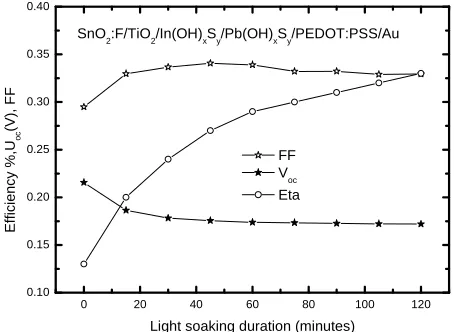
The performance of SnO2:F/TiO2/In(OH)xSy/Pb(OH)xSy/
Au eta solar cell soaked in solar simulator light for 120 minutes is shown in Figure 1. Its photovoltaic parame-
ters, fill factor (FF), open circuit voltage (Uoc) and effi-
ciency (eff) as a function of light soaking duration in minutes are given. The solar cell showed an exponential increase in conversion efficiency, from eff = 0.13% for
0 20 40 60 80 100 120
0.10 0.15 0.20 0.25 0.30 0.35 0.40
Effi
ci
ency %
,U
oc
(V), F
F
Light soaking duration (minutes) FF V
oc Eta
[image:2.595.310.537.86.252.2]SnO2:F/TiO2/In(OH)xSy/Pb(OH)xSy/PEDOT:PSS/Au
Figure 1. Light soaking characteristics for SnO2:F/TiO2/ In(OH)xSy/Pb(OH)xSy/PEDOT:PSS/Au solar cell.
as-prepared solar cell to as high as eff = 0.33% repre- senting increment factor of 2.5, while on the other hand, short-circuit current density showed an increment by a factor of 2.8 from Jsc = 2.1 mA/cm2 to 5.9 mA/cm2.
The effect of light soaking for similar device but with- out TiO2 window layer is shown in Figure 2. The
SnO2:F/In(OH)xSy/Pb(OH)xSy/PEDOT:PSS/Au solar cell
device, after soaking for extended duration of 180 min- utes, the conversion efficiency increased from 0.29% to 0.78% representing an increment factor of 2.7, while short circuit current density reached a maximum value of
Jsc = 10.1 mA/cm2 from a minimum value of Jsc = 3.4
mA/cm2 for as-prepared solar cell for the same duration
representing an increment factor of about 3. The Uoc of
this type of device was observed to decrease with soak- ing duration similar to that of complete eta solar cell shown in Figure 1, while fill factor, there was a slight
increment and after 30 minutes of soaking, it started to decrease for the rest of duration the sample was soaked.
The next experiment tested on the effect of light soak- ing on a reduced type solar cell which has either the polymer material removed or both TiO2 and the polymer
material. The fill factor and open circuit voltage of SnO2:
F/TiO2/In(OH)xSy/Pb(OH)xSy/Au solar cell both showed
a decrement of between 0.01 and 0.03 respectively, as shown in Figure 3. The short circuit current density, Jsc
and conversion efficiency, (eff) both increased by a fac- tor of about 2.1 and 1.6 respectively after soaking the solar cell for 180 minutes. The initial value was Jsc = 4.7
mA/cm2 for as-prepared solar cell and increased to J sc =
9.9 mA/cm2 after light soaking, while the conversion
efficiency reached 0.56% from the initial value of 0.36%. Lastly, the solar cell device to be studied was the sim- plest p-n heterostructure consisting of SnO2:F/In(OH)xSy/
Pb(OH)xSy/Au, this is shown in Figure 4.
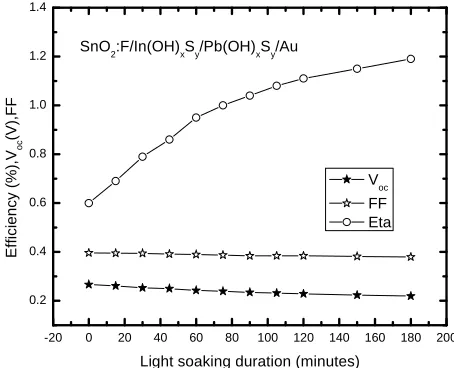
For this type of device in Figure 4, the open circuit
0 20 40 60 80 100 120 140 160 180 200 0.1
0.2 0.3 0.4 0.5 0.6 0.7 0.8 0.9
Voc FF Eta
Eff
iciency(
%)
,U
oc
,F
F
[image:3.595.60.287.85.268.2]Light soaking duartion (minutes) SnO2:F/In(OH)xSy/Pb(OH)xSy/PEDOT:PSS/Au
Figure 2. Light soaking characteristics for SnO2:F/In(OH)xSy/
PEDOT:PSS/Au solar cell.
0 20 40 60 80 100 120 140 160 180 200 0.10
0.15 0.20 0.25 0.30 0.35 0.40 0.45 0.50 0.55 0.60 0.65
V
oc
FF Eta
Efficie
n
c
y
(%)
,U
oc
(V
),
FF
Light soaking duration (minutes) SnO
[image:3.595.309.536.87.271.2]2:F/TiO2/In(OH)xSy/Pb(OH)xSy/Au
Figure 3. Light soaking characteristics for SnO2:F/TiO2/ In(OH)xSy/Pb(OH)xSy/Au solar cell.
displayed by the sample given in Figure 3. That is, there
was a general decrease with increasing light soaking du- ration. On the other hand, conversion efficiency and short circuit-current density changed by a factor of about 2.0 and 2.5 respectively. The final value of Jsc = 14.3
mA/cm2 after light soaking for 180 minutes from an ini-
tial value of about Jsc = 5.7 mA/cm2, while the conver-
sion efficiency, the value for as-prepared solar cell was 0.60% and increased up to 1.19% after light soaking for 180 minutes.
From the preliminary results of light soaking experi- ments for full eta solar cell with buffer layer and simpli- fied solar cell devices realized by eliminating some lay- ers, it can be deduce that light soaking improves the solar cell overall conversion efficiency and short circuit cur- rent density. The parameters have been observed to im- prove with light soaking duration since after 180 minutes
-20 0 20 40 60 80 100 120 140 160 180 200 0.2
0.4 0.6 0.8 1.0 1.2 1.4
Voc FF Eta
Eff
ici
ency (
%
),
Voc
(V),
FF
Light soaking duration (minutes) SnO2:F/In(OH)xSy/Pb(OH)xSy/Au
Figure 4. Light soaking characteristics for SnO2:F/In(OH)xSy/
Pb(OH)xSy/Au solar cell.
of samples exposure to solar simulator light, both effi- ciency and short circuit current density increased by a factor of between ~2 and 3 which is a very big change given the initial values of as-prepared solar cells. Clearly, it can be observed that all samples containing PEDOT: PSS as a hole conductor had the highest gain in overall conversion efficiency of the solar cell, compare devices
A (SnO2:F/TiO2/In(OH)xSy/Pb(OH)xSy/PEDOT:PSS/Au)
and C (SnO2:F/TiO2/In(OH)xSy/Pb(OH)xSy/Au in Table 1
against devices B (SnO2:F/(OH)xSy/Pb(OH)xSy/PEDOT:
PSS/Au) and D (SnO2:F/In(OH)xSy/Pb(OH)xSy/Au).
Another interesting observation is that, when TiO2
layer is removed for samples of similar structure, that is devices containing PEDOT:PSS layer and those without, as shown by pairs of samples A, C and B, D; the absence
of TiO2 layer in both cases results into increment of short
circuit current density and therefore the overall conver- sion efficiency. This shows that PEDOT:PSS acts as a protective layer to the Pb(OH)xSy and prevents Au back
contact from diffusing into the bulk of the material thus increasing surface states leading to higher recombination rate. On the other hand, although TiO2 improves the op-
toelectrical properties of the respective solar cell because of its highly structured porous surface, its presence to- gether with the In(OH)xSy layer material, tends to in-
crease the space charge region such that recombination loss can set in, but when TiO2 is absent the distant of the
[image:3.595.59.286.308.490.2]Table 1. Changes in solar cell parameters of eta solar cell and that of simplified devices, d represents decrease in value, i-d represents increase then decrease in value.
device PV Jsc Voc FF Eff
A 2.8 d di 2.5
-B 2.1 d d 1.6
C 3.0 d di 2.7
-D 2.5 d d 2.0
3.2. Degradation Studies after Light Soaking
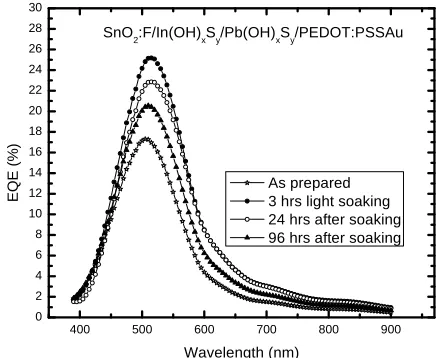
Degradation studies after soaking was performed for a device of similar structure to solar cell device C shown
in Table 1. The external quantum efficiency first was
measured before light soaking and found to be about 17% at peak wavelength of about λ = 505 nm for as- prepared sample, this is as shown in Figure 5. Then the
sample was exposed to solar simulator light for 180 min- utes (3 hours), the external quantum efficiency was again measured and found to have increased to 25% at peak wavelength of about λ = 514 nm.
Henceforth, the sample was kept in inert gas filled chamber, and subsequent measurement were taken after 24 hours and 96 hours and found external quantum effi- ciency to have dropped to 23% (at peak wavelength of about λ = 513 nm) and 21% (at peak wavelength of about λ = 510 nm) respectively. The drop in external quantum efficiency after soaking can be attributed to charge-dis- charge effects of the deep levels present in In(OH)xSy
layer as reported elsewhere in the literature [9,13]. The samples have also been found to be resilient to light soaking (figure not shown), 1 week old sample was found to regain both short circuit current density and conversion efficiency by a factor of about 1.3 and 1.2 respectively.
4. Conclusion
Light soaking has been performed for the first time in eta solar cell device. The effects of light soaking on eta solar cell with the following layers:
SnO2:F/TiO2/ In(OH)xSy/Pb(OH)xSy/PEDOT:PSS/Au and
other reduced devices derived from this structure, have been investigated. It has been found that conversion effi- ciency and short circuit current density can be increased by light soaking in solar cell devices having In(OH)xSy/
Pb(OH)xSy heterostructure. The increase in efficiency
and short circuit current density has been attributed to the filling of trap states and/or charge-discharge of deep lev- els in In(OH)xSy. The question about the specific layer/s
or interface responsible for the observed light soaking effects is still not completely clear and therefore necessi- tates further investigation.
400 500 600 700 800 900 0
2 4 6 8 10 12 14 16 18 20 22 24 26 28 30
As prepared 3 hrs light soaking 24 hrs after soaking 96 hrs after soaking
EQ
E (%
)
Wavelength (nm) SnO
2:F/In(OH)xSy/Pb(OH)xSy/PEDOT:PSSAu
Figure 5. Degradation studies using external quantum quan- tum efficiency for SnO2:F/In(OH)xSy/Pb(OH)xSy/PEDOT:
PSS/Au solar cell.
5. Acknowledgements
R. J. M wish to thank the organic solar cells group headed by Konstantinos Fostiropoulous hosting him and for financial support through Hermholtz-Zentrum Berlin für Materialien und Energie. Gratefully thanked also are the University of Nairobi (UoN), DAAD, and Interna- tional Programmes in Physical Sciences (IPPS), Uppsala University for financial support.
REFERENCES
[1] S. Siebentritt, K. Ernst, C. H. Fischer, R. Koenenkamp and M. Ch. Lux-Steiner, “CdTe and CdS as Extremely Thin Absorber Material in an eta Solar Cell,” Proc. 14th Eur. Photovoltaic Solar Energy Conf. Exhibition. Barce-lona, Spain, 1997, p. 1823.
[2] I. Kaiser, K. Ernst, C. H. Fischer, R. Koenenkamp, C. Rost, I. Sieber and M. Ch. Lux-Steiner, “The eta Solar Cell with CuInS2: A Photovoltaic Cell Concept Using an
Extremely Thin Absorber,” Solar Energy Materials and Solar Cells, Vol. 67, No. 1-4, 2001, pp. 89-96.
http://dx.doi.org/10.1016/S0927-0248(00)00267-1 [3] B. O’Regan and M. Graetzel, “A Low Cost High Effi-
ciency Solar Cell Based on Dye-Sensitized Colloidal TiO2 Films,” Nature, Vol. 353, No. 6346, 1991, pp. 737-
740. http://dx.doi.org/10.1038/353737a0
[4] T. P. Brennan, O. T. Katherine, E. Roelofs, J. Xu, F. B. Prinz and S. F. Bent, “Efficiency Enhancement of Solid State PbS Quantum Dot-Sensitized Solar Cells with Al2O3 Barrier Layer,” Journal of Material Chemistry A,
Vol. 1, No. 26, 2013, pp. 7566-7571. http://dx.doi.org/10.1039/c3ta10903h
[5] C. Grasso and M. Burgelman, “Theoretical Study on the Effect of an Intermediate Layer in CIS Based ETA Solar Cells,” Thin Solid Films, Vol. 451-452, 2004, pp. 156- 159.
[image:4.595.58.286.122.209.2]miskaya, C. H. Fischer, M. Ch. Lux-Steiner and Th. Dit- trich, “Highly Structured TiO2/In(OH)xSy/PbS/PEDOT:
PSS for Photovoltaic Applications,” Solar Energy Mate- rials and Solar Cells, Vol. 89, No. 1, 2005, pp. 13-25. http://dx.doi.org/10.1016/j.solmat.2004.11.011
[7] R. Bayon, R. Musembi, A. Belaidi, M. Bar, T. Gumis- kaya, C. H. Fischer, M. Ch. Lux-Steiner and Th. Dittrich, “Highly Structured TiO2/In(OH)xSy/PbS/PEDOT:PSS to
be used in Photovoltaic Applications,” Comptes Rendus Chimie, Vol. 9, No. 5, 2006, pp. 730-734.
http://dx.doi.org/10.1016/j.crci.2005.02.049
[8] E. Karber, A. Abass, S. Khelifi, M. Burgelman, A. Kat-erski and M. Krunks, “Electrical Characterization of All- Layer Sprayed Solar Cells Based on ZnO Nanorods and Extremely Thin CIS Absorber,” Solar Energy, Vol. 91, 2013, pp. 48-58.
http://dx.doi.org/10.1016/j.solener.2013.01.020
[9] A. Belaidi, R. Bayon, L. Dloczik, K. Ernst, M. Ch. Lux- Steiner and R. Konenkamp, “Comparison of Different Thin Films Absorbers Used in eta Solar Cells,” Thin Solid Films, Vol. 431-432, 2003, pp. 488-491.
[10] S. Gavrilov, I. Oja, B. Lim, A. Belaidi, W. Bohne, E.
Strub, J. Roahrich, M. Ch. Lux-Steiner and Th. Dittrich, “Charge Selective Contact on Ultra-Thin In(OH)xSy
Het-erostructure Prepared by SILAR,” Physica Status Solidi (a), Vol. 203, No. 5, 2006, pp. 1024-1029.
http://dx.doi.org/10.1002/pssa.200521468
[11] I. Oja, A. Belaidi, L. Dloczik, M. Ch. Lux-Steiner and Th. Dittrich, “Photoelectrochemical Properties of In(OH)xSy/
PbS(O) Structures Deposited by SILAR on TiO2,” Semi- conductor Science and Technology, Vol. 21, No. 4, 2006, pp. 520-526.
http://dx.doi.org/10.1088/0268-1242/21/4/018
[12] R. J. Musembi, M. Rusu, J. M. Mwabora, B. O. Aduda, K. Fostiropoulos and M. Ch. Lux-Steiner, “Intensity and Temperature Characterization of eta Solar Cell,” Physica Status Solidi (a), Vol. 205, No. 7, 2008, pp. 1713-1718. http://dx.doi.org/10.1002/pssa.200723466
[13] F. Lenzmann, M. Nanu, O. Kijatkina and A. Belaidi, “Substancial Improvement of the Photovoltaic Character- istics of TiO2/CuInS2 Interfaces by the Use of Recombi-