Prosiding Seminar Kebangsaan Aplikasi Sains dan Matematik 2013 (SKASM2013) Batu Pahat, Johor, 29 - 30 Oktober 2013
A THIRD-ORDER SHOCK CAPTURING SCHEME FOR
INVISCID FLOWS
M. A. H.
oha am ad',
B. ~ a s u n o ~ , A. R. A. ~ z i 2 and M. H. M. NO?',',4~epartment of Mechanical Engineering
Centre for Diploma Studies Universiti Tun Hussein Onn Malaysia
[email protected]. my [email protected]
'~epartment of Aeronautic Engineering
Faculty of Mechanical and Manufacturing Engineering Universiti Tun Hussein Onn Malaysia
In this paper, a third-order compact upwind scheme is specified for calculating flows containing discontinuities. A detailed investigation was conducted to assess the performance of the basic third-order compact central discretization schemes. From observation, discretization of the convective flux terms of the Euler equation is based on a hybrid flux-vector splitting, known as the advection upstream splitting method (AUSM) scheme which combines the accuracy of flux-difference splitting and the robustness of flux-vector splitting. The scheme utilizes the AUSM flux splitting method and a third-order compact upwind space discretization relation for calculating third-order numerical flux function. The idea of total variation diminishing (TVD), by limiting the flux gradient, is used to capture discontinuities. TVD shock capturing properties of the scheme are achieved through a minmod flux limiter. A multistage TVD Runge-Kutta method is employed for the time integration. In addition to that, development and modification of source code for the one-dimensional flow is validated with two test cases namely, unsteady shock tube and quasi-one- dimensional-supersonic-subsonic flow. Further analysis had also been done in comparing the characteristic of AUSM scheme against experimental results, obtained from previous works and comparative analysis with computational results generated by van Leer and KFVS schemes. Furthermore, there is a remarkable improvement with the extension of the third-order AUSM scheme, the improvement of shock capturing properties such as the accuracy of shocks, contact discontinuities and rarefaction waves were achieved.
Keywords: Third-order; Upwind scheme; AUSM; TVD; Runge-Kutta.
1. INTRODUCTION
solutions of continuity, momentum and energy equations. The numerical solution of the Euler equations is determined while through the space or time to obtain a final numerical description of the physically and geometrically complex flow of engineering relevance. The computed results complement experimental and theoretical techniques by providing more detailed information of the flow. The development of a more powerful digital computers enabled advancement to be made in the field of computational fluid dynamics. However, CFD cannot solve all the flow problems due to the limitation of computer resources and available theoretical foundation for modeling complex flow such as combustion, compressibility effect and etc. In general, upwind schemes are categorized as either FDS (flux difference splitting) or FVS (flux vector splitting). The most popular FDS scheme is the Roe's (Roe, 1981) scheme due to its accuracy and efficiency. The FVS schemes, such as Steger and Warming's, Steger and Warming, 198 I), van Leer's (Van Leer, 1982) and KFVS (Ravichandran,
1997) are known to be simple and robust for capturing of intense shocks and rarefaction waves. However, while FVS is based on scalar calculations and FDS is based on matrix calculations. (Liou and Steffen, 1993) have proposed AUSM (Advection Upstream Splitting Method) that has the accuracy of FDS schemes and the robustness and efficiency of FVS schemes. In this method, the inviscid flux at a cell interface is split into a convective contribution, upwinded in the direction of the flow and a pressure contribution which is upwinded based on acoustic considerations. The direction of the flow is determined by the sign of a Mach number defined by combining information fiom both the left and right states about the cell interface.
In this work the computational code using AUSM scheme was used to develop a one-dimensional Euler solver by using high-order compact finite-difference techniques for compressible flows. The validation was used up to the third-order against experimental and comparison of computational results due to van Leer and KFVS schemes. Due to the efficiency of the scheme as observed by other researchers namely (Liou and Steffen, 1990), (Liou, 1993), (Liou, 1996), (Radespiel and Kroll, 1995), (Billet and Louedin, 2001), (Mary and Sagaut, 2002), (Evje and Fjelde, 2003), (Manoha et al., 2004), (Wada and Koda, 2004), (Mawlood et al., 2002, 2003, 2006), (Zha and Hu, 2004) and (Chaudhuri et al., 2005). Besides that, the characteristic of the numerical method was not compared completely with the other schemes. The test problems considered contain various types of discontinuities, such as shock waves, rarefaction waves and contact surfaces. In the absence of available CFD code, a comprehensive validation of code is required and the AUSM scheme has yet to be validated for a wide range of cases. For this reason, a systematic approach has to be
-
Prosiding Seminar Kebangsaan Aplikasi Sains dan Matematik 2013 (SKASM2013)
Batu Pahat, Johor, 29 - 30 Oktober 2013 2. THE BASIC DISCRETIZATION METHOD
A. Spatial Discretization and Numerical Fluxes
The model equation for nonlinear scalar conservation law in one-dimensional space can be written as (Roe, 1981) & (Steger and Warming, 1981)
with the subject to the given initial condition (Roe, 1981) and (Steger and Warming, 1981)
af
( 4where
-
is some vector-valued function of u. Equation (2), is specialised toax
Equation (1) can be written in split flux form as (Ravichandran, 1997)
where
f
( u ) =f
+ ( u )+
f - (u). This flux vector splitting has been introduced by (Steger and Warming, I98 1). The split fluxesf
+ ( u ) andf
- ( u ) are also homogeneousfunctions .of degree one in u (Hirsch, 1990). Conservative semidiscretization of equation (4) can be written as (Ravichandran, 1997)
A
where
A+,
,,
andf,-,,,
is known as the numerical flux function.Following (Ravichandran, 1997), a high-order numerical flux can be obtained as follows. The numerical flux
f
i + ,,
is decomposed into positive and negative parts,a A
fi:l12
andfi;,,,
suchthatThe decomposed numerical fluxes are defined such that
where
F,'
/ A x is a high-order approximation to the derivativeaf
'(ui
>
,
to be dxdetermined by a high-order compact scheme. (Zhong, 1998) has presented a third-order approximation to a first derivative by an upwind based compact relation as
Equation (9) can be written for the interior points i = 2 to i =
N -
1
.
For the boundary pointsi
=1
andi =N ,
the following second order explicit relations are usedPlugging equation (8) in equation (9) yields the following relations for the interior points i = 2 t o i =
N
-1.
With F,' and
F;
evaluated explicitly, two sets of (N-
1) equations are to be inverted for the split numerical fluxesj:,,,
.
Before using these fluxes it is necessary to limit their values and this is achieved by defining the differencesProsiding Seminar Kebangsaan Aplikasi Sains dan Matematik 2013 (SKASM2013) Batu Pahat, Johor, 29 - 30 Oktober 2013
dl:,(;;) = min mod(dA:,,,, D ' )
dA;;l: = m i n mod(di,,,2
,
D - )The third-order TVD flux differences of (Yee, 1987) may be used here
1
D' = -(minmod(6+f;+,,R6+f;+)
+
2minmod(6+f;+,R6+f;:))6
where
1
I
ilI
4 .
The limited numerical fluxes are then calculated fromand
,. ,.+(m) + j - ( m )
A j l I j 2 = &+I12 1+1/2
The min mod h c t i o n can be defined as
a i f la1 < lbl, (ab) > 0
b i f (b
(
< (a(, (ab) > 00 i f ( a b ) < O
3. EULER EQUATIONS AND FLUX SPLITTING SCHEME
The one-dimensional Euler equation may be written as
and p , u, p, e and H are the density, velocity, pressure, total energy, and total enthalpy respectively. The total enthalpy H, is related to the other quantities by the relation
P
H = e + -
P (22)
and for a perfect gas
where
y
is the ratio of specific heat and takes the value of 1.4 for air.The extension of the scalar h g h order numerical fluxes developed above to Euler equations is straightforward. The AUSM flux splitting technique used here is detailed in references (Liou and Steffen, 2004; Zhong, 1998). Once the split fluxes
E:
are obtained then the method described above is used to obtain the higher order numerical fluxes. Equation (1 8) is, thus, written in a semidiscretized form aswhere
Using the method-of-lines (Ravichandran, 1997), the systems of equations (21) are integrated by a multistage TVD Runge-Kutta scheme (Yee, 1987).
4. BOUNDARY CONDITIONS
For the shock tube problem considered in this paper, a short time span for unsteady flow is considered such that the waves will not reach the end walls and so conditions at these boundaries are held fixed. Meanwhile, for the supersonic-subsonic nozzle
-
Prosiding Seminar Kebangsaan Aplikasi Sains dan Matematik 2013 (SKASM2013)
Batu Pahat, Johor, 29 - 30 Oktober 2013
5. RESULTS AND DISCUSSION
In this study, two problems are considered as the shock tube problems such as unsteady shock tube and quasi one-dimensional flow in a divergent nozzle were using as a comparative study. In addition, the computed results were compared with available exact solutions, and numerical results from other schemes, such as AUSM scheme, van Leer's scheme and KFVS scheme. Results show the third-order compact scheme.
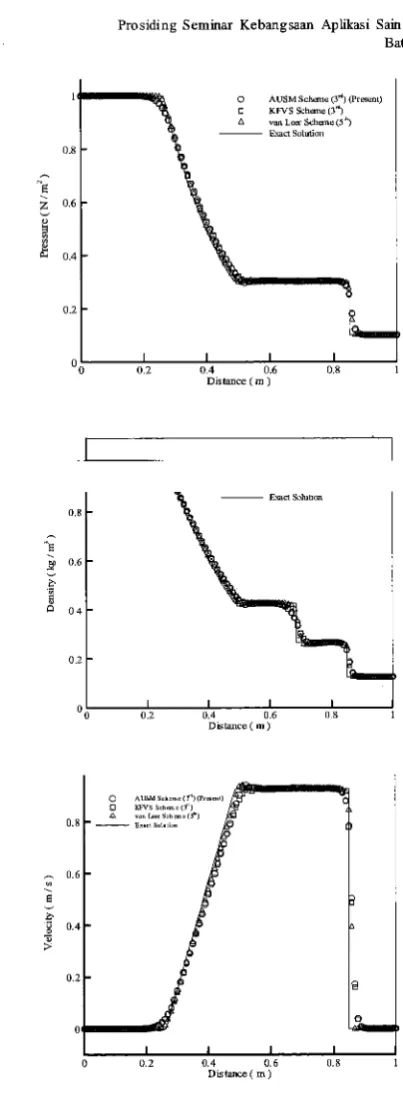
The first problem considered is the unsteady shock tube problem. This problem is an interesting test case to assess the ability of a compressible code to capture shocks and contact discontinuities and to produce exact profiles in the rarefaction wave. The problem spatial domain is 0 _< x I 1. The initial solution of the problem consists of two uniform states, termed as left and right states, separated by a discontinuity at
x
= 0.5. As in the first problem, results are obtained using third-order upwind schemes with the AUSM scheme, van Leer's scheme and KFVS scheme. The number of mesh points used is 101 and CFL = 0.2. The initial conditions of the left and right states areThe wave pattern of this problem consists of a rightward moving shock wave, a leftward moving rarefaction wave and a contact discontinuity separating the shock and rarefaction waves and moving rightward. Fig. 1 shows results obtained by the third- order accurate schemes for the distribution of pressure, density and velocity along the tube at time, t = 0.2 units, in comparison with the exact solution. From the numerical result of third-order schemes, it is shows that the AUSM scheme is able to produce non-oscillatory and crisp shock transition, whch can hardly be obtained from the KFVS and van Leer schemes. This is true as the results produced by the JSFVS scheme are more diffusive in comparison with the AUSM scheme, while the van Leer scheme generated a small jump around the contact discontinuity in the velocity hstribution. In addition, it .is shows that in the density profile the contact discontinuity is narrowly visible especially at AUSM scheme compare to the other schemes. Meanwhile, the transition of the shock wave in the velocity profile occupies four to six zones. Beside these findings, it is also observed that the third-order AUSM scheme is able to produce numerical solutions that are on par with the third-order KFVS and fifth-order compact upwind van Leer schemes.
The second problem considered is a quasi one-dimensional supersonic-subsonic flow in a divergent nozzle. The nozzle cross-section
S(x)
varies according toThese conditions correspond to a normal shock at
x
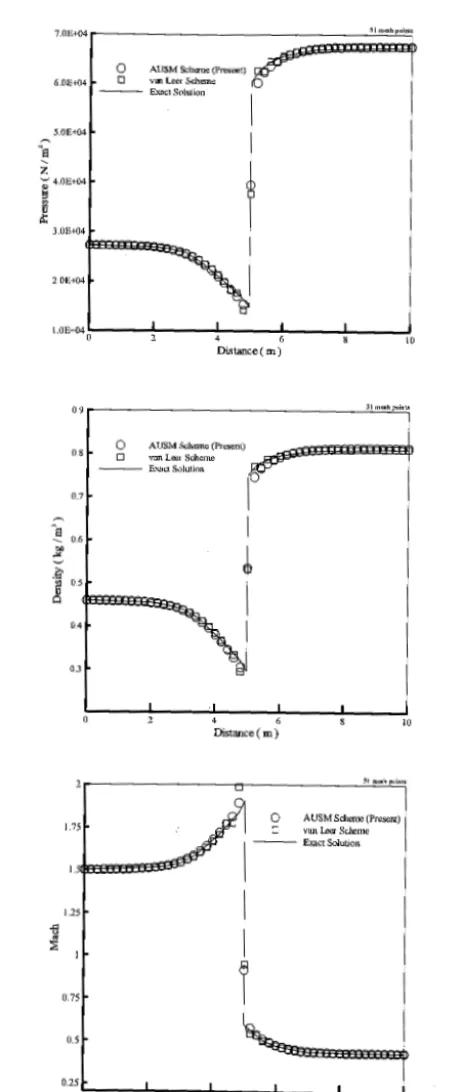
= 5 with supersonic flow at the inlet Mach number MI = 1.5 and subsonic flow at the outlet Mach number MN = 0.43 1. Calculation are performed with a time step, At corresponding to Courant-Friedrichs- Lewy, CFL number = 1. The number of points used to solve this problem is N = 51. The integration in time is continued until steady state is reached. The solution is assumed to converge when the absolute value of the residual in pressure1
pn+'-
pnI
I0.1.
Fig. 2 shows the numerical solutions computed by fifth-order compact upwind van Leer scheme (Mawlood, et al., 2002) are also used to compare with the third-order AUSM scheme. Examination of these figure revealed that the degrees of post-shock oscillations are more severe within the van Leer scheme in comparison to the AUSM scheme.
6. CONCLUSIONS
Prosiding Seminar Kebangsaan Aplikasi Sains dan Matematik 2013 (SKASM2013) Batu Pahat, Johor, 29 - 30 Oktober 2013
1 o AUSM s c h e @*I prsenc) 0 KFVS k h a n r ( 3 3
A Y ~ L M S&me(5*>
- Exact Solution
0.8
,.
"e 5 0.6
-
P
0.4
I I I I I
0.2 0.4 0.6 0.8 1 Distance ( m )
Exact Solurlon
L
I I 1 I I
0 0.2 0.4 0.6 0.8 1
Dls lance ( m )
[image:9.535.119.321.91.641.2]AUSM Schane (Present)
v n Leer schmr
Emct SOI",,""
I
I I I0 4
I
6 8 Distance ( m )
10
0 AUSMScheme (Present) vanleerlchme
- &anact Solutlon
0 25 I I
0 2 4 I
I 6 8 Distance i m )
[image:10.556.167.398.97.643.2]10
Prosiding Seminar Kebangsaan Aplikasi Sains dan Matematik 2013 (SKASM2013) Batu Pahat, Johor, 29 - 30 OMober 2013
Acknowledgement
The authors would like to thanks to Dr Bambang Basuno who was a constant source of advice, encouragement and support throughout this study. I wish to express my thanks to the other members of my research study especially to Dr Mahmood Khalid Mawlood for his helpful discussions and advice.
References
Roe, P. L., (1981) Approximate riemann solvers, parameter vectors, and difference schemes. Journal of Computational Physics, vol, 43. pp. 357-372.
Steger, J. L. and Warming, R. F., (1 98 1) Flux vector splitting of the inviscid gas dynamic equations with
application toJinite difference methods. Journal of Computational Physics, vol. 40, pp. 263-293.
Van Leer, B., (1982) Flux vector splitting for the euler equation. Lecture Notes in Physics, vol. 170, pp. 507-512.
Ravichandran, K. S., (1997) High order KFVS algorithms using compact upwind difference operators. Journal of Computational Physics, vol. 130, pp. 161-173.
Liou, M. S. and Steffen, C. J. Jr., (1993) A newflwc splitting scheme. Journal of Computational Physics, vol 107, pp. 23-39.
Liou, M.-S. and C. J. Steffen, Jr., (1990) Development of a newflux splitting scheme. Center for Modeling of Turbulence and Transition (CMOTT), pp. 144-145.
Liou, M.-S. (1993). On a new class ofjlux splittings. Lecture Notes in Physics 414, 1993, pp. 115. Liou, M.-S., (1996) A sequal to AUSM: AUSM+. Journal of Computational Physics, vol. 129, pp. 364-
382.
Radespiel, R. and Kroll, N., (1995) Accurate flux vector splitting for shocks and shear layers. Journal of Computational Physics, vol. 121, pp. 66-78.
Billet, G. and Louedin, O., (2001) Adaptive limiters for improving the accuracy of the MUSCL approach
for unsteady flows. Journal of Computational Physics, vol. 170, pp. 161- 183.
Mary, I. and Sagaut, P., (2002) Large eddy simulation offlow around an airfoil near stall. AIAA J., vol. 40, pp. 1 139 - 1145.
Evje, S. and Fjelde, K. K., (2003) On a rough AUSM scheme for one-dimensional two-phase model. Computers and Fluids, vol. 32, pp. 1479-1530.
Manoha, E., Redonnet, S. Terracol, M., and Guenanff, G., (2004) Numerical simulation of aerodynamics
noise. ECCOMAS 24.
Wada, K. and Koda, J., (2004) Instabilities of spiral shock - I. onset of wiggle instability and its
mechanism. Monthly Notices of the Royal Astronomical Society, vol. 349, No. 11, pp. 270-280.
Mawlood, M. K., Asrar, W., Omar, A. A. and Basri, S., (2002) A higher-order shock capturing scheme
for inviscid flows. Proceedings, 2nd World Engineering Congress, Sarawak, Malaysia, pp. 383-
388.
Mawlood, M. K., Asrar, W., Omar, A.A. and Basri, S., (2003) A high-resolution compact upwind
algorithm for inviscid flows. 41" Aerospace Sciences Meeting and Exhibit Conference, AIAA
Mawlood, M. K., Basri, S., Asrar, W., Omar, A. A., Mokhtar, A. S. and Ahmad M. M. H. M., (2006) Solution of Navier-Stokes equations by fourth-order compact schemes and AUSMJlux splitting.
International Journal of Numerical Methods for Heat & Fluid Flow, vol. 16, No.
1, pp.
107-120.Zha, G. C. and Hu, Z., (2004) Calculation of transonic internalJlows using an eficient high-resolution upwind scheme. AIAA Journal, vol. 42, No. 2, pp. 205
-
214.A. Chaudhuri, C. Guha and T. K. Dutta, (2005) Application of AUSM and AUSM+ in inviscid flow.
CHEMCON-05, New Delhi, Session: Computational Fluid Dynamics, pp. 1-8.
Hirsch, C., (1990) Numerical computation of internal and external flows. vol. 2: Computational methods for inviscid and viscous flows. John Wiley and Sons, UK.
Zhong, X., (1998) High-orderfinite-difSerence schemes for numerical simulation of hypersonic boundary-