Journal of Chemical and Pharmaceutical Research
__________________________________________________
ISSN No: 0975-7384 CODEN(USA): JCPRC5
J. Chem. Pharm. Res., 2011, 3(4):404-409
Development and validation of HPLC method for determination of prasugrel
in bulk and its pharmaceutical formulation
B. Mohammed Ishaq1, K. Vanitha Prakash1* and G. Krishna Mohan2
1
Department of Pharmaceutical Analysis, SSJ College of Pharmacy, Gandipet, Hyderabad, A.P. India
2
Centre for Pharmaceutical Sciences, IST, JNTU Hyderabad, A.P. India
_________________________________________________________________________________________
ABSTRACT
To develop and validate a simple, sensitive, precise and specific reverse phase high performance
liquid chromatographic method for the determination of prasugrel in bulk and tablet dosage
forms. The HPLC separation was carried out by reverse phase chromatography on inertsil
ODS-3V column (5µm; 250x4.6mm) with a mobile phase composed of 0.02M potassium
dihydrogen orthophosphate, 0.02M dipotassium hydrogen orthophosphate in water: Acetronitrile (30:70 v/v) in isocratic mode at a flow rate of 1ml/min. The detection was
monitored at 210nm. The calibration curve for prasugrel was linear from 100 to 600ng/ml. The
interday and intraday precision was found to be within limits. The proposed method has adequate sensitivity, reproducibility and specificity for the determination of prasugrel in bulk
and its tablet dosage forms. LOD and LOQ for prasugrel were found to be 0.25 µg/ml and 0.75
µg /ml respectively. Accuracy (recoveries: 99.8-101.2%) and reproducibility were found to
satisfactory. The proposed method is simple, fast, accurate and precise for the simultaneous
quantification of Prasugrel in dosage form, bulk drugs as well as for routine analysis in quality control.
Keywords: Prasugrel, RP-HPLC Method, Reverse phase chromatography, Acetonitrile,
Validation.
_________________________________________________________________________________________
INTRODUCTION
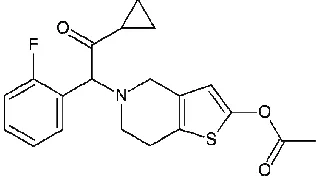
is 5-[2-cyclopropyl-1-(2-fluorophenyl)-2-oxoethyl]-4,5,6,7-tetra hydrothieno[3,2- c]pyridin-2-yl acetate. It is a member of the thienopyridine class of ADP receptor inhibitors, like ticlopidine and clopidogrel. These agents reduce the aggregation (“clumping”) of platelets by irreversibly binding to P2Y12 receptors. Prasugrel inhibits adenosine diphosphate– induced platelet aggregation more rapidly, more consistently, and to a greater extent than do standard and higher doses of clopidogrel in healthy volunteers and in patients with coronary artery disease. Literature survey revealed that only a few analytical methods like LC-MS [7, 8]and HPTLC [9], but no HPLC method was reported for its analysis. Hence a new HPLC method was developed and validated for the assay of the drug in tablets. The structure of prasugrel is shown in Fig. 1.
Fig. 1: Chemical Structure of Prasugrel
EXPERIMENTAL SECTION
Prasugrel was provided as a gift sample by MSN Laboratories, Hyderabad, A. P. Drug was used without any further purification. All other reagents required for experimentation were of analytical reagent (AR) grade. Chemicals used for this experiment Potassium dihydrogen orthophosphate, Acetronitrile were purchased from Merck, Mumbai.
Chromatographic conditions
The HPLC system (Shimadzu co, Tokyo, Japan) consisted of a Shimadzu model LC-10 ATVp, a Shimadzu model SPD-6AV variable wavelength detector (Possessing deuterium lamp with a sensitivity of 0.005 AUFs and adjusted to an absorbency of 210nm), a Shimadzu model C-R5A chromatograph integrator module (chart speed at 10mm/min), a Shimadzu model SIL- 6A auto injector and a Shimadzu module SCL-6A system controller.
Isocratic elution of mobile phase 0.02M potassium dihydrogen orthophosphate, 0.02M dipotassium hydrogen orthophosphate in water: Acetronitrile (30:70 v/v) with flow rate of 1 ml/min. Seperation was performed on inertsil ODS-3V analytical column (thermo hypresil, 5µm; 250x4.6mm i.d with C18 insert (100 Ao, waters limited) as pre column to protect the analytical column from strongly bonded material. Integration of the detector output was performed using the Shimadzu Empower software to determine the peak area. The contents of the mobile phase were filtered through 0.45 µm membrane filter and degassed by sonication before use. The flow rate of mobile phase was optimized to 1 ml / min which yield a column back pressure of 110-112 kg/cm2. The run time was set at 20 min and column temperature was maintained at ambient. The volume of injection was 20 µl, prior to injection of analyte, the column was equilibrated for 30-40 min with mobile phase. The eluent was detected at 210 nm. The developed method was validated in terms of specificity, linearity, accuracy, limit of detection, limit of quantification, intra-day and inter-day precision and robustness for the assay of prasugrel as per ICH guidelines [10].
Standard Preparation
Stock solution of prasugrel was prepared by dissolving 500 mg of prasugrel in 100 ml volumetric flask and the volume is made up with the diluents. Subsequent dilutions of this solution ranging from 0.05 – 500 µg/ml were made with the diluent.
Sample Preparation
20 tablets were taken and their average weight was calculated. The tablets were crushed to a fine powder, dose equivalent to 10 mg was transferred to a 100 ml volumetric flask, dissolved in diluent and then the solution was made up to the mark with the same and filtered through 0.45 µ
membrane filter. 5 ml of this solution was pipetted into 50ml volumetric flask and diluted with the diluent to get concentration of 500 µg/ml.
[image:3.595.99.537.240.620.2]RESULTS
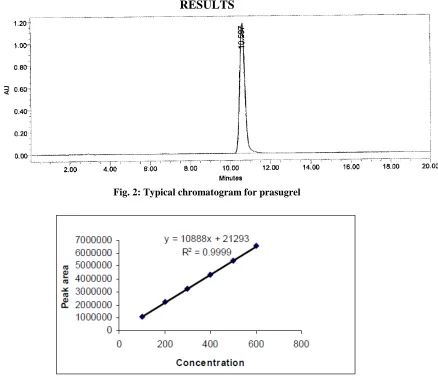
[image:3.595.101.539.241.425.2]Fig. 2: Typical chromatogram for prasugrel
Fig. 3: Linearity graph of prasugrel
System suitability
As Per USP 27 System suitability tests were carried out on freshly prepared. Standard solution of prasugrel to check the various parameters. Such as efficiency, retention time, and peak tailing which was found to comply with USP requirements. The instrumental precisions as determined by six successive injections of the standard solution give RSD below 2% of Retention Time and area.
Linearity
The calibration curve for prasugrel was drawn by plotting the mean peak area versus concentration yielded coefficient of regression r2=0.9999 over a concentration range (100‐600µg/ml) the representative linear regression equation for prasugrel Y=10888 X+21293 as shown in Fig. 3.
Accuracy
The accuracy of the proposed analytical method was determined by recovery experiments. The recovery studies were carried out at three different concentration levels in triplicate (80, 100 and 120%). The analyzed samples yielded high recovery values from the developed method .The % recovery results of the method are given in Table‐1.
Table 1: Recovery study data
Precision
The precision of the method for the determination of prasugrel was studied using the parameters like system precision, method precision and intermediate precision. System precision was determined by six replicate injections of standard solution injected in to the HPLC system. The relative standard deviation was less than 2%. Method precision was determined by the six individual sample preparations injected to the HPLC system. The relative standard deviation was less than 2%. Ruggedness of the method was determined by different analysts, different columns and different instruments on different days. RSD was found below 2%. The results indicating that the developed HPLC method was found to be precise.
Robustness
The robustness of the method was studied by small changes in the method like altering the mobile phase pH, flow rate and changes in wavelength. It was observed that there were no changes in the chromatograms. System suitability and chromatographic parameters were validated such as asymmetry factor, tailing factor and number of theoretical plates were calculated. The results are given in Table‐2.
Table 2: System suitability studies
S. No Parameters Results 1 Tailing factor 1.36 2 Theoretical plates 8974.24 3 Retention time 10.597
Amount of drug added (µg/ml) Amount of drug found (µg/ml) % Recovery
400 380.32 95.08
500 428.75 85.75
Limit of Detection and Limit of Quantification
The limit of Detection (LOD) and limit of Quantification (LOQ) of the developed method were determined by injecting progressively low concentrations of the standard solutions using the developed RP-HPLC method. The LOD is the smallest concentration of the analyte that gives a measurable response (signal to noise ratio of 3). The LOD for prasugrel was found to be 0.25 µg/ml. The LOQ is the smallest concentration of the analyte, which gives response that can be accurately quantified (signal to noise ratio of 10). The LOQ of prasugrel was found to be 0.75 µg /ml. It was concluded that the developed method is sensitive.
Assay
20 µl of standard and sample solutions were injected into an injector of RP-HPLC, from the peak area of standard amount of drug in sample were computed. The values are given in Table: 3
Calculations:
% of Prasugrel in tablet formulation (Pasugen) =
Where At: Average area due to pasugen formulation peak in sample preparation As: Average area due to prasugrel peak in STD preparation
Ws: Weight of working standard (Prasugrel) Wt: Weight of sample (Pasugen formulation) P: Potency of the working standard.
Table 3: Analysis of formulation
DISCUSSION
UV spectrum of Prasugrel was recorded, from which 210 nm was selected as wavelength. Flow rate of 1.0 ml/min was selected.0.02M potassium dihydrogen orthophosphate, 0.02M dipotassium hydrogen orthophosphate in water: Acetronitrile (30:70 v/v) was selected as mobile phase. The retention time was found to be 10.597. Prasugrel shown linearity in the range of 100‐600µg/ml, and the co-efficient was found to be 0.999. Recovery studies were performed at 80, 100 and 120% levels. The sensitivity of method LOD and LOQ was found to be 0.25 µg/ml and 0.75 µg /ml respectively. The stability at room temperature and refrigeration was found to be 3 and 8.5 hrs respectively.
From the obtained results it can be concluded that the proposed method is quite precise and accurate. The low standard deviation and good percentage recovery indicates the reproducibility and accuracy of the method. The absence of additional peaks in the Chromatogram indicated that there is no interference of the common excipients used in the tablets. The proposed HPLC method is sensitive and reproducible for the analysis of prasugrel in Tablet dosage forms. The method was duly validated by using required statistical parameters.
Amount of drug (mg/tab)
% Label Claim % RSD Labelled Estimated
10 mg 9.865 98.65 0.05
Table 4: Optimized chromatographic conditions
Parameters Optimized conditions
Chromatograph HPLC (Shimadzu with SPD-6AV detector) Column inertsil ODS-3V (5µm; 250x4.6mm ) Mobile Phase
0.02M potassium dihydrogen orthophosphate, 0.02M dipotassium hydrogen orthophosphate in water: Acetronitrile (30:70 v/v)
Flow rate 1 ml/min
Detection wave length 210 nm Injection volume 20 µl Column temperature Ambient
CONCLUSION
A convenient and rapid RP- HPLC method has been developed for estimation of Prasugrel in tablet dosage form. The assay provides a linear response across a wide range of concentrations. Low intra-day and inter-day % RSD coupled with excellent recoveries. The proposed method is simple, fast, accurate and precise for the simultaneous quantification of Prasugrel in dosage form, bulk drugs as well as for routine analysis in quality control.
Acknowledgment
The authors are grateful to MSN Laboratories, Hyderabad, India, for providing gift sample of Prasugrel and to the SSJ College of Pharmacy, Hyderabad, A.P, India, for providing necessary facilities and chemicals.
REFERENCES
[1] Chang WC, Midodzi WK, Westerhout CM, et al. J Epidemiol Community Health, 59, 2005, 427–33.
[2] Gupta M, Chang WC, Van de Werf F, et al. Eur Heart J, 24, 2003, 1640–50. [3] Giugliano RP, Llevadot J, Wilcox RG, et al. Eur Heart J, 22, 2001, 1702–15. [4] Bassand JP, Hamm CW, et al. Eur Heart J, 28, 2007, 1598–660.
[5] Silber S, Albertsson P, Aviles FF, et al. Eur Heart J, 26, 2005, 804–47
[6] Wiviott SD, Braunwald E, McCabe CH, et al. N Engl J Med, 357, 2007, 2001–15.
[7] Tian ER, Ruterbories KJ, Verburg EM, Weerakkody GJ, Kurihara FN, Stereoselective Metabolism of Prasugrel in Humans Using a Novel Chiral Liquid Chromatography-Tandem Mass Spectrometry Method, American Society for Pharmacology and Experimental Therapeutics, 35(6), 2007, 917-921.
[8] Farid NA, McIntosh M, Garofolo F, Wong E, Shwajch A, Kennedy M, Young M, Sarkar P, Kawabata K, Takahashi M, Pang H, Rapid Communications in Mass Spectrometry, 21(2), 2007, 169-179.