The Obstacles for the Teaching of 8th Grade TR History
of Revolution and Kemalism Course According to the
Constructivist Approach (An Example of Exploratory
Sequential Mixed Method Design)
Yavuz Karademir, Selcuk Besir Demir
*Division of Social Studies Education, Department of Elementary Education, Faculty of Education, Sivas Cumhuriyet University, Turkey
Copyright © 2015 by authors, all rights reserved. Authors agree that this article remains permanently open access under the terms of the Creative Commons Attribution License 4.0 International License
Abstract
The aim of this study is to ascertain the problems social studies teachers face in the teaching of topics covered in 8th grade TRHRK Course. The study was conducted in line with explanatory sequential mixed method design, which is one of the mixed research method, was used. The study involves three phases. In the first step, exploratory process was followed, in the second step measurement tool was developed and in the third step the measurement tool was applied to the sample chosen from the universe. In this study, data collection process was realized in two steps. In the first step, qualitative data were collected and later on quantitative data were collected using quantitative measurement tool, which was developed based on qualitative data and then validated. The qualitative study group of the research was determined using criterion sampling, which is one of the purposeful sampling methods. The quantitative study group was determined via double (two-phase) cluster sampling method. In line with the responds provided by the participants, qualitative findings were categorized and presented as 3 themes: (i) inadequacy of course time and the problems caused by intensive content, (ii) adoption of Behaviorist Approach as opposed to constructivism, (iii) Problems caused by perception, attitude towards the course and other factors. Following from this, 23-item quantitative measurement tool was developed and administrated on the qualitative sample of the study composed of 1090 social studies teachers working in 28 cities. Quantitative data indicated that qualitative data can be generalized. As a result, even if the education program of TRHRK is designed according to constructivist approach, traditional, teacher-centered history education based on memorization is continued because of the obstacles defined in the current study.Keywords
TR History of Revolution and Kemalism, the Constructivist Approach, Ideology and History, Problems1. Introduction
As a result of reformist efforts in 2005 in Turkey, the education programs for all elementary education courses were prepared and applied based on constructivist approach [27, 52, 58]. In new education programs adopted by MNE, it is seen that a new “student-centered understanding balancing information and skill, enabling students to communicate with their environments and considering students’ own lives and individual differences” was adapted [7, 9, 10, 19, 25, 46, 58, 74].
As defined above, examination of the problems social studies teachers face in a course which has an important mission and objectives is important. In this context, studies were carried out on various aspects of 8th Grade TRHRK course. For example, in a study by Camkıran [15], teachers expressed their discomfort with the inadequacy of information in textbooks; Adalar [2] concluded that physical conditions made it difficult to reach the attainments in the education program. In other studies, it was determined that social studies teachers face various problems related to the social and physical conditions of the environments of the schools, the inadequacy of the sources in the education environment, administrators, teachers, students and parents and these problems were all related to each other. They also found that there was not enough time to over the syllabus; therefore, some activities in the constructivist approach could not be applied [2, 8, 24]. The studies in the literature carried out quantitative studies which do not examine the causes of the problems in depth. When the developments with regard to these courses are considered together with these studies, it is seen that the syllabus was arranged according to constructivist approach and weekly hour of the TRHRK course was increased from 2 to 3 as of 2008-2009 educational year. As of 2010 and 2011 educational year, the topics in recent period were added and the weekly hours of the course was decreased from 3 to 2.
In the face of the changes in education program as of 2005 and the deficiencies emphasized in education program, the problems social studies teachers face in TRHRK course are to be examined in detail and determined. Especially, the matters that obstruct the application of constructivism on which the program is based are to be determined.
Following from here, the aim of this study is to determine the problems social studies teachers encounter in the teaching of TRHRK course and to examine the reasons of these problems in depth, to convert the results obtained with qualitative research method into a quantitative measurement tool and in turn to determine if these problems can be generalized to the universe of social studies teachers in Turkey. For these reasons, this study is significant in that it determines the situations with regard to the problems encountered and create a perspective for the future.
2. Method
2.1. The Design of the Study
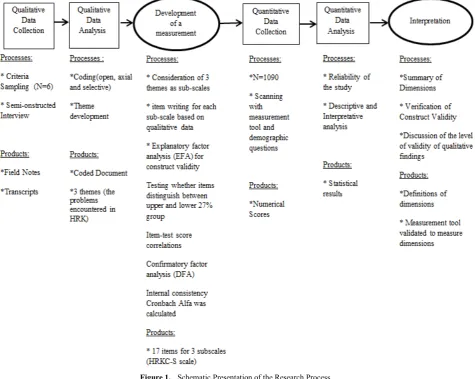
This study was carried out in line with mixed method approaches. In the study, “exploratory sequential method”,
which is one of the mixed method designs, was used. Exploratory sequential method is a design in which the researcher starts with exploring qualitative data and then uses these findings in quantitative research stage [20]. In exploratory sequential mixed method design as in explanatory sequential mixed method, the second data base is founded upon findings of in initial data base. The aim of exploratory sequential mixed method is to develop better methods for measurement for a specific universe and to see whether data obtained from a few individuals (in the qualitative dimension) can be generalized to the universe [20]. The study has three stages. In the first stage is exploratory stage, in the second stage the measurement tool was developed and in the third stage the measurement tool was applied on the sample from the universe.
2.2. Process
In this study, data was collected in two stages. In the first stage qualitative data were collected and later on a quantitative measurement tool was designed based on qualitative data and quantitative data were collected with this quantitative measurement tool for which necessary validation analyses were made. The qualitative data obtained in the first stage was used to develop a measurement tool with good psychometric characteristics. The researcher analyzed two databases separately and the findings obtained from qualitative database were used to make quantitative measurements.
During the study, sequential timing was followed and the collection and analysis of qualitative data was prioritized. Based on the results explored, the researchers passed on the quantitative stage and preliminary results were tested to test or assess qualitative exploratory findings. The first stage of the study was carried out with a constructivist point of view and the second stage was carried out with post-positivist view and an interactive and sequential procedure with emphasis on qualitative data.
The researchers analyzed the two data bases separately and used the findings obtained from exploratory database to create quantitative measurements. The findings of the mixed method have been interpreted in the discussion section. First of all qualitative findings, the use of qualitative findings (development of a measurement tool, development of new quantitative measurements etc.) were reported and later on quantitative findings were reported. According to Morse [61], the research process can be
symbolized as follows QUALITATIVE →quantitative. The
Figure 1. Schematic Presentation of the Research Process
Table 1. Detailed Information about the Participants
Nickname Gender Branch Department Graduated Length of Service(Year) Place of Duty
P1 Male Social studies Social studies education 11 Town(Affiliated with a County) P2 Female Social studies Social studies education 14 Town(Affiliated with a County) P3 Male Social studies Social studies education 7 City Center P4 Female Social studies Social studies education 6 City Center P5 Male Social studies Social studies education 7 County Seat P6 Female Social studies Social studies education 13 County Seat
2.3. Qualitative Phase 2.3.1. Participants
The focus group interview in the first phase of the study was made with social studies teachers in Sivas province. The study group is composed of 6 teachers (3 female and 3 male) working in state schools. The service lengths of the participants ranged between 6 to 14 years. To determine the study group, criteria sampling method, which is one of the purposeful sampling methods, [66] was used. While the study group was being determined according to criteria method, social studies teachers with at least 6 years of service length was chosen considering that they had
2.3.2. Qualitative Data Collection Tool 2.3.2.1. Qualitative Phase
In this study, “Semi-structured Interview Form”, which is one of the qualitative study methods, was used. Semi-structured interview technique seems to be a more suitable technique for research as it has certain level of standardization and flexibility as well [66, 89].
Before interview questions were prepared, the table showing “Units, Number of Attainments, Number of Hours and Rates”, which has been recreated after the weekly hour of TRHRK course was decreased from 3 hours to 2 hours was examined carefully. The number of the course hours was decreased according to the Primary Aims of Turkish National Education and the Fundamental Turkish National Education Law no. 1739 and according to the decisions made by Board of Education and Discipline after 2008 and particularly the decision taken by the board on 20.07.2010 with decision no. 75. The studies in the literature on 8th Grade TRHRK course [2, 8, 15, 24, 58] were examined, and as a result of the examinations draft interview form was developed. The questions in the draft interview form were examined in detail by a faculty who is expert in qualitative research methods. In line with expert views, interview questions were reshaped.
The drafted interview form was piloted with two Social studies teachers who started working before 2008 and experienced the amendments made in the course to test the quality and adequacy of the questions in the interview form. The teachers who took part in the pilot application were not included in the qualitative study group. As a result of pilot application, it was determined that there was not any problem with the questions in the interview.
All questions in the interview form were put to the participants. Different questions were also asked to analyze answers in depth. In general, the participants were asked questions about the sufficiency of weekly hours of the course for the attainments in TRHRK course, about the methods and techniques used in TRHRK course, physical conditions, learning environment, students and parents of the students. Data with regard to the study were collected in a silent environment, which would not disturb the interviews. The interviews were made in January 2014. Interviews which last a total of 221 min 34 second were made. The participants
were given information about the aim of the study and they were ensured that personal information will be kept confidential.
2.3.3. Interpretation of Qualitative Data Analysis 2.3.3.1. Analysis of Qualitative Data
2.3.3.1.1. Interview Transcriptions
All interviews made with the study group were recorded via voice recorder device. The data recorded were transformed into raw data as written texts via Microsoft Word processor and these transcriptions were presented to the participants one by one and it was confirmed that these texts comply with what they said.
2.3.3.1.2. Data Coding
Before data were coded, the researchers read the transcriptions line by line. Meanwhile, important dimensions in the framework of the study were determined and the meaning of each dimension was described. The words and concepts used by the participants were used in coding as much as possible. However, when the words and concepts participants use were inadequate other concepts which were considered to express the relevant case or opinion, were determined as codes by the researchers. In data coding, line by line analysis method defined by Patton [66] was used. A word, word groups or a sentence was used as units for data analysis. In coding process, axial and selective coding techniques were used.
2.3.3.1.3. Interpretation Techniques
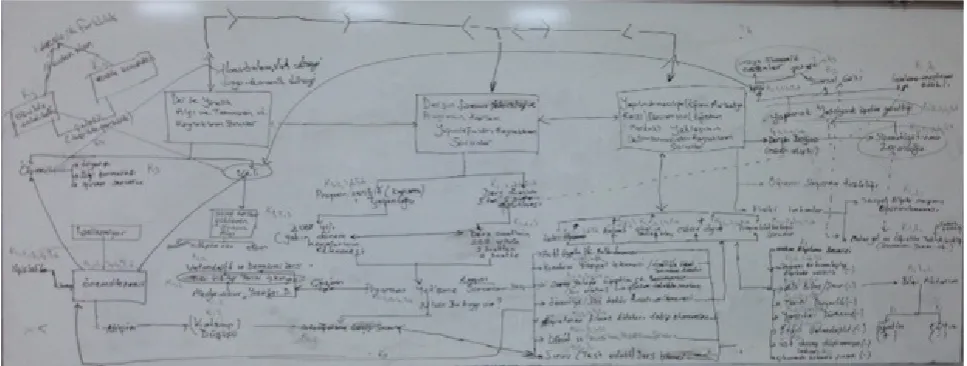
Figure 2. The Pattern Showing the Relation between themes and findings obtained
2.3.4. Credibility, Transferability, Consistency and Confirmability for Qualitative Dimension 2.3.4.1. Credibility
Validity is one of strengths of qualitative research and it is based on the determination of whether findings are accurate in the view of the reader, the participant and the researcher [22]. To increase the validity of the study, the studies by Adalar [2], Bingöl [8], Camkıran [15], Delen [24], MEB [58] were examined, conceptual framework with regard to the issue was developed and the interview form was developed. The interviews with the study group were transcribed and the transcriptions were examined by the participants for the verification of their accuracy.
2.3.4.2. Transferability
All the interviews with the study group were recorded with a voice recorder device. All the data obtained in the research process were assessed and coded one by one by the researchers and another faculty who has good command of qualitative research methods and overall agreement among all coders was achieved. Each process in the study is presented to the readers in details. Detailed descriptions are used in the reporting process so that they can visualize all components of the process. To this end, researchers are of the opinion that descriptive data can be transferred to the study groups in similar contexts. According to the researchers, results obtained in this study will be understood in the same or similar way. In this context, the findings of the study were summarized with a plain and clear-cut manner so that readers can visualize the research process and research medium.
2.3.4.3. Consistency
To increase the consistency of the study, all of the qualitative data were presented to the readers without any generalization. All the data obtained in the research process were evaluated and coded one by one by the researchers and another faculty who has good command of qualitative
research methods and overall agreement among all coders was achieved. For the reliability calculation of all coding in the study, reliability formula proposed by Miles and Huberman [60] were used [Reliability = Agreement / (Agreement +Disagreement)]. In the coding, over 80% agreement was achieved for each question.
2.3.4.4. Confirmability
To ensure confirmability of the study, raw data, coding and patterns obtained in the process are stored by the researchers so that interested people can examine them.
2.4. Quantitative Phase
Data collected in the qualitative phase, which is the first stage of the study, form a basis for the quantitative dimension. In this context, instead of comparing qualitative and quantitative data, answer for the following question was sought: “Can qualitative themes be generalized to the universe?”
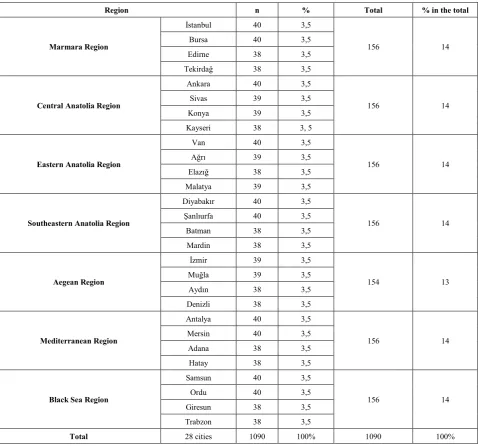
2.4.1. Quantitative Study Group
Table 2. Information with Regard to the Study Group
Region n % Total % in the total
Marmara Region
İstanbul 40 3,5
156 14
Bursa 40 3,5 Edirne 38 3,5
Tekirdağ 38 3,5
Central Anatolia Region
Ankara 40 3,5
156 14
Sivas 39 3,5 Konya 39 3,5 Kayseri 38 3, 5
Eastern Anatolia Region
Van 40 3,5
156 14
Ağrı 39 3,5
Elazığ 38 3,5
Malatya 39 3,5
Southeastern Anatolia Region
Diyabakır 40 3,5
156 14
Şanlıurfa 40 3,5
Batman 38 3,5 Mardin 38 3,5
Aegean Region
İzmir 39 3,5
154 13
Muğla 39 3,5
Aydın 38 3,5
Denizli 38 3,5
Mediterranean Region
Antalya 40 3,5
156 14
Mersin 40 3,5 Adana 38 3,5 Hatay 38 3,5
Black Sea Region
Samsun 40 3,5
156 14
Ordu 40 3,5 Giresun 38 3,5 Trabzon 38 3,5
Total 28 cities 1090 100% 1090 100%
2.4.2. Development of a Scale for the Problems Social Studies Teachers Face in TRHRK Course (HRKC-PS)
2.4.2.1. Development of an Item Pool
In the development process of the scale with regard to the problems Social studies teachers face in TRHRK course, first of all items were written using the codes obtained in the qualitative phase, descriptive quotations from the participants statements and the categories obtained as a result of content analysis and themes. Item tool was developed based on the data obtained in the qualitative process. As a result of all examinations, a 30-item pilot item pool including 14 items related to the first theme, 7 items related to the second theme and 9 items related to the third theme was created.
In this study, the scale was graded as follows: “I totally
disagree: 1”, “I disagree: 2”, “I partially agree /disagree: 3”, “I agree: 4” and “I totally agree: 5”. All the attitude items were written to express factual cases not desirable/ undesirable cases. Later on, two different faculty members, who hold PhD degree in Social studies Education and History Education, were asked to criticize the items in the item pool, the aim of the study, the way they are expressed and especially for their compliance with qualitative findings.
findings, 3 items were removed from the item pool.
All items were examined with the help of an expert who holds PhD in education in terms of language, meaning and expression. After the examinations, necessary changes with regard to punctuation, spelling, language, meaning and expression were made. In this process, it was decided that there was no need to remove any item from the item pool.
After these stages, tentative item pool was assessed by a faculty member who holds PhD and who is experienced in scale development. Throughout the process defined above, the items were evaluated in terms of whether factual cases could be expressed and type of expression, compliance with the aim of the study and qualitative data and content validity. As the faculty member stated that 2 items did not exactly match, these items were removed from the item pool.
As a result, 3 items were omitted from the item pool in line with feedback from two lecturers who are expert in History and Social studies Education, and 2 items were removed in line with feedback from two lecturers who are expert in Assessment and Evaluation. Thus 5 items were eliminated from the tentative item pool which had 30 items before the pilot application.
2.4.2.2. Pilot Application Process
Before pilot application, the tentative item pool had 25 items. The draft scale, whose items were ordered randomly, was piloted with 132 Social studies teachers who work in Sivas and not included in the qualitative study group. 132 teachers who took part in the pilot application were not included in the study group. The pilot application included five times more teachers than the number of items in the tentative pool. As a result of pilot application, draft data collection tool filled in by 132 Social studies teachers were transferred on PASW 18 software, basic descriptive and inferential statistical analyses were made on the items. It was determined that two items were left blank more than 10% of the teachers. Therefore, these items were removed from the pool. When the researchers were applying tentative item pool in the pilot application process, they followed the process as non-participant observers. After expert views and pilot application process, 23-item draft scale was administrated to the quantitative sample of the study. As stated by Bulling [14], and Creswell and Pablo- Clark [21], these data were used both in EFA and CFA analyses in the scale development process and as a basis for quantitative findings.
2.4.2.3. Findings with Regard to Construct Validity
Before explanatory factor analysis, item-test correlations of 23-item tentative scale were calculated and it was seen that item-test correlation for all item-test correlation was higher than 0.40. In explanatory factor analysis, first of all Kaiser-Meyer-Olkin (KMO) test was applied to determine the suitability of sample size for constructing factors. As a result of analysis KMO value was found to be 0.710, which
is higher than 0.60 limit value. In line with this finding, it was concluded that sample size is “adequate” for factor analysis [12, 69]. Besides, when Bartlett sphericity test result were examined, it was determined that chi-square value was significant (Χ2(253)=12297.919; p<.01). Based
on these results, it was accepted that data can create factors [17, 44, 69].
2.4.2.4. Exploratory Factor Analysis of HRKC-PS
In order to determine the factor construct of HRKC-PS, principal component analysis, and varimax technique, which is one of the vertical rotation methods were chosen by considering openness and significance issues [12, 83]. However, as a result of the first factor analysis, promax technique, which is one of the skewed rotation techniques, was used because the correlation between factors was higher than 0.30 and factors were developed dependent on a qualitative pattern and were directly related to each other.
In the exploratory factor analysis, which was repeated a few times with the technique stated, 0.40 was determined as the lower limit for factor load value, and three items which were lower than this value were eliminated (item 4, 5 and 12). When factor load values in the scale were examined, it was determined that 1 item (item 10) loaded high value on more than one factor and the difference between the factor load values was lower than 0.10. Therefore, these items were regarded as overlapping items and removed from the scale. After each factor analysis performed observing the items designed according to the themes in tentative item pool and the logical and content related reasons the relation between the item and content, meaning and most importantly theme presented as qualitative findings, incompatible items were eliminated. As a result, in line with logical reasons mentioned above and the study design and procedures, two items (item 16 and 19) were removed from the scale. In this process, the procedures mentioned in
mixed method studies by Balcı [4], Brownlow [12], Hutcheson and Sofroniou [44], Creswell [20], Fabrigar and Wegener [31] and particularly Bulling [14], were followed. 2.4.2.5. Exploratory Tool Design in the Study
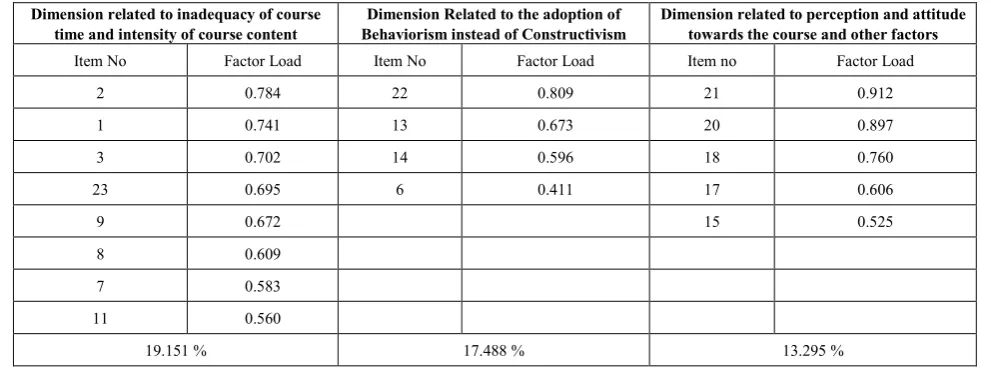
Table 3. Factorial Structure of HRKC-PS as a result of EFA
Dimension related to inadequacy of course
time and intensity of course content Behaviorism instead of Constructivism Dimension Related to the adoption of Dimension related to perception and attitude towards the course and other factors
Item No Factor Load Item No Factor Load Item no Factor Load
2 0.784 22 0.809 21 0.912
1 0.741 13 0.673 20 0.897
3 0.702 14 0.596 18 0.760
23 0.695 6 0.411 17 0.606
9 0.672 15 0.525
8 0.609
7 0.583
11 0.560
19.151 % 17.488 % 13.295 %
2.4.2.6. Item-total Correlations and Item Discrimination Characteristics
[image:8.595.57.553.95.279.2]Item-test correlation values explaining validity coefficient for each item are given in Table 4. Table 4. Item-test correlation values for HRKC-PS
Factors Items
2 1 3 23 9 8 7 11 22 13 14 6 21 20 18 17 15
Dimension related to inadequacy of course time and intensity of course content
,609 ,632 ,573 ,690 ,625 ,625 ,589 ,545
Dimension Related to the adoption Behaviorism instead of
Constructivism
,558 ,751 ,700 ,618
Dimension related to perception and attitude towards the course and other factors
,665 ,681 ,733 ,616 ,550
Total ,493 ,508 ,502 ,537 ,574 ,570 ,491 ,468 ,595 ,604 ,505 ,521 ,551 ,556 ,718 ,524 ,458
It is seen that the item-test correlation coefficients of items given in Table 3 range between 0.751 and 0.545. These values indicate that three items have high level (0.70 -1.00) and other items have medium level (0.30-0.70) item test correlation [12].
There is a medium level and significant correlation (0.405) between the dimensions related with inadequacy of course time and intensity of syllabus content and the dimension of the adoption of the Behaviorist Approach opposed to Constructivism. Besides, there is a low level and significant correlation (0.260) between the dimensions related with inadequacy of course time and intensity of program and the dimension related to perception and attitude towards the course and other factors. And there is a low level and significant correlation (0.234) between the dimension related to the Behaviorist Approach as opposed to Constructivism and the dimension related to perception and attitude towards the course and other factors.
Independent sample t-test was used to calculate item discrimination power of the items on the scale. To this end, total scores obtained from the scale were ordered in descending order and the upper and lower 27% groups were determined. Independent t-test values were calculated based on the scores of the both groups. As a result of analysis, it was concluded that there is a significant difference between the upper and lower groups for each item on the scale
(p<.01). This significant finding indicates that the items on
the scale have desired level of discriminative characteristic [12].
2.4.3. Confirmatory Factor Analysis (CFA)
Table 5. CFA results of HRKC-PS
Fit -Criteria Values of HRKC-PS
X2 116
Sd 351.23 (P < 0.01)
X2/sd 3.02
p- Value 0,001
NFI (Normed Fit Index) 0.95 NNFI (Non-Normed Fit Index) 0.91 RMR (Root Mean Square Residual) 0.092 SRMR (Standardized Root Mean Square Residual) 0.099 GFI (Goodness of Fit Index) 0.95 AGFI (Adjusted Goodness of Fit Index) 0.87 CFI (Comparative Fit Index) 0.96 RFI (Relative Fit Index) 0.91 IFI (Incremental Fit Index) 0.96 PNFI (Parsimony Normed Fit Index) 0.84
It is seen in CFA that HRKC-PS has acceptable fit level as the rate of X2 to freedom degree is a little above 3 (3,02), and has good fit because GFI is 0.95, AGFI is 0.87 and CFI is 0.96 The other fit values are within acceptable limits [5, 11, 79]. These values indicate that the scale is compatible with real data. As it was understood that all goodness of fit values are within acceptable limits, it was concluded that there factorial HRKC-PS is usable and valid model.
[image:9.595.161.479.377.734.2]2.4.4. Findings with Regard to Internal Consistency
Cronbach Alpha reliability analysis was performed to determine reliability coefficient of the scores obtained from HRKC-PS. The Cronbach Alpha coefficient was calculated as 0.853. The Cronbach Alpha reliability coefficient was 0.769 for the dimension of inadequacy of course time and intensity of syllabus content, which is one of the sub-factors. The Cronbach Alpha reliability coefficient was 0.675 for the dimension related to the adaptation of the Behaviorist Approach as opposed to Constructivism and 0.660 for the dimension related to perception and attitude towards the course and other factors. These results indicate that sub-scales are reliable [12]. All these results provided above indicate that the scale developed based on qualitative data is a valid data collection tool with adequate psychometric characteristics.
2.4.5. Validity in Mixed Research
In mixed method research, researchers who use exploratory sequential mixed method design are to check the validity of quantitative data together with qualitative data validity. Special concerns with regard to validity emerge. Besides, when using this design the researcher who makes the research proposal is to participate in the study. The concern in this issue is to use appropriate steps to develop a measurement tool with good psychometric characteristics [21].
In line with these issues, this study attempted to develop a measurement tool with good psychometrics characteristics. In this process, the steps mentioned above were followed and the advantages of the richness of qualitative data were used when developing the measurement tool. Finally, to prevent the repetition of the responds, the sample in the qualitative dimension was not included in quantitative dimension. For qualitative dimension, credibility, transmissibility and confirmability were presented to readers under separate headings and this process was carried out according to qualitative research procedures. Validity and reliability for the quantitative dimension was calculated in detail and step by step.
3. Findings
3.1. Qualitative Findings
As a result of analysis of the interviews made in the study, there themes were found with regard to the problems Social Studies teachers face in TRHRK course. These themes are: 1. The problems stemming from the inadequacy of the
course time and the intensity of the syllabus content. 2. The problems stemming from the adoption of
Behaviorist Approach as opposed to Constructivism. 3. The problems stemming from perception and attitude
towards the course and other factors.
3.1.1. The Inadequacy of the Course Time and Intensity of Program’s Content
The fundamental finding of the study is that participants experience that it is not possible to cover the content (attainments, activities) of TRHRK course mentioned in the educational program in the allocated course hours. Participants stated that in line with constructivist approach the course hour was increased from 2 to 3 by the Board of education and discipline in 2008 and this continued until 2010. However, the unit titled as “Turkey in Recent Period: The Second World War and After it” was added in the syllabus and the number of weekly course hours was decreased from three hours to two hours. As a result of these changes, the problem of not being able to cover the content of the syllabus emerged, which caused teachers to feel the anxiety of finishing the program. With regard to this anxiety, P5 stated that “I cannot cover so many subjects. I am not a superman, I have supernatural powers” and wanted to emphasize that it was not possible to cover the content of the program according to the principles of the constructivist approach.
The scope of the syllabus and the inadequacy of the weekly course hour caused teachers to have the anxiety of covering the syllabus in time. It was determined that the source of this anxiety was the desire to cover the content of TRHRK questions asked in the TRHRK course common exam administrated by the Ministry of National Education. P6 stated that the time period allocated to cover such an intensive program was one of the fundamental problems experienced in TRHRK course and perceived this problem as the source of other problems. P6 used the simile of “race horse” to envisage how much effort they showed and their dissatisfaction. Examples based on experience were used to emphasize that this opinion was dominant among all participants. The anxiety to finish the course syllabus caused the participants to adopt teaching via expository teaching strategy, not to use different methods and techniques other than narration and question answer technique, to teach the subjects superficially, not to be able to allocate enough time for the subjects, which engrain in the consciousness of citizenship and acculturation. They are the important elements of Social Studies education, which is supposed to engrain in national consciousness and historical sensitiveness. Besides, lack of time causes them to go astray from the instruction in teacher’s guidebook, and not to be able to integrate the elements of feedback, motivation and consolidation in their lessons. P123456 made self-assessment and they stated that they taught the lesson using the expository teaching method and stated that the basic reason for this was the anxiety of covering the syllabus in time.
P6 stated that the attainments in the program could not be covered and if the students were given voice in the lessons, it was seen that almost all of the participants were of the same opinion. The anxiety of finishing the syllabus stemming from the limited time allocated for the course, caused the participants no to be able follow the teacher’s guide book which was designed according to the constructivist approach. All of the participants stated that they did not use the guidebook and that if they used it, the syllabus would not be covered if they used the guidebook. With regard to this issue, P2, stated that “if I were to follow the steps mentioned in the guidebook, I would not be able to finish even half the syllabus. Let alone the questions that I am suggested to ask to the students, I would not be able to cover the topics even if I just taught the topics in the book”. It was also clearly stated by the participants that when the inadequacy of course time and the desire of the students to prepare for Transition to Secondary Education Exam were combined, they studied the topics superficially to meet the requirements of a multiple choice exam and thus digressed from the assessment tools used in the constructivist approach. Besides, they attached importance to the attainments by categorizing them according to the possibility of “their being asked or not in the exam”.
They stated that they were not able to spare enough time for many topics including the Çanakkale Victory, Historical Congresses, Period of National Struggle, which were believed to engrain in national consciousness and historical sensitiveness. The participants are clearly of the opinion that the problems stemming from the anxiety of covering the syllabus blocked the way to long-lasting and meaningful learning and caused lessons to be based on rote learning, exam focused, not having topical integrity.
In parallel with this and based on the problems mentioned above, the participants stated they that they could not provide opportunities for high level thinking and for making inferences and had to teach lessons which are deprived of the quality to help learners acquire the skills to perceive place, time and chronology and related this issue with the first theme. Besides, it was determined that they digressed from the aims of THRK course like effective citizenship, national consciousness and historical sensitiveness, lost their educational mission and took over the mission of information transmission, in their own words. P6 summarizes the issue mentioned above by saying "We continuously think about the topics about which questions can be asked on the exam, the things to be done. I mean we always think about transmitting knowledge. How can we help children to make permanent behavioral change? We do not ponder on things like that."
From the statements of P123456, it was found that they could finish the topics of TRHRK course with makeup lessons in some elective courses like Media Literacy course and Citizenship and Democracy Education course. When inadequacy of course time and the desires of the students to prepare for transition to secondary education exam (TEOG)
are combined, all the participant social Studies teachers stated they used the courses which are not included in TEOG exam as make up courses.
3.1.2. The problem Caused by Teachers’ Adoption of the Behaviorist Approach as Opposed to Constructivism The basic factors in the collection of findings obtained under this theme are the findings in the first theme. In other words, these two themes are closely related to each other. The fact that inadequacy of course time determined in the scope of the first theme causes the anxiety of finishing the syllabus. This anxiety causes the adoption of the behaviorist approach, the use of direct narration method instead of different methods, teaching the topics superficially, not giving enough voice to students, digression from the teacher’s guidebook, formation of rote learning and information transmission focused learning environment instead of meaningful, up-to-date and realistic course. These factors cause a syllabus designed according to the constructivist approach to be taught according to the behaviorist approach. The abstract dimension of TRHRK course by its nature makes it far from learning by experience compared to other courses; therefore, the participants think that the course should be taught with a teacher-centered approach, which is one of the biggest problems experienced. The basic factors that cause the adoption of Behaviorist approach instead of constructivism can be categorized as follows: the physical inadequacy of the education environment, high number of students, teacher’s perception with regard to the nature of the course, socio-economic factors. In the study, lack of single classes for Social Studies because of inadequate physical conditions, inadequacy of materials and instructional technology, lack of software and other materials were determined as other factors which cause the inability to apply constructivism.
When existing difficulties by the nature of the course are considered, it is seen that most of the participants stated the obligation of concretizing topics and attainments as a difficulty. It was concluded that study visits are to be organized so that students can learn by doing; however, there is no opportunity for such activities because of financial problems, parents’ attitudes, and safety problems, official procedures, which can be expressed as socio-economic and socio-cultural reasons. This case was expressed by P4 as follows:“Actually the Çanakkale Victory is to be taught in the place where the war was fought. We cannot afford it. We live in the country. Yes, we do not live in a village, we live in a county but we cannot make such study trips because the socio-economic levels of the students vary.” P6 states that
turn to virtual trips; however, it was found that because of the inadequacy of equipments and infrastructure and the inadequate teacher knowledge and skill, research and study focused education environment in which learners learn by doing cannot be provided, which is one of the factors that make the application the constructivist approach in TRHRK courses impossible.
3.1.3. Problems Caused by Perception and Attitude towards the Course and Other Factors
Under the theme called the problems caused by the perception and attitude towards the course and other factors in general the problems related to students and parents were found as reasons for the problems Social Studies teachers experience in TRHRK. In particular, the findings from the first two themes indicated that students did not internalize the course, and they did not care about the course by saying
“After all it is written in the book.” In other words, it was determined that all the participants thought that the reasons mentioned in the first and second theme caused the students to trivialize the course in their minds. The fact that the percentage of the questions from TRHRK course in central exams administrated for transition to secondary school is relatively low when compared to those of Mathematics, Science and Technology course was also expressed by the participants as another factor that trivialize the course in the view of the students. According to the participants, students’ viewing the lesson as not important takes students away from the course and draw them to indifference.
In the study, the difference between students’ readiness level and socio-economic level was stated by the participants as another problem faced in TRHRK course. Another factor causing the problems experienced in TRHRK course were determined to be problems caused by parents or factors outside the school. It is claimed that versions of historical events talked about at home or in close environment are different from those taught at school because of ideological differences. This causes the students to have a conflicting mental scheme in their minds with regard to history. It was claimed by the participants that this conflict led to prejudice or negative attitudes of learners towards the course, to informational convergence and to problem of trust. P3 stated the problem by saying the following sentences: “The parents
of the students have some negative judgments about the History of Revolution. These are spoken in the family and students who hear such things make comments about these topics. We are having problems with regard to this issue. The attitudes of families and what we teach are different, students have some problems. This is the most common problem I have with regard to this issue …”
3.2. Quantitative Findings
3.2.1. Inferential Statistics
There is not a significant difference between the participants in the quantitative study group and the first dimension (t51=-1.45, p=.227>.05); the second dimension (t51=-1.61, p=.775>.05) and the third dimension (t51=-1.96, p=.163> .05) in terms of gender. Besides, there is not a significant difference between the service lengths of the participants and the first dimension (F=1.035, p=.311 > 0.05); the second dimension (F =9,16, p =,848> .05) and the third dimension (F=1,17, p= ,311> .05). No significant difference between the participants in the first dimension (F =1,37, p =,242 > .05)) and the second dimension (F =1,19, p =,310>.05) was found in terms of the region where the participants work. However, it was found that there was a significant difference between the participants in the third
dimension (F =5,09, p=,002< .05)) in terms of the region
where the participants work. For example, the participants working in the Black Sea (
x
=4,78), Eastern Anatolia (x
=4,71) and Southeastern Anatolia Region (x
=3,68) experienced more problems with regard to “perception and attitude towards the course and other factors” compared to the participants working in other regions.3.2.2. Descriptive Statistics
3.2.2.1. The Quantitative Findings with Regard to
Inadequacy of the Course Time and the Intensity of the Syllabus
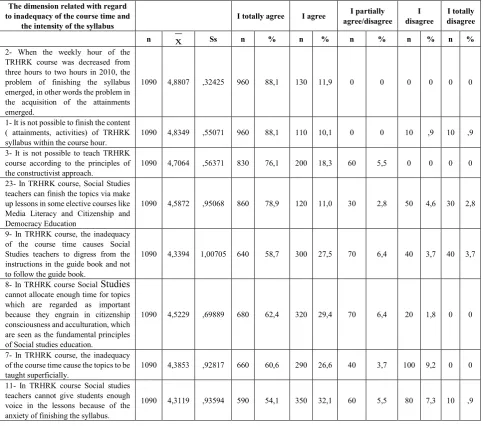
Table 6. Thequantitative findings with regard to inadequacy of the course time and the intensity of the syllabus
The dimension related with regard to inadequacy of the course time and
the intensity of the syllabus I totally agree I agree
I partially
agree/disagree disagree I disagree I totally
n
x
Ss n % n % n % n % n %2- When the weekly hour of the TRHRK course was decreased from three hours to two hours in 2010, the problem of finishing the syllabus emerged, in other words the problem in the acquisition of the attainments emerged.
1090 4,8807 ,32425 960 88,1 130 11,9 0 0 0 0 0 0
1- It is not possible to finish the content ( attainments, activities) of TRHRK
syllabus within the course hour. 1090 4,8349 ,55071 960 88,1 110 10,1 0 0 10 ,9 10 ,9 3- It is not possible to teach TRHRK
course according to the principles of
the constructivist approach. 1090 4,7064 ,56371 830 76,1 200 18,3 60 5,5 0 0 0 0 23- In TRHRK course, Social Studies
teachers can finish the topics via make up lessons in some elective courses like Media Literacy and Citizenship and Democracy Education
1090 4,5872 ,95068 860 78,9 120 11,0 30 2,8 50 4,6 30 2,8
9- In TRHRK course, the inadequacy of the course time causes Social Studies teachers to digress from the instructions in the guide book and not to follow the guide book.
1090 4,3394 1,00705 640 58,7 300 27,5 70 6,4 40 3,7 40 3,7
8- In TRHRK course Social Studies cannot allocate enough time for topics which are regarded as important because they engrain in citizenship consciousness and acculturation, which are seen as the fundamental principles of Social studies education.
1090 4,5229 ,69889 680 62,4 320 29,4 70 6,4 20 1,8 0 0
7- In TRHRK course, the inadequacy of the course time cause the topics to be
taught superficially. 1090 4,3853 ,92817 660 60,6 290 26,6 40 3,7 100 9,2 0 0 11- In TRHRK course Social studies
teachers cannot give students enough voice in the lessons because of the anxiety of finishing the syllabus.
1090 4,3119 ,93594 590 54,1 350 32,1 60 5,5 80 7,3 10 ,9
While 88,1% of the participants in the study group completely agree that decrease in the weekly hours of TRHRK course from three hours to two hours in 2010 has caused the problem of finishing the syllabus, in other words acquiring the attainments, 11,9% stated that they agreed with that. This item developed based on qualitative findings was answered positively by all participants. The qualitative finding that as a result of decrease in TRHRK course’s weekly hour in 2010, the problem of finishing the syllabus, in other words the problem of acquisition of attainments, emerged was quantitatively supported by the participants at a high level (
x
=4.8807). 88,1% of the participants in the study completely agreed with the conclusion that “It is not possible to finish the content of the TRHRK syllabus”, 10,1% answered that they agreed. This item developed based on qualitative findings was answered positively by 98,2 % of the participants. The rate of those who did not agree with this statement was rather low1,8%.76,1% of the participants in the study completely agreed
with the conclusion that it was not possible to finish the syllabus of TRHRK course according to the principles of the constructivist approach within time allocated for the course, and the percentage of those who stated that they agreed was 18,3%. 94,4 % of the participants stated that they agreed with this item developed based on qualitative findings. The rate of those who agreed partially was5,5%. The qualitative finding that it is not possible to finish the syllabus of the TRHRK course within course time allocated was highly supported by the participants in quantitative phase (
x
=4.7064).While 62,4% of the participants completely agreed with the qualitative finding that “In TRHRK course Social studies cannot allocate enough time for topics which are regarded as important because they engrain in citizenship consciousness and acculturation, which are seen as the fundamental principles of Social studies education.”, 29,4% supported this finding by stating that they agreed. 91,8% of the participants in the quantitative part stated positive opinion and agreed with the finding obtained in the qualitative part.
3.2.2.2. Quantitative Findings with Regard to the Adoption of Behaviorist Approach instead of the Constructivist Approach
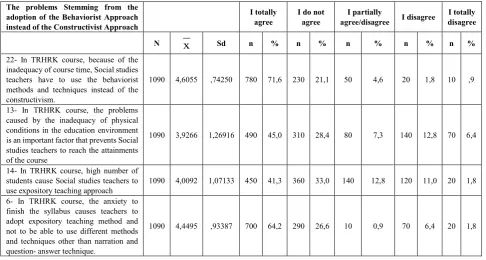
While 71,6% of the participants totally agree with the qualitative finding that “In TRHRK course, because of the inadequacy of course time, Social Studies teachers have to use the behaviorist methods and techniques instead of the constructivism. 21,1% stated that they agreed. While 92,7%
of the participants stated positive opinion and that they agreed with this qualitative finding. While 45,0% of the participants stated that they totally agreed with the statement that “In TRHRK course, the problems caused by the inadequacy of physical conditions in the education environment is an important factor that prevents Social studies teachers to reach the attainments of the course”, the percentage of those who stated that they agreed is 28,4%. 73,4% of the participants in the quantitative study supported qualitative finding. The rate of those who agreed partially is 7,3%. The rate of those who stated opposing view is 19,2%. While 64,2% of the participants in the study completely agreed with the finding that “in TRHRK course, the anxiety to finish the syllabus cause teachers to adopt expository teaching method and not to be able to use different method and techniques other than narration and question- answer technique”, 26,6% agreed with this statement. 91.8% of the participants in the quantitative part stated positive opinion and agreed with the finding obtained in the qualitative part.
Table 7. Quantitative Findings with Regard to the Adoption of Behaviorist Approach instead of the Constructivist Approach
The problems Stemming from the adoption of the Behaviorist Approach instead of the Constructivist Approach
I totally
agree I do not agree agree/disagree I disagree I partially disagree I totally
N
x
Sd n % n % n % n % n %22- In TRHRK course, because of the inadequacy of course time, Social studies teachers have to use the behaviorist methods and techniques instead of the constructivism.
1090 4,6055 ,74250 780 71,6 230 21,1 50 4,6 20 1,8 10 ,9
13- In TRHRK course, the problems caused by the inadequacy of physical conditions in the education environment is an important factor that prevents Social studies teachers to reach the attainments of the course
1090 3,9266 1,26916 490 45,0 310 28,4 80 7,3 140 12,8 70 6,4
14- In TRHRK course, high number of students cause Social studies teachers to
use expository teaching approach 1090 4,0092 1,07133 450 41,3 360 33,0 140 12,8 120 11,0 20 1,8 6- In TRHRK course, the anxiety to
finish the syllabus causes teachers to adopt expository teaching method and not to be able to use different methods and techniques other than narration and question- answer technique.
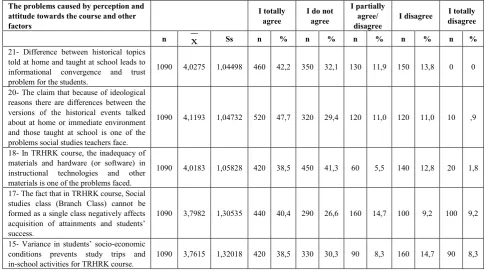
[image:14.595.63.550.336.596.2]Table 8. Quantitative Findings with regard to perception and attitude towards the course and other factors
The problems caused by perception and attitude towards the course and other factors
I totally
agree I do not agree
I partially agree/
disagree I disagree
I totally disagree
n
x
Ss n % n % n % n % n %21- Difference between historical topics told at home and taught at school leads to informational convergence and trust problem for the students.
1090 4,0275 1,04498 460 42,2 350 32,1 130 11,9 150 13,8 0 0
20- The claim that because of ideological reasons there are differences between the versions of the historical events talked about at home or immediate environment and those taught at school is one of the problems social studies teachers face.
1090 4,1193 1,04732 520 47,7 320 29,4 120 11,0 120 11,0 10 ,9
18- In TRHRK course, the inadequacy of materials and hardware (or software) in instructional technologies and other materials is one of the problems faced.
1090 4,0183 1,05828 420 38,5 450 41,3 60 5,5 140 12,8 20 1,8
17- The fact that in TRHRK course, Social studies class (Branch Class) cannot be formed as a single class negatively affects acquisition of attainments and students’ success.
1090 3,7982 1,30535 440 40,4 290 26,6 160 14,7 100 9,2 100 9,2
15- Variance in students’ socio-economic conditions prevents study trips and
in-school activities for TRHRK course. 1090 3,7615 1,32018 420 38,5 330 30,3 90 8,3 160 14,7 90 8,3
3.2.2.3. Quantitative Findings with Regard to Perception and Attitude towards the Course and Other Factors Quantitative Findings with regard to perception and attitude towards the course and other factors are presented in Table 8
42,2 % of the participants in the study stated that they totally agreed with the statement that “the difference between historical subjects told at home and taught at school leads to informational convergence and trust problem for the students”, 32,1% stated that they agreed with it. The percentage of those who stated opposing view is 13,8%. It was concluded qualitative finding that there is a difference between the versions of the historical topics talked about at home or in immediate environment and those at school causes informational convergence and trust problem in students was highly supported by the participants in the quantitative part (
x
=4,0275).While 47.7% of the participants in the study totally agree with the qualitative finding that because of ideological reasons there are differences between the versions of the historical events talked about at home or immediate environment and those taught at school is one of the problems social studies teachers face, 29,4% stated that they agree. While 38,5% of the participants totally agree with the qualitative finding that “in TRHRK course, the inadequacy of materials and hardware (or software) in instructional technologies and other materials is one of the problems faced”, 41,3% stated that they agreed. 79,8% of the participants stated positive opinion and agreed with this qualitative finding. The percentage of those who agreed
partially is 5,5%. The percentage of those who stated opposing view is 14,6%. 38,5% of the participants in the study totally agreed with the qualitative finding that variance in students’ socio-economic conditions prevents study trips and in-school activities for TRHRK course, 30,3% stated that they agreed. 68,8% of the participants who took part in the quantitative study stated positive opinion and agreed with the qualitative finding. The percentage of those who partially agree is 8,3%. The percentage of those who stated opposing view is 23,0%.
4. Discussion and Conclusions
The study in line with the views of the participants was constructed under the following three themes: problems stemming from the inadequacy of the course time and intensity of the syllabus, the problems caused by the adoption of the Behaviorist approach instead of constructivism, and the problems caused by the perception and attitude towards the course and other factors. Under the light of the quantitative data collected via quantitative data collection tool developed based on qualitative data, it was concluded that qualitative data can be generalized.
in the quantitative part of the study, which revealed that this situation is a problem experienced throughout Turkey. This result is in parallel with the result of a study by Bingöl [8] that “the view that time allocated for this course is not enough is prevalent among teachers”.
With regard to the intensity of the course syllabus, both qualitative and quantitative findings which indicate that it is not possible to cover the syllabus of the course in line with the principles of the constructivist approach within the weekly course hour allocated support each other. In a study
by Karacaoğlu [51], it was stated that the biggest problem in renewed programs was time problem. In the study, the participants stated that in line with the constructivist approach number of weekly hours of the course was raised form 2 hours to 3 hours in 2008 by the Board of Education and Discipline and this continued up to 2010. However, in 2010 the unit titled as “Turkey after Ataturk: The Second World War and after” was added to the syllabus of the TRHRK course and weekly hours of the course was decreased from 3 to 2. This decrease in weekly course hour led to the problem of finishing the syllabus and this problem caused teachers to have the anxiety of finishing the syllabus.
It was stated by Delen [24] that the topics of the recent area should be added to the syllabus. After this change was made, it was determined in a study by Adalar [2] that this change was responded positively by teachers. However, when the intensity of the content and the time allocated for the course are considered in combination, P5 summarized the problem by saying, “I cannot finish so many topics, I am not a Superman, I do not have supernatural powers”.
It was determined that all the participants in the qualitative phase stated that it was impossible to finish the syllabus of the TRHRK course by observing the principles of the constructivist approach within the course time allocated. It was concluded that this qualitative finding is supported by all of the 1090 teachers in the quantitative sample. In other words, this finding can be generalized. In the literature, Brooks and Brooks [10], Jonassen [47], Tynjala [82], stated that the content of a course is to be considered and enough time is to be allocated so that a course can be taught according to the principles of the constructivist approach. Acun [1], Wulf & Schave [86], stated that the scope and content of the syllabus and time is to be balanced very well. Even if the syllabus is designed according to constructivism, it is not possible to apply constructivism in the class if adequate time is not allocated or not very well planned [42, 45, 64, 67, 84]. In this context, decision makers should reconsider the balance between the time allocated for the course, the content, scope and intensity of the syllabus according the principles of the constructivist approach [6, 16, 32, 59, 71, 72, 80].
The social studies teachers who took part in the study stated that the inadequacy of course time caused them to have the anxiety of finishing the syllabus of TRHRK course; therefore, they covered some attainments of the course in
Media Literacy and Citizenship and Democracy Education courses. It was revealed that when the inadequacy of the course time was combined with the students’ desire to prepare for transition to secondary education, Social studies teachers started to use the hours of the courses from which questions are not asked in TEOG exam. This case which means that Citizenship and Democracy Education, Media Literacy courses are not taught seems to be an important finding of the study.
It was found that the qualitative finding that imbalance between the weekly hours of TRHRK course and the intensity of the syllabus causes lessons to be taught superficially was accepted 87,2% of the participants in the quantitative part. In particular, they stated that they could not spare enough time for topics including Çanakkale Victory, Congress and the Period of National Struggle which are regarded important by the participant teachers and believed to help the development of national consciousness and historical sensitivity. P6 summarizes the case defined as follows: “We continuously think about the topics about which questions can be asked on the exam, the things to be done. I mean we always think about transmitting knowledge." This qualitative finding was accepted by 91.8% of the participants in the quantitative part of the study, which indicates that it can be generalized.
Teachers adopt exam-based approach to prepare their learners for TEOG exam, and they digress from the assessment-evaluation means and methods of the constructivist approach and they taught the topics superficially and attached importance to attainments by categorizing them according to the possibility of “their being asked or not in the exam”. This case conflicts with the assessment principles of the constructivist stated by Holt–Reynolds [43], Jonassen [48], Semerci [73]. Constructivists, who are opposed to teacher centered lessons, argue that in general individuals’ construction of information or discovering it. According to the constructivists, teachers should guide students to discover scientific theories and historical events [18, 35, 57, 65, 68, 88]. However, qualitative and quantitative findings indicating that in TRHRK course teachers could not give enough voice to the students and taught teacher-centered lesson support each other.
Gençmehmetoğlu [38], Gömcü [39] and Yanpar-Şahin [87] similar studies were obtained. In constructivist classes, according to Gagnon and Collay [36] as learning takes place in a meaningful, unique and complex environment, unique learning activities by which students can make their own decisions, apply their own learning plan, monitor his/her own improvement and assess his/her own study. In this context [10, 13, 29, 30, 33, 34, 35, 36, 48, 54, 55, 59, 63, 71, 80, 81, 82, 85] it is important to make up the deficiencies stemming from physical conditions and environment and design constructivist classes.
In the study, it was found that besides economic and cultural problems caused by the differences between socio-economic levels of the students, bureaucratic obstacles prevent study trips or activities outside school. Especially, when socio-constructivist approach is adopted in the teaching of topics in history, experiencing in in the teaching of history and social studies indicated by Maxim [57] and Parker [65], building connection with real life
indicated by Çınar, Teyfur and Teyfur [23], Postletwaite [70], Sunal & Has [76], Maxim [57], Mercer [59], Tobias, & Duffy [80] and organizing study trips with a researching and inquiring approach based on proofs are important. In this context, lack of study trips and activities outside school seems to be one of the important obstacles for the application of the constructivist approach.
Because of ideological differences participants, sometimes there are differences between versions of the historical topics told at home or in close environment and at school, which leads to information convergence and trust problem for the students. The fact that this qualitative finding was supported by 77% of the teachers in the quantitative phase indicates that this is an important problem faced in TRHRK course. Especially, when differences in knowledge and perception of history, history education and historical topics because of ideological, cultural and social are considered, there is a need for objective history teaching [27, 50, 53, 57, 65, 78, 90]. In this context, it is considered that it will be beneficial to research this problem with an objective point of view. Stradling [75], who reported that similar problems are seen in Europe as well, stated that there are a number of TV programs on the media and internet which have commercial and political concerns and students fail to assess the accuracy of information presented in such programs and this is an educational problem. As a result, even if the syllabus is designed according to constructivist approach, traditional, teacher-centered, based on information and memorization, and exam focused education, which is away from the principles of the constructivism continues because of the obstacles mentioned above.
In this study, the biggest obstacle for the teaching of TRHRK course according to the constructivist approach was the inadequacy of weekly hour allocated for the course. When the scope of the content and changes in the syllabus are considered, this issue is too important to disregard. In
line with this, it is suggest that the relation between content and time be reconsidered by decision makers. However, teachers regard the problems related to the system. In this context, the current situation can also be understood as a justification and /or defense mechanism of the teachers for their attitudes. Besides, the categories that emerged in the study suggest that it is necessary to examine teachers’ self-efficacies in terms of the application of constructivism. Finally, the claim that there is difference between the versions of historical event told at home and at school and the confusion that this situation causes in the minds of the learners and brings the content of current history syllabus up for discussion and make us question why the version of history told at home is different from official history.
Note
This study was produced from Master Thesis written by
Yavuz KARADEMİR under the supervision of Asst. Prof. Dr. Selçuk Beşir DEMİR.
REFERENCES
[1] Acun, R. (2011). Curriculum development in history using systems approach. Educational Sciences: Theory & Practice, 11(2) 823-838.
[2] Adalar, H. (2010). Sosyal Bilgiler Öğretmenlerinin 8. Sınıf
T.C İnkılap Tarihi ve Atatürkçülük Dersi Yeni Öğretim
Programına İlişkin Görüşlerinin Değerlendirilmesi.
Gaziosmanpaşa Üniversitesi, Sosyal Bilimler Enstitüsü, İlköğretim Anabilim Dalı, Sosyal Bilimler Bilim Dalı,Yüksek Lisans Tezi.
[3] Alexander, R. (2003). Culture and pedagogy: International
comparisons in primary education. United Kingdom:
Blackwell Publishing.
[4] Balcı, A. (1995). Sosyal bilimlerde araştırma. Ankara:
Ankara Üniversitesi Eğitim Bilimleri Fakültesi Yayınları. [5] Bartholomew, D. J., Knott, M., & Moustaki, I, (2011) Latent
variable models and factor analysis: A unified approach. West Sussex: Wiley.
[6] Beal, C. M., & Bolick, C. M. (2013). Teaching social studies in middle and secondary schools. New Jersey: Pearson. [7] Bevevino, M. M., Dengel, J., & Adams, K. (1999).
Constructivist theory in the classroom. Clearing Hause, 72, 275–279
[8] Bingöl, M. (2009). İlköğretim İkinci Kademe 8. Sınıfta
Okutulan Türkiye Cumhuriyeti İnkılap Tarihi ve Atatürkçülük Dersinin Öğretimi, Karşılaşılan Sorunlar ve
Çözüm Önerileri(Ağrı İli Örneği). Selçuk Üniversitesi, Sosyal
Bilimler Enstitüsü, İlköğretim Anabilim Dalı, Sosyal Bilgiler Öğretmenliği Bilim Dalı, Yüksek Lisans Tezi
understanding: the case for constructivist classrooms. Alexsandria: The Association for the Supervision and Curriculum Development.
[11] Brown, T. A. (2006). Confirmatory factor analysis for applied research. New York: Guilford Pres.
[12] Brownlow, C. (2004). SPSS explained. London: Routledge. [13] Bukova-Güzel, E. (2007). The effect of a constructivist
learning environment on the limit concept among mathematics student teachers. Educational Sciences: Theory & Practice,7(3), 1155-1198.
[14] Bulling, D. (2005). Development of an instrument to gauge preparedness of clergy for disaster response work: A mixed
methods study. Unpublished manuscript, University of
Nebraska–Lincoln.
[15] Camkıran, T. M. (2011). 1981 ve 2006 Türkiye Cumhuriyeti İnkılap Tarihi ve Atatürkçülük 8.Sınıf Programlarına Göre Hazırlanmış Ders Kitaplarının İçerik ve Kullanılabilirlik
Açılarından Karşılaştırılması. Marmara Üniversitesi, Eğitim
Bilimleri Enstitüsü, Sosyal Bilimler Anabilim Dalı, Yüksek Lisans Tezi.
[16] Chen, C. (2003). A constructivist approach to teaching: implications in teaching computer networking. Information Technology, Learning and Performance journal, 21(2). [17] Child, D. (2006). The essentials of factor analysis. London:
Continuum International Publishing Group.
[18] Cooper, H., & Dilek, D. (2007). A comparative study on primary pupils' historical questioning processes in Turkey and England: Empathic, critical and creative thinking. Educational Sciences: Theory & Practice, 7(2), 684-726. [19] Copley, J. ( 1992). The integration of teacher education and
technology: A Constructivist model. In D. Carey, R. Carey, D. Willis & S. Willis ( Eds),Tecbnology and teacher education (p. 681). Charlottesville VA: AACE.
[20] Creswell, J. W. (2013). Araştırma deseni (Çev Edt: Demir, S. B.). Ankara: Eğiten Kitap.
[21] Creswell, J. W., & Pablo-Clark V. (2014). Karma yöntem araştırmaları (Çev Edt: Dede, Y. ve Demir, S. B.). Ankara: Anı
[22] Creswell, J., & Miller, D. (2000) ‘Determining Validity in Qualitative Inquiry’, Theory Into Practice, 39(3): 124–130. [23] Çınar, O., Teyfur, E., & Teyfur, M. (2006). İlköğretim okulu
öğretmen ve yöneticilerinin yapılandırmacı eğitim yaklaşımı
ve programı hakkındaki görüşleri. İnönü Üniversitesi Eğitim
Fakültesi Dergisi, 7(11), 47-64.
[24] Delen, S. (2007). İlköğretim ve Ortaöğretimde Öğretmen Görüşlerine Göre Türkiye Cumhuriyeti İnkılap Tarihi ve
Atatürkçülük Dersi'nin Öğretinde Karşılaşılan Sorunlar ve
Çözüm Önerileri. Gazi Üniversitesi, Eğitim Bilimleri Enstitüsü, Ortaöğretim Sosyal Alanlar Eğitimi Anabilim Dalı, Yüksek Lisans Tezi.
[25] Demirel, Ö. (2005). Eğitimde program geliştirme: Kuramdan uygulamaya (8. Baskı.). Ankara: PegeamA
[26] Dilek, D. (1999). History in the Turkish elementary school: Perceptions and pedagogy. Unpublished doctorate dissertation, The University of Warwick, Coventry.
[27] Dinç, E. (2001). The influence of politics on history teaching. Unpublished master’s thesis, The University of Leicester, Leicester.
[28] Dinç, E. (2011). A comparative ınvestigation of the previous and new secondary history curriculum: The ıssues of the definition of the aims and objectives and the selection of curriculum content. Educational Sciences: Theory & Practice, 12(1), 271-299.
[29] Eggen, P., & Kauchak, D. (2001). Educational Psychology: windows on classrooms. Upper Saddle River, NJ.: Prentice Hall.
[30] Ernst, P. (1995). The one and the many. In L. Steffe & J. Gale (Eds.). Constructivism in education (pp. 459-486). New Jersey: Lawrence Erlbaum Associates.
[31] Fabrigar, L. R. & Wegener. D. T. (2011). Exploratory factor analysis. Oxford: Oxford University Pres.
[32] Fensham, P. J., Gunstone, R. F., & White, R. T. (1994). Science content and constructivist views of learning and teaching. In P. J. Fensham, R. F. Gunstone & R. T. White (Eds.), The content of science (pp. 1-8). London: The Falmer Press
[33] Fox, R. (2001). Constructivism examined. Oxford Review of Education. 27, 33-39.
[34] Gabler, I. C., & Schroeder, M. (2003). Constructivist methods for the secondary classroom: Engaged minds. New Jersey: Pearson.
[35] Gagnon G. W., & Collay, M, (2005). Constructivist learning design. Thousand Oaks, CA: Sage.
[36] Gagnon, G. W. & Colloy, M. (2001). Designing for learning: Six elements in constructivist classrooms. Thousand Oaks, CA: Corwin Press.
[37] Gencer, H. (2007). İlköğretim TC İnkılap Tarihi ve Atatürkçülük Dersinde Amaç Gerçekleştirme Başarısına İlişkin Öğretmen Görüşlerinin Değerlendirilmesi(Diyarbakır
Örneği). Dicle Üniversitesi, Sosyal Bilimler Enstitüsü, Eğitim
Bilimleri Eğitimi Anabilim Dalı, Eğitim Programları ve Öğretimi Bilim Dalı, Yüksek Lisans Tezi.
[38] Gençmehmetoğlu, R. (2009). VIII. Sınıf Türkiye Cumhuriyeti İnkılap Tarihi ve Atatürkçülük Dersinde Yer Alan Olgu, Kavram ve Genellemelerin Öğretimi ve Önemi. Erzurum: Atatürk Üniversitesi, Sosyal Bilimler Enstitüsü, İlköğretim Anabilim Dalı, Yüksek Lisans Tezi.
[39] Gömcü, B. (2006). İlköğretim 8. Sınıf T.C İnkılap Tarihi ve Atatürkçülük Dersi'nin Kurtuluş Savaşı Dönemi Ünitesinin İşlenişinde Karşılaşılan Problemlere İlişkin Öğretmen ve Öğrenci Görüşleri. Ankara: Gazi Üniversitesi, Eğitim Bilimleri Enstitüsü, Sosyal Bilgler Eğitimi Anabilim Dalı, Yüksek Lisans Tezi.
[40] Gülnahar, F. (2012). Sosyal Bilgiler Öğretmen Adaylarının Lisans Eğitimlerinde Gördükleri Atatürk İlkeleri ve İnkılap Tarihi Dersine Yönelik Tutumların Değerlendirilmesi (Erzincan Üniverisitesi Örneği). Erzincan: Erzincan Üniversitesi, Sosyal Bilimler Enstitüsü, Sosyal Bilgiler Eğitimi Anabilim Dalı, Yüksek Lisans Tezi.