Feasibility Study on Composition and Mechanical Properties of Marine
Clay based Geopolymer Brick.
S. M. Tamizi
1,a, A.M. Mustafa Al Bakri
1,b, H. Kamarudin
1,c, C.M. Ruzaidi
1,d,
J. Liyana
1,eA.K. Aeslina
2,f1
Center of Excellence Geopolymer and Green Technology, School of Materials Engineering, Universiti Malaysia Perlis (UniMAP), P.O. Box 77, D/A Pejabat Pos Besar, Kangar, Malaysia.
2
Faculty of Civil and Environmental Engineering ,Universiti Tun Hussein Onn Malaysia (UTHM), 86400, Parit Raja, Batu Pahat, Johor, Malaysia
E-mail: [email protected], [email protected], [email protected],
d
[email protected], [email protected], [email protected],
Keywords: Marine Clay,Geopolymer Brick,Composition. Compressive Strength
Abstract.
Geopolymer is an inorganic polymer performed in synthesis process of an aluminosilicate material which activated by alkaline activator solution. Marine clay, considered to be a waste substance which have an important aluminosilicate sources in developing geopolymer synthesis since it contains sufficient amounts of alumina and silica. In this experimental study, local marine clay composition was been identified to determine the amount of alumina and silica. The raw sample compositions were identified by using X-ray fluorescence (XRF). Incorporated with it composition, compressive strength of brick were been tested in aged of 1, 2 and 3 day and compared with local production of cement brick (CB). This research is aimed at determining the properties of Kuala Perlis marine clay in order to verify its suitability as a pozzolana materials as well as the sufficient amount of Al and Si to enhance the properties of geopolymer brick.
Introduction
Geopolymer is a new approach in materials technology recently since it was been named by Davidovits in 1979. The method of solidification is much more popular since it can be applied in various applications[2]. With excellent mechanical properties, low shrinkage, chemical resistant, corrosion resistance, environmental friendly and long span durability[4-7]; it attracted more research on various parameters like silicate activator pH, different molarity of NaOH, alkaline activator ratio and studying the materials that enriched with Si and Al [1, 2, 8-12]. Marine clay, considered to be a waste substance which have an important aluminosilicate sources in developing geopolymer synthesis since it contains sufficient amounts of alumina and silica [12]. A natural pozzolana is an enriched material with aluminious and siliceous that act with sodium hydroxide and sodium silicate [13] to form cementitious properties in low temperature [14].
studied by Zhang, Yao [7] was as protection coating to marine concrete. This project was focus on solving the issue of increasing waste disposal material as well as to perform new material from synthesis process by mixing marine clay with alkaline activator solution.
In the Table: 1 was showed the chemical composition of different type of Aluminous and siliceous sources by differ researcher.
Table 1:X-ray fluorescence analysis of Al and Si materials used in the geopolymer synthesis
According to ASTM 618 [22], in producing of cementitiuos material, the minimum requirement of total composition of silicon oxide, aluminium oxide and iron oxide was 70% of total weight. The chemical component determinations and the limits placed on each do not predict the performance of the fly ash or natural pozzolan with hydraulic cement in concrete, but collectively help describe composition and uniformity of the material [22].
Materials and Experimental Details Raw Material
Marine Clayused in this study was collected along seashore in Kuala Perlis, Malaysia at varies depth 0.3 – 1.0 m. Six (6) spotted point for sampling location. The sample taken have been remarked as MC 01 for sampling at point 1, then MC 02 for sampling at point 2 and continuous marking for other sample. The sample was been dried up in the oven at temperature of 105°C in 48 hours and it been pulverized and sieved in 315 µm sieving pan.
Preparation of alkaline activator Solution
The alkaline liquid that used was a combination of sodium silicate solution and sodium hydroxide solution. The Sodium silicate (Na2SiO3) solution was supplied by South Pacific Chemicals Industries
Sdn. Bhd. (SPCI) Malaysia. The chemical composition of the Na2SiO3 solution was SiO2 = 30.1%,
Na2O = 9.4% and water = 60.5% by mass with a SiO2/Na2O modulus of 3.2, specific gravity at 20°C
= 1.4g/cc and viscosity at 20°C = 400cP. The sodium hydroxide (NaOH) solution was prepared by dissolving the NaOH powder made in Taiwan with 99% purity in distilled water . The NaOH solution was prepared with 12 M concentration [1, 3] and cooled down to room temperature .
Mixing Process
In the mixing process, the dry marine clay mixed homogenously with alkaline activator to perform synthesis paste in fixed ratio of 1:2 then the ratio of sodium silicate solution to sodium hydroxide solution, by mass, was fixed at 2.5. The synthesis pastes were mixed with fine aggregate in ratio 1:3 and moulded in the brick mould with dimensioning is according to BS3921 [23]. The samples were cured at a temperature 70 °C for 24 hr and maintained at room temperature until the testing was conducted [1].
Chemical Composition
A.M Mustafa
al Bakri [1] Phair, J. W et al [2] Liew, Y. M [3]
Fly Ash (% by weight)
K-Feldspar (% by weight)
Metakaolinite (% by weight)
Kaolin (% by weight) SiO2 52.11 67.1 59.6 54 Al2O3 23.59 17.6 33.9 31.7 Fe2O3 7.39 0.2 1.2 4.89
TiO2 0.88 0.01 3 1.41
CaO 2.61 0.2 0.2 <0.05
MgO 0.78 0 0.3 0.7
Na2O 0.42 <0.1 0.17 0.05
K2O 0.8 10.6 0.2 6.05
P2O5 1.31 0.3 0.14 -
SO3 0.49 0 0 -
Testing
Compression Strength Test
The compressive strength test for geopolymer bricks were carried out according to ASTM C67-07a [24] by using 20T JiNAN Hydraulic Compression Testing Machine at the rate loading of 0.05 kN/s or not exceed 0.15kN/s. The load applied is limited on the strecher face of the brick. The compressive strength is taken as the maximum compressive load it can carry per unit area.
X-Ray Fluorescence
Investigation on chemical compositions on dry marine clays was tested using X-ray Fluorescence (X-RF). This action was taken to analyze the initial composition of marine clay. From this characterization, the entire particle that made marine clay is identified.
Result and Discussion
[image:3.595.50.542.315.529.2]Chemical Composition of Kuala Perlis Marine Clay
Table 2: Chemical Composition of Kuala Perlis Marine Clay
Chemical Composition
(% by weight)
Average (% by weight)
ASTM C 618 Class
N (min =70%)
MC01 MC02 MC03 MC04 MC05 MC06
SiO2 33.5 42.53 35.22 46.21 35.44 41.51 39.07
72.16
Al2O3 8.82 11.2 9.26 6.1 7.57 9.37 9.76
Fe2O3 20.19 26.15 23.66 21.91 21.02 21.61 23.33
CaO 26.3 30.2 25.36 32.14 28.78 28.96 27.29
K2O 2.78 1.58 2.13 1.84 2.33 2.18 2.16
Cl 4.82 5.12 4.56 5.34 5.04 5.12 4.83
CuO 0.084 0.088 0.068 0.026 0.162 0.017 0.08
MgO 0.21 0.256 0.221 0.231 0.266 0.248 0.23
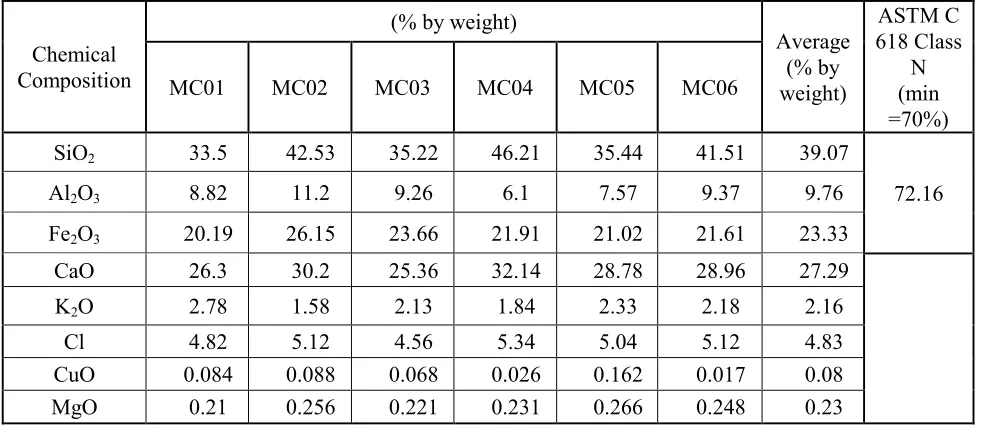
Table 2 shows the chemical composition of marine clay in 6 different areas along the Kuala Perlis offshore. According ASTM C618-13 [22], the total chemical composition that required for cementitious materias on natural pozzolana materials (Class N) was 70% of their total mass. Based on previous research [1, 3, 9], even no reported on the total amount of composition but it can been seeing that the result was good especially in compressive strength.
The result of X-ray Fluorescence on the sample shows that average percent by weight was 72.16 % and its slightly higher than minimum requirement. The chemical compositions of marine clay listed in Table 2 shows the major oxide components are silica (SiO3), Alumina (Al2O3), Iron
(Fe2O3) and lime (CaO). Other components such as K2O, ZnO and CuO are present in small
Compressive Strength
Table 3: Compressive Strength of Marine Clay Based Geopolymer Brick
Average Compressive Strength, MPa
Day testing 1D 2D 3D 7D
Marine Clay
Brick 4.82 5.95 7.94 9.34 Conversional
Cement Brick 3.06 3.49 3.02 3.33
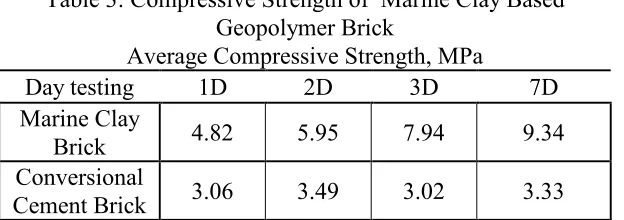
Table 3 shows the compressive test result of the marine clay based geopolymer brick. The average strength of geopolymer brick was achieved at 4.82MPa after 24-h curing [21] . While for the other tested day (2D, 3D, 7D) also shows the progressive increment of the compressive strength compare to conversional cement brick. Hardjito, E.Wallah [21] also reported that because the chemical reaction of the geopolymer paste very fast in polimerisation process, so the compressive strength was not vary for the concrete properties. The cement based product relies on the hydration process which takes more time to gain the strength. According to ASTM C91 [25], the requirement for masonry cement for type M in term of compressive strength was 12.4 MPa. Further study need to be carried out on other properties of the matrix composition such as soundness and durability of paste.
Summary
The total chemical composition of oxide component which are silica (SiO3), Alumina (Al2O3) and
Iron (Fe2O3) that required in ASTM C618-13 [22] was proved that the average composition of 70% of
the weight Kuala Perlis marine clay which mixed with appropriate alkaline activator solution, was gain the compressive strength in early day. Incorporated with marine clay composition, the compressive strength was improved due to suitability of marine clay composition with previous cementitious or pozzalana material.
Acknowledgements
This work was financially supported by the King Abdul Aziz City Science and Technology (KACST). The authors extend their thanks and appreciation to Centre of Excellence Geopolymer and Green Technology (CEGeoGTECH) and the School of Materials Engineering, Universiti Malaysia, Perlis (UniMAP).
References
[1] Bakri, A.M.M.A., et al., The Effect Of Alkaline Activator Ratio On The Compressive Strength Of Fly Ash-Based Geopolymers. Australian Journal of Basic and Applied Sciences, 2011. 5(9): p. 1916-1922.
[2] Phair, J.W., J.S.J. van Deventer, and J.D. Smith, Effect of Al source and alkali activation on Pb and Cu immobilisation in fly-ash based “geopolymers”. Applied Geochemistry, 2004. 19(3): p. 423-434.
[3] Liew, Y.M., et al., Processing and characterization of calcined kaolin cement powder.
Construction and Building Materials, 2011. 30(0): p. 794-802.
[4] Huat, B.B.K., Othman, K., & Jaffar, A.A. , Geotechnical Properties of Malaysian Marine Clays.
J. Ins. Engineers Malaysia, 1995. Vol. 56: p. pp.23-33.
[5] Provis, J.L. and J.S.J. Van Deventer, Geopolymers: Structures, Pricessing, Properties and Industrial Applications2009: Taylor & Francis.
[7] Zhang, Z., X. Yao, and H. Zhu, Potential application of geopolymers as protection coatings for marine concrete: I. Basic properties. Applied Clay Science, 2010. 49(1–2): p. 1-6.
[8] Panias, D., I.P. Giannopoulou, and T. Perraki, Effect of synthesis parameters on the mechanical properties of fly ash-based geopolymers. Colloids and Surfaces A: Physicochemical and Engineering Aspects, 2007. 301(1–3): p. 246-254.
[9] Phair, J.W. and J.S.J. Van Deventer, Effect of the silicate activator pH on the microstructural characteristics of waste-based geopolymers. International Journal of Mineral Processing, 2002. 66(1–4): p. 121-143.
[10]Zhang, Z., et al., Effects of halloysite in kaolin on the formation and properties of geopolymers.
Cement and Concrete Composites, 2012. 34(5): p. 709-715.
[11]Živica, V., Effects of type and dosage of alkaline activator and temperature on the properties of alkali-activated slag mixtures. Construction and Building Materials, 2007. 21(7): p. 1463-1469. [12]BARBOSA, et al. Synthesis and Characterization of Sodium Polysialate inorganic polymer based on Alumina and Silica. in Geopolymer International Conference '99. 1999. Institut Géopolymère, Saint-Quentin, France.
[13]Xu, H. and J.S.J. Van Deventer, Ab initio calculations on the five-membered alumino-silicate framework rings model: implications for dissolution in alkaline solutions. Computers & Chemistry, 2000. 24(3–4): p. 391-404.
[14]Akande, J.M., C. Arum, and F.M. Omosogbe, Determination of the Pozzolanic Properties of Olotu Marine Clay and Its Potentials for Cement Production. Materials Sciences and Applications, 2011. 2: p. 53-58.
[15]Liu, S.Y., et al., Depositional and geotechnical properties of marine clays in Lianyungang, China. Engineering Geology, 2011. 121(1–2): p. 66-74.
[16]Rajasekaran, G., K. Murali, and R. Srinivasaraghavan, Microfabric, chemical and mineralogical study of Indian marine clays. Ocean Engineering, 1998. 26(5): p. 463-483.
[17]Cox, J.B., A Review of the Engineering Characteristics of the Recent Marine Clays in South East Asia1968: Asian Institute of Technology.
[18]C.S.Chen and S.M. Tan, Some Engineering Properties of Soft Clay From Klang Area. 2nd International Conference on Advance in Soft Soil Engineering and Technology, 2003: p. pp. 79-87.
[19]Chui, P.C. and J.H. Tay, Non-Conventional Construction Materials from Dredging Spoils.
Journal of Environmental Monitoring Assessment, 1997. Vol.44: p. 285-294.
[20]C.M.Chan and R.Robani, Alternative Aggregates from Clay-POC: An Exploratory Study, in
International Conference on Construction and Building Technology2008. p. 423-432.
[21]Hardjito, D., et al., On the Development of Fly Ash-Based Geopolymer Concrete. ACI Materials Journal, 2005(101-M52).
[22]C618-13, A., Standard Specification for Coal Fly Ash and Raw or Calcined Natural Pozzolan for Use in Concrete 2012.
[23]BS3921, Specification for Clay Bricks, B.S. Institution, Editor 1985, British Standard Institution. [24]C67-07a, A., Standard Test Methods for Sampling and Testing Brick and Structural Clay Tile,
2007.