Journal of Chemical and Pharmaceutical Research, 2013, 5(1):180-184
Research Article
ISSN : 0975-7384
CODEN(USA) : JCPRC5
A simple and sensitive RP-HPLC method for estimation of citrus
bioflavonoids in pharmaceutical solid dosage forms
Shantaram Nangude
1*and Manisha Vite
21
Meyer Organics Pvt.Ltd. Wagle Estate, Thane, Maharashtra, India
2
Vishal Institute of Pharma. Edu. And Research, Ale, Pune, Maharashtra, India
_____________________________________________________________________________________________
ABSTRACT
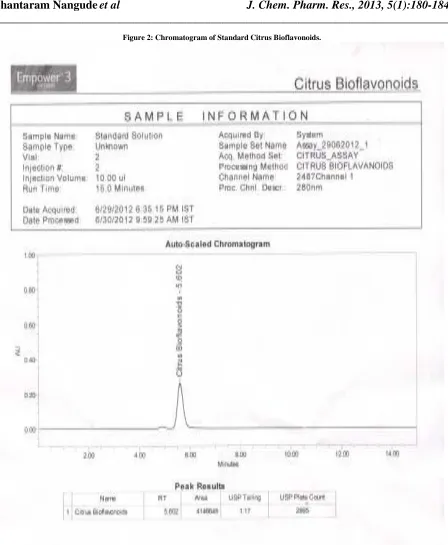
An RP-HPLC method was developed and validated for the estimation of citrus bioflavonoids in bulk drug and solid dosage forms. The chromatographic system was equipped with Zorbax XDB C-18,250 X 4.6 mm internal diameter with 5 micron particle size column and PDA detector set at 280nm, in conjunction with a mobile phase of Methanol and Water in the ratio of 70:30 at a flow rate of 1.0 ml/min. The retention time of citrus bioflavonoids was found to be 5.602 minute. The separation was performed at ambient temperature. Linearity was observed in the concentration range of 100-1200µg/ml with correlation co-efficient 0.9999 and slope 9599.5.Percentage recovery obtained 100.07-100.62%. The percentage Assay was found to be 99.65 to 102.13%.The proposed method is precise, accurate, selective and rapid for the determination of citrus bioflavonoids in bulk drug and solid dosage forms. The proposed method is optimized and validated as per the International Conference on Harmonization (ICH) guidelines.
Keywords : RP-HPLC; Citrus Bioflavonoids; Validation.
_____________________________________________________________________________________________
INTRODUCTION
Citrus Bioflavonoids comprise a group of water soluble plant pigments found in foods such as orange and lemons and are partly responsible for giving these foods their colorful look. They are believed to enhance the absorption and utilization of Vitamin C.In addition bioflavonoids possess antioxidant properties that help fight cell damaging free radicals in the body.1-4 Literature survey reveals that Methods available for determination of different flavonoids in different parts of plants.5 No method is available for determination of citrus bioflavonoids in bulk drug and pharmaceutical dosage forms; we have decided to estimate Citrus Bioflavonoid by RP-HPLC method. This paper presents simple, rapid and reproducible and an economical RP- HPLC method for estimation of citrus bioflavonoids in bulk drug and pharmaceutical dosage forms. The proposed method is optimized and validated as per the International Conference on Harmonization (ICH) guidelines.6
EXPERIMENTAL SECTION
Reagents and Solutions
Methanol, Water and Dimethylformamide of HPLC grade and double distilled water were used in analysis.
Mobile Phase Preparation
Prepared a mixture of Methanol (HPLC Grade) and Water (HPLC Grade) in the ratio of 50:50 %( v/v) mixed and sonicated.
Preparation of standard Solution
Accurately weigh 10 mg of Citrus Bioflavonoids Working Standard and transferred it into a 25 ml volumetric flask. Dissolved with 10 ml of Dimethylformamide, sonicated for 5 minutes and dilute to volume with mobile phase up to 25 ml. Filter through 42 No. filter paper and inject.
Procedure for analysis of tablet formulation
Weighed 10 tablets and triturate in mortar and pestle. Weigh powdered equivalent to 10 mg of Citrus Bioflavonoids in 25 ml volumetric flask, Dissolved with 10 ml of Dimethylformamide, sonicated for 5 to 10 minutes and make up the volume with mobile phase up to 25 ml & mixed. Centrifuged for 15 minutes at 2500 rpm. Filter supernatant solution through 0.22 micron syringe filter and inject.
Method validation
The method was validated for linearity, accuracy, intra-day and inter-day precision, robustness and ruggedness in accordance with ICH guidelines.
Linearity
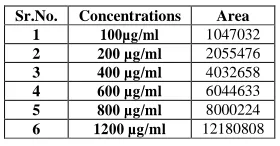
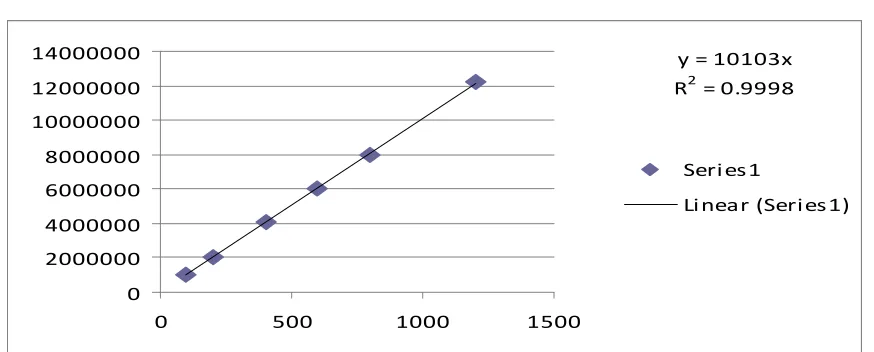
[image:2.595.228.368.468.541.2]Prepared a Standard stock solution of Citrus Bioflavonoids 2000 µg/ml by dissolving 50 mg standard in 25 ml volumetric flask. Several aliquots of standard solution were taken into different 20ml calibrated volumetric flasks and diluted up to mark with mobile phase such that final concentration of Citrus Bioflavonoids was 100-1200 µg/ml . Five replicates per concentration were injected and chromatograms were recorded. Evaluation was performed with PDA detector at 280 nm, peak areas were recorded for all the peaks. The peak areas show excellent correlation between peak area and concentration range. The linearity graph is shown in the Figure 1 and the value obtained was shown in table 1.
Table 1: Data for Linearity of Citrus Bioflavonoids
Sr.No. Concentrations Area 1 100µg/ml 1047032
2 200 µg/ml 2055476
3 400 µg/ml 4032658
4 600 µg/ml 6044633
5 800 µg/ml 8000224
6 1200 µg/ml 12180808
Precision
One set of three different concentrations of standard solutions of Citrus Bioflavonoids was prepared. All the solutions were analyzed thrice in order to record any intra day variations in the results. For Inter day variations study three different concentrations of the mixed standard solutions in linearity range were analyzed on three consecutive days. The peak area was recorded and Relative standard deviation (RSD) was calculated for both series of analyses.
Recovery studies
To check the accuracy of the method, recovery studies were carried out by addition of standard drug solution to pre-analyzed sample solution at three different levels 50%, 100% and 150%.Each level was injected 3 times. The percentages of recoveries were calculated.
Figure 1: Linearity of Citrus Bioflavonoids
y = 10103x
R2 = 0.9998
0 2000000 4000000 6000000 8000000 10000000 12000000 14000000
0 500 1000 1500
Seri es 1
[image:3.595.80.517.117.293.2]Li near (Seri es 1)
Table 2: Data for Recovery study
Level of % Recovery Mean Recovery* Standard Deviation % R.S.D. 50 100.44 0.445 0.432 100 100.62 0.391 0.385 150 100.07 0.193 0.198 *Average of three determinations, R.S.D. is relative standard deviation
Ruggedness and Robustness:
In the robustness study, the influence of small, deliberate variations of the analytical parameters on retention time of the drug was examined. The following two factors were selected for change: flow rate of the mobile phase (1.0 ± 0.1 ml/min) and a wavelength at which the drugs were recorded (280 ± 2 nm). One factor at the time was changed to estimate the effect. Ruggedness of the method was determined by carrying out the assay by different analysts on different days. It was observed that there were no marked changes in the chromatograms, which demonstrated that the RP-HPLC method developed is robust and rugged.
Limit of Detection and Limit of Quantification
LOD and LOQ were calculated as 3.3 σ /S and 10 σ /S respectively; where σ is the standard deviation of the
response (y-intercept) and S is the slope of the calibration plot.
RESULTS AND DISCUSSION
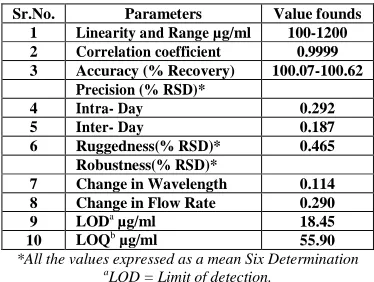
Table 3: Summary of validation parameters of proposed RP-HPLC method
Sr.No. Parameters Value founds 1 Linearity and Range µg/ml 100-1200 2 Correlation coefficient 0.9999 3 Accuracy (% Recovery) 100.07-100.62
Precision (% RSD)*
4 Intra- Day 0.292
5 Inter- Day 0.187
6 Ruggedness(% RSD)* 0.465 Robustness(% RSD)*
7 Change in Wavelength 0.114 8 Change in Flow Rate 0.290
9 LODa µg/ml 18.45
10 LOQb µg/ml 55.90
*All the values expressed as a mean Six Determination
aLOD = Limit of detection. bLOQ =Limit of quantitation.
CONCLUSION
Proposed study describes a new and simple RP-HPLC method for the estimation of Citrus Bioflavonoids. The method validated was according to ICH guidelines, it is found to be simple, sensitive, accurate and precise. Therefore the proposed method was used for the routine analysis of the pharmaceutical dosage forms.
REFERENCES
[ 1 ] M e r c k Index - an encyclopedia of chemicals, drugs and biologicals, 13th edition, 1425.
[2] J.Trevor; G.Katzung; B.Masters; K atz ung and Trevor’sPharmacology, 7th edition, MC Graw-Hill
Publication, New York, 2005; 127-128.
[3] F. S. K Barar; Essentials of Pharnacotherapeutics. 4th edn., S.Chand and Company Ltd., New Delhi, 2007, 123-124. [4] A.H.Becket, J.B.Stenlake; Practical pharmaceutical chemistry. 4th edn. CBS. Publishers, New Delhi, 2, 2005, 278-280.
[5] http://www.solgar.com/SolgarProducts/Citrus-Bioflavonoid-Complex.htm.