Human preferences for sexually dimorphic faces may
be evolutionarily novel
Isabel M. Scotta, Andrew P. Clarka, Steven C. Josephsonb, Adam H. Boyettec, Innes C. Cuthilld, Ruby L. Friede, Mhairi A. Gibsonf, Barry S. Hewlettc, Mark Jamiesong, William Jankowiakh, P. Lynne Honeyi, Zejun Huangj,
Melissa A. Lieberte, Benjamin G. Purzyckik, John H. Shaverk, J. Josh Snodgrasse, Richard Sosisk, Lawrence S. Sugiyamae, Viren Swamil, Douglas W. Yum,n, Yangke Zhaoj, and Ian S. Penton-Voako,1
aDepartment of Life Sciences–Psychology Division, Brunel University, Uxbridge UB8 3PH, United Kingdom;bDepartment of Anthropology, University of Utah,
Salt Lake City, UT 84112;cDepartment of Anthropology, Washington State University, Pullman, WA 99164;dSchool of Biology, University of Bristol, Bristol BS8
1UG, United Kingdom;eDepartment of Anthropology, University of Oregon, Eugene, OR 97403;fDepartment of Archaeology and Anthropology, University
of Bristol, Bristol BS8 1UU, United Kingdom;gSchool of Law and Social Sciences, University of East London, London E16 2RD, United Kingdom;hDepartment of
Anthropology, University of Nevada, Las Vegas, NV 89154;iDepartment of Psychology, MacEwan University, Edmonton, AB, Canada T5J 4S2;jDepartment of
Psychology and Behavioral Science, Zhejiang University, Hangzhou, Zhejiang 310028, China;kDepartment of Anthropology, University of Connecticut, Storrs,
CT 06269;lDepartment of Psychology, University of Westminster, London W1B 2UW, United Kingdom;mSchool of Biological Sciences, University of East
Anglia, Norwich NR4 7TJ, United Kingdom;nState Key Laboratory of Genetic Resources and Evolution, Kunming Institute of Zoology, Kunming, Yunnan
650223, China; andoSchool of Experimental Psychology, University of Bristol, Bristol BS8 1TU, United Kingdom
Edited by Susan T. Fiske, Princeton University, Princeton, NJ, and approved August 19, 2014 (received for review May 27, 2014)
A large literature proposes that preferences for exaggerated sex typicality in human faces (masculinity/femininity) reflect a long evolutionary history of sexual and social selection. This proposal implies that dimorphism was important to judgments of attractive-ness and personality in ancestral environments. It is difficult to evaluate, however, because most available data come from large-scale, industrialized, urban populations. Here, we report the results for 12 populations with very diverse levels of economic develop-ment. Surprisingly, preferences for exaggerated sex-specific traits are only found in the novel, highly developed environments. Sim-ilarly, perceptions that masculine males look aggressive increase strongly with development and, specifically, urbanization. These data challenge the hypothesis that facial dimorphism was an im-portant ancestral signal of heritable mate value. One possibility is that highly developed environments provide novel opportunities to discern relationships between facial traits and behavior by ex-posing individuals to large numbers of unfamiliar faces, revealing patterns too subtle to detect with smaller samples.
facial attractiveness
|
evolution|
cross-cultural|
aggression|
stereotypingI
nspired by evidence from nonhuman species indicating that exaggerated sex-typical traits (e.g., large antlers, peacock tails) are often attractive to mates or intimidating to rivals (1, 2), morphological sex typicality in humans (masculinity in men and fem-ininity in women) has been the focus of considerable research into attractiveness judgments (3, 4). Facial attractiveness research has been revolutionized by this explanatory framework from the bi-ological sciences, which proposes that attractive human faces hon-estly signaled mate value within ancestral environments.An influential proposal is that facial femininity is a signal of fertility in human female faces (4–9) because, within same-age women, it is associated with estrogens (10), which, in turn, are related to measures of reproductive health (11). Like ovarian function, facial femininity declines with age in adulthood (12, 13). The proposal that fertile women should be attractive to men is seemingly uncontroversial because males who discriminatively mate with fertile females should achieve a straightforward re-productive advantage over those males who do not, with all other factors being equal (6). Although direct associations between facial femininity and fertility have not been demonstrated, the consensus from Western preferences, and from the limited cross-cultural data available, is that femininity is attractive, as predicted by the fertility hypothesis (14–17). In environments where fertility is high and variable, this relationship should be even more apparent. In male faces, masculinity has been variously proposed to signal heritable disease resistance (“good genes”or“ immunocompe-tence”) (4, 15, 18–22) and/or perceived as a cue of aggressiveness
and, consequently, intrasexual competitiveness (22, 23). The “honesty”of face shape as an indicator of immunocompetence is proposed to be the result of an immunosuppressive effect of tes-tosterone. Because testosterone influences the growth of sex-typical traits in many species (24, 25), masculine facial shape is proposed to be a costly, and thus honest, signal of male quality (22). The hypothesis that cues of heritable health should be attractive to females is widely accepted (26), although the evidence for a link between heritable health and masculinity in humans is tentative at best (22).
Support for a link between masculinity and aggression is largely indirect, and it consists of an association between testosterone and both aggressive behavior (27, 28) and face shape (25), in ad-dition to the fact that honest signaling of dominance is commonly observed in nonhuman species (3). Masculine faces are per-ceived as aggressive in those groups (i.e., urban, Western) where the relationship has been tested (29). Because masculinity may signal both (desirable) immunity and (potentially costly) aggres-sion in humans, some authors have proposed that preferences for masculinity reflect women trading-off benefits of traits putatively associated with health against those traits associated with pro-social behaviors, such as parental investment (23, 30, 31).
Significance
It is a popular assumption that certain perceptions—for example, that highly feminine women are attractive, or that masculine men are aggressive—reflect evolutionary processes operating within ancestral human populations. However, observations of these perceptions have mostly come from modern, urban populations. This study presents data on cross-cultural perceptions of facial masculinity and femininity. In contrast to expectations, we find that in less developed environments, typical“Western”perceptions are attenuated or even reversed, suggesting that Western perceptions may be relatively novel. We speculate that novel environments, which expose individuals to large numbers of unfamiliar faces, may provide novel opportunities—and motives—to discern subtle rela-tionships between facial appearance and other traits.
Author contributions: I.M.S., S.C.J., and I.S.P.-V. designed research; I.M.S., A.P.C., S.C.J., A.H.B., R.L.F., M.A.G., B.S.H., M.J., W.J., P.L.H., Z.H., M.A.L., B.G.P., J.H.S., J.J.S., R.S., L.S.S., V.S., D.W.Y., Y.Z., and I.S.P.-V. performed research; I.M.S., A.P.C., I.C.C., and I.S.P.-V. ana-lyzed data; and I.M.S., A.P.C., I.C.C., and I.S.P.-V. wrote the paper.
The authors declare no conflict of interest.
This article is a PNAS Direct Submission.
Freely available online through the PNAS open access option.
1To whom correspondence should be addressed. Email: [email protected].
This article contains supporting information online atwww.pnas.org/lookup/suppl/doi:10. 1073/pnas.1409643111/-/DCSupplemental.
ANTHR
OPOLOGY
PSYCHOLOGI
CAL
AND
COGNITIVE
SCIENC
Consistent with both of these proposals, data indicate that preferences for masculinity are stronger in circumstances where indirect benefits (heritable quality) can be realized without ac-companying direct costs (aggression and low paternal investment). Such circumstances include judging attractiveness in the context of a short-term (vs. a long-term) relationship (32) and in the fol-licular phase of the menstrual cycle when conception following intercourse is most likely (33). Masculinity is also reported to be more strongly preferred in environments with relatively high pathogen burdens (19, 30) and in environments with higher local homicide rates (23), which has been interpreted as a response to variation in the benefits of heritable disease resistance (19) and in the net benefits conferred by aggressive males under varying levels of male–male competition (23).
All of this supporting evidence comes with a very important caveat; although there has been some cross-cultural work in this area (34), the majority of studies have been conducted in Western, often student, populations characterized by high levels of devel-opment and urbanization [Western, educated, industrialized, rich, and democratic; so-called WEIRD participants (35)]. Re-search on preferences in other groups is scant and methodologi-cally inconsistent, using Internet-based designs or a limited cross-cultural component (7, 15–18). Because there are differences between Western/non-Western and industrial/small-scale societies in many behaviors, including aspects of visual perception and mate choice (35), this over-representation greatly limits generalizability. Perhaps most importantly, large-scale (post)industrial societies present inhabitants with large numbers of unfamiliar faces and provide venues for the efficient exchange of (visual) social in-formation (e.g., posters, television, Internet); these factors may be instrumental in the acquisition and reinforcement of prefer-ences (36–39). It is possible therefore that rather than being a legacy of ancestral selection pressures, preferences for di-morphism emerge in large urban groups as a byproduct of the information-processing strategies used to process large amounts of social information or in response to arbitrary cultural norms.
Development also introduces an increased presence of highly differentiated social roles that arise from a greater division of labor, along with opportunities to acquire prestige without strength or aggression. Because partner preferences have been proposed to develop in response to sex-typical social roles (40, 41), it is possible that increasingly differentiated roles could influence masculinity preferences if desirable social roles not pres-ent in less developed groups are associated with facial appearance. We assessed preferences for, and trait attributions made to, faces varying in dimorphism in a cross-cultural sample of 12 groups, in-cluding non-Western, nonstudent, and small-scale societies (n= 962; Table 1 andTables S1andS2). We tested the predictions, derived from the immunocompetence handicapping hypothesis,
that (i) preferences for dimorphism will be stronger in less devel-oped groups and (ii) masculine faces would be perceived as ag-gressive in all populations, with perceptions in low-development groups at least as strong as in groups with high development. We estimated social development with the Human Development Index (HDI), which is a composite indicator compiled by the United Nations Development Program. To investigate which aspects of development were associated with variation in perception of our facial stimuli, we took the World Health Organization measures of years lost to disease and United Nations (UN) measures of ho-micide rates as proxy measures of disease burden and male intra-sexual competition, respectively (both log-transformed), and UN measures of levels of urbanization. Using these national statistics almost certainly underestimates disease burden in the small-scale societies in our sample, which is a conservative estimate with regard to our hypotheses.
Participants were asked to choose the most attractive face from five sets (representing five different ethnicities, representing con-siderable phenotypic variation in human faces) of three opposite-sex photographs, with one 60% masculinized [i.e., with the shape differences between male and female faces caricatured by 60% (4)], one 60% feminized, and one unaltered face in each set (Fig. 1). Participants assessed attractiveness for long-term and short-term relationships. Participants were also asked to choose the most aggressive-looking face, and responses were scored in the same way. Custom randomization tests were used to test for nonrandomness of choice (e.g.,Fig. S1), and ordinal generalized linear mixed models (GLMMs) were used to test for associations between choices and predictor variables.
Although the previous literature suggests that familiarity effects of ethnicity can subtly affect dimorphism preferences, this influence is small and inconsistent across cultures and is unlikely to bias results as a result of exposure to ethnic variation in facial appearance (4, 15).
Results
[image:2.585.42.551.556.727.2]Men’s Preferences for Female Faces. There were no significant preferences among the Aka, Shuar, or Tchimba (randomization tests, all P ≥ 0.08) or relationship context effects on choice [likelihood ratio (LR) tests, allP>0.466], but all other groups showed nonrandom preferences (Fig. 2). Randomization tests revealed an average male preference for feminized female faces among the Canadian, Fijian, Hangzhouvian, Kadazan, Shanghainese, Cree, and UK populations (allP<0.0003). Cree respondents expressed a stronger (P<0.0006) preference for femininity in the short-term vs. long-term relationship context. Miskitu and Tuvans preferred feminized faces for long-term relationships (P<0.004
Table 1. Summary information for the groups tested
Group Local region Country Subsistence mode nmale nfemale
nfemale after exclusions
Canadian students Alberta province Canada Market economy 23 60 18 UK students Bristol city United Kingdom Market economy 80 238 134 Shanghai students Shanghai municipality China Market economy 41 38 38 Hangzhou citizens Zhejiang province China Market economy 43 52 48 Cree Canadians Alberta province Canada Market economy 26 28 13 Tuvans Tyva Republic Russia Pastoralism, wages 30 30 18 Kadazan-Dusun Sabah region Malaysia Pastoralism, agriculture 25 26 18 Fijian villagers Cakaudrove province Fiji Foraging, agriculture, wages 9 10 5 Shuar Morona Santiago
province
Ecuador Horticulture, hunting, foraging, recent small-scale agropastoralism
30 31 19
Miskitu Región Autónoma del Atlántico Sur
Nicaragua Horticulture, fishing, hunting 13 17 15
Tchimba Kunene region Namibia Pastoralism 35 27 20 Aka Southwest Central African
Republic
Central African Republic
andP<0.001, respectively) and masculinized faces for short-term relationships (P<0.034 andP<0.001, respectively).
The HDI was a significant positive predictor of preferences in both long-term and short-term relationship contexts, with a sig-nificantly stronger effect for short-term relationships (context * HDI interaction: LR test=13.94, df=1,P=0.0002; long-term: slope=1.58,z=2.08,P=0.038; short-term: slope=2.68,z=
2.42,P=0.016), indicating that men in high-HDI environments had stronger preferences for feminine women.
To explore which aspects of development may underlie this re-lationship, models with disease burden, fertility rate, and urbani-zation, alone or in combination, were fitted. For both long-term and short-term relationships, only urbanization was retained as a sig-nificant predictor of preferences (long-term: slope=0.020,z=2.72,
P=0.007; short-term: slope=0.025,z=2.00,P=0.045). These data indicate that preferences for facially feminine women are present in highly and moderately developed urban environments but are largely absent from the small-scale groups tested here.
[image:3.585.40.286.51.279.2]Women’s Preferences for Male Faces.In male faces, women showed evidence of nonrandom preferences in all groups (Fig. 2). Ran-domization tests revealed significant female preferences for masculinized male faces across both relationship contexts for the Canadian, Hangzhou, and Kadazan samples (P<0.00001,P= 0.017, andP=0.0009, respectively); a significant preference for neutral faces among Cree, Fijians, Shanghainese, and Tchimba participants (P<0.00002,P=0.047,P=0.002, andP<0.00001, respectively); and a significant preference for femininity among the Miskitu and Shuar (P=0.00002 andP=0.038, respectively). There were also significant differences between groups in the effect of relationship context on preference (group * context interaction: LR test=48.285, df=11,P=1.27×10⁻⁶). For UK participants, there was a significant preference for neutral faces in long-term relationships (P<0.00001) and for masculinity in the short-term context (P< 0.00001). Aka and Tuvans showed a preference for masculinized faces in short-term relationships (P=0.005 andP<0.00001, respectively) and for feminized faces in long-term relationships (P=0.017 andP=0.0003, respec-tively). For the Kadazans and Canadians, there were significantly stronger (P=0.002 andP=0.00032, respectively) masculinity preferences for the short-term vs. long-term relationship context. Responses from contraceptive pill users, pregnant women, and women over 40 y of age were excluded from the analysis [changes
Fig. 1. Examples of stimuli used. A European female composite (Upper) and an East Asian male composite (Lower) are shown. Masculinized stimuli (Left) and feminized stimuli (Right) are shown.
Fig. 2. (A) Preferences for sex dimorphism in female faces, by group. Blue sections indicate the proportion of a group that chose masculinized faces as most attractive, white sections indicate the proportion that chose neutral faces, and pink sections indicate the proportion that chose feminized faces. (B) Preferences for sex dimorphism in male faces, by group. Blue sections indicate the proportion of a group that chose masculinized faces as most attractive, white sections indicate the proportion that chose neutral faces, and pink sections indicate the proportion that chose fem-inized faces.
ANTHR
OPOLOGY
PSYCHOLOGI
CAL
AND
COGNITIVE
SCIENC
[image:3.585.50.534.424.675.2]to groupn(sample size specific to each ethnic group) are provided in Table 1], because these variables have been proposed to influence masculinity preferences (33, 42) (including these participants had no qualitative effect on the reported findings).
Ordinal GLMMs indicated that, contrary to our predictions, the HDI was positively associated with preferences for mascu-linity in the long-term relationship context (z=2.08,P=0.038). There was much higher variability, and no significant relation-ship, in the short-term context (z=1.435,P=0.151), although long-term and short-term slopes were not significantly different (context * HDI interaction: LR test=0.751, df=1,P=0.386). To investigate this relationship further, ordinal GLMMs were fitted with years of life lost to disease (log-transformed), local homicide rates, and urbanization level, plus all possible inter-actions, as potential independent variables. The only significant predictor, and the best-supported model based on the Akaike information criterion, was years lost to disease (slope=−0.211,
z = 2.286, P = 0.022; Fig. 3); populations with higher disease burden were less likely to prefer masculine faces. This finding in particular, that masculinity preferences are negatively related to disease burden, directly contradicts the predictions of the im-munocompetence hypothesis, as well as findings from prior re-search using cross-cultural samples collected online (19).
Furthermore, we found no effects of menstrual cycle-related conception probability on masculinity preferences, adding to an ongoing debate in the field (43, 44). These findings cast further doubt on immunocompetence explanations (additional details are provided inSI Results; also seeTable S3andFig. S2).
Attributions of Aggression. As predicted, there was a significant cross-cultural tendency for females to associate masculinity with aggression. All groups chose masculine male faces as “least prosocial/most aggressive” (randomization tests, all P< 0.004; Fig. 4). Again, an ordinal GLMM showed that the strength of this trait attribution was positively associated with the HDI (slope=1.25,z=4.392,P<0.0001). However, ordinal GLMMs fitting homicide rate, disease burden, gross domestic product, and urbanization as potential independent variables demon-strated that urbanization was the best, and an extremely tight, predictor of the strength of the relationship between masculinity and the perceptions of aggressiveness (slope=0.018,z=6.284,
P<0.00001; Fig. 5).
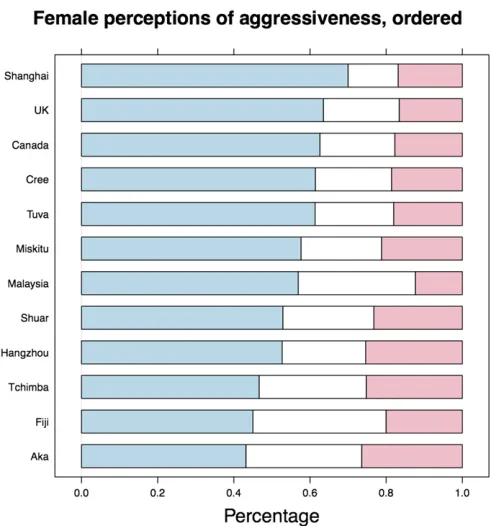
Similar results were found for female faces (SI Results and Figs. S3,S4, andS5).
Controlling for Cultural Nonindependence.A potential explanation for the observed relationships between environmental variables and preferences in our data are that these traits are transmitted between cultural groups (the problem of nonindependence of cultures). This transmission can occur when groups have shared cultural ancestry or engage in cultural borrowing and sharing. To explore this possibility, it was necessary to use a different analysis approach and an alternate method of summarizing preference data. Participants’ choices for the most attractive female faces were recorded as+60 (feminine), 0 (average), or −60 (mas-culine), whereas for male faces, responses were recorded as+ 60 (masculine), 0 (average), or−60 (feminine). Responses were averaged across long-term and short-term relationships and all faces to create a general preference score for each participant. Culturally “lagged”variables were created and entered into regressions as control variables (details are provided in SI Results). These analyses provided no evidence of a relationship between groups’ preferences and the preferences of culturally similar groups (all
P>0.05), and all significant environmental predictors remained significant after controlling for the effects of cultural proximity (SI Results). These analyses suggest that preferences and personality attributions are organized primarily by environmental variables, such as development and urbanization, rather than by cultural interchange or shared ancestry.
Discussion
In summary, preferences for dimorphism, and perceptions that masculinity signals aggressiveness, are stronger in large-scale, urban societies and in groups that have low disease, fertility, and homicide rates. These results do not simply reflect poor task per-formance in lower development environments, because directional preferences are present in several such populations. Notably, women’s preferences for masculinity are actually reversed, and not simply attenuated in several of the small-scale groups. We also note that the trait attribution data are more consistent across cultures than the preference data (perceptions of masculinity as“nasty”are statistically significant in each group). Although familiarity with printed images may account for some variance in our results, our data indicate that observers are making meaningful (i.e., non-random), but culturally variable, judgments of the stimuli. Our sample of 12 cultures is far from exhaustive, and further research will help clarify the generalizability of these results; nevertheless, the findings are hard to reconcile with theories that facial di-morphism was an ancestral cue of mate value. Some recent authors have expressed doubt about immunocompetence hypotheses of di-morphism preferences, on the basis of theoretical considerations (29, 34), and our findings provide empirical validation for these concerns. However, our data show that the distribution of dimorphism preferences is nonrandom across cultures, and this observation requires explanation. In a cross-cultural study of this nature, it is impossible to determine the causal factors underlying the pattern of data, which may reflect environmental or ethnographic differ-ences that we have not considered. Nonetheless, the urbanization data, in particular, lead us to speculate (parsimoniously) that the “visual diet”of the observers may be an important factor in de-termining trait attributions and preferences. Prior research shows that preferences are influenced by visual exposure and calibrated to local morphological norms (38). If facial dimorphism were greater in high-HDI environments, women from such environ-ments might be predicted to prefer more masculine faces than women from low-HDI environments. This possibility is plausible, because men in Western industrialized contexts may have higher testosterone levels than men in small-scale societies, likely re-flecting a reduction in energetic stressors, such as food shortage and disease (45), and sexual dimorphism in body size is also greater in these environments (46).
Visual diet may also play a role in shaping perceptions of the link between dimorphism and personality. Our findings indicate that masculine facial appearance is cross-culturally perceived to be associated with aggression but that the strength of these attributions is closely associated with indices of development,
particularly urbanization. In high-HDI environments, countless unfamiliar conspecifics are encountered, and heuristics, such as rapid stereotypical trait attribution, might be useful to cope with the ensuing volume of social information (47). In contrast, in small-scale societies, personality attributions could more typically be made on the basis of verifiable information obtained through di-rect personal experiences or via reputational information.
Our findings raise the possibility that many recent reports of trait attribution in the face perception literature [e.g., rapid, stereotypical trait attributions made to faces (48)], and the ap-parent importance of such judgments in predicting the outcome of important decisions [e.g., electoral contests (49)], reflect in-formation-processing strategies acquired as the result of histor-ically recent social environments, possibly indicating an ontogenetic effect of extensive experience with unfamiliar faces in urban/ modern Western environments.
Nonetheless, the stereotypes used in urbanized environments may have a kernel of truth: the evidence that masculinity is a correlate of aggressiveness, for example, is reasonably strong (22). The increased differentiation of social roles in high-HDI environments could affect the signal value of masculinity. If more prestigious social roles are occupied by more masculine indi-viduals, masculinity may act as a more reliable indicator of pres-tige in high-HDI environments than in low-HDI environments, and hence be viewed as attractive. Further work is required to determine if the relationship between appearance and prestige is stronger (or weaker) in high-HDI rather than low-HDI envi-ronments. It may also be the case that femininity is a better cor-relate of reproductive potential, or some other aspect of mate value, in high-HDI environments than it is in low-HDI environ-ments. Such facial attributions may therefore reflect functional processes, even if they have not played an important role in human societies until recently, when the large datasets required to recognize these weak associations have been offered by expo-sure to large numbers of conspecifics.
Materials and Methods
Stimuli consisted of sets of facial photographs, one set for each of five ethnic groups (European, East Asian, South Asian, African Caribbean, and South American). For each ethnic group, composite photographs were generated using morphing software (Psychomorph) to average same-sex photographs for each of the five groups. Feature points were delineated on the male and female composites and used to define a vector describing the average male and female facial morphology. This information was used to transform the 10 composites in either a masculine or feminine direction along the male–
female axis, following previous methods (4). European, East Asian, and South Asian composites used were those composites constructed by Stephan et al. (50). Details of the African Caribbean composite can be found in a study by Penton-Voak et al. (15). The South American composites were constructed from 24 females and 24 males of the Matsigenka (Peru). The resulting 10 sets of stimuli each consisted of three same-sex, same-ethnicity composite photographs: the original composite, a 60% feminized composite, and a 60% masculinized composite (Fig. 1).
Participants (n =962) were from 12 different populations with widely varying socioecologies (Table 1 andTables S1andS2). Participants took part on a voluntary basis. Each participant was presented with a set of three opposite-sex photographs and asked to choose the one that he or she found most at-tractive for a long-term relationship. After choosing a face, the same question was repeated using faces from each of the remaining four ethnic groups, one after another. The process was then repeated with judgments about attrac-tiveness for a short-term relationship and for perceptions of personality and other traits not reported here (SI Materials and Methods). Participants from Canada, the United Kingdom, and Hangzhou (China) took part in a self-administered computer presentation, whereas participants from the remain-ing groups were presented with laminated cards by a researcher. Prior research suggests that these methods produce similar results (15).
For all questions, a brief exposition of what exactly was meant by the question was given as follows:
i) Which face is most attractive in a long-term context (which face looks like it would make the best long-term partner, meaning, among other things, marriage)?
ii) Which face is most attractive in a short-term context (short-term means attractive for things like dating or a sexual relationship but without prospects for the long term)?
iii) Which face is the nastiest (most cruel, unkind, aggressive, difficult, un-pleasant to live with)?
After completing the experiment, a participant information questionnaire was administered in which additional questions were asked regarding social, demographic, health, and economic factors.
[image:5.585.39.286.49.312.2]For each ethnic group of face and relationship context, participants faced a trinary choice between three faces (masculinized, neutral, and feminized). To test for nonrandomness of choice (irrespective of direction), we used randomization tests written in R version 2.15.1. For each trinary choice,n(sample size specific to each ethnic group) simulated subjects picked
Fig. 4. Male faces perceived as most aggressive-looking, by group. Blue sections indicate the proportion of a group that chose masculinized faces as most aggressive, white sections indicate the proportion that chose neutral faces, and pink sections indicate the proportion that chose feminized faces.
Fig. 5. Masculinity of male faces perceived as most aggressive-looking, by level of urbanization. Average levels of masculinity in the male faces chosen as most aggressive-looking by group, plotted against level of urbanization, are shown. Participants in urban environments were more likely to choose masculine faces when asked to choose the most aggressive-looking face.
ANTHR
OPOLOGY
PSYCHOLOGI
CAL
AND
COGNITIVE
SCIENC
[image:5.585.297.540.521.677.2]one with a probability of one-third; this process was repeated five (single-re-lationship context, long-re(single-re-lationship context, or short-re(single-re-lationship context) or 10 (both contexts together) times, representing the choices of each subject over the five ethnic face types. The mean proportion of choices for mascu-linized, neutral, and feminized faces was calculated and represented as a locus in a ternary diagram. The vector from the centroid (equal choices to the three categories) was calculated as the measure of the direction and magnitude of preference. This procedure was replicated 100,000 times to give a distribution of vectors under random choice using Monte Carlo randomization methods (51). The proportion of vectors exceeding the magnitude of the observed vector for a class of choosers (e.g., Canadians in the short-term relationship context and Tuvans in both contexts according to the question) represents the
Pvalue for that class of choosers under the null hypothesis (a graphical demonstration is shown inFig. S1).
To test for associations between choices and predictor variables, ordinal GLMMs (52) were fitted using the ordinal package in R (53), with participant identification and population of the chooser as random effects. This approach is an extension of logistic regression to account for the fact that, rather than two choices (e.g., masculinized vs. feminized), there is a trinary choice, with the three choices representing an ordered sequence from masculinized through
neutral to feminized. Being mixed models, they also account for the non-independence of experimental participants’choices, given that each partici-pant scored several faces (i.e., from different ethnic groups). This feature captures both the repeated-measures nature of each participant’s choices and the hierarchical structure of the data (participants nested within ethnic group and predictors only applicable at the latter level). Ordinal GLMMs were con-sidered the most appropriate, and conservative, approach because we could not assume that preferences across masculinized, neutral, and feminized faces would be linear. The convergence of models was assessed by inspecting the maximum absolute gradient of the log-likelihood function and the magnitude of the Hessian (53). We note that analysis of the mean preference scores with weighted ordinary least squares regression (less appropriate to the data but not reliant on iterative model fitting) yields very similar results in pattern and statistical significance.
ACKNOWLEDGMENTS.We thank Justin Park and Martin Tovée for helpful comments on the manuscript and Thomas Pollett for helpful discussion about statistical analyses. This research was funded by a Leverhulme Trust grant (to I.S.P.-V.). I.M.S. was supported by a University of Bristol studentship.
1. Ryan MJ, Keddy-Hector A (1992) Directional patterns of female mate choice and the role of sensory biases.Am Nat139(S1):S4–S35.
2. Folstad I, Karter AJ (1992) Parasites, bright males, and the immunocompetence handicap.Am Nat139(3):603–622.
3. Johnstone RA (1995) Sexual selection, honest advertisement and the handicap prin-ciple: Reviewing the evidence.Biol Rev Camb Philos Soc70(1):1–65.
4. Perrett DI, et al. (1998) Effects of sexual dimorphism on facial attractiveness.Nature
394(6696):884–887.
5. Johnston VS (2000) Female facial beauty: The fertility hypothesis.Pragmatics & Cognition
8(1):107–122.
6. Symons D (1995) Beauty is in the adaptations of the beholder: The evolutionary psychology of human female sexual attractiveness.Sexual Nature/Sexual Culture, eds Abramson PR, Pinkerton SD (Univ of Chicago Press, Chicago), pp 80–118. 7. Jones D, Hill K (1993) Criteria of facial attractiveness in five populations.Hum Nat4(3):
271–296.
8. Johnston VS, Franklin M (1993) Is beauty in the eye of the beholder?Ethol Sociobiol
14(3):183–199.
9. Cunningham MR, Roberts AR, Wu CH, Barbee AP, Druen PB (1995)“Their ideas of beauty are, on the whole, the same as ours”: Consistency and variability in the cross-cultural perception of female physical attractiveness.J Pers Soc Psychol68(2):261–279. 10. Smith MJ, et al. (2006) Facial appearance is a cue to oestrogen levels in women.Proc
Biol Sci273(1583):135–140.
11. Roumen FJME, Doesburg WH, Rolland R (1982) Hormonal patterns in infertile women with a deficient postcoital test.Fertil Steril38(1):42–47.
12. Peccei JS (2001) Menopause: Adaptation or epiphenomenon?Evol Anthropol10(2):43–57. 13. Moore FR, Law Smith MJ, Taylor V, Perrett DI (2011) Sexual dimorphism in the female face is a cue to health and social status but not age.Pers Individ Dif50(7):1068–1073. 14. Rhodes G (2006) The evolutionary psychology of facial beauty.Annu Rev Psychol
57(1):199–226.
15. Penton-Voak IS, Jacobson A, Trivers R (2004) Populational differences in attractive-ness judgements of male and female faces: Comparing British and Jamaican samples.
Evol Hum Behav25(6):355–370.
16. Jones D (1995) Sexual selection, physical attractiveness, and facial neoteny: Cross-cultural evidence and implications.Curr Anthropol36(5):723–748.
17. Scott IML, Swami V, Josephson SC, Penton-Voak IS (2008) Context-dependent pref-erences for facial dimorphism in a rural Malaysian population.Evol Hum Behav29(4): 289–296.
18. Barber N (1995) The evolutionary psychology of physical attractiveness: Sexual se-lection and human morphology.Ethol Sociobiol16(5):395–424.
19. DeBruine LM, Jones BC, Crawford JR, Welling LLM, Little AC (2010) The health of a nation predicts their mate preferences: Cross-cultural variation in women’s pref-erences for masculinized male faces.Proc R Soc Lond B Biol Sci277(1692):2405–2410. 20. Thornhill R, Gangestad SW (2006) Facial sexual dimorphism, developmental stability,
and susceptibility to disease in men and women.Evol Hum Behav27(2):131–144. 21. Little AC, Jones BC, Penton-Voak IS, Burt DM, Perrett DI (2002) Partnership status and
the temporal context of relationships influence human female preferences for sexual dimorphism in male face shape.Proc Biol Sci269(1496):1095–1100.
22. Scott IML, Clark AP, Boothroyd LG, Penton-Voak IS (2013) Do men’s faces really signal heritable immunocompetence?Behav Ecol24(3):579–589.
23. Brooks R, et al. (2011) National income inequality predicts women’s preferences for masculinized faces better than health does.Proc R Soc Lond B Biol Sci278(1707):810–812. 24. Roberts ML, Buchanan KL, Evans MR (2004) Testing the immunocompetence handicap
hypothesis: A review of the evidence.Anim Behav68(2):227–239.
25. Pound N, Penton-Voak IS, Surridge AK (2009) Testosterone responses to competition in men are related to facial masculinity.Proc Biol Sci276(1654):153–159. 26. Tybur JM, Gangestad SW (2011) Mate preferences and infectious disease: Theoretical
considerations and evidence in humans.Philos Trans R Soc Lond B Biol Sci366(1583): 3375–3388.
27. Mehta PH, Beer J (2010) Neural mechanisms of the testosterone-aggression relation: The role of orbitofrontal cortex.J Cogn Neurosci22(10):2357–2368.
28. Archer J (2006) Testosterone and human aggression: An evaluation of the challenge hypothesis.Neurosci Biobehav Rev30(3):319–345.
29. Puts DA (2010) Beauty and the beast: Mechanisms of sexual selection in humans.Evol Hum Behav31(3):157–175.
30. DeBruine LM, Jones BC, Little AC, Crawford JR, Welling LLM (2011) Further evidence for regional variation in women’s masculinity preferences.Proc R Soc Lond B Biol Sci
278(1707):813–814.
31. Penton-Voak IS, et al. (1999) Menstrual cycle alters face preference.Nature399(6738): 741–742.
32. Little AC, Connely J, Feinberg DR, Jones BC, Roberts SC (2011) Human preference for masculinity differs according to context in faces, bodies, voices, and smell.Behav Ecol
22(4):862–868.
33. Jones BC, et al. (2008) Effects of menstrual cycle phase on face preferences.Arch Sex Behav37(1):78–84.
34. Yu DW, Proulx SR, Shepard GH (2007)Masculinity, culture and the Paradox of the Lek. Body Beautiful: Evolutionary and Sociocultural Perspectives, eds Furnham A, Swami V (Palgrave Macmillan, Basingstoke, UK), pp 88–107.
35. Henrich J, Heine SJ, Norenzayan A (2010) The weirdest people in the world?Behav Brain Sci33(2-3):61–83, discussion 83–135.
36. Yu DW, Shepard GH, Jr (1998) Is beauty in the eye of the beholder?Nature396(6709): 321–322.
37. Jones BC, DeBruine LM, Little AC (2008) Adaptation reinforces preferences for cor-relates of attractive facial cues.Vis Cogn16(7):849–858.
38. Little AC, Jones BC, DeBruine LM (2011) Facial attractiveness: Evolutionary based re-search.Philos Trans R Soc Lond B Biol Sci366(1571):1638–1659.
39. Batres C, Perrett DI (2014) The influence of the digital divide on face preferences in El Salvador: People without internet access prefer more feminine men, more masculine women, and women with higher adiposity.PLoS ONE9(7):e100966.
40. Wood W, Eagly AH (2002) A cross-cultural analysis of the behavior of women and men: Implications for the origins of sex differences.Psychol Bull128(5):699–727. 41. Wood W, Eagly AH (2012)Biosocial Construction of Sex Differences and Similarities in
Behavior, Advances in Experimental Social Psychology, eds Zanna MP, Olson JM, (Academic, San Diego), pp 55–123.
42. Little AC, et al. (2010) Women’s preferences for masculinity in male faces are highest during reproductive age range and lower around puberty and post-menopause.
Psychoneuroendocrinology35(6):912–920.
43. Wood W, Kressel L, Joshi P, Louie B (2014) Meta-analysis of menstrual cycle effects on women’s mate preferences.Emot Rev6(3):229–249.
44. Gildersleeve K, Haselton MG, Fales MR (2014) Do women’s mate preferences change across the ovulatory cycle? A meta-analytic review.Psychol Bull140(5):1205–1259. 45. Bribiescas RG (1996) Testosterone levels among Aché hunter-gatherer men: A
func-tional interpretation of population variation among adult males.Hum Nat7(2): 163–188.
46. Anton SC, Snodgrass JJ (2012) Origins and evolution of genusHomo: A new per-spective.Curr Anthropol53(S6):S479–S496.
47. Macrae CN, Milne AB, Bodenhausen GV (1994) Stereotypes as energy-saving devices: A peek inside the cognitive toolbox.J Pers Soc Psychol66(1):37–47.
48. Willis J, Todorov A (2006) First impressions: Making up your mind after a 100-ms exposure to a face.Psychol Sci17(7):592–598.
49. Todorov A, Mandisodza AN, Goren A, Hall CC (2005) Inferences of competence from faces predict election outcomes.Science308(5728):1623–1626.
50. Stephan CN, et al. (2005) Two-dimensional computer-generated average human face morphology and facial approximation.Computer Graphic Facial Reconstruction, eds Clement JG, Marks MK (Elsevier Science, Burlington, VT), pp 105–127.
51. Robert CP, Casella G (2010)Introducing Monte Carlo Methods with R(Springer, New York). 52. Agresti A (2002)Categorical Data Analysis(Wiley, Hoboken, NJ), 2nd Ed. 53. Christensen RHB (2011) Analysis of ordinal data with cumulative link models—estimation