Full Length Research Article
PRODUCT DEVELOPMENT THROUGH CFD SIMULATION AND EXPERIMENTAL TESTING OF A 200
LITER BIOMASS FIRED INSTITUTIONAL COOK STOVE
*Debela Geneti Desisa, Venkata Ramayya, A. and Getachew Shunki Tiba
Mechanical Engineering/ JIT, Jimma University, Ethiopia
ARTICLE INFO ABSTRACT
In this work, complete analysis of 200 liter institutional cook stove, design, simulation and field test was carried out. In developing country, including Ethiopia, biomass is the major energy source especially, for cooking and heating purpose from single family to institutional level. In this back drop, this project will focus on 200 liter size of biomass fired institutional cook stove that incorporates secondary air for complete combustion. Materials were selected for each component of the stove according to their temperature resistance required. Dimensions were derived for each of the components by equating the ratio of volume increment from already existing size(60 liter and 100 liter) using scale up technique. The stove performance test was done using water boiling test for the new stove and parametric calculations were done using WBT (Water Boiling Test) version 4.2.2. Validation of CFD (Computational fluid dynamics) simulation was done by comparing with experimental results. Different cases were investigated for different percent of primary and secondary air combination for specific air fuel ratio. The CFD simulation material waswood-volatile-airfrom the ANSYS 14.5 database and naturally flow atmospheric air. Based on simulation result 60:40 (primary vs secondary) air supply was found to be best option compared to 75 : 25 and 50 : 50. The stove require a SFC of 41.25 gram per liter and average cooking time of 129.5 minute for 200 liters.
Copyright©2016, Debela Geneti Desisa et al.This is an open access article distributed under the Creative Commons Attribution License, which permits unrestricted use, distribution, and reproduction in any medium, provided the original work is properly cited.
INTRODUCTION
Globally, biomass accounts for ten percent of energy production, two-thirds of which is used for cooking and heating purposes in developing countries (IEA 2013). For example biomass accounts for over 94 % of the national energy supply in Ethiopia (World Bank, 1996) and about 80 %
of the total energy supply in the SADCC region (Usinger et
al., 1999). Despite increasing access to electricity and modern
fuels, consumption of solid biomass fuels continues to increase (FAO 2013). While the combustion of these fuels is generally viewed as a renewable, carbon-neutral energy source, such fuels are generally not harvested or used in a sustainable way. Biomass meets about 14 percent of the world’s energy needs
(Amrose et al. (2008)) by the fact that biomass energy can
converted into power, heat, and fuels for potential use in all parts of the country.
*Corresponding author: Debela Geneti Desisa,
Mechanical Engineering/ JIT, Jimma University, Ethiopia.
This source of energy needs concern, as scarce, diminishing, costly, time-consuming, uncertain in supply and often inaccessible. Approximately half of the energy content in the original wood feedstock is lost during traditional charcoal production due to low conversion efficiency and loss of energy in volatile and gaseous emissions. Therefore, the impact of charcoal production on deforestation and environmental degradation is greater than that from wood fuel harvesting. In addition to deforestation and erosion, a major environmental problem in a country, wood fuel supplies became relatively more distant from the markets, prices increased, and some stove makers began more intensive efforts to improve their models and make them more efficient. Distinguished from domestic stove mainly by its larger size and more sturdy construction. Many stove designers were highly working on improvement of biomass cooking stove in recent decades. But, the majority of improved cooking stoves, that built today, are for domestic cooking, often used by single families. However, there are also schools, colleges, hospitals, prisons, factories and, perhaps, large temporary settlements such as refugee camps or sites of religious festivals where a large number of
ISSN: 2230-9926
International Journal of Development Research
Vol. 06, Issue, 09, pp.9576-9584, September, 2016
DEVELOPMENT RESEARCH
Article History: Received 19th June, 2016
Received in revised form 21st July, 2016
Accepted 28th August, 2016
Published online 30th September, 2016
Key Words:
200 liter institutional cook stove, Primary air,
people may need feeding at a time. In the region(Kilimanjaro region), increasing demand for wood-based biomass is visible in public institutions such as hospitals, prisons, boarding secondary schools, university campuses, and factories which consume large quantities of wood fuel, estimated at 35,661 tons of firewood and charcoal annually, thereby significantly contributing to deforestation and land degradation (Multimba,
2014 and Mutimba et al., 2014). In a sense, stoves that serve
[image:2.595.40.287.307.432.2]large group of people are known as institutional stoves. It is distinguished from domestic stove mainly by its larger size and more sturdy construction. In a sense, stoves that serve large group of people are known as institutional stoves. The students’ cafeteria kitchen of Jimma University, Ethiopia are using biomass fired traditional three stone and enclosed chimney stoves. To solve the smoky operation problem Jimma University carried out a pilot study with In Stove make institutional stove (four with 100 liter size and two 60 liter size). To implement more of these stoves the problem is students’ cafeteria kitchen are using 200 liter size for cooking and boiling tea since large number of students are getting serviced.
Figure 1. Enclosed chimney and Baseline stove during operation
An open fire is often 90% efficient at the work of turning wood into energy. But only a small proportion, from 10% to 40%, of the released energy makes it into the pot (Bryden, 2002). Improving stoves is an effective way of improving the environment and serving communities. Because cooking at schools is primarily accomplished using fuelwood, stoves that use less fuelwood offer the potential to reduce stress on the environment, reduce the time-labor burden of fuelwood collection, and improve air quality in indoor school kitchens
(Adkins et al., 2010). The CFD model is capable of describing
the fluid dynamics and chemical processes taking place in the overall combustion process, capturing known phenomena like air velocity, temperature distribution and chemical species
concentrations (Smail et al., 2015). Objective of Simulation is
first and foremost, the cost-effectiveness of carrying out multiple parametric studies with greater accuracy allows the construction of new and more improved system designs and concerted optimization carried out on existing equipment with substantial reduction of lead times, which results in enhanced efficiency and lower operating costs. Secondly, the primary objective is to gain an increased knowledge of how systems are expected to perform, so evolutionary improvements during the design and optimization process can be made. Based on this second point, CFD therefore continually asks the question “What if . . . ?” in all investigative studies and analyses.
MATERIAL AND METHODS
Study area
The study were carried out at Jimma University, Ethiopia. The place is located {N 7° 40'} {E 36° 49'} {GMT +3.0 Hours} Elevation 1676m above sea level and Standard Pressure at this Elevation is 82746Pa (SWERA). The Jimma is one of the higher institutions in the country which give services more than 20,000 students in its four campuses.
Method of fabrication
Material was selected for each component of the stove according to their temperature resistance required. The next step were specifying dimensions for each components from already existing size stove (60 liter and 100 liter). The method I used were equating the ratio of volume increment from 60 liter to 100 liter, from 100 liter to 200 liter with size increment ratio as well. Multiplying the original size by increment factor (IF) obtained, then add to the original size itself in order to get the new dimension.
100/60 = 1.667 (the volume increment factor is 0.667
or 66.7% for 60 liter to 100 liter size)
200/100 =2 (the volume increment factor is 1 or
100% for 100 liter to 200 liter size)
Similar technique was done for every size of a components, then equating as follow.
0.667/1 = x/z where: x, z is size increment of 60L to
100L and 100L to 200L respectively.
(Original size * IF) + Original size = new dimension
Study variable
The main variables under these studies were:
Temperature
Pressure
Moisture content of the firewood
Boiling point of water
Thermal efficiency, specific fuel consumption and
burning rate
Data processing and analysis
Fuel woods were split, dried and its weight was
measured before firing.
Using different temperature measuring device
(thermometer, digital thermometer, and thermocouple) boiling of water was measured.
Recording the starting time and the stopping time of
Instrument used
During experiment testing of WBT a number of instruments were used.
200 Liter size vessel
Thermocouple,
Thermometer,
Multimeter,
Digital thermo and hygrometer,
digital weight measuring device
drying oven/furnace
Experimental Methods
Experimental testing is a systematic approach to the evaluation of the useful and adverse characteristics of a particular model. It is helpful for comparing different models from the end-use point of view. Testing also helps in gaining in-depth knowledge about the performance of the individual components which is useful for undertaking further design modifications or incorporating other design features. The experiment was done using water boiling test, to assess stove performance, heat leaked from the circumference of the stove and raise of temperature under bottom of the vessel a well as from the grate. The Water Boiling Test (WBT) was selected that, it is relatively short, simple simulation of common cooking procedures and it is a useful tool for approximation of the cooking process. Field testing is loosely testing that takes place with actual users, in their environment. It is the Study of actual fuel use, emissions concentrations in users’ homes/environment and studies of user attitudes toward a stove. Rather than lab testing, field test is the proper way to verify a performance outcome such as reduced fuel use or emissions, since it is not tightly controlled as lab testing because they rely on monitoring actual use rather than the idealized use required by a strict laboratory procedure.
Experimental Setup
In institutional stove, the vessel is inserted in to the stove, it cannot totally affected by environmental conditions like wind velocity. The combustion is occurred inside the stove and the outer part is insulated. The Figure 2 shows the configuration of temperature measuring technique using thermocouple in different positions of the stove. Positions 1-4 were from the circumference of the stove, position 5 and position 6 were in chimney (at the bottom and at the outlet), position 7 and position 8 were under the bottom of the vessel and position 9 was from the grate. The rise in temperature of water in the vessel was measured by thermometer and parallel with thermocouple.
The procedures followed were:
Prepare fuel wood of appropriate size and measure its
mass
Kerosene, not more than 10ml (for ignition purpose)
Wait for 3-4 minute after ignition
Insert the vessel into the stove
Prepare clean water (make sure that 200 liters of water
were added to the vessel)
Record ambient temperature, environmental humidity
and initial water temperature
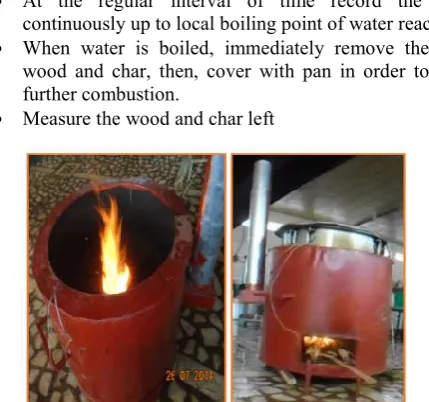
At the regular interval of time record the data
continuously up to local boiling point of water reach.
When water is boiled, immediately remove the fuel
wood and char, then, cover with pan in order to stop further combustion.
[image:3.595.324.539.84.285.2] Measure the wood and char left
Figure 2. Experiment setup
Stoichiometric analysis
The initiating concept upon which all of the biomass firing depends is the chemistry of wood combustion and creating stoichiometric conditions for combustion. A balanced equation for the combustion of wood follows:
Fuel (wood) + air (oxidizer) product of combustion + Energy
CxHyOz + ath(O2 + 3.76N2) xCO2 + yH2O + zN2
Assuming the amount of air required for burning 1 kg of fuel; the air fuel ratio will be:
(1)
Table 1. Oxygen required for elementary analysis and its product
Mass (per kg) O2, Required Products
Carbon 0.5043 1.3448 1.849
Hydrogen 0.0601 0.4808 0.5409 Sulfur 0.0008 0.0008 0.0016
Oxygen 0.4329 -0.4329 -
Nitrogen 0.0017 - 0.0017
Chlorine 0.0002 - 0.0002
The value of, A/F = 7.2:1
CFD Model setup
In today world, CFD models are well established tools that help in design, prototyping, testing and analysis. The 3D model shown in Figure 3, describes half of the geometry with a symmetry plane to reduce the computational domain and the corresponding boundary conditions. The wood volatile mixed with atmospheric air is considered here.
Objective of CFD Simulation
First and foremost, the cost-effectiveness of carrying
[image:3.595.331.537.480.554.2]lead times, which results in enhanced efficiency and lower operating costs.
Secondly, the primary objective is to gain an increased
[image:4.595.64.261.154.517.2]knowledge of how systems are expected to perform, so evolutionary improvements during the design and optimization process can be made. Based on this second point, CFD therefore continually asks the question “What if . . . ?” in all investigative studies and analyses.
[image:4.595.336.527.384.522.2]Figure 3. Model symmetry
Figure 4. Model flow symmetry
Assumptions of the proposed model
The viscous dissipation is negligible
Pressure - based, double precision and absolute velocity
formulation.
The flow will be Turbulent and standard K & models
were used.
Eddy dissipation model was selected
Process assumed to be Steady state.
Cmu =0.09,c1-Epsilon = 1.44, c2-Epsilon = 1.92 and
TKE Prandtl number = 1 ,were taken as default model constant.
Governing Equations for Reactions
Conservation of mass
Conservation of momentum
Conservation of energy pecies transport equation
Combining all the governing equation and simplifying the following equation is obtained.
(2)
Where,
) – heat diffusion - Pressure increase - Power of viscous stress
- comes from diffusion velocity - heat released;
RESULT AND DISCUSSION
Experimental result
The water boiling test done intended to measure the thermal efficiency, specific fuel consumption, time-to-boil, fuel consumption, fuel burn rate, and fire power. The test is not only investigating WBT protocol, but also includes estimation of heat loss/leak through different part of the stove and in smoke (in chimney) using thermocouple. The WBT was done by considering two cases; in the first case, the stove with inner insulation. The insulation material was construction sand and it has a thickness of 20 cm over the cylinder of combustion chamber. In the second case, the inner insulation was removed and the test was conducted again. Referring to the Figure 2 (experimental setup) the average heat loss investigated were described in the following table.
Figure 5. In Stove during operation
Table 2. Comparison of temperature leakage through the circumference of the stove with and without inner insulation
cases Ave T
circumference of the stove chimney bottom of l,7
1 2 3 4 base
05 Surf 06 With 84 95 194 176 160 123 611 Without 107 153 152 169 196 117 -
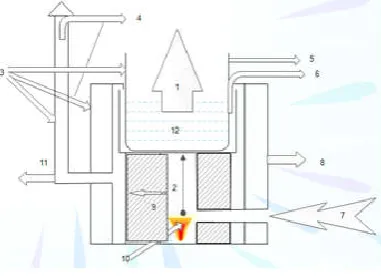
Measuring of flame temperatures to a high degree of precision is quite difficult because of two reasons; (1) intrusiveness of instrumentation; and (2) interpretation difficulties due to the time-varying nature of the measurement. In a wood-burning cook stove, useful heat is absorbed in the food, but heat losses are associated with the following mechanism:
Evaporation (2) Distance From Fuel to Pot (3)
Air or Fuel (8) Radiation From Stove (9) Conduction Through Stove (10) Wet Wood (11) Radiation from chimney (12) Pot content
Figure 6. Heat loss parameter
Since the construction of In Stove allows full immersion of vessel in the stove and totally insulated, some of these losses are avoided. The WBT calculation was conducted with the standard WBT version 4.2.2, the fuel wood was eucalyptus tree, and the wind condition is moderate and local boiling point is 95. The average fuel consumed (moist) 12.63 kg, and thermal efficiency 47%. Gross calorific value (dry fuel) equal to 18,700 kj/kg (HHV), the net calorific value (dry fuel) is 17,380 kj/kg (LHV), and the effective calorific value (accounting for fuel moisture) is 14,190 kj/kg (EHV) and char calorific value is 29,500kj/kg were taken as initial test condition.
Simulation Result
As discussed earlier the already existing InStove is with the primary air only but the new In Stove incorporates secondary air. One aim of simulation under this work was to verify the necessity secondary air during combustion and to answer the question what if…?. A balance between primary and secondary air is needed to control the combustion so that there is sufficient air to produce complete burning of the volatile gases and good mixing between air and the pyrolysis gases.
Mesh Sensitivity of Simulation
Different Mesh sizes were studied in order to insure independency of mesh sensitivity of CFD numerical solution. “Bulk” none mesh element size is varied first and the mesh
[image:5.595.339.529.112.231.2]element count is also included to note increasing computational cost. Different mesh sizes were conducted with the element size of 8, 6, and 4 millimeters. Triangular mesh geometry was taken as default mesh profile.
Figure 7. Mesh geometry
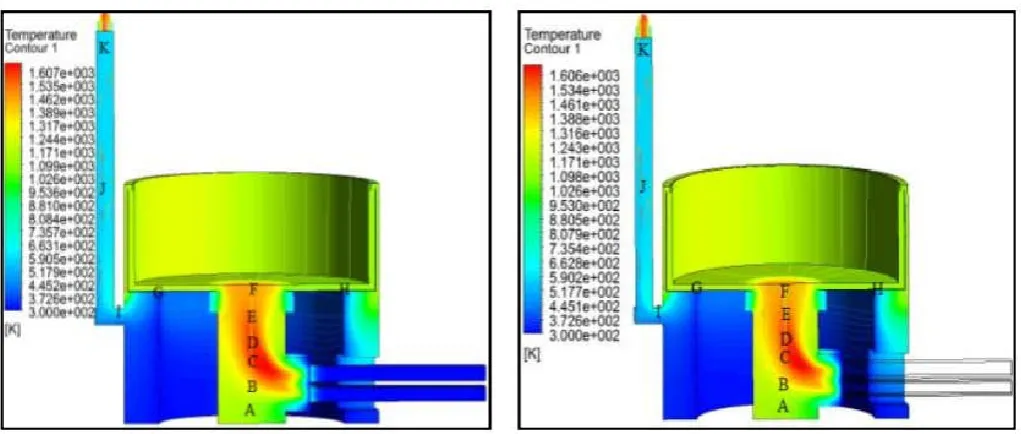
In the first case, comparison were done between supplying 100% primary air and supplying both primary and secondary air by ratio of 75% to 25%. In the other cases, comparisons were made for the ratio of amount of the primary air to the secondary air; 75% to 25%, 60% to 40% and 50% to 50% while keepingair fuel ratio constant. Here the contour result comparison.
Figure 8. Iteration profile
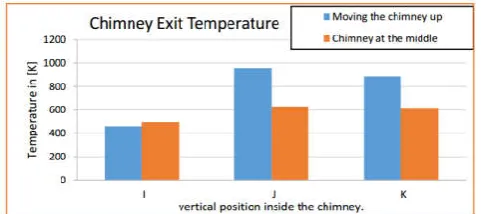
Changing the position of chimney also another assumption that somebody may think. Keeping all conditions constant including the same air fuel ratio and only changing the position of chimney in a vertical direction, the variation observed were described in the Figure 15. When chimney was move up, high temperature were recorded in the exit flue gas comparing with one in the middle.
[image:5.595.314.552.322.493.2] [image:5.595.59.538.606.800.2]
Figure 10. Supplying both primary and secondary air (75% - 25%)
Figure 11. Comparing thermal load of the first case
[image:6.595.43.554.523.740.2]Figure 13. Supplying (60% - 40%) of air
[image:7.595.35.556.74.564.2]Figure 14. Supplying (50% - 50%) of air
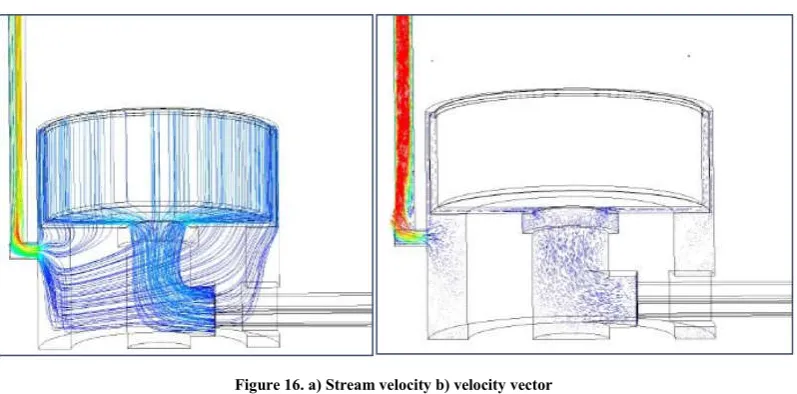
[image:7.595.35.552.304.760.2]Figure 16. a) Stream velocity b) velocity vector
Figure 17. Comparison of chimney exit temperature
Figure 18. Moving the chimney up
Figure 20. Comparison of chimney exit temperature
Conclusion
One advantage of using CFD simulation in product development is the cost-effectiveness of carrying out multiple parametric studies with greater accuracy allows the construction of new and more improved system designs and concerted optimization can be carried out on existing equipment with substantial reduction of lead times, which results in enhanced efficiency and lower operating costs. From the CFD simulation, the case in which both primary and secondary air supplied was selected for its greater thermal load. The ratio of primary air to secondary air (60% to 40%) shows best performance among the CFD counter result obtained. The chimney must be in proper position along the vertical direction. From this project I conclude it is best option if it is at the middle in line with bottom of the vessel. The chimney exit temperature also better in this case. The average fuel consumed (moist) 12.63 kg for 200 liter of water and average thermal efficiency of 47% were obtained.
Acknowledgement
I would like to acknowledge Jimma University Research and Post Graduate Office for financial support of this project. Last but not least, i would like to express my gratitude to all decent individuals those support me during my work, in particular Mr. Mitiku Soboka, Mr.Yohannes Mitiku, Mr. Mamo Tessema, and Mr. Teka Tesfaye.
I wish them all continuous success in their future careers. Finally, I owe my loving thanks to my family for their
unconditional support, love, encouragement and
understanding; without which I would not have reached this point of my life.
REFERENCE
Adkins, E. et al. 2010. Testing institutional biomass
cookstoves in rural Kenyan schools for the Millennium Villages Project, Energy for Sustainable Development, doi:10.1016/j.esd.2010.07.002
Amrose, G. et al. 2008. Development and Testing of the
Berkeley Darfur Stove, California.
Bryden, M. et al. 2002. Design principle for wood burning
cook stoves, s.l.: Aprovecho research center shell
foundation partinership for clean indoor air.
Multimba, S., 2014. Scaling up fuel efficient technologies for
domestic, institusions and industrial use with carbon benefits in the kilimanjaro region, Final report. consultancy report sustainable land management project,
Tanzania,: regional administrative secretary kilimanjaro/ united nation development program.
Mutimba, S., et al, 2014. An opportunity to switch energy
Sources in institutions in the kilimanjaro region,Tanzania and benefit from carbon finance under the sustainable land
management, Kenya: open journal of soil science.
Smail, K. et al. 2015. CFD Approach for Modeling High and
Low Combustion in a Natural Draft Residential Wood Log
Stove. International Journal of Heat and Technology,
Vol.33 (1), Canada.
Swami, D., Tak, A. K., Das, A. K., Gulhane, N. P. 2013. Flow Simulation & Thermal Analysis Of Pyrolysis Of Wood
Particle In Vertical Column. (IJERT), I Vol. 2 (6) India
Usinger, J. et al. 1999. Project and stove design for large scale
cooking in developing countries, Keyna: (GTZ)GmbH,
Division 45 – Rural Development.