7303
REFRAMING TASK PERFORMANCE WITH TECHNOLOGY
TO PROMOTE POSITIVE INTERDEPENDENCE
IN LANGUAGE LEARNING
KYEONG-OUK JEONG
Hannam University, Department of English Education, Graduate School of Education, Korea E-mail: [email protected]
ABSTRACT
The purpose of this study is to investigate how technology can be implemented in the task-based English language learning in order to promote learner collaboration and to build positive interdependence among EFL learners. This study examined the role of new technology in promoting learner motivation and autonomy and boosting mutual collaboration to enhance language learning task performance. The pedagogical framework to enhance task performance of English language learners in this study is based on constructivism and technology-enhanced language learning. The prevailing utilization of technology in English language learning and teaching supports sociocultural notion of learning and teaching based on constructivist perspectives. With the advantages of technology-enhanced EFL learning and teaching settings, more relevant and meaningful learning occurs through mutual social interaction with others in authentic and collaborative contexts. This study reveals that the use of technology-enhanced task performance and mutual scaffolding plays a crucial role in promoting positive interdependence among EFL learners in completing a given task. Classroom implementation to integrate new technology will be suggested as instructional procedure. This study revealed that the use of web-based or mobile-based technology integration in task-based EFL learning was effective for improving university students’ English communicative competence in the metacognitive, cognitive, affective, and social levels. Technology-enhanced task-based language learning could contribute to enhancing collaborative classroom culture in order to develop positive interdependence among language learners for successful learning along with supporting the self-directed English learning ability.
Keywords: Technology-enhanced learning, Task performance, Collaborative learning, Positive
interdependence, Scaffolding in learning
1. INTRODUCTION
Recently, educators around the world have been integrating various innovative digital technologies in the field of language education. This attempt of technology implementation has resulted in more effective English teaching and learning both for teachers and for learners. The recent educational setting, featured by ubiquitous accessibility to online-based learning resources, learning sites, and learning communities, indicates that learners are expected to take the initiative and have ownership in their learning process [1]. Having ownership and responsibility, learners can be active agents of their own learning, promote critical and metacognitive thinking skills, reflect their learning process, and anchor their existing knowledge into newly acquired knowledge to make meaningful subsumption in their cognitive learning structure [2]. Learners can be self-directed learners who can set up personal learning goals according to their needs and interest, and dynamically construct knowledge meaningful to
7304 reliable and effective learning resources, the goals of learning in the classroom are no longer the dissemination of knowledge from the teachers as the sage to learners as the passive recipient of knowledge. To improve language learners’ communicative competence, learner motivation, and autonomy, educators need to implement new pedagogical tools in their language teaching practice in order to make language courses more relevant and effective [3].
Within the current pedagogical paradigm of English as a foreign language (EFL) education, the notion of scaffolding has been significant as the sociocultural principle of collaborative and supportive learning. Scaffolding was originally identified as the support offered by teachers in supporting learners to reach a higher level of their learning performance [4] [5]. Later, the support shared among learners was included to re-conceptualize the concept of scaffolding in more collaborative structure of learning [6]. The concept of scaffolding was further extended with the development of technology and its integration in educational fields. Educational technology and web-based learning resources have created a potential for collaborative learning within powerful learning environment [7] [8]. Learner collaboration can be realized through task-based language learning performance. Providing learners with technology-enhanced language learning tasks and activities has developed in great popularity because EFL learners can develop positive interdependence while they are engaged in sharing mutual scaffolding and collaborative learning experiences. Task-based collaborative language learning has been implemented as significant components in EFL education by promoting positive interdependence among language learners, creating innovation in school curriculum and designing course syllabus in EFL institutions around the world.
In the context of communicative language teaching approach in EFL education, technology-enhanced cooperative language learning has been introduced as an alternate to the traditional language learning and teaching method. Since technology permeates learners’ daily lives as a crucial channel of communication, technology-enhanced learning and collaborative interaction have gained growing interests as a genuine process of enhancing language learning task performance in EFL classrooms. Technology-enhanced task-based language learning might offer new possibilities for encouraging positive interdependence among EFL learners and deepening mutual understanding of the role of metacognitive, cognitive, affective, and social
aspects such as motivation and autonomy of EFL learners [9].
The purpose of this study is to develop theoretical perspectives about the effects of technology-enhanced task-based EFL learning. In addition, this study aims at examining the effects of task-based language learning in developing positive interdependence and self-directed English learning ability among EFL learners.
2. RELATED RESEARCH
2.1 The role of technology in language learning
7305
Figure 1: The Concept of Technology Use in Language Learning and Teaching
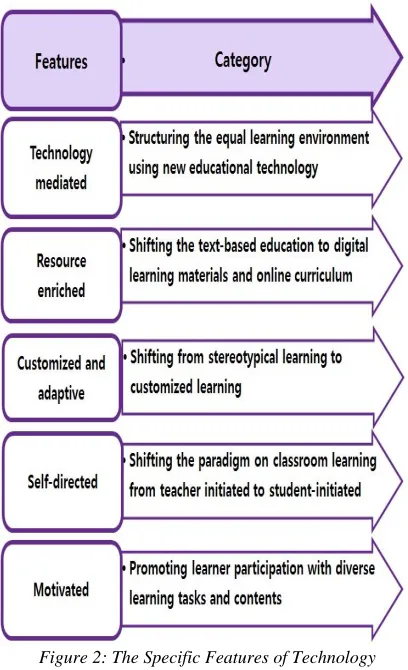
With the concept of ‘technology mediated’, identical conditions of learning environment can be structured using various pedagogical technology. Through the idea of ‘technology mediated’, the notion of textbook dependent instruction can be upgraded with authentic learning materials and online curriculum design. The enhanced utilization of technology has been found to boost language learning outcomes and metacognitive learning strategies of language learners [11] [12].Regarding the concept of ‘customized and adaptive’, the notion of learning has been transformed from stereotypical learning into personalized learning. Research shows that language learners’ learning experience in utilizing technology in their learning can raise English as foreign language (EFL) learners’ awareness and abilities in autonomous language learning [13]. If a relevant set of language learning skills and appropriate technology-enhanced language learning resources are provided, the language learning experiences can be personalized through systematic ongoing assessment and customized support for students’ autonomous language learning [14]. Several effective technological systems, such as digital portfolio and cloud-based self-reflective diaries, can be provided for tailoring the learning experience of language learners. This kind of digital learning resources and encouragement can enhance language learners’ affirmative insights of autonomous learning and help them to integrate more technology-enhanced resources into their learning plans.
With the notion of ‘self-directed’, the paradigm on classroom learning and teaching has shifted from teacher-initiated to student-initiated. Improving self-directed use of new technology for English language
learning is crucial for cultivating the advantages and potential of technology for language instruction [10]. Furthermore, concerning the idea of ‘motivated’, learners are encouraged to take part in their language learning with diverse learning tasks and contents with the integration of diverse and authentic technology. With respect to the maintenance of learning intention, it is very much related to the language learners’ intrinsic motivation to acknowledge the responsibility for their study. This awareness can be enhanced by assisting language learners to understand the rationale behind the learning goals and to choose appropriate learning tasks with the effective integration of new technology in language learning [14]. Figure 2 shows the specific features of technology integration in language learning [15].
Figure 2: The Specific Features of Technology Integration in Language Learning
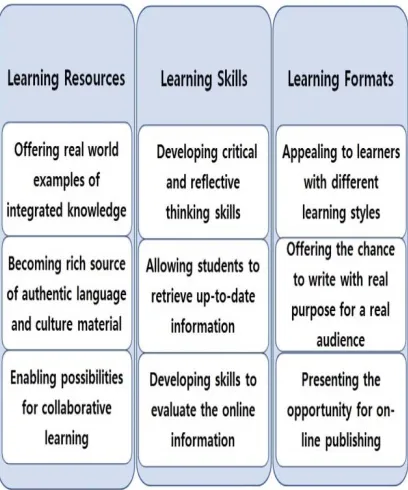
[image:3.612.314.518.308.643.2]7306 intercultural learning materials, and possibilities of building interpersonal intelligence through collaborative language learning resources. Regarding learning skills, technology-enhanced EFL learning can encourage learners to develop reflective thinking skills, guide them to realize how to access state-of-the-art digital information, and help them to develop skills for evaluating the quality of online information. Finally, with the learning formats, technology-enhanced EFL learning can customize the needs of language learners with diverse learning styles and provide them with opportunities to use English with real communicative purpose with real audience. The benefits of incorporating new technology into EFL instruction can be specified in the figure 3 [16]. Figure 3 shows the benefits of technology-enhanced EFL learning in terms of learning resources, learning skills, and learning format.
Figure 3: The Benefits of Technology-enhanced EFL Learning
2.2 The characteristics of language learning in
Constructivism
The current pedagogical context of EFL education is based on the theoretical framework of constructivism, which emphasizes cooperative, learner-centered, interactional, authentic, and supportive classroom language learning environment [17]. The prevailing utilization of technology in English language education supports sociocultural notion of education based on constructivist
perspectives. With the advantages of technology-enhanced EFL educational settings, more relevant and meaningful learning occurs through mutual social interaction with others in authentic and collaborative contexts [18]. Learners can reach the maximum level of their potential within their zone of proximal development (ZPD) through scaffolding or mutual collaboration [4]. ZPD can be depicted as the gap between the current developmental level as identified by individual linguistic performance, and the possible developmental level as enhanced by linguistic production that is facilitated collaboratively with a teacher or peers [19]. The facilitation provided from teachers or more competent peers is scaffolding, which can be provided through meaningful interaction. The most essential proposition of constructivism is that learners actively acquire knowledge through social interaction with teachers and the outside world by integrating and reframing their prior knowledge both in width and in depth [20].
According to the concept of learning based on constructivism, the characteristics of constructivist learning can be identified into five aspects: self-directed learning, individualized learning, motivational learning, interactive learning, and contextual learning. Figure 4 shows the definition of learning based on constructivism.
Figure 4: The Concept of Learning in Constructivism
[image:4.612.313.519.425.596.2]7307 for each language learner may vary according to their needs and interest. Therefore, optimal opportunities for individualized learning should be given to each learner so that they can make a progress through the learning activities at different pace, according to their own learning speed and abilities. To be motivated learners, they should build the competencies to monitor their learning strategies and learning processes. For interactive learning to happen, in the cognitive dimension, learners can cultivate their critical and reflective thinking skills by reconstructing their knowledge through the scaffolding from their teachers or more competent peers. For contextual leaning to occur, language learning should be positioned within the relevant social context and the mutual learning community, where the knowledge should be used. The most ideal and natural way to learn new language skills and knowledge is by embedding them in the interactive social and functional contexts [22]. Finally, through this learning experience, they can support the idea of positive interdependence to become successful learners. With respect to the maintenance of motivational learning, learners should be encouraged to assume the responsibility for their own learning and to develop the ability to confirm their own learning goals and take care of their learning resources.
2.3 Collaborative language learning through
task-based performance
Task-based language learning is an instructional approach that can provide language learners with abundant chances to be actively engaged in communication in order to achieve a language learning goal or complete a given learning activity. This instructional approach strives to cultivate language learners’ interlanguage through providing language learners with language learning tasks and then using English to complete the task [23]. Task-based language teaching can justify the concept of communicative language teaching. The main authority of teachers in the language classroom is transformed as the facilitator of learning. This transformation of teacher roles leads to cultivating language learners’ independent and self-directed learning ability. In turn, collaboration among the peers becomes an indispensable factor in undertaking the successful completion of the given language learning tasks.
For task-based language learning activities, collaborative learning can be accomplished when the group members with different learning abilities actively interact with each other through sharing information in order to achieve the same learning
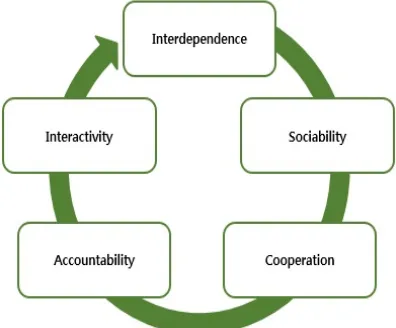
[image:5.612.318.516.429.593.2]goals and experience positive interdependence in their mutual learning. While developing positive interdependence, individual learners become responsible for their own learning. At the same time, they also try to motivate and assist each other to fill the gap in ZPD through mutual scaffolding. Through completing the learning tasks, they can maximize their potential as confident and competent language learners. For task-based language activities, teachers should try to design syllabus and lesson plans for the language learners to be involved in authentic communication and collaborative interaction. The meaningful experience of completing language learning tasks through collaboration and scaffolding is one of the crucial features to the successful learning process for language learners [24]. For meaningful task-based language learning occur, task types should be classified according to the proficiency level and the cognitive developmental stages of the language learners: listing, ordering and sorting, comparing, problem solving, sharing personal experiences, and projects with creative tasks [25]. According to the concept of task-based learning, several interrelated characteristics of task-based learning can be identified into five aspects: interdependence, sociability, cooperation, accountability, and interactivity [26]. Figure 5 shows the interlocking relationship in task-based learning.
Figure 5: The Concept Task-based Learning
7308 among the members of the learning community. In performing task-based language learning activities, learners can understand the value of sociability, cooperation, accountability, and interactivity in cultivating the classroom culture with positive interdependence for their success in learning.
3. SUPPORTING INTERDEPENDECE IN TASK-BASED LANGUGE LEARNING
3.1 Research context
This study was conducted in an EFL university classroom at a central part of Korea. The participants of this study were mostly sophomores who enrolled at an English course, which especially aimed at improving integrated English proficiency skills. This course was not a mandatory course. Among English 4 language skills, the students showed insecure attitudes toward their productive English proficiency levels such as their speaking skill and writing skill compared to their receptive English proficiency level such as reading skill and listening skill. Accordingly, they showed low self-confidence level in their English speaking ability or writing ability. Therefore, to boost their self-confidence and to offer more comfortable learning experience with the lowered affective filter, group-based pedagogical tasks should be arranged.
Pedagogical tasks with the collaborative language learning activities were set up in order to help the students with low level of linguistic proficiency and low level of self-confidence to be engaged in the collaborative learning experience. Technology-enhanced task-based EFL speaking and writing learning activities were introduced to help the participants to improve their communicative competence by maximizing the classroom interaction through the web-based or mobile-based platform. Each of the participants of this studies was assigned to a collaborative learning group. The group members were expected to offer mutual scaffolding to each other not only to help them to improve their productive English skills but also help them to boost their self-confidence level.
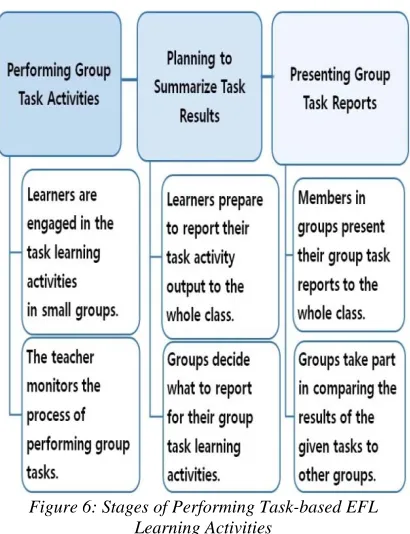
The purposes of making cooperative groups were to maximize collaborative interaction, and to attain more productive learning results. Participants were encouraged to play active roles within their pedagogical task groups and to improve their English productive skills. The incorporation of digital devices and web-based or mobile-based course learning platforms also played an important role in supporting the collaborative group interaction. The technology-enhanced task-based EFL learning activities were implemented according
[image:6.612.316.521.146.413.2]to three different procedural stages: task stage, planning stage, and reporting stage. Figure 6 shows the cyclic features of the task-based EFL learning activities.
Figure 6: Stages of Performing Task-based EFL Learning Activities
3.2 Data collection and analysis
For this study, data were collected through different sources. At the end of the course, cloud-based online questionnaire survey with Google forms with the five Likert-scales (highly disagree as 1 and high agree as 5) was conducted to find out the participants’ perspectives about technology-enhanced task-based language learning performance in their collaborative EFL learning. Anonymity of the questionnaire survey was guaranteed to acquire more reliable survey results. Also, the volunteered participants took part in the semi-structured interview.
4. RESULT AND DISCUSSION
7309
Table 1: Students’ Responses toward Technology-enhanced Task-based Language Learning Performance
Question Items Mean A task-based classroom activity is a
more interesting way of learning. 4.21 I feel comfortable when I participate
in the task-based classroom activities.
4.13
I feel more motivated in a
task-based learning. 4 I became a more active learner in the
task-based learning. 4.19 I experienced more classroom
interaction in the task-based learning.
4.47
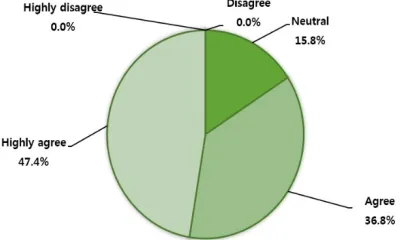
According to the research result, 84.2% of the participants responded that a task-based classroom activity was a more interesting way of learning. This feedback is well-matched to the existing study result in that technology-enhanced task-based EFL learning activities can offer English learning tasks that are relevant to leaner interests [26]. Participants also responded that they feel comfortable when they participated in the task-based classroom activities. They could improve their social skills by exchanging mutual scaffolding and interacting one another to reach the shared learning goals of the group. Figure 7 shows participants’ response for the interesting aspect of technology-enhanced task-based learning.
Figure 7: Students’ Response to the Interesting Aspect of Technology-enhanced Task-based EFL Learning
According to the research result, 79% of the participants responded that they felt more motivated in a task-based classroom activity. As the previous research results already discovered, in order to improve language learners’ motivation and autonomy, educators need to implement new pedagogical
[image:7.612.317.518.174.303.2]methods in their language teaching practice in order to make language courses more relevant and effective [3]. Figure 8 shows participants’ response for the motivating aspect of technology-enhanced task-based learning.
Figure 8: Students’ Response to the Motivating Aspect of Technology-enhanced Task-based EFL Learning
According to the research result, 94.7% of the participants responded that they experienced more classroom interaction in the task-based classroom. This result is compatible to the previous study in that the most ideal and natural way to learn new language skills is by embedding them in the interactive social and functional contexts [22]. Figure 9 shows participants’ response for the interactional aspect of technology-enhanced task-based learning.
Figure 9: Students’ Response to the Interactional Aspect of Technology-enhanced Task-based EFL Learning
[image:7.612.318.515.471.591.2] [image:7.612.92.292.497.617.2]7310
Since task-based classes offer really the best group activities. I think it was a very enjoyable lesson in the free atmosphere.
One-sided lecture class had many parts to reduce class participation, but as this semester, we were able to participate in the task-based group activities as well.
I was able to raise my understanding of the linguistic contents by gathering various opinions from peers.
Through learner-centered lessons and collaborative learning, I was able to improve my chances of doing my own English learning.
This is a class that is led by students. If I do not take part in the group-based task performance, it will cause a trouble to my team, and if I do not understand the contents, I will interrupt my group members’ learning. I have a lot of responsibility for my learning.
5. CONCLUSIONS
The aim of this study was to develop theoretical perspectives about the effect of technology-enhanced task-based EFL learning. In addition, this study tried to examine the effects of technology-enhanced task-based EFL learning in boosting self-directed English learning ability and positive interdependence among EFL learners. This study revealed that the technology-enhanced task-based EFL learning was effective for improving university students’ English productive proficiency in the metacognitive, cognitive, affective, and social dimensions. Technology-enhanced task-based EFL learning was also effective in decentralizing the classroom culture, and transferring more authority and control from teachers to learners. Technology-enhanced task-based EFL learning could contribute to improving collaborative classroom culture along with supporting the interdependence in EFL classroom as well as the self-directed English learning ability.
ACKNOWLEDGEMENT
This work was supported by 2018 Hannam University Research Fund.
REFRENCES:
[1] T. Teo, S.C. Tan, C.B. Lee, C.S. Chai, J.H.L. Koh, W.L. Chen, and H.M. Cheah, “The self- directed learning with technology scale (SDLTS) for young students: An initial development and validation,” Computers & Education, Vol. 55,
No. 4, 2010, pp. 1764–1771.
[2] D. Ausbel, “Cognitive structure and the facilitation of meaningful verbal learning,”
Journal of Teacher Education, Vol. 14, 1963, pp.
217-221.
[3] Y. C. Wang, “Promoting collaborative writing through wikis: a new approach for advancing innovative and active learning in an ESP context,”
Computer Assisted Language Learning, Vol. 28,
No. 6, 2015, pp. 499-512.
[4] L. Vygotsky, Mind in society: The development of
higher psychological processes, Cambridge, MA:
Harvard University Press, 1978.
[5] D. Wood, J.S. Bruner, and G. Ross, “The role of tutoring in problem-solving,” Journal of Child Psychology and Psychiatry and Allied
Disciplines, Vol. 17, 1976, pp. 89–100.
[6] C. Crook, “Collaborative interactions at computers,” in C. Crook (Ed.), Computers and
the collaborative experience of learning (pp.
148–188), London: Routledge, 1994.
[7] K. Mavrou, A. Lewis, and G. Douglas, “Researching computer-based collaborative learning in inclusive classrooms in Cyprus: The role of the computer in pupils’ interaction,”
British Journal of Educational Technology, Vol.
41, No. 3, 2010, pp. 486–501.
[8] Y. C. Hsieh “A case study of the dynamics of scaffolding among ESL learners and online resources in collaborative learning,” Computer
Assisted Language Learning, Vol. 30, No. 1/2,
2016, pp. 115-132.
[9] Y. G. Butler, “Communicative and task-based language teaching in the Asia-Pacific region,” in Deusen-Scholl, N. V. & S. May, (Eds.), Second
and Foreign Language Education (pp. 327-338),
Cham: Springer, 2017.
[10] C. Lai, M. Shum, and Y. Tian, “Enhancing learners’ self-directed use of technology for language learning: the effectiveness of an online training platform,” Computer Assisted Language
Learning, Vol. 29, No. 1, 2016, pp. 40-60.
[11] V. Zenotz, “Awareness development for online reading,” Language Awareness, Vol. 21, 2012,
pp. 85–100.
7311 awareness,” Language Learning & Technology,
Vol. 17, No. 2, 2013, pp. 75–99.
[13] K. Smith, and H. Craig, “Enhancing the autonomous use of CALL: A new curriculum model in EFL,” CALICO Journal, Vol. 30, No.
2, 2013, pp. 252–278.
[14] D. R. Garrison, “Self-directed learning: Toward a comprehensive model,” Adult Education
Quarterly, Vol. 48, 1997, pp. 18–33.
[15] The Korea Education and Research Information Service, Instructional Design of Smart
Education, Seoul, KERIS, 2012.
[16] K. Frizler, “The Internet as an educational tool in ESOL writing instruction,” Unpublished Master's thesis, San Francisco State University, 1995. Retrieved May, 2, 2005, from the World
Wide Web:
http://thecity.sfsu.edu/~funweb/thesis.htm. [17] J. O'Neil, “Our Schools as Learning
Organizations: A Conversation with Peter Senge,” Educational Leadership, Vol. 52, No. 7,
1995, pp. 20-23.
[18] J. D. Wilhelm, and P. D. Friedemann,
Hyperlearning: Where Project, Inquiry, and
Technology Meet, York, ME: Stenhouse
Publishers, 1998.
[19] A.S. Ohta, Second language acquisition processes in the classroom: Learning Japanese.
Mahwah, NJ: Lawrence Erlbaum Associates, 2001.
[20] S. Lee, “Translating constructivism into EFL classrooms through the use of technology,”
Multimedia-Assisted Language Learning, Vol. 8,
No. 1, 2005, pp. 220-249.
[21] J. Kormos, and K. Csizer, “The interaction of motivation, self-regulatory strategies, and autonomous learning behavior in different learner groups,” TESOL Quarterly, Vol. 48, No.
2, 2014, pp. 275-299.
[22] A. Collins, J. Brown, and S. Newman, “Cognitive apprenticeship: Teaching the crafts of reading, writing, and mathematics,” in L. Rensnik (Ed.), Knowing, learning, and
instruction (pp. 453-493), Hillsdale, NJ:
Lawrence Erlbaum Associates, 1989.
[23] J. C. Richard, and T. S. Rogers, Approaches and
Methods in Language Teaching, Cambridge:
Cambridge University Press, 2001.
[24] J. Harmer, The Practice of English Language
Teaching, Hoboken, NJ: Longman ELT, 2007.
[25] J. Wills, Framework for Task-based Learning,
Essex: Longman, 1996.
[26] D. W. Johnson, R. T. Johnson, and K. A. Smith, “Cooperative Learning and Individual Student Achievement in Secondary Schools,” in Pedersen, J. E., and A. D. Digby (Eds.),
Secondary Schools and Cooperative Learning