ISSN: 1992-8645 www.jatit.org E-ISSN: 1817-3195
REINFORCING TEACHER’S ROLE IN RETAINING
STUDENTS’ INTERESTS DISCUSSING ONLINE IN THEIR
LEARNING PROCESS AT MALAYSIAN TERTIARY
INSTITUTIONS
MOHD FADZLI ALI, NOORSHAZERIZA HISHAMUDDIN, LOKMAN MOHD TAHIR,
MOHD NIHRA HARUZUAN MOHD SAID
Faculty of Education, Universiti Teknologi Malaysia, 81310 UTM Skudai, Johor, Malaysia E-mail: [email protected] | [email protected]
ABSTRACT
Many studies from the literature related to asynchronous online discussions among tertiary students provide various advantages such as allowing students’ flexibility to provide feedbacks [38], enabling their knowledge construction [30], developing their critical thinking [39], and interacting with the lecturers regardless of time and space [1]. Thus, the use of online discussion has further become predominant to support tertiary education. Likewise in Malaysian context, research related to online discussion has demonstrated increased confidence in students’ learning. Although the findings showed positive response, there are studies [20], [3], [29], [24] proved otherwise mainly because of the teachers’ weaknesses in keeping students’ interests and motivation to use online discussions in their learning process. Based on Ames’ [4] teaching strategies and Keller’s [21] ARCS model, a systematic guidance was developed for teachers to properly help students discussing online in completing their assignments. With reference to this systematic guidance, a qualitative case study on how to retain the students’ motivation using online discussion was conducted. The respondents were final year students working in small groups. Each respondent was made compulsory to answer a checklist based on the items from Khan [22] that was used to gauge their background skills in using online forum before conducting the study. The research instruments used were online discussions and interviews. The transcripts from the online discussions were analysed using a coding scheme developed from the systematic guidance (developed from Ames’ [21] teaching strategies and Keller’s [21] ARCS model while the data from the interviews with the group leaders were used to support the findings derived from the transcript analysis. The findings revealed that the teaching strategies used in this study were able to retain the students’ interest and motivation to continue discussing online in completing their project assignments.
Keywords: Asynchronous Online Discussions, ARCS Model, Students’ Motivation, Teaching Strategy,
Higher Education
1. INTRODUCTION
In 2006, the Ministry has published an official report on the recommendations concerning the development and direction of higher education in Malaysia [27]. The report became part of the Malaysia national education policy. The Ministry has directed all tertiary institutions including public and private universities to integrate the use of online learning with classroom learning, emphasise the role of the teacher as facilitator, and promote learning as an on-going process throughout life. The e-learning policy became ambitious in 2010 when the government’s higher educational development
ISSN: 1992-8645 www.jatit.org E-ISSN: 1817-3195
academic staff is high. Some tertiary institutions have made the use of e-Learning compulsory among their lecturers and students.
To further understand the use of online learning in higher education, it is important to explore the previous studies. By reviewing the existing literature on the experiences of teachers and advantages of using online learning, it can add further refreshing and potential benefits.
2. RESEARCH BACKGROUND
Many studies from the literature related to asynchronous online discussions among tertiary students have provided various advantages. Wonziak and Silveira [38] found that online forum discussion allows flexibility by students controlling the time and there is location for them to post and give feedback to the messages in the forum. Ally [1] also states that since learners can complete online courses in their own space and can contextualize the learning, situated learning is facilitated. Tutoring can be easily done by the instructor at anytime and anywhere, and they can also guide the students to appropriate information based on their needs. [1] The adoption of online courses in traditional learning environments to complement face-to-face teaching is increasing. [30] Online discussion forums are expected to enable flexible and independent learning and knowledge construction. [40] Using online forum for discussions has been seen as a potential strategy to encourage critical thinking. [26] Online collaborative learning has become more commonly accepted as an effective strategy that is now made possible by the technology. There is a theoretical perspective which is also begun to be accepted as social constructivism theory for explaining the effectiveness of collaborative learning in an online environment to the extent that Kanuka and Anderson [20] claims it as “currently the most accepted epistemological position associated with online learning” (p.60).
Lecturers also play an important part in delivering the learning to students. Besides using traditional methods of classroom teaching delivering learning such as ‘chalk and talk’, roundtable discussions and so on, online discussions have been used widely by students. The use of online discussions has been further improved when they were applied to higher education. [2] Many lecturers have used online forum discussions to evaluate their students’ understanding and knowledge based. When the online forums become the most popular method for delivering learning, it
is not only important to have the right way of delivering that learning, but to retain or maintain learners’ interest and motivation. Learning effectiveness is determined by the level of interaction during the session. [34]
In the Malaysian context, previous research regarding the use of online discussions has been highlighted. Kamarulzaman et al. [19] conducted a study on examining students’ experiences using e-learning as a collaborative e-learning tool. Although the findings revealed some positive experiences among students using Moodle as an e-learning platform motivates them to continuously use Moodle, the role of lecturers and instructors are vital in helping to retain the learners’ interests online. With a structure that provides control and choice over time, place and pace, e-learning has emerged as a viable mode for working adults who wish to upgrade their knowledge. [3] A study by Maslawati and Shahizan [24] revealed that although the use of online forums within a distance learning program helps to foster greater interaction among learners who are geographically distant from one another, it is also important to emphasise the teacher’s role in determining how online forum discussion promote a sense of community among distance learners and their role in motivating students to discuss online.
However, such flexibility provides leeway for these adults to procrastinate and for their motivation to dwindle. Noriah et al. [29] conducted a study on ESL tertiary students’ writing attitudes. They found negative attitudes towards writing as well as other language learning problems linked to ESL students’ poor performance in writing. The team suggested a special online writing program that could act as a supplement for the course and help to motivate and enhance the learners’ writing ability and interest. A study by Maslawati and Shahizan [24] revealed that although the use of online forums within a distance learning program helps to foster greater interaction among learners who are geographically distant from one another, it is also important to emphasise the teacher’s role in determining how online forum discussion promote a sense of community among distance learners and their role in motivating students to discuss online.
ISSN: 1992-8645 www.jatit.org E-ISSN: 1817-3195
(2008) points to the lack of immediacy of response and lack of interactive features within the online forum itself.
3. PROBLEM STATEMENT
Based on the weakness of using online forums, as featured by Rovai [34], [11] and previous studies. [24][29][3][20] in the Malaysian context the question was how to retain students’ interest and motivation to discuss online and make learning activities meaningful.
4. RESEARCH OBJECTIVE
The main objective of this study was to determine how to retain students’ motivation in online discussions. Thus, the research question developed was: How would the students’ discussions, through online forums, retain their motivation to complete group assignments?
5. CONCEPTUAL FRAMEWORK
A conceptual framework for this study was derived from Ames’ [4] teaching strategies and Keller’s [21] ARCS model.
Diagram 1: Ames’ (1992) teaching strategies and Keller’s (1987) ARCS model
The first teaching strategy of Ames [4] describes the role of lecturer in informing students about the course goals that they must achieve: developing teaching-aided materials. Achieving these goals at this stage are related to the phases of Attention and Relevance of Keller’s [21] ARCS model where learners match their personal goals to develop a positive attitude. The second strategy highlights that the lecturer should relate the course goals to each other; this will make students feeling confident to carry out the tasks (assignments). In this phase (Confidence) the learners will feel that they will succeed and be able to control their success. For the third strategy, the lecturer constantly reminds the students to assess their progress on the tasks. This relates to the phase of Satisfaction of Keller’s [21] ARCS model where students feel satisfied with the completion of their tasks.
6. LITERATURE REVIEW
The use of the internet in tertiary learning has the potential to provide a shared space for students to learn in group. Students’ learning interactions yield positive contributions. [23][28] Dillenbourge and Scheinder [10], when describing collaborative learning, stated that is it when “…two or more subjects build synchronously and interactively a joint solution to some problem”. During task engagement, the discussion occurs as an important component of collaboration when collaborative learning must be mediated by verbal exchanges among learners that claims the cognitive benefits. [33]
ISSN: 1992-8645 www.jatit.org E-ISSN: 1817-3195
well as creating mutual understanding in a learning community” [12] Online forum discussions in distance education can provide opportunities for dialogue, debate and conversational learning. In addition, it can also provide access to other students’ experiences and opinions, and has the potential for a real sense of community such as a new type of learning community which can provide a space for collective thinking and access to peers for socializing and communication. [25]
Group activity is the greatest strength of online learning since it facilitates interaction. [17] It is possible to have the social, affective, and cognitive benefits of peer interaction and collaboration in online learning. Online forums can improve access to education, depending on students’ flexibility in location and time, and provide the ideal space for self-paced, active and collaborative learning “in a peer-support[ed] and exchange environment”. [19] p. 12
For knowledge acquisition and cognitive development, interaction is necessary and becomes a fundamental process in learning settings. [6] Gallini and Barron [13] indicate that by reading and responding to peers’ and instructors’ posts, online discussion can provide opportunities for learners to engage in social interactions. It is important to understand the students’ online interactions because these can influence the quality of online learning. [37]
Interaction is the main aspect of an educational experience, as indicated by Garrison and Cleveland-Innes [14] where more systematic and structured interaction is required when trying to promote the development of reflection and critical thinking through modelling and scaffolding. Clark [7],[8] has indicated the “active ingredient” of learning as the method or instructional design. For the needs of the students, it is possible to promote the learning when the instructional design is particularly well adjusted.
Despite the advantages of using online forum for discussion highlighted in the literature, it does pose some different challenges. The challenges are how to remain motivated to discuss online. Students may lose motivation to interact with their members and thus resulted in being discouraged in their study. Since students must be motivated to successfully discuss online, there are strategies derived from Ames’ teaching strategies along with Keller’s ARCS model that could be used to regain their motivation. An effective online forum discussion needs to be developed based on the most
appropriate levels of interaction. The quality of the learning is not judged by using the online forum discussion, but the effectiveness of the learning is determined by the interaction levels during the learning session. [34]
7. RESEARCH SETTING
This research was conducted as a qualitative case study as it focuses on a small group of students throughout the study. [11] Purposive sampling was used for this research. [32] The respondents of this study are the undergraduate students of a selected government institution of higher learning that were randomly selected. There were eleven respondents working in small groups of 3 to 4 members. This study was conducted in a selected government institution of higher learning. The respondents of this study were undergraduates of the institution concerned.
8. RESEARCH INSTRUMENTS
The research instruments used were online forum discussion allocated for each group and interviews with the research instruments used were online forum discussions allocated for each group and interviews with the group leaders. The transcripts of the online forum discussions were printed out and analysed using content analysis approach. By using Henri’s [17] model – Instruction Analysis Model (IAM) – a coding procedure was developed. Each group leader was interviewed. The interview was held using semi-open-ended techniques. The data from the interviews was to support findings derived from online discussion analysis to address the research questions.
9. RESEARCHPROCEDURE
ISSN: 1992-8645 www.jatit.org E-ISSN: 1817-3195
constantly monitored by the teacher. This was to ensure that the students would stay motivated and keep on revising and improving their group project so that they achieved their goal. At the end of the semester, each respondent had to answer a checklist on learning strategies used in online forum discussions; this was developed based on Khan [22] with some modification to suit the research. It had
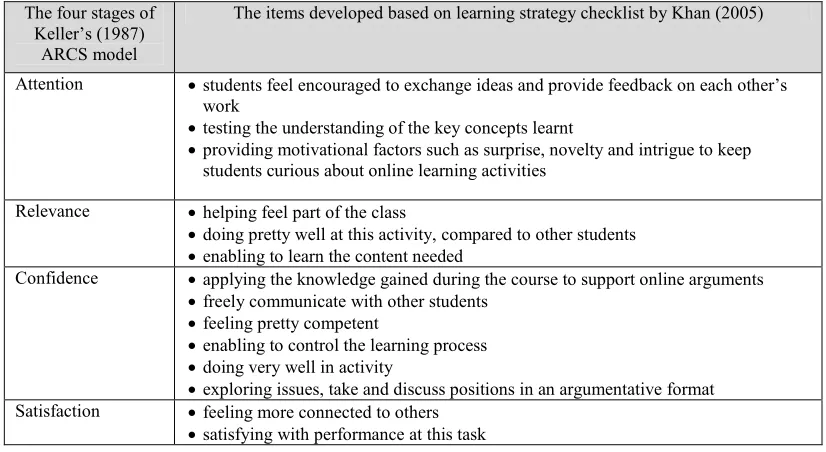
[image:5.612.102.515.216.442.2]two important sections. Section A was to gauge the level of the respondents’ usage of online forums. The items in section B (Table 1) were related to the students’ motivation to discuss online after being guided systematically by the lecturers, and were organised according to the stages of Keller’s [4] ARCS model.
Table 1: The organisation of the items from section B according to the four stages of Keller’s (1987) ARCS model
The four stages of Keller’s (1987)
ARCS model
The items developed based on learning strategy checklist by Khan (2005)
Attention •students feel encouraged to exchange ideas and provide feedback on each other’s work
•testing the understanding of the key concepts learnt
• providing motivational factors such as surprise, novelty and intrigue to keep students curious about online learning activities
Relevance • helping feel part of the class
•doing pretty well at this activity, compared to other students • enabling to learn the content needed
Confidence • applying the knowledge gained during the course to support online arguments •freely communicate with other students
• feeling pretty competent
•enabling to control the learning process • doing very well in activity
•exploring issues, take and discuss positions in an argumentative format Satisfaction • feeling more connected to others
•satisfying with performance at this task
8. DATA FINDINGS AND ANALYSIS
Before the online discussions could be analysed, it was important to firstly look at the checklist which was filled out by the students at the end of the semester. The results of the checklist indicated the students’ high familiarity in using online learning as they knew how to use a forum for online discussion and what worked best for them. The next move was to motivate the students to use online discussions in their learning process before the research questions could be addressed. In motivating students to learn, the lecturer provided guidance and support throughout their learning process. This was explained based on Ames’ teaching strategies and Keller’s ARCS model.
8.1.Motivating the students
The class was conducted based on the three-step teaching strategies by Ames [4]. The first step was when the lecturer informed the students of their goal throughout the course. The goal was the ability of each group to develop education courseware. The lecturer started with uploading some good samples
ISSN: 1992-8645 www.jatit.org E-ISSN: 1817-3195
The important goal working in group was to develop courseware. In the second step, the lecturer connected this goal (developing courseware) among members within each group. Each group was asked to discuss online the progress of their group assignment. Each group also extended their online discussions after classroom meetings or teaching. The lecturer made sure that each group conducted online discussions. The lecturer observed each group’s online discussions. Where necessary, the lecturer exchanged ideas on the improvement of groups’ projects and provided suggestions. This part includes the third stage (component), which is to establish positive expectations for achieving success among learners.
The third or last step was when the lecturer periodically told students to assess their own progress in the courseware development. During the last class of the semester, every group presented their projects in class. The lecturer provided constructive comments to further improve their projects. With these comments each group felt satisfied, as the lecturer had evaluated their projects. The students felt that they had accomplished the main objective of the level. This is the satisfaction stage of Keller’s [21] ARCS model: for learners to obtain some type of satisfaction or reward from a learning experience.
Throughout these steps, the final project (courseware development) was successfully completed by each group as they were well-motivated and assisted by the lecturer. Furthermore, the effort from the students themselves had actually motivated them to complete their projects as a team. Schunk [35] stated that motivation can influence what we learn, how we learn, and when we choose to learn. Brophy [6] claimed that the contemporary views link motivation to individuals’ cognitive and affective processes, such as thoughts, beliefs and goals, and emphasise the situated, interactive relationship between the learner and the learning environment. According to Noor Zainab [31], attitudes and motivation play significant roles in the process of teaching and learning, as attitudes can affect the students’ behaviour in carrying out the learning activities and reacting to the various learning situations.
8.2.Retaining Students’ Motivation through
Online Discussion
Before the course began, the instructor reminded the students of the purpose of each discussion thread, how it related to the learning objectives, and how it could promote deeper thinking. Each group’s online discussions reflected their thorough understanding in developing the courseware, as well as their work commitments, as a result of the proper guidance and support from the lecturer. These online discussions had to be analysed in order to address the research question. The students’ online discussions were printed out and analysed using a coding procedure developed based on Ames’ [4] teaching strategies and Keller’s [21] ARCS model.
Developing Coding Procedure: The stages in Keller’s [21] ARCS model were labelled K-A (for Attention), K-R (for Relevance), K-C (for Confidence) and K-S (for Satisfaction). Each teaching strategy from Ames [4] was identified as AI (for goals worth achieving), AII (for connecting goals) and AIII (for assessing progress). The coding from both Keller’s [21] ARCS model and Ames’ [4] teaching strategies were combined for further analysis. The code of AI is related to the Attention stage (K-A) and Relevance stage (K-R), which form AI (K-A) and AI (K-R) respectively. The code of AII is combined with the Confidence stage (K-C) to form AII (K-C), while AIII is combined with the Satisfaction stage (K-S) to form AIII (K-S).
Employing Raters: The total number of postings from the three groups was 202. Each posting was rated by two raters based on the coding procedure.
Categorising Students’ Postings of Online
Discussions
ISSN: 1992-8645 www.jatit.org E-ISSN: 1817-3195
Table 2: The categorisation of students’ posts based on Ames’ (1992) Teaching Strategy and Keller’s (1987) ARCS model
Group
Teaching Strategy (Ames, 1992)
Numbers of posting based on Keller’s (1987) ARCS model
Numbers of Posting Attention
(K-A)
Relevance (K-R)
Confidence (K-C)
Satisfaction (K-S)
1
AI 16 11 - - 24
45
AII - - 16 - 16
AIII - - - 5 5
2
AI 14 32 - - 46
76
AII - - 23 - 23
AIII - - - 7 7
3
AI 7 46 - - 53
81
AII - - 21 - 21
AIII - - - 7 7
Legends : AI (for goals worth achieving)
AII ( for connecting goals) AIII (for assessing progress)
K-A (for Attention) K-R (for Relevance) K-C ( for Confidence) K-S ( for Satisfaction)
Group 1 had the most posts associated with the Attention stage AI (K-A) in the first step of Ames’ teaching strategies. This was followed by group 2 (14 posts) and group 3 (7 posts). The most number of online posts associated with the relevance stage AI (K-R) in the first step of Ames’ teaching strategies was from group 3 with 46 messages; this was followed by group 2 and group 1 with 32 messages and 11 messages respectively. The number of online posts that could be derived from the confidence stage AI (K-C) in the second step of Ames’ teaching strategies was 23 messages from group 2, 21 messages from group 3 and 16 messages from group 1. Group 2 and 3 had the same number of online posts in the third step of Ames’ teaching strategies with 7 messages, while group 1 had 6 messages. This means that the students realised that they needed to stay focussed in completing their project in the group as it could not be done single-handedly. According to the group leaders, the students had given their best efforts to select the topic and the appropriate learning theory related to the project. They were also enthusiastically involved in discussions through the online forum and committed to completing the projects assigned to them.
Based on the analysis of the transcripts from each group’s online discussion, students were motivated to have a positive attitude to completing their group’s projects. This could be seen from their discussions via the online forum. The lecturer managed to retain the students’ motivation to continue discussing online; the team leader also played a large role as motivator to their team. As a leader, they had to make sure the team members
were involved in every discussion. The lecturer and team leaders had also played significant role in contributing and exchanging ideas through online discussions. The students were satisfied with the communication, not only from their team members but also from the lecturer.
From the findings, all of the teams were showing their teamwork on completing the assignments with make the discussion successfully by connecting the goals of the group task. Almost all of the team members provided their opinions and ideas regarding managing their projects. They also gave feedback regarding the improvement of any deficiencies or errors, to ensure that their work could be carried out easily. Besides, they were also able to evaluate their assignment well with involving in the discussion by give their views on the ideas given by members of the group. Students who took all or part of their course online performed better, on average, than those taking the same course through traditional face-to-face instruction.
9. CONCLUSION
ISSN: 1992-8645 www.jatit.org E-ISSN: 1817-3195
Ames’[4] teaching strategies. This study could serve as a best practice and an important reference when using online forum to keep students motived in their learning.
However, the obvious limitation in this study is the conduct of interview with the group leaders. All members in the group should have been interviewed simultaneously in a focus group interview setting where each individual team member could respond to any issues rose so that the lecturer or researcher can enhance his understanding by taking in the viewpoints of all group members. This would provide various insights on the potentially difficult behaviours that can occur in groups or teams including how the group members reflect leadership qualities.
ACKNOWLEDGMENT
The authors wish to thank Ministry of Higher Education (MOHE) and Universiti Teknologi Malaysia (UTM) for providing the Flagship Research Grant Scheme for this study (vote number: Q.J130000.2431.02G68) and GUP Research Grant Scheme (vote number: Q.J130000.2531.11H50)
REFERENCES
[1] Ally, M. Foundations of educational theory for online learning. In Terry (Ed.), The theory and practice of online learning (pp. 3−31). (2nd ed). Athabasca, AB: Athabasca University, 2004
[2] Azidah Abu Ziden, Fong Soofl Fook, Rozhan M. Idrus & Issham Ismail. The Types of Online Interaction Model: Individual Approaches in Online Discussions. In L. Perlovsky (Eds.). Advanced Educational Technologies, WSEAS Press, pp. 206-211, 2009
[3] Alias, N. A.. Design of a Motivational Scaffold for the Malaysian e-Learning Environment. Educational Technology &. Society, 15 (1), 137–151. 137, 2012
[4] Ames, C. Classrooms: Goals, structures, and student motivation. Journal of Educational Psychology, 84, 261-271, 1992
[5] Barker, P. Designing interactive learning. In T. de Jong & L. Sarti (Eds.). Design and production of multimedia and simulation-based learning material (pp. 1-30). Dordrech: Kluwer Academic Publishers, 1994.
[6] Brophy, J. Motivating students to learn (3rd ed.). New York, NY: Routledge, 2010
[7] Clark, R. Reconsidering research on learning from media. Review of Educational Research, 53(4), 445-459, 1983
[8] Clark, R. Media will never influence learning.
Educational Research and
Development, 42(2), 21-29, 1994
[9] Dillenbourg, P., & Schneider, D. Collaborative learning and the internet, [Online document]. Available:
http://tecfa.unige.ch/tecfa/research/CMC/colla/ iccai95_1.html [2013, 18 August], 1995 [10] Ellis, A. Student-centred collaborative learning
via face-to-face and asynchronous online communication: What's the difference?
Proceedings 18th ASCILITE Conference
Melbourne, 9-12 December, 2001 http://www.ascilite.org.au/conferences/ melboume01/pdf/papers/ellisa.pdf [11] Feagin, J, Orum, A. & Sjoberg, G. A case for
case study. Chapel Hill, NC: University of North Carolina Press, 1991
[12] Garrison, D.R. A cognitive constructivist view of distance education: An analysis of teaching-learning assumptions. Distance Education,
14(2), 199-211, 1993
[13] Gallini, J.K., & Barron, D. Participants' perceptions of web-infused environments: A survey of teacing beliefs, learning approaces, and communication. Journal of Research on Technology in Education, 34(2), 139- 156, 2002
[14] Garrisons, D.R. &. Cleveland-Innes, M. Facilitating cognitive presence in online learning: Interaction is not enough. American Journal of Distance Education, 19(3), 133-148, 2004
[15] Hanafi, A., Zuraidah, A., Rahman-dan R. & Idrus, M. Characteristics of the Web-Based Learning Environment in Distance Education: Students’ Perceptions of Their Learning Needs. Educational Media International, 41(2), 103-110, 2004
[16] Harasim, L.M. (Ed.). Online education: Perspectives on a new environment. New York : Praeger, 1990
[17] Henri, F. Computer conferencing and content analysis. In A. Kaye (Ed.) Collaborative learning through computer conferencing: The Najaden papers (pp.117-136). London: Springer-Verlag, 1992
ISSN: 1992-8645 www.jatit.org E-ISSN: 1817-3195
[19] Kamarulzaman, Yusniza; Madun, Azian; & Farinda Abdul Ghan (2011), Attitude towards E-learning Among Students: Evidence from A Malaysian Public University, British Journal of Arts and Social Sciences, Vol.3 No.2, 132-142, 2011
[20] Kanuka, H., and T. Anderson. Online social interchange, discord, and knowledge construction. Journal of Distance Education 13 (1): 57–74, 1998
[21] Keller, J.M. Strategies for stimulating the motivation to learn. Performance & Instruction. 26(8), 1-7, 1987
[22] Khan, B. E-learning quick checklist. Hershey, PA: Information Science Publishing, 2005 [23] Laurillard, D. Relinking university teaching: a
framework for the effective use of educational technology. London: Rouliedge, 1993
[24] Maslawati, M., Harieza, H., & Shahizan, S. Adult Learners’ Perceptions of a Designed Hypermedia in a Blended Learning Course at a Public University in Malaysia. The Turkish Online Journal of Educational Technology, 14(1), 31-38, 2015
[25] Mason, R., & Kaye, A.R. Towards a new paradigm for distance education. In L.M. Harasim (Ed.), Online education: Perspectives on a new environment (pp. 279-288). New York: Praeger, 1990
[26] Meyer, K. A. Face-to-face versus threaded discussions: The role of time and higher-order thinking. Journal of Asynchronous Learning Networks, 7(3), 55-65, 2003
[27] Ministry of Higher Education Malaysia, The Report by the Committee to Study, Review and Make Recommendations Concerning the Development and Direction of Higher Education in Malaysia, Putrajaya: Ministry of Higher Education Malaysia, 2006
[28] Moore, M. Three types of interaction. In K. Henry, M. Jon, & D. Keegan (Eds.), Distance Education: New perspectives. London: Routledge, 1993
[29] Noriah Ismail, Supyan Hussin & Saadiyah Darus. ESL tertiary students’ writing problems and needs: Suggested elements for an additional online writing program (IQ-Write) for BEL311 course. The International Journal of Learning, 18(9), PP.70-80, 2012
[30] Noroozi, O., Weinberger, A., Biermans, H. J. A., Mulder, M., & Chizari, M. Facilitating argumentative knowledge construction through
a transactive discussion script in CSCL. Computers & Education, 61, 59-76, 2013 [31] Noor Zainab Abdul Razak. The Internet and Its
Benefits in an ESL Classroom. In ELI Matters 1: Issues in English Language Learning and Teaching. Serdang: Universiti Putra Malaysia Press,2004.
[32] Patton, M. Q. Qualitative evaluation and research methods {2nd ed.). Newbury Park, CA: Sage Publications, 1990
[33] Pressley, M., & McCormick, C. B. (1995). Advanced educational psychology: for educators, researchers, and policymakers. New York: Harper Collins College Publishers [33] Rovai, A. Building sense of community at a
distance.International Review of Research in Open and Distance Learning (IRRODL), 3, 1. Retrieved April 23, 2004, from http://vvww.irr0dl.0rg/c0ntent/v3.l/r0vai.pdf, 2002
[34] Rovai, A. P. Facilitating online discussions effectively. The Internet and Higher Education. 2007, 10(1): 77-88, 2007
[35] Schunk, D. H., Pintrich, P. R., & Meece, J. L. Motivation in education (3rd ed.). Upper Saddle River, NJ: Pearson Merrill Prentice Hall, 2008
[36] Trentin, G. The quality-interactivity relationship in distance education. Educational Technology, 40(1), 17-27, 2000
[37] Verdejo, M.F. Interaction and collaboration in distance learning through computer mediated technologies. In T.T. Liao (Ed), Advanced Educational Technology: Research issues and future technologies (pp. 77-88). Berlin: Springer-Verlag, 1996
[38] Wozniak, H. & Silveira, S. Online discussions: Promoting effective student to student interaction. In R. Atkinson, C. McBeath, D. Jonas-Dwyer & R. Phillips (Eds), Beyond the comfort zone: Proceedings of the 21s' ASCILITE Conference (pp. 956-960). Perth,
5-8 December.
http://www.ascilite.org.au/conferences/perth04/ procs/wozniak.html, 2004