ORIGINAL RESEARCH ARTICLE
EXTRACORPOREAL MEMBRANE OXYGENATION (ECMO) IN THE MANAGEMENT OF
SEVERE THORACIC TRAUMA
*1,4
Pazooki, D.,
1Zeraatian, S.,
2Mesbah, M.,
2Kamalzadeh, N.,
1Hosseini, M.
4Granhed, H. and
3Naseripour, M.
1
Iran University, Hazrat Rasol Akrm Hospital, Department of Surgery and Cardiovascular & Thoracic surgery
Tehran Iran
2
Iran University, Hazrat Rasol Akrm Hospital, Department of Cardiovascular & Thoracic anesthesia Tehran Iran
3Iran University, Hazrat Rasol Akrm Hospital, Department of ophthalmology and president of Iran University,
Tehran Iran
4
Sahlgrenska University Hospital, Department of Surgery, Gothenburg Sweden
ARTICLE INFO ABSTRACT
This article will provide a general overview of ECMO use and outcomes in thoracic trauma with severe respiratory failure.
Copyright © 2018,Pazooki et al. This is an open access article distributed under the Creative Commons Attribution License, which permits unrestricted use, distribution, and reproduction in any medium, provided the original work is properly cited.
INTRODUCTION
Blunt thoracic injury is common in motor vehicle accidents and has a high mortality rate that accounts for 26% of deaths in children (Peclet, 1990). This can also result in acute respiratory distress syndrome (ARDS), which can be challenging to manage. Depending on the severity, mortality in these cases can be up to 30-45% (Schuerer, 2008 and ARDS Definition Task Force, 2012). ECMO has recently been used for patients with multiple traumas because it can reduce hemorrhagic complications with the development of ECMO technology and the application of a heparin-coated circuit (Madershahian, 2007).
*Corresponding author:1,4Pazooki, D.,
Iran University, Hazrat Rasol Akrm Hospital, Department of Surgery and Cardiovascular & Thoracic surgery Tehran Iran
4
Sahlgrenska University Hospital, Department of Surgery, Gothenburg Sweden
When a patient does not respond to conventional therapy, such as lung-protective mechanical ventilation, extracorporeal membrane oxygenation (ECMO) can be applied as a treatment option; its use has recently increased in patients with ARDS (Wu, 2014). Extracorporeal membrane oxygenation (ECMO) is a form of life support that provides cardiopulmonary assistance outside the body. ECMO was initially introduced in the 1970s to assist neonates with severe respiratory failure (Bartlett, 1997). ECMO may be used to support lung function for severe respiratory failure or heart function for severe cardiac failure. In 1972, Hill et al published the first report of ECMO use in an adult with post-traumatic respiratory failure (Hill, 1972). In 1979, a randomized clinical trial comparing ECMO to conventional ventilator therapy for acute respiratory distress syndrome failed to show improved outcomes with ECMO use, resulting in the abandonment of the technique for support of adults with respiratory failure (Zapol, 1979). Increased interest in ECMO use in new-borns and children
ISSN: 2230-9926
International Journal of Development Research
Vol. 08, Issue, 04, pp.19888-19892, April,2018
Article History:
Received 11th January, 2018
Received in revised form 05th February, 2018 Accepted 19th March, 2018
Published online 30th April, 2018
Key Words:
ECLS; ECMO; Traumatic respiratory failure; Blunt and penetrating thoracic trauma; Tracheobronchial injuries;
Cardiac contusions; Shock.
Citation: Pazooki, D., Zeraatian, S., Mesbah, M., Kamalzadeh, N., 1Hosseini, M. Granhed, H. and Naseripour, M.M. 2018. “Extracorporeal membrane oxygenation
(ecmo) in the management of severe thoracic trauma”, International Journal of Development Research, 8, (04), 19888-19892.
with respiratory failure was spurred in the 1980s when Bartlett et al and O’Rourke et al showed improved outcomes for these populations (Bartlett, 1982 and O'Rourke, 1989). Developed as an offshoot of cardiopulmonary bypass and the membrane oxygenator, ECMO can be used in patients of all ages (new-born to adult). Extracorporeal membrane oxygenation (ECMO) is a temporary mechanical support system used to aid heart and lung function in patients with severe respiratory or cardiac failure (Zwischenberger, 2005). ECMO seems to improve outcomes for cardiopulmonary resuscitation after cardiac arrests occurring both in and out of the hospital (Chen, 2008; Chen, 2008; Wang, 2014). Since then, its indications have been gradually expanded into different aspects of resuscitation medicine (Carmichael, 2002; Maslach-Hubbard,
2013 and Rinieri, 2015). Extracorporeal membrane
oxygenation (ECMO) provides circulatory and respiratory support and allows the extended survival of select patients with severe acute cardiopulmonary failure refractory to conventional treatment (Chia-Hsuin Chang). ECMO is indicated for similar reasons in patients with severe cardiopulmonary compromise secondary to accidental and surgical trauma (Arlt, 2010). ECMO is mainly used as a bridge treatment to delayed surgical management (Sian, 2014). ECMO is now used to support cardiorespiratory dysfunction in a variety of diseases, including sepsis, and as an adjunct to cardiopulmonary resuscitation in many centers worldwide.
ECMO Indications
ECMO support is only deployed when conventional therapies have failed to support the function of the heart and lungs adequately and when risk of mortality is high and imminent (Zwischenberger, 2005). ECMO is a support modality, not a treatment; it is only beneficial in patients whose primary disease is reversible. ECMO has been used to support primary or secondary diseases that cause respiratory or cardiac failures in new-borns, children and adults. It may be used to bridge patients with heart failure as they await heart transplantation or placement of a long-term circulatory support device, such as a ventricular assist device. ECMO utilization also is emerging as an adjunct to cardiopulmonary resuscitation (ECPR) (Thiagarajan, 2007 and Thiagarajan, 2009). In patients with cardiac arrest failing to respond to conventional therapies, initiation of ECMO may promote survival by allowing for investigation and treatment of the cause.
ECMO circuit
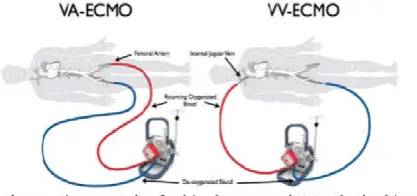
An ECMO circuit can be set up as veno-venous (VV) or venoarterial (VA). Other external gas exchange systems provide similar functions without the pump component of VV- or VA-ECMO (Extracorporeal Membrane Oxygenation, 2016). These arteriovenous extracorporeal lungs assist devices bypass the lungs, but not the heart, and use the patient’s blood pressure to sustain circulation of externally oxygenated blood. Because of the requirement for adequate cardiac function in candidate patients, these systems have more limited application (Extracorporeal Membrane Oxygenation, 2016).
VV-ECMO provides external gas exchange, bypassing the lungs and protecting them from high tidal volumes of ventilation that would otherwise be needed to oxygenate and ventilate the patient. VV-ECMO is indicated for patients with potentially reversible respiratory failure, including those with severe acute respiratory distress syndrome (ARDS), primary graft dysfunction following lung transplant, and trauma to the
lungs (Extracorporeal Membrane Oxygenation, 2016).
[image:2.595.310.559.383.545.2]VA-ECMO provides the same external gas exchange as VV-ECMO, but also augments blood flow in settings of severe cardiac injury. VA-ECMO is indicated for patients with cardiac failure, including cardiogenic shock unresponsive to typical intensive care medicines and cardiac arrest that does not respond to cardiopulmonary resuscitation (CPR) (Extracorporeal Membrane Oxygenation, 2016). VA-ECMO may also be used for patients following heart surgery or as a bridge to heart transplantation. Both VA- and VV-ECMO may be used intraoperatively as a planned alternative to traditional cardiopulmonary bypass in selected patient populations (e.g., lung or heart transplantation) (Extracorporeal Membrane Oxygenation, 2016). Despite the risks of systemic anticoagulation and of consumptive coagulopathy in trauma cases, ECMO has been used successfully in critically ill patients with traumatic lung injury and can offer an additional treatment modality (Cordell-Smith, 2006).
Fig. 1. Diagnoses of ECMO, Patients >17 years old
Fig. 2.
Several case reports and small case series describe the use of ECLS in the management of paediatric and adult traumatic
respiratory failure including blunt and penetrating
parenchymal and tracheobronchial injuries, cardiac contusions and shock (Ju-Hee Park, 2016 and Debbie, 2014).
[image:2.595.318.527.660.758.2]The role of extracorporeal life support (ECLS)in the management of acute respiratory failure of the trauma victim is not well defined.Recent advances in extracorporeal life support technology (ECMO) now allow patients with end-stage lung disease or sever cardio-pulmonary trauma andtraumatic respiratory failure to be successfully supported for prolonged periods of time and preventing the use of mechanical ventilation (Debbie, 2014). Only a few case reports have been presented the successful application of ECMO as an intraoperative support during the surgical repair of traumatic bronchial injury (Liu, 2014). Prolonged use of ECMO (> 14 days) has been applied for respiratory failure and is associated with an increase in survival rates as high as 50-70% to native lung recovery (Wiktor, 2015).
Case
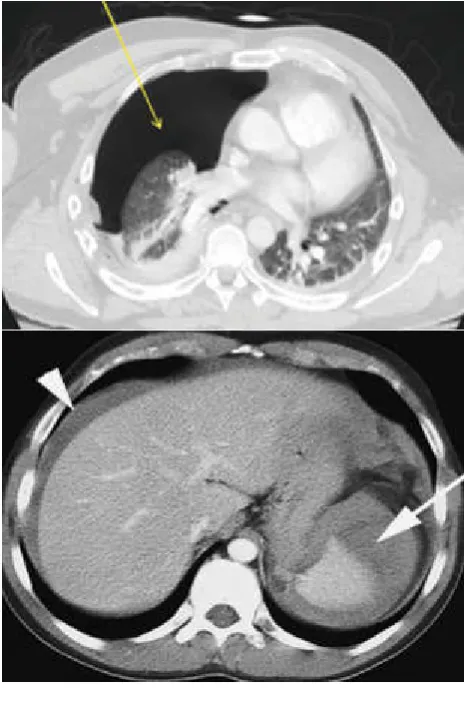
[image:3.595.309.553.233.783.2]A 19-year-old Man with a serious blunt thoracic trauma during a Motorcycle Racing. On admission to the ED, he was awake with spontaneously breathing but dyspnoeic with haemoptysis and severe hypoxemia (SAO2 < 50%). The anaesthesiologist will decide to intubate him in ED, but after endotracheal ventilation was started, the gas exchange rapidly worsened with subcutaneous emphysema and cardiac arrest,which necessitated CPR and ACLS. Chest X-ray demonstrated a huge right pneumothorax with 7 rib fracture from costa 3-9 with flail. Urgent chest tube inserted for a right tension pneumothorax.
Fig. 4. CT scans
The O2- saturation levels worsened, and continuous massive air leakage was present. Emergency bronchoscopy was mandatory, but it failed to reveal injuries in the trachea and main stem bronchus. An endobronchial tube with left
intubation was inserted, without the gas exchange
improvement. Emergency trauma CT scans showed showed a suspicious lower right bronchial tear with diffuse bilateral pulmonary contusion, with the mild left pneumothorax and a large quantity of abdominal fluid with splenic laceration. A chest tube was inserted on the left hemi thorax, but gas exchange remained stable with an O2saturation of 60%. A team of cardiothoracic surgeons, anaesthesiologistsand trauma leader, recommended a veno-venous ECMO, because the team were agreed that the patient would not survive without ECMO. The patient was placed on an extracorporeal circuit (Bio-Medicus; Medtronic Inc, Minneapolis, Minn) Fig-4 with venous access achieved through the right jugular vein and right femoral vein using a percutaneous Seldinger technique Fig-5,6 (VV-ECMO).
Fig. 5.
Fig. 6.
[image:3.595.45.279.387.738.2]Anticoagulation with IV heparin was set to activated clotting times between 250 and 300 seconds. Heparinized blood was extracted from the internal jugular vein and through a centrifugal pump reached a membrane oxygenator and heat exchanger and returned through the femoral vein. With a blood flow of 2.5 L/min and an FIO2 of 60%, the oxygenation saturation increased, and the patient maintained good oxygen levels averaging 95%; thus allowing, surgical intervention was possible. An exploratory laparotomy showed a large amount of
blood and huge laceration of spleen, without
[image:4.595.63.276.230.422.2]otherintraperitoneal or retroperitoneal visceral injury. A right posterolateral thoracotomy by thoracic surgeon confirmed the large pulmonary contusion with multiple parenchymal tears and a transverse disruption in the intermediate bronchus.
Fig. 8. From Radiology Quiz/Radiopaedia.org
The location of the injury,and presence of irregular borders did not allow to conservative approach to bronchus without the risk of stenosis, therefore a lower bilobectomy was performed by thoracic surgeon. 72 hours later, the patient was successfully weaned from ECMO.
DISCUSSION
However, the respiratory function of our patient was not sufficient for lungrecovery, despite aggressive application of conventional approaches, including ventilation with positive end-expiratory pressure. The successful outcome of this yang patient is most likely attributable to the young age of the patient, and his sufficient reserve energy, early institution of
ECMO and aggressive surgical intervention after
cardiopulmonary stabilization.
The application of ECMO has been heavily debated.
Timing for the use of ECMO is considered critical.
The technique is especially useful if it is used early in the treatment course when the pathologic abnormality is potentially reversible (Panden, 2013).
Conclusion
ECMO is mainly used as a bridge treatment to delayed surgical management. ECMO can provide temporary replacement for damaged lung with sufficient ventilation and oxygenation allowing time for surgery and recovery. Despite the risks of
systemic anticoagulation and of consumptive coagulopathy in trauma cases, ECMO has been used successfully in critically ill patients with traumatic lung injury and can offer an additional treatment modality.
Disclosure: The authors declare no conflicts of interest.
Acknowledgment
The authors of the present study would like to express their very gratitude to all colleagues for their help in offering us resources in running this research.
REFERENCES
ARDS Definition Task Force, Ranieri VM, Rubenfeld GD, Thompson BT, Ferguson ND, Caldwell E,et al: Acute respiratory distress syndrome: the Berlin Definition. JAMA 2012; 307: 2526-33.
Arlt, M., Philipp, A., Voelkel, S., Rupprecht, L., Mueller, T., Hilker, M., Graf, B.M., Schmid, C. 2010. Extracorporeal membrane oxygenation in severe trauma patients with
bleeding shock. Resuscitation., 81:804–809. doi:
10.1016/j.resuscitation.2010.02.020.
Bartlett, R.H., Andrews, A.F., Toomasian, J.M., et al. 1982. Extracorporeal membrane oxygenation for newborn respiratory failure: forty-five cases. Surgery., 9(2):425-433. Bartlett, R.H., Gazzaniga, A.B., Huxtable, R.F., Schippers, H.C., O’Connor, M.J., Jefferies, M.R. 1977. Extracorporeal
circulation (ECMO) in neonatal respiratory failure. J
Thorac Cardiovasc Surg., 74:826–833.
Carmichael, T.B., Walsh, E.P., Roth, S.J. 2002. Anticipatory use of venoarterial extracorporeal membrane oxygenation
for a high-risk interventional cardiac procedure. Respir
Care., 47:1002–1006.
Chen, Y.S., Lin, J.W., Yu, H.Y., Ko, W.J., Jerng, J.S, Chang, W.T., Chen, W.J., Huang, S.C., Chi, N.H., Wang, C.H., Chen, L.C., Tsai, P.R., Wang, S.S., Hwang, J.J., Lin, F.Y.
2008. Cardiopulmonary resuscitation with assisted
extracorporeal life-support versus conventional
cardiopulmonary resuscitation in adults with inhospital cardiac arrest: an observational study and propensity
analysis. Lancet., 372:554–561. doi:
10.1016/S0140-6736(08)60958-7.
Chen, Y.S., Yu, H.Y., Huang, S.C., Lin, J.W., Chi, N.H., Wang, C.H., Wang, S.S., Lin, F.Y., Ko, W.J. 2008. Extracorporeal membrane oxygenation support can extend
the duration of cardiopulmonary resuscitation. Crit Care
Med., 36:2529– 2535. doi: 10.1097/ CCM.0b013e318183
f491.
Chia-Hsuin, Chang, M.D., DSc; Hsi-Chieh Chen, M.S. James, L. Caffrey, PhD; Jiun Hsu, MD; Jou-Wei Lin, MD, MPH, PhD; Mei-Shu Lai, MD, PhD; Yih-Sharng Chen, MD, PhD,Survival Analysis After Extracorporeal Membrane Oxygenation in Critically Ill Adults A Nationwide Cohort Study DOI: 10.1161/CIRCULATIONAHA.115.019143 Cordell-Smith, J.A., Roberts, N., Peek, G.J., Firmin, R.K.
2006. Traumatic lung injury treated by extracorporeal membrane oxygenation (ECMO). Injury., 37: 29-32 Debbie, F. Lew1, Curtis J. Wray1, Kevin P. Lally1, Lillian S.
Kao1 and Adam M. Vogel2J Surgery December 2014 Vol.:2, Issue:2
Hill, J.D., O'Brien, T.G., Murray, J.J., et al. 1972. Prolonged extracorporeal oxygenation for acute post-traumatic respiratory failure (shock-lung syndrome). Use of the Bramson membrane lung. N Engl J Med. 286(12):629-634. Ju-Hee Park, M.D.1, Junghyeon Lim, M.D.2, JaeJin Lee,
M.D.3, and Hee Sung Lee, M.D.The Use of Extracorporeal Membrane Oxygenation in the Surgical Repair of
Bronchial Rupture,2016 February 31(1):54-57 /
http://dx.doi.org/10.4266/kjccm.2016.31.1.54
Liu, C., Lin, Y., Du, B., Liu, L. 2014. Extracorporeal membrane oxygenation as a support for emergency bronchial reconstruction in a traumatic patient with severe
hypoxaemia. Interact Cardiovasc Thorac Surg, 19:
699701.
Madershahian, N., Wittwer, T., Strauch, J., Franke, U.F., Wippermann, J., Kaluza, M. et al: 2007. Application of ECMO in multitrauma patients with ARDS as rescue therapy. J Card Surg., 22: 180-4.
Maslach-Hubbard, A., Bratton, S.L. 2013. Extracorporeal membrane oxygenation for pediatric respiratory failure: history, development and current status. World J Crit Care Med, 2:29–39. doi: 10.5492/wjccm.v2.i4.29.
O'Rourke, P.P., Crone, R.K., Vacanti, J.P., et al. 1989. Extracorporeal membrane oxygenation and conventional medical therapy in neonates with persistent pulmonary hypertension of the newborn: a prospective randomized study. Pediatrics., 84(6):957-963.
Panden, M.L., Conrad, S.A., Rycus, P.T., Thiagarajan, R.R. 2013. ELSO Registry. Extracorporeal Life Support Organization Registry Report 2012. ASAIO J. 59: 202–10. Peclet, M.H., Newman, K.D., Eichelberger, M.R., Gotschall,
C.S., Garcia, V.F., Bowman, L.M. 1990. Thoracic trauma in children: an indicator of increased mortality. J Pediatr Surg, 25: 961-5; discussion 965-6
Rinieri, P., Peillon, C., Bessou, J.P., Veber, B., Falcoz, P.E., Melki, J., Baste, J.M. 2015. National review of use of extracorporeal membrane oxygenation as respiratory support in thoracic surgery excluding lung transplantation.
Eur J Cardiothorac Surg. 47:87–94. doi:
10.1093/ejcts/ezu127
Schuerer, D.J., Kolovos, N.S., Boyd, K.V., Coopersmith, C.M. 2008. Extracorporeal membrane oxygenation: current clinical practice, coding, and reimbursement. Chest., 134: 179-84.
Sian, K., McAllister, B., Brady, P. 2014. The use of extracorporeal membrane oxygenation therapy in the delayed surgical repair of a tracheal injury. Ann Thorac Surg., 97: 338-40.
Thiagarajan, R.R., Brogan, T.V., Scheurer, M.A., et al. 2009.
Extracorporeal membrane oxygenation to support
cardiopulmonary resuscitation in adults. Ann Thorac Surg. 87(3):778-785.
Thiagarajan, R.R., Laussen, P.C., Rycus, P.T., et al. 2007.
Extracorporeal membrane oxygenation to aid
cardiopulmonary resuscitation in infants and children. Circulation., 116(15):1693-1700.
Wang, C.H., Chou, N.K., Becker, L.B., Lin, J.W., Yu, H.Y., Chi, N.H., Hunag, S.C., Ko, W.J., Wang, S.S., Tseng, L.J., Lin, M.H., Wu, I.H., Ma, M.H., Chen, Y.S. 2014. Improved outcome of extracorporeal cardiopulmonary resuscitation for out-ofhospital cardiac arrest: a comparison with that for extracorporeal rescue for in-hospital cardiac
arrest. Resuscitation. 85:1219–1224. doi: 10.1016/
j.resuscitation. 4.06.022.
Wiktor, A.J., Haft, J.W., Bartlett, R.H., Park, P.K., Raghavendran, K., Napolitano, L.M. 2015. Prolonged VV ECMO (265 Days) for ARDS without technical complications. ASAIO J., 61: 205-6.
Wu, M.Y., Lin, P.J., Tseng, Y.H., Kao, K.C., Hsiao, H.L., Huang, C.C. 2014. Venovenous extracorporeal life support for posttraumatic respiratory distress syndrome in adults:
the risk of major hemorrhages. Scand J Trauma Resusc
Emerg Med., 22: 56.
Zapol, W.M., Snider, M.T., Hill, J.D. et al. 1979.
Extracorporeal membrane oxygenation in severe acute respiratory failure. A randomized prospective study. JAMA., 242(20):2193-2196.
Zwischenberger, J.B., Bartlett, R.H. 2005. Extracorporeal life
support: an overview. In: ECMO Extracorporeal
Cardiopulmonary Support in Critical Care. 3rd ed. Ann Arbor, MI: Extracorporeal Life Support Organization; 1-4. Zwischenberger, J.B., Bartlett, R.H. 2005. Extracorporeal life
support: an overview. In: ECMO Extracorporeal
Cardiopulmonary Support in Critical Care. 3rd ed. Ann Arbor, MI: Extracorporeal Life Support Organization; 1-4.