HIPPOCAMPAL NEURON FIRING IN
GEOMETRICALLY DIFFERENT ENVIRONMENTS:
EVIDENCE FOR LONG-TERM, INCIDENTAL, AND
INCREMENTAL LEARNING
Colin Lever
Thesis submitted for consideration for the degree o f Doctor o f Philosophy
Department o f Anatomy and Developmental Biology University College London
ProQuest Number: 10006791
All rights reserved
INFORMATION TO ALL USERS
The quality of this reproduction is dependent upon the quality of the copy submitted.
In the unlikely event that the author did not send a complete manuscript and there are missing pages, these will be noted. Also, if material had to be removed,
a note will indicate the deletion.
uest.
ProQuest 10006791
Published by ProQuest LLC(2016). Copyright of the Dissertation is held by the Author.
All rights reserved.
This work is protected against unauthorized copying under Title 17, United States Code. Microform Edition © ProQuest LLC.
ProQuest LLC
789 East Eisenhower Parkway P.O. Box 1346
CONTENTS
ABSTRACT Page 1
INTRODUCTORY OVERVIEW Page 3
Hippocampal involvement in learning and memory Page 3 Unit-recording evidence of hippocampal learning? Page 4
Unit-recording evidence of other features of hippocampal learning and memory Page 6 The contribution of this thesis to hippocampal studies - learning and memory Page 6 Stimulus and motivation for the present study Page 7
CHAPTER 1 - HISTORICAL INTRODUCTION Page 10
A brief history of spatial mapping Page 10
Temporal associative and representational accounts of learning Page 10 Latent, or Incidental learning Page 13
Spatial orientation experiments - the detour Page 18 Tolman’s “cognitive map” Page 21
O’Keefe and NadeTs hippocampal cognitive map Page 25
CHAPTER 2 - ANATOMY OF THE HIPPOCAMPAL FORMATION Page 31
1) The hippocampal formation: Gross morphology, spéciation, and intrahippocampal circuitry Page 31
Intrahippocampal circuitry Page 34
2) Afférents to the hippocampal formation Page 36 Cortical afferents to rhinal cortex Page 37
Parasubiculum and Presubiculum: Inputs via Entorhinal cortex Page 38 Other subcortical input to the hippocampal formation Page 41
Input to Septal vs Temporal hippocampus Page 42 3) Efferents of the hippocampal formation Page 43
CAl efferents Page 43 Subicular efferents Page 43
Entorhinal efferents: cortical Page 44 Entorhinal efferents: subcortical Page 45 Parasubicular and Presubicular efferents Page 45
CHAPTER 3 - PHYSIOLOGY OF THE HIPPOCAMPUS Page 47
1) EEG states Page 47 LIA Page 47
Gamma frequency oscillations Page 49
Theta - Basic features and characteristics Page 49 Mechanisms of theta generation Page 50
Correlates of theta Page 51
Relationship between theta and displacement Page 51
2) Cell types, and complex-spike cell firing in the hippocampus Page 54 Complex spikes cells and theta cells Page 54
The complex spike phenomenon - intracellular and extracellular recording Page 55 Spike broadening and calcium entry Page 55
3) Long term potentiation (LTP) Page 56
CHAPTER 4 - PHYSIOLOGICAL CORRELATES: REVIEW OF PLACE CELLS, AND
HEAD DIRECTION CELLS Page 61
A) Place cell review Page 61
Locational firing of pyramidal cells (place cells and place fields) Page 61 Basic Place field characteristics Page 62
Multiple place fields of single cells Page 62 Place fields and directionality Page 63 Place fields and angular location Page 64
The multimodal sensory nature of the place cell phenomenon Page 65 The relative importance of distal and proximal cues Page 68
Place fields and environmental scaling - size and number Page 69
Place field extent within an environment - are there differences in the dorsal and ventral hippocampus? Page 70
Place cell firing patterns can be different in different environments Page 72 Variance in spatial firing Page 73
Robustness in spatial firing - a population code for place Page 74 Robustness in spatial firing - persistence and stability over time Page 75 The phase shift phenomenon Page 77
Speed-related increases of place cell firing Page 79 “Anticipatory firing” of place cells Page 81
Homogeneity of place fields within an environment Page 83
Topography of place fields within the hippocampal neural structure Page 85 Differences between CA3 and CAl cells: firing rates, field size, directionality, spatial specificity Page 85
Place field establishment Page 87
Relationship between place field firing and animal spatial behaviour Page 89 Place field persistence under conditions of altered goal and/or
reward contingencies Page 90
B) Hippocampal cells - non-spatial correlates? Page 97 1) Approach cells
2) Mismatch cells
3) Cue-Sampling correlates 4) Wood et al, 1999
C) Head-direction cells - presubicular cells Page 101
D) Interactions between hippocampal cells and presubicular cells Page 103
CHAPTER 5 - SOME MODELS AND THEORIES OF HIPPOCAMPAL FUNCTION Page 105
Spatial theories and models: place field formation and navigation Page 105 Models of navigation Page 105
Distances-between-field peaks and synaptic weights - The Cognitive Graph model Page 105
S-R models: Brown and Sharp Page 107
The models of Burgess, O’Keefe and colleagues Page 108 Modelling different environments Page 110
Non-spatial accounts of hippocampal function Page 111 Configurai learning theory Page 111
Declarative theory Page 113
Relational declarative theory Page 115
Subjects Page 120
Electrodes and Microdrives - basic details Microdrives - further details Page 121 Tetrodes - further details Page 124 Surgery Page 125
Unit recording Page 126 Long-term recording Page 128
Screening for activity and ensuring stability Page 128 Laboratory layouts and testing procedures - general Page 131
Trial timing, sequence and alternation - general comments
Procedures for bringing each rat in and out of the environments (Exps. 1 & 2) Page 131
Environments - the “morph box” Page 133 Task Page 135
Data analysis Page 135
Data analysis - the isolation of single units from the multi-unit tetrode data Page 134
Cluster cutting was not done on a trial-by-trial basis Page 137 Data analysis - derivation of place field characteristics Page 138 The effects of smoothing Page 141
Data analysis - “silent” cells
Data analysis - Preliminaries before firing patterns can be compared within and across shapes Page 143
Data analysis - comparison of trials in square and circle shapes - Spatial transformations Page 144
Data analysis - Indices of similarity of firing within and across shapes Page 143 Rate-related measures Page 145
Distance-between-peak (DBP) related measures Page 145
Centroid of peaks comparison measure (CPCP distance) Page 147
Monte Carlo simulation of the distribution of peaks assuming random firing Page 148
Histology and cell localisation Page 150 CHAPTER 7 - THE PILOT STUDY Page 153
Introduction Methods Results
Summary and the implications for further experiments Animals r966 and r977 were used again in experiment IB
CHAPTER 8 - EXPERIMENT lA AND EXPERIMENT IB Page 161
Experiment 1 : Aims, focus of analysis, terminology Methods for experiment lA and IB Page 161
Common procedures to Experiment 1A and IB Page 161
Results of the Monte Carlo Simulation for Experiment 1 Page 165 Results
Experiment 1A - Day 1 - Descriptive overview Page 166 Experiment IB - Day 1 - Descriptive overview Page 170 Procedure Page 170
Experiment 1A and IB - Day 1 - Quantitative Procedures and Results Page 174 Quantitative Procedures
Statistics
Experiment IB - Day 1 - Quantitative Results Page 179
Experiment 1A and IB - Day 1 - Discussion : Summary and Measures of similarity Page 182
Experiment 1A and IB - Further trials - Descriptive Results Page 187 Experiment IB only - Days 2 to 6 of main experiment Page 187 Experiment 1A and IB - Morph “diamond” probe phase Page 187
Experiment 1A and IB - Probe trials examining the basis of the similarity of firing Page 189
Introduction Probe trials - types Results
Experiment IB - Delay testing Page 193 Experiment 1 - discussion Page 195
CHAPTER 9 - EXPERIMENT 2 Page 198
Experiment 2 - Rationale and aims Page 198 Methods - Experiment 2 Page 200
Experiment 2 - Environmental set up Experiment 2 - Procedural details Experiment 2 - Observations of rearing
Experiment 2 - Morph Transfer Phase - probing the nature of remapping Experiment 2 - Delay phase - testing long-term memory
Results of the Monte Carlo simulation for Experiment 2 Results Overview, and Plan of Results Page 206
Experiment 2 - Results Page 208
1) Day 1 to DayEnd time series experiment - General, qualitative results Page 208 2) Day 1 to Day 6 - time series experiment - combined data Page 231
3) Day 1 to DayEnd time series experiment - individual rats Page 237 Analysis - introduction and procedures Page 237
Results Page 241 Animal rl079 Page 242 Animal rl029 Page 243 Animal rl077 Page 246 Discussion - Incremental remapping Page 248
4) Morph transfer trials Page 251 Introduction
Procedure Results
Results summary - Wooden-to- Morph within-shape firing patterns Results summary - Morph square vs Morph circle
Discussion - morph transfer phase - information transfer? Page 259 5) Delay Phase Page 261
Introduction to analysis Results
Discussion - long-term storage and retrieval Page 271 6) Probe trials Page 274
Discussion - Probe trials Page 279 CHAPTER 10 - DISCUSSION Page 283
Organisation of Discussion
Similar across-shape firing on initial exposures Page 283
system
What does “complete remapping” look like?
Is the single factor of experience sufficient to account for all the apparent discrepancies with earlier work?
Muller and Kubie (1987) and Quirk et al (1992): Similar procedures to this study Muller and Kubie (1987) and Quirk et al (1992): Different procedures to this study Established position-direction constancy: “all novelty is but oblivion”
Experience as a factor in remapping in this study: incremental learning Page 297 Incremental learning and the cognitive map theory Page 299
Incidental (aka. latent) learning and the cognitive map theory Page 300
Why does thorough/complete remapping take so long? Is the current task a useful way of investigating hippocampal function?
The Morph Transfer Phase and incidental learning: evidence for “knowledge transfer” based on “latent learning” in a “cognitive map”-type system? Long-term hippocampal storage: The Delay Tests Page 304
The role of the hippocampus in exploration: environmental discrimination Page 305
APPENDIX Page 311
BIBLIOGRAPHY Page 312
GLOSSARY Page 328
HIPPOCAMPAL NEURON FIRING IN
GEOMETRICALLY DIFFERENT ENVIRONMENTS:
EVIDENCE FOR LONG-TERM, INCIDENTAL, AND
INCREMENTAL LEARNING
Colin Lever
Thesis submitted for consideration for the degree o f Doctor o f Philosophy
Department o f Anatomy and Developmental Biology University College London
CONTENTS
ABSTRACT Page 1
INTRODUCTORY OVERVIEW Page 3
Hippocampal involvement in learning and memory Page 3 Unit-recording evidence of hippocampal learning? Page 4
Unit-recording evidence of other features of hippocampal learning and memory Page 6 The contribution of this thesis to hippocampal studies - learning and memory Page 6 Stimulus and motivation for the present study Page 7
CHAPTER 1 - HISTORICAL INTRODUCTION Page 10
A brief history of spatial mapping Page 10
Temporal associative and representational accounts of learning Page 10 Latent, or Incidental learning Page 13
Spatial orientation experiments - the detour Page 18 Tolman’s “cognitive map” Page 21
O’Keefe and NadeTs hippocampal cognitive map Page 25
CHAPTER 2 - ANATOMY OF THE HIPPOCAMPAL FORMATION Page 31
1) The hippocampal formation: Gross morphology, spéciation, and intrahippocampal circuitry Page 31
Intrahippocampal circuitry Page 34
2) Afferents to the hippocampal formation Page 36 Cortical afferents to rhinal cortex Page 37
Parasubiculum and Presubiculum: Inputs via Entorhinal cortex Page 38 Other subcortical input to the hippocampal formation Page 41
Input to Septal vs Temporal hippocampus Page 42 3) Efferents of the hippocampal formation Page 43
CAl efferents Page 43 Subicular efferents Page 43
Entorhinal efferents: cortical Page 44 Entorhinal efferents: subcortical Page 45
Parasubicular and Presubicular efferents Page 45
CHAPTER 3 - PHYSIOLOGY OF THE HIPPOCAMPUS Page 47
1) EEG states Page 47 LIA Page 47
Gamma frequency oscillations Page 49
Theta - Basic features and characteristics Page 49 Mechanisms of theta generation Page 50
Correlates of theta Page 51
Relationship between theta and displacement Page 51
2) Cell types, and complex-spike cell firing in the hippocampus Page 54 Complex spikes cells and theta cells Page 54
The complex spike phenomenon - intracellular and extracellular recording Page 55 Spike broadening and calcium entry Page 55
3) Long term potentiation (LTP) Page 56
CHAPTER 4 - PHYSIOLOGICAL CORRELATES: REVIEW OF PLACE CELLS, AND
HEAD DIRECTION CELLS Page 61
A) Place cell review Page 61
Locational firing of pyramidal cells (place cells and place fields) Page 61 Basic Place field characteristics Page 62
Multiple place fields of single cells Page 62 Place fields and directionality Page 63 Place fields and angular location Page 64
The multimodal sensory nature of the place cell phenomenon Page 65 The relative importance of distal and proximal cues Page 68
Place fields and environmental scaling - size and number Page 69
Place field extent within an environment - are there differences in the dorsal and ventral hippocampus? Page 70
Place cell firing patterns can be different in different environments Page 72 Variance in spatial firing Page 73
Robustness in spatial firing - a population code for place Page 74 Robustness in spatial firing - persistence and stability over time Page 75 The phase shift phenomenon Page 77
Speed-related increases of place cell firing Page 79 “Anticipatory firing” of place cells Page 81
Homogeneity of place fields within an environment Page 83
Topography of place fields within the hippocampal neural structure Page 85 Differences between CA3 and CAl cells: firing rates, field size, directionality, spatial specificity Page 85
Place field establishment Page 87
Relationship between place field firing and animal spatial behaviour Page 89 Place field persistence under conditions of altered goal and/or
reward contingencies Page 90
B) Hippocampal cells - non-spatial correlates? Page 97 1) Approach cells
2) Mismatch cells
3) Cue-Sampling correlates 4) Wood et al, 1999
C) Head-direction cells - presubicular cells Page 101
D) Interactions between hippocampal cells and presubicular cells Page 103
CHAPTER 5 - SOME MODELS AND THEORIES OF HIPPOCAMPAL FUNCTION Page 105
Spatial theories and models: place field formation and navigation Page 105 Models of navigation Page 105
Distances-between-field peaks and synaptic weights - The Cognitive Graph model Page 105
S-R models: Brown and Sharp Page 107
The models of Burgess, O’Keefe and colleagues Page 108 Modelling different environments Page 110
Non-spatial accounts of hippocampal function Page 111 Configurai learning theory Page 111
Declarative theory Page 113
Relational declarative theory Page 115
Subjects Page 120
Electrodes and Microdrives - basic details Microdrives - further details Page 121 Tetrodes - further details Page 124 Surgery Page 125
Unit recording Page 126 Long-term recording Page 128
Screening for activity and ensuring stability Page 128 Laboratory layouts and testing procedures - general Page 131
Trial timing, sequence and alternation - general comments
Procedures for bringing each rat in and out of the environments (Exps. 1 & 2) Page 131
Environments - the “morph box” Page 133 Task Page 135
Data analysis Page 135
Data analysis - the isolation of single units from the multi-unit tetrode data Page 134
Cluster cutting was not done on a trial-by-trial basis Page 137 Data analysis - derivation of place field characteristics Page 138 The effects of smoothing Page 141
Data analysis - “silent” cells
Data analysis - Preliminaries before firing patterns can be compared within and across shapes Page 143
Data analysis - comparison of trials in square and circle shapes - Spatial transformations Page 144
Data analysis - Indices of similarity of firing within and across shapes Page 143 Rate-related measures Page 145
Distance-between-peak (DBP) related measures Page 145
Centroid of peaks comparison measure (CPCP distance) Page 147
Monte Carlo simulation of the distribution of peaks assuming random firing Page 148
Histology and cell localisation Page 150 CHAPTER 7 - THE PILOT STUDY Page 153
Introduction Methods Results
Summary and the implications for further experiments Animals r966 and r977 were used again in experiment IB
CHAPTER 8 - EXPERIMENT lA AND EXPERIMENT IB Page 161
Experiment 1 : Aims, focus of analysis, terminology Methods for experiment lA and IB Page 161
Common procedures to Experiment lA and IB Page 161
Results of the Monte Carlo Simulation for Experiment 1 Page 165 Results
Experiment 1A - Day 1 - Descriptive overview Page 166 Experiment IB - Day 1 - Descriptive overview Page 170 Procedure Page 170
Experiment lA and IB - Day 1 - Quantitative Procedures and Results Page 174 Quantitative Procedures
Statistics
Experiment IB - Day 1 - Quantitative Results Page 179
Experiment 1A and IB - Day 1 - Discussion : Summary and Measures of similarity Page 182
Experiment 1A and IB - Further trials - Descriptive Results Page 187 Experiment IB only - Days 2 to 6 of main experiment Page 187 Experiment 1A and IB - Morph “diamond” probe phase Page 187
Experiment 1A and IB - Probe trials examining the basis of the similarity of firing Page 189
Introduction Probe trials - types Results
Experiment IB - Delay testing Page 193 Experiment 1 - discussion Page 195
CHAPTER 9 - EXPERIMENT 2 Page 198
Experiment 2 - Rationale and aims Page 198 Methods - Experiment 2 Page 200
Experiment 2 - Environmental set up Experiment 2 - Procedural details Experiment 2 - Observations of rearing
Experiment 2 - Morph Transfer Phase - probing the nature of remapping Experiment 2 - Delay phase - testing long-term memory
Results of the Monte Carlo simulation for Experiment 2 Results Overview, and Plan of Results Page 206
Experiment 2 - Results Page 208
1) Day 1 to DayEnd time series experiment - General, qualitative results Page 208 2) Day 1 to Day 6 - time series experiment - combined data Page 231
3) Day 1 to DayEnd time series experiment - individual rats Page 237 Analysis - introduction and procedures Page 237
Results Page 241 Animal rl079 Page 242 Animal rl029 Page 243 Animal rl077 Page 246 Discussion - Incremental remapping Page 248
4) Morph transfer trials Page 251 Introduction
Procedure Results
Results summary - Wooden-to- Morph within-shape firing patterns Results summary - Morph square vs Morph circle
Discussion - morph transfer phase - information transfer? Page 259 5) Delay Phase Page 261
Introduction to analysis Results
Discussion - long-term storage and retrieval Page 271 6) Probe trials Page 274
Discussion - Probe trials Page 279 CHAPTER 10 - DISCUSSION Page 283
Organisation of Discussion
Similar across-shape firing on initial exposures Page 283
system
What does “complete remapping” look like?
Is the single factor of experience sufficient to account for all the apparent discrepancies with earlier work?
Muller and Kubie (1987) and Quirk et al (1992): Similar procedures to this study Muller and Kubie (1987) and Quirk et al (1992): Different procedures to this study Established position-direction constancy: “all novelty is but oblivion”
Experience as a factor in remapping in this study: incremental learning Page 297 Incremental learning and the cognitive map theory Page 299
Incidental (aka. latent) learning and the cognitive map theory Page 300
Why does thorough/complete remapping take so long? Is the current task a useful way of investigating hippocampal function?
The Morph Transfer Phase and incidental learning: evidence for “knowledge transfer” based on “latent learning” in a “cognitive map”-type system? Long-term hippocampal storage: The Delay Tests Page 304
The role of the hippocampus in exploration: environmental discrimination Page 305
I APPENDIX Page 311
I BIBLIOGRAPHY Page 312
I GLOSSARY Page 328
I
ABSTRACT
When rats move around environments, hippocampal neurons fire in restricted portions o f these environments. These neurons are thus called place cells, and are thought to provide the rat with a map-like representation o f space, which can be used to guide behaviours such as navigation, and environmental discrimination.
Previous work has indicated that place cells can show different firing patterns in different environments (O ’Keefe and Conway, 1978; Kubie and Ranck, 1983). This phenomenon is often referred to as “remapping” (Muller, 1996). Previous studies had shown different patterns o f firing in differently-shaped walled environments (Muller and Kubie, 1987). In particular, place cell remapping was reported between square- walled, and circular-walled boxes (Quirk et al, 1992; Sharp, 1997).
The present study re-examined the remapping phenomenon in square-walled and circular-walled boxes under controlled conditions which did not alter the rats’ directional sense.
similar to remapped firing patterns was gradual. This is interpreted as evidence for incidental and incremental hippocampal discriminatory learning; the hippocampus learns to represent two boxes as different that it initially considers similar.
Further study showed that this acquired pattem-alteration was stable after a delay period o f a month, during which the animals were not exposed to the testing
environment. When re-tested the patterns showed similar levels o f remapping to that obtained at the end o f the time-series experiment. This is interpreted as important evidence for long-term storage o f learned patterns. Other tests are described which were intended to probe the nature o f the initial similiarity, and subsequent divergence, o f the place cell firing patterns. Also described is an attempt to show transfer o f knowledge from one environment to another.
INTRODUCTORY OVERVIEW
This overview has two aims: to outline the ways in which the present thesis makes a contribution to hippocampal study; and to provide the background context in which the thesis was begun. The overview is intended to be succinct, and references to particular studies are not generally given except where those studies are o f particular relevance to this thesis.
Hippocampal involvement in learning and memory
The hippocampus is widely thought to be crucially involved in learning and memory.
While its precise role in mnemonic processes is not agreed-upon, several kinds of approaches, including those based on surgical lesions, genetic manipulation, and pharmacology, have produced increasing support for the above almost-universal assumption: in essence, animals including humans with impaired hippocampal function have been shown to be impaired on tasks requiring specific learning and memory components.
Moreover, various levels o f study o f the hippocampus have also indicated a
physiological basis for long-term learning processes, involving experience-dependent changes in connectivity between hippocampal synapses. The phenomenon o f
hippocampal physiological learning process which involves synaptic change (Bliss and Collingridge, 1993).
Despite a great deal o f unit-recording study o f the hippocampus in the last 30 years, however, the extracellular recording approach has, arguably, convincingly
demonstrated only relatively simple features o f presumptive hippocampal learning processes, at the level o f single cells.
Unit-recording evidence o f hippocampal learning?
Strong evidence for hippocampal learning processes, that might help to explain aspects o f hippocampal function suggested by other approaches, has been difficult to obtain. A guiding aim is for experience-dependent alterations in firing patterns to be demonstrated in ensembles o f hippocampal cells, and for these altered firing patterns to be shown to be correlates o f a learning process relevant to behaviour.
and not the emergence, itself, o f the new pattern, reflects a learning process. Such an interpretation is supported by the recent demonstration that NMDA-receptor-blockers given at the time o f exposure to a second environment did not prevent the emergence o f a different pattern (“representation B”) in that second environment, but only prevented the new pattern from being stable on the following day: such that yet another pattern was seen (“representation C”) on re-exposure to the second environment.
In short, some experience-dependent alterations in place cell firing may not depend on synaptic change, whether in hippocampus or elsewhere. The demonstration o f the learning process in these studies appears to be limited to creating stability in a representation. This is not to say that if change occurs rapidly, we can rule out the possibility that such change does not involve learning.
Two studies have produced evidence o f experience-dependent change in hippocampal cells, somewhat suggestive o f a learning process (Mehta et al, 1997; 2000). Running along linear tracks, rats’ place fields were shown to develop asymmetries, and to increase in size, as running progressed. Impairing NMD A- function does block these experience-dependent changes (Mehta et al, 2000). However, it is far from easy to suggest a role for such changes in place fields, in terms o f behaviour. This
Unit-recording evidence o f other features o f hippocampal learning and memory There has been little attempt to show, at the unit-recording level, that information learned in one context is transferable to that o f another context, despite the fact that information-transfer is held to be a crucial feature o f many theories o f hippocampal function (including eg. Eichenbaum, 1994; Morris and Frey, 1997; O ’Keefe and Nadel, 1978; Squire, 1994). Finally, there has been no attempt at all, to my knowledge, to provide unit-recording evidence to the effect that experience-
dependent, learned, firing-pattem alterations are stable in the long-term (eg. a month).
The contribution o f this thesis to hippocampal studies - learning and memorv This study can be seen as trying to fill in some o f the above-outlined gaps in the specifically leaming-and-memory aspects o f hippocampal unit-recording studies. In particular, this thesis aims to provide simple and convincing evidence of:
1) Experience-dependent alterations in the firing patterns o f place cells, which are the presumed correlates o f an incidental and incremental hippocampal learning process. (There is no strong claim for the relationship between these firing-pattem-alterations and behaviour, but one possibility is that these alterations reflect incidental
environmental discrimination.)
2) The transfer o f knowledge from one context to another.
3) Long-term storage and retrieval o f that which has been learned.
The main contribution o f this thesis to hippocampal studies rests on the claims to have provided evidence for these mnemonic-related processes. Those aspects o f the
on hippocampal learning and memory issues. Accordingly, any merit in the present thesis stands or falls with respect to these three claims, o f which the second is perhaps the most vulnerable.
The study does present results, from all the experiments reported (Chapters 7, 8 and 9), which contradict a simple view that hippocampal firing pattern differences
between a square and a circle are obligatory. As such, this is already a contribution to the field, since most workers appear to have assumed it was obligatory (see next section). But in my view the most interesting aspect o f the thesis for hippocampal studies in general is probably that part most obviously concerned with learning and memory.
Stimulus and motivation for the present studv
The present study builds upon previous studies o f place cells in different
environments, and it may be useful to comment on these, in so much as they help explain the original stimulus and motivation for the present study.
The studies o f Muller and Kubie (1987), Quirk et al (1992), and Sharp (1997) had all found that markedly different place cell firing patterns occurred in walled-
In seeming contrast to these studies, O ’Keefe and Burgess (1996) found regularities in firing patterns across environments o f different shape. Four rectangular walled
environments varying in the length o f one or both dimensions were used. Place cells fired in a way that did not show “remapping”; the majority o f across-shape firing patterns could be understood in terms o f a relatively simple model which assumed that each cell fired in response to a fixed set o f inputs. There was continuity, rather than discreteness, in the representation o f the four environments.
A common, and probably the dominant, interpretation o f all these studies, as represented by M uller’s (1996) review at that time, was that if environments were “sufficiently different”, they would induce hippocampal remapping. Implicit in this view was the idea that squares and rectangles were not sufficiently different from each other, but that circles and squares/rectangles were. Explicit was the notion that remapping occurred in an all-or-none fashion, instantaneously. The moment o f
remapping might be immediate, or delayed, with respect to the moment o f exposure to a new environment, but if it occurred, all cells would change their firing patterns, as far as could be detected, simultaneously (Bostock et al, 1991; Kentros et al, 1998; Muller, 1996). More detailed discussion o f the above-mentioned studies is deferred to the Discussion chapter.
CHAPTER 1
HISTORICAL INTRODUCTION
A brief history o f spatial mapping
This thesis is about the change with experience in the map-like representation o f space in rats, a representation neurally instantiated in hippocampal cell firing patterns. Over time these cells learn to differentiate between environments they originally treated as equal. The thesis presents the representational change as reflecting incidental, rather than biologically motivated, learning processes. Once they occur, the changes persist for a long time, and are presumably used to guide future
experience.
The thesis is thus about spatial maps, incidental learning, and the rodent hippocampus. How is it that these three things came to be associated with one another?
Temporal associative and representational accounts o f learning
Psychology between and after the wars was sharply divided between two schools of thought about learning. The first and larger, which might be classed as “temporal associative”, contended that learning took place as a result o f the arbitrary
associations between an organism’s responses to the world, and what might be seen as the w orld’s fixed and changing responses to the organism, ie. stimuli. These
associations were often explicitly conceived to operate within a fixed framework of non-arbitrary, biological, and species-specific neural patterns corresponding to reflexes and drives. The nature o f such drives was constant over an animal’s life.
while a given drive’s valency was reduced and increased according to the
contingencies o f living. While appreciating the importance o f drives, the second and smaller school contended that animals could acquire the knowledge o f representations o f features and relationships in their environment (more will be said about this school later).
Associationists emphasised paradigms like classical and operant conditiong,
conditioned reflexes, and stimulus-response chains (some o f these terms are explained in what follows). The basic mechanism o f learning operated through temporal
contiguity, such as between an auditory tone, and shock, or between making the body turn rightwards, and seeing a food pellet. More concretely, synapses were neural site o f the learning mechanism.
The flavour o f such thinking can be savoured by quoting Allport on the conditioned reflex, in the context o f stimulus-response theory:
“The prepotent reflexes are subject to synaptic change in their central portions. The effects o f such changes are (1) to extend the range and complexity o f the stimuli capable o f exciting the response, and (2) to refine and specialize the response itself. The first effect, which may be called an afferent modification, is brought about by the principle o f the conditioned response; the second, resulting in an efferent modification, is due to the selection and fixation o f successful random movements in the processes o f habit formation and thought”.
In the temporal associative scheme, reinforcement related to the biological drives o f a given animal (positive and negative), but since the learning mechanisms and many o f the drives were assumed to be universal, potentially all behaviour might be explained in these terms. The associations themselves were, in contrast, arbitrary, potentially infinite, and coincidental. This school o f thought viewed learning in explicitly anti- mimetic terms. Thus rats did not have formal models o f the world, which they could manipulate as needed; they simply modified their behaviour patterns in response to its contingencies. Where certain strings o f behaviour patterns were not prepotent, the law o f effect “stamped in” random responses that led to reward, and stamped out those that led to punishment, or no reward.
With hindsight, the associative Behaviourists brought a great deal o f rigour to psychology, and much insight is still available by continuing their programme carefully, but the narrow, exclusive manner in which their learning principles were applied now seems highly dogmatic.
With reference to learning in the spatial domain, and to rats in mazes, in particular, the temporal associative school conceived the solution o f maze problems in terms of simple stimulus-response (S-R) connections. Tolman’s taxonomy o f the two classes o f thinking in the S-R school is useful. Tolman divided the different approaches to explaining how the rats arrived at the goals in mazes into:
1) Those which asserted that because “crucial stimuli from the maze get presented simultaneously with the correct responses more frequently than they do with any o f the incorrect responses, [this greater frequency strengthens] “the neural
connections between the crucial stimuli and the correct responses.. .at the expense o f the incorrect connections”.
2) Those which emphasised the backward temporal contiguity between the “need reductions” (ie. drive satisfaction) and the correct responses. In other words, ““positive reinforcement” . . .strengthened the connections which have most closely preceded them”.
(Quoted from Tolman, 1948)
These kinds o f ideas are, o f course, still with us today. Thus in a recent computational model o f spatial learning in the Morris water maze, locational, directional, and
reinforcer cells are initially connected randomly, but when the model animal “encounters the reward location... connections are altered, so that recently active synapses are strengthened.. .thus, successful moves in a particular locational and directional context are “stamped in”” (Brown and Sharp, 1995).
But what if one were to demonstrate that rats could learn ostensibly spatial problems in the absence o f reward, or in the absence o f differential reward?
Latent, or Incidental learning
In opposition to this stimulus-response school, Tolman placed him self and others in a camp called “field theorists”. Tolman proposed that “in the course o f learning,
Experiments on latent learning were clearly very important in causing Tolman and others to insist on the incompleteness o f the simple associative story o f rat maze learning behaviour. In his 1948 paper, Tolman adduced five kinds o f experiments to support his cognitive field map theory, latent learning being the first, and perhaps most convincing, paradigm. Because it relates so directly to the present thesis, I concentrate on latent learning here.
A definition o f latent learning might be that which occurs in the absence o f reward, or in the presence o f reward which does not differentiate between responses. Such learning was described as latent, in so much as the behavioural consequences o f the learning were not demonstrated (or demonstrable) to experimenters until after reward had been introduced. The concept will be better understood by fleshing out the details o f a crucial experiment by Blodgett (Blodgett, 1929).
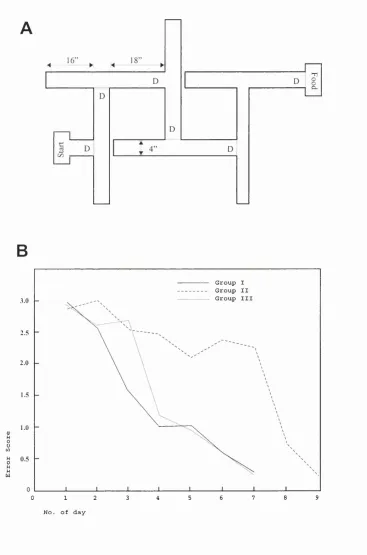
Rats were run on a six choice-point alley maze (see Figure la A), with the furthest arm-end from the start-point containing the goal box, in which food could be placed. Rats were only run for one trial a day. For the group o f rats, the controls, food was placed in a goal box. For the 2"^ and 3"^^ groups, food was only present in the goal box from day 3 to 7, and from day 7 to 9, respectively. (The experiment terminated on day 7 for the and 2"^ groups.) The control group’s errors declined linearly over days, while the errors o f the experimental groups did not greatly diminish, until after food
Blodgett’s latent learning experiment
A
T l
B
- Group I Gr oup II •• G r oup III
3.0
2.5
2.0
1.0
:
0
u
cn
0
a
9
0 1 2 3 4 5 6 7 8
No. of day
Figure la The latent learning experiment of Blodgett (1929). A) The 6 choice-point maze setup.
was introduced, at which point (day 4 for 2" group, day 8 for 3"^ group), the errors plummeted dramatically (see Figure laB). The errors for the 2"^ group on day 4 were indistinguishable from the control group on that day, and their error-curves merged from then. The 3"^^ group’s error performance on day 8, having experienced food reward only once the previous day, was similar to that o f the other groups on day 6. Similar results were seen in the times to traverse the maze. Finally, it needs to be said that on non-rewarded days, the controls were fed in the goal box and immediately again in their home cage, but the experimental animals were not fed until at least one hour later in a different environment that was not the home cage. Such a procedure minimises the role o f purely temporal associations.
The most obvious conclusion to be drawn from these data is that the rats had been learning much more about the maze environment during non-rewarded trials than they had exhibited. Since this learning did not manifest itself until after reward had been introduced, Blodgett called it latent.
Tolm an’s interpretation was that “as long as the animals were not getting any food at the end o f the maze, they continued to take their time in going through it - they continued to enter many blinds”, (it is after all not necessary that such behaviour should attract the term “errors”), but once they were motivated to do so, they avoided blinds and went to the food directly. He concluded that during the non-rewarded trials they “had been building up a ‘m ap’” . (Tolman, 1948).
Tolman and Honzik performed a very similar study to Blodgett’s, on a 14 choice- point maze, feeding the non-reward animals two hours after reaching the goal, in their
home cages. They obtained similarly striking results (Tolman and Honzik, 1930, cited in Tolman, 1932, 1948). It is perhaps worth pointing out that Tolman and Honzik added a further control group who were never rewarded, but still showed a decline, admittedly modest compared to the other groups, in errors. It could be argued that they received a reinforcement at the goal box, o f being taken away from the aversive presence o f some lab stimuli, and the experimenters, to a more familiar cage.
(Apparently Hull did in fact argue this point - O ’Keefe, personal communication.) More recently however, Kavanau (1969, cited in Gallistel, 1990) attached a 512 choice-point vertical maze to the living quarters o f mice; apparently the mice learned to traverse it without error, though no reward was present at the other end.
Such learning may perhaps more appropriately be called incidental, since it is patent to the experimenter. The term incidental learning willl generally be preferred in this thesis, except where historically necessary. The important thing to stress at this stage is the unconditional, apparently obligatory, and “self-initiated” (Tolman, 1948) character o f the learning in the experiments described above. Before leaving this section, it should quickly be emphasised that latent learning was explicitly applied by Tolman to situations in which reward was “non-differential [with respect to
alternative responses] and very mild” (Tolman, 1948), but where rats subsquently showed, when motivated, that for instance they had acquired knowledge o f the locations o f food and water.
available to the rat which might encourage different overt responses, or representations, in the two environments.
Spatial orientation experiments - the detour
The final paradigm that Tolman selected to buttress the cognitive map concept involved what he called spatial orientation experiments. It is useful to describe the original and now classic, though flawed, sunburst experiment because it illustrates a form o f latent learning, as well as suggesting directional constituents in the cognitive map.
An obvious criticism o f theories o f spatial behaviour which only allowed for S-R learning, without representational knowledge o f environmental relationships, was implied in the question o f what an animal might do if some o f the stimuli in its environment changed. It is perfectly feasible to imagine that in a natural environment, a fallen tree might block a well-reinforced route normally taken by rats to a reliable food source. Strict S-R theory would predict an expensive series o f trial and error journeys and/or frustration. Tolman, Ritchie, and Kalish (1946), in a paper called “Orientation and the short cut” asked if rats were capable o f generating efficient detour behaviour. (The phrase “short cut” is evocative, but not entirely descriptive o f their experiment.)
These authors first trained rats on an elevated maze which required the animals to walk on to a circular table, go up a straight alley, then turn through right-angled arms in a left, right, and right again sequence, to reach a goal box. Thus although the rats turned left or west out o f the straight alley to eventually reach the goal, the goal was
located to the “north-east” o f the straight alley. The intent was clearly to distinguish between a response or spatial strategy. Were the rats learning spatial information incidentally while they were learning to get to the goal box? Could they make a detour?
The test o f this was to block the straight alley, attach a series o f arms radiating from the circular table, remove the goal box, and observe which arms the rats entered. The results showed that after finding the straight alley blocked, and returning to the circular table, the rats “began exploring practically all the radiating paths. After going out a few inches only on any one path, each rat finally chose to run all the way out on one”. The path taken by the largest number o f rats (36%) was indeed the one “which ran to a point some four inches in front o f where the entrance to the food box had been” (Tolman, 1948).
(One problem with this experiment is that a light was placed above the goal arm. Arguably, the rats could have used a strategy involving, say, increasing the size o f the light stimuli in their field o f vision. As the finding has been replicated by others (eg. Harley, 1979) no further comment is made here.) Tolm an's interpretation was that rats had acquired a “map to the effect that food was located in such and such a direction in the room”, although there had been no requirement to do so for previously correct performance.
The “short cut” experiment and concept is at the heart o f map-like incidental
behaviours, they cannot deal simply with short-cut or detour findings, as is freely admitted for instance, by the authors o f the water maze learning model. Brown and Sharp, quoted earlier. H ull’s habit-family hierarchy concept, which tried to deal with such findings in an S-R way, had to posit “that the animal at the beginning o f a maze experiment is already in possession o f a vast repertoire o f equivalent but fairly distinct locomotor habits, any one o f which, in free space, would mediate a transition o f his body from the starting point to the goal.” (Hull, 1934). Like his assumption o f transient reactive inhibition just after response-performance, in order to explain the spontaneous alternation behaviour o f rats on T mazes, H ull’s thinking seems to have had a high level o f ingenuity in order to account for rats’ map-ingenuousness.
At any rate, one o f the important points for Tolman was that by acquiring knowledge o f “field relations” (Tolman, 1932) in the environment (Tolman’s understanding of which is mentioned in the next section), rats could use this information in a context different to that originally encountered. Thus, one o f the key issues in cognitive map accounts is knowledge transfer, in the case o f the “short-cut”, between similar but different configurations o f the same environment.
Tolman adduced other kinds o f experiments in favour o f the cognitive map view. We can partly illustrate his use o f M uenziger’s Vicarious Trial and Error (VTE) concept by simply referring to the hesitating behaviour in the sunburst maze quoted above, in which rats appear to be comparing the radial arms. In Tolm an’s view such behaviour illustrated that an animal’s activity was not just o f responding passively to discrete stimuli, in the way o f an S-R machine lacking decision properties, but rather actively selecting and comparing stimuli. This kind o f point was further elaborated with
respect to interesting work by Krechevsky showing so-called ‘hypothesis’ behaviour which seems to the human observer to demonstrate the successive use o f different kinds o f strategy to solve problems.
Tolman’s “cognitive man”
Our purpose to this point has simply been to indicate the type o f finding that led to Tolman’s cognitive map formulation, and to emphasize the way in which latent learning, beyond the explanatory power o f S-R models, is at the heart o f the mapping concept. No attention has been paid to the huge variety o f experimental evidence against S-R views o f learning, such as those in the 1940s and 50s purporting to demonstrate place, rather than response learning. This section proceeds at once to flesh out Tolman’s map.
To anticipate somewhat, it is fair to describe O ’Keefe and N adel’s (1978)
hippocampal cognitive map as far more restricted than Tolm an’s, which was also unspecified neurally. O ’Keefe and N adel’s cognitive map involves an absolute spatial framework, imposed on the animal by pressures o f evolutionary time, whereas
The 1948 paper gives little explicit detail o f the mapping processes and structures. Certainly, it is clear that the map indicated “routes and paths and environmental relationships”, and contained information “to the effect that” certain things were in certain places. Importantly, his language implies that rat maps are acquired in stages (“they had been building up a ‘m ap’”), and in a relatively autonomous way. It was also clear that rat maps were assumed to be more comprehensive than, for instance, maze area, and embraced “a wider arc o f the environment” including spatial
relationships inherent in the wider laboratory frame. Finally, as we have seen, he posited that the map could be used to determine spatial behaviour in a flexible way.
An important emphasis o f Tolman’s (eg. Tolman, 1932, pl76-178) was upon
expectation: The map (using his later term) confers on the rat the ability to compare a current situation with a previously stored one. Tolman describes a thought experiment illustrating that the “perceptual expectation” derived from knowledge o f “concrete spatial relations” could be the basis o f disrupted behaviour and “surprise” if say, food was located in a different place from that in which it was orginally encountered (Tolman, 1932, p i 17). Thus some specific predictions about the role o f learning and memory were predicated within the field map concept. It implied the m ap’s concrete spatial relations, which included in some way an indication o f the disposition o f objects, were subject to long-term storage, and could be retrieved as appropriate to generate efficient behaviour. Memory existed in the form o f manipulable knowledge, which could be used to compare the current state o f an environment and its features with an earlier state. This was an important and influential point o f view. (O ’Keefe and Nadel would later look for, and claim a neural basis for, such a function in the “misplace” comparator-type cells in the hippocampal C A l field. It is also interesting
that from a different neuroethological perspective Ranck (1973) quickly found cells he later termed “mismatch” cells.)
Tolman had comparatively little specifically to say about how the knowledge o f the comprehensive set o f relations in cognitive maps was organised into a dynamic
system. And with regard to space itself, it is clear that his map concept lacked any fine detail on the formal nature o f spatial representation. His sense that the field relations in the map were closely analogous to those o f Lewin’s “Topologie” suggests a rather agnostic attitude towards geometrical ideas.
But we have seen enough o f his ideas to show that they were not devoid o f formal understanding, had predictive power, and were at least sufficient to inspire a search for neural codes o f spatial relations. His theoretical emphases, with regard to spatial mapping, may now be summarised:
1) Mental maps embody spatial relations extractable from environments, such as distances, directions, sequences, and so on, within which the locations o f objects can be stored.
2) During apparently “purely random exploring” (p. 176), map knowledge is acquired unconditionally and relatively autonomously, for later use by the organism.
4) Related to 3) The long-term storage o f field relationships and objects within these confers, with retrieval, comparator properties to a cognitive mapping system, supporting expectations that guide more efficient behaviour.
These four principles show many similarities to axioms at the core o f the O ’Keefe and Nadel model o f the hippocampal cognitive map. I hope to have shown how latent learning paradigms involve the essentials o f all these four principles. Although Tolm an’s ideas were somewhat rough-and-ready, the conceptual stage was set sufficiently for future investigators.
Tolm an’s influence was probably both direct and indirect (through Hebb, for instance). The preface to O ’Keefe and Nadel (1978) relates how H ebb’s graduate seminar was particularly influential for the cognitive mapping theory. Hebb “emphasised the extent to which behaviourist notions could handle most o f the available data and pointed to those few areas which showed the limitations o f this approach: latent learning, sensory conditioning, the surprise o f Tinklepaugh’s monkeys”. We have seen how two o f these three areas, latent learning and surprise, had previously been mapped by Tolman. His sense o f the specific role o f a mapping system, and its particular contribution to behaviour was influential, particularly in the way he seized on Blodgett’s latent learning and Krechevsky’s “hypothesis”
experiments. As we shall see, however, the formal nature o f the spatial mapping system as proposed by O ’Keefe and Nadel owed little or nothing to Tolm an’s scheme.
O ’Keefe and N adel's hippocampal cognitive map
Almost immediately after O ’Keefe and Dostrovsky’s (1971) finding that certain hippocampal neurons fired in restricted portions o f environments, O ’Keefe and Nadel began elaborating the theory put forward in the 1971 paper that the hippocampus acted as a cognitive mapping system (eg. Nadel and O ’Keefe, 1974; O ’Keefe, 1976; O ’Keefe and Nadel, 1978). This section focuses on the book o f 1978.
O ’Keefe and Nadel turned to the philosophical and geographical literature, as well as psychological and neuroscientific study to tease out a highly specified model o f the hippocampal contribution to spatial cognition. They contended that the hippocampal system’s workings generated the organism’s intuitive framework o f absolute, unitary space. This framework was posited to be innate and Euclidean. The geomimetie quality (at least on a scale appropriate to a rat, for instance) o f such a spatial
representation was evolutionarily determined, and inescapably imposed on the animal. This is a remarkably Kantian position. (More recently, O ’Keefe, (1996) has suggested that our representation o f space is confined to a mere three dimensions due to the restrictions implicit in hippocampal structural anatomy.) The explicitly Euclidean framework stood in contrast to Tolman’s non-committal geometry, and the still- prevailing notions o f relativistic, behavioural space.
The most important difference from the schemes o f Tolman and almost all others (eg. Piaget) was their Kant-like insistence on the logically primary status o f places.
interpreting sense data obligatorily spatially, or is built-up from object-based, relativistic constructs, remains highly controversial today.
It seems that it was both the combination o f the discovery o f “place” cells, and philosophical considerations about space, that prompted O ’Keefe and Nadel to stress the a priori nature o f space. O ’Keefe and Nadel explicitly adopted a Kantian position, positing the a priori nature o f abstact places, represented by place cells:
“The constituents o f space are places, and thus an alternative definition o f a map is the representation o f a set o f connected places which are systematically related to each other by a group o f spatial transformation rules. ... The
absolute space defined by Kant exists in the absence o f objects.” (O ’Keefe and Nadel, 1978, p.78).
Specifically, they proposed the hippocampal pyramidal neurons represented the places, that an as-yet-unidentified source o f directional information existed in the hippocampus, and they speculated how speed and/or distance information could be generated for the workings o f the mapping system. While compass-like direction cells have subsequently been found in the nearby presubiculum (Ranck, 1984: Taube et al,
1990), it remains unclear how distance might be coded in the system (see chapters 3, 4, and 5). There are very preliminary indications o f speed cell signals in the
hippocampus (O ’Keefe et al, 1998) and the presubiculum (Sharp, 1997; Cacucci, Lever, and O ’Keefe, unpublished), and there are stronger indications that place cell firing is modulated by speed (eg. Czurko et al, 1999, discsussed in Chapter 4). At any rate, they presumed that the information was available to the mapping system to
systematically relate the places to each other by transformation rules embodied in the hippocampal neuronal network, and to provide the basis o f an allocentric spatical system for navigation, environmental discrimination and so on.
Such assumptions were the basis o f a theory which reinterpreted the existing hippocampal-lesion literature, and many made specific predictions for future study. This chapter ends by listing some o f those predictions related to the present study. They are treated in more detail in the Discussion (Chapter 10), and are only briefly outlined here.
1) The hippocampus learns in a one-trial manner, and its maps are not incrementally altered by repeated exposures to the same environment.
2) The hippocampus both constructs and stores maps. Thus at least place information is stored in the long-term by the hippocampus.
3) The hippocampus is at least in part an incidental learning system. This is one o f its differences from other learning systems in the brain. (These authors o f course wished to make the point that the learning is not incidental in an ordinary sense, but reflect obligatory functioning o f hippocampus in map-making.)
4) The hippocampus can retrieve information learned, in other contexts not identical to those in which the information was learned. This is the point about knowledge- transfer.
CHAPTER 2
ANATOMY OF THE HIPPOCAMPAL FORMATION
1) The hippocampal formation: Gross morphology, spéciation, and
intrahippocampal circuitry
The hippocampus proper is generally considered to consist o f the dentate gyrus and Cornu Ammonis fields (CA3, CA2 and C A l) fields, while terms like “the
hippocampal formation” also include one or more o f the subiculum, entorhinal cortex, parasubiculum, and presubiculum. Some authors include the subiculum in
“hippocampus”, since the subiculum is allocortical (having only three layers like dentate gyrus and CA fields).
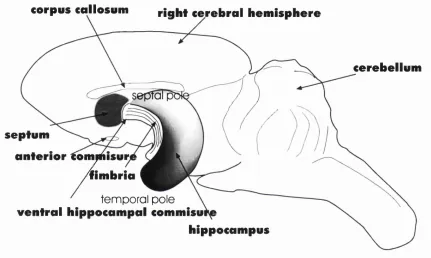
corpus callosum
Hgh* cerebral hem isphere
cerebellum
septum
anterior ^ m ^ is u r
4imbria
tem poral pole
ventral hippocampal commisui
hippocampus
Entorhinal C
/
interlocking U sheets, one made by the dentate gyrus, the other by the CA3 and CA l fields.
With possible differences along the septal-ventral axis in rodents in mind, it is
important to state that the evolution o f the brain in primates including man has meant that in primates the hippocampus is found only more ventrally, a deep structure within the medial temporal lobe. The equivalent o f the dorsal hippocampus in rats is the posterior hippocampus in primates. There is an emerging suggestion that the dorsal
hippocampus in birds and rodents, and the posterior hippocampus in primates may preferentially be involved in tasks relating to spatial navigation (Colombo et al, 1998; Hock and Bunsey, 1998; Maguire et al, 2000; Moser et al, 1993; 1995), though suggestions o f discrete functions in the two areas have not been convincing.
The increase in size o f the hippocampus over evolution in primates to man has only been modest. Stephan and collaborators, in various studies cited in Eccles (1989), compared species and used an encephalization index taking account o f size, using Tenrencinae, the most primitive living mammals, as a baseline (1.0 all areas). This results in an index o f only 4.9 for the human hippocampus, which may be compared to thalamus (14.8), cerebellum (21.8), striatum (22.0), and o f course the spectacular neocortex (196.4). The figure 4.9 does disguise some variety. The indices for dentate (2.8), subiculum (3.3), and CA3 (1.7) are all smaller than this average, while the CA l index is 6.6. (Virtually all the cells in the present study were recorded from C A l).
Intrahippocampal circuitrv
An overview o f intrahippocampal circuitry is given here. Hippocampal connectivity differs from that o f neocortex by lacking much o f the strong, reciprocal innervation seen for instance in visual cortex. Hippocampal connectivity is much simpler, and more serial. Figure 2b sketches the principle synaptic connections involving the hippocampus proper, from:
1) Entorhinal cortex (layers II and III) to Dentate gyrus, CA3, and C A l (via the “perforant path”)
2) Dentate gyrus to CA3 (mossy fibres) 3) CA3 to C A l (Schaffer collaterals)
If we add that CA l projects to the subiculum and entorhinal cortex (deep layers), and that CA3 has quite dense associational inputs to itself, this picture gives us the basic elements in the circuit involving the hippocampus proper.
Some nomenclature and further details o f connectivity may be mentioned by looking further at Figure 2b.
It may be seen that C A l is divided into: a) stratum oriens towards the alveus,
b) stratum pyramidale, the layer o f the principal pyramidal cells,
c) stratum radiatum beneath the pyramidal layer (ie. towards the hippocampal fissure), and
CA3 is similar, but is considered to have an additional narrow layer, the stratum lucidum, above the stratum radiatum. The stratum lucidum o f CA3 is occupied by the mossy fiber axons originating from the dentate gyrus.
The stratum radiatum o f the CA region can be defined as the region in which the CA3-CA3 associational and CA3-CA1 Schaffer collateral connections are located (Amaral and Witter, 1995). The dense perforant pathway fibers from neurons o f the superficial layers o f the entorhinal cortex course through the stratum lacunosum- moleculare, and terminate here, as do afferents from other regions, including the nucleus reuniens input from the thalamus.
The dentate gyrus consists o f three layers. The stratum granulosum is the principle cell layer o f the granule cells. The stratum moleculare is the layer closest to the hippocampal fissure, where the granule cell dendrites are located. Granule cells are unipolar - there are no granule cell dendrites on the other side o f the granule layer. The dense projection to the dentate gyrus from entorhinal cortex targets the granule cell dendrites in the molecular layer. The third layer is the hilus, often called the polymorph layer o f the dentate gyrus (Amaral and Witter, 1995).
2) Afferents to the hippocampal formation
Perhaps the major source o f input to the hippocampus comes from the superficial layers (II and III) o f the entorhinal cortex. Thalamic input via the entorhinal cortex may have been underemphasised, but it seems relatively certain that entorhinal cortex is the major route for neocortical information to reach hippocampus. Much o f this entorhinal input to hippocampus comes in turn from postrhinal (rodent equivalent o f
parahippampal cortex) and perirhinal cortices, but all these rhinal cortices project directly to hippocampus.
This section considers first the cortical afferents to the rhinal cortex, then the afferents to the entorhinal cortex in general, and finally subcortical and other afferents.
Cortical afferents to rhinal cortex
Burwell and Amaral’s studies (1998a, 1998b) have shown interesting features o f cortical input to the perirhinal (areas 35 and 36), postrhinal, and entorhinal (lateral and medial) cortices. All these cortical regions (considered as 5 regions) receive most o f their inputs from unimodal association and polym odal association areas,
suggesting that the hippocampus receives abstracted, highly-processed information from neocortex, but there is also some specialization o f inputs associated with each cortical area. Not all will be described, but for instance:
1) postrhinal cortical input is 40% visual and 20% visuospatial, and less than 15% of its input comes directly from sensorimotor or primary unimodal areas. In fact, 71% o f its input is from polymodal association areas.
2) lateral entorhinal input is 34% olfactory, and less than 7% o f its input comes directly from sensorimotor or primary unimodal areas.
3) medial entorhinal input can be considered to be a kind o f mixture o f 1) and 2). Medial entorhinal input is 31% olfactory, 12% visual, 16% visuospatial (only
Para/Presubicular input to Hippocampus
mainly via Entorhinal Cortex
Medial Septum/Diagonal Band of Broca
Thalamus (Laterdorsal, Anterior, Reunions,
Intralaminar)
Basolateral Amygdala
Claustrum
Subiculum and C A 1
Parasubiculum Presubiculum
Entorhinal Cortex Layer II
Entorhinal Cortex Layer III i
All sensory modalities feed into these regions, though there is comparatively little input from gustatory areas, and auditory areas (except to area 36: 9%).
These general principles apply, mutatis mutandis (particularly with respect to olfaction), to the monkey brain. The authors give very convincing evidence that the postrhinal cortex can be considered homologous to the primate parahippocampal cortex.
We now focus on entorhinal, parasubicular, and presubicular input. The broad trends o f neocortical input to entorhinal cortex have been described, with reference to Burwell and Amaral’s studies (1998a, b). These authors ignored presubicular and parasubicular input in their studies (percentages given above did not take these areas into account). It has become increasingly obvious, however, that these areas are o f particular importance to hippocampal function, and recent studies have increasingly paid attention to connectivity o f the presubiculum and parasubiculum.
The next section describes the connectivity o f these two related regions. Figure 2c is a diagram summarising the main points o f this section.
Parasubiculum and Presubiculum: Inputs via Entorhinal cortex
1994; Kohler, 1985; Steward and Scoville, 1976; Van Green and Wyss, 1990a; Witter, 1993). Additionally, the parasubiculum has a direct and fairly substantial projection to the molecular layer o f the dentate gyrus (Kohler, 1985; W itter et al,
1988).
It can thus be seen that the parasubiculum targets the “earlier” stages o f hippocampal processing. These early stages o f hippocampal formation processing may be more strongly influenced by parasubiculum than previously thought, as suggested by a recent study estimating neuron numbers in the area: in the rat, parasubicular external lamina (layer II/III) neurons (1.5 xlO^) outnumber those in layer II o f the MEA and LEA combined (1.1 x 10^) for instance; together, the presubiculum and parasubiculum contain the same number o f neurons (7 xlO^) as the MEA and LEA combined (6.9 xlO^), parasubiculum contributing about 30% to this total (Mulders et al, 1997). (Underestimation o f the size o f the parasubiculum may partly be due to the mapping o f Swanson et al. (1978)).
The present author has found that parasubicular input (focusing on its caudal region) comes primarily from, subcortically: the medial septum/diagonal band o f Broca complex (hereafter “medial septum”), anterior, reunions, intralaminar, and laterodorsal thalamic nuclei, basolateral amygdala, and claustrum, and cortically: subiculum, entorhinal, visual and anterior and posterior cingulate cortices (Lever, Owen, Donnett, O ’Keefe, unpublished). Rostral parasubiculum appears to have a larger input from C A l and amygdala (Van Groen and Wyss, 1990a.) Input from visual and cingulate cortices was modest, and by far the greatest cortical input was