MODEL OF A BLANK FORM FOR COMPUTER
LABORATORY WORK ON RESEARCH OF THE SPEED
SELECTOR
NURILA SAIDULLAYEVA1, ROZA SPABEKOVA2, GAUKHAR OMASHOVA3, KENZHAN KABYLBEKOV4, NURLIBEK TAGAYEV5, ALIYA BITEMIROVA6, MERUYERT
AIMAMBETOVNA BERDIYEVA7
1Assossiate Professor, M.O. Auezov South Kazakhstan State University
2Candidate of Chemical Sciences, M.O. Auezov South Kazakhstan State University
3 Assossiate Professor, M.O. Auezov South Kazakhstan State University
4 Assossiate Professor, M.O. Auezov South Kazakhstan State University
5 Assossiate Professor, M.O. Auezov South Kazakhstan State University
6 Candidate of Chemical Sciences, South Kazakhstan State Pedagogical Institute
7PhD, Senior Lecturer, M.O. Auezov South Kazakhstan State University
E-mail: [email protected], 2 [email protected], 3 [email protected], 4 [email protected], 5
[email protected], 6 [email protected], 7 [email protected]
ABSTRACT
This paper presents the model of a black form for the organization of computer laboratory work on studying the speed selector that provides short theoretical data, tasks with the subsequent computer check, ambiguous tasks, research and creative assignments. Students may not complete them all, and the teacher may combine them or offer other similar tasks taking into account the ability of each student. This model was tested by pupils of Shymkent schools: Nazarbayev Intellectual School of Physics and Mathematics, the regional school "Daryn" for gifted children, M. Auezov Gymnasium-School in Arys and by first-year students enrolled in the specialty "Physics" during laboratory classes. According to the questionnaires of students, teachers and parents, almost all the respondents noted the effectiveness of teaching: such lessons are held with great interest of students and increased motivation for learning. This model helps to realize an individual approach to each student as well as promotes the development of experimental skills, research and creative abilities, critical thinking skills and adaptive competence, deep mastering of the topic, the effective use of information and computer technology. At the same time, such assignments as solving ambiguous tasks and tasks with missing data contribute to the development of an informal approach to the problem of theoretical competence.
Keywords:Blank Form Model, Computer Laboratory Work, Mass Spectrometer, Speed Selector, Research And Creative Tasks, Electric Field Intensity, Magnetic Field Induction, Electron, Proton, Helium And Uranium Kernels.
1. INTRODUCTION
Since 2013, at the Department of Physics and Theory and Methods of Physics Teaching at M. Auezov South-Kazakhstan State University, the following disciplines have been introduced:
"Information Technology in Education",
"Information Technology in Physics Teaching", "Methods of Using Electronic Textbooks", which
include the development and use of modern information technology in physics teaching. There have been created new computer models, training programs, databases and methods for their use in physics teaching in schools, colleges, lyceums and universities.
using modern teaching information technology; to develop cognitive universal abilities (skills of theoretical thinking, research and creative search), that has never been researched before. The relevance of this work is the modern view on our society as a learner implies that the education system should be focused (more so than before) on the development and education of students’ adaptive competence, i.e. the ability to consciously and flexibly apply the acquired knowledge and skills in different contexts.
The research includes explanation of methods that were used, the information about speed selector and how it is used by students. It also contains control questions for checking readiness for work and the results of the research.
Erik de Corte (2014) [1] discusses what exactly should be studied in order to acquire adaptive competence in any field. He believes that a complex of cognitive, emotional and motivational components is necessary for the development of adaptive competence, namely: the subject base in the form of structured knowledge in a certain field, the skills of using heuristic methods of thinking, meta-knowledge - ideas about one's own cognitive activity, motivation and emotions, self-regulation skills for managing one’s own cognitive, motivational and emotional processes, as well as positive beliefs in relation to oneself as a learner and to the process of study in various fields. Teaching, the purpose of which is the formation of adaptive competence, should be a constructive, self-regulating, specific and joint process of building knowledge and skills [1]. The article gives an example of creating an effective learning
environment focused on improving the
effectiveness of teaching.
L.G. Bushuyev (2011) [2] presents the criteria of information competence, expressed through the qualities of the "information" personality on the basis of a complex of knowledge and skills in the field of information technology. Among them special attention is paid to the ability to interpret the results obtained; to make decisions on the use of a particular software; to foresee the consequences of decisions and to draw appropriate conclusions. He gives a number of practical examples of the formation of information competence at various stages of the lesson - research, for example, on the topic "Aeronautics".
O.V. Sviridenko (2011), L.A. Kormiltseva (2011), S.N. Blokhina (2011) and L.L. Petryakovs (2011) [3-6] present the developments of lessons on the topics "Fundamentals of thermodynamics", "Atomic physics", "Refraction of light",
"Coefficient of efficiency" with the use of electronic teaching aids.
A powerful means of physics teaching, according to many domestic and foreign experts, is the products of the "Physicon" company [7]. Their disks "Open Physics 25" contain methodical recommendations on the composition of tasks and their implementation in virtually all sections of the school curriculum. Along with other researchers [8-13], we believe that each physics teacher, if desired, can independently design a computer laboratory work using interactive models from the multimedia course "Open Physics" of the "Physicon" company. For this, it is recommended to use the same algorithm for creating laboratory works, which is applied in this multimedia course. First, it is recommended to introduce the theory of the question, then answer control questions and perform tasks, the solution of which requires conducting a computer experiment and checking the result obtained.
2. MATERIALS AND METHODS
One of the difficult problems of introducing these results in educational institutions is the insufficient practical ability of teachers to use computer models of physical phenomena to organize laboratory work. Computer laboratory works are carried out to consolidate the topic covered, and activization, motivation and, ultimately, the effectiveness of training largely depends on the organization of computer laboratory work. Using the products of the “Physicon” company [7], we developed some models of blank forms for the organization of computer laboratory work on studying various physical phenomena [14-33], which are successfully used by teachers of educational organizations in our region. For example, Kabelbekov and Bayzhanova with the article “The use of multimedia capabilities of computer systems to expand the demonstration resources of some physical phenomena” [14]. They include brief information from the theory of the phenomenon, introductory tasks with the model, computer experimental tasks with the subsequent verification of answers, tasks with missing data and ambiguous tasks, research, searching, creative and problem tasks for students.
It is necessary to modernize teaching methods and actively develop the education system, creating regional school centers. We should intensively introduce innovative methods, solutions and tools into the domestic education system, including distance learning and on-line training, accessible to all comers [1].
3. RESULTS
A blank form includes the following materials:
•Topic: Research of work of the speed
selector.
•Objective: To investigate the motion of an
electron, a proton, and to find conditions for ensuring the rectilinear uniform motion of the nuclei of helium, uranium-235 and uranium-238 isotopes.
3.1. Brief Theoretical Information. The Speed Selector
In a variety of devices, for example, in mass spectrometers, it is necessary to perform a preliminary selection of charged particles in terms of velocities, that is, among charged particles having different specific charges, it is necessary to isolate those that have the same velocities and to ensure the uniform rectilinear motion. This purpose is performed by so-called speed selectors.
In the simplest speed selector, charged particles move in crossed homogeneous electric and magnetic fields. An electric field is created between the plates of a flat capacitor; a magnetic field is created in the gap between the poles of an electromagnet.
The electric force
F
e=
qE
r
r
and the
Lorentz force
F
=
q B
ϑ
sin
α
, where α is theangle between the velocity vectors and the magnetic field induction, affect the particle moving in the crossed electric and magnetic fields. In both fields, these forces deflect the charged particle from the original direction.
Under certain conditions, these forces can accurately balance each other. In this case, the charged particle will move inside the condenser evenly and rectilinearly. Such a particle, flying through the capacitor, will pass through a small aperture of the diaphragm and get perpendicularly to the equal magnetic field. Once in the magnetic field such a particle is twisted. Under the Lorentz force, the particle moves along a circle whose radius of curvature depends on the specific charge.
The condition of the rectilinear particle
trajectory is
qE
=
q B
ϑ
(when these forcescompensate each other). This condition depends not on the charge and mass of the particle, but on the magnitude of its initial velocity. Under given crossed electric and magnetic fields, the selector will separate the particles moving uniformly
rectilinearly with the velocity of
ϑ
=
E B
/
. Onlythose particles that have passed through the speed selector and have fallen into the uniform magnetic field of the device can be divided by the mass spectrometer by their radius of curvature.
[image:3.612.314.503.292.436.2]The mutual arrangement of the vectors , and for a positively charged particle is shown in Figure 1.
Figure 1. The Mutual Arrangement Of The Vectors , And For A Positively Charged Particle
The magnitude of the Lorentz force is
numerically equal to the area of the parallelogram constructed on the vectors , multiplied by the charge value q and directed perpendicularly to the vectors and . When the charged particle moves in the magnetic field, the Lorentz force does no work. Therefore, the magnitude of the velocity vector does not change when the particle moves.
If the charged particle moves in the homogeneous magnetic field under the Lorentz
force, and its velocity lies in a plane
perpendicular to the vector , then the particle will move along the circumference of the radius:
Figure 2. Circular Motion Of A Charged Particle In The Homogeneous Magnetic Field
The period of circulation of the particle in the homogeneous magnetic field is
This expression shows that for charged
particles of a given mass m, the period of
circulation does not depend on the velocity υ and
the radius of the trajectory R. The angular velocity
of motion of the charged particle along a circular
trajectory is called the cyclotron frequency:
The cyclotron frequency does not depend on the velocity (and hence on the kinetic energy) of the particle. This circumstance is used in cyclotrons-accelerators of heavy particles (protons, ions).
Homogeneous magnetic fields are used in a
variety of devices and, in particular, in mass
spectrometers – devices which make is possible to
measure the masses of charged particles – ions or nuclei of different atoms. Mass spectrometers are used to separate isotopes, i.e. the nuclei of atoms with the same charge, but different masses (for
example, 20Ne and 22Ne). The simplest mass
spectrometer is shown in Figure 4. Ions emitted
from source S pass through several small holes
forming a narrow beam. Then they fall into the
velocity selector, in which the particles move in
crossed homogeneous electric and magnetic fields. An electric field is created between the plates of a flat capacitor, a magnetic field – in the gap between the poles of an electromagnet. The initial velocity of charged particles is directed perpendicularly to the vectors Е and .
The particle moving in crossed electric and magnetic fields is affected by the electric force and the magnetic Lorentz force. Under the
condition of E = υB, these forces exactly
counterbalance each other. If this condition is met, the particle will move uniformly and rectilinearly and, flying through the capacitor, it will pass through the hole in the screen. Given the values of electric and magnetic fields, the selector will separate those particles that move with the velocity of υ = E / B.
Then the particles with the same velocity value enter the chamber of the mass spectrometer,
in which a homogeneous magnetic field / is
created. The particles move in the chamber in a plane perpendicular to the magnetic field under the Lorentz force. The particle trajectories are the
circumferences of the radii R = mυ / qB'. Measuring
the radii of the trajectories at known values of υ and
B', one can determine the ratio q/m. In the case of
isotopes (q1 = q2), the mass spectrometer makes it
possible to separate particles with different masses. Modern mass spectrometers make it possible to measure the masses of charged particles with an
accuracy greater than 10–4.
[image:4.612.91.297.69.224.2]Figure 3 shows how the speed selector is installed in front of the chamber of the mass spectrometer.
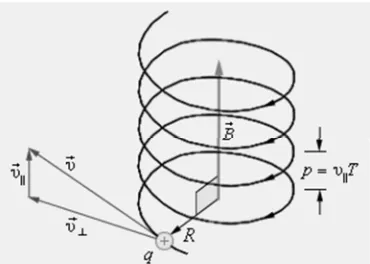
[image:4.612.314.507.378.687.2]If the particle velocity has a component along the direction of the magnetic field, then such a particle will move in the homogeneous magnetic field along the helix. In this case, the radius of the
helix R depends on the magnitude of the component
υ┴ of the vector , perpendicular to the magnetic
field, and the pitch of the helix p – on the
magnitude of the longitudinal component υ|| (Figure
[image:5.612.91.276.208.340.2]5).
Figure 4. Motion Of A Charged Particle Along The Helix In A Homogeneous Magnetic Field
Thus, the trajectory of the charged particle kind of wounds on the line of magnetic induction. This phenomenon is used in engineering for the magnetic thermal insulation of high-temperature plasma, i.e. completely ionized gas at a temperature
of about 106 K. The substance in this state is
obtained in installations of the “Tokamak” type when studying controlled thermonuclear reactions. Plasma should not touch the walls of the chamber. Thermal insulation is achieved by creating a magnetic field of special configuration.
Figure 5. Model Of The Speed Selector Of Charged Particles
3.2. Performance of Computer Laboratory Work by Students
In the computer model "The speed selector" (Figure 5), the directions of electric and magnetic fields are mutually perpendicular. The charged particle with the initial velocity falls parallel to the plates of the charged capacitor and perpendicular to the magnetic field.
The computer experiment considers the motion of an electron, a proton, the nuclei of
helium, uranium-235 and uranium-238 isotopes. The velocities of charged particles can be set in the
range of 1,0*104-5,0*107 m/s, depending on the
nature of the particle, the electric field intensity – in the range from 0.2 to 5.0 kV/m, the magnetic field induction – from 0.2 to 10.0 mT.
Students perform work in accordance with the tasks proposed in the blank form, fill them in and give or send them by e-mail to the teacher.
3.2.1. Control questions for checking readiness for work:
[image:5.612.91.292.513.636.2]• What forces act on a charged particle having the initial velocity in the electric field? Answer:...
...
• Write down the expression for the force acting on a charged particle having a mass m and a charge q in the electric field with a voltage E .. Answer: ...
• What forces act on a charged particle having the initial velocity in the magnetic field? Answers:
... • Write down the expression for the force acting on a charged particle having a mass m and a charge q in the magnetic field with an induction B. Answer: ... ...
• Write down the expression for the radius of a circle that is circumscribed by a charged particle with a mass m and a charge q that is perpendicular to the direction of the magnetic field with an induction B at a speed of V. Answer: ... ... ...
• Write down the expression for the period of rotation around a circle that is circumscribed by a charged particle with a mass m and a charge q perpendicular to the direction of the magnetic field with an induction B at a speed of V. Answer: ... ...
• Which is the trajectory of a charged particle having a mass m and a charge q that falls at an angle α (0≤α≤π/2) to the direction of the magnetic field with an induction B at a speed of V. Answer: ...
• Write down the step expression for the screw line of a charged particle having a mass m and a charge q that has fallen at an angle α (0≤α≤π/2) to the direction of the magnetic field with an induction B at a speed of V. Answer: ... ...
fields? Answers: ... ...
• What is the trajectory of a charged particle in the magnetic field with a velocity V parallel to it? Answers: ... ...
• It is known that a charged particle that has traveled along the direction of the electric field moves rectilinearly in an accelerated manner. Why is this method unsuitable as the speed selector?
Answers: ...
...
• It is known that a charged particle that has traveled along the direction of the magnetic field does not experience the Lorentz magnetic force and moves rectilinearly. Why is this method unsuitable
as the speed selector? Answers:
... ...
1. Introductory tasks with the computer model "The speed selector".
1.1. To what extent can the intensity of the electric field be varied during the investigation of
the motion of an electron? Answers:
... ... 1.2. To what extent can the induction of the magnetic field be varied during the investigation of
the motion of an electron? Answers:
... ...? 1.3. For which particles is the computer model of the speed selector intended? Answers:…..
1.4. To what extent can the initial velocity of an electron be varied during the investigation of its motion? Answers: ... ...
1.5. To what extent can the initial velocity of a proton be varied during the investigation of its motion? Answers: ... ...
1.6. To what extent can the intensity of the electric field be varied during the investigation of
the motion of a proton? Answers:
... ... 1.7. To what extent can the induction of the magnetic field be varied during the investigation of
the motion of a proton? Answers:
... ... 1.8. To what extent can the initial velocity of an α-particle (helium nucleus) be varied during the
investigation of its motion? Answers:
... ... 1.9. To what extent can the electric field strength be varied during the investigation of the motion of an α particle (helium nucleus)? Answers: ...
1.10. To what extent can the induction of the magnetic field be varied during the investigation of the motion of an α particle (helium nucleus)? Answers: ...
1.11. To what extent can the initial velocity of an α-particle (helium nucleus) be varied during the investigation of its motion? Answers: ... ...
1.12. To what extent can the electric field strength be varied during the investigation of the motion of an α particle (helium nucleus)? Answers: ...
1.13. To what extent can the induction of the magnetic field be varied during the investigation of the motion of an α particle (helium nucleus)? Answers: ...
1.14. To what extent can the initial velocity of the uranium-235 nucleus be varied during the
investigation of its motion? Answers:
... ... 1.15. To what extent can the intensity of the electric field be varied during the investigation of the motion of the uranium-235 nucleus? Answers: ...
1.16. To what extent can the induction of the magnetic field be varied during the investigation of the motion of the uranium-235 nucleus? Answers: ...
1.17. To what extent can the initial velocity of the uranium-238 nucleus be varied during the
investigation of its motion? Answers:
... ... 1.18. To what extent can the intensity of the electric field be varied during the investigation of the motion of the uranium-238 nucleus? Answers: ...
1.19. To what extent can the induction of the magnetic field be varied during the investigation of the motion of the uranium-235 nucleus? Answers: ...
2. Tasks with the subsequent computer verification of the answers:
These tasks should first be solved on paper and checked in the course of the computer experiment. Preliminary solution must be taken along with the form.
2.1. What is the value of the magnetic field induction at an electric field strength of E = 1.0 kV / m for ensuring a rectilinear uniform motion of an electron with a velocity of
ϑ
= 2.0 ∙ 107 m / s?Answers: ...
...
induction at an electric field strength of E = 1.5 kV / m for ensuring a rectilinear uniform motion of an electron with a velocity of
ϑ
= 1.5 ∙ 107 m / s?Answers: ...
...
2.3. What is the value of the magnetic field induction at an electric field strength of E = 2.0 kV / m for ensuring a rectilinear uniform motion of an electron with a velocity of
ϑ
= 2.0 ∙ 107 m / s?Answers: ...
...
2.4. What is the value of the magnetic field induction at an electric field strength of E = 2.5 kV / m for ensuring a rectilinear uniform motion of an electron with a velocity of
ϑ
= 2.5 ∙ 107 m / s?Answers: ...
...
2.5. What is the value of the magnetic field induction at an electric field strength of E = 3.0 kV / m for ensuring a rectilinear uniform motion of an electron with a velocity of
ϑ
= 3.0 ∙ 107 m / s?Answers: ...
...
2.6. What is the value of the magnetic field induction at an electric field strength of E = 4.0 kV / m for ensuring a rectilinear uniform motion of an electron with a velocity of
ϑ
= 4.0 ∙ 107 m / s?Answers: ...
...
2.7. What is the value of the magnetic field induction at an electric field strength of E = 5.0 kV / m for ensuring a rectilinear uniform motion of an electron with a velocity of
ϑ
= 5.0 ∙ 107 m / s?Answers: ...
...
2.8. What is the value of the electric field strength at a magnetic field induction of B = 0.1 mT for ensuring a rectilinear uniform motion of a
proton with a velocity of
ϑ
= 4.0 ∙ 107 m / s?Answers: ...
...
2.9. What is the value of the electric field strength at a magnetic field induction of B = 0.1 mT for ensuring a rectilinear uniform motion of a
proton with a velocity of
ϑ
= 4.5 ∙ 107 m / s?Answers: ...
...
2.10. What is the value of the electric field strength at a magnetic field induction of B = 0.1 mT for ensuring a rectilinear uniform motion of a
proton with a velocity of
ϑ
= 3.5 ∙ 107 m / s?Answers: ...
...
3. Ambiguous tasks and tasks with missing data
3.1. At what values of the electric field strength and magnetic field induction is it possible to achieve the rectilinear uniform motion of an
electron having an initial velocity of
ϑ
=2.0 ∙ 107 m/ s and can this experiment be realized on the model, taking into account its capability? Realize it, if possible. Answers: ...
3.2. At what values of the electric field strength and magnetic field induction is it possible to achieve the rectilinear uniform motion of an
electron having an initial velocity of
ϑ
=2.5 × 10⁷m / s and can this experiment be realized on the model, taking into account its capability? Realize it, if possible. Answers: ...
3.3. At what values of the electric field strength and magnetic field induction is it possible to achieve the rectilinear uniform motion of an
electron having an initial velocity of
ϑ
=3.0 ∙ 107 m/ s and can this experiment be realized on the model, taking into account its capability? Realize it, if possible. Answers: ...
3.4. At what values of the electric field strength and magnetic field induction is it possible to achieve the rectilinear uniform motion of a
proton having an initial velocity of
ϑ
=1.0 ∙ 105 m /s and can this experiment be realized on the model, taking into account its capability? Realize it, if possible. Answers: ...
3.5. At what values of the electric field strength and magnetic field induction is it possible to achieve the rectilinear uniform motion of a
proton having an initial velocity of
ϑ
=2.5 ∙ 105 m /s and can this experiment be realized on the model, taking into account its capability? Realize it, if possible. Answers: ...
3.6. At what values of the electric field strength and magnetic field induction is it possible to achieve the rectilinear uniform motion of a
proton having an initial velocity of
ϑ
=3.0 × 10⁵ m/ s and can this experiment be realized on the model, taking into account its capability? Realize it, if possible. Answers: ...
3.7. At what values of the electric field strength and magnetic field induction is it possible to achieve the rectilinear uniform motion of α
particle having an initial velocity of
ϑ
=1.0 ∙ 105 m3.8. At what values of the electric field strength and magnetic field induction is it possible to achieve the rectilinear uniform motion of α
particle having an initial velocity of
ϑ
=2.5 ∙ 105 m/ s and can this experiment be realized on the model, taking into account its capability? Realize it, if possible. Answers: ...
3.9. At what values of the electric field strength and magnetic field induction is it possible to achieve the rectilinear uniform motion of α
particle having an initial velocity of
ϑ
=3.0 ∙ 105 m/ s and can this experiment be realized on the model, taking into account its capability? Realize it, if possible. Answers: ...
3.10. At what values of the electric field strength and magnetic field induction is it possible to achieve the rectilinear uniform motion of the uranium-235 and uranium-238 nuclei having an
initial velocity of
ϑ
=1.0-105 m / s and can thisexperiment be realized on the model, taking into account its capability? Realize it, if possible. Answers: ...
3.11. At what values of the electric field strength and magnetic field induction is it possible to achieve the rectilinear uniform motion of the uranium-235 and uranium-238 nuclei having an initial velocity of
ϑ
=2.5 ∙ 105 m / s and can thisexperiment be realized on the model, taking into account its capability? Realize it, if possible. Answers: ...
3.12. At what values of the electric field strength and magnetic field induction is it possible to achieve the rectilinear uniform motion of the uranium-235 and uranium-238 nuclei having an
initial velocity of
ϑ
=3.0-105 m / s and can thisexperiment be realized on the model, taking into account its capability? Realize it, if possible. Answers: ...
4. Research assignments.
4.1. Determine the conditions for the rectilinear and uniform motion of an electron that has fallen perpendicular to the speed selector. Implement these conditions in a computer experiment. Analyze the results 3.1-3.7 and draw conclusions. Answers: ...
4.2. Determine the conditions for the rectilinear and uniform motion of a proton that has fallen perpendicular to the speed selector. Implement these conditions in a computer experiment. Analyze the results of 3.8-3.14 and draw conclusions. Answers: ...
4.3. Determine the conditions for the
rectilinear and uniform motion of an α-particle that has fallen perpendicular to the speed selector. Implement these conditions in a computer experiment. Analyze the results of 3.15-3.21 and draw conclusions. Answers: ...
4.4. Determine the conditions for the rectilinear and uniform motion of the uranium-235 nucleus that has fallen perpendicular to the speed selector. Implement these conditions in a computer experiment. Analyze the results of 3.22-3.28 and draw conclusions. Answers: ...
4.5. Determine the conditions for the rectilinear and uniform motion of the uranium-238 nucleus that has fallen perpendicular to the speed selector. Answers: ...
4.6. In the "mass spectrometer" model, the built-in selector operates in the mode whose parameters can be changed: the initial velocities of the nuclei of С12 and С14, Ne20 and N22, U235 and
U238 isotopes in the interval from 1,000 to 10,000
m/s. These particles fall into the homogeneous magnetic field of the analyzer (separating them along the radius of curvature). What should the crossed electric and magnetic fields be, so that the given particles fall into the analyzer with the uniform rectilinear velocity, allowing their composition to be analyzed? Answers should be given separately for С12 and С14, Ne20 and N22, U235
and U238. Answers: ...
5. Creative tasks.
5.1. Suggest several tasks similar to those in paragraphs 2-2.10. Answers: ...
5.2. Suggest several tasks similar to those in paragraphs 3-3.28. Answers: ...
5.3. Suggest several tasks similar to those in paragraphs 4-4.5. Answers: ...
Number of completed
tasks
Number of mistakes
Evaluation of work
3. DISCUSSION
The model of the blank form for the organization of computer laboratory work is preliminarily distributed to all students in printed form. Each student fulfills his or her own variant, which is determined by the teacher, except for control questions.
assignments for solving ambiguous tasks, some students could not choose interdependent parameters. The teacher suggests the algorithm for solving such tasks, then with the active participation of students the solutions are brought to the logical end. In assessing the work, special attention was paid to the fulfillment of research and creative tasks and the completeness of answers.
The comparison of the results showed that 90% of students of Nazarbayev Intellectual School of Physics and Mathematics, 80% of the regional school "Daryn" for gifted children and 70% of M.Auezov School-Gymnasium in Arys successfully coped with the tasks. Such indicators, in our opinion, relate to the level of computerization of schools and, of course, primarily to the level of physics teaching, and the difficulties of students in solving ambiguous tasks and tasks with missing data are due to the fact that in the practice of all schools such tasks were not offered to students before at all. When analyzing the content of textbooks, we found out that such tasks are practically absent in the books recommended for schools.
4. CONCLUSIONS
The proposed model of the blank form for the organization of computer laboratory work on studying the work of the speed selector includes brief theoretical information, introductory tasks with the computer model, tasks with the subsequent verification of answers, tasks with missing data and ambiguous tasks, research and creative tasks.
Brief theoretical information gives the definition of the speed selector of charged particles (electron, proton, α-particle and nuclei of 235, U-238 isotopes) and the principle of its operation. Introductory tasks with the computer model include a number of questions related to the ability to change parameters (initial particle velocity, electric field strength, magnetic field induction), taking into account the possibility of the model. The fulfillment of tasks with the subsequent computer verification of answers provides for their preliminary solution on paper, the implementation of task conditions in the computer experiment, the verification of coincidence of the answers and the presentation of the results of solving tasks on paper along with the blank.
Tasks with missing data and ambiguous tasks provide for the implementation of an independent choice of one of two interrelated parameters on the computer model, their implementation on the computer model to separate
the particles moving with the uniform rectilinear velocity at the output of the speed selector. Research tasks include assignments for establishing the conditions for the rectilinear uniform motion of particles. Tasks with the subsequent computer verification of answers must first be solved on paper and then checked in the computer experiment. A preliminary solution of the task must be submitted along with the blank form.
This model was tested by pupils at schools of Shymkent: Nazarbayev Intellectual School of Physics and Mathematics, the regional school
"Daryn" for gifted children, M.Auezov
Gymnasium-School in Arys and by first-year students enrolled in the specialty "Physics" during laboratory classes.
REFERENCES:
[1] De Corte, E. “Innovative perspectives of
studying and teaching in the field of higher education in the 21st century. (Translated from
English by E. Shadrina)”. Issues of Education,
No. 3, 2014, pp. 8-29.
[2] Bushuyev, L.G. “Formation of information
competence in physics lessons”. Issues of
Education, No. 88, 2000, pp. 11-22.
[3] Sviridenko, O.V. "Fundamentals of
thermodynamics". Developing a physics lesson (10th grade) using electronic learning resource.
Issues of Education, No. 88, 2011, pp. 11-22.
[4] Kormiltseva, L.A. “Lesson-project "Atomic
physics". Issues of Education, No. 97, 2011,
pp. 23-34.
[5] Blokhina, S.N. “Development of a physics
lesson in 8th grade "Refraction of light". Issues
of Education, No. 98, 2011, pp. 41-59.
[6] Petryakova, L.L. “Efficiency coefficient”.
Summary of the physics lesson, 7th grade. Issues of Education, No. 114, 2013, pp. 31-45.
[7] CD of the “Physicon” company. "Open Physics
1.1". 2001.
[8] Hertel, G., Senichenkov, Yu.B, Novik, L.V.
"Sir Newton, what do you think about computer training?" - Journal "Computer Tools in Education", St. Petersburg, Informatization of Education, No. 1, 2003, p. 60-66.
[9] Kavtrev, A.F. "Laboratory work for the
computer course "Open Physics". Uniform motion. Simulation of inelastic collisions”.
Newspaper "Physics", No. 20, 2001, pp. 5-8.
[10]Fradkin, V.E. "Teachers’ mastering the ways of
implementing the educational potential of new information technologies in the process of
Doctoral Dissertation. St. Petersburg,. 2002,
25 p.
[11]Kavtrev, A.F. “The experience of using
computer models in physics lessons”. Issues of
Internet Education, No. 3, 2002.
[12]Gomulina, N.N. “Technique of carrying out
computer laboratory work using the
multimedia course "Open Physics 2.5".
Interaction of parallel currents, 2003.
http://www.college.ru/physics/op25part2/plann ing/teach/lessons.html
[13]Leonov, N.F. “The use of computers for
teaching physics”. Issues of Internet Education,
No. 2, 2001.
http://archive.1september.ru/fiz/2001/20/no20_ 02.html
[14]Kabelbekov, K.A., Bayzhanova, A. “The use of
multimedia capabilities of computer systems to expand the demonstration resources of some
physical phenomena”. Proceedings of the
All-Russian Scientific and Practical Conference.
Conference with international participation.
Tomsk, 2011, pp. 210-215.
[15]Kabelbekov, K.A., Saydakhmetov, P.A.,
Arysbayeva, A.S. “The model of the blank for the organization of students’ independent performance of computer laboratory works”.
Proceedings of the National Academy of Sciences of the Republic of Kazakhstan, Series
of Physics and Mathematics, Almaty, 2013,
No. 6, pp. 82-89.
[16]Kabelbekov, K.A., Saydakhmetov, P.A.,
Baydullayeva, L.E., Abduraymov, R.
“Methods of application of the regularities of photo and Compton effects, models of blank forms for the organization of computer
laboratory work”. Proceedings of the National
Academy of Sciences of the Republic of
Kazakhstan, Series of Physics and
Mathematics, Almaty, 2013. No. 6, pp.
114-121.
[17]Kabelbekov, K.A., Saydakhmetov, P.A.,
Turganova, T.K., Nurullayev, M.A.,
Baydullayeva, L.E. “The lesson model on the
collecting and scattering lens”. Proceedings of
the National Academy of Sciences of the Republic of Kazakhstan, Series of Physics and
Mathematics, No. 2, Almaty, 2014, pp.
286-294.
[18]Kabelbekov, K.A., Ashirbayev, Kh.A.,
Saydakhmetov, P.A, Rustemova, K.Zh., Baydullayeva, L.Ye. “The blank model for the organization of the performance of computer laboratory work on the investigation of light
diffraction”. Proceedings of the National
Academy of Sciences of the Republic of
Kazakhstan, Series of Physics and
Mathematics, No. 1 (299), Almaty, 2015, pp.
71-77.
[19]Kabelbekov, K.A., Ashirbayev, Kh.A.,
Takibayeva, G.A., Saparbayeva, E.M.,
Baydullayeva, L.E., Adineyeva, Sh.I. “The blank model for the organization of computer laboratory work on the motion of charged particles in the magnetic field and the operation
of a mass spectrometer”. Proceedings of the
National Academy of Sciences of the Republic of Kazakhstan, Series of Physics and
Mathematics, No. 1 (299), Almaty, 2015, pp.
80-87.
[20]Kabelbekov, K.A., Ashirbayev, Kh.A.,
Saydakhmetov, P.A., Baygulova, Z.A.,
Baydullayeva, L.E. “The blank model for the organization of computer laboratory work on
the study of Newton's rings”. Proceedings of
the National Academy of Sciences of the Republic of Kazakhstan, Series of Physics and
Mathematics, No. 1 (299), Almaty, 2015, pp.
14-20.
[21]Kabelbekov, K.A., Ashirbayev, Kh.A.,
Sabalakhova, A.P., Dzhumagaliyeva, A.I. “The blank model for the organization of the performance of computer laboratory work on
the study of light interference”. Proceedings of
the National Academy of Sciences of the Republic of Kazakhstan, Series of Physics and
Mathematics, No. 3 (301), Almaty, 2015, pp.
131-136.
[22]Kabelbekov, K.A., Ashirbayev, Kh.A.,
Sabalakhova, A.P., Dzhumagaliyeva, A.I. “The blank model for the organization of study on the effects of the Doppler computer model”.
Proceedings of the National Academy of Sciences of the Republic of Kazakhstan, Series
of Physics and Mathematics, No. 3 (301),
Almaty, 2015, pp. 155-160.
[23]Kabelbekov, K.A. “Organization of computer
laboratory work”. Textbook (Shymkent), 2015, 77 p.
[24]Kabelbekov, K.A., Ashirbayev, Kh.A.,
Arysbayeva, A.S., Dzhumagaliyeva, A.M. “The blank model for the organization of computer laboratory work on the study of
physical phenomena”. Modern High
Technologies, No. 4, Moscow, 2015, pp. 40-43.
[25]Kabylbekov, K.A., Saydakhmetov, P.A.,
Ashirbayev, Kh.A., Omashova, G.Sh.,
Proceedings of the National Academy of Sciences of the Republic of Kazakhstan, Series
of Physics and Mathematics, No. 1 (305),
2016, pp. 111-116.
[26]Kabelbekov KA, Saidakhmetov PA, Omashova
G.Sh., Berdalieva Zh., Dzhumagalieva A.I. “The blank model for the organization of computer laboratory work on the study of the interaction of two infinitely long parallel
conductors with currents”. Proceedings of the
National Academy of Sciences of the Republic of Kazakhstan, Series of Physics and
Mathematics, No. 1 (305), 2016, pp. 135-140.
[27]Kabelbekov, K.A., Saydakhmetov, A.A.,
Omashova, G.Sh., Suttibayeva, D.I.,
Kozybakova, G.N. “The blank model for the organization of computer laboratory work on
the study of the isobar process”. Proceedings
of the National Academy of Sciences of the Republic of Kazakhstan, Series of Physics and
Mathematics, No. 2 2016, pp. 92-97.
[28]Kabelbekov, K.A., Saydakhmetov, P.A.,
Omashova, G.Sh., Abekova, Zh.A.,
Nurullayev, M.A. “The blank model for the organization of the performance of research
assignments in physics”. Proceedings of the
National Academy of Sciences of the Republic
of Kazakhstan, No. 3, 2016, pp. 67-73.
[29]Kabelbekov, K.A., Saydakhmetov, P.A.,
Ashirbayev, Kh.A., Abdubayeva, F.I.,
Doskanova, A.E. “The study of the work of gas
on the computer model”. Proceedings of the
National Academy of Sciences of the Republic
of Kazakhstan. No. 2 2016, pp. 83-88.
[30]Kabelbekov, K.A., Saydakhmetov, P.A.,
Omashova, G.Sh., Serikbayeva, G.S.,
Suyerkulova, Zh.N. “The blank model for the organization of computer laboratory work on the study of free mechanical vibrations”.
Proceedings of the National Academy of Sciences of the Republic of Kazakhstan, Series
of Physics and Mathematics, No. 2, 2016,
pp.84-91.
[31]Kabelbekov, K.A., Madiyarov, N.K.,
Saydakhmetov, P.A. “The independent
construction of research tasks for computer
laboratory work on thermodynamics”.
Proceedings of the IX International Scientific and Methodic Conference. Teaching of natural
sciences (biology, physics, chemistry),
mathematics and computer science, Tomsk,
2016, pp. 93-99.
[32]Kabelbekov, K.A., Saydakhmetov, P.A.,
Omashova, G.Sh. “Aynymaly current
tizbegindegi inductive coil reaktivi
kedergіsіnің current zhilіgіne tәuеldіgіn zertteuge arnalғan computer izerthanalyұ
zhmyysty ұyymdastyru”. Proceedings of the
National Academy of Sciences of the Republic
of Kazakhstan, 2017, No. 1, pp. 77-82.
[33]Kabelbekov, K.A., Saydakhmetov, P.A.,
Omashova, G.Sh., Ashirbayev, Kh.A.,
Abekova, Zh.A. “Organization of computer laboratory work on the study of real-gas
isotherms”. Proceedings of the National
Academy of Sciences of the Republic of