International Journal of Emerging Technology and Advanced Engineering
Website: www.ijetae.com (ISSN 2250-2459,ISO 9001:2008 Certified Journal, Volume 4, Issue 1, January 2014)
78
Performance Study of Adhoc on-Demand Link Quality Aware
Route Search Protocol (AO-LQARSP)
M. Subramanya Bhat
1, N. M. Mohan Kumar
2, V. Jyothi
3and J. T. Devaraju
4 1,3Dept. of Electronics, Vijaya College, R.V. Road, Bangalore-560004
2,4Dept of Electronic Science, Bangalore University, Bangalore-560056
Abstract—A Wireless Sensor Network (WSN) is a network
with few tens to thousands of small devices called sensor nodes which are connected wirelessly and involve in communicating the data. WSNs have generated tremendous interest among researchers in recent years because of its potential usage in wide variety of applications. The sensor nodes in WSNs have scarce power; they work in harsh and unattended environments which initiates the need for a better and more reliable routing path to send data. In this paper a routing protocol is proposed to select the route based on better signal strength conditions using Link Quality Indicator of the received signal for IEEE 802.15.4 standard. The performance of the proposed routing protocol is compared with standard reactive routing protocol Adhoc On-demand Distance Vector (AODV) with metrics like total packets received, throughput, total bytes received, average end-to-end delay and average jitter and total energy consumed for various node density scenarios.
Keywords—WSN, LQI, AODV, RREQ, RREP.
I. INTRODUCTION
Wireless Sensor and Actuator Networks (WSANs) constitute an important and exciting new technology with great potential for improving many current applications as well as creating new revolutionary systems in areas such as Wireless sensor networks (WSNs). WSNs will potentially affect all aspects of our lives, bringing substantial improvements in a broad spectrum of modern technologies ranging from battlefield surveillance, environmental monitoring, biological detection, smart spaces, disaster search and rescue, industrial diagnostics, sensing a building integrity or structural vibrations during an earthquake, the stress of an airplane’s wings, are some of the applications where WSN promise to change how researchers gather data [1].
Today, many sensors exist around the world collecting environmental data. In most cases, the WSN systems measure a limited number of parameters at a large granularity. WSNs have the potential of dense and flexible coverage and most importantly enabling correlation across many WSNs.
Dense coverage might include sensors placed within centimeters to meters distance between each of them, enabling a precise understanding of certain phenomena. A single sensor node may only be equipped with limited computation and communication capabilities. However, nodes in a WSN, when properly programmed and networked, can collaboratively perform signal processing tasks to obtain information of a remote and probably dangerous area in an untended and robust way [1,2].
In WSNs, since messages travel multiple hops it is important to have a high reliability on each link, otherwise the probability of a message transiting the entire network would be unacceptably low. Significant work is being done to identify reliable links using metrics such as received signal strength indicator (RSSI), link quality indicator (LQI) and packet delivery ratio. Routing is complicated if either the message source or destination or both are moving. Many protocols have been developed that rely on metrics to represent the reliability and integrity of the links [3-5]. The Packet Reception Rate (PRR) and Packet Loss Rate (PLR) are the most common of such indicators. Both PRR and PLR are based on a given number of packet transmissions. One of the most desirable features for LQI is its ability to use the minimum possible resources (time and energy) to assess the channel by high degree reliability. Evaluating the quality of a link in the shortest possible time allows algorithms to adapt rapidly to fast changes in the overall link quality configuration of a network. Link quality assessments made by spending the minimum possible energy are always desirable, especially working with energy-constrained sensor nodes. Examples of such indicators include the classical RSSI and the CC2420-specific LQI [6].
International Journal of Emerging Technology and Advanced Engineering
Website: www.ijetae.com (ISSN 2250-2459,ISO 9001:2008 Certified Journal, Volume 4, Issue 1, January 2014)
79 II. RELATED WORK
Most of the works that have been carried out are based on AODV (Adhoc On-demand Distance Vector) protocol [7], which was originally proposed in RFC 3965. LABILE (Link Quality-Based Lexical Routing) [8] proposes a routing algorithm based on lexical structures and link quality evaluation. Through the use of LQI, i.e., a metric provided by the physical layer of IEEE 802.15.4 standard [9], LABILE is able to evaluate the link quality. The LABILE proposal evaluates end-to-end link quality, by classifying the possible values of LQI into good or bad.
The EEURP (Energy Efficient Unicast Routing Protocol) [10] proposes a cost function to select routes based on hop count, the average energy consumption in the end-to-end path and the minimum energy level. A routing protocol based on three possible routing techniques is presented in [11]. The routing schemes are the following: simple routing, Round-Robin and weighted-Round Robin.
A number of wireless routing protocols are proposed to provide communication in wireless environment using open source simulators. Some among them are PAODV, AODV, CBRP, DSR and DSDV [12], performance of DSDV, DSR, AODV and TORA [13], performance of SPF, EXBF, DSDV, TORA, DSR and AODV [14], comparison of DSR and AODV [15], performance of STAR, AODV and DSR [16], comparison of AMRoute, ODMRP, AMRIS and CAMP [17], performance of DSR, CBT and AODV [18], comparison of DSDV, OLSR and AODV [19] and many more. These performance comparisons are carried out for ad-hoc networks.
There are several other efforts related to the work under study. In the work of Perkins et.al [20], evaluation of DSR and AODV was studied using nS-2 network simulator. Another relative work has been presented by Broch et.al [21]. In the work [22], four ad-hoc routing protocols are evaluated using nS-2 for 50-node network models. Besides comparison of adhoc networks several other papers have dealt with ZRP and worked on the perfect zone radius value. Hass and Pearlman have done extensive research in ZRP [23]. In [24] DSR and AODV is evaluated using NS-2 network simulator. Various routing protocols are been analysed in [25] including AODV and DSR.
III. OVERVIEW OF ROUTING PROTOCOLS
A WSN is a network consisting of numerous sensor
nodes with sensing, wireless communication and
computing capabilities.
These sensor nodes are scattered in an unattended environment (i.e. sensing field) to sense the physical world. The sensor nodes either form a flat network topology where sensor nodes also act as routers and transfer data to a sink through multi-hop routing, or a hierarchical network topology where more powerful fixed or mobile relays are used to collect and route the sensor data to a sink.
A routing protocol will be considered adaptive if it can adapt to the current network conditions and available energy levels. In addition, these protocols can be based on multi-path routing, query, negotiation, or quality of service, among others depending on the protocol functioning. In the networks employing flat routing protocols, every node usually plays the same role of sensing the event. Due to the large number of nodes, assigning a global identifier to each node is not feasible. Adhoc On-demand Distance Vector routing (AODV) is an example of reactive flat routing protocol.
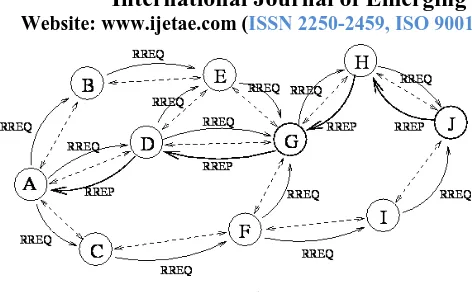
Adhoc On-demand Distance Vector (AODV): AODV is a reactive routing or on-demand routing protocol, since it does not maintain route information nodes if there is no communication. If a node wants to send a packet to another node then it searches for the route in an on-demand manner and establishes the connection in order to transmit and receive the packet. This protocol performs route discovery process whenever a node wishes to send packets to destination by using control messages route request (RREQ) and route reply (RREP). Neighbourhood information is obtained from broadcasted hello packets. It is a flat routing protocol which does not need any central administrative system to handle the routing process. The AODV protocol is a loop free and uses sequence numbers to avoid the infinity counting problem which is typical to the classical distance vector routing protocols [26].
International Journal of Emerging Technology and Advanced Engineering
Website: www.ijetae.com (ISSN 2250-2459,ISO 9001:2008 Certified Journal, Volume 4, Issue 1, January 2014)
[image:3.612.59.295.113.259.2]80
Fig 1. Route Discovery in AODV protocol
A route is established if the RREQ message reaches either the destination itself, or an intermediate node with a valid route entry for the destination. As long as a route is established between source and destination node, AODV remains passive. When the route becomes invalid or lost, AODV will again issue a new request.
AODV uses three types of control messages for its route maintenance:
RREQ - A route request message is transmitted by a source node to find path towards a destination node. As an optimization AODV uses an expanding ring technique when flooding these messages. Every RREQ carries a time to live (TTL) value that states for how many hops this message should be forwarded. This value is set to a predefined value at
the first transmission and increased at
retransmissions. Retransmissions occur if no replies are received. Data packets waiting to be transmitted (i.e. the packets that initiated the RREQ) should be buffered locally and transmitted by a FIFO principle when a route is set.
RREP - A route reply message is unicasted back to the originator of a RREQ if the receiver is either the node using the requested address, or it has a valid route to the requested address. The reason one can unicast the message back, is that every route forwarding a RREQ caches a route back to the originator.
RERR - Nodes monitor the link status of next hops in active routes. When a link breakage is detected in an active route, a route error (RERR) message is used to notify other nodes about the loss of the link. In order to enable this reporting mechanism, each node keeps a precursor list, containing the IP address for each of its neighbours that are likely to use it as a next hop towards each destination.
When the RREQ is received by a node that is either the destination node or an intermediate node with a fresh enough route to the destination, it replies by unicasting the route reply (RREP) towards the source node. As the RREP is routed back along the reverse path, intermediate nodes along this path set up forward path entries to the destination in its route table and when the RREP reaches the source node, a route from source to the destination established.
Route Maintenance in AODV: A route established between source and destination pair is maintained as long as needed by the source. When a link breaks in an active routing path, the broken link is invalid and a RERR message is sent to other nodes. These nodes in turn propagate the RERR to their precursor nodes and so on until the source node is reached. The affected source node may then choose to either stop sending data or reinitiate route discovery for that destination by sending a new RREQ message.
IV. PROPOSED PROTOCOL
In this paper, an optimised route search protocol Adhoc On-demand Link Quality Aware Route Search Protocol (AO-LQARSP) is proposed for IEEE 802.15.4 standard to address the need of a stable route to improve the throughput in a power scarce WSNs.
Consider a scenario of WSN (figure 2), in which sensor nodes are placed randomly. In order to transfer data packets from source node 1) to the destination node (node-17) and if, the source node (node-1) does not have any valid route to the destination in its routing table, then it need to establish a route to the destination node (node-17). In the process of route discovery, source node (node-1) floods the Route Request (RREQ) message along with LQI=0 and hop count=0. The nodes which are in the radio range of source node (nodes 2, 3, 4, 5 and 6) receive the RREQ message with initial LQI=0 and hop count=0 and at
each node LQIij value is calculated using the equation 1
[26,27].
) 1 ( )] mW ( Power Noise + ) mW ( Power ce Intreferen [
) mW ( Power Message ceived
Re =
ij
LQI
Where, i is the node ID which floods the RREQ massage
and j is the node ID which receives the RREQ message. In
International Journal of Emerging Technology and Advanced Engineering
Website: www.ijetae.com (ISSN 2250-2459,ISO 9001:2008 Certified Journal, Volume 4, Issue 1, January 2014)
81
Hop=3 LQI1,4
LQI1,2
LQI1,3
LQI1,5
LQI1,6
LQI2,7
LQI7,8
LQI5,9
LQI4,10
LQI9,13
LQI8,12
LQI13,17
LQI15,17
LQI14,17
LQI10,14
LQI9,12
LQI6,11
LQI11,16
LQI11,15
Hop=1 Hop=0
Hop=1
Hop=1 Hop=1
Hop=1 Hop=2 Hop=2
Hop=2 Hop=2
Hop=3 Hop=3
Hop=3
Hop=4
Source
Destination
7
10
11 5
6 3 2
9 8
16 15 14 13 12
4
1 17
Shortest path Possible Route
[image:4.612.55.292.143.329.2]Delayed LQI
Fig 2. Scenario of route discovery in proposed protocol
Also, aggregate value of LQI (LQIagg) is calculated at
these nodes (2, 3, 4, 5 and 6) by adding received LQI value
from the previous node (LQIRx) and LQI value calculated
at the current node (LQIij) (equation 2) i.e.,
) 2 (
j i
LQI + Rx LQI = agg LQI
These nodes (2, 3, 4, 5 and 6) broadcast RREQ message
with corresponding LQIagg and incremented hop count to
their neighbouring nodes. Further, nodes (7, 9, 10 and 11) receive the RREQ message from the respective predecessor
nodes, calculate the LQIij value for the first RREQ message
received and subsequent RREQ messages are ignored. The
LQIaggvalue is calculated at each node for the first RREQ
message using equation 2 and then broadcast the RREQ
message with updated LQIagg and incremented hop count to
their neighbours. Similar process of flooding RREQ messages has been carried out by all other subsequent receiving nodes till these messages reach the destination node.
At the destination node, when it receives first RREQ message it initiates the timer with delay period of 500ms and waits to receive RREQ messages from other possible routes. Meanwhile, destination node calculates average
LQI (LQIav) for each received RREQ message
corresponding to possible route within delay period (500ms) using the equation 3.
(3)
Count Hop
agg LQI =
av LQI
The destination node then opts for the path with larger
LQIav value among all possible paths. Further, destination
node establishes a route by sending route reply (RREP) message to the source node through all the active nodes
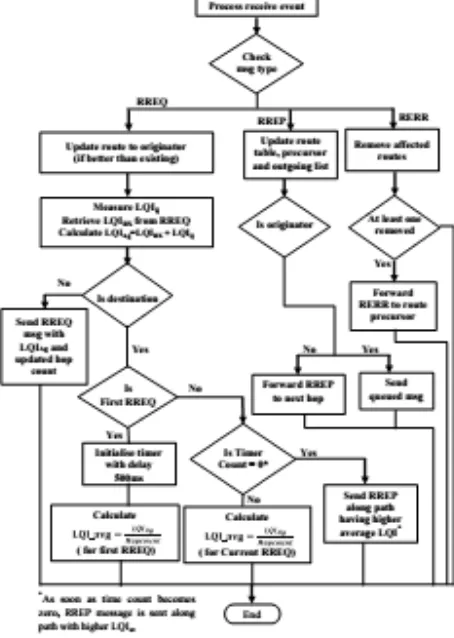
involved in the route with higher LQIav. Figure 3 shows
[image:4.612.334.561.218.537.2]the flowchart of the proposed protocol.
Fig 3. Flowchart for the proposed AO-LQARSP algorithm
V. SIMULATION RESULTS AND DISCUSSIONS
International Journal of Emerging Technology and Advanced Engineering
Website: www.ijetae.com (ISSN 2250-2459,ISO 9001:2008 Certified Journal, Volume 4, Issue 1, January 2014)
[image:5.612.331.551.133.308.2]82
Table 1. Simulation Parameters
Area 1000m x 1000m
Simulation Time 500 second
Number of nodes 50, 75, 100,150, 200 and 250
Nodes Placement Random
Traffic type CBR
Energy model Mica Motes
Battery model Linear
Radio type IEEE 802.15.4
No. of Channels One
Channel frequency 2.4 GHz
Path loss model Two Ray
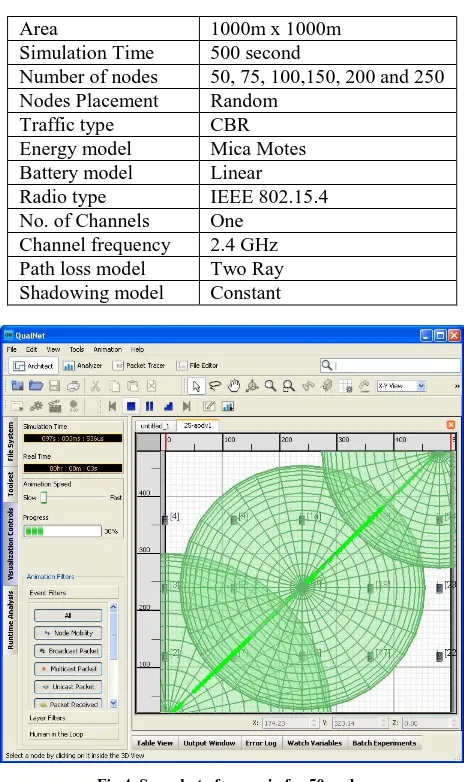
[image:5.612.52.284.157.548.2]Shadowing model Constant
Fig 4. Snapshot of scenario for 50 nodes
Total Packets Received: The variation of total packets received as a function of different node density for the proposed protocol and AODV protocol is shown in figure 5. From figure 5 it is evident that, proposed protocol shows improvement in the packets received as compared with standard AODV. This is because, in the proposed protocol stable route is opted based on larger average LQI value
which minimises the packet loss.
50 75 100 125 150 175 200 225 250
470 475 480 485 490 495 500 505 510
Total Pac
k
et
s Re
ce
ive
d
Nodes
[image:5.612.335.552.330.503.2]AODV AO_LQARSP
Fig 5. Variation of Total Packets received with varying node density
50 75 100 125 150 175 200 225 250
490 495 500 505 510 515
T
hrough
pu
t (
bp
s)
Nodes AODV
AO_LQARSP
Fig 6. Variation of Throughput with varying node density
Throughput: Figure 6 shows the variation of throughput as a function of node density for AO-LQARSP and AODV protocols. From the figure 6, it is clear that, in proposed protocol the throughput is enhanced as compared to AODV protocol and it is also evident that throughput is stabilised with increase in node density for proposed protocol.
International Journal of Emerging Technology and Advanced Engineering
Website: www.ijetae.com (ISSN 2250-2459,ISO 9001:2008 Certified Journal, Volume 4, Issue 1, January 2014)
83
50 75 100 125 150 175 200 225 250
30000 30500 31000 31500 32000 32500
T
ot
al
B
yt
es
R
ece
ived
Nodes AODV AO_LQARSP
[image:6.612.58.279.121.305.2]
Fig 7. Variation of Total bytes received with varying node density
25 50 75 100 125 150
0.007 0.008 0.009 0.010 0.011 0.012 0.013 0.014
T
ot
al
ener
gy consum
ed (
m
J)
Nodes
AODV AO_LQARSP
Fig 8. Total energy consumed by nodes with varying node density
Total energy consumed: Figure 8 shows the variation of total energy consumed by all the active nodes along the path of data transmission with node density for implemented protocol and AODV. From the figure 8 it is evident that, total energy consumed in the proposed protocol is marginally less compared to AODV and decreases with increase in node density for both the protocols.
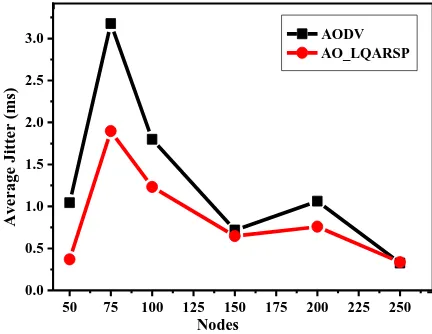
Average end-to-end delay and jitter: Figures 9 and 10 shows the variation of end-to-end delay and jitter with different node densities for implemented AO-LQARSP and standard AODV protocol respectively. It is evident from the figure 9 that, end-to-end delay is almost same for both AO-LQARSP and AODV protocols. The average jitter performance of AO-LQARSP protocol is less compared to AODV protocol (figure 10), this indicates that better and stable route is established in the proposed routing protocol.
50 60 70 80 90 100 110 120 130 140 150 160 0.075
0.080 0.085 0.090 0.095 0.100 0.105 0.85 0.90 0.95 1.00
E
nd
t
o E
nd
D
el
ay (
m
s)
Nodes AODV
[image:6.612.335.545.136.319.2]AO_LQARSP
Fig 9. Variation of End-to-End delay with varying node density
50 75 100 125 150 175 200 225 250
0.0 0.5 1.0 1.5 2.0 2.5 3.0
Ave
r
age
Jitt
e
r
(
m
s)
Nodes
AODV
AO_LQARSP
Fig 10. Variation of Average jitter with varying node density
VI. CONCLUSION
In this paper, a routing protocol is proposed to select the best possible stable route based on link quality indicator. The simulation study of the proposed protocol is carriedout for different node densities. The metrics like throughput, bytes received, end to end delay, average jitter and energy consumed are used to compare proposed AO-LQARSP with standard AODV protocol. From the metrics it is evident that the proposed protocol performs better as compared to AODV.
Acknowledgements
[image:6.612.63.273.324.498.2] [image:6.612.334.550.337.504.2]International Journal of Emerging Technology and Advanced Engineering
Website: www.ijetae.com (ISSN 2250-2459,ISO 9001:2008 Certified Journal, Volume 4, Issue 1, January 2014)
84 One of the authors thank the management of BHS higher Education Society, Bangalore and UGC for the author to avail FIP.
Authors would also thank Nihon communication, Bangalore for their support.
REFERENCES
[1] Perkins C., ―Ad-Hoc Networking‖, Addison Wesley, 2001. [2] M.Subramanyabhat, D.Swetha and J.T. Devaraju, ―A Performance
Study of Proactive, Reactive and Hybrid Routing Protocols using Qualnet Simulator‖, IJCA (0975 - 8887). Vol-28(5), August 2011. [3] Abdelali EL BOUCHTI Said EL KAFHALI and Abdelkrim
HAQIQ, ―Performance Modelling and Analysis of Connection Admission Control in OFDMA based WiMAX System with MMPP Queuing‖, World of Computer Science and Information Technology Journal (WCSIT) Vol-1, (4), 148, 2011
[4] Ben-Jye Chang, Yan-Ling Chen and Chien-Ming Chou, ―Adaptive Hierarchical Polling and Cost-based Call Admission Control in IEEE 802.16 WiMAX Networks‖, In proceedings of IEEE WCNC, 2757, 2007.
[5] Ben-Jye Chang and Yan-Ling Chen, ―Adaptive hierarchical polling and Markov decision process based CAC for increasing network reward and reducing average delay in IEEE 802.16 WiMAX networks‖, Computer Communications 31, 2280, 2008.
[6] Abdelali EL BOUCHTI Said EL KAFHALI and Abdelkrim HAQIQ, ―Performance Modelling and Analysis of Connection Admission Control in OFDMA based WiMAX System with MMPP Queuing‖, World of Computer Science and Information Technology Journal (WCSIT) Vol-1(4), 148, 2011
[7] David A. Levine, Ian F. Akyildiz and Mahmoud Naghshineh, ―A Resource Estimation and Call Admission Algorithm for Wireless Multimedia Networks Using the Shadow Cluster Concept‖, IEEE/ACM Transactions on Networking, Vol-5(1), 1-12, Feb 1997 [8] Jinglun Shi, Zhilong Shan and Xuxun Liu, ―A Two-Level Routing
Scheme forWireless Sensor Network‖, International Journal of Distributed Sensor Networks, 6, May 2012.
[9] W.R.Heinzelman, A.Chandrakasan and H. Balakrishnan, ―Energy-efficient communication protocol for wireless microsensor networks‖, in Proceedings of the The 33rd Annual Hawaii International Conference on System Siences (HICSS-33’00), 223, January 2000.
[10] Dinesh Singh, Ashish K. Maurya and Anil K. Sarje, ―Comparative Performance Analysis of LANMAR,LAR1, DYMO and ZRP Routing Protocols in MANET using Random Waypoint Mobility Model‖, 62, IEEE 2011.
[11] Sree Ranga Raju and Dr. Jitendranath Mungara, ―ZRP versus AODV and DSR: A Comprehensive Study on ZRP Performance‖ International Journal of Computer Applications (0975 – 8887) Vol-1(12), 35, 2010.
[12] Parma N and Dr. S. C. Sharma, ―Routing Load Analysis of Broadcast based Reactive Routing Protocols AODV, DSR and DYMO for MANET‖, International journal of grid and distributed computing Vol-4(1), 81, March 2011.
[13] Shaily Mittal and Prabhjot Kaur, ―Performance Comparison of AODV, DSR and ZRP Routing Protocols in MANETs‖, International conference on Advances in Computing, Control and Telecommunication Technologies, IEEE computer society, 165, 2009.
[14] Alexander Klein, ―Performance Comparison and Evaluation of AODV, OLSR and SBR in Mobile Ad-Hoc Networks‖ 571, IEEE 2008.
[15] Anjali Goyal, Sandip Vijay and Dharmendra Kumar, ―Simulation and Performance Analysis of Routing Protocols in Wireless Sensor Network using QualNet‖, International Journal of Computer Applications (0975 – 8887), Vol-52(2), 47, August 2012.
[16] N. Ramanathan, K. Chang, R, Kapur, L. Girod, E. Kohler and D. Estrin, ―Sympathy for the Sensor Network Debugger‖, ACM SenSys, November 2005.
[17] R. Stoleru, T. He and J. Stankovic, ―Spotlight: A High Accuracy, Low-Cost Localization System for Wireless Sensor Networks‖, ACM Sensys, November 2005.
[18] R. Stoleru, T. He and J. Stankovic, ―Walking GPS: A Practical Localization System for Manually Deployed Wireless Sensor Networks‖, IEEE EmNets, 2004.
[19] G. Virone, A. Wood, L. Selavo, Q. Cao, L. Fang, T. Doan, Z. He, R. Stoleru, S. Lin and J. Stankovic, ―An Assisted Living Oriented Information System Based on a Residential Wireless Sensor Network‖, Proceedings D2H2, May 2006.
[20] M. Welsh and G. Mainland, ―Programming Sensor Networks with Abstract Regions‖, USENIX/ACM NSDI, 2004.
[21] K. Whitehouse, C. Karlof, A. Woo, F. Jiang and D. Culler, ―The Effects of Ranging Noise on Multihop Localization‖: An Empirical Study, IPSN, April 2005.
[22] A. Wood and J. Stankovic, ―Denial of Service in Sensor Net works‖, IEEE Computer, Vol-35(10), 54, October 2002.
[23] A. Wood, G. Virone, T. Doan, Q. Cao, L. Selavo, Y. Wu, L. Fang, Z. He, S. Lin and J. Stankovic, ―AlarmNet‖, ACM SenSys, April 2005.
[24] T. Yan, T. He and J. Stankovic, ―Differentiated Surveillance for Sensor Networks‖, ACM Sensys, November 2003.
[25] G. Zhou, T. He, J. Stankovic and T. Abdelzaher, ―RID: Radio Interference Detection in Wireless Sensor Networks‖, Infocom, 2005.