Cooper, Richard P. (2007) Tool use and related errors in ideational apraxia:
The quantitative simulation of patient error profiles. Cortex 43 (3), pp.
319-337. ISSN 0010-9452.
Downloaded from:
Usage Guidelines:
Please refer to usage guidelines at or alternatively
Birkbeck ePrints: an open access repository of the
research output of Birkbeck College
http://eprints.bbk.ac.uk
Cooper, Richard P. (2007). Tool use and
related errors in ideational apraxia: The
quantitative simulation of patient error profiles.
Cortex
43
(3) 319-337.
This is an author-produced version of a paper published in
Cortex
(ISSN 0010-9452). This version has been peer-reviewed but does not include
the final publisher proof corrections, published layout or pagination.
All articles available through Birkbeck ePrints are protected by intellectual
property law, including copyright law. Any use made of the contents should
comply with the relevant law. Copyright © 2007 Masson - An Elsevier
Company. All rights reserved.
Citation for this version:
Cooper, Richard P. (2007). Tool use and related errors in ideational apraxia:
The quantitative simulation of patient error profiles.
London: Birkbeck ePrints.
Available at:
http://eprints.bbk.ac.uk/archive/00000565
Citation for the publisher’s version:
Cooper, Richard P. (2007). Tool use and related errors in ideational apraxia:
The quantitative simulation of patient error profiles.
Cortex
43 (3) 319-337.
http://eprints.bbk.ac.uk
Introduction
Failures in the performance of simple tasks involving multiple objects, such as lighting a candle or juicing an orange, have frequently been reported following neural injury. These failures often involve the repetition or omission of key steps in the tasks, together with misuse of and/or failure to use necessary or appropriate tools. Thus, when lighting a candle a patient who is prone to such errors might fail to strike the match before bringing it towards the wick of the candle, or even attempt to strike the match against the candle instead of against the side of the matchbox. Such errors have been attributed to a variety of causes, both at the anatomical level and the cognitive level. Thus, Luria (1966), who observed action errors in patients with bilateral frontal lesions, suggested that the errors arose from “the gross disintegration of the ‘preliminary synthesis’ of intended actions and […] disturbances of the process of comparison of intention and effect” (Luria, 1966, p. 238). He referred to the deficit as frontal apraxia. De Renzi & Lucchelli (1988), on the other hand, observed similar errors in patients with predominately left temporoparietal lesions, and suggested that they arose from a deficit in the retrieval of object-related knowledge, and in particular from “a lack of access to a specific aspect of the semantic store” (De Renzi & Lucchelli, 1988, p. 1183). De Renzi & Lucchelli’s
I am grateful to Raffaella Rumiati, Tim Shallice, Georg Goldenberg, attendees of the symposium on Apraxia of Tool Use held at the 1st Congress of the European
Neuropsychological Societies, and two anonymous reviewers for thoughtful comments that have helped to shape this paper.
work was framed within the context of ideational apraxia originating with Pick (1905) and Liepmann (1920). More recently, Schwartz and colleagues (Schwartz et al., 1991; Schwartz et al., 1995; Schwartz
et al., 1998) and Humphreys & Forde (1998) have
performed detailed studies of errors in the semi-naturalistic action of frontal patients, while Rumiati et al. (2001) have documented action errors in two patients with left hemisphere damage (one with a cortical-subcortical lesion affecting the superior parietal lobule and the other with a large fronto-temporo-parietal ischemic lesion).
Schwartz and colleagues have also performed detailed analyses of the types of action errors produced by patients, and have demonstrated similar proportions of each type of error in different patient groups (closed head injury patients: Schwartz et al., 1998; left stroke patients: Buxbaum et al., 1998; right stroke patients: Schwartz et al., 1999; and dementia patients: Giovannetti et al., 2002). On the basis of this, Schwartz
et al. (1998) argued that action disorganisation
following neural injury arises from a general inability to sustain the cognitive resources necessary for the performance of naturalistic activities. An alternative account, however, for the similarities in error profiles may be developed by assuming that behaviour is the product of multiple interacting systems, where the interactions are such that damage to different systems may, at least on the kinds of naturalistic tasks explored by Schwartz and colleagues, result in similar behavioural disorders. Hartmann et al. (2005) have provided evidence for such an account by demonstrating that while two groups of patients with left and right brain damage did not differ on the performance of two naturalistic tasks (preparing filter
The Quantitative Simulation of Patient Error Profiles
Richard P. Cooper
School of Psychology,
Birkbeck, University of London
coffee and assembling a tape recorder), they did differ on a number of other measures (e.g., keeping track of multi-step actions and retrieval of functional knowledge) which, Hartmann et al. argue, support those tasks.1
Cooper et al. (2005) have developed an account of this alternative type based on the Norman & Shallice (1980, 1986) dual-systems theory of the control of routine and willed behaviour. According to this theory, one system – contention scheduling – is responsible for the control of routine action, while another – supervisory attention – is able to bias this system when willed control over behaviour is required. Contention scheduling is itself a complex process, requiring the integration of hierarchically structured task knowledge (action schemas relating to, for example, the sequence of actions involved in preparing a cup of tea) and situation-specific factors (such as whether sugar is available in cube form or in granulated form). In addition, even simple tasks require the maintenance and monitoring of goals (such as whether sugar has been added when preparing tea) – concepts that belong more to the realm of supervisory attention than contention scheduling. Working with a computational elaboration of the contention scheduling theory, Cooper & Shallice (2000) have demonstrated how a system of this form can yield the kinds of action errors seen in patients. More recently Cooper et al. (2005) have augmented the system with supervisory functions relating to monitoring. By applying the resultant system to the semi-complex task of preparing and packing a child’s lunchbox, Cooper et al. (2005) demonstrated that damage to different aspects of the system (i.e., to either the processes involved in schema activation or the processes involved in the activation of object representations) can lead to similar error patterns, as seen in the different patient groups studied by Schwartz and colleagues (i.e., Schwartz et al., 1998; Buxbaum et al., 1998; Schwartz et al., 1999; Giovannetti et al., 2002).
The results of the Cooper et al. simulation studies are encouraging because they provide an explanation not only for the similarities between the error profiles of patient groups but also for the sensitivity of such error profiles to effects of the context in which a task is performed, such as the number of distractor objects present in the immediate environment. However, the work to date has focussed on data from group studies of semi-complex naturalistic tasks (preparing and packing a child’s
1 Unlike Schwartz and colleagues, Hartmann et al. (2005) did
not perform analyses of the errors of their patient groups. Rather, they scored performance on naturalistic tasks in terms of accomplishment of steps within each task and examined associations and dissociations between these measures and performance on other tasks. An error analysis was not attempted primarily because of difficulties in inter-rater reliability when scoring errors (Goldberg, p.c., 2005).
lunchbox). It is important also to demonstrate that the model can account for the error patterns of individual patients. The previous work also did not attempt to account for certain classes of error relating specifically to tool use (e.g., tool omission errors, where a patient might ignore a tool such as a knife and instead spread butter on toast using his/her finger, or pantomime errors, were a patient might pantomime the use of a tool instead of actually using the tool), or for certain subtypes of errors (such as errors relating to the location of an action, which Rumiati et al. (2001) divide into two categories). This paper reports simulation work that addresses these shortcomings. We begin with a summary and discussion of the error data of two ideational apraxic patients originally reported by Rumiati et al. (2001). This is followed by an overview of the computational model and a report on the results of a series of simulation studies that demonstrate a good fit between the behaviour of the model when appropriately lesioned and the ideational apraxic patients. The discussion then focuses on a range of issues including the relationship between specific parameters and particular error profiles.
Sequential and Conceptual Errors in
Purposeful Action
Central to the quantitative study of deficits in the organisation of action is the classification of errors, and numerous error classification systems have been developed. Many authors have adopted a core set of error types that differentiates between general clumsiness, sequence errors of various types (including omission of key actions, anticipatory selection of actions, addition of irrelevant or unnecessary actions, and inappropriate repetition of actions), tool omission or misuse errors, object substitution errors (e.g., pouring coffee grounds instead of sugar onto cereal), mislocation errors (performing an action in the wrong location) and mis-estimation errors (using grossly too much or too little of some substance), as well as numerous other, less common, types of error. (See, for example, De Renzi & Lucchelli, 1988; Schwartz et al., 1991; Schwartz et al., 1998; Humphreys & Forde, 1998, Rumiati et al., 2001)
knife to cut an orange with a pressing motion instead of a sawing motion), and of the various mislocation errors the classification distinguishes between mislocation errors in which the correct action is performed in completely the wrong place (pouring liquid onto the table instead of into a container) and those in which the correct action is performed at the wrong location of the tool or target object (e.g., striking the match on the wrong part of the matchbox).
Note that while errors of tool use do not form a distinct class within the classification, many of the error types within the classification do specifically relate to tool use. For example, tool omission errors involve failure to use a tool when one is necessary by convention and when an appropriate tool is available. Other errors involve tool misuse (e.g., hammering with a saw: Rumiati et al., 2001) and mislocation of a tool-appropriate action (e.g., bringing a lit match to the wrong end of a candle when attempting to light the candle: De Renzi & Lucchelli, 1988). A critical feature of all of these errors is that they arise in the course of using one or more objects within goal-directed or purposeful action, and involve the failed use of an object or objects in an attempt to achieve one’s goals.
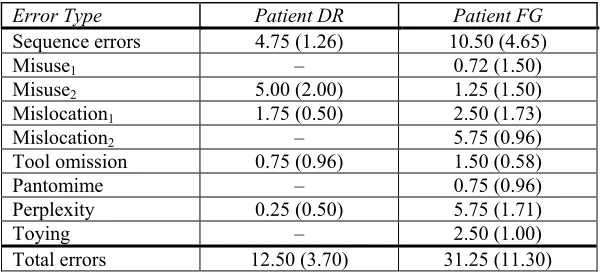
A key feature of the Rumiati et al. classification is that neurological patients may show a tendency towards one type of misuse error over the other, or towards one type of mislocation error over the other. Thus Rumiati et al. (2001) reported the error profiles of two ideational apraxic patients who each completed four attempts at ten simple multiple objects tasks similar to those used by De Renzi & Lucchelli (1988) in assessing ideational apraxia. The tasks included lighting a candle, preparing orange juice, pouring a drink from an initially sealed bottle, etc. The error data are summarised in Table 2. As can be seen from the
table, patient DR made an average of 12.50 errors over the 10 tasks, and his most common error type was misuse2. Most of his other errors were sequence errors,
though he also made several mislocation2 errors and
some tool omission errors. It is of particular note that DR never produced misuse1 type errors (so his misuse
errors were always appropriate for the type of tool being used, but inappropriate for the precise situation in which the tool was being used). Similarly DR never produced mislocation2 type errors. So although he
sometimes selected the wrong target location for actions such as pouring, when the correct target or implement was selected he always performed the action in the correct location on that target or implement. This pattern provides some support for Rumiati et al.’s subdivision of the two types of error.
DR’s behaviour contrasts with that of FG, who was in general more error prone. While FG produced errors of all types (including tool omissions at similar rates to DR), he tended to produce more mislocation2
errors than mislocation1 errors, and his misuse errors
were relatively rare in comparison with DR. The difference in error patterns is striking but does not necessarily implicate different functional deficits in the two patients; the tendency toward misuse2 errors in the
less severe disorder may simply be overridden by a tendency towards mislocation2 errors in the more
severe disorder.
A Computational Account of Normal
and Impaired Action Selection
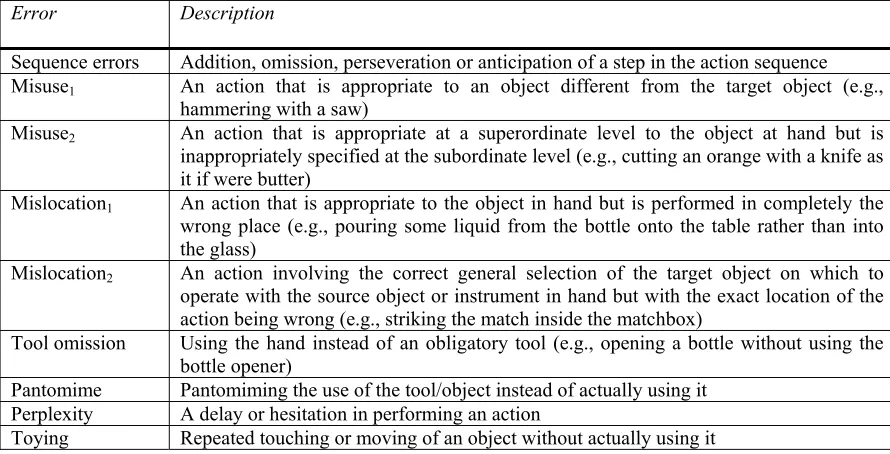
[image:5.595.74.519.104.331.2]Rumiati et al. (2001) provided a verbal account of their patients’ errors within the framework of the computational model of action selection developed by Cooper & Shallice (2000), but that model was intended only to provide a qualitative account of patient errors. Table 1: Definitions and examples of the principal error types adopted by Rumiati et al. (2001).
Error Description
Sequence errors Addition, omission, perseveration or anticipation of a step in the action sequence Misuse1 An action that is appropriate to an object different from the target object (e.g.,
hammering with a saw)
Misuse2 An action that is appropriate at a superordinate level to the object at hand but is
inappropriately specified at the subordinate level (e.g., cutting an orange with a knife as it if were butter)
Mislocation1 An action that is appropriate to the object in hand but is performed in completely the
wrong place (e.g., pouring some liquid from the bottle onto the table rather than into the glass)
Mislocation2 An action involving the correct general selection of the target object on which to
operate with the source object or instrument in hand but with the exact location of the action being wrong (e.g., striking the match inside the matchbox)
Tool omission Using the hand instead of an obligatory tool (e.g., opening a bottle without using the bottle opener)
Pantomime Pantomiming the use of the tool/object instead of actually using it Perplexity A delay or hesitation in performing an action
Thus, the model did not lead to a quantitative account of the error profiles of individual patients. Rumiati et al. (2001) were therefore unable to relate the error patterns of their patients to a specific functional deficit within the model. In order to address both of these issues, the extended Cooper & Shallice model (as described by Cooper et al., 2005) has been applied to a subset of the multiple object tasks used by Rumiati et al. (2001) with a view to providing a quantitative account of the error profiles of Rumiati et al.’s patients. This section provides basic details of the model and its application to the multiple object tasks. (Full details of the model are available in Cooper & Shallice (2000) and Cooper et al. (2005)). The results of the multiple object task simulation studies are reported in the following section.
Principal Assumptions of the Model
The Schema Network
It is assumed that knowledge of routine action sequences such as those involved in simple multiple object tasks is embodied in schemas. Thus, we may have a schema for lighting a match or for opening a wine bottle. Schemas are held to be purposeful or goal directed (in that they may be invoked in order to achieve a specified goal) and consist of a set of components that are themselves subgoals and that are ordered through pre-conditions and post-conditions. Thus, the schema for lighting a match might consist of three subgoals: holding a match, holding a matchbox and holding a lit match, where the pre-conditions of the first two subgoals are that a hand be available to hold the object and the pre-condition of the third is that an unused match be held in one hand and a closed matchbox held in the other. Other schemas will exist that achieve the subgoals (e.g., for fixating upon a match and then grasping it appropriately, or for fixating upon the side of a matchbox and then striking the head of a held match against it). Schemas thus form
a hierarchy, with high level schemas corresponding to more complex action sequences and low level schemas corresponding to simple actions such as fixating on an object or picking up the fixated object.2
It is further assumed that schemas have activation levels and that behaviour is controlled by those schemas that have the highest levels of activation. Schemas that are sufficiently active (i.e., whose activation is greater than threshold) excite those schemas that achieve their subgoals (subject to satisfaction of pre-conditions and post-conditions), while schemas that correspond to alternative ways of achieving a common goal or share effector requirements compete for activation through mutual inhibition.
Schemas may also be triggered or activated either in a top-down fashion by intentions generated and maintained by some super-ordinate cognitive system (Norman & Shallice’s supervisory attentional system) or in a bottom-up fashion by features or objects in the environment. The former reflects top-down or willed control of behaviour, while the latter is consistent with neurological disorders in which objects seem to capture behaviour (e.g., utilisation behaviour (Lhermitte, 1983; Shallice et al, 1989; Boccardi et al., 2002) and anarchic hand syndrome (Goldberg et al., 1981; Della Sala et al., 1991)). The latter also requires that for each schema there be a function that specifies the extent to which any given state of the environment triggers the schema.
2 Following Botvinick & Plaut (2004), we assume that
[image:6.595.148.449.149.287.2]fixating upon an object is itself an action. The lowest level of the schema hierarchy therefore includes schemas for fixating on objects (e.g., fixate-source) and operating on the currently fixated object (e.g., pick-up, which picks up the currently fixated object). This treatment of fixation is discussed further below.
Table 2: Means (and standard deviations) of the number of errors of each type produced by two ideational apraxic patients on a battery of 10 multiple objects tasks. The figures are based on four attempts by each patient at the battery of tasks as reported by Rumiati et al. (2001). DR had a large uni-lateral ischemic lesion affecting the left frontal, temporal, and parietal cortices. FG had a uni-lateral cortical-subcortical haemorrhage of the left superior parietal lobule.
Error Type Patient DR Patient FG
Sequence errors 4.75 (1.26) 10.50 (4.65)
Misuse1 – 0.72 (1.50)
Misuse2 5.00 (2.00) 1.25 (1.50)
Mislocation1 1.75 (0.50) 2.50 (1.73)
Mislocation2 – 5.75 (0.96)
Tool omission 0.75 (0.96) 1.50 (0.58)
Pantomime – 0.75 (0.96)
Perplexity 0.25 (0.50) 5.75 (1.71)
Toying – 2.50 (1.00)
The Representation of the Environment and
Argument Selection
Specification of schema triggering functions requires specification of some representation of the environment. This is also needed to give an account of the selection of objects and tools to which schemas are applied. It is therefore assumed that a second system encodes representations of object present in the environment, and that these representations also have associated activation levels that reflect each object’s salience with respect to a given function or use. Thus, in the preparing an espresso coffee pot using coffee from a tin and a spoon, the parts of the coffee pot (including its filter), the coffee tin and the spoon would be represented in the object representation system with activation values corresponding to their salience as sources, targets, implements, etc. Given this system, the act of adding coffee from the tin to the filter using the spoon requires simultaneous activation of the coffee tin as a source, the coffee pot’s filter as a target, and the spoon as an implement. In normal functioning this is achieved through excitatory links between the schema network and the object representation network, with the “spoon coffee into filter” schema exciting the appropriate object representations for each functional role. At the same time, reverse links between the object representation network and the schema network implement schema triggering functions and ensure that highly active object representations tend to excite object-appropriate schemas. This provides a positive feedback loop between the schema domain and object representation domain and helps to ensure that both
schemas and appropriate object representations are active at the same time.
A critical feature of the bi-directional excitatory links between schemas and object representations is that the links are not all-or-none. Rather, an active schema provides partial excitation of representations of objects that are similar to those used by the schema, and vice versa. Similarity is implemented through the use of feature-based representations, with similarity defined in terms of feature overlap. Thus, if two object representations share most of their features then one schema may excite both representations, but the representation that fits the schema’s triggering function best will receive the greatest excitation, and so, all other things being equal, should become most active. As in the schema network, lateral inhibition operates between units to ensure that, for example, no more than one object representation can become active for a given function at a given time.
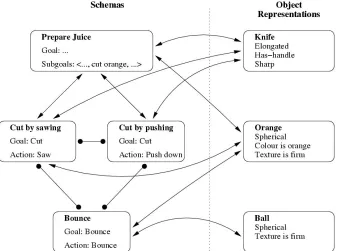
[image:7.595.131.469.74.325.2]pushing is inappropriate for oranges). Consequently, in normal functioning the activation of the representations of the orange and the knife will increase, as will the activation of cut by sawing. At the same time, the activation of cut by pushing will decrease (due to inhibition from cut by sawing). Note also that excitation of the representation of the orange will cause excitation of other orange-related schemas, such as
bounce (which is excited because the orange is
spherical, and this feature triggers the bounce schema).
The bounce schema will also not normally be highly
active, however, as it competes with the cut schemas and received no top-down excitation. Details of the schema hierarchy, object representations, and schema/object representation associations for the orange juicing task are given in Appendix A.
Justification and Consequences of the Key
Assumptions
A key element of the model is the separation of schemas from object representations and the interactions between the schema and object representation networks that this allows. The separation is motivated by the idea that schemas are abstractions over action sequences. As such they represent what is shared by different instances of the schema (e.g., common subgoals or features of objects to which the schema may have been applied) and abstract away what is not shared (e.g., the particular objects to which the schema may have been applied). Schemas thus have “argument slots” that must be filled or bound for any instance of the schema. This situation parallels that of linguistic phrase structure, where syntactic constraints specify a certain grammatical structure, but where the slots in that structure are filled in with specific words in order to convey specific meanings.
The problem of binding objects to a schema’s argument roles is solved by selecting objects based on activation within the object representation networks. Other models of sequential action selection, in both the psychological literature (that of Botvinick & Plaut, 2004) and the AI literature (that of Maes, 1989) avoid this problem of binding objects to schema instances by assuming that action primitives are object specific. Thus, Botvinick & Plaut (2004) include “fixate teabag” as a basic action, while Maes (1989) includes “pick up sander” as a basic action. The difficulty with this solution is that it does not generalise beyond the precise situation under consideration. Thus, it is unclear how Botvinick & Plaut’s model should behave when several teabags are present, or when several objects that are more or less similar to a teabag are present.
One way of viewing the object representation network within the current model is as a simplified theory of object-based attention in which attention is directed by action. Object-based views of attention are supported by studies of feature grouping (Duncan, 1984; Vecera & Farah, 1994), as well as studies of
negative priming (Tipper, 1985) and inhibition of return (Tipper et al., 1991). The approach adopted here is not intended to be a complete theory of object-based attention, rather it rests on three assumptions:
1. that objects can be represented as complete entities and that those representations can be excited or inhibited by different aspects of a task;
2. that the activation of an object representation and its subsequent selection is mediated by the object’s functional role; and
3. that an object may be represented in terms of its major parts, and that these representations may play the same role as whole object representations. Assumption 1 is consistent with the results of the studies cited above, as well as the experimental findings of Tucker & Ellis (1998) and the theoretical view advocated by Humphreys & Riddoch (2003). Assumption 2 receives support from studies of negative priming in which the nature of an object representation’s priming is dependent upon the object’s function in the context of the current goal (e.g., Tipper et al., 1994). Assumption 3 is consistent with work on part-based selection within the object-based attention literature (e.g., Vecera et al., 2001). This work demonstrates that the parts of an object can indeed be selectively processed by visual attention. The real question in the context of the current model, however, is what defines an object’s parts. That is, what defines the nodes within the object representation network? Should both ends of the candle, for example, be represented in the network as separate entities? At present, this is informed purely by the location errors made by patients.
A further element of the model that requires comment concerns the use of schemas to fixate upon objects and their parts. As noted above, the lowest level of the schema hierarchy includes schemas for fixating upon objects according to functional role. Thus, in order to pick up a knife (for example) when cutting and juicing an orange, the model must first select the fixate implement schema (while higher order schemas excite the knife as an implement), and then
the pick-up schema. This use of fixation schemas
differs from previous work with the model, in which schemas of the form pick-up implement were used. The use of separate schemas is motivated by Botvinick & Plaut’s (2004) presentation of several strands of evidence (e.g., Land et al.’s (1999) studies of eye movements during everyday tasks) that suggest that fixation precedes physical action. The change does not, however, amount to a significant change to the model: all that is involved is a change to the lowest level of the schema hierarchy, with schemas such as pick-up implement being decomposed into fixate implement and pick-up. Fixated objects may excite schemas (and vice
versa) if the schema triggering conditions are so
Error Within the Model
The model’s behaviour on a specific task is determined by the schemas present in the schema network, the object representations present in the object representation network, and numerous parameters that control the flow of activation within and between the networks. Previous work has demonstrated that with appropriate schemas, object representations and parameter settings the model is able to produce well-formed sequences of action in tasks such as preparing a cup of instant coffee and packing a child’s lunchbox, but that when the parameters are varied, for example by reducing the propagation of top-down excitation in the schema network or adding normally distributed random noise to activation levels in any of the networks, the model produces action errors ranging from slips and lapses similar to those of neurologically healthy individuals when distracted (Reason, 1979) to disorganised behaviour similar to that of patients who have suffered a closed head injury or unilateral stroke (cf. Cooper et al., 2005). Thus, increased noise in the schema network may lead to sequential errors when a schema becomes active either before its preconditions are met (resulting in an anticipation error) or after it has already been successfully completed (resulting in a perseverative error). Similarly such noise may lead to a schema failing to be activated above threshold when it should (resulting in an omission error), being activated above threshold when it is not appropriate to the task at hand (resulting in an action addition), or being deselected in favour of a related but currently inappropriate schema (resulting in a blend or capture error).
Noise in the schema network may also result in the mis-selection of objects on which to act, due to the excitatory links between schemas and object representations. These errors may take the form of misuse1 or misuse2 errors on the Rumiati et al.
classification, depending on the relationship between the action and objects on which the action is carried out (i.e., a misuse1 error if the action is appropriate to a
different type of object, as in hammering with a saw, and a misuse2 error if the action is appropriate to a
related object, as in attempting the wrong cutting action with a knife: cf. Figure 1), or even mislocation1
or mislocation2 errors if the object relates to the
location of an action (e.g., the target for pouring from a jug or for striking a match).3 In addition, the
bi-directional nature of these links means that improper control of activation propagation can also lead to objects present in the object representation network triggering simple toying behaviours or more complex
3 Note that mislocation
2 errors require that the object
representation network includes units corresponding to all relevant parts of all objects: thus in the case of striking a match against a matchbox it is necessary to represent both ends of the match and all surfaces of the matchbox and its drawer.
object-appropriate actions, as in utilisation behaviour, particularly when top-down propagation of activation within the schema network is attenuated.
The ideational apraxic patients documented by Rumiati et al. (2001) produced three classes of error beyond those described above: pantomiming, tool omission and perplexity. In fact, the lesioned model also produces a number of other types of error – types of error that have not been analysed in previous work. First, the model may omit to pick up a tool or other object prior to attempting to use the object (e.g., attempting to pour when not holding anything, or attempting to open a bottle without first picking up the bottle opener). We now interpret these errors as tool omission or pantomime errors, depending on the context. Thus, attempting to pour when not holding anything qualifies as a pantomime error, while attempting to open a bottle without first picking up a bottle opener qualifies as a tool omission error. Second, within the model the “pour” schema may be selected when the same object is active as both a source and a target. The resulting action, of pouring an object into itself, is not physically possible. Again, such errors were not analysed in previous work, but we now interpret them as perplexity errors, i.e., errors in which the patient pauses and shows signs of confusion.4 The
model is thus capable of producing the full range of error types observed by Rumiati et al. (2001).
Simulating Performance on Multiple
Object Tasks
Methods
Different tasks provide different opportunities for error (Schwartz et al., 1998; Forde & Humphreys, 2002). For example, the multiple object tasks of preparing a letter for posting and juicing an orange both provide opportunities for mislocation1 errors – in the former
one might apply the stamp to the letter instead of to the envelope, while in the latter one might juice the orange correctly but then pour the juice onto the table instead of into a glass – but of the two tasks only juicing an orange provides opportunities for tool omission errors and misuse2 errors. A clear picture of a particular
patient’s apraxic deficit can therefore only be obtained by testing the patient on a variety of tasks. Equally, when attempting the quantitative simulation of
4 An alternative view is that perplexity errors might
ideational apraxic performance it is important to simulate performance over a range of tasks rather than over just one or two tasks. For this reason, the model described above has been applied to five (i.e., half) of the multiple object tasks employed by Rumiati et al. (2001). The tasks were:
1. Placing a candle in a candlestick and lighting it using a match;
2. Uncorking a bottle and pouring its contents into a glass;
3. Assembling an espresso pot;
4. Juicing an orange and pouring the juice into a glass; and
5. Preparing a letter for posting by placing it in an envelope and addressing and stamping the envelope.
Schema hierarchies, object representation networks and schema triggering functions were implemented for each of these tasks. In each case objects were represented with a granularity commensurate with the errors reported by Rumiati et al. Thus, the candle was represented as consisting of two ends (one with a wick suitable for lighting and the other suitable for inserting in the candlestick), and the matchbox drawer was represented as distinct from the matchbox (making it possible to differentiate between lighting the wick and lighting the base of the candle, or striking a match on the box and striking it in the drawer). In all cases the schema hierarchy was hand-coded according to a commonsense decomposition of the task into goal-directed schemas and subschemas, and schema triggering functions were designed to ensure sensible performance of the task when all parameters of the model were fixed at values found in previous research to yield well-structured behaviour (cf. Cooper et al., 2005).
To illustrate, the schema for lighting a candle was decomposed into four subgoals: positioning the candle, lighting the match, lighting the candle with the lit match, and extinguishing the match. The first of these subgoals could be achieved by a schema which itself consisted of two subgoals: first that the most active theme5 be held and second that the held object
be inserted into the candlestick. Continuing down the hierarchy, holding the most active theme involved first fixating on the most active theme and then picking up the fixated object. Triggering functions for these schemas ensured that the schema for positioning the candle activated the base of the candle as a theme and the candlestick as the target.
In most cases the schema hierarchy for each task was supplemented with additional “distractor”
5 For the purposes of this task the functional role of “theme”
is employed for the object that should be inserted into the candlestick and lit. The theme role is used because the other roles discussed above (source, target and implement) seem inappropriate.
schemas. Thus, the schema hierarchy for juicing an orange, which is reproduced in Appendix A, included a schema for bouncing a ball and several cutting schemas (allowing the knife to be used in several ways). Without such schemas it would be impossible for the model to generate behaviours such as bouncing the orange or misusing the knife: both of which were observed in the behaviour of DR and FG.
Output of the model, in the form of a sequence of actions, was analysed by a separate program. This program maintained a state of the environment consisting of the objects present (such as a candle, a candlestick, a matchbox and a number of matches) and relevant features of those objects (such as their location, whether the matchbox was open, whether each match had been lit and/or extinguished, and so on), and modified the state according to each successive action, recording and categorising any errors along the way. The output of the scoring program was the number of errors of each type committed by the model on a given task. For the most part categorisation of errors was straightforward (e.g., as when scoring a sequence in which the wrong end of the candle was inserted in the candlestick), but an element of judgement was required in some cases. For example an act such as attempting to write an address on the envelope without first picking up the pen was scored as a pantomime error, while attempting to scoop ground coffee from the coffee tin without first picking up the spoon was scored as a tool omission error. The principle employed in differentiating such errors was whether the action could be successfully performed. Thus, one cannot successfully use one’s hand to inscribe an address on an envelope, but one can use one’s hand to scoop coffee. The model is also able to generate behavioural sequences that are nonsensical, such as attempting to open the matchbox when it is not held, or attempting to pour from a container into itself. Such behaviours were scored as perplexity errors.
Simulation 1: Variation of Noise within
the Object Representation Network
Method
The model was first run 100 times for NO at its default value (0.005). As anticipated this yielded no errors, demonstrating that the model could successfully complete all five multiple object tasks without error. This in itself is an important result as it further demonstrates the generality of the extended contention scheduling theory.
The model was then run 100 times for each value of NO ranging from 0.05 to 0.50 at intervals of 0.05. Each run of the model included two attempts at each of the five multiple object tasks (yielding 10 tasks per run, equivalent to the 10 tasks completed by DR and FG on each testing session). A measure of the fit between the mean error profile of the model at each point in the parameter space and the error profiles of DR and FG was then calculated. This fit was the root mean square difference between the two sets of dependent variables (i.e., the error counts for the nine different types of error).6
Results
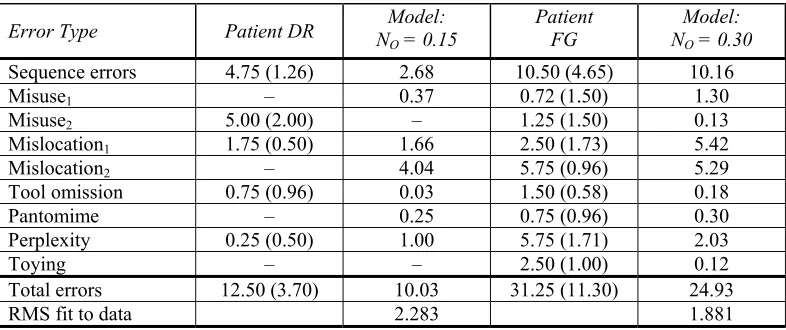
Table 3 shows the optimal fits obtained between the model and patient data using the above procedure. These fits should be interpreted with some caution, as the sample size for each patient (four blocks of the ten multiple object tasks) is small and there is evidence of practice effects in the patient data, with all patients producing more errors on their first block than on any subsequent block. Nevertheless, and as can be seen from the table, the best fit for patient DR’s error profile was with NO = 0.15. This yielded a mean of 10.03 errors over the 10 multiple object tasks. While this compares well with the total number of errors produced by DR (of 12.50 with a standard deviation of 3.70), the
6 Other measures of fit, including correlation and a sum of
weighted squared differences based on the formula for chi-square goodness of fit, were considered but found to yield similar results.
detailed fit to DR’s error profile is actually quite poor. The model produces only half as many sequence errors as DR, and DR was never observed to produce the error type, mislocation2, that was most common in the
model’s behaviour. The fit to patient FG, however, is more encouraging. With NO = 0.30 the model produced an average of 24.93 errors (within one standard deviation of the mean number of errors produced by FG), and like FG the model’s modal error type was that of sequence. The model also yielded values within one standard deviation of FG’s performance on misuse1,
misuse2, mislocation2 and pantomime errors. The
differences between the model’s performance and that of FG were in mislocation1 errors (which the model
produced with greater frequency than FG) and in tool omission, perplexity and toying errors (which the model produced with lesser frequency than FG).
Discussion
While the absolute results of this first attempt at fitting the model to the error profiles of DR and FG are mixed, the general pattern of errors produced by the model is encouraging. With high levels of noise the model produces each of the types of error produced by documented ideational apraxic patients. In particular, errors seen in Rumiati et al.’s (2001) ideational apraxic patients but not discussed in previous simulation work (tool omission, pantomime and perplexity) do occur, as do both subtypes of mislocation and misuse error. The results also provide weak support for the proposition that the difference in impairment between DR and FG is not purely one of severity, at least in the sense that if FG’s impairment is reducible to high levels of noise within the object representation network, DR’s impairment is not.
[image:11.595.102.495.114.279.2]It should also be noted, however, that the precise proportions of the various error types produced by the model depend upon both the specification of the task within the model and the details of the representation of objects. Thus, the model could not Table 3: Best fits to the error profiles of patients DR and FG following variation of NO, the parameter corresponding to the standard deviation of noise in the object representation networks.
Error Type Patient DR NO = 0.15 Model: Patient FG NO = 0.30 Model:
Sequence errors 4.75 (1.26) 2.68 10.50 (4.65) 10.16
Misuse1 – 0.37 0.72 (1.50) 1.30
Misuse2 5.00 (2.00) – 1.25 (1.50) 0.13
Mislocation1 1.75 (0.50) 1.66 2.50 (1.73) 5.42
Mislocation2 – 4.04 5.75 (0.96) 5.29
Tool omission 0.75 (0.96) 0.03 1.50 (0.58) 0.18
Pantomime – 0.25 0.75 (0.96) 0.30
Perplexity 0.25 (0.50) 1.00 5.75 (1.71) 2.03
Toying – – 2.50 (1.00) 0.12
Total errors 12.50 (3.70) 10.03 31.25 (11.30) 24.93
produce the misuse2 error of attempting to cut an
orange with the wrong type of cutting motion if it were not given the knowledge that a knife could be used to cut either by sawing or by pushing. Similarly the model could not produce the mislocation2 error of striking the
match inside the matchbox if the representation of objects did not distinguish between the matchbox and the drawer of the matchbox. The schema sets and object representations for each task therefore amount to additional degrees of freedom that might be employed in attempting to fit the patient error profiles. In the absence of any reliable method for determining these aspects of simulation, and in an attempt to enforce some methodological constraint, they have been fixed in such a way as to allow, but not enforce, the specific errors reported by Rumiati et al. (2001). However, Rumiati et al. (2001) report only example errors, and not a complete list of the errors produced by their patients, so it is likely that the opportunities for some error classes (particularly relating to misuse, which depend in the model on extraneous schemas) are under-represented in the simulation. Even so, the basic conclusion, that while FG’s behaviour might be modelled by noise within the object representation network but that DR’s behaviour cannot, stands.
Simulation 2: Variation of the Strength
of Schema/Object Interactions
Increased noise within the object representation networks was originally used by Cooper et al. (2005) to model the behaviour of an otherwise unselected group of left stroke patients originally reported by Buxbaum et al. (1998). The addition of noise is an appropriate technique when attempting to model data from a group that is unlikely to be homogeneous. Indeed, there was considerable variability in the lesion sites of the left stroke patients investigated by Buxbaum et al. (1998), with some patients having uni-lateral lesions affecting frontal lobes and others with lesions restricted to temporoparietal and/or subcortical areas. It is therefore reasonable to suggest that the behaviour of specific patients might be better described by alterations to other parameters. Several parameters would seem to be potential candidates, but evidence is emerging that suggests that left parietal structures play a role in the triggering of schemas by objects. Arbib (1997, cited in Humphreys & Riddoch, 2003), for example, argues that parietal cortex is activated in situations in which particular motor behaviours are legitimate, and, in a PET study of healthy subjects, Rumiati et al. (2004) found that left inferior parietal cortex was reliably activated when subjects produced a wide range of skilled actions triggered by objects.
This emerging evidence suggests that left parietal damage may affect the excitation of schemas by objects (or vice versa). Two parameters control this excitation: SE, the strength of excitation of schemas from object representations, and OE, the strength of excitation of object representations from schemas. In previous work these parameters, which scale the
influence of each subsystem on the other, have been set at 0.10 and 0.40 respectively. Decreasing the former will reduce the effect of object representations on schemas and is likely to make the model less sensitive to environmental or situational factors, while decreasing the latter will reduce the effect of schemas on object representations and is likely to make the model prone to selecting incorrect objects on which to act. However, both parameters affect the feedback loop between schemas and object representations, so both manipulations are likely to have wider behavioural consequences.
Method
In order to determine the consequences of these manipulations and explore the possibility that the deficits of DR and FG might be explained by partial ablation of either the object representation to schema route or the schema to object representation route, four further sets of simulations were performed. In all cases the procedure employed in Simulation 1 was followed. That is, the model was run for 100 trials at each of a number of points in parameter space, with each run consisting of two attempts at the five multiple object tasks. The root mean square differences between the resultant mean error profiles and the error profiles of the patients were then calculated for each point in the parameter space (as in Simulation 1) in order to determine the parameter settings leading to the best fit for each patient.
Simulation 2a involved a more thorough exploration of the effects of noise, so as to rule out the possibility that noise in different systems could account for the differences in the patient error profiles. The simulation was run for 100 trials at each point in the two dimensional parameter space defined by increasing the standard deviation of noise in the object representation networks, NO, from 0.05 to 0.50 at intervals of 0.05 and increasing the standard deviation of noise in the schema network, NS, from 0.05 to 0.50 at intervals of 0.05. This joint manipulation of parameters entailed running the complete simulation at 10 × 10 = 100 points in parameter space.
Simulation 2b explored the combined effects of decreased schema to object excitation combined with increased noise in the object network. The simulation was run for 100 trials at each point in the two dimensional parameter space defined by decreasing OE from its default value of 0.40 to 0.00 at intervals of 0.05 and increasing NO from 0.025 to 0.250 at intervals of 0.025. This joint manipulation of parameters entailed running the complete simulation at 9 × 10 = 90 points in parameter space.
schema network, with NS ranging from 0.025 to 0.250 at intervals of 0.025. Thus, 11 × 10 = 110 complete simulations, each involving 100 trials, were performed.
Finally, Simulation 2d examined the effects of simultaneously decreasing the strength of both the effect of object representations on schemas and of schemas on object representations. OE was reduced from 0.40 to 0.00 at intervals of 0.05 while SE was reduced from 0.10 to 0.00 at intervals of 0.01. At the same time, noise was manipulated in all networks. Five levels of N were considered: 0.005 (the default), 0.025, 0.050, 0.075 and 0.100. This three dimensional parameter manipulation involved 9 × 11 × 5 = 495 complete simulations.
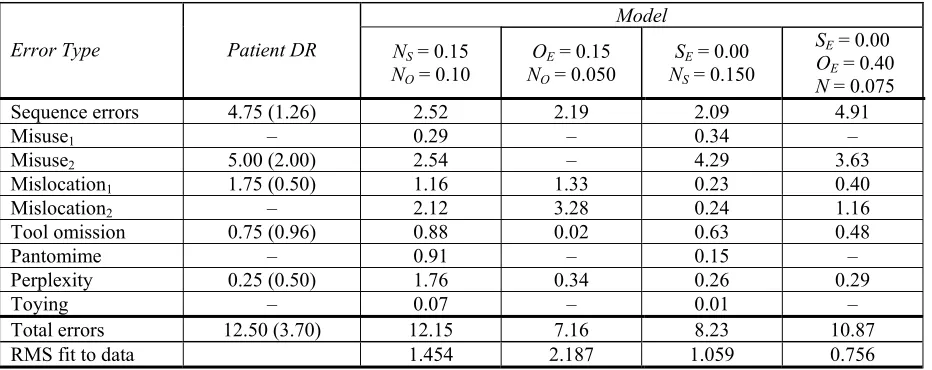
Results
Table 4 shows the best fits to DR’s error profile obtained from each of the four parameter manipulations. Recall that the best fit for Simulation 1 (when noise in the object representation network was increased) to DR’s error profile was in fact quite poor with an RMS of 2.283. This fit is improved if noise is increased in both the schema and object representation networks (with the RMS reducing to 1.454), but manipulating noise alone does not capture many key aspects of DR’s performance. Comparing the results of Simulation 1 and Simulation 2a shows that increasing noise within the schema network leads to increased rates of misuse2 errors and decreased rates of
mislocation1 errors (both of which bring the model’s
error profile more in line with that of DR), but substantial differences remain. The model produces mislocation2 errors and pantomime errors at modest
rates, while DR produced no such errors, and the number of misuse2 errors produced by the model is low
in comparison to DR.
Manipulation of the strength of schema to object representation links and object noise (Simulation 2b) also yields a poor fit to DR’s behaviour. As with Simulation 1, this manipulation fails to produce any
misuse2 errors (which were common in DR’s
behaviour), and produces many mislocation2 errors
(which were absent in DR’s behaviour). The fit contrasts with that obtained in Simulation 2c by manipulation of the strength of object representation to schema links and schema noise. This manipulation demonstrates that when object representation to schema links are completely severed (i.e., SE = 0.00), modest levels of noise in the schema network (e.g., NS = 0.15) result in an error profile similar to that of DR, with the exception that this manipulation leads to slightly fewer sequence errors, slightly fewer mislocation1 errors, and slightly more mislocation2
errors.
An even better fit is obtained when both schema to object representation and object representation to schema links are modulated, and noise is added to all networks (Simulation 2d). However in this case the fit was still obtained with SE = 0.00 (i.e., object representation to schema links completely severed) and OE = 0.40 (i.e., schema to object representation links at their default strength). Thus the improvement in fit over Simulation 2c (which examination of the error profiles suggests is due primarily to increased rates of sequence errors in the output of Simulation 2d) arises solely from the addition of noise to all networks, and not from any additional manipulation of either the SE or OE parameters.
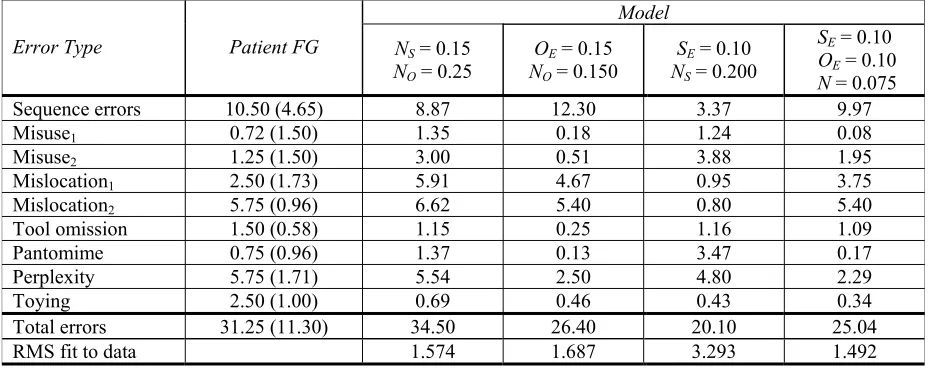
Table 5 shows the best fits to FG’s error profile obtained from each of the four parameter manipulations. Recall that the fit obtained in Simulation 1 (with an RMS of 1.881 at NO = 0.30) was better than that obtained for DR, however Simulation 1 could not account for FG’s relatively high rates of tool omission, perplexity and toying errors, or his relatively low rate of mislocation1 errors. Some of these
[image:13.595.67.533.103.288.2]discrepancies are addressed by the fits obtained in Simulation 2. For example, noise in both the schema and object representation networks yields levels of tool omission and perplexity errors similar to that produced Table 4: Best fits to the error profiles of patient DR following variation of several key parameters.
Model
Error Type Patient DR NS = 0.15
NO = 0.10
OE = 0.15 NO = 0.050
SE = 0.00 NS = 0.150
SE = 0.00 OE = 0.40 N = 0.075
Sequence errors 4.75 (1.26) 2.52 2.19 2.09 4.91
Misuse1 – 0.29 – 0.34 –
Misuse2 5.00 (2.00) 2.54 – 4.29 3.63
Mislocation1 1.75 (0.50) 1.16 1.33 0.23 0.40
Mislocation2 – 2.12 3.28 0.24 1.16
Tool omission 0.75 (0.96) 0.88 0.02 0.63 0.48
Pantomime – 0.91 – 0.15 –
Perplexity 0.25 (0.50) 1.76 0.34 0.26 0.29
Toying – 0.07 – 0.01 –
Total errors 12.50 (3.70) 12.15 7.16 8.23 10.87
by FG, particularly when schema noise is set to 0.15 and object representation noise is set to 0.25. A similar overall fit to FG’s data is also obtained by reducing the strength of links from schemas to object representations to 0.15 while increasing object representation noise to 0.15. However, reducing the strength of object representation to schema links and increasing schema noise produces a poor fit. (In fact, the best fit in this case is obtained when SE = 0.10, its default value, so all errors are due to the noise in the schema network.)
As in the case of DR, the best fit to FG’s error profile is obtained by simultaneously varying the strength of schema to object representation links and object representation to schema links, while adding noise to all networks. However, in this case the best fit occurs when object representation to schema links are at their default strength, and schema to object representation links are reduced to 0.10 (from a default of 0.40). The fit produced in this case (with N = 0.075), while not as good as the final fit for DR, captures most of the key aspects of FG’s error profile, including the relative incidence of sequence errors, the tendency in misuse errors to misuse2 over misuse1 errors, the
tendency in mislocation errors to mislocation2 over
mislocation1 errors, the absolute rate of tool omission
errors, and the relative rates of pantomime, perplexity and toying errors (though the absolute rates of these last three types of error are low).
Discussion
The results of Simulation 2 provide some support for the extended Norman & Shallice (1986) theory as implemented in the model of Cooper & Shallice (2000). While it is not surprising that manipulating two parameters yields a better fit than manipulating one parameter, and that manipulating three parameters yields a better fit than manipulating two, the results of these simulations demonstrate not only that the model is prone to the same kinds of errors as ideational apraxic patients on simple multiple object tasks, but
that the model, when suitably lesioned, can produce those errors at rates similar to those of documented patients. In particular, the model can account (albeit in a post hoc fashion) for the tendencies towards different subtypes of misuse and mislocation errors seen in DR and FG.
While a variety of parameter manipulations yield reasonable fits between the model and patient data, the best is obtained when noise is added to all networks. According to this account, both patients have a general action selection deficit that may be modelled by the addition of noise (with standard deviation of 0.075) to the schema and object representation networks. DR is best accounted for by assuming, in addition, the complete severing of object representation to schema links (i.e., of the triggering of schemas by object representations) with intact schema to object representation links, while FG is best accounted for by assuming, in addition, a partial severing of schema to object representation links (i.e., of the links by which schemas excite and ultimately select their arguments) with intact object representation to schema links. The simulations thus support the view that DR and FG have related but distinct deficits.
General Discussion
[image:14.595.66.534.104.288.2]We have demonstrated that the model of routine action control developed by Cooper & Shallice (2000) can account for normal behaviour on a range of simple multiple object tasks, and that when damaged through the partial ablation of activation pathways and the addition of random noise to activation levels the model is also able to provide a quantitative account of the error profiles of two ideational apraxic patients. Application of the model to the multiple object tasks with the standard parameter settings provides support for the generality of the model. Simulation of the patient error profiles provides support for the mechanisms and their interactions implemented in the model. It also provides some insight into the possible Table 5: Best fits to the error profiles of patient FG following variation of several key parameters.
Model
Error Type Patient FG NS = 0.15
NO = 0.25 NOOE = 0.150 = 0.15 NSSE = 0.200 = 0.10
SE = 0.10 OE = 0.10 N = 0.075
Sequence errors 10.50 (4.65) 8.87 12.30 3.37 9.97
Misuse1 0.72 (1.50) 1.35 0.18 1.24 0.08
Misuse2 1.25 (1.50) 3.00 0.51 3.88 1.95
Mislocation1 2.50 (1.73) 5.91 4.67 0.95 3.75
Mislocation2 5.75 (0.96) 6.62 5.40 0.80 5.40
Tool omission 1.50 (0.58) 1.15 0.25 1.16 1.09
Pantomime 0.75 (0.96) 1.37 0.13 3.47 0.17
Perplexity 5.75 (1.71) 5.54 2.50 4.80 2.29
Toying 2.50 (1.00) 0.69 0.46 0.43 0.34
Total errors 31.25 (11.30) 34.50 26.40 20.10 25.04
cause, at the computational level, of the patients’ deficits.
Basic Assumptions of the Model
The success of the model also lends support to the model’s basic assumptions. Three of those assumptions that are particularly relevant to the current work are: 1) that the control of everyday object-related activities is dependent on the interaction of multiple subsystems, specifically related to action schemas and object representations; 2) that action schemas are goal directed; and 3) that tool use is not a specific isolable faculty but is the product of mechanisms that support goal-directed object-related activity. We briefly consider the role of each of these in turn.
The triggering of schemas by object representations and vice versa is central to the model’s functioning and the account both of the error profiles of DR and FG and of the differences between those error profiles. The triggering of schemas by object representations was a central aspect of the original Norman & Shallice (1986) theory. It is effectively a cognitive equivalent of the Gibsonian notion of affordance (Gibson, 1979), and is supported by data from slips and lapses in routine action (such as capture errors: Reason, 1979, Norman, 1981), empirical studies concerning the relationship between perception and action (e.g., Rumiati et al., 1998; Tucker & Ellis, 1998), and neuropsychological case studies of utilisation behaviour (e.g., Lhermitte, 1983; Shallice et al., 1989; Boccardi et al., 2002) and anarchic hand syndrome (e.g., Goldberg et al., 1981; Della Sala et al., 1991). The reverse links, from schemas to object representations, are required in the model to ensure that appropriate objects are selected during schema-directed action. They complete a positive feedback loop between schemas and object representations, which is essential to ensuring that appropriate schemas and objects are co-activated without the need for a third homunculus responsible for simultaneously activating appropriate representations in each subsystem. The feedback loop also plays an important part in the model’s account of capture errors and utilisation behaviour, for without positive feedback activation of schemas by object representations would not reach threshold.
The goal directed nature of schemas plays a critical role in determining the relationships between schemas and subschemas. As noted above, schemas consist of a set of subgoals, not subschemas. So when a schema is activated above threshold it excites all those schemas that could achieve any of the original schema’s subgoals (provided the preconditions of the subgoal are met and the postconditions are not). Many other authors have argued for the goal directed nature of even everyday or routine activities (e.g., Miller et al., 1960; Duncan, 1986; Fuster, 1989; Schwartz et al., 1991). Equally some have argued that goals are epiphenomenal or even illusory, particular with respect to the kinds of behaviours considered here (e.g.,
Botvinick & Plaut, 2004). It is therefore relevant to note that the current model’s account of certain types of misuse error is critically dependent upon the way goals mediate schema/subschema relations. For example, the model’s account of the error of attempting to cut the orange when preparing orange juice by pushing down on the knife rather than sawing depends on the fact that the goal of cutting with a knife (which is appropriate at that point of the task) can be achieved in various ways depending on the things being cut, including sawing and pushing. Cut by sawing and cut by pushing therefore compete. In normal functioning excitation from the target of the cutting action will differentiate between the two, while an error may arise if noise or some other factor overrides this excitation. The existence of such misuse errors therefore provides support for the model’s treatment of goals. (For further arguments concerning the critical role of goals, see Cooper & Shallice, in preparation.)
Goals also serve an important role in the model’s account of tool use (and tool use errors), because tool use is viewed as a goal-directed activity. At the same time, tool use is not seen as a special faculty or as even requiring any special machinery over and above what is required for everyday action (although special machinery is likely to be involved in the invention of tools and the use of tools for non-standard purposes). Tool omission errors are particularly instructive in this respect, for they imply a goal or purpose to an activity beyond simply performing a learnt sequence of actions. Thus squeezing an orange to prepare orange juice, whether performed by twisting a piece of orange on a juicer or by omitting the tool and squeezing it by hand, achieves a goal of extracting the juice from the orange, just as scooping ground coffee from a tin into an espresso pot’s filter, whether done using a spoon or by hand, achieves a goal of filling the filter with ground coffee. It is the common goal or purpose that unifies the conventional action sequence and the sequence involving a tool omission, and within the model it is the common goal or purpose that allows tool omission errors to contribute successfully to ongoing behaviour.
The Relation Between Parameter
Settings and Types of Error
The simulation studies demonstrate that the model produces certain types of error with certain frequencies at different settings of its parameters, but in their raw form they provide little explanation as to why particular parameter values may lead to particular error profiles. This is because interactions within the model make it difficult to relate specific parameter manipulations to the occurrence of specific errors. Nevertheless the simulations show that different parameter manipulations do yield different error profiles.
consider the effects of increased noise within the object network (as in Simulation 1). Since the activation of object representations by schemas is not all or none, normal functioning will result in substantial activation of appropriate target objects but moderate activation of objects that are perceptually or semantically similar. Modest levels of noise in the object network, coupled with competition through lateral inhibition that tends to amplify any differences, can result in an incorrect but similar object becoming highly active and then being operated on by the selected schema. (As the incorrect object is similar to the correct target object, it will also provide some activation to the currently selected schema, meaning that selection of an alternative schema is unlikely.) Since the representation of objects in the current simulations assume that different parts of an object are in general more similar to each other than different objects, the most likely error with modest levels of noise in the object network is that of mislocation2 (e.g., striking the match against the
matchbox drawer instead of against the matchbox, or inserting the wrong end of the candle into the candlestick). Higher levels of noise in the object representation network result in the model confusing increasing less similar objects. Hence mislocation1
errors also occur, but the activation of highly dissimilar objects also leads to activation and possible selection of schemas unrelated to the task. Hence at higher levels of noise sequence errors such as action additions are also common.
Similar analyses may be attempted for other parameter manipulations. For example, severing the links from object representations to schemas will mean that schema activation will be based entirely on top-down processes (i.e., task expectations). Activity in the object representation network (e.g., relating to the type of knife or the type of object which is to be cut) will be supported by activity in the schema network, but will provide no input to the schema network. Hence activity in the object representation network will not be able to disambiguate between, for example, alternative schemas for cutting. All other things being equal, the model will then be just as likely to attempt to cut an orange by sawing it as by pushing on it.7 Thus, this
parameter manipulation leads to high rates of misuse2
errors (as in the case of DR). In contrast, severing the links from schemas to object representations will mean that schemas will be unable to activate appropriate objects. If the links are completely severed, mislocation and misuse errors (of both types) should
7 In fact, the error of attempting to cut an orange by pushing
is relatively common in apraxic patients, while the converse error of attempting to cut butter by sawing is rare if it occurs at all (Goldenberg, 2005, p.c.). This may reflect different strengths of “affordance” between the tool and the relevant schema. That is, it is consistent with the model that a knife might more strongly afford cut by pushing than cut by sawing. If this were the case, cut by pushing would dominate cut by sawing in the absence of top-down excitation.
therefore be expected, but it some residual excitation from schemas to object representations remain then mislocation2 errors are likely to be favoured (as in the
case of FG).
Alternative Computational Accounts of
Action Selection and its Disorders
A number of alternative accounts of the organisation and control of sequential action have been proposed (e.g., MacKay, 1985; Grafman, 1989, 1995; Humphreys & Forde, 1998; Botvinick & Plaut, 2004). Of these, only that of Botvinick & Plaut (2004) has been developed into a complete computational instantiation. The core of the model is a recurrent connectionist network in which action at each point in time is a function of the current inputs to the system (consisting of a representation of any held or fixated objects) and a learned time-varying context coded within the model’s layer of hidden units. The model has been applied to tasks such as preparing coffee and tea – tasks of similar complexity to the multiple object tasks considered here – and shown to produce errors similar to those of Schwartz et al.’s (1998) frontal patients when the hidden unit activations were corrupted through the addition of random noise.
Botvinick & Plaut (2004) do not specifically discuss the action errors of ideational apraxic patients such as DR and FG. While there is little doubt that the Botvinick & Plaut model could be applied to the multiple object tasks considered here, it would seem that accounting for the specific error profiles of these patients would present significant difficulties. Two issues appear to be critical. First, there is no place in the theory of sequential action control on which the Botvinick & Plaut model is based for the concept of a goal. It is therefore unclear how tool-use errors considered to arise from goal-directed aspects of behaviour (such as tool omission errors and misuse2
errors) might arise in the Botvinick & Plaut model. In any case, published simulations suggest that the model produces very low rates of what Schwartz et al. (1998) refer to as object substitution errors (which generally correspond to misuse1 or mislocation1 errors under the