http://dx.doi.org/10.4236/ojmp.2014.35037
The Role of Attitude Strength in Predicting
Organ Donation Behaviour by Implicit and
Explicit Attitude Measures
Gundula Hübner1,2, Anja Mohs1, Lars Eric Petersen1 1Martin-Luther-University Halle-Wittenberg, Halle, Germany 2MSH Medical School Hamburg, Hamburg, Germany
Email: [email protected]
Received 20 August 2014; revised 20 September 2014; accepted 8 October 2014
Copyright © 2014 by authors and Scientific Research Publishing Inc.
This work is licensed under the Creative Commons Attribution International License (CC BY).
http://creativecommons.org/licenses/by/4.0/
Abstract
Explicit attitude measures seem to be rather poor predictors of organ donation behaviour. This study examined whether implicit attitude measures acted as better predictors. Special attention was paid to the moderating role played by attitude strength in predicting deliberate donation be-haviour. In this study (N = 78), explicit and implicit measures of attitudes towards organ donation, as well as behavioural commitment, were assessed. Implicit associations were measured by an Im- plicit Association Test; five constructs assessed self-reported—understood as reflected—attitude strength. The explicit attitude measure appeared to be the best single predictor of whether the participant ended up taking an organ donor card. More importantly, test results demonstrated the moderating role of attitude strength. In the case of low attitude strength, the likelihood of taking a donor card increased with an increasing positive implicit association. In contrast, increasing strength was associated with a weaker link between card taking and the implicit attitude measure. The results are discussed in light of the power of implicit associations to predict more deliberate behaviours.
Keywords
Health Attitudes and Behaviour, Implicit and Explicit Attitude Measures, Organ Donation
1. Introduction
gap may be in part due to two conceptual problems. Firstly, until recently, research on organ donation focus on cognitive attitudes, neglecting feelings associated with organ donation [2]. Secondly, researchers investigating attitudes toward organ donation commonly rely on explicit, self-reported attitude measures, e.g. [2]. Two main limitations challenge the validity of self-reporting, cf. [3]. Generally, factors such as demand characteristics or self-presentation concerns may influence self-reporting. Furthermore, they afford introspection to indicate reli-able attitude scores. Indirect attitude measures may circumvent these limitations.
There are good reasons to expect that implicit attitude measures add to the understanding of organ donation behaviour. Organ donation is socially desired and has moral implications, since to decide against donation is equal to a decision against saving lives. Likely, these pro-donation expectations support overly positive direct assessments and thus mask critical evaluations. Additionally, considering becoming an organ donor prompts re-flection on one’s own mortality and thus is likely to inhibit introspection [4]. So far, the impact of implicit asso-ciations on organ donation remains an open question.
1.1. Implicit Attitude Measures
The most widely used approach to measure implicit social cognitions is the Implicit Association Test (IAT) [5]. Basically, the IAT is a computerised sorting task. It measures the strength of associations between constructs by forcing respondents to associate themselves with the same response key. Sorting is assumed to be easier and therefore faster, if two highly associated concepts share the same response keys, compared with sharing different ones [6] [7]. The IAT is a popular method to investigate social phenomena, such as health protection (e.g. [8]) or self-concept of anxiety (e.g. [9]). Referring to organ donation, the IAT-anxiety is of special interest, since organ donation is connected to negative feelings and cognitions, particularly about death and dying. In the present arti-cle, the IAT-anxiety is adopted to provide an implicit measure of organ donation attitudes.
1.2. The IAT as a Predictor of Behaviours
Several studies provide evidence that the IAT can predict behaviours in some but not all cases, cf. [10]. Implicit measures seem to predict particularly spontaneous behaviours such as white Americans’ non-verbal behaviours toward African-Americans, cf. [11]. The IAT can even predict behaviours under more volitional control, such as voting [12] or condom use [8]. However, it fails to predict the choice of a candy bar versus an apple [13]. Mod-erator effects offer one possible explanation for these inconsistent results. For example, Perugini [14] found im-plicit and exim-plicit attitude measures to interactively predict smoking. Additionally, individual differences in automatic evaluations at the associative level seem to moderate the IAT’s predictive validity [15]. Overviews of variables moderating the implicit-explicit consistency provide a better understanding of these attitude indicators’ interrelation [10] [16]. The present paper focuses on one possible moderator on the implicit-explicit relation in predicting behaviours, namely, attitude strength.
1.3. Attitude Strength as a Moderator
Strong attitudes can be defined as attitudes that are stable, resistant to changes, and that influence thoughts and behaviours [17]. However, attitude strength seems to be a heterogeneous construct. Several self-reported meas-ures of attitude strength exist, including attitude importance, certainty, knowledge or cognitive elaboration (see [17] [18] for an overview). These direct measures have in common that they are based on reflected assessments. Consequently, we understand self-reported attitude strength based on reflection.
So far, the reported findings are in line with the motivation and opportunity as determinants of the behaviour model’s assumption (MODE) [22] that strongly associated evaluations are automatically activated and guide behaviours. Conversely, increased deliberation increases the impact of explicit attitude measures. Likewise, these findings—as Conner and colleagues [20] point out—are in accord with the assumption that implicit and explicit attitude measures represent different influential processes that can interact with each other [23] [24]. However, research on representational strength [16] as a moderator of the implicit-explicit relation has relied on everyday content behaviours, such as food choice [20] or social groups and political issues [21]. In contrast, the decision to become a potential organ donor by signing a donor card clearly affords cognitive deliberation.
It remains an open question whether the above-reviewed assumptions and results can be generalised to this specific case of deliberate behaviours. If so, based on the MODE model in the deliberate mode, explicit attitude measures capturing conscious elaboration should predict donation behaviour while the impact of implicit asso-ciations should be minimal [22]. Further, research on attitude strength shows evidence for an increasing attitude- behaviour relation as attitude strength increases, e.g. [17]. Similarly, according to the dual-process approach [23] [24], the relation between explicit attitude measures and behaviours should increase as systematic and effortful in-formation processing increases, while the predictive power of implicit attitude measure should remain unaf-fected. However, a contrasting assumption can be derived from the reflective-impulsive model (RIM) [24].
The RIM presents two information-processing systems that operate in parallel and interact with one another. The reflective system is characterised as an explicit decision-making process, while the impulsive system elicits behaviours through simple associative links and motivational orientations. Both the systems can activate behav-ioural schemata that, in turn, activate overt behaviours. Simultaneously, more than one schema can receive acti-vation, even from both systems. Which behavioural schema will prevail depends on the conditions and on the strength of the activation for each schema. This offers a new perspective on the role of implicit associations in the case of more deliberative processing. Strong attitudes toward deliberative behaviours result from reflecting on behavioural outcomes and integrating them into an overall judgment, e.g. [25]. Furthermore, implicit associa-tions stem from automatic emotional reacassocia-tions to stimuli while explicit processes are more cognitively con-trolled [26]. Thus, in the case of higher attitude strength, we expect the reflective system to dominate the execu-tion of deliberate behaviours. Contrastingly, in the case of weaker strength, prior evaluaexecu-tions are unlikely and impulsive reactions may be inferred as additional and affective information [27]. Correspondingly, we hypothe-sise that the impact of implicit associations on deliberate behaviours is stronger when the attitude strength is weak. Since organ donation is likely to activate associations with death and dying, we expect a negative IAT ef-fect.
In sum, the present contribution aims to understand the role of implicit associations in the organ donation de-cision and the moderating impact of attitude strength on the implicit association-behaviour relation.
2. Method
2.1. SampleThe sample consisted of 90 participants recruited on university campus. Nine participants were discarded for incomplete questionnaires, and three due to computer failure. Of the remaining 78 participants, 48.7% were wo- men, 51.3% were men. Ages ranged from 19 to 33 years, with an average age of 22.4. The majority held a uni-versity entrance qualification (96.2%) and were students (91.0%). Political (24.3%), nature (16.2%), and eco-nomic (16.2%) sciences were the most frequent subjects. Students of medicine and psychology, and organ-donor card holders were excluded from the survey.
2.2. IAT Procedure and Stimuli
to organ donation. Participants were told to be as accurate as possible, while going as quickly as possible; errors were marked. Each participant completed the measures anonymously while in a small group. To control for se-quence effects, half of the participants first completed the IAT and next the questionnaire including the explicit measures; the other half received the reversed sequence. Furthermore, we counterbalanced the block order. Nearly half of the respondents (n = 41) received the compatible block first (organ donation + anxiety) while the other half (n = 37) started with the incompatible block (organ donation + calmness).
IAT data were treated using the improved scoring algorithm (D1 measure) [29]. The IAT effect was calculated by taking the latency for the organ donor + calmness task (incompatible task) minus the latency for the organ donor + anxiety task (compatible task). Scores were recorded, so that positive scores indicated greater facility for the organ donor + calmness task and more positive implicit donation attitudes.
2.3. Explicit Variables
To measure explicit attitude towards organ donation a four-item semantic differential scale had participants re-spond to “I think organ donation is…” on four adjective pairs (senseless/useful, dispensable/desirable, bad/good, negative/positive); 8-point bipolar scales ranging from –4 to +4 (α = 0.86).
In total, five constructs assessedattitude strength:
1) The first strength indicator was cognitive elaboration on signing an organ donor card. Participants were asked to self-report whether they had reflected (thought about/deliberate) on signing a donor card before par-ticipating in our survey. Two groups were categorised: participants who had not reflected on signing were coded as “low strength” (0), those who had as “high strength” group (1). To validate this categorisation, four further attitude strength indicator were assessed; 2)Five statements assessed issue involvement (α = 0.82); participants rated how strongly they disagreed (0 = not at all) or agreed (5 = strongly). An item example is “Organ donation is an important topic to me”. The mean of the items served as issue involvement indicator; 3) One item meas-ured attitude certainty. Participants indicated how strongly they agreed with the statement “I am well enough informed to make a decision to sign an organ donor card or not” (0 = do not agree at all to 5 = strongly agree); 4) Next, participants rated their subjective knowledge on a 4-point scale ranging from 0 (not at all informed) to 3 (very well informed); 5) To assess communication activity, participants were asked how frequently they com-municated about organ donation (0 = never to 2 = occasionally). Out of the last four indicators, we aimed to construct a compound strength measure.
Behaviour was assessed as taking (1) or not taking (0) an organ donor card after the survey. For this purpose, each questionnaire included a donor card on the second to last page, to be removed easily and anonymously. Participants were not informed about this card before.
3. Results
3.1. Descriptive Results
Almost equal parts of the sample had either reflected on signing an organ donor card (47.4%, n = 37; high strength group) or not (52.6%, n = 41; low strength group). Average issue involvement was rather strong (M = 3.75, SD = 0.86) while attitude certainty was below the midpoint (M = 2.73, SD = 1.21). Subjective knowledge also was low; most participants (76.9%) indicated they felt little informed about organ donation, while only 13.6% felt well or very well informed. Additionally, none of the respondents communicated occasionally about organ donation with others, 76.9% only seldom, and 23.1% had never done so.
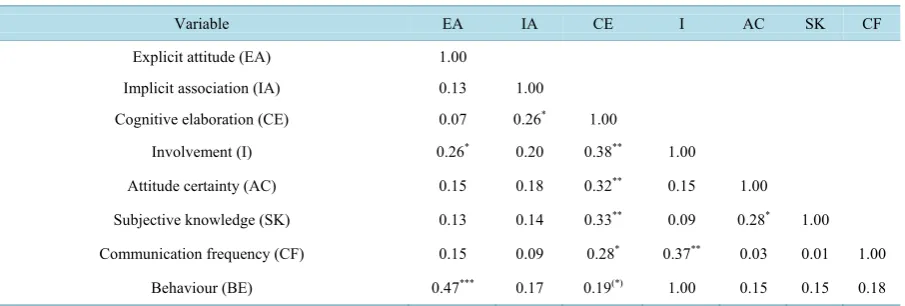
The explicitly assessed attitude toward organ donation was high positive on average (M = 3.14, SD = 0.75) while the implicit association was only slightly positive (M = 0.10, SD = 0.42). The majority of respondents (60.3%) took the donor card after answering the questionnaire. The variables’ intercorrelations (Table 1) re-mained below r = 0.50.
3.2. Compound Strength Measure
Table 1. Correlations between explicit (explicit attitude) and implicit attitude (implicit association) measure, attitude strength indicators and behaviour (N = 78).
Variable EA IA CE I AC SK CF
Explicit attitude (EA) 1.00
Implicit association (IA) 0.13 1.00
Cognitive elaboration (CE) 0.07 0.26* 1.00
Involvement (I) 0.26* 0.20 0.38** 1.00
Attitude certainty (AC) 0.15 0.18 0.32** 0.15 1.00
Subjective knowledge (SK) 0.13 0.14 0.33** 0.09 0.28* 1.00
Communication frequency (CF) 0.15 0.09 0.28* 0.37** 0.03 0.01 1.00
Behaviour (BE) 0.47*** 0.17 0.19(*) 1.00 0.15 0.15 0.18
Note: (*)p < 0.10; *p < 0.05; **p < 0.01; ***p < 0.001.
showed that involvement’s items and the attitude certainty statement loaded on two different factors. Therefore, in contrast to Nosek [21]—but in accord with others, e.g. [18]—we could not construct a compound strength measure and evaluated the remaining three concepts, namely cognitive elaboration, involvement, and attitude certainty, independently.
3.3. Implicit and Explicit Attitude Relation
A significant overall IAT effect was observed. However, against expectation the IAT measure provided evi-dence for positive implicit associations (M = 0.10, SD = 0.42; t (77) = 2.06, p < 0.05), indicating a greater facil-ity for the organ donor + calmness task. The explicit and implicit attitude measures did not correlate signifi-cantly (r = 0.13, ns.; Table 1).
3.4. Predicting Behaviours
To investigate both the unique contribution of the implicit and explicit attitude measure, as well as the modera-tor effect of attitude strength, hierarchical logistic regressions were performed, using hierarchically well-for- mulated models. The continuous attitude variables were centred [30] [31].
Firstly, the impact of implicit and explicit attitude measures on behaviour was tested. At the first step, both variables were entered as predictors of taking a donor card. The model explained 30% of variation in behaviour (Nagelkerkes R2) with the explicit attitude measure being the only significant predictor (B = 1.55, SE = 0.43, p < 0.001; implicit association: B = 0.71, SE = 0.64, p = 0.27). To explore a possible interaction, in a second step, the concept’s multiplicative term was entered, improving the overall prediction only moderately by 4% (Na-gelkerkes R2 = 0.34, R2 change = 4%; χ2 = 2.96, p = 0.085). This trend towards significance was reflected in the interaction term (B = 2.10, SE = 1.27, p = 0.097).
Secondly, the moderating role of the attitude strength measures was calculated. The analysis was conducted consecutively with the three attitude strength indicators—cognitive elaboration, involvement, and attitude cer-tainty. In each analysis, in the first step the implicit and explicit attitude measures, together with one of the three attitude strength indicators, were entered as predictors of taking a donor card. The second step involved all two-way interactions while the three-way interaction was entered in step three (Table 2).
Table 2. Results of the logistic regression analyses to predict taking or not an organ donor card with explicit (explicit atti-tude) and implicit attitude (implicit association) measure, three attitude strength indicators and their interactions.
Attitude strength = cognitive
elaboration Attitude strength = involvement Attitude strength = attitude certainty
Variable B SE Wald B SE Wald B SE Wald
Step 1
Explicit attitude (EA) 1.61 0.45 12.90** 1.47 0.45 10.54** 1.51 0.43 12.33***
Implicit association (IA) 0.52 0.67 0.61 0.45 0.67 0.46 0.66 0.65 1.04 Attitude strength (AS) 0.83 0.56 2.22 0.97 0.38 6.50* 0.13 0.23 0.34
Nagelkerkes R2 0.33*** 0.40*** 0.31***
Step 2
EA × IA 2.81 1.68 2.79(*) 1.70 1.53 1.24 2.91 1.47 3.92(*)
EA × AS −1.84 1.29 2.04 −0.30 0.72 0.18 0.89 0.66 1.83
IA × AS −3.89 1.57 6.14* −2.17 0.99 4.77* −1.90 0.80 5.62*
Nagelkerkes R2 0.48** 0.49* 0.45**
Step 3
EA × IA × AS −1.01 0.49 0.08 2.41 2.36 3.85 0.81 2.32 0.12
Nagelkerkes R2 0.48 0.51 0.45
Note: N = 78; B = unstandardised Beta coefficient; SE = standard error of B; (*)p < 0.10, *p < 0.05, **p < 0.01, ***p < 0.001.
three-way interaction term was included but was not a significant predictor (B = 0.45, SE = 3.13, p = 0.77), Na-gelkerkes R2 = 0.48 remained. Consequently, the three-way interaction could be eliminated [31]. The two further analyses with the more robust indicators involvement and attitude certainty corroborated the first analysis out-come (see Table 2)—involvement and attitude certainty moderated the relation between implicit association and behaviour, too.
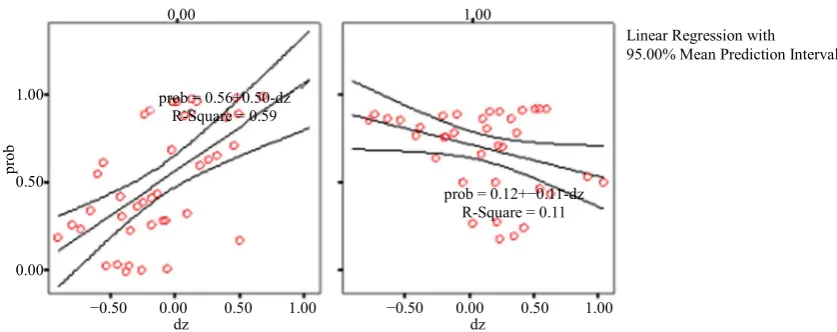
To interpret the interaction between the implicit association and attitude strength in detail, the predicted pro- babilities of taking a donor card as derived from the logistic model were plotted for a range of the IAT values [31]. AsFigure 1shows, for participants who had not reflected about signing a card (low attitude strength), the likelihood of taking a donor card increased with an increasing positive implicit association; 34% variance in the behavioural likelihood was explained. Conversely, for participants who had already thought about signing a do-nor card (high strength group), the link between behavioural likelihood and implicit associations was weaker (R2 = 0.11), as expected. The relation was slightly negative. The simple slopes analyses for involvement and attitude certainty showed the same directions.
In sum, the results show that when both attitude measures are entered simultaneously as predictors, only the explicit attitude measure predicts significantly whether someone takes an organ donor card or not. More impor-tantly, the data provide evidence for the moderating role of attitude strength. Implicit associations were observed more effective predictor of taking a donor card in case of low attitude strength.
4. Discussion
4.1. Implicit Associations and Attitude Strength
−0.50 0.00 0.50 1.00
dz −0.50 0.00 dz 0.50 1.00 0.00
1.00
pr
ob
0.50
0.00 1.00
prob = 0.56+0.50-dz R-Square = 0.59
prob = 0.12+−0.11-dz R-Square = 0.11
[image:7.595.103.522.82.248.2]Linear Regression with 95.00% Mean Prediction Interval
Figure 1.Simple slopes for the interaction between implicit associations and strength indicator “cognitive elabora-tion” on probability of taking an organ donor card.
Deliberate behaviour requires reliable knowledge and evaluations to come up with a behavioural decision, e.g. [19]. In the case of insufficient prior evaluations, further information is likely to be needed. Therefore, it seems highly possible that impulsive reactions were used as affective information to confirm one’s reflective associa-tions [27]. When the attitude strength was indicated as strong, implicit associations barely influenced the delib-erate behaviour, and the reflective system seemed to dominate card taking. This dominance can be explained by the assumption that strong attitudes are based on elaboration, which leads to more consistent and accessible schema [22] [32]. Additionally, when the impulsive and reflective system activates conflicting schemata, the re-flective system more likely controls the behaviour [24]. The slightly negative link between the implicit associa-tion and donaassocia-tion behaviour in the case of high attitude strength might underline the dominance of the reflective system. It seems possible that in the high strength group, negative impulsive reactions were even overcompen-sated. However, this interpretation is speculative and needs further investigation.
4.2. Interplay between Explicit and Implicit Attitude Measures
In line with the results obtained by Perugini [14], an interaction—though marginally significant—between im-plicit and exim-plicit attitude measures was observed. The interactive pattern suggests that the prediction of taking an organ donor card or not is more effective when implicit and explicit attitude measures are in the same direc-tion. Although this interaction showed only a trend towards statistical significance, it appeared independently of attitude strength. The implicit association’s direct impact on card taking behaviour was far from significant (p = 0.76). Accordingly, the present data provide little evidence for an additive model. Still, this missing additive pattern should be interpreted with caution, since implicit and explicit attitude measures can be dissociated for different reasons, e.g. [16] [32]. The same is true for the correlation between the implicit and explicit attitude measures. In this respect, the measures’ correlation might have been stronger if the measured constructs would be connected closer. More specifically, in our IAT we combined organ donation with anxiety and calmness items, which is slightly different than a global positive or negative evaluation used in the explicit attitude meas-ure.
4.3. Positive IAT Effect
the observed positive IAT effect was merely due to the fact that the alternative category was not a single coher-ent category.
4.4. Limitations and Conclusions
Some limitations of this contribution should be acknowledged. First, it would be desirable to validate our find-ings experimentally, e.g. by varying deliberate behaviour conditions. A second shortcoming is the behaviour measure. Taking a donor card, admittedly, does not necessarily indicate signing it. Indeed, to control actual signing behaviours will have been a stronger behaviour measure. Still, anonymously taking an offered organ donor card is a potentially important step that suggests some movement in the direction of becoming an organ donor. Third, to validate the moderating impact of attitude strength on the relationship between implicit attitudes and deliberate behaviours, tests should be performed in domains other than organ donation.
Despite these limitations, the present results suggest that dissociations between implicit attitude measures and deliberate behaviours can be due to attitude strength. While impulsive reactions seem to be used as affective in-formation to form a decision when nonexistent or weak summary evaluations exist, reflective outputs prevail in the case of strong attitudes. However, the present results mirror the predictive power of explicit attitude meas-ures as well.
Our study examined implicit associations in a domain not previously examined—organ donation behaviour. More importantly, the present contribution offers a new explanation as to why implicit associations sometimes do and sometimes do not predict more deliberate behaviours. Additionally, the results offer practical recom- mendations that communication strategies designed to foster attitude strength can help to overcome implicit as-sociations’ impact on the organ donation decision.
References
[1] Moloney, G. and Walker, I. (2002) Talking about Transplants: Social Representations and the Dialectical, Dilemmatic Nature of Organ Donation and Transplantation. British Journal of Social Psychology, 41, 299-320.
http://dx.doi.org/10.1348/014466602760060264
[2] Van den Berg, H., Manstead, A.S.R., van der Pligt, J. and Wigboldus, D.H.J. (2005) The Role of Affect in Attitudes toward Organ Donation and Donor-Relevant Decisions. Psychology & Health, 20, 789-802.
http://dx.doi.org/10.1080/14768320500161786
[3] Greenwald, A.G., Banaji, M.R., Rudman, L.A., Farnham, S.D., Nosek, B.A. and Mellott, D.S. (2002) A Unified Theory of Implicit Attitudes, Stereotypes, Self-Esteem, and Self-Concept. Psychological Review, 102, 4-27.
http://dx.doi.org/10.1037/0033-295X.102.1.4
[4] Greenberg, J., Solomon, S. and Pyszczynski, T. (1997) Terror Management Theory of Self-Esteem and Social Be- haviour: Empirical Assessments and Conceptual Refinements. In: Zanna, M.P., Ed., Advances in Experimental Social
Psychology, Vol. 29, Academic Press, New York, 61-139.
[5] Greenwald, A.G., McGhee, D.E. and Schwartz, J.L.K. (1998) Measuring Individual Differences in Implicit Cognition: The Implicit Association Test. Journal of Personality and Social Psychology, 74, 1464-1480.
http://dx.doi.org/10.1037/0022-3514.74.6.1464
[6] Greenwald, A.G. and Nosek, B.A. (2001) Health of the Implicit Association Test at Age 3. Zeitschrift für Experimentelle
Psychologie, 48, 85-93. http://dx.doi.org/10.1026//0949-3946.48.2.85
[7] Nosek, B.A., Greenwald, A.G. and Banaji, M.R. (2007) The Implicit Association Test at Age 7: A Methodological and Conceptual Review. In: Bargh, J.A., Ed., Automatic Processes in Social Thinking and Behaviour, Psychology Press, New York, 265-292.
[8] Marsh, K.L., Johnson, B.T. and Scott-Sheldon, L.A.J. (2001) Heart versus Reason in Condom Use: Implicit versus Ex- plicit Attitudinal Predictors of Sexual Behaviour. Zeitschrift für Experimentelle Psychologie, 48, 161-175.
http://dx.doi.org/10.1026//0949-3946.48.2.161
[9] Schnabel, K., Banse, R. and Asendorpf, J. (2006) Assessment of Implicit Personality Self-Concept Using the Implicit Association Test (IAT): Concurrent Assessment of Anxiousness and Angriness. British Journal of Social Psychology, 45, 373-396. http://dx.doi.org/10.1348/014466605X49159
[10] Greenwald, A.G., Poehlman, T.A., Uhlmann, E. and Banaji, M.R. (2009) Understanding and Using the Implicit Asso-ciation Test: III. Meta-Analysis of Predictive Validity. Journal of Personality and Social Psychology, 97, 17-41. http://dx.doi.org/10.1037/a0015575
Journal of Personality and Social Psychology, 82, 62-68. http://dx.doi.org/10.1037/0022-3514.82.1.62
[12] Friese, M., Bluemke, M. and Wänke, M. (2007) Predicting Voting Behaviour with Implicit Attitude Measures. The 2002 German Parliamentary Election. Experimental Psychology, 54, 247-255.
http://dx.doi.org/10.1027/1618-3169.54.4.247
[13] Karpinski, A. and Hilton, J.L. (2001) Attitudes and the Implicit Association Test. Journal of Personality and Social
Psychology, 81, 774-778. http://dx.doi.org/10.1037/0022-3514.81.5.774
[14] Perugini, M. (2005) Predictive Models of Implicit and Explicit Attitudes. British Journal of Social Psychology, 44, 29- 45. http://dx.doi.org/10.1348/014466604X23491
[15] Perugini, M. and Prestwich, A. (2007) The Gatekeeper: Individual Differences Are Key in the Chain from Perception to Behaviour. European Journal of Personality, 21, 303-317. http://dx.doi.org/10.1002/per.633
[16] Hofmann, W., Gschwendner, T., Nosek, B.A. and Schmitt, M. (2005) What Moderates Implicit—Explicit Con- sis-tency? European Review of Social Psychology, 16, 335-390. http://dx.doi.org/10.1080/10463280500443228
[17] Krosnick, J.A. and Petty, R.E. (1995) Attitude Strength: Antecedents and Consequences. Lawrence Erlbaum, Mahwah. [18] Bassili, J.N. (2008) Attitude Strength. In: Crano, W.D. and Prislin, R., Eds., Attitudes and Attitude Change, Psychology
Press, New York, 237-234.
[19] Visser, P.S., Krosnick, J.A. and Simmons, P.J. (2003) Distinguishing the Cognitive and Behavioural Consequences of Attitude Importance and Certainty: A New Approach to Testing the Common-Factor Hypothesis. Journal of Experi-
mental Social Psychology, 39, 118-141. http://dx.doi.org/10.1016/S0022-1031(02)00522-X
[20] Conner, M., Perugini, M., O’Gorman, Ayres, K. and Prestwich, A. (2007) Relations between Implicit and Explicit Measures of Attitudes and Measures of Behavior: Evidence of Moderation by Individual Difference Variables.
Perso-nality and Social Psychology Bulletin, 33, 1727-1740. http://dx.doi.org/10.1177/0146167207309194
[21] Nosek, B.A. (2005) Moderators of the Relationship between Implicit and Explicit Evaluation. Journal of Experimental
Psychology: General, 134, 565-584. http://dx.doi.org/10.1037/0096-3445.134.4.565
[22] Fazio, R.H. (1995) Attitudes as Object-Evaluation Associations: Determinants, Consequences, and Correlates of Atti- tude Accessibility. In: Petty, R.E. and Krosnick, J.A., Eds., Attitude Strength: Antecedents and Consequences, Law- rence Erlbaum, Mahwah, 247-283.
[23] Greenwald, A.G. and Banaji, M.R. (1995) Implicit Social Cognition: Attitudes, Self-Esteem, and Stereotypes.
Psycho-logical Review, 102, 4-27. http://dx.doi.org/10.1037/0033-295X.102.1.4
[24] Strack, F. and Deutsch, R. (2005) Reflective and Impulsive Determinants of Social Behaviour. Personality and Social
Psychology Review, 8, 220-247. http://dx.doi.org/10.1207/s15327957pspr0803_1
[25] Petty, R.E., Haugtvedt, C.P. and Smith, S.M. (1995) Elaboration as a Determinant of Attitude Strength: Creating At- titudes That Are Persistent, Resistant, and Predictive of Behaviour. In: Petty, R.E. and Krosnick, J.A., Eds., Attitude
Strength: Antecedents and Consequences, Lawrence Erlbaum, Mahwah, 93-130.
[26] Rudman, L.A. (2004) Sources of Implicit Attitudes. Current Directions in Psychological Science, 13, 79-82. http://dx.doi.org/10.1111/j.0963-7214.2004.00279.x
[27] Clore, G.L., Gasper, K. and Garwin, E. (2001) Affect as Information. In: Forgas, J.P., Ed., Handbook of Affect and So-
cial Cognition, Lawrence Erlbaum, Mahwah, 121-144.
[28] Egloff, B., Schwerdtfeger, A. and Schmuckle, S.C. (2005) Temporal Stability of the Implicit Association Test-Anxiety.
Journal of Personality Assessment, 84, 82-88. http://dx.doi.org/10.1207/s15327752jpa8401_14
[29] Greenwald, A.G., Nosek, B.A. and Banaji, M.R. (2003) Understanding and Using the Implicit Association Test: I. An Improved Scoring Algorithm. Journal of Personality and Social Psychology, 85, 197-216.
http://dx.doi.org/10.1037/0022-3514.85.2.197
[30] Aiken, L.S. and West, S.G. (1991) Multiple Regression: Testing and Interpreting Interactions. Sage, Newbury Park. [31] Jaccard, J. (2004) Interaction Effects in Logistic Regression. Sage, Thousand Oaks.
[32] Petty, R.E. and Cacioppo, J.T. (1986) The Elaboration Likelihood Model of Persuasion. In: Berkowitz, L., Ed., Advan-
ces in Experimental Social Psychology, Vol. 19, Academic Press, New York, 123-205.
[33] Olson, M.A. and Fazio, R.H. (2004) Reducing the Influence of Extrapersonal Associations on the Implicit Association Test: Personalizing the IAT. Journal of Personality and Social Psychology, 86, 653-667.
http://dx.doi.org/10.1037/0022-3514.86.5.653
[34] Fiedler, K., Messner, C. and Bluemke, M. (2006) Unresolved Problems with the “I”, the “A” and the “T”: A Logical and Psychometric Critique of the Implicit Association Test (IAT). European Review of Social Psychology, 17, 74-147. http://dx.doi.org/10.1080/10463280600681248
[35] Rothermund, K. and Wentura, D. (2001) Figure-Ground Asymmetries in the Implicit Association Test (IAT). Zeitsch-