
Munich Personal RePEc Archive
Excess sensitivity of consumption using
micro data in the UK
Yu, Ge
2005
EXCESS SENSITIVITY OF CONSUMPTION
USING MICRO DATA IN THE UK
1 INTRODUCTION
The arguments over the Permanent Income Hypothesis (PIH) and the rational
expectations extension of it (REPIH), concerning suggestions of excess sensitivity of
consumption, have been continued for decades without an explicit solution. This is
because there have been no conclusive findings in empirical studies. Most empirical
results show confidence in supporting one or rejecting the other. This vagueness has
significant and negative consequences for understanding the consumption/savings
processes of households and for improving our knowledge of economic trends and
stabilization from a policy perspective.
In the literature, many researchers have carried out investigations to test the validity of
assumptions such as hyperbolic discount rates1, binge augmented consumption, habit
persistence, and the excess sensitivity of consumption to income. However, only a few
empirical papers have investigated the impact of individual subjective information on
economic outcomes.
The methodology developed by Souleles (2001) to test for excess sensitivity with respect
to household data has a deep intuitive appeal. Rather than testing excess sensitivity using
aggregate data, Souleles used US household-level data from the Michigan Index of
Consumer Sentiment. He found that consumer sentiments were useful in forecasting
future consumption, even after controlling for lagged consumption and macro variables
such as stock prices. Furthermore, the systematic demographic components in forecast
errors were used to reject of the PIH. Melvin (2003) also examined the link between
subjective job loss expectations and the subsequent impact on household consumption
behavior behind the intuition suggested by Flavin (1981) and Campbell and Deaton
(1989).
In this paper, I follow Souleles (2001) and Melvin (2003) by using data derived from the
BHPS. This contains questions on the expected level and changes in a number of relevant
economic variables and British respondents’ uncertainty in making these predictions
covering the years 1991 until 2002. One of the main novelties of this thesis is that it uses
the financial situation validate in the BHPS to value the respondents’ well being instead
of the term ‘income’ popularly used in most papers. This is particularly interesting due to
the potential relationship between macro-economic shocks and individual psychological
well-being. Thus, while a narrow interpretation of financial situation is income, a broader
interpretation would take into account the values of any assets agents hold and the
incomes they currently received or expect to receive in the future. Most interesting, some
who experience an increase in current income may feel themselves worse off financially.
This is similar to the results in paper 5 in which respondents’ expectations decrease with
increasing real income. In other words, the idea of an agent’s financial situation or
satisfaction can potentially include many factors that are difficult to identify or value but
can significantly affect agents’ decision making behaviour in the real world. Furthermore,
Das and Van Soest (1996) argue that subjective answers reflect real rather than nominal
changes. Although the questions in the BHPS are not very well specified, it seems
reasonable to assume that respondents have the same broad concepts in mind when
answering questions on their financial outcomes and future expectations. In each wave of
the BHPS, agents answer questions on whether their actual financial situation has
changed in the past twelve months, and on whether they expect it to change over the next
twelve months. Both questions are answered on a three points scale2. In addition, the
following analysis breaks down the whole sample into various sub-samples to test for
excess sensitivity among each of these groups. It is hoped that these results can provide a
deeply insight into the divergence of sensitivity of each individual component to
consumption fluctuations.
2 RELATED STUDIES
Hall’s random walk hypothesis of consumption argues that if agents have rational
expectations (that is, if they are forward-looking) then current consumption should only
depend on consumption in the most recent period, and that not other variables will feature.
The implication of the REPIH is that if all past and predictable information is
incorporated in current consumption, no lagged information can provide additional
explanatory power in accounting for variations in future consumption. Thus, one way to
test the predictions of the REPIH is to examine whether consumption is sensitive to
anticipated changes in interested explanatory variables such as income. This approach has
been taken by Hall and Mishkin (1982), Altonji and Siow (1987), Attanasio and
Browning (1995) and Lusardi (1996) among others. As a means of testing the impact of
lagged variables on consumption, regression equations of the following from have been
introduced:
1 1
1 ( + ) +
+ = +
Δct βEt yt εt or Δct+1 =βEt(yt+1 −yt)+εt+1 (1)
Where y is household real income. If theoretical predictions of the permanent income
model and rational expectations are valid then H0:β =0. In many studies (eg. Hall,
1978; Zeldes, 1989; Jappelli et al., 1998) the (log) level of income is used. Attanasio and
Weber (1993) used the growth in income. It is noted that the income term can be
considered as predictable income or income growth in t or t+1, using instruments dated
t-1 or earlier. The Euler equation is a period-to-period arbitrage condition and therefore does not take into account the effects of future constraints on current behavior. As such,
when estimating Euler equations using panel data. Chamberlain (1984) states that “a time
average of forecast errors over T periods should converge to zero as N →∞. But an average of forecast errors across N individuals surely need not converge to zero as
∞ →
N ; there may be common components in those errors, due to economy-wide innovations.” As a result, a set of time dummies are also included in equation (6.1) to
guard against this problem in many empirical studies3. Altug and Miller (1990) claim that
these dummies can be interpreted as the undiversified aggregate risk facing intertemporal
decisions under a complete market setting. Although the panel data (1991-2002)
employed in this thesis is longer than that used in some earlier studies, the time
dimension may still not be long enough. As a result, time dummies are included in the
regressors.
Flavin (1981) used the excess sensitivity tests to mount a powerful rejection of the
REPIH. Two ideas are developed in her work. One is that a stronger test for consumption
than the reduced-form consumption equation is provided. In addition, she attempts to
identify consumer’s reaction to both anticipated and unanticipated income shocks.
Flavin’s model mainly focuses on the role played by current income in providing new
information about future income. Under the permanent income hypothesis a rational
agent can use such information to upgrade his/her permanent income expectations. A
drawback of Flavin’s test is that both income and consumption processes need to be
modeled and the results which emerge from this are sensitive to the modeling
specifications that are used4.
Thus, a trended ARMA representation was used to model the time-series properties of the
income process and to specify agent’s expectations about their future levels of income.
Under assumption of an ARMA process for income, actual revisions in permanent
income can possibly be acquired from the contemporaneous observation of current
3
Zeldes (1989), Altongji and Siow (1987), and Runkle (1991)
income. This revision is given by the forecast error in the ARMA specification and such
an error represents unanticipated news associated with current observations of income5.
The magnitude of the revision would then depend on the parameters of the ARMA
representation of the income process. Together with this argument, one can ‘specify a
structural equation relating the change in consumption to the contemporaneous revision
in permanent income (modeled using the income innovation) and the change in current
income’. [pp.976]. As a result, it is possible to use Flavin’s model to explore the
determinants of change in consumption for inferring agents’ expectations.
Since the path of future income is uncertain, an individual must make his consumption
plans on the basis of some set of expectations about future income. Given the
expectations about future income held in period t, the individual’s permanent income can be expressed as
⎥ ⎦ ⎤ ⎢ ⎣ ⎡ + + =
∑
∞ = + + 0 1 ) 1 1 ( k k t t k t pt E y
r A
r
y (2)
where is permanent income at time t; is their stock of assets at time t; r is the
constant real rate of interest; is their labor income at time t; and is the
expectations operator for expectations at time t.
p t
y At
t
y Et
Allowing for a stochastic, or transitory, component of consumption, the consumption
function for the representative individual becomes t, or
p t t y u
c = +
t k k t t k t
t E y u
r A
r
c ⎥+
⎦ ⎤ ⎢ ⎣ ⎡ + + =
∑
∞ = + + 0 1 ) 1 1( (3)
5
where the error term ut denotes the transitory component of consumption.
Solving for ct+1 in terms of ct, subject to At+1 =(1+r)At + yt −ct, gives:
∑
∞ = + + + + + + = + + − − + + 0 1 1 1 11 ) ( ) (1 )
1 1 ( k t t k t t t k t
t E E y r u u
r r
c
c (4)
Consumption will evolve as random walks only if the transitory consumption term is
identically zero, ut ≡0. So I can re-write
⎥ ⎥ ⎦ ⎤ ⎢ ⎢ ⎣ ⎡ − ⎟ ⎠ ⎞ ⎜ ⎝ ⎛ + + − ⎟ ⎠ ⎞ ⎜ ⎝ ⎛ + = − + = Δ
∑
∑
∞ = + + − + + ∞ = + + − + 2 1 1 1 1 1 1 ) ( 1 1 ) ( 1 1 ) ( ) 1 ( k k t t t k t t t k k t t t k t y E E r y E y r r y E E r r c (5)Consequently I use the above equation to understand how changes in expectations of
future income relate to consumption changes. Because the first term represents the
household’s expectations errors concerning current income, , while the second term
corresponds to the influence of changing expectations regarding future income ,
, changes in consumption between the two periods can be decomposed into these
two terms. A basic empirical implication of this model is that, even if the behavioral
marginal propensity to consume out of current income is zero, consumption should
respond to changes in current income because these innovations provide new information
about future income and therefore induce revisions in expected permanent income. In
other words, one alternative hypothesis is that expectations errors might not be classical
but rather contain systematic components correlated with the excess sensitivity regressor.
Chamberlain (1984) states that systematic expectations errors can be a potential problem
in estimating any rational expectations (or forward-looking) model in a short panel. For
instance, female respondents might, on average, have been optimistic about future over
the sample period, so that they increase their consumption due to their over-optimism or a
positive correlation between consumption and expectations would not be inconsistent
with the REPIH. The availability of the direct measures of respondents’ expectations
errors in the BHPS makes it possible to test this point directly.
The null hypothesis in Flavin’s paper is the permanent income hypothesis associated with
an autoregressive specification for the process governing labor income. In general, it also
can be specified as followed:
) )( ( ) 1 ( 1 0 τ α αη
ε T t t t t k t k
k
k t
t
t r E E w y
c − + +
− = − − + + = = =
Δ
∑
(6)t t
y L ε
φ( ) = (7)
where . Flavin also introduces the possibility of unanticipated capital
gains in the model, so surprises in non-labor income, , are allowed to be different
from zero. Strictly speaking, Flavin’s excess sensitivity hypothesis allows consumption to
respond to current and lagged changes in income by more or less than is required by the
permanent income theory. The extended version of Flavin’s model is as followed:
τ k t k t k
t w y
y+ = + + +
τ
y
t t
y
L μ ε
ξ( ) = + (8)
t t t
t L y u
c = + + Δ +
Δ γ θε β( )
where ξ( )=
∑
=0ξ ,ξ0 =1 andi i p i L
L β(L)=
∑
ip=0βiLi;β0 ≠1. It should be noted thatFlavin rearranges the AR(p) income process equation and substitutes the error term εt into the consumption equation for income variable. Hence, the first difference of
innovation in the income process in the unrestricted version of the model. The measures
of excess sensitivity of consumption to current income,β, provide an estimate of the
amount of additional response of consumption to the new information contained in
current income. In sum, according to the REPIH, consumption changes should not be
related to other variables except of the amount to income innovation provided by the
error term ε . Hence all the β coefficients, which represent the extend to which
consumption responds to previously predictable changes in income, should be zero.
In Flavin’s paper, she runs an eight-order auto-regression (p=8) for the labor income
process. The restriction β0 =β1 =...=β7 =0 is imposed on the system to obtain a
constrained system that can be estimated. She then used data on non-durable goods
consumption from 1949(3) to 1979(1) and found that the likelihood ratio statistic for the
hypothesis 0β0 =β1 =...=β7 = was 27.02 for . Hence the random
walk specification of Hall was rejected by Flavin. [pp. 999]. The estimates for the first
three sensitivity parameters are .335, .071 and .049. These results indicate a strong excess
sensitivity response of consumption to changes in current income. [pp. 1002] 96
. 21 ) 8 (
2 =
χ
However Mankiw and Shapiro (1985) and Deaton (1992) began to question the validity
of the stationary income process assumption, one of the main econometric techniques
used by Flavin, and discussed the actual form that modeling the income process should
take when such a process appears to be non-stationary. They also criticized the method
used by Flavin to account for the upward trending behaviour of income which dealt with
the non-stationary nature of the income process by fitting exponential time-trends to both
consumption and income, and by replacing consumption and income in the regressions
by their residuals. In particular, Mankiw and Shapiro argued that excess sensitivity is
induced by this detrending procedure, even if excess sensitivity is not present in the data.
(8) cannot provide much information for both sides of the consumption equation as each
are of a different order of integration6. The problems about making inferences about the
coefficients on lagged income using standard t and F-tests are essentially the same as the problems that occur in discerning the existence of a unit root in a univariate time series,
and the use of standard normal tables at usual significance levels results in over-rejection.
Deaton (1992) ran a Monte Carlo experiment7 to test this point and found that the
t-statistics for excess sensitivity on each of the income variables, and the test for excess sensitivity as a whole (an F-test), rejected more than the customary 5%8.
However Stock and West (1988) challenged Mankiw and Shapiro’s suggestion that
excess sensitivity was the result of bad econometric practice by using the concepts of
cointegration and error correction to provide a means of testing excess sensitivity:
t d t d
t t
t b bc b y b y u
c = 0 + 1 −1 + 2 −1+ 3 −2 +
where yd is the same income measure used by Flavin. Now, if savings is defined as
t t d
t t
t b b b c b b y b s u
c = 0 +( 1 + 3) −1+( 2 − 3) −1 + 3 −1 + (9)
We would see that the savings variable plays the error correction role in this model if we
expect the coefficient of the lagged consumption variable (b1 +b3) to be close to one.
Sims, Stock and Watson (1990) show that in a regression of integrated variables of the
same order, standard asymptotic theory can be applied to parameters that can be written
as the coefficients of stationary variables. If consumption and disposable income are
cointegrated, then the last two variables of equation (9) are stationary. Hence, it is
6
To see this note that in (21) the income equation is already in reduced form, and to obtain the reduced form for consumption I only need to substitute the income equation into the consumption equation (see Deaton (1992) pp. 89).
7
Deaton himself recognizes that ‘the Monte Carlo results, although tailored to reflect the actual data, do not generate results that look like Flavin’s’. [pp. 94]
8
possible to make inferences about the excess sensitivity parameters and . Stock
and West also used Monte Carlo experiments to show that their technique worked and
found evidence in favor of excess sensitivity. Thus, according to Stock and West, the
problem with Flavin’s test procedure is that the imposition of a unit coefficient upon the
lagged consumption variable alters the asymptotic distributions of the estimates.
However once we correct for this problem, evidence for excess sensitivity still appears to
exist.
2
b b3
3 DATA
4 METHODOLOGY
In life cycle models of individual behaviour, future expectations play an important role.
As a result, it is believed that they may help in making forecast of individual behaviour in
consumption or saving. This has lead to an increasing interest in data on, and the
modelling of, expectations. The preceding discussion has clearly indicated that standard
theoretical predictions are prone to dismissals primarily depending on the information
sets the household faces. Any assumption on the homogeneity of preferences and
information sets the households face might lead to inefficient evaluations. To deal with
this shortcoming, Souleles (2001) came up with a simple but novel way of estimating
consumption patterns by exploring the response of different types of households over
time. In this paper, following on from Souleles (2001) and from Melvin (2003), direct
information on respondents’ future financial change expectations, which are different
from the standard approach9 of inferring expectations from panel data on outcomes that
leads to the assumption of rational expectations are used, to test for excess sensitivity.
In this analysis, the individual’s financial variables are used as a proxy of income to
explore the relationship between financial well-being and household consumption. To the
extend, the current income shock yt+1−Etyt+1 is taken the place of the financial
expectations errors. Financial expectations change is related to future income
expectations change, . The first part of this paper follows Souleles’ (2001)
method to test for the excess sensitivity of consumption to changes in financial
expectations. To do this Souleles added the lagged expectations variable Fisitx to a standard linearized Euler equation for consumption. Thus, for household i the change in consumption between period t+1 and t is specified as
k t t t E y
E+ − ) + ( 1
) 10 ,..., 1 (
1 , 1 , , 1
1
, = + + + =
Δcit+ αtimet+ βFisitxit γWit+ εit+ t (10)
Where Δc refers to changes in household nondurable consumption10; time includes a full set of year dummies (1992~2002), which controls for all aggregate (uniform) effects,
including seasonality, aggregate interest rates, and other macro variables which allow for
changes in the households financial situation from year to year; Fisitx denotes the expectations of financial situation change; while W controls for demographic characteristics such as changes in the number of adults and children11 in the household.
There are many possible sources of excess sensitivity, such as myopia and the existence
of liquidity constraints. As a result, the second stage of the analysis is to explore the
possible sources of excess sensitivity associated with the whole sample and with some
sub-samples of it. The analysis also distinguishes between anticipated changes in
financial situation that are negative (deteriorated financial situation changes) from those
that are positive (improved financial situation changes). This asymmetry between
10
Since many studies examine the change in log consumption, the results of the analysis using this alternative dependent variable are presented as well.
11
negative and positive resource changes is first discussed in Altonji and Siow (1987) and
recently analyzed by Shea (1995b;1995a). A simple extension of equation (6.10),
following Shea (1995b), provides a deeper insight into the evolution of the consumption
process given the following:
) 10 ,..., 1 (
1 , 1 , , 2 , 1 1 1
, = + + + + =
Δ − + + +
+
+ time Fisitx Fisitx W t
cit α t β it β it γ it εit (11)
where β1 and β2 are dummy variables indicating and respectively.
This form allows us to test whether excess sensitivity can be explained by the following
reasons.
−
t i
Fisitx,
+
t i
Fisitx,
1. Rule-of-Thumb Consumers. There are consumers who are myopic. They are assumed to have a constant marginal propensity to consume out of current wealth
or income and therefore do not behave as predicted by the REPIH. As a result,
such consumers will be excessively sensitive to variables known in the
information set. However, rule-of-thumb consumers will respond to changes in
their financial resources regardless of whether these are expected to be an
improvement (a positive change) or a deterioration (a negative change). In other
words, if consumers are myopic, β1 and β2 should both be significantly
positive and of similar magnitudes.
2. Liquidity Constraints. Consumption models based on the presence of liquidity constraints predict a stronger (positive) response in consumption growth to
positive predicted financial resource growth than to negative financial resource
growth because liquidity constraints only preclude borrowing against future
expected financial source growth but do not inhibit saving ahead of future
expected financial resource reductions. Hence consumers can save and smooth
outcome would also be expected if forecast errors represent a transitory financial
situation shock as in buffer-stock saving models, such behaviour reflects
‘self-imposed’ liquidity constraints. Thus, if liquidity constraints were the main
cause for rejections of the REPIH, we should observe excess sensitivity only
when consumers expect increases in financial resource but are prohibited from
borrowing. In such a case β2 should be significant if a household head is
genuinely liquidity constrained, but β1 should be insignificant.
3. Asymmetric Preferences. Another plausible explanation for the excess sensitivity to predicted changes in financial resource is that households do not have
time-separable preferences as assumed. If there is inertia in preferences, perhaps
due to the role of habit formation, households will only adjust their behavior
slowly. In the case of asymmetric preferences, β1 should be significant while
2
β should be insignificant. Carroll (1995) applied two dummy variables to test
the existence of an asymmetric response of consumption to positive and negative
shocks to permanent income by using information on union contracts to construct
a measure of expected income growth for each household. He found that the
response of consumption to negative income shocks were much higher than those
associated with positive income shocks. Likewise, Bowman et al. (1998) used a database derived from five countries (Canada, France, West Germany, Japan, and
the United Kingdom) to estimate the expected income growth and found
empirical support for an asymmetry in consumption behaviour. Bowman et al’s method for estimating the expected income growth was to regress actual income
In most cases, economists who assume that individuals do not make systematic errors
under the REPIH find that it works well using aggregate data. Because the BHPS
involves information on individuals’ financial well-being, this paper tests to see whether
individuals’ subjective financial well-being influences their consumption behaviour
(non-durable consumption). Next, this paper examines the overall distribution of
individual financial well-being and consumption with respect to various categorizations
of household types.
To carry out a further investigation of the failure of Hall’s random walk hypothesis, this
paper then returns to the residual, ε, which determines changes in consumption and
potentially includes many factors, such as measurement error or unobserved
heterogeneity in discount rates. According to Flavin (1981), Campbell and Deaton (1989),
and Melvin (2003), equation (6) can help to decompose ε into two components: the
change in consumption resulting from unexpected current financial changes; and any
revisions in expected future financial situations. Empirically, the following equation (12)
is used, which shows a direct relationship between financial expectations errors and
household consumption, to assess whether systematic heterogeneity in expectations errors
can lead to spurious inference more generally in forward-looking models.
) 10 ,..., 1 (
1 , 1 , 1 , 1
, 1
1
, = + + + Δ + + =
Δcit+ αtimet+ βFisitxt ϕFisiteit+ φ Fisitxit+ γWit+ εit+ t (12)
Where Fisite denotes financial expectations errors and ΔFisitx denotes changes in
respondents’ financial expectations. For consistent estimates of β, the forecast errors
need to be uncorrelated with the excess sensitivity regressor Fisitx. With direct measures of expectations errors, we can test the implications of systematic heterogeneity in the
errors. Also, shocks to financial situation are considered to be among the most important
sources of the overall changes in consumption in ε . Under the alternative hypothesis
we would expect to find β =0 and ϕ >0, since the REPIH allows for consumption to
respond to the current financial shocks represented by Fisite. εi,t =μi +vi,t, where
i
μ captures the unobserved, time-invariant characteristics of the individual. It means that,
for all observations relating to a given individual, μi will have the same value,
reflecting their unchanging unobserved characteristics. For μi to be properly specified,
it must be orthogonal to the individual effects. are random errors. In this case
and the
it
v
) , 0 ( ~ ), , 0 (
~ 2 2
v it
i IID σ v IID σ
μ μ μi are independent of the . In other words,
the cross-sectional specific error term
it
v
i
μ must be uncorrelated with the errors of the
variables if this is to be modeled with other explained variables. However the later
assumption is unrealistic in the present context, as W includes demographical variables
that are correlated with, for example, any unobserved ability captured in μi . Furthermore, if this unobserved individual specific effect is also correlated with the
expectations errors, then the main coefficient of interest, β, will be biased. Panel data
allow us to overcome these potential problems of endogeneity by treating the unobserved
effect μi as random, and I estimate equations (11) and (12) using random effect models.
In the process of developing detailed simulation models we need to identify a proxy for
non-durable consumption while food and grocery expenditures are considered to be fairly
unresponsive to changes in purchasing power in aggregate data, that is, the consumption
of food is relatively inelastic to income, at the level of individual or household. We might
expect to observe significant changes in food and grocery expenditure when there are
noticeable changes in their financial circumstances and a reasonably strong relationship
between food expenditures and their financial well-being. All specifications have the
derived from the BHPS, I exploit cross-sectional variation by controlling for time effects
and investigate the source of any excess sensitivity by using a random effects model.
5 RESULTS AND ANALYSIS
5.1 Evaluating Excess Sensitivity
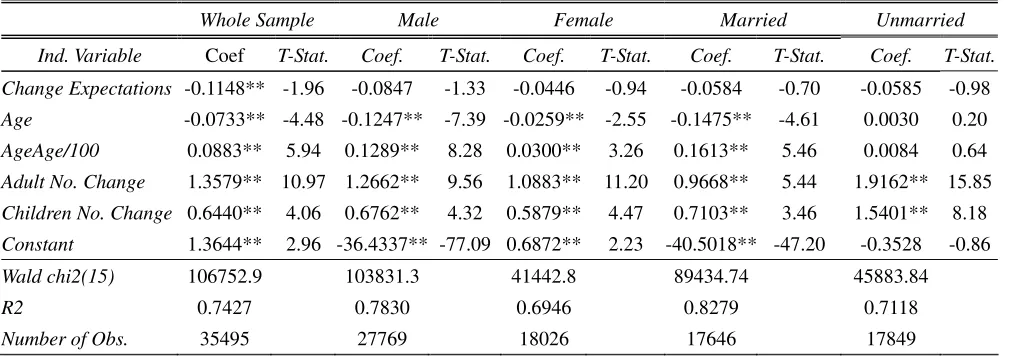
In terms of the excess sensitivity tests, there are two main findings. First, Table 1 in
Appendix provides robust estimates of the model parameters for the estimating equation
(10). If the REPIH holds, one would expect to find that the coefficient of financial well
being growth (β) would not be statistically different from zero. Instead the test reports a
significant β with a coefficient estimate of -0.1148 for nondurable consumption in the
whole sample. This clearly indicates that consumption fluctuated with anticipated
changes in financial well being and this amounts to a decisive rejection of the REPIH:
consumption is excessively sensitive to current financial well being changes, or, in other
words, it suggests that individuals fail to peg their consumption to expectation of their
permanent wealth.
Carroll (2001) explains the correlation between future expected resource growth and the
probability of excess sensitivity by arguing that such households are more likely to want
to borrow or because expected resource growth effectively raises the degree of
impatience. In addition, the information on financial expectations appears to help predict
consumption. The signs on β are negative in most sub-samples. Thus, in all cases,
better financial states are associated with less steep consumption profiles; that is, higher
expectations are associated with less saving. This outcome is both consistent with
precautionary motives for saving (Deaton, 1992; Carroll, 1992; Lusardi, 1998) as well as
with increases in expected future resources. While adding demographic variables into the
these variables act as important control variables. Thus age is employed as a significant
variable in the regressions. Age decreased consumption up to 41.5 and thereafter
increased it (because quadratic ax2 +bx+c turns over at
a b x
2
−
= , which for age
and age2 coefficient is ) 100 41.50 0883
. 0 2 ) 0733 . 0 (
(− − × × ≈ ). Other demographic
terms also showed plausible signs. For example, there was a positive relationship
between consumption growth and family size or changes in the number of children.
Second, the evidence for excess sensitivity is statistically significant in only some
sub-samples. For example, with respect to household heads with highly educated level,
β(-0.1605) was statistically significant at the 5% level; however it was insignificant for
other groups in the education sub-sample. This suggests that high-educated agents fail to
smooth their consumption, but agents with comparatively lower education level smooth
consumption very effectively in the sense that they do not display excess sensitivity. In
the same vein, I can refer the employee, the self-employed, or higher degree holders as
the excess sensitivity groups. Among the other groups, agents’ expectations did not affect
their nondurable consumption. In other words, the REPIH could not be rejected for
results in these sub-groups.
5.2 Tests for Myopia and Liquidity Constraints
As was indicated earlier, deeper insights into the relationships between the excess
sensitivity of consumption and the dependence of consumption to financial situation
change can be obtained by extending equation (10) to equation (11). In addition, changes
in financial situation are divided into negative and positive parts to investigate whether
consumption changes are more sensitive to stochastic financial deteriorations or
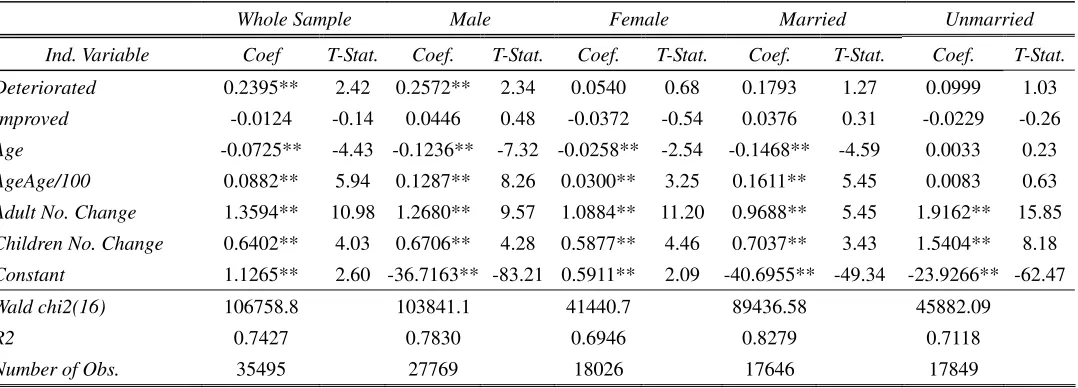
improvements. The estimated equation and results are presented in Table 2 in Appendix.
A similar set of instruments as in the previous case were used for these estimations. These
deterioration in their future financial situation. Conversely the coefficient of positive
financial well being growth is insignificant and ambiguous. The above exercise proves an
important point in that we can formally reject β1 =β2 =0 in favor of β1 >β2, a result
strikingly similar to that found by Shea (1995b).
Under predictable or expected financial well being changes, myopia would imply that
consumption fluctuates equally in response to both positive and negative financial
situation variations. Thus, if households are indeed myopic, they would be incapable of
pegging their consumption to their permanent income, in which case, consumption
should increase whenever their financial situation improves and decrease whenever their
financial situation deteriorates. Hence changes in consumption should be uniformly
related to changes in financial well being. This analysis finds that consumption is affected
only by negative financial well being growth. This does not conform to the situation of
myopic consumption behavior. One the other hand, if liquidity constraints exist, predicted
financial situation deterioration should make forward-looking individuals save more, and
thereby avoid a decline in their consumption. Therefore, consumption should be more
sensitive to predicted financial situation improvement than to financial situation
deterioration, due to existence of anticipatory savings. However, if financial well being
fluctuations are predictable, the above results are not indicative of either myopia or
liquidity constraints. And, the effect of anticipated financial well being fluctuations might
be quite different. Individuals, then, would be incapable of forecasting financial situation
deterioration. Thus it is plausible that an inability to borrow pulls consumption down with
deteriorated financial situation. Nevertheless, the failure of the REPIH is apparent from
the empirical results. However, the cause for this breakdown remains unclear in the
present analysis.
Consequently, asymmetric preferences appear to be the most important source of the
nonseparabilities in preferences, and I would focus on those that induce asymmetric
responses to positive and negative predicted financial resource changes. Such behavior
could arise if individuals weigh outcomes that are above and below a certainty equivalent,
or treat gains and losses differently.12 For example, if consumers with asymmetric
preferences (i.e., they are averse to negative changes) expect a negative income change in
t+1, they would gamble that the negative shock will not occur rather than revise
downward in expectation of the negative shock. A small reduction in and a large
negative change in can therefore translate into a large negative for a given
expected change in financial resources. In contrast, when consumers anticipate a future
but positive income change in period t, they will revise upward immediately just as
any expected utility maximizer would. This implies that
t
c
t
c
1 +
t
c Δct+1
t
c
1 +
Δct will be small in response
to the anticipated positive change in financial resources. In summary, I used equation (11)
to test three hypotheses and found that Asymmetric Preferences appears to be the most important source of excess sensitivity.
Turning to the results from sub-samples, the coefficients of anticipated financial well
being deterioration are significant in male, employee, and the highly educated groups in
line with the explanation of asymmetric preferences in the whole sample. However, the
coefficient of financial well being improvement is significant in self-employed group.
This result implies that liquidity constraints can be the source of excess sensitivity for the
self-employed respondents.
5.3 Detecting Excess Sensitivity in Systematic Heterogeneity
Another possibility, but one that has not previously received much scrutiny in the
12
literature, is systematic heterogeneity in expectations errors. This is especially likely to be a problem since both the financial situation variables and expectations errors were
found to be correlated with household’s demographic characteristics in paper five. These
findings suggest that even a long sample period and a full set of time dummies might not
be enough to ensure the orthogonality of the expectations errors with the financial
situation variables13. Furthermore, Flavin (1981) derives a model to identify the
consumers’ reaction to expectations errors and changes in expectations of their future
resources. The direct measures of households’ expectations errors found in the BHPS
make it possible to explore whether expectations errors play an important role in the
rejection of the REPIH. As a result the expectations errors were added into equation (10)
and equation (12) was used to consider whether systematic heterogeneity in expectations
errors was another source of excess sensitivity.
There is likely to be a multicollinearity problem if financial expectations changes are
correlated with expectations errors. In other words, even a long sample period and a full
set of time dummies might not be enough to ensure orthogonality of the expectations
errors with the financial expectations regressors. To test for multicollinearity each x was regressed on all of the other x variables. The 2
1−R from this regression was then used to see what fraction of the first x variable’s variance was independent of the other x
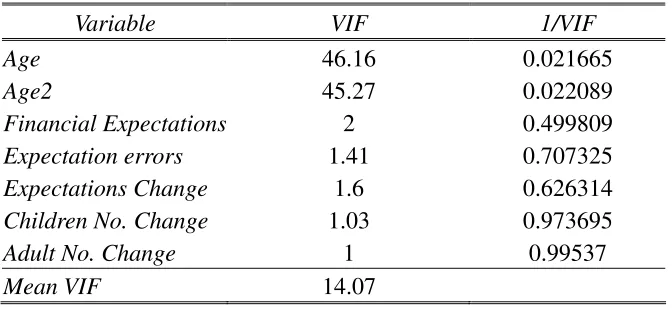
variables. The results from VIF (Variance Inflation Factor) Table 3 in Appendix give a
quick and straightforward check for multicollinearity. The 1/VIF column at right in a VIF
table gives the values equal to 1−R2 . It shows that 65.8% of the variance in
expectations errors’ was independent of age, age2, financial expectations, expectations change, change in number of adults, and change in number of children. Similarly, about 63.9% of the expectations change’s variance was independent of the other variables.
13
The VIF column in the center of the VIF table reflects the degree to which other
coefficients’ variances (and standard errors) are increased due to the inclusion of that
predictor. This shows that both expectations errors and expectations change have virtually no impact on the other variances. In sum, there is not substantial
multicollinearity in the regressions.
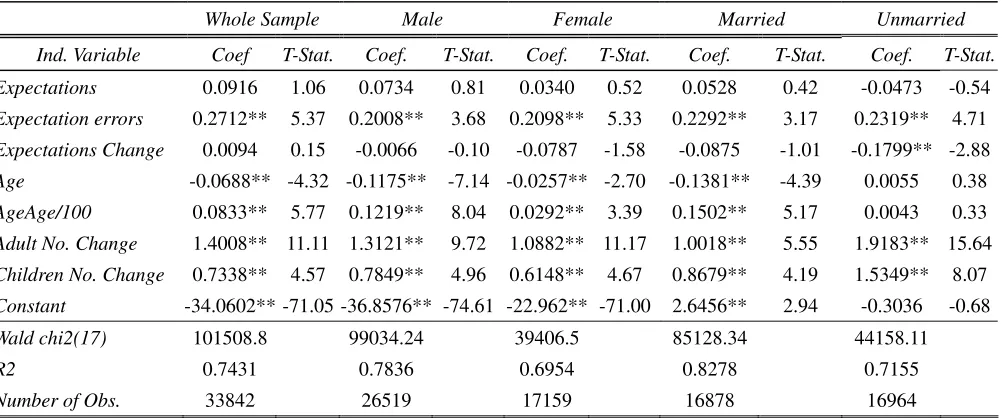
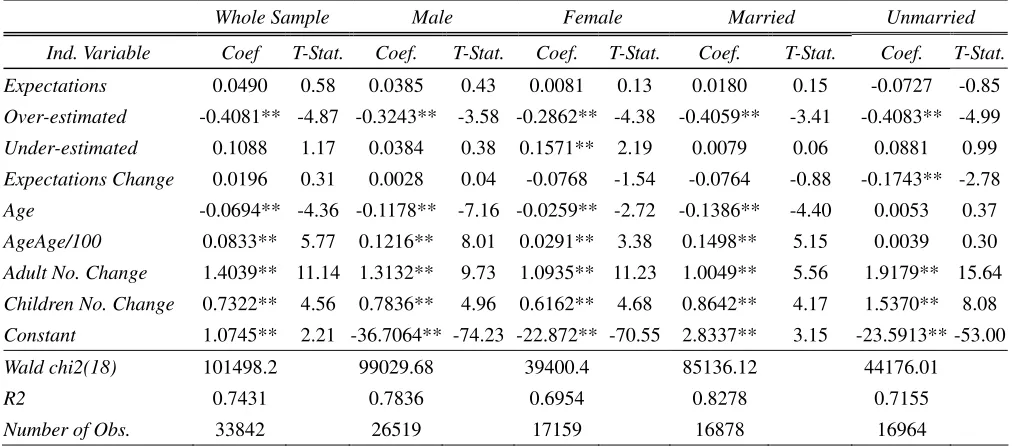
Table 4 in Appendix shows that the coefficients of ϕ on the expectations errors, Fisite,
are significant in the whole sample and nearly all of the sub-samples despite the inclusion
of the time dummies in the equation. It notes that the excess sensitivity regressor β
becomes insignificant in all groups, except for the self-employed and the respondents
with the secondary education level, when expectations errors and expectations changes
are controlled for. This means that some excess sensitivity persists among self-employed
and the secondary-educated respondents and is not due to heterogeneity in expectations
errors alone. However, for most respondents, some of the excess sensitivity appears to be
due to systematic heterogeneity in expectations errors. This suggests the possibility that
previous excess sensitivity tests might have made spurious inferences. Also, the resulting
coefficients of expectations errors in Table 4 are positive and marginally significant. In
other words, the more positive the expectations errors, the more pessimistic the
household is in regards to their financial situations and the larger is the magnitude by
which they would change their consumption. The coefficients φ of the changes in
expectations of future financial resources are not significant except for the unmarried and
the self-employed groups. The insignificance of the φcoefficients is consistent with the
assumption that changes in expectations of future financial resources are incorporated
into current consumption.
For more details about the response of consumption to expectations errors, I
over-pessimistic) from those that were negative (over-estimated/over-optimistic), and
denoted them by and , respectively. The equation now took the
form:
+ +1 ,t i
Fisite Fisitei−,t+1
) 10 ,..., 1 ( 1 , 1 , 1 , 1 , 2 1 , 1 1 1
, = + + + + Δ + + =
Δ + + + +
+ −
+ +
+ time Fisitx Fisite Fisite Fisitx W t
cit α t β t ϕ it ϕ it φ it γ it εit
The results (Table 5) of splitting the expectations error term were again consistent with
the predicted result: positive expectations errors were positively correlated with
consumption but the relationship was insignificant except for higher-educated agents. In
addition, there was no significant differences in the consumption growth changes
between over-pessimistic agents and “smart” agents. This implies that agents refuse to
decrease their consumption level in when they are pessimistic about their future
financial source. will be small when their pessimistic expectations are proved to
wrong. In contrast, the coefficient for negative expectations errors (over-estimation) are
also of the correct sign and highly significant in most of the sub-groups. Thus consumers
who tend to be over-optimistic increase their consumption more than those that have
correct expectations of their future financial resources. It means that agents increase their
consumption as soon as they feel optimistic about their future financial resources. But, if
they are over optimistic, there would be a large increase in and a relatively less
increase or even a reduction in . This would lead to a negative consumption growth.
So, the results of splitting the expectations errors provide more evidence to support the
finding that asymmetric preferences are an important cause of excess sensitivity.
t
c
1 + Δct
t c 1 + t c 6 CONCLUSION
and has evaluated the model empirically with a household micro panel data set which
includes exhaustive information on consumption. The theoretical formulation presented
here is that of a benchmark consumption model following the main assumptions of the
REPIH. The primary focus of the discussion was to re-evaluate the excess sensitivity
puzzle of consumption behavior. Simple investigations on the BHPS data set, used for
empirical aspects of this thesis, revealed some interesting facts. What follows from this
empirical work is that consumption may be associated with other variables other than
financial wealth. In the introductory sections, I reviewed the work by Souleles (2001) and
Flavin (1981) which used US data sets. Their studies appear to be an excellent
benchmarks for formulating the analysis strategy: this empirically revisit the random
walk hypothesis of consumption using Souleles’s method; used the extensions presented
in Shea (1995b) to evaluate myopic consumption behavior and the existence of liquidity
constraints; and finally, a follow-up of the Flavin test of excess sensitivity was carried out
to investigate the role of expectations errors in explaining the excess sensitivity. While
this previous work used aggregate data to test the REPIH hypothesis, the present study
employed their methodology to investigate patterns from the BHPS data set.
The results clearly refute the predictions of the rational expectation extensions of the
PILCH. In the first regression (Table 1), the results indicate an excess sensitivity of
current consumption to one-period lagged financial well being.
In the next regressions, financial wealth growth was divided into positive and negative
parts. The results (Table 2) indicate that consumption fluctuations are significantly related
to financial wealth declines, but not related to financial wealth increases. However,
although the failure of the REPIH is substantiated from these results, they do not shed
light on whether it is myopia or liquidity constraints that are the main cause for this
failure. Ambiguity arises because if myopia exists, then consumption should fluctuate
and financial situation changes are predictable, individuals should be able to smooth their
consumption in cases of declines in financial wealth by saving beforehand, in forecast of
the future financial deterioration. If financial deterioration cannot be forecasted,
anticipatory saving is not plausible. In the presence of strict borrowing constraints,
households might face a fall in their consumption in such circumstances.
The third step tried to remove the ambiguity in understanding the cause for the
breakdown of the REPIH by turning whether the systematic heterogeneity in forecast
errors explains this breakdown. Previous studies, which lacked explicit measures of these
errors, have not been able to consider this hypothesis directly. Demographic components
of forecast errors were found to explain some of the excess sensitivity. Generally
speaking, since forecast errors are correlated with household demographic characteristics,
they will be correlated with many regressors of interest in forward-looking models,
suggesting that non-classical forecast errors are in practice a general and potentially
serious problem. In addition, these results are consistent with another alternative model of
behavior: that of individuals exhibiting loss aversion over future consumption changes.
In sum, excess sensitivity is a critical finding of the present study. For the first time in the
literature, to my knowledge, an attempt has been made to understand the divergence in
the patterns of expenditure using subjective data from British household. Many studies in
the past have discussed consumption behavior using aggregated data. What I proposed, in
this study, was a way of exploring the cross-sectional variation in financial wealth
expectations, which contained information not included in with the other macro variables
used in forecasting. Of the BHPS survey questions, those asking specifically about the
household, rather than the aggregate economy, were found to contain the most useful
APPENDIX
Table 1 Financial Expectations and Consumption Changes
) 10 ,..., 1 (
1 , 1 , ,
1 1
, = + + + =
Δcit+ αtimet+ βFisitxit γWit+ εit+ t
Dependent Variable = Change in Nondurable Consumption (BHPS: 1991~2002)
Whole Sample Male Female Married Unmarried
Ind. Variable Coef T-Stat. Coef. T-Stat. Coef. T-Stat. Coef. T-Stat. Coef. T-Stat.
Change Expectations -0.1148** -1.96 -0.0847 -1.33 -0.0446 -0.94 -0.0584 -0.70 -0.0585 -0.98
Age -0.0733** -4.48 -0.1247** -7.39 -0.0259** -2.55 -0.1475** -4.61 0.0030 0.20
AgeAge/100 0.0883** 5.94 0.1289** 8.28 0.0300** 3.26 0.1613** 5.46 0.0084 0.64
Adult No. Change 1.3579** 10.97 1.2662** 9.56 1.0883** 11.20 0.9668** 5.44 1.9162** 15.85
Children No. Change 0.6440** 4.06 0.6762** 4.32 0.5879** 4.47 0.7103** 3.46 1.5401** 8.18
Constant 1.3644** 2.96 -36.4337** -77.09 0.6872** 2.23 -40.5018** -47.20 -0.3528 -0.86
Wald chi2(15) 106752.9 103831.3 41442.8 89434.74 45883.84
R2 0.7427 0.7830 0.6946 0.8279 0.7118
Number of Obs. 35495 27769 18026 17646 17849
Employee Self-employed Higher Secondary Others
Ind. Variable Coef T-Stat. Coef. T-Stat. Coef. T-Stat. Coef. T-Stat. Coef. T-Stat.
Change Expectations -0.1096* -1.79 -0.1441* -1.86 -0.1605** -2.16 0.0522 0.52 0.0339 0.10
Age -0.0643** -3.86 0.0233 1.07 -0.0032 -0.15 -0.1808** -6.65 -0.0848 -0.93
AgeAge/100 0.0790** 5.23 0.0082 0.43 0.0307 1.59 0.1779** 6.65 0.0973 1.14
Adult No. Change 1.3412** 10.22 1.4836** 8.97 1.1939** 7.95 1.5559** 7.24 1.2357 1.47
Children No. Change 0.6946** 4.07 0.8849** 3.37 0.9221** 4.38 0.3875 1.59 1.1247 1.14
Constant 1.1867** 2.51 -1.3904** -2.13 -0.5752 -0.90 4.0056** 5.63 1.5711 0.60
Wald chi2(15) 94818.27 50805.26 71613.4 35960.68 2551.19
R2 0.7379 0.7135 0.7396 0.7667 0.7461
Number of Obs. 32308 19577 23974 10637 884
Table 2 Financial Expectations and Consumption Changes
) 10 ,..., 1 (
1 , 1 , ,
2 , 1 1 1
, = + + + + =
Δcit+ αtimet+ β Fisitxi−t β Fisitxi+t γWit+ εit+ t
Dependent Variable = Change in Nondurable Consumption (BHPS: 1991~2002)
Whole Sample Male Female Married Unmarried
Ind. Variable Coef T-Stat. Coef. T-Stat. Coef. T-Stat. Coef. T-Stat. Coef. T-Stat.
Deteriorated 0.2395** 2.42 0.2572** 2.34 0.0540 0.68 0.1793 1.27 0.0999 1.03
Improved -0.0124 -0.14 0.0446 0.48 -0.0372 -0.54 0.0376 0.31 -0.0229 -0.26
Age -0.0725** -4.43 -0.1236** -7.32 -0.0258** -2.54 -0.1468** -4.59 0.0033 0.23
AgeAge/100 0.0882** 5.94 0.1287** 8.26 0.0300** 3.25 0.1611** 5.45 0.0083 0.63
Adult No. Change 1.3594** 10.98 1.2680** 9.57 1.0884** 11.20 0.9688** 5.45 1.9162** 15.85
Children No. Change 0.6402** 4.03 0.6706** 4.28 0.5877** 4.46 0.7037** 3.43 1.5404** 8.18
Constant 1.1265** 2.60 -36.7163** -83.21 0.5911** 2.09 -40.6955** -49.34 -23.9266** -62.47
Wald chi2(16) 106758.8 103841.1 41440.7 89436.58 45882.09
R2 0.7427 0.7830 0.6946 0.8279 0.7118
Number of Obs. 35495 27769 18026 17646 17849
Employee Self-employed Higher Secondary Others
Ind. Variable Coef T-Stat. Coef. T-Stat. Coef. T-Stat. Coef. T-Stat. Coef. T-Stat.
Deteriorated 0.2665** 2.66 0.0332 0.29 0.1867* 1.64 0.1716 0.90 -0.4017 -0.56
Improved 0.0260 0.28 -0.2830** -2.20 -0.1348 -1.19 0.1884 1.35 -0.1693 -0.34
Age -0.0630** -3.78 0.0221 1.01 -0.0030 -0.13 -0.1792** -6.59 -0.0858 -0.94
AgeAge/100 0.0786** 5.21 0.0084 0.44 0.0306 1.58 0.1772** 6.62 0.0969 1.14
Adult No. Change 1.3438** 10.24 1.4839** 8.97 1.1943** 7.95 1.5564** 7.24 1.2270 1.46
Children No. Change 0.6892** 4.04 0.8862** 3.38 0.9213** 4.37 0.3807 1.56 1.2056 1.21
Constant -33.1035** -75.42 -1.5727** -2.54 -0.9157 -1.53 3.9791** 5.91 -43.8725** -17.51
Wald chi2(16) 94829.95 50809.74 71610.9 35965.68 2549.62
R2 0.7379 0.7136 0.7396 0.7667 0.7462
Number of Obs. 32308 19577 23974 10637 884
Note: Every equation contains full year dummies. Instruments are same for all estimated equations. The dependent variable is the change in weekly food consumption. ** = significant at 5%, *=significant at 10%.
Table 3 Variance Inflation Factor (VIF)
Variable VIF 1/VIF
Age 46.16 0.021665
Age2 45.27 0.022089
Financial Expectations 2 0.499809
Expectation errors 1.41 0.707325
Expectations Change 1.6 0.626314
Children No. Change 1.03 0.973695
Adult No. Change 1 0.99537
Table 4 Financial Expectations and Consumption Changes
) 10 ,..., 1 (
1 , 1 , 1 , 1
, 1
1
, = + + + Δ + + =
Δcit+ αtimet+ βFisitxt ϕFisiteit+ φ Fisitxit+ γWit+ εit+ t
Dependent Variable = Change in Nondurable Consumption (BHPS: 1991~2002)
Whole Sample Male Female Married Unmarried
Ind. Variable Coef T-Stat. Coef. T-Stat. Coef. T-Stat. Coef. T-Stat. Coef. T-Stat.
Expectations 0.0916 1.06 0.0734 0.81 0.0340 0.52 0.0528 0.42 -0.0473 -0.54
Expectation errors 0.2712** 5.37 0.2008** 3.68 0.2098** 5.33 0.2292** 3.17 0.2319** 4.71
Expectations Change 0.0094 0.15 -0.0066 -0.10 -0.0787 -1.58 -0.0875 -1.01 -0.1799** -2.88
Age -0.0688** -4.32 -0.1175** -7.14 -0.0257** -2.70 -0.1381** -4.39 0.0055 0.38
AgeAge/100 0.0833** 5.77 0.1219** 8.04 0.0292** 3.39 0.1502** 5.17 0.0043 0.33
Adult No. Change 1.4008** 11.11 1.3121** 9.72 1.0882** 11.17 1.0018** 5.55 1.9183** 15.64
Children No. Change 0.7338** 4.57 0.7849** 4.96 0.6148** 4.67 0.8679** 4.19 1.5349** 8.07
Constant -34.0602**-71.05 -36.8576** -74.61 -22.962** -71.00 2.6456** 2.94 -0.3036 -0.68
Wald chi2(17) 101508.8 99034.24 39406.5 85128.34 44158.11
R2 0.7431 0.7836 0.6954 0.8278 0.7155
Number of Obs. 33842 26519 17159 16878 16964
Employee Self-employed Higher Secondary Others
Ind. Variable Coef T-Stat. Coef. T-Stat. Coef. T-Stat. Coef. T-Stat. Coef. T-Stat.
Expectations 0.0274 0.30 0.2884** 2.51 0.0772 0.70 0.3247** 2.31 -0.3071 -0.61
Expectation errors 0.1973** 3.79 0.2801** 4.07 0.2559** 4.04 0.3063** 3.65 0.0423 0.14
Expectations Change -0.0103 -0.16 0.2538** 3.01 0.0593 0.76 0.0585 0.57 -0.6300* -1.72
Age -0.0560** -3.35 0.0332 1.55 -0.0014 -0.07 -0.1785** -6.59 -0.0793 -0.86
AgeAge/100 0.0704** 4.65 -0.0013 -0.07 0.0274 1.48 0.1767** 6.63 0.0872 1.01
Adult No. Change 1.3433** 10.06 1.6320** 9.58 1.2940** 8.50 1.5325** 6.95 1.1838 1.40
Children No. Change 0.7061** 4.10 1.1414** 4.29 1.0624** 5.04 0.4047 1.62 1.4404 1.40
Constant -33.1386** 65.96 -2.4334** -3.55 -0.9631 -1.46 -36.362** -48.38 2.3245 0.82
Wald chi2(17) 90390.05 48296.51 67982.0 34669.7 2559.19
R2 0.7380 0.7157 0.7419 0.7659 0.7502
Number of Obs. 30827 18515 22649 10323 870
Table 5 Financial Expectations and Consumption Changes
) 10 ,..., 1 ( 1 , 1 , 1 , 1 , 2 1 , 1 1 1, = + + + + Δ + + =
Δ + + + +
+ −
+ +
+ time Fisitx Fisite Fisite Fisitx W t
cit α t β t ϕ it ϕ it φ it γ it εit
Dependent Variable = Change in Nondurable Consumption (BHPS: 1991~2002)
Whole Sample Male Female Married Unmarried
Ind. Variable Coef T-Stat. Coef. T-Stat. Coef. T-Stat. Coef. T-Stat. Coef. T-Stat.
Expectations 0.0490 0.58 0.0385 0.43 0.0081 0.13 0.0180 0.15 -0.0727 -0.85
Over-estimated -0.4081** -4.87 -0.3243** -3.58 -0.2862** -4.38 -0.4059** -3.41 -0.4083** -4.99
Under-estimated 0.1088 1.17 0.0384 0.38 0.1571** 2.19 0.0079 0.06 0.0881 0.99
Expectations Change 0.0196 0.31 0.0028 0.04 -0.0768 -1.54 -0.0764 -0.88 -0.1743** -2.78
Age -0.0694** -4.36 -0.1178** -7.16 -0.0259** -2.72 -0.1386** -4.40 0.0053 0.37
AgeAge/100 0.0833** 5.77 0.1216** 8.01 0.0291** 3.38 0.1498** 5.15 0.0039 0.30
Adult No. Change 1.4039** 11.14 1.3132** 9.73 1.0935** 11.23 1.0049** 5.56 1.9179** 15.64
Children No. Change 0.7322** 4.56 0.7836** 4.96 0.6162** 4.68 0.8642** 4.17 1.5370** 8.08
Constant 1.0745** 2.21 -36.7064** -74.23 -22.872** -70.55 2.8337** 3.15 -23.5913** -53.00
Wald chi2(18) 101498.2 99029.68 39400.4 85136.12 44176.01
R2 0.7431 0.7836 0.6954 0.8278 0.7155
Number of Obs. 33842 26519 17159 16878 16964
Employee Self-unemployed Higher Secondary Others
Ind. Variable Coef T-Stat. Coef. T-Stat. Coef. T-Stat. Coef. T-Stat. Coef. T-Stat.
Expectations -0.0035 -0.04 0.2462** 2.18 0.0421 0.39 0.2701** 1.96 -0.2683 -0.54
Over-estimated -0.3178** -3.68 -0.4010** -3.66 -0.3588** -3.49 -0.5398** -3.76 -0.0316 -0.06
Under-estimated 0.0544 0.58 0.0794 0.68 0.1205 1.09 0.0748 0.44 0.2042 0.33
Expectations Change -0.0019 -0.03 0.2707** 3.20 0.0719 0.92 0.0634 0.61 -0.6364* -1.74
Age -0.0566** -3.38 0.0329 1.53 -0.0020 -0.10 -0.1781** -6.57 -0.0800 -0.86
AgeAge/100 0.0704** 4.65 -0.0012 -0.07 0.0275 1.49 0.1753** 6.57 0.0887 1.02
Adult No. Change 1.3439** 10.06 1.6354** 9.60 1.2956** 8.51 1.5380** 6.97 1.1840 1.40
Children No. Change 0.7045** 4.09 1.1504** 4.33 1.0608** 5.03 0.4004 1.60 1.4624 1.42
Constant 0.9124* 1.80 -32.6397** -47.91 -33.678** -52.17 -36.132** -47.95 2.3397 0.82
Wald chi2(18) 90387.81 48285.78 67970.9 34675.5 2556.6
R2 0.7380 0.7156 0.7419 0.7659 0.7503
Number of Obs. 30827 18515 22649 10323 870
Reference List
1. Altonji, Joseph G, Aloysius Siow. "Testing the Response of Consumption to
Income Changes with (Noisy) Panel Data." Quarterly Journal of Economics, 1987, 102 293-328.
2. Altug, Sumru, Robert A.Miller. "Household Choices in Equilibrium."
Econometrica, 1990, 58 543-571.
3. Attanasio, O. P., Weber, G. "Consumption Growth, the Interest Rate and
Aggregation." Review of Economic Studies, 1993, 60 631-649.
4. Attanasio, Orazio P., Martin J.Browning. "Consumption over the Life Cycle and
over the Business Cycle." Review of Economic Studies, 1995, 60 631-649.
5. Campbell, John, Angus Deaton. "Why is Consumption So Smooth?" The Review of Economic Studies, 1989, 56 (3), 357-373.
6. Carroll, Christopher D. "A Theory of the Consumption Function, with and without
liquidity constraints." Journal of Economic Perspectives, 2001, 15 (3), 23-46.
7. Chamberlain, Gary. "Panel Data," Zvi Griliches, Michael D.Intriligator,
Handbook of Economietrics. Amsterdam: North-Holland, 1984.
8. Das, M., van Soest, A. "A Panel Data Model for Subjective Information on
Household Income Growth." CentER Discussion Paper, 1996, 9675.
9. David Bowman, Deborah Minehart, Matthew Rabin. "Loss Aversion in A
10. Deaton, Angus. Understanding Consumption. Oxford: Oxford University Press, 1992.
11. Flavin, M. A. "The Adjustment of Consumption to Changing Expectations about
Future Income." Journal of Political Economy, 1981, 51 974-1009.
12. Hall, Robert E., Frederic S.Mishkin. "The Sensitivity of Consumption to
Transitory Income: Estimates from Panel Data on Households." Econometrica, 1982, 50 (2), 461-481.
13. Laibson, D. "Golden Eggs and Hyperbolic Discounting." Quarterly Journal of Economics, 1997, 100 (4), 1083-1113.
14. Lusardi, Annamaria. "Permanent Income, Current Income and Consumption:
Evidence from Two Panel Data Sets." Journal of Business and Economics Statistics, 1996, 14 81-90.
15. Mankiw, N. Gregory, Shapiro, Matthew D. "Trends, Random Walks, and Tests of
the Permanent Income Hypothesis." Journal of Monetary Economics, 1985, 16
165-174.
16. Melvin Stephens Jr. "Job Loss Expectations, Realizations, and Household
Consumption Behavior." NBER Working Paper, 2003.
17. Shea, John. "Union Contracts and the Life Cycle-Permanent Income Hypothesis."
American Economic Review, 1995a, 85 186-200.
18. Shea, John. "Myopia, Liquidity Constraints, and Aggregate Consumption: A
Simple Test." Journal of Money, Credit, and Banking, 1995b, 27 798-805.
19. Sims, C. A., Stock, J. H., Watson, M. W. "Inference in Linear Time Series Models
20. Souleles, Nicholas S. "Consumer Sentiment: Its Rationality and Usefulness in
Forecasting Expenditure - Evidence from the Michigan Micro Data." NBER Working Papers, 2001, 8410.
21. Stock, James H., West, Kenneth D. "Integrated Regressor and Tests of the
![Poly[[tetrakis(μ2 pyrazine N,N′ dioxide κ2O:O′)dysprosium(III)] tris(perchlorate)]](data:image/gif;base64,R0lGODlhAQABAIAAAP///wAAACH5BAEAAAAALAAAAAABAAEAAAICRAEAOw==)