Munich Personal RePEc Archive
Macroeconomic Performance and Critical
Development Issues
Tarp, Finn and Lau, Morten Igel
University of Copenhagen
August 1996
Online at
https://mpra.ub.uni-muenchen.de/29791/
1 The article was presented at the sixteenth Arne Ryde Symposium on
Post-Apartheid Southern Africa -- Economic Challenges and Policies for the Future arranged by the Department of Economics at Lund University, 23--4 August, 1996, Lund, Sweden.
Comments and suggestions by participants at the Symposium, an anonymous refereee and Mr. Thomas Thygesen, Chief Economist at Svenska Handelsbanken’s Copenhagen branch are
MOZAMBIQUE
Macroeconomic Performance and Critical Development Issues
by
Finn Tarp and Morten Igel Lau1
Institute of Economics, University of Copenhagen Studiestræde 6, DK-1455 Copenhagen K
1. Introduction
Complete transformation of a seriously distorted colonial economy was what the Mozambican liberation movement ‘Frente de Libertação de Moçambique’ (Frelimo) set out to achieve after independence in 1975. Yet, the command-type economic policies adopted by Frelimo proved unsuccessful. A vicious war and a gamut of deep seated structural problems inherited from the colonial era also contributed to paving the way to economic collapse. As a result, a fairly typical stabilization and structural adjustment programme (ERP) was launched in 1987 with the assistance of the International Monetary Fund (IMF) and the World Bank. Thus, focus in the economic reform effort in Mozambique has so far been on: (i) macroeconomic attempts to stabilize the economy, (ii) liberalization through reductions in centralized administrative controls and increased use of indirect price and credit policies, rather than direct
administrative intervention in the allocation of resources, and (iii) a process of privatization.
Assessments of the impact and degree of success of the ERP vary. Some observers take note of the fact that there are now more goods in the shops in Mozambique than ever before in the post-independence years. They also support the claim that the reforms have secured the much needed turn-around in economic trends (USAID 1996). Others such as Green (1992) are less sanguine. They point out that the overall macroeconomic and social situation in Mozambique remains precarious and vulnerable to shocks. Reference is also made to the deterioration of various social indicators, and they argue that the rate of robbery and urban crime is rising sharply, and that urban people are becoming wary about going out at night. This was not the case before 1987.
In spite of the above affirmations, the macroeconomic performance of Mozambique and the underlying causal mechanisms that drive actual economic outcomes are poorly understood. Statistical data are scarce and susceptible to error, even when compared to the situation in other African countries, and it is difficult to separate the economic effects caused by structural poverty from those caused by pre-reform economic policies, the economic recovery program-me and exogenous factors such as the security situation and the weather. Thus, it cannot, at this stage, be expected that a complete and fully reliable picture can be patched together. Nevertheless, as peace has now returned to Mozambique after more than a decade of damaging internal strife, it is particularly pertinent to review past policies and try to assess their effects. A sound basis for future policy formulation can only be formed by appreciating fully the complex circumstances that led to the breakdown in 1986 and the subsequent policy reforms.
Hence, what will be done in this article is to present the results of a careful analytical review of the Mozambican economy based on the scattered evidence available at the time of writing. In this regard, a recently published set of national accounts data, covering the period up to 1993, will be drawn upon. However, the objective is not to reach a final position on whether adjustment has worked or not. Rather, the issues to be addressed are (i) to find out what can be said about the macroeconomic performance of Mozambique over the past decade in light of the events that led to the ERP and the actual reform policies pursued, and in turn (ii) to identify on this basis some of the more critical macroeconomic problems facing the Mozambican government in the short to medium-term.
2. Macroeconomic and Political Trends Before 1987
Mozambique became independent from Portugal on 25 June 1975. The liberation movement Frelimo took office in a chaotic atmosphere. Some 90 per cent of the 200,000 Portuguese settlers -- i.e. the majority of the skilled and semi-skilled labour force and most experienced managers -- left the country after destroying much of the capital stock. The main effects of the exodus were felt in the civil service, plantation agriculture, rural marketing and distribution and the administration of enterprises, ports and railways. Hence, the exodus created a vacuum in public and private administration and left Mozambique practically without skilled workers in production and service activities.
A new constitution was introduced at independence with a 230 member People’s Assembly as supreme state authority. However, effective control of the highly centralized political and executive system of government was vested in the central organ of the ruling Frelimo party, the 10 member Standing Political Committee. Administrators were appointed by the state to run abandoned companies, and the Third Congress of Frelimo in 1977 outlined the strategy and policies for a radical transformation of socio-economic structures. The establishment of the material and ideological basis for a socialist society became an overall goal, and focus was put on the role of the state in savings, investment, production and trade. Thus, state control permeated almost all commercial activities in the economy. Private companies
remained in existence, but as small scale entities, and they were subjected to strict regulation.
The government launched an over-ambitious 10-year development plan (PPI) in December 1981, and the 1980s were expected to become the ‘Decade for the Victory over
Underdevelopment’ with annual GDP growth rates of 17 per cent and a fivefold increase in agricultural production by 1990. Four key programmes formed the core of the plan: (i) cooperativization of the countryside, (ii) creation and development of heavy industry, (iii) development of a state agricultural sector, and (iv) massive human resource development. Large centralized investment projects were designed, including big state farms and plants to produce iron and steel, aluminium, chemicals and fertilizers from gas, paper and heavy engineering goods. However, Mozambique lacked human and capital resources to achieve growth rates of the above order, and the war totally disrupted production and marketing. Hence, Mozambique entered a deep recession in the early 1980s. Moreover, the tendency to rely on direct, centralized administrative allocation of resources was -- as is normally the case -- reinforced as the war effort escalated and economic financing became scarcer.
Agricultural policies were focused on big state owned farms and production cooperatives. Numerous communal villages were established, but the inability of the government to provide adequate support on a continuous basis for their development gradually undermined peasant confidence in Frelimo. Moreover, the heavy government investment in state farms led to the accumulation of substantial foreign debt. In the end, this debt became unsustainable, as mechanisation and irrigation schemes did not yield expected economic returns due to the lack of experienced commercial farmers and absence of economic incentives.
Furthermore, while the smallholder sector accounted for almost the entire food production of Mozambique, basic agricultural services were lacking. The trading network broke down when the Portuguese left the country, and the war made it even more difficult to trade goods and services. Frelimo tried to promote agricultural marketing through a parastatal (Agricom), but the activities of the company were largely unsuccessful. Consequently, peasants became more and more isolated from markets during the first half of the 1980s. The government increased the support for private farmers in 1983 by improving allocations of machinery and inputs, but producer prices for marketed crops were kept below market clearing prices and discouraged farmers to sell their output on official markets. Finally, the drought in 1983--4 had a
products fell by more than 50 per cent during the first half of the 1980s, and food aid grew to more than 500,000 tons on an annual basis (Tarp 1990). In fact, food aid grew to more than 85 per cent of the total official grain supply and became an important source of government revenue, while per capita food consumption probably fell by more than one-third from 1979--86.
The industrial sector was unable to cope with the large investment projects initiated by the government in 1981. The Portuguese exodus left the country without the necessary human capital, and centralized control of prices and distribution, lack of foreign exchange, shortage of inputs, the disruptive effects of war, irregular power supplies and the world recession in the early 1980s made it impossible to maintain production levels. Thus, industrial activity fell rapidly during the first part of the 1980s, and by 1986 industrial output was less than half its 1981 level.
Frelimo recognized some of the shortcomings of the PPI already in 1983 at the party’s Fourth Congress. Excessive centralization of decision making and the rigidity of the management system were identified as key internal problems alongside external factors stemming from South African destabilization. Frelimo also realized that the economic system adopted was inflexible and extremely vulnerable to economic shocks. Consequently, Frelimo called for a reordering of priorities and prepared an economic action programme for the 1984--6 period. Renewed emphasis was put on the importance of the peasant sector and private initiative was to be promoted in all sectors of the economy. Nominal consumer and agricultural producer prices were raised, prices of some crops were liberalized, and producer incentives came more into focus as an issue. Several of the huge state farms were divided into smaller and more manageable units and some plants were rehabilitated.
2Domestic bond financing could not be relied on because such markets did not exist.
come to an end. South African backing of Renamo continued and rendered major parts of the countryside insecure.
Many of the more difficult constraints to developing Mozambique are related to the structural deformation of the economy which took place during the colonial period. The economy was mainly organized to serve the needs of South Africa and Southern Rhodesia and enabled the colonial power to extract most of the economic surplus. Hence, transport links running east--west were developed by the Portuguese to connect the hinterland with the ports on the coast, while north--south communication was neglected. Indeed, it remains a major problem for agricultural producers in the more productive north to reach markets in the south, and considerable price differentials exist across different regions in the country. The transport infrastructure was also affected by widespread sabotage by Renamo during the war, and the tense political relationship with South Africa implied that South African traffic through Maputo harbour by 1986 had been reduced to only 10 per cent of the 1973 level. The sharp decline in agricultural and industrial production had negative spillover effects as well, and transport earnings fell drastically during the first half of the 1980s.
The above trends contributed to the accumulation of substantial debts by state owned
companies. In addition, public deficits averaged no less than 16.6 per cent of GDP from 1981 to 1986, while the fiscal deficit including grants from foreign donors averaged 11.1 per cent of GDP during the same period. More than 40 per cent of the public deficits including grants were financed by expanding the domestic money supply, the rest by foreign loans.2 Hence,
domestic credits tripled from 1981 to 1986. Meanwhile, the official exchange rate of the metical was kept fixed in relation to the US dollar and exchange rate adjustments hardly ever occurred. Thus, parallel markets for goods and foreign exchange emerged due to the
The recession caused by the war and the grossly overvalued exchange rate had disastrous effects on exports, and the increasing difficulties in trading made the situation even worse. By 1985 exports of goods and services were less than 30 per cent of the 1980 level, and imports contracted as well. The drop in imports was more limited than that of exports and implied that total exports covered less than 25 per cent of total imports by 1986 -- down from 50 per cent of total imports in 1981. Consequently, Mozambique became heavily dependent on foreign grants and loans. At the end of 1986, Mozambique had a total outstanding international debt of 3.4 billion US dollars as compared to 750 million US dollars in the early 1980s, and
scheduled debt service reached 275 per cent in 1986. Moreover, aid flows accounted for more than half of GDP, and capital expenditures -- which remained stagnant in monetary terms during 1981--8 -- were almost completely donor financed by 1986, leaving little room for the government to manoeuvre (Tarp 1990).
In sum, the command-type strategy adopted by Frelimo at independence had shortcomings that are clearer today after the upheavals in eastern Europe than they were at the time. Moreover, these problems were seriously aggravated by the war and the structural problems inherited from the colonial era. Thus, the economic policies pursued by Frelimo failed. By 1986 internal and external economic balances had become close to impossible to manage, while the majority of the small peasant sector was left in an extremely vulnerable situation. Some 60 per cent of the population were poor in absolute terms, and social indicators were among the worst in the world. Generalized shortages were epidemic, parallel markets grew rapidly, the exchange rate was grossly overvalued and dependency on donors for financial assistance and food aid excessive. Hence, crisis management had become the order of the day with little attention to medium and longer-term needs. Finally, the government was loosing effective control of the economy, and popular support behind Frelimo dwindled.
3. Macroeconomic Policy Reforms
Rehabilitation Programme’ (ESRP) in 1989 to put focus on the social dimension of the adjustment effort. The objectives of the reforms were initially to raise production levels by 1990 to those of 1981, reduce financial imbalances, eliminate parallel markets and create a basis for future economic growth. In particular, the plan was to increase marketed agricultural production by the family sector by an average growth rate of 29 per cent per year between 1987 and 1990 and boost industrial output and transport activity by average annual growth rates of 12 per cent and 23 per cent, respectively (Economist Intelligence Unit 1996).
Mozambique joined the IMF and the World Bank already in 1984, but received no financial backing from the Bretton Woods institutions before the introduction of the ERP. Extensive discussions with the Fund and the Bank preceded the adoption of the ERP, and the first agreement was signed in March 1987. Since then Mozambique has received a series of Structural Adjustment Loans (SALs) and Sectoral Adjustment Loans (SECALs). IMF credits have also been relied on, including both the Structural Adjustment Facility (SAF) and the Enhanced Structural Adjustment Facility (ESAF). The introduction of the ERP and the agreement with the IMF and the World Bank were instrumental in facilitating debt-rescheduling negotiations with external creditors. Debt-debt-rescheduling agreements on
concessional terms were reached with Western countries and private banks in 1987, and there has been some progress on bilateral debt reductions since 1990. In addition, the composition of foreign resource inflows has also been modified in the direction of flows with a higher grant element. Hence, the foreign debt to GDP ratio has generally stayed around 400 per cent in recent years, despite substantial trade deficits.
Few prices are by now administered centrally by the government, while most state farms and many small and medium-sized enterprises have been privatized. Yet, approximately two-thirds of gross industrial output was still under state control by the end of 1993. Indeed, a considerable part of the retail sector had been privatized at that stage, however, the larger industrial enterprises were mainly under state control. The privatization process accelerated during 1995, but such institutional changes remain of key importance on the reform agenda.
On the fiscal side, the government tried to enforce more rigorously the fixed limits on expenditures by state owned companies after the adoption of the ERP. In particular, direct subsidies and credits were cut, and interest payments on credits were introduced. Indeed, explicit budgetary subsidies to parastatals were reduced from 11.6 per cent of GDP in 1986 to less than 1 per cent of GDP by 1991. Yet, earnings by the state owned companies have not improved correspondingly, and some sources indicate that direct subsidies have to some extent been substituted by indirect credits from state owned banks (USAID 1996). On the revenue side, little permanent progress has so far been achieved, despite various attempts to be discussed in section 4, and there is an evident need to rationalize the tax system, especially with respect to strengthening the weak customs administration. Public sector budget deficits before grants increased substantially during the first years after the introduction of the
economic reforms in spite of tightened budget controls. On the other hand, foreign grants rose as well, so public budget deficits after grants have decreased on average since the pre-reform period.
The official exchange rate was brought to more realistic levels after the introduction of the ERP, and an official market for foreign exchange was introduced in 1990. The foreign exchange rate is now floating and decreased from 40 meticais to the US dollar in 1987 to 5,918 meticais in 1994. As pointed out above, the government gradually controlled fewer prices, and subsidies were progressively lifted from food and other items. Consequently, consumer prices of imports and domestic goods and marketed crops rose considerably towards commercial market clearing rates during the early reform period, and the annual inflation rate reached almost 182 per cent in 1987. Moreover, current account deficits have since 1987 been well above pre-reform levels despite realignments of the foreign exchange rate and the liberalization of foreign exchange markets in 1990.
The liberal constitution adopted by the Mozambican government in November 1990, after discussions at the Fifth Congress of Frelimo, was an important additional step in the attempt to promote economic and social recovery. The introduction of the new constitution marked a critical move towards political pluralism and democracy, and executive, legislative and judiciary powers were separated. A peace accord was agreed upon by Frelimo and Renamo in October 1992, and the United Nations (UN) installed its third largest peacekeeping operation ever in 1993. Yet, the demobilization of the Frelimo and Renamo armed forces did not begin until March 1994. The new constitution and the peace accord paved the way for the first free general election in October 1994, and president Chissano of Frelimo stayed in power. Frelimo acquired 44 per cent of the parliamentary vote, and Renamo became the leading opposition party after doing well in key central provinces. Problems with dual administration in central regions have, however, existed since the election, and basic institutions and democratic practices remain for the time being weak.
4. Macroeconomic Performance after ERP
3 The production level in 1990 was equal to 96.6 per cent of the production level in
1981.
sources remain. Moreover, data have until recently only been available on the expenditure side (i.e. consumption, investment and international trade), precluding separate estimates of value added from the supply side. Nevertheless, concerted efforts have been made by the government to improve statistical data since the October 1994 elections, and the new data released are relied on in what follows. It must be kept in mind however, that statistical figures provide at best indications of general trends.
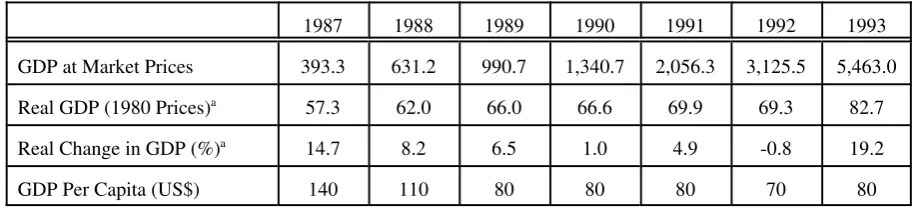
[Table 4.1 about here]
Based on the available data, it appears that the economic reforms had a positive effect on aggregate production. Real GDP growth rates were high during the first three years after the ERP was introduced (Table 4.1), and real GDP grew by no less than 44 per cent from 1987 to 1993. However, the objectives set by the ERP were not met.3 The ongoing war was a major
obstacle to economic recovery, and the worldwide recession and the 1991--2 drought in Southern Africa added to existing problems such as administrative chaos and shortages of foreign exchange. Hence, economic growth slowed down in the beginning of the 1990s, and GDP actually fell in 1992. The peace accord, better weather conditions and the establishment of the UN peacekeeping operation implied that GDP increased by almost 20 per cent in real terms in 1993, but this appears to have been a temporary boost only, see also the Economist Intelligence Unit (1996).
Reliable census data do not exist due to the war and the enormous number of displaced
people. Almost half of the population, numbering 16.9 mio. In 1993, were displaced internally or externally at the end of the war, and income data are as noted above uncertain. However, the figures in Table 4.1 do illustrate the extreme poverty in Mozambique. Indeed,
Mozambique is clearly one of the poorest nations in the world in terms of GDP per capita, and this is so even if GDP data are underestimated as argued in recent World Bank studies.
rate of no less than approximately 2.6 per cent just to maintain the standard of living. The average annual growth rate of real GDP between 1987 and 1993 was 7.5 per cent when measured in local currency, indicating that an increase in real income per capita took place during this period. The metical depreciated rapidly right after the economic reforms were introduced because the currency was kept at an artificially high rate prior to the adoption of the ERP. Hence, real income per capita measured in US dollars decreased considerably from 1987 to 1989 and has remained at approximately 80 US dollars since 1989 -- except in 1992 when real GDP per capita fell to 70US dollars due to the drought. It must be kept in mind, however, that the purchasing power in terms of US dollars prior to the reforms was clearly overestimated, so the real average living standard measured in US dollars may still have increased since 1987 when account is taken hereof.
Many official prices were as already discussed liberalized and adjusted towards market prices in the early years of the ERP-reform period. Hence, consumer prices increased by almost 182 per cent in 1987. The rate of inflation fell to 48 per cent in 1988 after the initial adjustment, and has varied between 34 per cent and 53 per cent from 1988 to 1993 with an average annual increase of approximately 46 per cent (National Planning Commission 1994). Domestic credits to state owned companies, periodic shortages of foreign exchange, the depreciation of the metical and the drought in the early 1990s contributed to keeping inflation rates high.
The high real GDP growth rates in the first couple of years after the implementation of the economic reforms may well reflect increasing incentives to sell products through official market channels rather than on parallel markets. Yet, informal sector activities have so far been estimated as a constant share of formal sector activities in published data. Hence, the GDP growth figures for the late 1980s are from this perspective too optimistic. However, according to the National Planning Commission (1994), informal sector activities did in fact increase their relative share of economic activity in the early 1990s. If this is correct, GDP growth in recent years would tend to be underestimated. It is still too early to tell what the trend in informal sector activities is, but the latest report by the National Planning
4The definition of agriculture in the Mozambican accounts does not incorporate
important agricultural activities such as agro-processing activities and commercial fishing. Official data do not include an explicit input-output table, but the National Planning Commission (1994) has made a rough estimate of sectoral value added at aggregate sector level by multiplying gross output figures with fixed coefficients to take account of
intermediate consumption. The fixed coefficients vary across sectors and periods capturing especially technological differences and various other developments. However, the method used is a rough approximation due to the large fluctuations in the production of almost all items which must have caused significant variations in real value added coefficients. In particular, the war and the drought in the early 1990s had devastating effects on production and trade, and the lack of foreign exchange when needed made it even more difficult to maintain a stable level of production. Nevertheless, the National Planning Commission has at least tried to provide an estimate of sectoral value added, which certainly gives a better idea of the actual sectoral performance than related gross output figures.
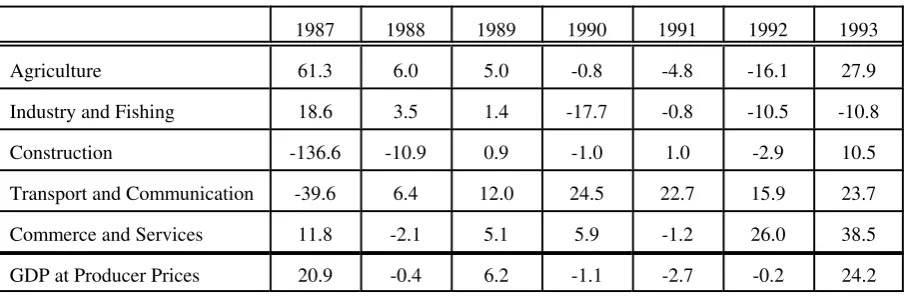
[Table 4.2 about here]
Agriculture is clearly the most important sector in the Mozambican economy and far more important than the figures in Table 4.2 reveal.4 The agricultural sector -- including
agro-processing activities and commercial fishing -- accounted for approximately 80 per cent of employment and 70 per cent of foreign exchange earnings in 1993. The relative share of industrial gross output has decreased consistently since the early 1980s except for a brief period of recovery after the ERP was introduced. Transport did very well after 1990. In particular, donor financed investments in ports and railways, large amounts of food aid for distribution in Southern Africa in 1991--2 and the peace accord in 1992 helped improve the performance of the transport sector. Commerce and service activities were positively affected by the peace accord and the installation of UN peacekeeping forces in 1993 and therefore accounted for approximately one-third of total value added in 1993.
5 Agricultural data should, in particular, be interpreted with caution because the war
made it impossible to collect reliable data in rural districts.
approximations and should not be taken too literally. In particular, the estimated figures in Table 4.3 tend to overestimate actual figures and trends due to the corrosive power of inflation on nominal values within periods.
[Table 4.3 about here]
Prices of agricultural products have in general increased considerably since the introduction of economic reforms, especially prices of export crops rose substantially. However, it is difficult to assess to what extent the price increases have been passed on to farmers. It seems likely that the extraordinary increase in agricultural value added in 1987 to some extent reflects substitution between formal and informal markets as a reaction to modified price signals. Subsequently, the combination of war and drought in 1991--2 implied that agricultural output declined in the early 1990s, but the rare combination of better weather conditions and peace had a very positive effect on agricultural production in 1993.
Nevertheless, Mozambique remains heavily dependent on food aid, and some 8 per cent of total imports of goods consisted of food aid in 1993.5 Hence, revised price policies have so far
by themselves been unable to ensure a breakthrough in agricultural production.
Industrial output surged right after the ERP was introduced because increased foreign grants and credits renewed the access to imported raw materials and spare parts. However, industrial production has decreased continuously since 1990, and industrial output was in 1994 almost equivalent to its 1986 level. The industry has been constrained by lack of access to foreign imports when required, management problems, administrative chaos and poor industrial policies. In addition, industrial performance has been negatively affected by tightened lending criteria and credits in recent years, and the privatization programme has forced some
Sabotage of the transport infrastructure and insecurity in rural areas had severe effects on transport earnings, and value added in the transport and communication sector declined by almost 40 per cent in 1987. Major efforts were made from the mid-1980s in rehabilitating ports and railways and improving security along the main transport corridors. In particular, a ten-year donor financed plan was initiated in January 1986 to rehabilitate the Beira port and improve transport links to Zimbabwe. Transport links to the two other major ports were also improved, and foreign-backed investment projects were initiated recently to improve the capacity and management of the Maputo and Nacala ports. Hence, transport has performed well, especially since 1990, and the significant increase in transport volumes of food aid in 1991--2 due to the South African drought was successfully handled.
According to the figures in Table 4.3, none of the optimistic sectoral objectives set out in the ERP in 1987 were achieved -- and this is so in spite of growth rates which may have been overestimated. Total marketed agricultural production increased by an average of 15.5 per cent per year from 1987 to 1990, indicating that average annual growth rates of marketed agricultural production by the family sector may have been far from the original growth target of 29 per cent per year. Industrial output increased by a poor 0.6 per cent on average during 1987--90, but industrial production fell substantially in the early 1990s, and so far without any signs of recovery. Growth rates of the transport and communication sector increased steadily from 1988--90, but the drastic fall in 1987 implies that value added fell by more than 10 per cent from 1987 to 1990. The transport and communication sector did well in the early 1990s, and the large donor-financed investment projects in transport infrastructure are likely to help establish a sound base for further growth in this sector.
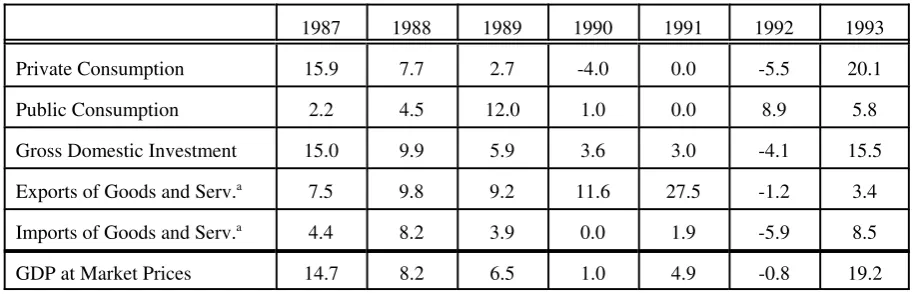
The increased access to foreign exchange had a positive effect on investment, and real growth rates in investment were high during the first couple of years after the ERP was initiated. Investment grew moderately in the beginning of the 1990s but fell in 1992 due to the recession and the increased emergency expenditures, which implied that imports of food increased on behalf of investment goods. However, investments soared in 1993 as the economy recovered from the drought.
[Table 4.4 about here]
As part of the economic reforms, the Mozambican government has introduced incentives such as tax holidays and absence of withholding taxes in order to attract foreign investment. Yet, it was difficult to attract private foreign direct investment in the late 1980s and early 1990s. The war raged and investors perceived investment regulations as inconsistent (Economist
Intelligence Unit 1996). Thus, inflows from this source have remained very low. As far as public investments are concerned, they are to a large extent financed by foreign donors. Accordingly, many investment projects are directed towards rehabilitating and expanding the economic, social and institutional infrastructure. According to Wuyts (1995) the donor projects extract skilled labour from the civil service, which is critical for the remainder of the public sector given the extremely small supply of skilled labour in Mozambique. In addition, the large inflows of foreign grants and credits keep foreign exchange rates above levels that would prevail in the absence of foreign aid. Hence, while the large extent of foreign aid is necessary to avoid a collapse of the economy, it may worsen prospects for the production of traded industrial goods in the short term.
most important export category in Mozambique, with prawns accounting for more than half of total export earnings in 1993 and almost the entire growth of total exports in US dollars since 1987.
Imports of goods measured in US dollars have also been increasing since the economic reforms began, except in 1992 when imports fell by almost 5 per cent. According to the Economist Intelligence Unit (1996), prevailing levels of imports were not sufficient to provide raw materials, spare parts and equipment to maintain production even at very
depressed levels. Hence, multilateral and bilateral donors provided foreign capital during the transition towards a market economy to finance an increase in imports and thereby underpin the reform effort. Accordingly, imports of raw materials, spare parts and equipment increased considerably between 1987 and 1993, while imports of food have been relatively stable.
The trade deficit increased in absolute terms by more than 50 per cent from 1987 to 1993 despite high real growth rates of exports after the introduction of the ERP. The realignment of the foreign exchange rate was not sufficient to avoid a deteriorating trade balance USAID (1995), which clearly aggravated the overall external balance of payments position. However, it is difficult to assess this more precisely as statistics on terms of trade have not been
compiled systematically.
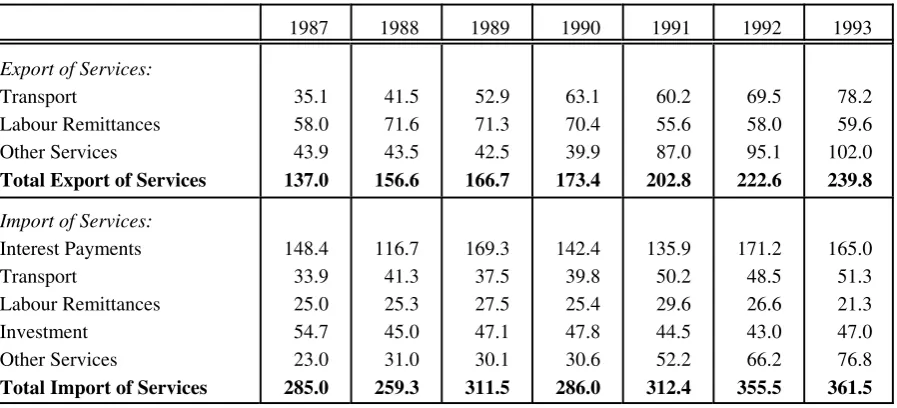
The deficit on the service account including net factor payments fluctuated between 102.7 and 148 million US dollars during the reform period without any increasing trends in recent years (Table 4.5). Foregn receipts from transportation have recovered somewhat since the late 1980s due to improved security along the main transport corridors and rehabilitation efforts, while workers’ remittances from abroad declined by 22 per cent from 1988 to 1991 as workers returned from East Germany. The main factor behind the movement in total service and factor payments has been interest payments. Indeed, interest payments have in general been at approximately the same level as total exports of services and labour remittances from abroad.
The OECD countries have since the colonial years been Mozambique’s most important trading partners. Yet, trade with neighbouring African countries increased after Mozambique joined regional organisations such as the Preferential Trade Area (PTA) and the Southern African Development Community (SADC). Close ties with communist countries after independence in 1975 led to some diversification of trade towards Eastern European
countries. However, this trade collapsed in 1990 after the upheavals in Eastern Europe and the reunification of Germany. Improved relations with South Africa in the late 1980s and South Africa’s membership of SADC in 1994 boosted trade between the two countries. In particular, exports to South Africa almost trippled between 1989 and 1994, and South Africa was the second most important export market of Mozambique in 1994.
5. Current Macroeconomic Imbalances
Despite the macroeconomic reform measures undertaken since 1987 within the context of the ERP, Mozambique is still one of the poorest countries in the world in terms of GDP per capita and structural problems go deep. Moreover, the rate of inflation is high, industrial
performance has been poor, public budget deficits are huge and Mozambique’s dependency on foreign aid and credits has increased. Indeed, the most pressing macroeconomic structural problems relate to the external balance, the public budget and more generally the mobilisation of domestic savings.
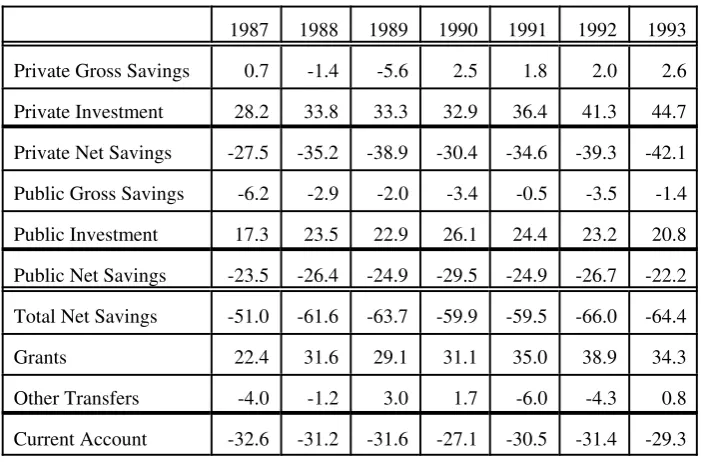
[Table 5.1 about here]
6 Investment often includes costs, which are in effect recurrent. For example, donor
financed projects are registered as capital investments independent of the nature of the project and its costs. Private investment in Table 5.1 is calculated as the difference between total investment and public investment and as such captures errors and omissions in the sectoral investment allocation.
exchange. However, the level of investment is evidently overestimated,6 and GDP growth
rates were not pushed up in accordance with the figures in Table 5.1. On the other hand, it is clear that domestic savings remained low. Indeed, public gross savings have been negative since the ERP was introduced. Private gross savings were also negative in the late 1980s but have been positive since 1990, reaching the limited level of 2.6 per cent of GDP in 1993. Hence, almost all investment expenditures have been financed by foreign capital inflows.
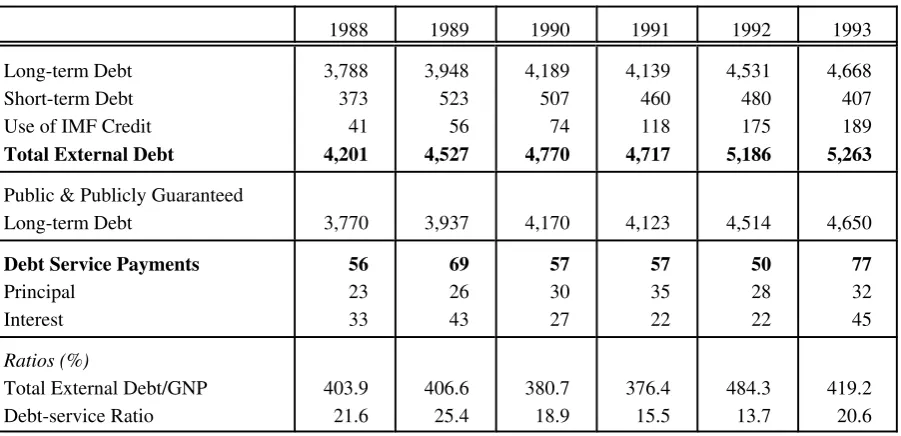
Although foreign grants rose in real and nominal terms after the first agreement with the IMF and the World Bank, current account deficits including foreign grants almost doubled in 1987 and have remained at approximately 30 per cent of GDP during the reform period. A number of agreements concerning debt rescheduling and debt reductions have been reached with Western creditors and private banks. However, the foreign debt continued to increase to a level of 4.2 times the size of GNP in 1993, while debt service payments were equivalent to 20.6 per cent of earnings from exports of goods and services (Table 5.2). According to the Economist Intelligence Unit (1996) the ratio of foreign debt to GNP was the second highest in the world in 1992, and the external debt remains a heavy burden on the Mozambican
economy.
The problems related to the extremely high level of foreign debt can be illustrated by a simple dynamic budget constraint:
Planning Commission (1994) GDP was equivalent to 1,043 million US dollars in 1993, while the current account deficit before grants was 949.6 million US dollars and foreign grants were 628.3 million US dollars. In addition, the foreign debt reached 5,263 million US dollars in 1993, but debt rescheduling agreements with foreign creditors implied that interest payments were only 45 million US dollars, i.e. the actual interest rate on foreign debts was less than 1 per cent. The very low interest payments during the post-reform period indicate that
Mozambique has actually defaulted and is extremely dependent on foreign aid. Hence, Mozambique is vulnerable with respect to external shocks, and considerable debt reductions are necessary to achieve a sustainable external debt position in the short term. Moreover, in the context of decreasing foreign aid to developing countries in recent years, it will be essential for Mozambique to reduce the dependency on foreign aid, and this can only be achieved by increasing exports and mobilising private and public net savings.
[Table 5.2 here]
Given the need to reconstruct Mozambique after the long period of war and the unsuccessful economic policies pursued by the Frelimo government following independence, it is essential to maintain a high level of investment. Nevertheless, there is an evident need to increase the productivity of investment and also the inter-sectoral allocation of investments have given rise to concern. For example, only 10 per cent of the 1996--8 public investment plan are geared towards agriculture, which is small relative to the critically important role of this sector in the development process. However, more detailed assessment and analysis would be required to estimate the appropriate level and kinds of investments required.
On the savings side, private savings increased but remained small despite attempts by the government to promote private savings through real interest rate adjustments and
credit allocation and a reduced rate of inflation are necessary to help improve private savings. Thus, a financial sector reform is an indispensable part of the policy reform package.
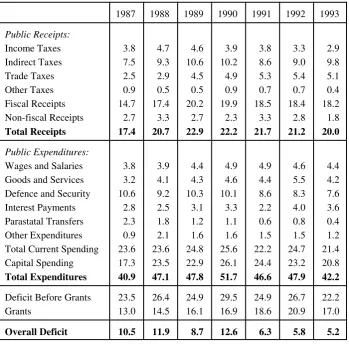
[Table 5.3 here]
Public deficits before grants have approximated 25 per cent of GDP since the introduction of the economic reforms because the government was unable to improve fiscal receipts while public expenditures increased moderately. Public expenditures have remained above 40 per cent of GDP since 1987, and this share only increased slightly as compared to average pre-reform levels -- when the exceptional low public expenditures in 1985 are disregarded. Current expenditures were frequently cut to levels below established target levels since the ERP was introduced due to revenue shortfalls, and public investment expenditures have as noted largely been financed by foreign grants and loans. Interest payments increased faster than other expenditures since the economic reforms were introduced, while expenditure cuts fell mainly on parastatal transfers (Table 5.3). Military expenditures accounted for almost 40 per cent of total current spending during the years of war, but expenditures on defence and security have declined relative to GDP since peace negotiations began in 1990. Yet, there is still room for further cuts in defence and security expenditures.
Given the severe level of poverty and the urgent need to improve the social, institutional and economic infrastructure it will be difficult for the government to cut overall expenditures in the near future. Indeed, cutting public expenditures may create social tensions, especially in the major cities. For example, there have been several outbreaks of riots in Maputo in recent years. It will therefore be essential to improve fiscal revenue.
slumped and permanent high inflation rates eroded the tax base. The introduction of tariff exemptions during the drought in 1992 and increased smuggling due to the improved access to neighbouring countries with the return to peace implied that customs performance
deteriorated since 1992. Indeed, the tariff exemptions have not been lifted after the weather conditions improved, and customs controls remain problematic. The suspected increase in informal sector activities in recent years will make it even more difficult to strengthen fiscal revenues.
Nevertheless, given the need to increase public savings it will be essential to increase the tax base especially through reduced tariff exemptions, improved customs controls and a more efficient tax administration. In addition, privatization of some of the remaining loss giving state owned enterprises may reduce public expenditures and indeed increase the tax base by allowing private companies to compete on equal terms. Moreover, financial sector reforms may promote investment by improving the allocation of credits through the financial system, which creates a basis for increased growth and saving in the longer term.
6. Conclusions
The long run growth potential of Mozambique is promising. Mozambique has a rich natural resource base, and the country is strategically situated along the east coast of Africa with harbours that can serve several neighbouring nations. Yet, Mozambique is the poorest country in the world and the economy is ravaged by colonial exploitation, a long period of war and misguided economic policies. Population growth rates remain high, while millions of refugees and displaced people are in a process of being reintegrated. Furthermore, most of the rural and economic infrastructure is in ruins. Hence, the recovery of production for domestic
consumption and export is bound to be difficult.
systems are serious constraints. Hence, it will take many years to generate enough wealth in Mozambique to (i) realize a real break through in terms of social indicators, (ii) put an end to absolute poverty, and (iii) achieve the objective of food security at national, provincial and household levels.
In terms of macroeconomic management and performance, a series of steps have been taken since the introduction of the ERP in 1987. Some progress has been made as regards price and trade liberalization, but results have in general been below those targeted. Real growth in the agricultural sector has been moderate at best, in particular when account is taken of
population growth, and industrial activity has experienced a serious contraction since 1990. Exports have not increased sufficiently to avoid a significant deterioration of the trade
balance, public sector deficits remain large, and inflation continues to be an endemic problem. Mozambique is, in other words, caught in an international debt trap, and dependence on foreign aid is excessive.
While debt service has been brought down due to debt rescheduling and reliance on capital inflows with a relatively high grant element, the debt overhang is large and continues to make the debt situation unsustainable. Moreover, the issue of how to handle the increasing
multilateral debt is looming in the background. Hence, further debt relief is certainly called for. This would also be necessary with a view to furthering private investment incentives and the fact that rehabilitation and development cannot be realized through stabilization alone. The supply side of the economy needs to be built up, and this will require continued investment at a high level.
References
Banco de Moçambique (1995) ‘Boletim Estatístico’, vol. 3, no. 8. Central Bank of Mozambique: Maputo.
de Vletter, F. (1995) ‘Urban Poverty and Employment in Mozambique: An Analysis of a Deepening Crisis and its Policy Implications’. Background paper prepared for the poverty reduction strategy for Mozambique prepared by the Poverty Alleviation Unit, Ministry of Planning and Finance: Maputo.
Economist Intelligence Unit (1996) Country Profile: Mozambique. EIU: London.
FAO (1982) The Agricultural Economy of Mozambique. FAO: Maputo.
Fortes, I. (1995) ‘O Perfil da Pobreza em Moçambique’. Background paper prepared for the poverty reduction strategy for Mozambique prepared by the Poverty Alleviation Unit, Ministry of Planning and Finance: Maputo.
Green, R.H. (1992) ‘Reconstrução: The Road from Emergencia to Developmento --Livelihoods and Macroeconomics’. Poverty Alleviation Unit, Ministry of Planning and Finance: Maputo.
Government of Mozambique and UN Agencies (1994) ‘Draft Country Strategy Note’. UNDP: Maputo.
National Planning Commission (1994) ‘Metodologia de Estimação das Contas Nacionais’. Ministry of Planning and Finance: Maputo.
Tarp, F. (1990) ‘Prices in Mozambican Agriculture’, Journal of International Development, vol. 2, no. 2, pp. 172--208.
USAID (1996) ‘Mozambique: Country Strategy Plan’ and ‘Economic Annex’. US Embassy: Maputo.
World Bank (1994) World Tables, Published for the World Bank by The Johns Hopkins University Press: Baltimore and London.
Table 4.1 Gross Domestic Product (MT bn).
1987 1988 1989 1990 1991 1992 1993
GDP at Market Prices 393.3 631.2 990.7 1,340.7 2,056.3 3,125.5 5,463.0
Real GDP (1980 Prices)a 57.3 62.0 66.0 66.6 69.9 69.3 82.7
Real Change in GDP (%)a 14.7 8.2 6.5 1.0 4.9 -0.8 19.2
GDP Per Capita (US$) 140 110 80 80 80 70 80
a At current-weighted constant prices.
Note: Refugees not permanently settled in the country of asylum are assumed to be part of the population of their country of origin.
Table 4.2 Gross Domestic Product by Origin (Current Producer Prices, MT bn and per cent).
1987 1988 1989 1990 1991 1992 1993 Total (MT bn) 379.6 606.1 940.8 1276.0 1950.0 2945.3 5089.3
Agriculture 42.5 40.2 43.1 40.3 38.0 32.3 33.1
Industry and Fishing 13.3 16.3 15.2 14.8 15.6 14.2 12.0
Construction 7.3 7.5 6.9 7.0 7.1 7.5 7.0 Transport and Communication 6.7 6.8 6.4 7.7 11.6 13.1 12.5
Commerce and Services 30.2 29.1 28.3 30.2 27.7 32.9 35.3
Total (per cent) 100.0 100.0 100.0 100.0 100.0 100.0 100.0
Table 4.3 Real Changes in Gross Domestic Product by Origin (Per cent).
1987 1988 1989 1990 1991 1992 1993 Agriculture 61.3 6.0 5.0 -0.8 -4.8 -16.1 27.9
Industry and Fishing 18.6 3.5 1.4 -17.7 -0.8 -10.5 -10.8
Construction -136.6 -10.9 0.9 -1.0 1.0 -2.9 10.5
Transport and Communication -39.6 6.4 12.0 24.5 22.7 15.9 23.7 Commerce and Services 11.8 -2.1 5.1 5.9 -1.2 26.0 38.5
GDP at Producer Prices 20.9 -0.4 6.2 -1.1 -2.7 -0.2 24.2
Source: National Planning Commission (1994)
Table 4.4 Real Changes in Gross Domestic Product by Expenditure (Per cent).
1987 1988 1989 1990 1991 1992 1993 Private Consumption 15.9 7.7 2.7 -4.0 0.0 -5.5 20.1
Public Consumption 2.2 4.5 12.0 1.0 0.0 8.9 5.8
Gross Domestic Investment 15.0 9.9 5.9 3.6 3.0 -4.1 15.5
Exports of Goods and Serv.a 7.5 9.8 9.2 11.6 27.5 -1.2 3.4
Imports of Goods and Serv.a 4.4 8.2 3.9 0.0 1.9 -5.9 8.5
GDP at Market Prices 14.7 8.2 6.5 1.0 4.9 -0.8 19.2
a Factor income is not included.
Source: National Planning Commission (1994)
Table 4.5 Export and Import of Services and Net Factor Payments (Current Prices, US$ m).
1987 1988 1989 1990 1991 1992 1993
Export of Services:
Transport
Labour Remittances Other Services
Total Export of Services
35.1 58.0 43.9 137.0 41.5 71.6 43.5 156.6 52.9 71.3 42.5 166.7 63.1 70.4 39.9 173.4 60.2 55.6 87.0 202.8 69.5 58.0 95.1 222.6 78.2 59.6 102.0 239.8
Import of Services:
Interest Payments Transport
Labour Remittances Investment
Other Services
Total Import of Services
148.4 33.9 25.0 54.7 23.0 285.0 116.7 41.3 25.3 45.0 31.0 259.3 169.3 37.5 27.5 47.1 30.1 311.5 142.4 39.8 25.4 47.8 30.6 286.0 135.9 50.2 29.6 44.5 52.2 312.4 171.2 48.5 26.6 43.0 66.2 355.5 165.0 51.3 21.3 47.0 76.8 361.5
Table 5.1 Savings-Investment and The Current Account (Per cent of GDP)
1987 1988 1989 1990 1991 1992 1993 Private Gross Savings 0.7 -1.4 -5.6 2.5 1.8 2.0 2.6
Private Investment 28.2 33.8 33.3 32.9 36.4 41.3 44.7
Private Net Savings -27.5 -35.2 -38.9 -30.4 -34.6 -39.3 -42.1
Public Gross Savings -6.2 -2.9 -2.0 -3.4 -0.5 -3.5 -1.4 Public Investment 17.3 23.5 22.9 26.1 24.4 23.2 20.8
Public Net Savings -23.5 -26.4 -24.9 -29.5 -24.9 -26.7 -22.2
Total Net Savings -51.0 -61.6 -63.7 -59.9 -59.5 -66.0 -64.4 Grants 22.4 31.6 29.1 31.1 35.0 38.9 34.3
Other Transfers -4.0 -1.2 3.0 1.7 -6.0 -4.3 0.8
Current Account -32.6 -31.2 -31.6 -27.1 -30.5 -31.4 -29.3
Table 5.2 The External Debt (US$ m).
1988 1989 1990 1991 1992 1993 Long-term Debt
Short-term Debt Use of IMF Credit
Total External Debt
3,788 373 41 4,201 3,948 523 56 4,527 4,189 507 74 4,770 4,139 460 118 4,717 4,531 480 175 5,186 4,668 407 189 5,263
Public & Publicly Guaranteed
Long-term Debt 3,770 3,937 4,170 4,123 4,514 4,650
Debt Service Payments
Principal Interest 56 23 33 69 26 43 57 30 27 57 35 22 50 28 22 77 32 45 Ratios (%)
Total External Debt/GNP Debt-service Ratio 403.9 21.6 406.6 25.4 380.7 18.9 376.4 15.5 484.3 13.7 419.2 20.6
Table 5.3 Public Receipts and Expenditures (Per cent of GDP).
1987 1988 1989 1990 1991 1992 1993
Public Receipts: Income Taxes Indirect Taxes Trade Taxes Other Taxes Fiscal Receipts Non-fiscal Receipts Total Receipts 3.8 7.5 2.5 0.9 14.7 2.7 17.4 4.7 9.3 2.9 0.5 17.4 3.3 20.7 4.6 10.6 4.5 0.5 20.2 2.7 22.9 3.9 10.2 4.9 0.9 19.9 2.3 22.2 3.8 8.6 5.3 0.7 18.5 3.3 21.7 3.3 9.0 5.4 0.7 18.4 2.8 21.2 2.9 9.8 5.1 0.4 18.2 1.8 20.0 Public Expenditures:
Wages and Salaries Goods and Services Defence and Security Interest Payments Parastatal Transfers Other Expenditures Total Current Spending Capital Spending Total Expenditures 3.8 3.2 10.6 2.8 2.3 0.9 23.6 17.3 40.9 3.9 4.1 9.2 2.5 1.8 2.1 23.6 23.5 47.1 4.4 4.3 10.3 3.1 1.2 1.6 24.8 22.9 47.8 4.9 4.6 10.1 3.3 1.1 1.6 25.6 26.1 51.7 4.9 4.4 8.6 2.2 0.6 1.5 22.2 24.4 46.6 4.6 5.5 8.3 4.0 0.8 1.5 24.7 23.2 47.9 4.4 4.2 7.6 3.6 0.4 1.2 21.4 20.8 42.2
Deficit Before Grants Grants 23.5 13.0 26.4 14.5 24.9 16.1 29.5 16.9 24.9 18.6 26.7 20.9 22.2 17.0
Overall Deficit 10.5 11.9 8.7 12.6 6.3 5.8 5.2