© 2017, IRJET | Impact Factor value: 5.181 | ISO 9001:2008 Certified Journal
| Page 1304
Mobile Data Transfer security through a cryptographic approach
1
Manikandan,
2Kumar chowdary,
3M.Manideep,
4T.N.Krishnakanth
1,
Professor,
Department of Computer science and Engineering, Vellore Institute of Technology, Vellore - 632014,
Tamil Nadu, India
2, 3, 4
Department of Computer Science and Engineering, Vellore Institute of Technology, Vellore - 632014,
Tamil Nadu, India
---***---Abstract -
As the mobile phones being numericallyascending on a day to day life it’s being proportionally effecting other hand (i.e., mobile phone security) utmost cases the important credentials are being stored in their respective mobiles. And use them on daily basis for their business environment and also private life. On the raising technology their found many changes in information technology which is adding up to it commercially which pushed a new risk, on this point the smart phone consists of much sensitive data which should be safeguarded. This paper tells how to protect your mobile or smart phone in cryptographic approach.
Key Words
:
cryptography, mobile transfer, Security,Technology, sensitive data
1.
INTRODUCTION
Rapid increase in mobile parallels exposing various threats on ABI research the raise in percentage of unique threat is 261% but here we protect our mobiles with password, picture password , pin etc., all these passcode system will be visible to others while you are unlocking it and on the other hand their comes the bio -metric way fingerprint , eye scanner , heart beat scanner, face recognition etc. which is appreciably secured but at some emergency case the device may not be in a position to handle while it may not be possible for access which shows its limitation so in this paper the cryptographic way of securing information is proceeded which brings algorithms into picture to makes the mobile more strong against to get compromise its security on a special note this paper mainly focus on hybrid process through which the data is being secured not only at the storage point but also while pushing the data or at the time ease of access between mobile to mobile or mobile to cloud.
2.
M
ETHODOLOGYCryptographic approach is being classified in to three types asymmetric cryptosystem ,symmetric cryptosystem and digital signatures here in symmetric cryptosystem the sender and receiver gets the same key
which on the aspect of confidentiality and avoid privacy, asymmetric cryptosystem possess different keys one for encryption and the other for decryption which is mainly works for key exchange and authentication and digital fingerprint will encrypt the data irreversibly and pushes for data integrity . Encryption is the new technology which protects through disturbing the data and acts unique for their respective key sizes and even stronger for specific from the another adjacent here involves many algorithms like triple DES (data encryption standards), RSA, blow fish, two fish, AES (advanced encryption standard), MD5, SHA1, ECC which on classifying to modern cryptography functions SHA1, MD5 under Digital signature. DES and AES under symmetric cryptosystem. RSA, ECC under asymmetric cryptosystem. Here considering the transfers in between cloud encryption will be the most preferred way to secure. It divides the clients in to public (open environment access for trusted clients) and private (confidential data usually carried out in encrypted form for avoiding piracy and to self-safeguard).
3.
PROPOSED WORK
Here if only encrypted security may not be sufficient on a hack-eye it can be easily decrypted to compromise the security and hence here to follow a hybrid approach and it is a triple tier proposal which runs digital fingerprint as the first tier it doesn’t involve any key on a hash function then the second tier will encrypt the encrypted data again and consider to be key (k1) and finally further encryption preceded through RSA/ESS algorithm as per their turnover time and necessity. All the Data encrypted will be stored in a phone memory the series will be applied for both the sides to maximize the security strength.
4.
IMPLEMENTATION
4.1
HYBRI
D
APPROACH
© 2017, IRJET | Impact Factor value: 5.181 | ISO 9001:2008 Certified Journal
| Page 1305
ordered. On encryption the data goes more secured inthe environment cloud as well as mobile.
4.2
TRIPLE DES(DATA ENCRYPTION
STANDARDS)
Basically it’s a symmetric key cipher applies DES to each data block three times and its key length is 168bits.
4.3
RSA ALGORITHM
It involves 2 keys in to the scripting, which has both private and public key, here public key used for encrypting the messages (can be known to anyone) and private key used to decrypt them (confidential), this is also called public key cryptography
4.4
BLOW FISH ALGORITHM
It is a fast free algorithm for the existing encryption, which drops in replacement of other algorithms of DES, the cipher size varies from 32 to 448 bits respectively.
4.5
TWO FISH ALGORITHM
It is optimized for 32-bit CPU, which has its block size as 128bit and ranging it from 128 to 256 bits.
4.6
AES(ADVANCEDENCRYPTION
STANDARDS)
AES has round key block, and its block size is 128 bits, each byte of the bit is combined with block using bitwise XOR.
4.7
MD5 ALGORITHM
An arbitrary length input produces 128-bit long message in the hash form.
4.8
SHA1 ALGORITHM
It is a 160 bit MD5 algorithm, which is a part of digital signature algorithm.
4.9
ECC ALGORITHM
This is a public key approach which requires smaller keys comparatively, this is applicable to pseudo-random generators.
The architecture of the implementation depends upon the alignment of the algorithms upon mobile device environment. Considering the hybrid approach this
paper would propose MD5+ECC+AES and MD5+RSA+AES, this application used to encrypt and decrypt the data, is in the point of view of indulging symmetric ,asymmetric and digital signature hence here consider some data about four samples considering their respective sizes, encrypting the data with these above mentioned algorithms in the mobile devices, upon making a instance server and a dynamic webpage, pushing the encryptions on server based on their input sizes separately and finally compare results.
5.
RESULTS
5.1
TURN OVERTIME
This analysis of time indicates the total time taken to process a request. Which is the algorithm path directed to get from one environment to another the time elapsed in this period is consider to be the turn overtime.
5.2
MEAN PROCESSING TIME
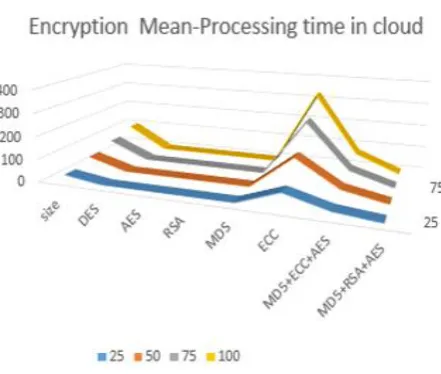
It is the difference in between encryption starting and ending timing. And the time is directly proportional to the size of the data.
5.3
THROUGHPUT
It is the amount of data passing through the encryption and changes occur on changing it size.
Fig-1: Time elapsed between cloud and mobile in encryption
© 2017, IRJET | Impact Factor value: 5.181 | ISO 9001:2008 Certified Journal
| Page 1306
Fig-3: Time elapsed between encryption and decryptionFig-4: Throughput table
Fig-5: Throughput Graph
Fig-6: Turn over time from mobile to mobile table
© 2017, IRJET | Impact Factor value: 5.181 | ISO 9001:2008 Certified Journal
| Page 1307
Fig-8: Turn over time from cloud to mobile tableFig-9: Turn over time for cloud to mobile
Fig-10: Turn over time from mobile to cloud table
Fig -11: Turn over time for mobile to cloud
Fig-12: Decryption mean-processing time in cloud
[image:4.595.317.572.339.519.2] [image:4.595.326.547.546.733.2]© 2017, IRJET | Impact Factor value: 5.181 | ISO 9001:2008 Certified Journal
| Page 1308
Fig-14: Encryption mean-processing time in localFig-15: Encryption mean-processing time in cloud
6.
CONCLUSION AND FUTURE WORK
As the evolved new technology cryptographic algorithms can perform even more stronger than before considering that this is proposed in multi system environment (mobile & cloud) and cryptography proposed on their access (mobile to mobile) & (mobile to cloud). This proposed system is strong enough but for the rapidly changing technology double digital signature algorithms may provide even more strength to the cryptography hence it is planned for future work especially in including of SHA1 as the second digital print.
7.
REFERENCES
[1] Display Solution for mobile cloud computing simeons P., De Turck F.
[2] Comparative Analysis of encryption algorithms for Data Communications by Shashi mehrotra.
[3] Privacy Manager for Cloud Computing by Zhang Q, Cheng L, Boutaba R.
[4] Security Framework for Cloud Computing Environment by Ayesha Malik, Muhammad Mohsin NazirA.
[5] Privacy Manager for Cloud Computing by Zhang Q, Cheng L, Boutaba R.
[6] SECURITY IN CLOUD COMPUTING by P. Syam Kumar, R. Subramanian and D. Thamizh Selvam.
[7] ieeexplore.ieee.org/document/7148427/
[8] https://en.wikipedia.org/wiki/mobilecomputing
[9] https://en.wikipedia.org/wiki/Cryptography
[10] https://en.wikipedia.org/wiki/encryption
[11] Advances and Applications in Mobile Computing.
[12] www.sciencedirect.com/science/article/pii/S18770 50915005001