EFFECT OF CONCENTRIC BRACING SYSTEMS ON LATERAL BEHAVIOUR
OF IRREGULAR BASE ISOLATED STEEL STRUCTURE
Praveena G S
1, M R Suresh
21
PG Student, Civil Engineering Department, Dr AIT Bengaluru, Karnataka, India.
2Associate Professor, Civil Engineering Department, Dr. AIT Bengaluru, Karnataka, India.
---***---Abstract -
Engineers must design buildings so that the frequency range of the building's response to ground motion was away from the frequency content of earthquakes.might be thought that structures can be protected from the destructive forces of earthquakes by increasing the strength of the structures so that they do not collapse. more rigid attachment of a building to its foundation will result in less damage in an earthquake. However, if the foundation is rigidly attached to the building or any other structure, all of the earthquake forces will be transferred directly and without a change in frequency to the rest of the building. Providing a base isolation device between the building and the ground can minimize the level of earthquake force transmitted to the buildings.In the present study a 25 storied building is considered, having overall plan dimension of 40 m x 40 m along X and Y direction. Two type of structure are considered, one is plan regular and plan irregular. Both types of structures are studied with fixed base and with base isolation. Plan irregular considered is L shape geometric configuration. Conclusions are made from modal, equivalent static and dynamic time history analysis of regular and irregular frame with and without base isolation in presence of concentric bracings.
Key Words: Base isolation(B.I.), Fixed base(F.B.), Built-up section, Concentric bracing, Lead rubber bearing, Steel moment resisting frame.
1.INTRODUCTION
Modern methods of seismic design (since the 1970s) allow structural engineers to design new buildings with the aim of predictable and ductile behaviour in severe earthquakes, in order to prevent collapse and loss of life. However some controlled damage is expected, which may result in the building being damaged beyond economic repair after severe shaking.
In a decades ago steel structure assumes a vital part in the development business. It is important to plan a structure to perform well under seismic burdens. steel bracings can build the vitality assimilation of structures and diminishing the request constrained by seismic loads. base isolation is a piece of capacity all together diminish the vibration powers.
It is broadly used to shield structures from tremor harming impacts. The base isolation framework need to perform three capacities, they are horizontal adaptability, energy dissemination and unbending nature. Type of base isolator used is Lead Rubber Bearing. which stiffness and yield strength has calculated based on the structural consideration. It is discovered that day and age of base confined structures is relatively higher than working under settled condition and with the lessened base shear at the base of structure.
2 OBJECTIVE OF WORK
Comparative study of concentric bracings with and without base isolation for plan irregular steel moment resisting frames. to response of structure such as displacement, base shear, drifts etc. by considering equivalent static and time history analysis.
2.1 METHODOLOGY
In the present investigation a 25 storied building is considered, having general arrangement measurement of 40 m x 40 m along X and Y course.
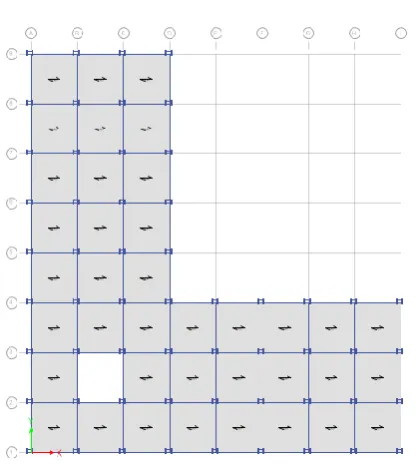
Two kind of structure are viewed as, one is design customary and design sporadic. The two sorts of structures are considered with settled base and with base confinement. Plan sporadic considered is L shape geometric design.
Type of base isolator utilized is Lead Rubber Bearing.
For both sort of structure, the impact of concentric bracings are examined.
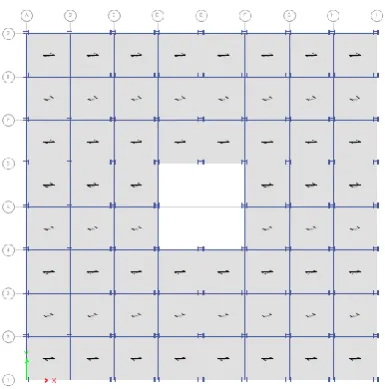
For customary square in design assembling a focal opening of 10m x 10m is give, though for L shape, 5m x 5m opening is given.
3. MODELING AND ANALYSIS
Demonstrating of steel minute opposing casing is finished utilizing ETABS Ver. 2015, which is 3D demonstrating and investigation programming bundle. Equivalent Static analysis and Time History analysis are carried out.
3.1 MODELS CONSIDERED
Following sorts of models are considered in this investigation. Add up to eight models are made with for settled base and segregated structures.
a. Fixed Base Plan regular
b. Fixed base Plan regular with concentric Bracing c. Fixed Base Plan Irregular
d. Fixed base Plan Irregular with concentric Bracing e. Base isolated with Plan regular
f. Base isolated Plan regular with concentric Bracing
g. Base isolated Plan Irregular
h. Base isolated Plan Irregular with concentric Bracing
[image:2.595.359.526.110.368.2]3.2 MODELING IN ETABS
Figure 1:Fixed Base Plan regular
[image:2.595.65.258.323.518.2]Figure 2: Fixed Base with plan regular concentric bracing elevation
[image:2.595.363.533.431.720.2]Figure 3: Base isolated Plan regular with concentric Bracing
Figure 4: Base Isolation with plan regular
[image:2.595.80.246.557.743.2]Figure 5: Base isolated Plan Irregular
3.2 FUNDAMENTAL CONSIDERATIONS
No. of storeys 25
Storey height 4m
Deck slab 200mm
Support conditions Fixed, based
Soil type Type 2. medium soil
Steel grade FE360
Grade of concrete M30
column Built up section
ISWB-600 Structural beam ISMB-600 Concentric bracings ISMB-600
3.3 LODING DATA
Live load = 4 kN/m2
Super dead load = 1.5 kN/m2 Glazing Load = 1 kN/m
3.4EARTHQUAKE DATA
Zone(Z) = V (0.36) Importance factor (I) = 1
Response Reduction Factor (R) = 5 Damping ratio = 10%
3.5 ISOLATOR PROPERTIES
Effective stiffness Linear (U1) = 1279332 kN/m Effective stiffness Non Linear(U2) = 977897 kN/m Yield strength (U3) = 36779 kN
4. RESULTS AND DISCUSSION
4.1 Static Analysis Results
4.2 TIME PERIOD
0.00 2.00 4.00 6.00 8.00
1 2 3 4 5 6 7 8 9 10 11 12
T
IM
E
P
R
IO
D
(
S
E
C
O
N
D
S
)
M ODE
MODE vs. TIME PERIOD
Fixed Base _Regular
CB_FB_Regular
BI_Regular
CB_BI_Regular
Figure: 6 Mode V/s Mode (time) period: Regular Frame
0.00 2.00 4.00 6.00 8.00
1 3 5 7 9 11
TI
M
E
PR
IO
D
(
SE
CO
N
D
S)
MODE
Mode VS. TIME PERIOD
Fixed Base _Regular CB_FB_Regular
BI_Regular
CB_BI_Regular
Figure: 7 Mode V/s Time Period: Irregular Frame
[image:3.595.78.288.88.321.2]4.3 BASE SHEAR
Figure:8 Maximum Base shear: Regular Frame
[image:3.595.306.562.574.741.2]Figure: 9 Maximum Base shear: Irregular Frame
4.4 STOREY DISPLACEMENT
Figure: 10 Storeys vs. Displacements: Regular Frame
0.00 50.00 100.00 150.00 200.00 sto re y 2 5 sto re y 2 1 sto re y 1 7 sto re y 1 3 sto re y 9 sto re y 5 sto re y 1 DISPL A CE M EN T (mm) STOREY
STOREY VS. DISPLACEMENTS
BI_Regular CB_BI_Regul ar BI_Irregular CB_BI_Irregu lar
Figure: 11 Storey vs. Displacements Irregular Frame
4.5 STOREY DRIFT
0.00000 0.00050 0.00100 0.00150 0.00200 sto re y 2 5 sto re y 2 0 sto re y 1 5 sto re y 1 0 sto re y 5 ST OR EY DR IF TS STOREY
STOREY VS. STOREY DRIFTS
Fixed Base _Regular CB_FB_Regul ar Fixed Base _Irregular CB_FB_Irreg ular
Figure: 12 Storey vs. Storey Drifts
0.00000 0.00050 0.00100 0.00150 0.00200 0.00250 0.00300 sto re y 2 5 sto re y 2 1 sto re y 1 7 sto re y 1 3 sto re y 9 sto re y 5 sto re y 1 ST OR EY DR IF TS STOREY
STOREY VS. STOREY DRIFTS
BI_Regular
CB_BI_Regular
BI_Irregular
CB_BI_Irregular
Figure: 13 Storeys vs.Storey Drifts
4.6 Dynamic Analysis Results
0.00 50.00 100.00 150.00 sto re y 2 5 sto re y 2 1 sto re y 1 7 sto re y 1 3 sto re y 9 sto re y 5 sto re y 1 DISPL A CE M EN T (mm) STOREY
STOREY VS. DISPLACEMENTS - Regular
Frame
FB Regular CB_FB_Reg ular BI Regular CB_BI_Regu larFigure: 14 Storey vs. Storey Displacements: Regular Frame
Figure: 15 Storeys vs. Storey Displacements: Irregular Frame
5. CONCLUSIONS
Following conclusions are produced using modular, proportionate static and dynamic time history investigation of normal and unpredictable edge with and without base confinement in nearness of concentric bracings.
Base separation can diminish the working over all recurrence by delaying the day and age, there by doing minimum harms to the structure.
Irregular structure will have less deformation because of later loads in correlation with the consistent even if there should be an occurrence of base disengagement aside from now and again.
Story drifts are more if there should arise an occurrence of base isolation contrasted with settled one at the establishment level, since there is as division of the substructure and super structure by base detachment.
Base isolation decrease the solidness of the structure essentially at the lower lever when contrasted with settled base.
Use of concentric bracings is proposed in base disconnected since, the removals and floats are more than that of settled base.
Displacements results are extracted from time history examination, and from the outcomes unmistakably, for standard structure around 29% expansion in removals if there should be an occurrence of BI structure without CB and 28% with concentric bracings. Yet, there is critical lessening in the event of FB with concentric than that of base segregation in time history examination.
REFERENCES
1. William H.R., James W.C., Lead dampers for base isolation, Proceedings of Ninth World Conference on Earthquake Engineering, 1998, Vol.2, pp. VIII-427-432.
2. Anand S.A., Concepts and techniques for seismic base-isolation of structures, Earthquake Engineering, Tenth World Conference, 1994.
3. Jain S.K., Thakkar S.K., Application of base isolation for flexible buildings, 13th World Conference on Earthquake Engineering, 2004.
4. Paul S, Paul J,Joaquin M, Development of new base isolation devices for application at refineries and petrochemical facilities, 13th World Conference on Earthquake Engineering, 2004.
5. Solanki T.H., Siddhaye V.R., Sabnis G.M., Seismic isolation for medium rise reinforced concrete frame buildings, 33rd Conference on Our world in concrete & structures, 2008.
6. Chimeh M.N., Homami, P., Efficiency of bracing systems for seismic rehabilitation of steel structures, 15th World Conference on Earthquake Engineering, 2006.
7. Savitha D., Satyam M., Harshi J., Shubham N., Review Paper on Base Isolation Method – The Best Retrofitting Technique, SSRG International Journal of Civil Engineering (SSRG-IJCE), 2016, vol 3 Issue 5, pp. 274-277.
8. Khan Z., Narayana B.R., Ahamed S.R., Effect of concentric and eccentric type of bracings on performance based seismic analysis of RC building, International Journal of Research in Engineering and Technology, 2015, Vol. 4, Issue: 06, pp. 278-283.
9. IS 800:2007, “General construction in steel – Code of Practice Bureau of Indian
standards, New Delhi”.
10.Indian Standard Criteria for Earthquake Resistant Design of Structures, IS: 1893 (Part 1) 2002, Part 1 General Provisions and Buildings (Fifth Revision), Bureau of Indian Standards, New Delhi, India.