Secure and Fast Adaptive Mobile Video Streaming
and Sharing in Wireless Mobile Network
Nisha Bhaskar Patil
PG Student of Computer Engineering Dept. Sandip Institute of Technology and Research Center, Nashik, India
Amol D. Potgantwar
HOD of Computer Engineering Dept. Sandip Institute of Technology and Research Center, Nashik, India
Abstract— The video traffic for mobile networks have been increasing remarkably but the wireless link capacity cannot keep up with the traffic. This results in less service quality of video streaming for mobile networks. The provisioning of video streaming services is vital to provide a required level of consumer happiness, given by the appearing video stream quality. Therefore it is important to choose the compression parameter and the network settings so that they make best use of the user quality. With cloud computing for mobile networks, a new formation is introduced called Adaptive mobile video streaming and sharing in wireless mobile network. Here, security is consigning to each patron in the form of One Time Password (OTP) method. With the help of OTP, the video is encrypted and at the user end it will be decrypted with the matching key. The user can upload the video only when he is register user & then the video is patterned by admin. Here security is assigned to each user so that the video cannot be seen by unregister user and cannot be seen by cloud provider using RC4 encryption technique. With the help of AMoV, we use the concept of adaptability and scalability features. So it provides effective utilization of bandwidth.
The aim of the presented work is to evaluate video quality of mobile video streaming at the user-level for a huge set of possible codec settings in 3G network and for a wide range of video content.
Keywords—OTP, PIN, Cloud Computing, Mobile Bandwidth, AMoV, ESoV
I. INTRODUCTION
A platform for other advanced technologies like mobile computing, big data to hammer its service and make available the QoS to the customers is offered by cloud computing. The cloud has full-fledged to an huge expand over the period of years. All the services that are available to the customer are done using cloud as their backbone, it provide enormous amount of resources and infrastructure to consumer who acts as vendors to small scale business and cloud could afford services to completely fledged association with less cost. The video streaming is not so complicated in connection-oriented networks, but in wireless link video streaming is challenging task. Network operators are made efforts to improve the wireless link bandwidth to satisfy requirements from mobile users but while receiving the video streaming packets via 3G/4G mobile networks, the mobile users are suffer from long buffering time and
intermittent interruptions due to the restricted bandwidth and link condition variation caused by multi-path fading and user mobility. Thus, it is critical to recover the service superiority of mobile video streaming while using the networking and computing resources capably. Alternatively, Dynamic Adaptive Streaming via HTTP (DASH) is a sizzling matter in academy and industry. The objective of DASH is to distribute video with high QoE even in dynamic network circumstances. The basic proposal is that the video is encoded at numerous bit rates and resolutions. Each encoding is alienated into chunks, video segments typically between 2-30 seconds in length. The client first downloads a manifest file which encloses information on the available audio and video streams, their encodings, and chunk intervals. Then, the client demands one chunk of video at a time using HTTP. Depending on its rate revision algorithm, it detects the presently available bandwidth for the session and the video quality is adjusted consequently. Recently there have been many studies on how to get better the service superiority of mobile video streaming on two characteristics:
Scalability: Mobile video streaming services [1] should hold up a wide spectrum of mobile devices; they have dissimilar video resolutions, dissimilar computing powers, different wireless links and so on. Also, the obtainable link ability of a mobile device may differ over time and space depending on its signal strength, other user’s traffic in the same cell, and link condition difference. Storing multiple adaptations of the same video content may acquire high overhead in terms of storage and communication. To address this issue, the Scalable Video Coding (SVC) technique of the H.264 AVC video compression standard describes a base layer (BL) with multiple [1] enhance layers (ELs). These sub streams can be encoded by utilizing three scalability features: (i) spatial scalability by layering image resolution,(ii) temporal scalability by layering the frame rate, and (iii) quality scalability by layering the image compression. By the SVC, a video can be decoded/played at the low down quality if only the BL is delivered. Conversely, the more ELs can be delivered; the improved quality of the video stream is accomplished.
moderately stable traffic links between servers and clients, perform inadequately in mobile environments. Thus the variable wireless link status should be appropriately dealt with to make available ‘tolerable” video streaming services. To address this concern, we have to adjust the video bit rate become accustomed to the presently time-varying available link bandwidth of every mobile client. Such adaptive streaming methods can efficiently decrease packet losses and bandwidth misuse.
Scalable video coding and adaptive streaming methods [1] can be in cooperation combined to achieve efficiently the best potential quality of video streaming services. So we dynamically adjust the number of SVC layers depending on the current link position. Each mobile user requires to personally report the transmission status (e.g., packet loss, delay and signal quality) periodically to the server, which forecasts the obtainable bandwidth for every client. Thus problem cause because of the substantial processing overhead, as the number of users increases. Cloud data centers can effortlessly provision for large-scale real-time video services as examined. In the cloud, multiple agent instances (or threads) can be preserved dynamically and efficiently depending on the time-changeable client requirement. Currently social network services (SNSs) have been growingly popular. There have been proposals to recover the quality of content release using SNSs. In SNSs [1], users may share, comment or re-post videos among friends and members in the same group, which evolves a client may watch a video that her friends have suggested. Clients in SNSs can also follow famous and trendy users based on their attentions, which is likely to be watched by its followers. In this view, we are further inspired to take advantage of the bond among mobile user from their SNS activities in order to prefetch in advance the establish the part of the video or even the complete video to the members of a group who have not observe the video up till now. In this proposed system, we design a adaptive video streaming and prefetching framework for mobile users with the above purposes in mind, dubbed Cloud [1]. AMES-Cloud makes a private client for each mobile user in cloud computing surroundings, which is utilized by its two main elements:
(i) AMoV (adaptive mobile video streaming), and (ii) ESoV (efficient social video sharing).
II
LITERATURE SURVEY
The overview of the basic concepts for extending H.264/AVC[2] towards SVC.
The integration[3] of Scalable Video Coding (SVC) into a generic platform for multimedia adaptation.
An adaptive packet-level FEC [4] protocol meant to complement existing MAC/ physical layer short-timescale error control mechanisms.
The SVC [5] design supports a special mode of fidelity scalability.
The problem of how to conserve energy[6] for executing
mobile application by task offloading to the cloud.
A mobile user exploits virtual machine (VM) technology[7] to rapidly instantiate customized service software.
An extensive cross-layer[8] signaling framework for a dynamic scalable video adaptation in varying network capacity.
A generic framework that facilitates migrating live media streaming [9] to a cloud platform.
Empirical measurement of BitTorrent[10] users in a commercial WiMAX network.
The continuity of QoS[11] perceived by mobile users while they are on the move between different access points, and also, a fair use of the network resources. A cross-layer[12] approach and also Multimedia applications based on the Transmission Control Protocol (TCP) and the Real-time Transport Protocol (RTP)
A visual language approach [13] to the layout adaptation of multimedia objects.
The effect of scalability dimensions on the video quality[14] by simulating scalable video transmission with/ without network packet losses in LTE.
A survey of cloud computing[15], highlighting its key concepts, architectural principles, and state-of-the-art implementation as well as research challenges. An unobtrusive, predictive and elastic cloud bandwidth auto- scaling system for VoD[16] providers.
An optimization framework[17] for energy-optimal application execution in the cloud-assisted mobile application platform
The optimal expected QoE[18] under a limited storage budget, which is measured by the logarithmic relation between the required bit rate and the actual streaming bit rate.
A resource optimization mechanism[19] for preemptable applications in federated heterogeneous cloud systems.
A Future Internet Performance Architecture[20] viz., FIPA that is extensible, fault-tolerant, standards-compliant and secure.
(DT-MANETs)[21] are designed to disseminate data to one or several particular destinations.
III
EXISTING SYSTEMThe cloud service may across different places, or even continents, so in the case of a video delivery and prefetching between different data centers, an transmission will be carried out, which can be then called “copy”. And because of the optimal deployment of data centers, as well as the capable links among the data centers, the “copy” of a large video file takes tiny delay. In SVC, a combination of the three lowest scalability is called the Base Layer (BL) while the enhanced combinations are called Enhancement Layers (ELs). To this regard, if BL is guaranteed to be delivered, while more ELs can be also obtained when the link can afford, a better video quality can be expected.
broadcast and professional editing applications. Storing the different versions (with different bit rates) of the same video content may incur high overhead in terms of storage and communication. To overcome from this problem, the Scalable Video Coding (SVC) technique of the H.264 compression of video standard defines a base layer (BL) with multiple enhance layers (ELs).
These substreams can be encoded by exploiting three scalability features: (i) spatial scalability by layering image resolution (pixels of screen), (ii) temporal scalability by layering the frame rate, and (iii) quality scalability by layering the compression of image. By this scalable video coding, a video can be played at the lowest quality if only the BL is transmitted. However, the more ELs can be transmitted. By this best quality of the video stream is achieved.
IV
PROPOSED SYSTEMIn this section we explain the AMES-Cloud framework includes the Adaptive Mobile Video streaming (AMoV) and the Efficient Social Video sharing (ESoV) using the OTP Key for security purpose in a cloud network..
Fig.1. AMES-Cloud framework with encryption and OTP
As shown in Fig. 1, the whole video storing and streaming system in the cloud is called the Video Cloud (VC). In the VC, there is a large-scale video base (VB), which stores the most of the popular video clips for the video service providers (VSPs). A temporal video base (tempVB) is used to cache new candidates for the popular videos, while temp VB counts the access frequency of each video. Note that management work will be handled by the controller in the VC. Specialized for each mobile user, a sub-video cloud (sub VC) is created dynamically if there is any video streaming demand from the user. The sub-VC has a sub video base (sub VB), which stores the recently fetched video segments. Note that the video deliveries among the sub VCs and the VC in most cases are actually not “copy”,
but just “link” operations on the same file eternally within the cloud data center. There is also encoding function in sub VC (actually a smaller-scale encoder instance of the encoder in VC), and if the mobile user demands a new video, which is not in the sub VB or the VB in VC, the subVC will fetch, encode and transfer the video. The encoder uses RC4 method for encryption and for the encryption technique every user has a unique PIN which is send by the cloud server to the user mobile through SMS.
The video is uploaded by the admin and the user also. But there is a condition that, if user wants to upload the video then he can just use upload section and after that it is stored on the sub VC only when the admin approves it. When the user is authorized then admin can upload the video otherwise it is discarded. In admin section there is a details section which contains the details of the video. After that a log section contains a new video, rated videos, and most played videos. During video streaming, mobile users will always report link conditions to their corresponding sub VCs, and then the sub VCs offer adaptive video streams. Note that each mobile device also has a temporary caching storage, which is called local video base (localVB), and is used for buffering and perfecting. For each individual client, the video stream has to be adapted according to its terminal capabilities and connection conditions. In current solutions, transcoders are deployed for this task. If the number of clients is high, transcoding becomes extremely inefficient, since it is computationally complex and also incurs a loss in compression efficiency. Using SVC and adaptation techniques, the customization of the video stream to the characteristics of each client (device capabilities, network capacity, user preferences) is facilitated.
Recently, social network services (SNS) have been increasingly popular. There have been proposals to improve the quality of content delivery using SNSs . In SNSs, users may share, comment or re-post videos among friends and members in the same group, which implies a user may watch a video that her friends have recommended. Users in SNSs can also follow famous and popular users based on their interests (e.g., an official facebook or twitter account that shares the newest pop music videos), which is likely to be watched by its followers.
through the SMS to his/her mobile by the Cloud server. We can use RC4 technique for the encoding purpose. User has to enter the key for encrypting the video and also enter the same key for decrypting the video. A new mobile video streaming framework, dubbed AMES- Cloud, which has two main parts: AMoV adaptive mobile video streaming) and ESoV (efficient social video sharing). AMoV and ESoV construct a private agent to provide video streaming services efficiently for each mobile user. For a given user, AMoV lets her private agent adaptively adjust her streaming flow with a scalable video coding technique based on the feedback of link quality. Likewise, ESoV monitors the social network interactions among mobile users, and their private agents try to prefetch video content in advance. We implement a prototype of the AMES-Cloud framework to demonstrate its performance.
With the help of AMES technique we can use various parameters as delay, jitter, segmentation, resolution. With the combination of all these parameters we get the result.
The mobile user can do the registration procedure. After that he can search for the video. Then result is produced for all videos. For playing a particular video user has to enter the key then after the video is played in our player only. The user has also share the video to his friends. The user can also search for a friend in his list and then he can send the request also. If any user wants to upload the video, then he can do so, but the video is uploaded on the VC only when the admin can approve that video.
V
IMPLEMENTATION DETAILSAMES is cloud architecture built specially to provide video ser vice to the user. In this technique we propose an adaptive mobile video streaming and sharing framework, called AMES-Cloud, which efficiently stores videos in the clouds (VC), and utilizes cloud computing to construct private agent (subVC) for each mobile user to try to offer “non-terminating” video streaming adapting to the fluctuation of link quality based on the Scalable Video Coding ability. Also AMES- Cloud can further seek to issue “none buffering “experience of video streaming by background pushing functions among the VB, subVBs and localVB of mobile users. We assess the AMES-Cloud by prototype implementation and shows that the cloud computing technique brings significant improvement on the adaptively of the mobile streaming. We disregard the cost of encoding workload in the cloud while implementing the prototype.
This method require three different steps
1. Uploading and Rating videos: 2. User details
3. Rate videos
1.ploading and Rating Video: Here we can upload the videos and also we can give rating to the videos depending upon the priorities or the usage.
2.ser Details: In this we will maintain the details of the users and also determine the age of each user. And keep track of the videos the user is requesting and account them. 3.Rate Videos: this wills avoid unexpected videos from users. After accept/reject videos then only users can/cannot view their own videos.
In this proposed system for video streaming we use AMES for video streaming & For Encoding video we use RC4. In other side for user authentication we use One Time Password (OTP) concept.
VI
PERFORMANCE ANALYSISIn this implementation we had analyzed system performance across number of users and we found that as compared to normal system our proposed system is efficient in various parameters like load balancing, response time, data security, access time, etc. Also due to proper flow of system bandwidth utilization at client end is also minimized due to which big data files are retrieve efficiently without hampering throughput of system.
In this paper we analyze proposed system on the following parameter. This parameter having some values which gives selection of different options for video streaming to different users.
[A]. If network speed is high we can get higher speed of video process which will minimize the delay.
Fig.2. Average Click-to-Play delay for Various Cases
The average click-to-play delay is different for different situation. On x-axis Time is calculated & on y-axis number of request for play.
[B] If video has higher resolution it will take more over heats and will cause more jitter.
Fig.3. Overhead of different SVC resolutions schemes in the Cloud The
[c] If we segment the video in multiple part it will avoid the buffering hence delay can minimize. The figure below shows the Temporal Segmentation with segmentation on x-axis & delay on y-axis.
Fig.4. Temporal Segmentation
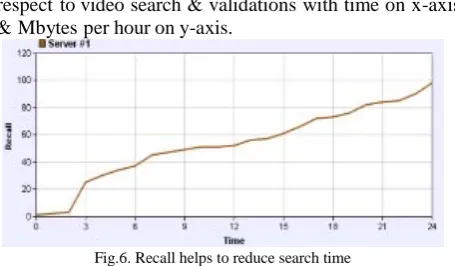
[d] Our system has higher level of precision with respect to video search & validations also recall can help to reduce the search time. For user can share video to his friend.
Fig.5. Higher level of precision with respect to video search
Above figure shows higher level of precision with respect to video search & validations with time on x-axis & Mbytes per hour on y-axis.
Fig.6. Recall helps to reduce search time
Above figure shows the recall with time on x-axis & recall on y-axis.
VII
CONCLUSION AND FUTURE WORK In video retrieval system, we are facing irrelevant results problem which has been controlled by using OTP method. Along with the security speed of operation is also optimized. We had maintained very simple flow of system to make user navigation efficiently. AMES algorithm is providing time, segmentation, jitter properties which is very efficient as compare to existing video retrieval website.This system provides video sharing facility to friend list which increases video recommendation & viewer’s knowledge. This system can be executed over the private LAN or across internet. The subVC server is helping to maintain load on cloud server.
In future, this system can be utilized for online E-learning process or multimedia blog type of application. Also security mechanism can be increased using one or more encryption algorithm.
ACKNOWLEDGMENT
The authors would like to thank Prof. A. D. Potgantwar for his help. This work was supported in part by the Sandip Foundation.
REFERENCES
[1] Xiaofei Wang, Ted “Taekyoung” Kwon, Victor C.M. Leung, “AMES- Cloud: A Framework of Adaptive Mobile Video Streaming and Efficient Social Video Sharing in the Clouds” in IEEE TRANSACTIONS ON MULTIMEDIA VOL:15 NO:4 YEAR 2013.
[2] H. Schwarz, D. Marpe, and T. Wiegand, “Overview of the Scalable
Video Coding Extension of the H.264/AVC Standard,” in IEEE
Transactions on Circuits and Systems for Video Technology, vol.
17, no. 9, pp. 1103–1120, Sep. 2007.
[3] M. Wien, R. Cazoulat, A. Graffunder, A. Hutter, and P. Amon, “Real- Time System for Adaptive Video Streaming Based on SVC,”
in IEEE Transactions on Circuits and Systems for Video
Technology, vol. 17, no. 9, pp. 1227–1237, Sep. 2007.
[4] A. Nafaa, T. Taleb, and L. Murphy, “Forward Error Correction Adaptation Strategies for Media Streaming over Wireless Networks,”
in IEEE Communications Magazine, vol. 46, no. 1, pp. 72–79, 2008.
[5] H. Schwarz and M. Wien, “The Scalable Video Coding Extension of
The H. 264/AVC Standard,” in IEEE Signal Processing
Magazine,vol. 25, no. 2, pp.135–141, 2008.
[6] W.W. Zhang, Y.G. and D.P. Wu, “Energy-Efficient Scheduling Policy for Collaborative Execution in Mobile Cloud Computing,” in
INFOCOM, Mini Conf., 2013.
[7] N. Davies, “The Case for VM-Based Cloudlets in Mobile
Computing,” in IEEE Pervasive Computing, vol. 8, no. 4, pp. 14–23,
2009.
[8] E. Piri, M. Uitto, J. Vehkaper, and T. Sutinen, “Dynamic Cross-layer Adaptation of Scalable Video in Wireless Networking,” in
IEEE GLOBECOM, 2010.
[9] F. Wang, J. Liu, and M. Chen, “CALMS : Cloud-Assisted Live Media Streaming for Globalized Demands with Time / Region
Diversities,” in IEEE INFOCOM, 2012.
[10] X. Wang, S. Kim, T. Kwon, H. Kim, Y. Choi, “Unveiling the
BitTorrent Performance in Mobile WiMAX Networks,” in Passive
and Active Measurement Conference, 2011.
[11] J. Fernandez, T. Taleb, M. Guizani, and N. Kato, “Bandwidth Aggregation-aware Dynamic QoS Negotiation for Real-Time Video
Applications in Next-Generation Wireless Networks,” in IEEE
Transaction on Multimedia, vol. 11, no. 6, pp. 1082–1093, 2009.
[12] T. Taleb, K. Kashibuchi, A. Leonardi, S. Palazzo, K. Hashimoto, N. Kato, and Y. Nemoto, “A Cross-layer Approach for An Efficient Delivery of TCP/RTP-based Multimedia Applications in
Heterogeneous Wireless Networks,” in IEEE Transaction on
Vehicular Technology, vol. 57, no. 6, pp. 3801–3814, 2008.
[13] K. Zhang, J. Kong, M. Qiu, and G.L Song, “Multimedia Layout
Adaptation Through Grammatical Specifications,” in ACM/Springer
Multimedia Systems, vol. 10, no. 3, pp.245–260, 2005.
[14] P. McDonagh, C. Vallati, A. Pande, and P. Mohapatra, “Quality-Oriented Scalable Video Delivery Using H. 264 SVC on An LTE
Network,” in WPMC, 2011.
[15] Q. Zhang, L. Cheng, and R. Boutaba, “Cloud Computing:
State-of-the-art and Research Challenges,” in Journal of Internet Services and
Applications, vol. 1, no. 1, pp. 7–18, Apr. 2010.
[16] D. Niu, H. Xu, B. Li, and S. Zhao, “Quality-Assured Cloud
Bandwidth Auto-Scaling for Video-on-Demand Applications,” in
[17] Y.G. Wen, W.W. Zhang, K. Guan, D. Kilper, and H. Y. Luo, “Energy- Optimal Execution Policy for A Cloud-Assisted Mobile Application Platform,” Tech. Rep., September 2011
[18] W.W. Zhang, Y.G. Wen, Z.Z. Chen and A. Khisti, “QoE-Driven Cache Management for HTTP Adaptive Bit Rate Streaming over
Wireless Networks,” in IEEE Transactions on Multimedia,
November 2012.
[19] J. Li, M. Qiu, Z. Ming, G. Quan, X. Qin, and Z. Gu, “Online Optimization for Scheduling Preemptable tasks on IaaS Cloud
systems,” in Journal of Parallel and Distributed Computing
(JPDC), vol.72, no.5, pp.666- 677, 2012.
[20] P. Calyam, M. Sridharan, Y. Xu , K. Zhu , A. Berryman, R. Patali, and A. Venkataraman, “Enabling Performance Intelligence for
Application Adaptation in the Future Internet,” in Journal of
Communication and Networks, vol. 13, no. 6, pp. 591–601, 2011.
[21] B. Aggarwal, N. Spring, and A. Schulman, “Stratus :
Energy-Efficient Mobile Communication using Cloud Support,” in ACM