© 2018, IRJET | Impact Factor value: 6.171 | ISO 9001:2008 Certified Journal | Page 3255
THE IMPACT OF BIOFUEL ON IC ENGINE AND THE ENVIRONMENT
Pratik L. Ilag
1, Saidas A. Khatal
2, Sandesh S. Mhaske
3, Uddhav S. Prabhu
4,
Guide-: Prof. Vinay More
21,2,3,4 Students, Department of Mechanical Engineering, Dilkap Research Institute of Engineering And Management
Studies, Neral, Tal-Karjat, Dist-Raigad, Maharashtra, India.
5Professor, Department of Mechanical Engineering, Dilkap Research Institute Of Engineering And Management
Studies, Neral, Tal-Karjat, Dist-Raigad, Maharashtra, India
---***---Abstract –
This paper contains Extracting esters from oil of Argemone Mexicana with additive n-Butanol using esterification and trans- esterification technique. Mexicana is a herbaceous medicinal plant belonging to the family papaveraceae, It is indigenous to mexico. Nowadays it is distributed throughout the of India, up to 1500m elevation of weed. Mexicana seeds were collected from the Agasthiyamalai Biosphere Regions Reverse Forest of South Western Ghats regions. The seeds were crushed by using Mortar and Pestle. The oil was extracted with hexane by using Soxhelt apparatus. The oil blended with conventional diesel at 10%(B10) & 20% (B20) proportions physic chemical analysis.Key Words: Biodiesel, Argemone Mexicana, Additive, Engine Testing, Biodiesel Production.
1. INTRODUCTION
Biodiesel has become more attractive recently because of its environmental benefits and the fact that the biodiesel is made from renewable energy source. The world energy crisis is a result of population growth and increasing energy consumption in both developed countries and emerging economics. The greater demand of petroleum products are as a result of enormous increase in the number of automobile serves the growing problem of the developing countries. With crude oil reserves estimated to last only few decades, therefore efforts are on way to find out new alternatives to diesel. Depletion of crude oil could cause a major impact on the transport sector. Diesel engines are widely used because of their higher power output, fuel economy and lower hydrocarbons (HCs) and carbon monoxide (CO) emissions than gasoline engines. However, emissions of particulate matter (PM), nitrogen oxides (NOx), Sulphur oxide (SOx), polycyclic aromatic hydrocarbons (PAHs) and exhaust odor from diesel engines have always been of great concerns. Biodiesel are gaining popularity owing to increased environmental awareness and the rising price of fossil fuel.
The Mexicana Oil with n-Butanol additives has been considered as a promising option for diesel engines because of friendliness.
1.1 Problem Statement
In today’s world, alternative fuels are needed more than ever. Conventional fuels, such as coal, natural gas, and fossil
fuel, are constantly being depleted; however, the world’s dependence on these fuels is still growing. Additionally, the price on foreign fuels is ever increasing. For these reasons, the US and the world are pursuing alternative fuel sources to lessen the dependency on conventional fuels. One alternative fuel is biodiesel; biodiesel can be produced from vegetable oil or animal fat and thus can be used to alleviate the foreign fuel dependency. In order for biodiesel to be a viable alternative fuel source, an industrial-scale biodiesel production process needs to be improved. Compared to current designs and fossil fuel, the process must be cost competitive.
The purpose of this project is to develop an industrial process to create biodiesel from oil extracted from Mexicana seeds. Mexicana oil has been a main focus for many research efforts for the last couple of decades because it is not primarily used as food, can be grown quickly, and does not require much area to grow. Mexicana-based biodiesel is still early in development and companies have had issues efficiently lysing, or extracting, the oil from the seeds. While no one has found a way to do this efficiently, many believe that Mexicana seed oil could be the answer to lessening the world’s dependency on fossil fuels.
1.2 Objectives
1) Identification and selection of feed stock for preparation of biodiesel.
2) Extraction of oil from seed of Mexicana with the help of soxhelt apparatus.
3) Preparation of biodiesel by using esterification and trans-esterification reaction.
4) Preparation of blends of biodiesel with diesel fuel. (BlendsB00, B06, B12, B18, B24).
5) Quality testing of all biodiesel with blends along with diesel fuels. (Density, viscosity,
Flash point, fire point, cetane no., calorific value, cloud point, pour-point, moisture)
6) Engine performance analysis of all blends (brake power, brake thermal efficiency,
© 2018, IRJET | Impact Factor value: 6.171 | ISO 9001:2008 Certified Journal | Page 3256 7) Combustion analysis-preparation of heat balance sheet.
8) Search of best blends that will substitute diesel fuel without modification in diesel engine.
9) Smoke analysis for all blends with diesel fuel
2. PROCEDURE OF BLENDS PREPARETION AND ENGINE TESTING
Collection of Mexicana Seeds
Drying of Mexicana Seeds
Crushing of Seeds: The seeds are Crushed by Mortar and Pestle.
Extraction of oil: Prior to the extraction process Mexicana seeds were dried at 500 C for 12 hours in the
oven to remove the excess moisture. The dried seeds were then weighed and powdered. The fine seed powder was then subjected to Soxhlet apparatus using methanol as a solvent. The duration of each batch was 10 hours for complete extraction. The solvent required for extraction of per kg seeds was in the ratio of 5:1 (5L solvent for 1kg seeds). The oil was recovered from the solvent by distillation process. The extracted oil was then measured to calculate the percentage oil in the seeds.
Esterification: This process is used to reduce acid value of the oil. In this process there are following steps:
A. First oil is preheated to 400C
B. Then 0.5 to 0.7% (5 to 7gm per liter) of H2SO4 is
added.
C. After 2 min nearly 13% (130gm per liter) of methyl/ethyl alcohol is added.
D. And temperature is maintained constant about 550 to 650C for abouy 45 to 50 minutes.
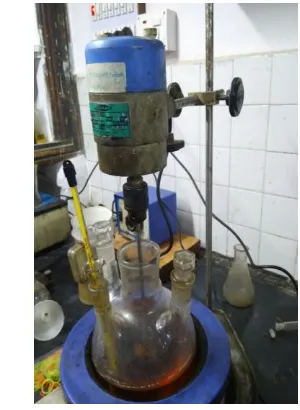
[image:2.595.356.506.77.282.2] Trans-Esterification: 1.5% (15gm per liter) of aluminum oxide will be added to 130 ml of Methyl alcohol. Then this mixture will be added in unit called trans-esterification unit. Again temperature will be maintained at 550 to 600 C for about 1hr30 min.
Figure -1: Esterification and Trans-esterification unit
Settling and seperation: In this process glycerin and alcohol mixture is settled at various levels. For this settling apparatus is used. The mixture in apparatus is kept over night. Another day separate layers of glycerin oil and alcohol mixture and unreacted Alcohol is obtained. The layers obtained in settling will be removed one by one separately.
Blends preparation with addition of N- Butanol: As we know oil and diesel being varying in densities cannot be mixed easily. To mix them homogenously following steps should be followed:
A. Diesel and oil are mixed in required proportion and then constantly heated at 400 to 450 C for
20 min unless two layers form homogenous mixture.
B. Blends prepared will be B00, B06, B12, B18 and B24.
C. n-Butanol is particular interest as a renewable biofuel as it is less hydrophilic, and possesses higher energy content, higher cetane number, higher viscosity, lower vapour pressure, higher flash point and higher miscibility than ethanol, making it more preferable than ethanol for blending with diesel fuel. Therefore, the problems associated with ethanol mentioned in the previous sub-section are solved to considerable extent when using n-Butanol, which is also less corrosive.
© 2018, IRJET | Impact Factor value: 6.171 | ISO 9001:2008 Certified Journal | Page 3257 Figure -1: Flow chart of Extraction of Biodiesel
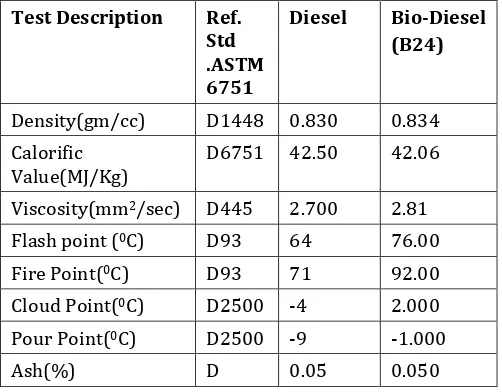
Table -1: Analysis of Diesel and Bio-Diesel
Test Description Ref. Std .ASTM 6751
Diesel Bio-Diesel (B24)
Density(gm/cc) D1448 0.830 0.834
Calorific
Value(MJ/Kg) D6751 42.50 42.06
Viscosity(mm2/sec) D445 2.700 2.81
Flash point (0C) D93 64 76.00
Fire Point(0C) D93 71 92.00
Cloud Point(0C) D2500 -4 2.000
Pour Point(0C) D2500 -9 -1.000
Ash(%) D 0.05 0.050
Engine testing: Engine testing was carried out on IC Engine with following specifications-
Fuel Diesel
No. of Cylinders 1
No. of Strokes 4
Cylinder Diameter 87.5mm
Stroke length 110mm
Connecting rod length 234mm
Orifice Diameter 20mm
Dynamometre arm length 185mm
Power 3.5kw
Speed 1500rpm
CR 18:1
As above engine specifications carried as C.R.18 readings been taken. The fuel tank and pipe were cleaned before inserting each blends of biodiesel. The emission testing were carried on AVL 437 smoke meter operating Unit.
3. RESULTS
[image:3.595.309.561.609.743.2]Gas Analysis of Blends
Table-2: Gas Analysis Chart
Blends Load
(in kg)
CO (%)
CO2 (%)
B00 0.3 0.024 0.5
3 0.027 0.9
6 0.016 1.2
9 0.015 1.6
12 0.016 1.9
B06 0.3 0.04 0.4
3 0.045 0.8
6 0.023 1.1
9 0.023 1.5
12 0.042 1.9
B12 0.3 0.042 0.5
3 0.043 0.9
6 0.033 1.2
9 0.031 1.7
12 0.032 2
B18 0.3 0.035 0.5
3 0.043 0.9
6 0.034 1.3
9 0.025 1.5
12 0.036 2
B24 0.3 0.038 0.5
3 0.048 0.9
6 0.037 1.2
9 0.038 1.6
12 0.045 2
Graphical Presentation of Gas Analysis
© 2018, IRJET | Impact Factor value: 6.171 | ISO 9001:2008 Certified Journal | Page 3258 For CO emission B6 is better at load 6kg and 9kg. B12 is
better at load 12kg. For CO emission this 2 blends are better than other blends.
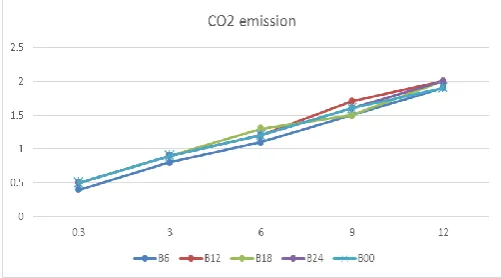
Chart -2: CO2 Emission(%) v/s Load(Kg)
In the above graph it is clearly seen that all blends having less CO2 emission. For CO2 emission B6 is better blend than
other blend at load 12kg.
Engine Analysis of Blends:
Graphical Representation of Blends
Chart -3: Brake Power(Kw) v/s Load(kg)
It is clearly seen that all blends having approximately same Brake Power as that of the pure diesel.
Chart -4: BEMP (Bar) v/s Load(Kg)
[image:4.595.35.286.125.264.2]All blend shaving almost same break mean effective pressure near to pure diesel blends are showing slight changes the value between B6 to B12.
Table-3: Engine Analysis Charts of Blends
Blends Load (Kg)
Torque (Nm)
BP (KW)
IP (KW)
BEMP (bar)
BTHE (%)
B00 0.3 0.48 0.08 1.13 0.09 2.15
3 5.36 0.85 1.91 1.02 16.26
6 11.18 1.78 2.69 2.12 25.38
9 16.15 2.53 3.19 3.07 28.89
12 21.67 3.35 3.97 4.12 31.92
B06 0.3 0.21 0.03 1.16 0.04 1.14
3 4.97 0.79 1.84 0.94 16.95
6 10.78 1.71 2.66 2.05 24.45
9 15.92 2.5 3.24 3.02 28.5
12 21.58 3.34 3.97 4.1 31.74
B12 0.3 0.48 0.08 1.18 0.09 2.21
3 5.91 0.96 2.05 1.12 18.32
6 10.52 1.7 2.69 2 26.53
9 16.71 2.64 3.35 3.17 28.25
12 21.6 3.35 4.04 4.1 33.71
B18 0.3 0.54 0.09 1.18 0.1 2.51
3 5.53 0.9 1.97 1.05 17.21
6 11.01 1.79 2.8 2.09 25.48
9 16.41 2.58 3.37 3.12 27.57
12 22.08 3.43 4.1 4.19 30.89
B24 0.3 0.21 0.04 1.15 0.04 1.01
3 5.4 0.88 1.88 1.03 16.66
6 10.83 1.75 2.89 2.06 24.97
9 17.01 2.68 3.49 3.23 30.6
12 21.27 3.31 4.01 4.04 29.86
4. CONCLUSIONS
In this project we have tested the various types of blends of Mexicana seed oil with the n-Butanol as an addition and their performance characteristics on IC Engine. To compare between the all different blends we have created and choosing the best blend one of them on the basis of performance, economy and safety for the environment.
© 2018, IRJET | Impact Factor value: 6.171 | ISO 9001:2008 Certified Journal | Page 3259 As Mexicana is wild plant it gets available easily and at
high quantity do production of Mexicana seed is easy and economical.
With addition of n-Butanol the qualities of the oil like higher cetane number, higher viscosity, low vapour pressure, higher flash point and higher missibility and another good quality is its less corrosive nature which increase the life of engine.
With the analyzing the result of various blends as in case of performance the B12 and B24blends are best, but the emission of B24 blend is higher as compare to the B12 blend among all this.
Hence, there has been always a need for alternate better fuel option for Diesel and Petrol and Bio-Diesel can solve this problem and can be a good option for Diesel.
Mexicana oil can be used for making Bio-Diesel with the use of additives to get more efficient blends some more blends should be tested.
5. FURTURE SCOPE
Solving world’s energy problem with Bio-Diesel is slightly difficult but it can play very important role as an option to Conventional Energy Resources.
With the help of some extra research, marketing and government policies Bio-Diesel can be use in our daily routine and demand for diesel can be reduced.
This research will also help for further studies and research related to Bio-Diesel made by crops or oil seeds. This research is about Mexicana seeds with n-Butanol additive this studies can be the base for the research on Mexicana because there is not so research has been done on Mexicana.
In preparation of Bio-Diesel a countable amount of glycerin can be use in many ways. A co-operative pharmaceutical company can be handled with more beneficial outcome with glycerin as main ingredient. This will lead to development of initial chain of industries working in condition.
It is expected that the best of Bio-Diesel will be lower than the conventional diesel fuel as Bio-Diesel are the key target for future energy market they can play important role in maintaining energy security.
Mexicana is a wild plant and does not need more attention for cropping of Mexicana is not difficult and economical. Mexicana seeds are also get available easily. Therefore Mexicana can be very good option for preparing Bio-Diesel.
Overall Bio-Diesel production and consumption especially for all blends with small portion of Bio-Diesel is technically reasonable as in alternative fuel in CI Engine without any modification of engine with considerable cost reduction.
REFERENCES
[1] Garcia VP, Valdes F, Martin R, Luis JC, Afonso AM, Ayala
JH. Biosynthesis of antitumoral and bactericidal sanguinarine. Journal of Biomedicine and Biotechnology 2006; 2006(63518):1–6.
[2] Usher GA. Dictionary of plants used by man. Constable,
ISBN 0094579202; 1974.
[3] Pesman MW. Meet flora Mexicana. Arizona: Dale S. King;
1962.
[4] Emboden W. Narcotic plants. Studio Vista, ISBN
0-289-70864-8; 1979.
[5] Genders R. Scented flora of the world. London: Robert
Hale, ISBN 0-7090-5440-8; 1994.
[6] Coffey T. The history and folklore of North American
wild flowers. Facts on File, ISBN 0-8160-2624-6; 1993.
[7] Suwal PN. Medicinal plants of Nepal. Kathmandu:
Department of Medicinal Plants; 1993.
[8] Chopra RN, Nayar SL, Chopra IC. Glossary of Indian
medicinal plants (including the supplement). New Delhi: Council of Scientific and Industrial Research, CSIR Publications; 1986.
[9] Azam MM, Waris A, Nahar NM. Prospects and potential
of fatty acid methyl esters of some non-traditional seed oils for use as biodiesel in India. Biomass and Bioenergy 2005;29: 293–302.
[10] Southcombe JE. Chemistry of oil industries. 2nd ed.
London: Constable and Co. Ltd.; 1926. p. 144.
[11] Williams KA. Oils, fats and fatty foods. 4th ed. London: J
and A Churchill Ltd.; 1966. pp. 124–391.
[12] India Bio-Diesel Corporation, Baramati, Dist- Pune,