Volume 71– No.8, May 2013
Applying Data Mining Technique for Predicting
Incubator Length of Stay in Egypt and USA
Hagar Fady S.
Taha EL-Sayed T.
Mervat Mahmoud M.
Dept. Of Computer Science & Eng., Faculty of Electronic Engineering
Dept. Of Electronics& Electrical communications, Faculty of Electronic Engineering
Dept. Of Computer Science & Eng., Faculty of Electronic Engineering
Menoufiya University, Egypt Menoufiya University, Egypt Menoufiya University, Egypt
ABSTRACT
This research aims to provide intelligent tool to predict incubator Length of Stay (LOS) of infants in Egypt and USA, in addition to define factors affecting Length of Stay (LOS) of preterm infants and their severity of impact.
This study has relied on data collected from both Egypt and US, to compare LOS‟s driving factors and the accuracy of LOS prediction in both countries.
The obtained results indicated that accurate and early diagnosis may speed up treatment and thus reduce length of stay.
General Terms
Data mining, Infant Incubator, Length of Stay
Keywords:Length of Stay, Data Mining, Regression,
Incubator, Premature.1.
INTRODUCTION
Data mining is the process of selecting, exploring and modeling large amounts of data in order to discover unknown patterns or relationships which provide a clear and useful result to the data analyst[1]. In healthcare, data mining is becoming increasingly popular, if not increasingly essential [2].
Predictive models in clinical medicine are „tools for helping decision making that combine two or more items of patient data to predict clinical outcomes‟. Such models may be used in several clinical contexts by clinicians and may allow a prompt reaction to unfavorable situations[1].
According to World Health Organization (WHO), newborn deaths, that is deaths in the first four weeks of life (neonatal period), today account for 41% of all child deaths before the age of five. The first week of life is the riskiest week for newborns, and yet many countries are only just beginning postnatal care programsto reach mothers and babies at this critical time.Almost 99% of newborn deaths occur in the developing world. With a reduction of 1% per year, Africa has seen the slowest progress of any region in the world.Existing interventions can prevent two-thirds or more of these deaths if they reach those in need [3].
A neonatal intensive care unit, usually shortened NICU (pronounced "Nickyoo"), is a unit of a hospital specializing in the care of ill or premature newborn infants. Infants are cared
important in specialized areas of the hospital, suchas intensive care units (ICU) or step down units.An early and accurate prognosis of LOS may have organizational, economic, and medical implications. At times of reduced health care budgets, optimal resource planning, e.g. staff scheduling and early discharge policy, is vital[5]. Evaluating LOS informationis a challenging task , but is essential forthe operational success of a hospital. Intensive careresources in particular are often limited and posescheduling problems for hospital staff and administrators. Predicting LOS is difficult andoften only done retrospectively [2].
Major contributions of this research are:
1. Studying LOS through deploying data mining technique with different algorithms.
2. Comparative study, based on real data collected, between Egypt (African developed country) and USA.This Comparative study casted light on differences in factors and patterns affecting LOS. This paper is organized as follows. Section 2, reviews related work in LOS prediction. Section 3demonstrates process, algorithms and structure of module used in LOS prediction. Section 4, describes the research results. Section 5, conclusion and key findings of the research
2. RELATED WORK
This research consists of three main stages as shown in Fig 3 below:
Fig. 1 Research methodology
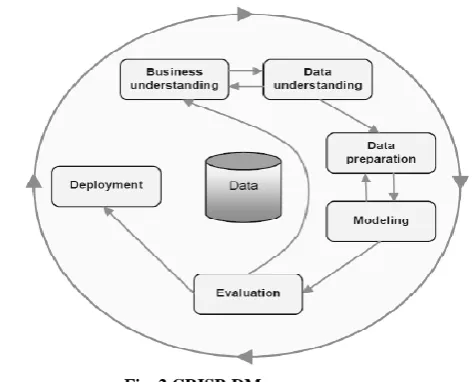
CRISP-DM (CRoss-Industry Standard Process for Data Mining) methodology is used as the process to develop data mining modules. This methodology consists of six phases (Business understanding, Data understanding, Data preparation, Modeling, Evaluation, Deployment) intended as a cyclical process (see Fig. 2.) [8].
Fig. 2 CRISP-DMprocess
3.1.1 Procedures and Forms of EGNN,NHDS:
EGNNis a not-for-profit organization whose mission is to improve the efficacy and efficiency of neonatal care in Egypt through a co-ordinate program of research, education, and quality improvement[9]. It has published “28 Day/Discharge Form” and “EGNN_Dataset_Definition_Manual_2010” which is being used in Egyptian neonatal units, in order to standardize data recorded for preterm infants.
NHDS, The National Hospital Discharge Survey, covers discharges from non-institutional hospitals, exclusive of Federal, military, and Veterans Administration hospitals, located in the 50 States and the District of Columbia [10]. Medical information is coded using the “International Classification of Diseases, 9th revision, Clinical modification (ICD-9-CM)” [11].
3.1.2 Previous research
It was found that majority of previous researches developed LOS prediction models based on few risk factors. Those studies used statistical techniques such as multiple linear regression, logistic regression and neural network in LOS prediction model. It also focused on studying LOS in one country\region, rather than analyzing how LOS pattern changes from a region to the other.
3.2Data Preparation
Data preparation includes 3 preprocessing steps(data selection, data cleaning and data transformation) applied to the data to help improve the accuracy,efficiency, and scalability of the classification or prediction process.
3.2.1 Data Selection
The study is carried on:
Infants admitted to neonatal care unit .Tanta University Hospital from December 2010 and December 2011. Number of records collected 302. Cases were organized as per EGNN form and guidelines [12][13].
Data available by NHDS “National Hospital Discharge Survey, 2002”[10]. Number of casesstudied 5000. Cases were organized as per NHD description, while diseases (diagnoses) were coded as per “International Classification of Diseases, Ninth Revision, Clinical Modification (ICD-9-CM)”[11] issued by Center of disease Control and Prevention (CDC).
Dead infants and Cases transferred to other hospitals before being discharged home were excluded. Data were organized and stored in electronic format, guided by the guidelines of EGNN, NHD and advice of preterm expert.
1- DEVELOP PREDICTIVE MODELS USING EGYPTIAN
DATA
2- DEVELOP PREDICTIVE MODELS USING American
DATA
3- COMPARING MODELS RESULTS
Validation
[image:2.595.56.293.394.585.2]Volume 71– No.8, May 2013
Table1.Sample offactors studied in this research
# Factor name Attribute
Name # Factor name
Attribute Name
1 Admission number Admission_no 12 (RDS) Respiratory
Distress Syndrome RDS
2 Gestational age M_Age 13 focal gestational
perforation FGP
3 Birth Weight Birth Weight 14 Cystic Periventricular
Leukomalacia Leukomalacia
4 Prenatal Care Prenatal_care 15 Hypoxic Ischemic
Encephalopathy (HIE) HIE
5 Multiple Birth Multiple_Birth 16 Patent Ductus
Arteriosus (PDA) PDA
6 Apgar 1Min __ __ Apgar 5 Min
- Start_Apgar
-End_Apgar 17 Jaundice Jaundice
7
Respiratory Support After Leaving Delivery Room(a,b,c,d,e,f)
-respiratory_supp_
a/b/c/e
18 Maxim.t.bilirubin Maxim
8 Steroids For CLD Steroids 19 Procedures Procedures
9
Indomethacin/Ibuprof en For PDA
(Prophylactic)
Indomethacin1 20 Length Of Stay LOS/ Dayscare
10 Addicted mother Addicted_mother 21 Blood disorder Blood_disorder
11 Surgery Surgery 22 Length of stay as
category variable LOS_CAT
3.2.2 DataCleaning
In order to perform LOS prediction using Oracle Data Miner,a column addressing the source of the data was added to the master table.
It is found that in some cases collected from Egypt, data wasincomplete, noisy and inconsistent. In this step,filling on missing values, smoothing out noise while identifying outliers and correcting inconsistencies in the data were performed. Historical Data collected.
3. 2.3Data Transformation
The study sample was randomly splitas follow:
Table2. Data Split
Source
of Data Development Test Total
Egypt 260 92 302
USA 3500 1500 5000
Data were discretized (that is, binned); numerical data binned into ranges of values (Quantile binning strategy),
3.3Module Development(modeling)
3.3.1Tool Selection
The following tools are used in this research:
I – Oracle Data Miner version11.1.0.4, for the mining activity, that acts as a client and 11g database release 11.1.0.6.0 as a server.
II – Oracle SQL developer. III – MS Excel.
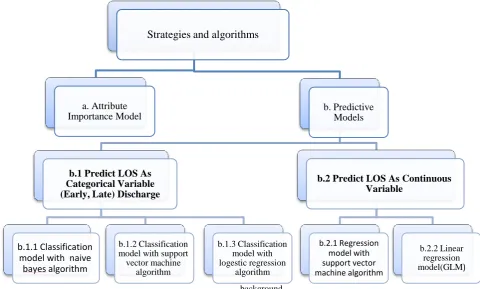
3. 3.2 Defining Strategies and Algorithms
Fig. 3Working strategies and algorithms
a. AttributeImportance Model
Oracle Data Mining provides a feature called Attribute Importance (AI) that uses the algorithm Minimum Description Length (MDL) to rank the attributes by significance in determining the target value. Attribute Importance can be used to reduce the size of a classification problem, giving the user the knowledge needed to eliminate some attributes, thus increasing speed and accuracy[14].
b. Predictive Model
b.1 Predict LOS as Categorical Variable
(early, late)Discharge
Three predictive models were constructed using classification method with Naive Bayes,SVM and logistic regression algorithms.
b.2 Predict LOS as Continuous Variable
)
the
Number of Days Spent at Incubator)
2 predictive models were constructed using regressionmethod with support vector machine and linear regression algorithm to predict the target variable (LOS).
In module deployment phase, Simple user interfaces were designed to enable medical team to operate the module in
background.
4.
RESEARCH RESULTS
Fig.4 Research results
4.1Sample Summary
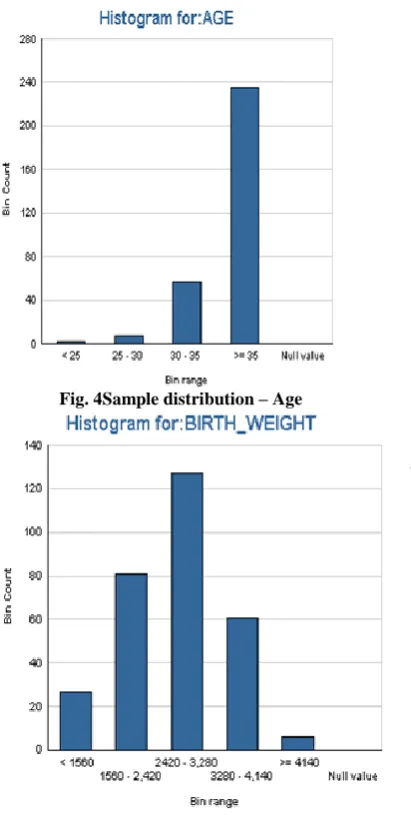
4.1.1 Sample summary for EGNN models
1) 78.81% of infants were categorized as early discharge and 21.19% were late.
2) Besides prematurity and neonatal jaundice, common diseases were included in the sample i.e. sepsis, Infant respiratory distress syndrome
(RDS)
due to immaturity of the lungs.1- sample summery
2- modules evaluation
3- factors affecting LOS
Strategies and algorithms
a. Attribute Importance Model
b. Predictive Models
b.2 Predict LOS As Continuous Variable
b.2.1 Regression model with support vector machine algorithm
b.2.2 Linear regression model(GLM)
b.1 Predict LOS As Categorical Variable (Early, Late) Discharge
b.1.1 Classification model with naive bayes algorithm
b.1.2 Classification model with support vector machine
algorithm
b.1.3 Classification model with logestic regression
Volume 71– No.8, May 2013
[image:5.595.94.403.73.689.2]Fig. 4Sample distribution – Age
Fig. 5 Sample Distribution – Birth Weight
[image:5.595.92.298.76.486.2]Fig. 6 Sample distribution – LOS – Category
Fig. 7Diseases frequency in EGNN models
4.1.2 Sample summary for NHDS models
1) 54.9% of infants were male and 45.1% were female. 2) 1.24% of infants were dischargedafter 1 day ( losflag =0)
(early) and 98.76% were late(losflag = 1).
[image:5.595.322.534.76.215.2]3) Necrotizing Enterocolitis (NEC), prematurity, sepsis and neonatal jaundice takes a highest percentage in diseases frequency.
Fig. 8Sample Distribution – NHDS
Fig.9Cases distribution by Sex in USA, Egypt
0% 20% 40% 60%
Male Female
Cases Distribution by Sex
[image:5.595.314.537.381.691.2] [image:5.595.79.276.499.688.2]Factor
US
Egypt
Addicted Mother
10%
0%
Blood Disorder
3%
0%
Cardiac
7%
5.63%
Congenital anomalies
17%
9%
gastrointestinal disorder
4%
5.96%
IUGR
22%
2%
Jaundice
41%
58%
NEC
43%
3.97%
prematurity
21%
13%
RDS
16%
40%
sepsis
20%
26%
Fig. 10 Diseases frequency
4.2 MODULES EVALUATION
Module validation and testing was carriedindependentlyfor EGNN and NHDS data. Results are compared in tables 6 and 7. Predictive confidence is a visualindication of the effectiveness of the model compared to a guess based on the distribution of target values in the build dataset [14]. If the model has a predictive confidence of 65.64% that means it is 65.64% better than naïve model.
The modules performance was also compared for EGNN and NHDS. (See table 4, 5)
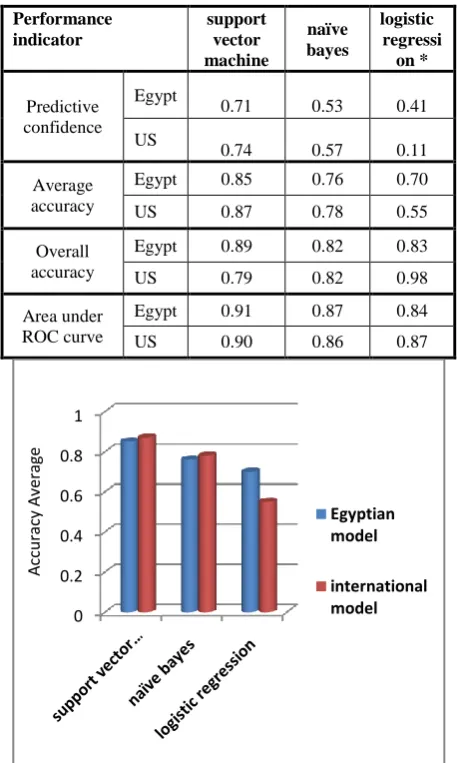
The comparative tables (4, 5) of predictive capabilities in case of algorithms used in our study and previous research‟s algorithm presented by Hintz et al [6] For EGNN and NHDS shows that:
1-
LOS prediction models as categorical variableFor EGNN and NHDS models, the support vector machine algorithm outperforms others as it presented high predictive confidence, average accuracy and Area Under Curve (AUC) followed by naïve bayes algorithm. On other hand, the logistic regression algorithm
variable
In EGNN and NHDS models, the SVM regression algorithm presented higher capability than linear regression algorithm by means of lower error and higher predictive confidence. SVM are becoming increasingly popular in medicine [15]. It can emulate some traditional methods, such as linear regression and neural nets, but goes far beyond those methods in flexibility, scalability, and speed [14].
By comparing EGNN and NHDS modules performance (see Fig.11, Fig.12), it was observed that all algorithms have close predictive confidence in both EGNN and NHDS data sets, excepts for logistic regression which showed poor predictive confidence with NHDS data set. LR (Logistic Regression) is not widely used for data mining because of an assumption that LR is unsuitably slow for high –dimensional problems[16].
Overall, the predictive validity of the research models (EGNN AND NHDS) was very good to excellent, with point estimates for the AUC of the Receiver Operating Characteristic(ROC) curves ranging between 0.91 and 0.89.
4.2.1 Evaluation of classification models
Table4. Performance indicator comparison for categorical variable
Performance indicator
support vector machine
naïve bayes
logistic regressi
on *
Predictive confidence
Egypt 0.71
0.53
0.41 US
0.74
0.57
0.11 Average
accuracy
Egypt 0.85 0.76 0.70
US 0.87 0.78 0.55
Overall accuracy
Egypt 0.89 0.82 0.83
US 0.79 0.82 0.98
Area under ROC curve
Egypt 0.91 0.87 0.84
US 0.90 0.86 0.87
0% 10% 20% 30% 40% 50% 60% 70%
US
Egypt
0 0.2 0.4 0.6 0.8 1
A
cc
u
racy
A
ve
rag
e
Egyptian model
[image:6.595.309.538.397.779.2]Volume 71– No.8, May 2013
4.2.2 Evaluation of Regression models
Table5.Performance indicator comparison for continuous variable
Performance Indicator
support vector machine
Linear regression* Predictive
confidence
Egypt 38.52 22.02
US 24.54 15.99
Mean absolute error
Egypt 5.65 10.44
US 2.49 3.56
Root Mean Square Error
Egypt 11.76 14.9
US 7.38 8.21
Fig. 12Comparing models predictive confidence in Egypt and USA
4.3 factors affecting LOS
Table 6, 7 demonstrates risk factors highly influencing LOS in Egyptian and American environment. Steroids,sepsis,FGP (Focal GastrointestinalPerforation) and Down syndrome were highly influencing LOS prediction process in EGNN forms. On other hand, leukomalacia, meningitis, ROP (Retinopathy of Prematurity), blood disorder and RDS were effective in NHDS.
Table6.Factorshighly affecting LOS in EGNN model
factor Attribute
importance Naïve bayes
Logistic regression
Linear regressi on
BPD * *
Down
factor Attribute
importance Naïve bayes
Logistic regression
Linear regressi on
Respiratory
support * *
Sepsis * *
Steroids * * * *
Surgery * *
Table7. Factors highly affecting LOS in US model
Factor Attrib ute import
ance
Naïve bayes
Logistic regressio
n
Linear regressio
n
Blood disorder
* *
Down syndrome
* *
Endocrinal * * *
HIE * *
leukomalaci a
* * *
MAS * *
meningitis * * *
Metabolic acidosis
* *
Neurological * *
Prematurity * *
RDS * *
ROP * * *
Table8. Factors affecting LOS in US and EGNN model
Factor Found in NHDS
Found in EGNN
Effective in NHDS
Effective in EGNN
Steroids * *
Sepsis * * * *
MAS * * *
Blood disorder
* *
RDS * * *
Prematurity * * * *
0 10 20 30 40 50 60 70 80
Egyptian model
[image:7.595.310.524.613.723.2]from very mild conditions to severely affected cases. NHDS were more meticulous as they include only sever forms of respiratory disorder.
MAS (Meconium Aspiration Syndrome) is available in both EGNN, NHDS models but was more effective in LOS in US.In Egyptian environment MAS is delayed diagnoses,it is not diagnoses till the moment of birth, when the amniotic fluid appears greenish in color.Before birth, the fetal monitor may show a slow heart rate.Risk factors for this condition should be identified as early as possible.
Analysis shows that poor diagnose for blood disorder, which is mainly because of lack of facilities, is critical in Egypt. Accurate and early diagnosis of disease in Egypt may help in infant's treatments, decrease incubator length of stay.
Other factors were not included in Egyptian sample, due to their culture, like addicted mother.
5. CONCLUSION
A predictive models comparison have beencarried out, running on data from Egypt and United States, using different types of algorithms on the task of predicting incubator's length of stay. The models included several predictive algorithms i.e naïve bayes, support vector machine, logistic regression and linear regression. Differentperformance measurements have been used to evaluate the ability of the different models to accurately predict the length of stay. The results of the work have shown that in both environments, support vector machine outperforms other algorithms that were tried.
Comparing the results of running differentalgorithms on the two data sets shows convergence in predictive performance,except for logistic regression algorithm.Thissupports the use of the suggested data mining models with other data sources concerning preterm infants.
On other hand, the majority of factors listed in EGNN forms are common with factors in NHDS. However, some factors are reflecting the American environment; i.e. addicted mother.
Our research gives indication that early and accurate diagnoses of infant's diseases in Egyptian environment, i.e MAS and blood disorder, will speed up treatment and thus reduces length of stay.This will provides the optimal and best incubator usage for the specific infant case. The decision making for the length of stay has been improved and made more accurate.
The obtained results are expected to be useful for determining the LOS especially in the Egyptian environment.
6. ACKNOWLEDGMENTS
Authors thanks Prof.Dr. Mohammed El-Rewesha, director of EGNN Gharbia for his support and guidance, and Inter-University Consortium for Political and Social Research (ICPSR) for the use of the National Hospital Discharge Survey.
Also,Authors thanks Dr.Eng.Ahmed Marzook for his guidance in Oracle programming. Also, Hager Fady thanks Dr.Asmaa Sherief, assistant lecturer in forensic medicine and clinical toxicology department, Faculty of Medicine - TantaUniversity, for her help and cooperation in data collection.
REFERENCES
[1] R. Bellaz and B. Zupan, "Predictive data mining in clinical medicine: Current issues and guidelines," International Journal of Medical Informatics, vol. 77, no. 2, pp. 81-97, February 2008.
[2] H. Koh and G. Tan, "Data Mining Applications In Healthcare," J. Health. Info. Man, vol. 19, no. 2, pp. 64-72, 2005.
[3] WHO, "Newborn deaths decrease but account for higher share of global child deaths," 2011. [Online]. Available:
http://www.who.int/mediacentre/news/releases/2011 /newborn_deaths_20110830/en/index.html. [4] J. Sandham, "Baby Incubation," 2008. [Online].
Available: http://www.ebme.co.uk.
[5] B. Zerinkow and K. Holtmannspötter, "Predicting Length-Of-Stay In Preterm Neonates," European Journal of Pediatrics, vol. 158, no. 1, 1999. [6] S. Hintz, C. Bann, N. Ambalavanan, M. Cotten, A.
Das and R. Higgins, "Predicting Time to Hospital Discharge for Extremely Preterm Infants," Journal of the American Academy of Pediatrics, vol. 125, pp. 146-154, 2010.
[7] P. Liu, L. Lei, J. Yin, W. Zhang, W. Naijun and E. El-Darzi, "Healthcare Data Mining: Prediction Inpatient Length of Stay," in 3rd International IEEE Conference on Intelligent Systems, Aveiro, 2006. [8] G. Kraljevic and S. Gotovac, "Modeling Data
Mining Applications for Prediction of Prepaid Churn in Telecommunication Services," Automatika, vol. 51, no. 3, pp. 275-283, 2010. [9] EGNN, "Egyptian Neonatal Network," [Online].
Available: http://www.egynewborn.net.
[10] National Hospital Discharge Survey, 2002, Michigan: Inter-University Consortium for Political and Social Research, 2002.
[11] International Classification of Diseases, Ninth Revision, Clinical Modification (ICD-9-CM), Center of Disea Control, 2008.
[12] EGNN, "Dataset Manual," EGNN, Cairo, 2010. [13] EGNN, "28 Day/Discharge Form," EGNN, Cairo,
2010.
[14] R. Haberstroh, Oracle® Data Mining Tutorial for Oracle Data Mining 11g Release 1, Oracle, 2008. [15] M. Clinic, "Infant jaundice," Mayo Foundation for
Medical Education and Research;, 2011. [Online]. Available:
http://www.mayoclinic.com/health/infant-jaundice. [16] J. Zurada and S. Lonial, "Comparison Of The