Annotating Logical Forms for EHR Questions
Kirk Roberts
†, Dina Demner-Fushman
‡ †School of Biomedical InformaticsUniversity of Texas Health Science Center at Houston Houston TX, USA
‡Lister Hill National Center for Biomedical Communications National Library of Medicine
National Institutes of Health Bethesda MD, USA
Abstract
This paper discusses the creation of a semantically annotated corpus of questions about patient data in electronic health records (EHRs). The goal is to provide the training data necessary for semantic parsers to automatically convert EHR questions into a structured query. A layered annotation strategy is used which mirrors a typical natural language processing (NLP) pipeline. First, questions are syntactically analyzed to identify multi-part questions. Second, medical concepts are recognized and normalized to a clinical ontology. Finally, logical forms are created using a lambda calculus representation. We use a corpus of 446 questions asking for patient-specific information. From these, 468 specific questions are found containing 259 unique medical concepts and requiring 53 unique predicates to represent the logical forms. We further present detailed characteristics of the corpus, including inter-annotator agreement results, and describe the challenges automatic NLP systems will face on this task.
Keywords:question answering, semantic parsing, electronic health records
1.
Introduction
Over the past few years, the adoption of electronic health records (EHRs) has grown remarkably in the United States (Office of the National Coordinator for Health Information Technology, 2014) and many other developed countries as well (Neumann, 2010). However, many usability issues with EHRs are a barrier to their effective use (Zhang and Walji, 2014), including difficulty accessing the information stored in EHRs. Natural language question answering (QA) provides an intuitive interface for retrieving EHR data by reducing the need to understand the internal organization of the data. However, since this data is stored in both un-structured text and un-structured databases, a deep semantic understanding of EHR questions is necessary for an effec-tive QA system.
Consider the following questions:
(1) What is her blood pressure and how low has it been?
(2) Is he on any inotropes?
(3) Is she wheezing this morning?
(4) Who is the patient’s nephrologist?
For a complete semantic understanding of these questions, several types of linguistic processing must be performed. First, Question (1) must be decomposed into two distinct questions. Second, medical concepts (“blood pressure”, “inotropes”, “wheezing”, and “nephrologist”) must be rec-ognized and normalized to an ontology consistent with how the data is stored in EHRs. Third, the phrase “this morning” must be recognized as an explicit temporal constraint on the answer space. Finally, the questions must be converted to a
logical form that captures their full meaning. This includes many other linguistic tasks, such as the implicit temporal semantics in each question. For the questions above, that meaning could be represented by the following lambda cal-culus forms:
(1a’) latest(λx.has test(x,0005823,visit))
(1b’) min(λx.has test(x,0005823,visit))
(2’) δ(λx.has treatment(x,0304509,status))
(3’) δ(λx.has problem(x,0043144,status)∧ time within(x, ‘this morning’))
(4’) latest(λx.has doctor(x,0260039,history))
These logical forms will be explained in more detail in Sections 3-5. After semantic parsing, a QA system can map the logical forms to structured queries (such as SQL for re-lational databases) or particular NLP-based extractors.
the question as much as possible prior to input to the se-mantic parser. Finally, a logical form layer indicates the final semantic form (Section 5).
The corpus described in this paper was manually double-annotated with each of these layers and reconciled. Section 6 describes the results of the annotation, including corpus analysis and inter-annotator agreement. Section 7 discusses some of the linguistic challenges with this task.
2.
Background
Medical Question Answering: Medical QA has seen sig-nificant interest (Athenikos and Han, 2010) due to the tremendous amount of biomedical knowledge, far beyond what any one clinician or researcher could comprehend. The field of medical QA has largely focused on search-ing for information outside the EHR, both targeted to-ward clinicians (Yu and Sable, 2005; Kobayashi and Shyu, 2006; Demner-Fushman and Lin, 2007; Schardt et al., 2007; Terol et al., 2007; Yu and Cao, 2008; Athenikos et al., 2009; Cairns et al., 2011; Cao et al., 2011; Patrick and Li, 2012) and consumers (Zhang, 2010; Liu et al., 2011; Andersen et al., 2012; Kilicoglu et al., 2013; Van Der Volgen et al., 2013; Roberts et al., 2014b; Roberts et al., 2014c; Roberts et al., 2014a; Roberts and Demner-Fushman, 2016). Clinician-targeted QA systems typically focus on the biomedical literature, while consumer QA sys-tems focus on consumer-friendly websites such as Medline-Plus1 (Schnall and Fowler, 2013). Additional work in In-formation Retrieval (IR) has sought to bring relevant litera-ture to clinicians using only a small set of general questions (Simpson et al., 2014; Roberts et al., 2015; Roberts et al., 2016).
Significantly less work has focused on QA for the EHR, though a good amount of attention has been paid to IR for the EHR (Voorhees and Tong, 2011; Voorhees and Hersh, 2012; Hanauer et al., 2014). Of note, Patrick and Li (2012) produced the set of EHR questions used here (Li, 2012). In their work, machine learning (ML) based text classification is used to identify a fixed number of templates, then infor-mation extraction ML recognizers are used to identify the arguments to these templates. Conversely, the logical forms presented here allow for a greater variety of questions to be recognized without pre-defining templates and customizing ML extractors for each template argument. The most sim-ilar work to our own, which understands questions about patient data using a logical form approach is Waldinger et al. (2011). While they focus on aggregate patient data in-stead of a specific patient (e.g., “Find patients on a regimen containing EFV and 3TC.”), this distinction is fairly minor. Instead, the main difference is the scope of their work is far more limited (only questions that can be answered by the Stanford HIV Drug Resistance Database), which enables semantic parsing to be performed using a small number of hand-built rules. To build a more generalizable QA sys-tem with logical forms, sufficient data is necessary to train state-of-the-art semantic parsers.
Semantic Parsing: Semantic parsers have received tremendous interest as of late. Much of the work can be or-ganized by what type of data is used to train the parser. This
1http://www.nlm.nih.gov/medlineplus/
includes logical forms (Zettlemoyer and Collins, 2005; Wong and Mooney, 2007; Muresan, 2011), question-answer pairs (Clarke et al., 2010; Liang et al., 2011), con-versation logs (Artzi and Zettlemoyer, 2011), and even un-supervised semantic parsing (Poon, 2013). While most of these focused on semantic parsing of questions, recent work includes semantic parsing to Abstract Meaning Representa-tion (Artzi et al., 2015). In this work, our goal is to provide a sufficient number of question/logical form pairs to train a baseline semantic parser. However, the broad range of the medical domain likely means that additional types of data will be necessary to achieve human-like semantic parsing capabilities for EHR questions.
3.
Question Decomposition
The first annotation layer simplifies questions by splitting those that contain multiple sub-questions, a process we re-fer to as question decomposition (Roberts et al., 2014b). This ensures that every question has a single logical form that provides one specific answer (though this answer could be a set of answers). In the EHR question data, decompo-sition is rarely necessary but it is required on a handful of questions. Consider the following questions with their de-compositions:
(5) Is she awake and obeying commands? (a) Is she awake?
(b) Is she obeying commands?
(6) What is the pacing mode and underlying rhythm? (a) What is the pacing mode?
(b) What is the underlying rhythm?
(7) What is the blood glucose and how high / low has it been?
(a) What is the blood glucose?
(b) How high has the blood glucose been? (c) How low has the blood glucose been?
We follow the procedures described in Roberts et al. (2014b) for syntactic decomposition and assembly of the decomposed questions. Most of the decomposable ques-tions require breaking a coordination into two or more parts. Further, where relevant, such as Question (7), coref-erential anaphors are resolved in the decomposed ques-tions so that each sub-quesques-tions can be considered self-contained.
4.
Normalization
The purpose of the normalization layer is to simplify the in-put to the semantic parser by leveraging existing NLP meth-ods, including the recognition of medical concepts and tem-poral expressions. Consider the following questions and their normalizations:
(8) What is his emotional status?
→ What ispatient pos nn:concept(C0684322)?
(9) What is her ventilation?
(10) Did the patient’s temperature exceed 38C in the last 48 hrs?
→ Didpatient pos nn:concept(C0005903) exceedmeasurement(‘38C’) in
temporal ref(‘the last 48 hrs’) ?
Several forms of normalization/recognition have been ap-plied here to make the semantic parsing task easier. First, “his”, “her”, and “the patient’s” have all been normalized to the single termpatient pos, meaning the parser won’t need to learn equivalent partient references entirely from the data. Second, medical concepts have been normalized to a structured ontology and represented with an ID. In order for a semantic parser to do this straight from ques-tion/logical form pairs, many examples of every concept would need to be in the data (for reference, some medi-cal ontologies contain over 100,000 concepts). Instead, au-tomatic NLP methods exist to perform this task (Pradhan et al., 2015). Finally, other expressions like the tempera-ture measurement “38C” and temporal expression “the last 48 hrs” are annotated. In this work, we do not normalize these expressions (this would require a grounding date for the temporal expressions, which we do not have). Instead, by recognizing them at the normalization layer, the seman-tic parser can simply pass their arguments to the equiv-alent logical form. For instance, temporal ref(‘the last 48 hrs’) would be mapped to the logical expression time within(•, ‘the last 48 hrs’), where the•argument is derived elsewhere.
We consider six different normalization categories for EHR questions:
• Major Hospital Event: admission,discharge,
readmission
• Major Hospital Relative Event: preoperative,
intraoperative,postoperative
• Person Reference: patient, patient pos,
staff
• Measurement:measurement(E), whereEis some string referring to a quantitative measurement such as temperature, weight, or length
• Spatial Reference: location ref(E), where E is some location string, typically referring to a place within the hospital (e.g., “the ICU”)
• Temporal Reference:temporal ref(E), whereE is a string with an absolute or relative date/time
• Medical Concept: A reference to some clinically applicable concept, normalized to SNOMED-CT (Stearns et al., 2001), but using UMLS (Lindberg et al., 1993) identifiers to be consistent with other nor-malization tasks (Pradhan et al., 2015). The anno-tations take the formPOS:TYPE(ID), wherePOS is the part-of-speech, and TYPE is a semantic type for the concept with the givenID. In this way, what we actually annotate looks slightly different than Ques-tions (8)-(10), but is functionally equivalent. For ex-ample, when the concept corresponds to the UMLS
Predicate Description
δ(S) Whether the setSis non-empty
at location(a,τ) Whether eventaoccurred at the location denoted by the stringτ
greater than(a,b), Whether the value of eventais greater
less than(a,b) or less than the value ofb is result(a,n) Whethernis the result of eventa latest(S) Returns the most recent event in setS max(S),min(S) Largest/smallest value in setS
positive(S), Filters the events in setS, returning only
negative(S) the positive/negative events (diagnostic tests, disease diagnoses, etc.)
sum(S) Sum of the results in setS time(a) The time of eventa
time within(a,τ) Whether eventais within the time denoted by the stringτ
Table 1: Common non-concept predicates used in the EHR question corpus.
type disease or injury, we use the labelproblem, and when the concept is a UMLS finding, we use the label finding. So in Question (8), we would actually use nn:finding(C0684322) instead of
nn:concept. This is simply for human readabil-ity and annotation ease, and is similarly handled in the logical form annotation. When input to a se-mantic parser, all the labels would be collapsed into
conceptwith the appropriate part-of-speech.
5.
Logical Form
To represent the deep semantics of EHR questions, λ -calculus expressions are used. These combine first or-der logic expressions with λ-expressions that denote sets matching a particular condition. This corresponds well to the organization of structured queries and is similar to many other semantic parsing tasks (Zettlemoyer and Collins, 2005; Artzi et al., 2014). The logical forms in this corpus combine the quantifier λ, predicates (boolean predicates and functions), and variables and literals that act as arguments to the predicates. The predicates can be bro-ken down into two main types: concept predicates that re-trieve information from the EHR, and non-concept predi-cates that manipulate that information. The most common non-concept predicates and their descriptions are detailed in Table 1.
Concept predicates are boolean functions that take the formhas TYPE(EVENT,CONCEPT,TIME), whereTYPE is the semantic type of theCONCEPT(the normalized ID), EVENTis a variable that refers to the event that is an instan-tiation of the concept, andTIMEis the implicit timeframe for the event (explicit temporal constraints use the predicate time within). Similar to normalization, theTYPEis just for readability, and at runtime all the concept predicates (which we refer to collectively ashas *) are collapsed into a sin-gle predicate. Questions (1)-(4) and logical forms (1a’)-(4’) show examples of how the complete logical forms are made with these components.
when those events could have occurred. Naively, one might assume all events of a certain type should be considered, but in general physicians are focused only on recent events. If they ask for the patient’s blood work, but no test had been performed in the 5 years, it is probably better to return noth-ing since such dated results are of little use. Conversely, if we assume all unspecified events must have occurred within the hospital or doctor’s visit, we would miss relevant events from the patient’s history. Instead, the implied time is a combination of the semantics of the event as well as subtle linguistic clues in the question. We consider five possible times: pmh(past medical history),history(all history up to present),visit(current inpatient/outpatient visit),
status (current status), and plan(future event). The overlap of these times are formally defined as:
history⊇visit⊇status history⊇pmh
pmh∩visit=∅
history∩plan=∅
Question (1) indicates events that occurred during the currentvisit, while Questions (2) and (3) are concerned with the patient’s status. The difference relates to the semantics of tests, treatments, and problems. Tests are gen-erally short events, thus occurring in the near past, while problems are more interesting when they are active, and treatments can be either. This also corresponds to the way many EHRs store information. For example, problem lists store only active problems. However, Question (4) refers to the patient’s doctor, which could easily be outside a hospi-tal, and thus useshistory.
6.
Results
The 446 questions were double-annotated and reconciled by two experts in medical informatics. The annotation oc-curred layer-wise: annotate normalizations, reconcile nor-malizations, annotate logical forms, and then reconcile log-ical forms (syntactic decomposition is rarely needed and does not require multiple annotation). The first 100 ques-tions were used for developing the logical forms and pro-ceeded in three phases (first 25, then another 25, then the remaining 50). Finally, the full set was double-annotated layer-wise and reconciled.
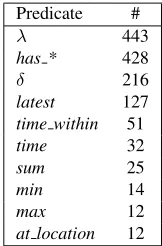
From the 446 original questions, syntactic decomposi-tion resulted in 468 sub-quesdecomposi-tions. From these, 420 con-cepts were normalized (259 unique). The most frequent concepts are shown in Table 2. Constructing the logical forms required 1,470 predicates (53 unique), the most com-mon of which are shown in Table 3. Only four of the time arguments were annotated (pmh questions are cer-tainly possible, but not within this data set), and were dom-inated by thevisittime (72%), with most of the remain-der beingstatus(25%). Theplantime was only 2% of the cases, while thehistorywas only 0.5%
When measuring inter-annotator agreement, it is im-portant to note that logical form annotations can be bro-ken down into sub-annotations, so measuring agreement on complete logical forms is overly strict. The annotators were in complete agreement for 58% of questions at the normal-ization layer and 42% of questions at the logical form layer.
UMLS CUI # Concept Name
C0392201 12 Blood glucose measurement C0456388 8 Blood product
C0005903 5 Body Temperature C0021925 4 Intubation
C0013227 4 Pharmaceutical Preparations C0445623 4 Microorganism
C1704353 4 fluid - substance C0042036 4 Urine
C2076600 4 Influenza due to Influenza A virus subtype H1N1
C1320225 3 Adverse drug event resulting from treatment of disorder
Table 2: Ten most frequent concepts, including their UMLS Concept Unique Identifier (CUI), frequency, and preferred name.
Predicate #
λ 443
has * 428
δ 216
latest 127
time within 51
time 32
sum 25
min 14
max 12
at location 12
Table 3: Ten most frequent predicates and their frequencies.
Agreement in the individual components was much greater. We measure the following using an F1-measure where one set of annotations acts as the gold and the other acts as the guess annotations. The most difficult annotation was con-cept normalization, which had an F1 of 0.61. This is due
to the many possible concepts in SNOMED-CT that a word or phrase could be normalized to. Often, there were up to a dozen possible choices. During reconciliation, a se-mantic type heuristic was devised (see Discussion) which would have significantly improved agreement by provid-ing a method for choosprovid-ing between equally valid normal-izations. Temporal expressions had better agreement (F1
= 0.88), with the most disagreements relating to whether to consider simple temporal words (e.g., “date”, “time”), which are no longer annotated. Similar disagreements oc-cured for spatial references (0.75), which were rare. There was complete agreement on measurements, which were also rare.
Logical form annotation has two main components where disagreement is possible: predicates and implicit time arguments. All other arguments are inherited from the normalization layer. Predicate agreement was quite good (F1= 0.85). Agreement on specific predicates varied greatly. The agreement onλ-expressions was near perfect (0.98). Other common predicates were quite high, such asδ (0.95), thehas *predicates (0.96), andtime within(0.95). However, agreement on the latest predicate was less im-pressive (0.64). The rarer predicates also tended to bring agreement down, with a combined F1 of 0.68. More
argu-ment to thehas *predicates. This had an F1agreement of 0.72. The difficulty here is in combining medical knowl-edge with assumptions of the author’s intent. It was pre-viously decided that, for the most part, the medical events are limited to within thevisittimeframe, but most dis-agreements were betweenvisitandstatus. As such, further assumptions were made based on the semantic type. For example, unless explicitly stated, tests and findings are assumed to have occurred in the recent past, and are thus
visitinstead ofstatus.
7.
Discussion
Concept normalization is known to be a difficult task due to UMLS ambiguity and many disambiguation methods have been proposed for automated systems(Jimeno-Yepes et al., 2011). Manual annotation revealed yet another layer of complexity: choosing the best semantic nuance. For ex-ample, in “What is the blood glucose and how high / low has it been?”, the conceptblood glucosecould be normal-ized to aprocedure(UMLS preferred name: “Glucose measurement, blood”), afinding(“Finding of blood glu-cose level”), or an observable entity (“Blood glu-cose status, or Organic Chemical”). All these mappings are acceptable in the context, but we still needed to agree on one, which led to establishing a sequence for prioritiz-ing mappprioritiz-ings durprioritiz-ing the early reconciliation phase. For in-stance, when available asubstancewas prioritized over aprocedure, and aprocedurewas prioritized over a
finding. The prioritization rules are based on the ob-served richness of semantic relations in SNOMED CT that will allow most flexibility in reaching other related con-cepts.
Another difficulty in normalization was to decide how closely the mappings should follow the form of the question as opposed to the intended meaning. Although we tried our best to avoid inference and stick to the lit-eral meaning when possible, some of the litlit-eral mappings would have been wrong. For instance, in “What microor-ganisms were cultured?” the concepts would have been
C0007635(“Cultured cells”) andC0445623 (“Microor-ganism”), which will present difficulty generating query to find positive microbiology test results in the end-goal plication. Therefore, C2242979 (“Microbial culture”) ap-pears to be a much better mapping for this question.
We aimed to create the smallest possible set of predi-cates to have more examples for each. For the most part, the questions can be captured by a handful of predicates. For several rare questions we chose representation with the existing predicates, perhaps losing some nuanced informa-tion, rather than creating a one-off new exact predicate. In those cases, we attempted to create a predicate that was simple to recognize, such as theis significantpredicate for the question “Has there been a bleeding event and is it significant?”. The far greater difficulty in this question is determining whether an event is significant given the vast number of possible medical events. This, however, is not a natural language problem and is out of the scope of this work.
Finally, as can be seen by relatively low agreement on several sub-tasks, some parts of this task were non-trivial
even for manual annotation, which indicates the tasks will be challenging for the current NLP systems, e.g., little work has been done so far on ranking adequate normalization options or deciding when to pick a pre-coordinated con-cept and when to chose post-coordination. The positive as-pect of our work, however, is that when possible we tried to align difficult tasks in this work with existing clinical nat-ural lanuguage processing tasks for which a separate large dataset is available, e.g., Pradhan et al. (2015).
8.
Conclusion
We have described the creation of a corpus of EHR ques-tions annotated with logical forms. Our goal is to provide semantic parsers with sufficient data to convert a natural language EHR query into a structured form that may be used to query an EHR database for patient information. The questions in the corpus were annotated at multiple layers: (a) syntactic decomposition, (b) concept normalization, and (c) lambda-calculus-based logical forms. Agreement re-sults indicate that certain aspects of this task are quite diffi-cult and will require innovative NLP approaches.
Acknowledgements This work was supported by the Na-tional Library of Medicine (NLM) grant 1K99LM012104, as well as the intramural research program at NLM.
9.
Bibliographical References
Andersen, U., Braasch, A., Henriksen, L., Huszka, C., Jo-hannsen, A., Kayser, L., Maegaard, B., Norgaard, O., Schulz, S., and Wedekind, J. (2012). Creation and use of Language Resources in a Question-Answering eHealth System. InProceedings of the Eighth International Con-ference on Language Resources and Evaluation, pages 2536–2542.
Artzi, Y. and Zettlemoyer, L. S. (2011). Learning compact lexicons for CCG semantic parsing. In Proceedings of the 2011 Conference on Empirical Methods in Natural Language Processing.
Artzi, Y., Das, D., and Petrov, S. (2014). Learning Com-pact Lexicons for CCG Semantic Parsing. In Proceed-ings of the 2014 Conference on Empirical Methods in Natural Language Processing, pages 1273–1283. Artzi, Y., Lee, K., and Zettlemoyer, L. (2015).
Broad-coverage CCG Semantic Parsing with AMR. In Pro-ceedings of the 2015 Conference on Empirical Methods in Natural Language Processing.
Athenikos, S. J. and Han, H. (2010). Biomedical question answering: A survey. Computer Methods and Programs in Biomedicine, 99:1–24.
Athenikos, S. J., Han, H., and Brooks, A. D. (2009). A framework of a logic-based question-answering system for the medical domain (LOQAS-Med). InProceedings of the 2009 ACM Symposium on Applied Computing, pages 847–851.
Cao, Y., Liu, F., Simpson, P., Antieau, L., Bennett, A., Cimino, J. J., Ely, J., and Yu, H. (2011). AskHER-MES: An online question answering system for complex clinical questions. Journal of Biomedical Informatics, 44:277–288.
Clarke, J., Goldwasser, D., Chang, M., and Roth, D. (2010). Driving semantic parsing from the world’s re-sponse. InProceedings of the Conference on Computa-tional Natural Language Learning.
Demner-Fushman, D. and Lin, J. (2007). Answering Clin-ical Questions with Knowledge-Based and StatistClin-ical Techniques.Computational Linguistics, 33(1):63–103. Hanauer, D. A., Mei, Q., Law, J., Khanna, R., and Zheng,
K. (2014). Supporting information retrieval from elec-tronic health records: A report of University of Michi-gans nine-year experience in developing and using the Electronic Medical Record Search Engine (EMERSE). Journal of Biomedical Informatics, 55:290–300. Jimeno-Yepes, A., McInnes, B. T., and Aronson, A. R.
(2011). Collocation analysis for UMLS knowledge-based word disambiguation. BMC Bioinformatics, 12(Suppl 3):S4.
Kilicoglu, H., Fiszman, M., and Demner-Fushman, D. (2013). Interpreting Consumer Health Questions: The Role of Anaphora and Ellipsis. In Proceedings of the 2013 Workshop on Biomedical Natural Language Pro-cessing, pages 54–62.
Kobayashi, T. and Shyu, C.-R. (2006). Representing Clini-cal Questions by Semantic Type for Better Classification. InProceedings of the AMIA Annual Symposium. Li, M. (2012). Investigation, Design and Implementation
of a Clinical Question Answering System. Ph.D. thesis, University of Sydney.
Liang, P., Jordan, M. I., and Klein, D. (2011). Learning Dependency-Based Compositional Semantics. In Pro-ceedings of the 49th Annual Meeting of the Association for Computational Linguistics, pages 590–599.
Lindberg, D. A., Humphreys, B. L., and McCray, A. T. (1993). The Unified Medical Language System. Meth-ods of Information in Medicine, 32(4):281–291.
Liu, F., Antieau, L. D., and Yu, H. (2011). Toward auto-mated consumer question answering: Automatically sep-arating consumer questions from professional questions in the healthcare domain. Journal of Biomedical Infor-matics, 44(6).
Muresan, S. (2011). Learning for deep language under-standing. InProceedings of the International Joint Con-ference on Artificial Intelligence.
Neumann, L. (2010). Comparative Domestic and Inter-national EHR Adoption. InNational Electronic Health Records Summit.
Office of the National Coordinator for Health In-formation Technology. (2014). Federal Health IT Strategic Plan: 2015–2020. Available at: https://www.healthit.gov/sites/default/files/federal-healthIT-strategic-plan-2014.pdf.
Patrick, J. and Li, M. (2012). An ontology for clinical questions about the contents of patient notes. Journal of Biomedical Informatics, 45:292–306.
Poon, H. (2013). Grounded unsupervised semantic pars-ing. InProceedings of the 51st Annual Meeting of the Association for Computational Linguistics.
Pradhan, S., Elhadad, N., South, B. R., Martinez, D., Chris-tensen, L., Vogel, A., Suominen, H., Chapman, W. W., and Savova, G. (2015). Evaluating the state of the art in disorder recognition and normalization of the clinical narrative. Journal of the American Medical Informatics Association, 22(1):143–154.
Roberts, K. and Demner-Fushman, D. (2016). Interactive use of online health resources: A comparison of con-sumer and professional questions. Journal of the Ameri-can Medical Informatics Association.
Roberts, K., Kilicoglu, H., Fiszman, M., and Demner-Fushman, D. (2014a). Decomposing Consumer Health Questions. In Proceedings of the 2014 BioNLP Work-shop, pages 29–37.
Roberts, K., Masterton, K., Fiszman, M., Kilicoglu, H., and Demner-Fushman, D. (2014b). Annotating Ques-tion DecomposiQues-tion on Complex Medical QuesQues-tions. In Proceedings of the Ninth International Conference on Language Resources and Evaluation, pages 2598–2602. Roberts, K., Masterton, K., Fiszman, M., Kilicoglu, H., and Demner-Fushman, D. (2014c). Annotating Ques-tion Types for Consumer Health QuesQues-tions. In Proceed-ings of the Fourth LREC Workshop on Building and Eval-uating Resources for Health and Biomedical Text Pro-cessing.
Roberts, K., Simpson, M. S., Voorhees, E., and Hersh, W. (2015). Overview of the TREC 2015 Clinical Decision Support Track. InProceedings of the 2015 Text Retrieval Conference.
Roberts, K., Simpson, M. S., Demner-Fushman, D., Voorhees, E., and Hersh, W. R. (2016). State-of-the-art in biomedical literature retrieval for clinical cases: A survey of the TREC 2014 CDS Track. Information Re-trieval Journal, 19(1).
Schardt, C., Adams, M. B., Owens, T., Keitz, S., and Fontelo, P. (2007). Utilization of the PICO framework to improve searching PubMed for clinical questions. BMC Medical Informatics & Decision Making, 7(16). Schnall, J. G. and Fowler, S. (2013). MedlinePlus.gov:
Quality Health Information for Your Patients.American Journal of Nursing, 113(9):64–65.
Simpson, M. S., Voorhees, E., and Hersh, W. (2014). Overview of the TREC 2014 Clinical Decision Support Track. InProceedings of the 2014 Text Retrieval Confer-ence.
Stearns, M. Q., Price, C., Spackman, K. A., and Yang, A. Y. (2001). SNOMED Clinical Terms: Overview of the De-velopment Process and Project Status. InProceedings of the AMIA Annual Symposium, pages 662–666.
Terol, R. M., Martinez-Barco, P., and Palomar, M. (2007). A knowledge based method for the medical question an-swering problem. Computers in Biology and Medicine, 37(10):1511–1521.
Pro-ceedings of the 2013 Annual Meeting and Exhibition of the Medical Library Association.
Voorhees, E. M. and Hersh, W. (2012). Overview of the TREC 2012 Medical Records Track. InProceedings of the 11th Text REtrieval Conference.
Voorhees, E. M. and Tong, R. M. (2011). Overview of the TREC 2011 Medical Records Track. InProceedings of the 10th Text REtrieval Conference.
Waldinger, R., Bobrow, D. G., Condoravdi, C., Das, A., and Richardson, K. (2011). Accessing Structured Health In-formation through English Queries and Automatic De-duction. InProceedings of the AAAI 2011 Spring Sym-posium, pages 70–73.
Wong, Y. and Mooney, R. J. (2007). Learning synchronous grammars for semantic parsing with lambda calculus. In Proceedings of the 45th Annual Meeting of the Associa-tion for ComputaAssocia-tional Linguistics.
Yu, H. and Cao, Y. (2008). Automatically Extracting Infor-mation Needs from Ad Hoc Clinical Questions. In Pro-ceedings of the AMIA Annual Symposium, pages 96–100. Yu, H. and Sable, C. (2005). BeingErlang Shen: Iden-tifying Answerable Questions. In IJCAI Workshop on Knowledge and Reasoning for Answering Questions. Zettlemoyer, L. and Collins, M. (2005). Learning to Map
Sentences to Logical Forms: Structured Classification with Probabilistic Categorical Grammars. InConference on Uncertainty in Artificial Intelligence.
Zhang, J. and Walji, M., editors. (2014). Better EHR: Usability, workflow, & cognitive support in electronic health records. National Center for Cognitive Informat-ics & Decision Making in Healthcare.