The preponderance of decision in a new
managerial function of information –
decision
Săvoiu, Gheorghe and Pirlici, Valeria
University of Pitesti
February 2007
THE PREPONDERANCE OF DECISION IN A NEW MANAGERIAL
FUNCTION OF INFORMATION – DECISION
1
Gheorghe SĂVOIU1, Valeria PÎRLICI2
1
University from Piteşti, [email protected]
2
University from Piteşti, [email protected]
The decision preponderate over information in a new central function of management defined as information-decision; we believe that the option for a compromise of the type: prognosis of product or service, organization, information-decision, stimulation and control better responds to the new managerial conditions. There frequently occur deadlocks in modelling decisions, especially owing to the lack of information (quality of the data, equations, the degre of accuracy etc.), but we believe that the option for a better decision, sometimes even instead of a better information, finally, means an optimal solution to short term.
Key words: managerial information and decision, mathematical hope, prudence, moderate, super-optimistic, equilibrium and regrets rule, decision trees.
Two tendencies characterize the recent approaches of the managerial functions, the first consisting in excessive multiplication, through adding ever new functions, beginning with setting the objectives and targets, continuing by motivation, exchange of opinions, formulating the plan and exerting control, structuring the tasks and adopting decisions, communicating the critical information, allotting resources, solving conflicts, delegation of authority, directing changes, measuring results, training people, innovating, and even decentralization, and the second one, which follows a trend of systematic reduction, either through regrouping, to only four functions, i.e. planning, including making decisions,
organizing in order to achieve high performances in the activity, leading, to which one should add motivating, as well as controlling, according to Justin Longeneker and Charles Pringle, or through reducing to only two functions, considered essential, such as supple / flexible organization, and cutting down the dimensions of the compartments of the organization, including the managerial ones, according to Sarah Freeman and Kim Cameron’s opinion, or restricting everything to a unique function, that of mustering the energies of the economic unit with a view to achieving the known and defined tasks, as Peter Drucker managed to define the essential managerial attribute, by using a unique principle, of maximal concentration. Regardless of their number or the way they are defined, the managerial functions do not mean strictly temporal successions of activities, and, from the angle of the organization seen as a system, regrouping, within the same function, management activities that are to be found in a strictly temporal succession does not become mandatory, on the contrary, within the same function, previsional, measuring, operational, and interpreting activities are even necessary, as they can be found in all the three phases of the management process, emphasising the process-directed perennialness of a function. In Romanian managerial economic literature, there are three dominant structure-patterns, starting from both the descriptive, and the contents-related side of the functions of management. The common parts of the three majority opinions are the similar total number of five functions, two of which being unanimously accepted (organization and stimulation), while for other two a few slight differences can be distinguished, in point of nuance and emphasis/stress (i.e. planning and control). The function of information-decision can be considered today the central function of management; we believe that the option for a compromise of the type: prognosis of product or service, organization, information-decision, stimulation and control better responds to the new managerial conditions.
programming, projection and estimate. General planning, as an economic notion of a fundamental type, remains a theoretic concept that expresses a set of coherent actions meant to direct and conduct economic activity, in accordance with the anticipations that are determined scientifically as part of a plan. Planning is an iterative function, combining the
acceptations of project-making, estimation, and even that of the managerial perspective, the three of them representing processes of scientific anticipation of the targets of management, based on hypotheses having a different degree of representatively and rigour. Planning also includes, in its general signification, managerial prediction, which is the result of the study of tendencies, having a character of anticipation, and involving as well the action of other factors than the classic ones in the management of the organization, and especially their correlations with the managerial results expected. The use of the term prognosis or forecast instead of planning points out to the fact that, out of the plurality of the plans worked out, the manager has carefully selected the one that holds the greatest probability of being achieved (as the meteorological origin of the term forecast
is obvious enough). Using, instead of planning and prognosis, the phrase managerial prevision is meant to point out the fact that the manager has not been in possession of perfectly veracious data, of complete hypotheses, of the quantified action of all the factors, and especially of those internally compensated. Even if the manager has very carefully chosen the term planning and prognosis / forecast, or a further nuanced substitute for them, other questions arise immediately, generating other necessary options, meaning that the concept will be accompanied by a new defining adjectival characteristic, such as: exploratory, trending, normative, global, analytic, fundamental etc. The product prognosis will develop most intensely in the context of the option for a prevalently quantitative management. Prognosis and fore-knowledge of the evolution of the product synthesize the scientific anticipation of the quantitative development and achieve the following objectives: 1. identify the major tendencies of the development of the main categories of products and types of production,
2. anticipate the implications of the major tendencies in the evolution of the specific product and of the characteristic production,
3. evaluate the trust margin of converting the possible into the probable, in keeping with the factors conditioning the product and the production,
4. detail the development alternatives for the product and production (including advantages and disadvantages per alternative) for identifying the optimal alternative,
5. estimate and detail any elements, attributes, characteristics that are convenient for intervening and correcting the anticipated course of the product and production, guarantee a certain degree of trustworthiness, in direct proportion to the duration of the prognosis horizon of the product and production (short, average and long, and, respectively, the strategic and tactic character of the product and production).
Prognosis of product, that of the service and even its aggregation into the production concept is dependent on significant previsions of a technological and strategic type. By setting the objectives/targets and what must be done in order to attain them, the prognosis of the product and of the service actually pave the way for organization, that is the allocation and arrangement of resources so as to meet the tasks established.
product quality control, putting together the production factors), organizing work (actions concerning division of work by operations, personnel selection, standardized repartition of work posts/positions, establishing the work rhythm, work rate setting, efficient stimulation of the employees, creating ergonomic conditions), and implicitly organizing management
(actions through which the organizational structure of the organization’s leadership, as well as its informational system are constituted). The concrete manner in which that function is exerted, the shortcomings in the capacity of appropriacy to the requirements of the external and internal environment generate the informal, less apparent, structures, which are fluid and subtle, yet have influences, positive or negative, that strongly influence the organization’s performances. The structural organization is materialized in organizational structures. The visible formal structure of the organization lies in the people in the positions, which are grouped in services and offices placed along a vertical line of hierarchies, or a horizontal line of cooperation. The attribute “formal” allotted to that structure can be accounted through creating and recording the structural forms and components by means of norms, regulations and documents, bearing the guarantee of the higher-level management of the organization. The functioning of the organization parameters are frequently marked by dynamism, uncertainty and, quite often, by hostility depends, in a decisive manner, on the way the human resources are placed and utilized. On the whole, the organizational structure exhibits two components: the leadership, or functional structure (the ensemble of the people, compartments and the mutual relationships holding between them, such a way constituted and ordered as to ensure the economic, technical and personnel conditions / requirements needed by the integral unfurling of the managerial and execution processes), and the production or operational structure (the ensemble of the people, compartments and the mutual relationships through which is ensured the direct achievement of the products and / or services which are part of the organization’s object of activity).
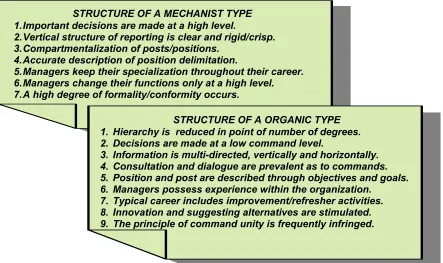
STRUCTURE OF A MECHANIST TYPE 1. Important decisions are made at a high level.
2. Vertical structure of reporting is clear and rigid/crisp. 3. Compartmentalization of posts/positions.
4. Accurate description of position delimitation.
5. Managers keep their specialization throughout their career. 6. Managers change their functions only at a high level. 7. A high degree of formality/conformity occurs.
STRUCTURE OF A ORGANIC TYPE 1. Hierarchy is reduced in point of number of degrees. 2. Decisions are made at a low command level.
3. Information is multi-directed, vertically and horizontally. 4. Consultation and dialogue are prevalent as to commands. 5. Position and post are described through objectives and goals. 6. Managers possess experience within the organization.
[image:4.595.70.513.450.713.2]7. Typical career includes improvement/refresher activities. 8. Innovation and suggesting alternatives are stimulated. 9. The principle of command unity is frequently infringed.
Figure 1. Organizational structures characteristically defining the organization, over the last century
importance of inter-disciplinary teams which can find, promptly and efficiently, an answer to these changes. The typical organizational configurations continuously expand; to the simple structure, based on direct supervision, is added automatic bureaucracy, through standardization of work processes, as well as the division-shaped form, centred on standardization of production, professional bureaucracy, stressing standardization of qualification, adhocracy, or reciprocal adjustment, etc. In the contemporary milieu, the structures of the organizations permanently develop and evolve, tending towards the image of a net-like structure, of a number of global informational systems, towards an organic web, rather than a hierarchy.
The informational organization is materialized in the informational system, in the organization’s energy and informational symmetry. In any organization, but not only there, management means more and more knowledge and competence, more learning, and all that presuppose an optimized informational system, maximized informational energy, and symmetrical information, characterized by the natural balance of inputs and outputs. In the managerial practice of the organization, projecting and improving organizational structures, and that of the informational system are made simultaneously, because they have the same starting points. The organizational structure influences the informational system by orienting the informational flows in keeping with the tasks and competences allotted to the various positions/posts, as well as the length of those flows, which are mainly determined by the number of hierarchical levels.
The new function of information-decision can be considered today the central function of management as a result of a necessary compromise in contemporary economy. Decision-making in the general context of this new function means a resolution adopted as a result of examination of a problem/issue or situation; the solution can be adopted either rapidly, as a decisional act, or strictly observing the stages as a decisional process, presupposing both the choice of a unique direction, or a singular action strategy, out of a number of relatively acceptable alternative directions or strategies, and engaging the resources, as the result of that conscious choice action leads to reaching a certain objective.
Decision, indissoluble connected to information, constitutes the nerve centre of management activities, as it can be found within all the other functions of the process of management, but it is not possible without the presence of continuous and pertinent information. Any decision primarily means correct information, in order to be able to choose. Information, as an active economic “resource” indispensable for decision (making), combines specific data relating to various stages of data collecting, selection, aggregation, and processing (i.e. micro-, mezo- and macro-). Seen from the angle of the economic level, information appears as the potential resource, or as an intangible (i.e. micro-economic) asset of the organization, as an economic or informational (i.e. mezo-economic) good / asset, and an independent (i.e. macro-economic) production factor. Information is data pre-determined for a certain utility (necessary in order to solve various managerial problems, precisely stated in specific cases).In the extended or process approach, the decision commixes the collecting and the processing of information in order to formalize, classify and make conscious the decisional problem, the identification of the alternatives, including their projecting, the selection of the criteria or principles for the final evaluation of the alternatives, the final option for a unique decision variant, implementation, monitoring and evaluation of the decision impact. The ensemble elements of a decisional component, which at the same time point out to its complex character, are the following:
B. The coefficients of importance of the decision-maker(s) represent specific weights individually allocated to the decision-maker(s), which, as a rule, when reunited, become equal to 100%, to 1000 0/00 , etc.;
C. The variants /alternatives represent the total number of the possible solutions for solving the managerial problem, out of which, after analysis, the decision-maker(s) must choose only one;
D. The states of nature and their probabilities of occurrence are defined as results of hazard or of various forces, whose action is directed differently and are apparently compensated, representing the complex of external conditions, independent of the decision-maker’s will and control, which can generate different values of the consequences, for each criterion in each of the existing variants;
E. The making criteria of are indicators or standpoints which the decision-maker(s) consider(s) necessary in order to evaluate the group of the variants/alternatives; F. The coefficients of importance of the decision-making criteria represent specific
weights individually allocated to the criteria, which, as a rule, when reunited, become equal to 100%, to 1000 0/00 etc.;
G. The consequences sum up the totality of the results corresponding to each criterion, in each of the existing variants, that is to say the elements of a quantitative order (values, factors and data, represented in figures) and/or of a qualitative order (represented by a qualifier), which will later on be converted into quantitative factors, through transformation algorithms;
H. The usefulness expected by the decision-maker(s), starting from the achievement of a certain consequence, is defined as the level or degree of attaining the anticipated result, which will solve the initial managerial problem;
I. The objectives of the decision reside in solving a problem of a managerial order.
The main classification of the decisional processes in the function of information-decision, i.e. the one having the most important practical implications, aims the degree or level of knowing the problematic situation that has occurred in the dynamics and the activity of the organization. In keeping with this approach, the following can be distinguished: decision-making processes in conditions of certainty, in conditions of risk, and in conditions of uncertainty. In conditions of certainty, complete information is available, which means there is a certain, and at the same time unique, state of nature, which holds the probability of the certain event (p1=1), as the decision-maker(s) precisely know(s) which will be the
result of each variant or alternative; this will quite infrequently occur in the political, economic and social milieu of the contemporary world. In order to select the optimal decisional variant, in such a situation the following will be efficiently turned to account: the method of global utility, ELECTRE, the Onicescu method, and the decision-making chart. In conditions of risk, the managerial decisions are defined through probabilistic or stochastic situations, and are to be distinguished through the fact that there are at least two results for only one alternative, but the chance for such results to appear is known a priori; a decision-maker can become, as seen through the angle of his/her decisional approaches, either a decision-maker characterized by adversity to the risk, neutral as to the risk, or an inclination for the risk. The reason why more than one results appear for the same alternative remains that of there existing several states of nature that are not controllable by the decision-maker(s), yet the probabilities for them to appear are known, and their sum is equal to one (Σpi = 1). In conditions of risk, the result of the choice
become, as considered through the angle of his/her decisional approaches, either a decision-maker characterized by adversity to the risk, neutral as to the risk, or an inclination for the risk.
A managerial problem imposing a decision in conditions of risk can be recognized precisely through the fact that there exist two or more results the probabilities of appearance of which are known a priori, and constitute a considerable part of the occurring/actual decisional situations. In conditions of uncertainty, the decision-maker(s) is again confronting with two or more results for the same alternative, but their chance to occur is unknown a priori. A problem compelling to making a decision in conditions of uncertainty presupposes that the probabilities for the states of nature to appear are unknown. In conditions of risk and uncertainty, managerial decision imposes treating the alternatives through economically evaluated consequences, and especially through model-adapted criteria. By expanding the linear programming models, one can attain models and methods of decision of the fuzzy type, and to models of a stochastic type (via using fuzzy sets, and, respectively, random variables). Another category of models and methods has to do with founding the optimal decision in conditions of uncertainty and risk. In this connection can be mentioned the strategic games, the von Neumann-Morgenstern axiom, the methods of the decision trees. The range of problems concerning the modelling of the decisions characteristic of the phenomena of economy also includes models and methods of decision in supply-and-stocking of a deterministic and stochastic type. Likewise, an important part is held by the deterministic and non-deterministic decisional models and methods of expectation. At present, a special treatment is also enjoyed by the methods concerning application of group decisions, modelled as a “aggregation” of individual preferences (on the basis of the rule of simple majority), or individual utilities (through aggregating the decision-makers’ individual utilities), the method of the successive permutations (based on the matrix of the partial adhesions and rejections), the Deutch-Martin algorithm (an algorithm whose iterations establish the hierarchies of the decisional variants starting from the line-moments, and from the column-moments in the synthetic informational table) etc. Some of the simplest methods applied in conditions of risk and uncertainty are the following succinctly:
a. the method of mathematical hope, or of the balanced/moderate average value of the alternatives as to the probability of their occurrence, applied in the situation where the decisional variants are evaluated through the agency of the unique criterion (optimized through maximizing/minimizing), or in the case the multiple decision criteria (equal or not in point of importance).
b. the method based on the prudence rule, derived from the previous method, and known as Abraham Wald’s rule, defined through maximin or maxi(minj Profitij), corresponding to
variant i and to state j, and, respectively, through minimax or mini(maxj Costsij), according
to which, in a prudent or pessimistic manner, the variant with a maximal profit or with a minimal loss in costs (to take an example in economic terms) will be chosen, thus preferring a decision made in the most unfavourable state of nature (or milieu), the decision-maker being by definition one characterized by adversity to risk;
c. the method based on the super-optimistic rule (the maximax or minimin rule), according to which the preferred variant is the one favourable at the extremes, of the type maximal profit and minimal costs, the decision-maker being characterized by inclination for risk; d. the method based on the rule of moderate optimism of Leonid Hurwicz, which proposes allocating a coefficient of optimism, noted with α, and which, through the agency of its interval of real or possible values, allotted to the completely favourable variant and to the completely unfavourable one, apparently re-enters the world of the probabilities, as
e. the method based on proportionality, rationality, and equilibrium of Thomas Bayes and Pierre-Simon Laplace, valid in the hypothesis of equal probabilities, where the states of nature are considered equivalent in probability and alternative, the preferred one being that having the bigger average profit, or the smallest average loss (the expected value, or the anticipated utility1 of a global type becoming maximal);
f. the method based on the rule of regrets of Leonard Savage, centred on the matrix of regrets, is construed by deducting all the consequences or utilities in each state of nature from the best consequence, or the maximal utility, for which the decision-maker will have the least possible regret, or no regret, if it is realized (regret being defined as the utility lost as a result of selecting a different variant than the optimal one, in conditions of complete information, Rij = regret corresponding to variant i and state j );
g. the method of the decision trees concretely joins together the following steps: defining the decisional problem and the possible events that probabilistically condition the decisional consequences of each alternative, representing the tree of decision, realizing the graph of all the combinations of decisional variants and states of nature, preparing the necessary information for calculating the values of the knots (determining the probabilities of all the alternatives in nature, and of the values associated to the arcs that reach the final knots), applying the roll-back rule for determining the optimal solution, and, at the end, determining the values associated to all the knots (decisions and event/uncertainty), directing the calculations from the final knots to the initial one.
The value of the decision modelled through statistical and mathematical methods is given by their capacity of reducing the degree of imprecision, and assess imprecision in the terms of statistics and probabilities theory. The prospects of building models and methods of managerial decision are amazing through the rigorous character of their principles:
9 human decision has the fundamental role in contemporary management;
9 construction of decisional models or methods represents a logical succession, and a time-phasing, in accordance with the principle of economicalness or the law of parsimony;
9 separating and combining the decisional models and the characteristic methods takes place within procedure chains;
9 the system of decision modelling is open, faciliting the addition and deletion of restrictions and variables;
9 the statistical-mathematical structure of the decision processes is independent of the manner of utilization;
9 the architecture of the decision systems is modular, hierarchical and dynamic;
1
9 the informational and logical links occur among decisional models of a collaborative, hierarchy-based, mixed type;
9 though including different types of decision models, the data base is unique.
An informatic system meant for management, conceived as a set of procedures of processing data and judgements, and also as a statistical-mathematic model, is elaborated according to the following logical series of moments and activities:
- identification of decisional objectives (dimension, character, structure, accuracy etc.),
- treating, synthetically, the decisional phenomenon (identification of the problem, spatial, temporal and functional delimitation, selection of variables, final problem’s formulation),
- treating, analogically, the decisional phenomenon (analogy and construction of the model, quantification of the statistical links between variables of the decision, formalization of the problem by means of the calculus algorithms and the “principle” solution),
- verification / validation (testing on a set of theoretical decisions or variants corresponding to the real situation, experimenting theough simulation),
- selecting the final decision as a usable final solution (in the context of the restrictions, the objectively priority function, and the specific free terms).
There frequently occur deadlocks in modelling decisions, especially owing to the lack of quality of the data, equations, the degre of accuracy etc. Both checking the decision criteria from a mathematical standpoint and statisticaly testing the hypotheses of the decisional model are mandatory.
The completeness and precision for an information-decision’s system Table no. 1
Degree of data completeness Degree of data precision Typology of the system
maximal maximal deterministic
relatively low relatively high probabilistic
relatively high relatively low vague (fuzzy), or uncertain relatively low relatively low intuitive or experience-based minimal minimal non-deterministic or “random”
The algorithm, the finite set of operations characteristic of the decisional model, has four essential features: determinism in execution, succession and a manner of operation, universality as to the set of the inputs, and spatial (descriptive) and temporal (execution) finiteness. Within the field of decisions, all the virtues of the managerial system can be found: a decision synthesizes the specific essence and the originality of the whole organization management, the best proof being supplied by consensus decision, characteristic of the Japanese model of management. The specific phases of the consensus decision (the consensus being obtained gradually, and within all the parallel and hierarchical, vertical and horizontal structures) emphasize the two great advantages of the group decisions, which, in this case, exponentially enhance its efficaciousness: the high degree of staff involvement in the major problems of the Japanese organization’s management, and the acceleration of the process of putting the decision into effect.
The managerial decision represents a type of decision with unmediated consequences at least on the actions of another person, or on another organizational structure, which possesses a few elements distinguishing it from other types of everyday decisions:
- the managerial decision always implies at least two categories of people: the manager, i.e. the one who decides, and one or several other persons, executives or members of the leading staff, who take part in putting into force or materialize the decision – hence a first source of intricacy and difficulty for the managerial decision;
- in conceiving and carrying out the managerial decision, it is necessary to consider and observe the objectives/targets of planning as well as prognosis, the organizational characteristic features concerning the position/post, the interests and qualifications of the group members, the specific traits of their stimulation and motivation, their potential, also identifying the concrete modalities of control and monitoring;
- the managerial decision exhibits a phenomenon of specific contagion, determining varied effects, both direct, and propagated (economic, technical, educational, human), though it can initially aim only at an individual’s level, or that of a compartment;
- the managerial decision, especially the strategic one, can transfer a number of its effects from the micro-economic milieu to the mezo-economic (regional) one, or even into the field of the macro-economic: it can have consequences not only at eh level of the entire organization, but also outside it, in the milieu external to the organization.
- the managerial decision, if compared to all the functions of management, has a dissipative character (being present within all the other managerial functions), and, when compared to some of the functions, it has an integrative–absorbing character (thus, the strategic decision has gradually absorbed and integrated the coordination of the whole set of work processes through which were harmonized the decisions and actions of the staff of the organization, and of its sub-systems within the predictions and the organizing system, so long-term decision has actually become a coordination conceived along dynamic lines). To ensure an efficient management, it is necessary the existence of adequate communication and information at all the levels of the organisation.
some people act in a given manner. Human behaviour is determined by certain motives/reasons, made conscious by the individual as aims/goals. Motivation can be defined as a process of selecting, orienting/guiding and maintaining the desired behaviour. Motivation appears subsequent to the modification of an energy (force or urge) which pushes the individual to adopt a certain conduct, which could allow him/her to annul a certain inner tension. It is this very dynamic that makes the employee conduct his/her work properly and also satisfy his/her physical and psychological needs through the lines of conduct that he/she adopts. Motivation, if correctly realized, gives birth to the performance desired by both the individual and the organization, generating not only the individual’s wealth, but also a feeling of usefulness, professional value, prestige, etc. By contrast, non-motivation is the situation characterized by a decrease in the quality of work, lack of satisfaction. Non-motivation is generated by blockages of an organizational or social order, which have occurred in the process of achieving one’s individual aims. It generates a reduction in the process of adaptation, or even its blockage. The connexion between the motivational theory and the managerial practice is vital for success in management. The function of stimulation has an operational character, and its foundation is represented by motivation, that is a continuous correlation of the satisfaction of the personnel’s needs and interests, and the achievement of the objectives/goals and tasks established. The main characteristic of scientific management remains conceiving motivation, and implicitly, stimulation, starting from the emotional states. In order to have an efficient stimulation it is necessary that the process of motivation should be complex, differentiated and gradual. The function of control (checking and evaluation) is defined as the ensemble of the processes by means of which the performances of the organization, of is subsystems and components are measured and compared with the objectives established initially with a view to eliminating the differences found, and integrating into the system the positive deviations. Control virtually presupposes an evaluation of the organization’s performance in order to determine whether or not it carries out its objectives, for which to do it is necessary to define or establish the standards of performance, the managerial and technical standards, monitoring and evaluation of performances, as well as correcting the deviations from the standards. The whole ensemble or cycle of control, which joins together continuous monitoring of results, comparing them with the plans, analysing the variations and reporting, is a costly process, in point of both financing, and duration In order to be even more efficient, control practically implies feedback in the single loop managerial formula, where the controller is the very manager of the structure, and, when there are greater deviations from the standards of performance, feedback in the double loop formula, or belonging to a higher order. Analysing the functions of management emphasises their continuous interdependence and also a number of characteristic features. Thus, functions are specific, in their entirety, exclusively to the managers, they have a general character, they benefit by a specific content and forms of manifestation in proportion to the level of the managerial hierarchy, they assume a different degree of practical realization and they are incorporated in the system of the organization. Statistics emphasise that information-decision take the most time in a manager’s life.
Bibliography:
[1]Certo S., -„Managementul modern”, Bucureşti, Editura Teora, 2002.
[2]Dănăiaţă I.,Bibu N.,Predişcan M.,-”Management.Bazele teoretice”,Editura Mirton,Timişoara, 2002. [3]Lucey T., -„Administrarea afacerilor”, Editura Technică, Bucureşti, 2001
[4] Nicolescu O., -“Management comparat”, Editura Economică, Bucureşti, 2001.
[5]Săvoiu G., Asandei M., Grigorescu R., Manole S.,- “Cercetări şi modelări de marketing. Metode cantitative în cercetarea pieţei“, Editura Universitară, Bucureşti, 2005.