Solution of Matrix Game with Triangular Intuitionistic
Fuzzy Pay-Off Using Score Function
Sibasis Bandyopadhyay1, Prasun Kumar Nayak1*, Madhumangal Pal2
1Bankura Christian College, Bankura, India
2Department of Applied Mathematics with Oceanology and Computer Programming, Vidyasagar University, Midnapore, India
Email: [email protected], *nayak_ [email protected], [email protected]
Received January 10, 2013; revised February 6, 2013; accepted March 4, 2013
ABSTRACT
Using score function in a matrix game is very rare. In the proposed paper we have considered a matrix game with pay-off as triangular intuitionistic fuzzy number and a new ranking order has been proposed using value judgement in-dex, available definitions and operations. A new concept of score function has been developed to defuzzify the pay-off matrix and solution of the matrix game has been obtained. A numerical example has been given in support of the pro-posed method.
Keywords: Triangular Intuitionistic Fuzzy Number; Matrix Game; Value Judgement Index; Score Function
1. Introduction
Game theory is the way to handle the problems where two conflicting interests situation exist. But in modern society a lot of problems exist which cannot be explained in simple crisp sense e.g. there may be the situation where pay-offs are not known precisely. In such cases fuzzy mathematics is a tool to handle such situation. Fuzziness in matrix games can appear in many ways but two classes of fuzziness seem to be very natural. These two classes of fuzzy matrix games are referred to as matrix games with fuzzy goal [1] and matrix games with fuzzy pay off [2]. In recent times much attention has been drawn to interval valued game, Nayak and Pal [3-5], Narayanan [6], Nishizaki [1]. In practical situations the pay-offs are given with in certain ranges rather than as an exact number. These uncertain situations are overcome when we use interval numbers as pay-offs. An interval number is an extension of a real number and also a subset
of a real line , Moore [7]. Zimmermann [8] shows
that
cut of a fuzzy number is an interval number.
The method of solution of a matrix game using interval numbers was already established, Nayak and Pal [5]. In Narayanan [6], probability and possibility approaches
have been used to solve a 2 2 interval game but no
certain distribution function has been used. Moreover,
reduction of an game to a sub game is a
basic problem in an interval game. In the dominance method [3], if the convex combination of any two rows(columns)of a pay-off matrix is dominated by the third row (column), it indicates that the third move of the
m n 2 2
row (column) of the player will be an optimal move but we are not certain as to which one of the first two moves will be an optimal one. This disadvantage is overcome through the graphical method [4]. But it may be the situation where the players can estimate the approximate pay-off values with some degree but there exist a hesitation. Such situations are handled by intuitionistic fuzzy (IF) numbers. Atanassov [9] first introduced the concept of IF-set where he explained an element of an IF-set in respect of degree of belongingness, degree of non-belongingness and degree of hesitancy. This degree of hesitancy is nothing but the uncertainty in taking a decision by a decision maker (DM). Atanassov [10] first described a game using the IF-set. Li and Nan [11] considered the matrix games with pay-offs as IF-sets. Seikh, Nayak and Pal [12] considered a bi-matrix game where they used IF-set. In this paper we have considered a matrix game where the pay-off elements are considered as triangular intuitionistic fuzzy number (TIFN). Nan, Li and Zhang [13] considered such TIFN as pay-off elements of the matrix and described the arithmetic operation and cut sets. In this paper, we have made a ranking order of the TIFN based on value judgement index and deviation indexe of membership and non-membership functions. A score function approach has been described to defuzzify the matrix. The numerical problem is a real life voting share problem and establishes the theory on strong ground.
The paper is organized as follows: In Section 2, basic definitions of intuitionistic fuzzy set is given intuitionis- tic fuzzy number, TIFN and score function are defined and arithmetic operations are described. In Section 3,
matrix game with TIFN pay-off, pure and mixed strategy have been described. In Section 4, numerical example is given. In Section 5 conclusion has been drawn.
2. Intuitionistic Fuzzy Sets
Here we are to introduce first some relevant basic pre- liminaries, notations and definitions of IFS, in particular the works of Atanassov [9,14].
Definition 1: Let X
x x1, , ,2 xn
be a finite uni-versal set. An Atanasson’s intuitionistic fuzzy set (IFS)
in a given universal set X is an expression A given
by
i, A i , A i : i
A x x x xX (1)
where the functions
: 0,1 ; 0
A X xi X A xi ,1
and A:X
0,1 ;xi X A
xi
0,1 define thedegree of membership and the degree of non-mem-
bership of an element xiX to the set AX ,
respectively, such that they satisfy the following con-
dition: for every xiX
0A x A x 1.
Let
1
A xi A x A x
which is called the Atanassov’s [14] intuitionistic index
of an element xi in the set A. It is the degree of
indeterminacy membership of the element xi to the set
A. Obviously, . If an Atanassov’s IFS
in
0A xi 1
C X has only an element, then is written as
follows C
= k, C k , C k
C x x x
which is usually denoted by C
C
xk ,C xk
for short.
Definition 2: Let A and be two Atanassov’s
IFSs in the set
B
X. AB iff
and
; for anyA xi B xi A xi B xi xi X
.
Definition 3: Let A and be two Atanassov's
IFSs in the set
B
X. AB iff
and
; for anyA xi B xi A xi B xi xi X
Namely, AB iff AB and BA.
Definition 4: Let A and be two Atanassov’s
IFSs in the set
B
X. The intersection of A and is
defined as follows:
B
, min , ,
max , .
i A i B i
A i B i i
A B x x x
x x x X
Definition 5: (Intuitionistic Fuzzy Number [15]): An
intuitionistic fuzzy number (Figure 1) Ai is
1) an intuitionistic fuzzy subset of the real line;
2) normal, i.e. there exists x0 such that
0 1 i A x (so i
0 0A x
);
3) convex for the membership function Ai i.e.
1 2
1 2 1 2
1
min , ; , , 0,1
i A
i i
A A
x x
x x x x
;
4) concave for the non-membership function i
A
i.e.
1 2
1 2 1 2
1
max , ; , , 0,1 .
i A
i i
A A
x x
x x x x
In our discussion we consider an intuitionistic fuzzy
number Ai as ,
ij ij
where ij Ai
xij and
ij ij Ai x
matrix.
as we consider it as ijth element of cost
2.1. Triangular Intuitionistic Fuzzy Number
The definitions and operations of TIFN given by Nan, Li and Zhang [13] are stated as follows:
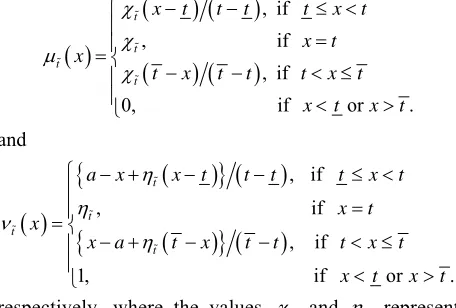
Definition 6: An TIFN t
t t t, ,
t, t definedon the real number set is an intuitionistic fuzzy set,
whose membership and non-membership function are given by
, if
, if
, if
0, if or .
t
t t
t
x t t t t x t
x t x
t x t t t x t
x t x t
and
, if
, if
, if
1, if or .
t t t
t
a x x t t t t x t
x t x
x a t x t t t x t
x t x t
respectively, where the values t and t represent
the maximum degree of membership and the minimum degree of non-membership, respectively, such that they
satisfy the following condition: 0t1,0t1
[image:2.595.309.537.402.556.2]and 0 t t 1.
Figure 1. Membership and non-membership functions of .
i
The hesitancy degree or the degree of indeterminacy
membership of the element x to the TIFN t can be
given as t
x 1 t
x t
x . Here t and trepresent respectively the confidence and non-confidence
levels of the TIFN . t
Definition 7: Let us consider two TIFNs as
, ,
; ,t tt t t t , s
s s s, ,
; s, s . Withs t
, the arithmetic operations are defined as follows:
1) t s
t s t, s t, s
; t
S, t
s ,where and represent min and max opera-
tors respectively.
“ ”
“ ”
2) t s
ts t, s t, s
t
S, t
s3)
, , , , if 0 and 0
, , , , if 0 and 0
, , , , if 0 and 0
s t S t
s t S t
s t S t
t s ts ts t s
t s t s ts ts t s
ts ts t s t s
4)
, , , ,if 0 and 0
, , , ,
if 0 and 0
, , , ,
if 0 and 0
s t S t
s t S t
s t S t t s t s t s
t s
t s t s t s t s
t s
t s t s t s
t s
5)
, , , , if 0 , , , , if 0
t t
t t t t t t
t t t
where is any real number.
6) 1
1 ,1 ,1
,t t
t t t t
2.2. Cut Sets of TIFN
Definition 8: A
,
- cut set of t
t t t, ,
t, t isdefined over a crisp subset of and it is given as
, : t , t
t x x x
1
,
where 0 t, t and 0 1.
Definition 9: A -cut set of t
t t t, ,
t, t isdefined over a crisp subset of and it is given as
: tt x x
. Corresponding closed interval isgiven as
,
t t
t t tt t t t
Definition 10: A
.
-cut set of t
t t t, ,
t, t isdefined over a crisp subset of and it is given as
: tt x x
. Corresponding closed interval isgiven as
1 1 1 1 t t t tt t t
t t , .
Definition 11: Let m t
and m t
be the meanvalues of the intervals t and t respectively i.e.
2
t
2 tm t t t t
and
2 1
t
2 1
t
.m t t tt
Then average index of the membership function
t x
and the average index of the non-membership
function t
x for the TIFN are defined as t
0t
d
2
4 A t
m t t t t t
1
d 1 2 4
t
A t m t t t t
t
respectively. Now we will introduce deviation index of
the membership function t x and non-membership
function t
x for the TIFN as follows. tDefinition 12: Let
t and
t be the meanvalues of the intervals t and t respectively i.e.
t t
t t
2 t
and
t
t
t t
2 1
t
.
Then deviation index of the membership function
x
and the average index of the non-membership
function
x for the TIFN are defined as t
0 1
d 4
and d 1 4
t
t
t t
t t t t
t t t t
respectively. Now we will state ranking order of TIFN. In doing that one thing we should have in mind that this ranking order is not unique and it depends on the purpose concerned. Here we will define a new ranking order
based on difference between A and A and for that
purpose we will define value judgement index a b, as
follows
Definition 13: Let and are two TIFN. The
average indexes of membership functions are a b
A a
and A
b respectively and that of the non-member-ship function are A a
and A b
respectively.Thedeviation indices of membership functions are
aand
b respectively and that of the non-member-ship function are
a and respectively.Then
b
, , π π .π π ma
A
x
a b
t a b
b A a a a A b A b
a b t t
(2) Now
1) if a b, 0 ;
0
then a is smaller than b, denoted by
IF a b
2) if a b, then aIF b.
in real number set and has the linguistic interpretation
“essentially less than”. Similarly “IF” and “ IF” can be
explained. For comparison of more than two TIFNs we
use the notations “ ” and “
” as
ka
l
a
1) if is largest among all
;
i i
a a
, 1,2, , n
k
l i
a i
2) if is smallest among all
.
i i
a a
, 1,2, , n
i
a i
Different ranking methods [16,17] have been adopted so far considering the membership and non membership function as triangular,trapezoidal or other forms of fuzzy numbers. But it is of no use when we consider the membership and non-membership functions as acceptan- ce and rejection degree of choice of a particular thing. In this case score function is very useful. It can be defined as follows:
Chen and Tan [18] first defined a score function ij
as deviation of a membership function
S
ij
from non-
membership function ij as
.
ij ij
S ij S
ij
(3)
Here bigger the value of ij represents bigger IFN but
when ij of two IFN are same then this definition does
not work. So, analyzing the deficiency of this score function Hong and Chi [19] have given a precise function as
S
.
ij ij
H (4)
Here also bigger the value of Hij gives bigger IFN.
Now these two scoring functions defined above have fundamental deficiency that they do not involve the
uncertainty function ij and this seems to be very
unrealistic. Liu [20] analyzing the hesitancy degree
modified the definition as
ij
1 ij 1
S ij ij .
(5)
Now here we will use a very simple score function which is defined as
A t A .
t t
F t
, a b
ff
(6)
Here one thing can be observed that
0 i F a F b
(7)
and two properties are given as 1) F t
s
F t
F
s
;
2) F
t F t
, is any real.3. TIFN Matrix Game
The table showing how payments should be made at the
end of the game is called a pay-off matrix. If the player
A has m strategies available to him and the player
has strategies available to him, then the pay-off for
various strategies is represented by pay-off
matrix. Here we consider the pay-off as TIFN
B
n
m n
, ,
t, tt t t t , written in the matrix form as
1 2
1 11 12 1
2 21 22 2
1 2
.
m
n
n
m m m mn
B B B
A t t t
A t t t
A t t t
Here it is assumed that when player A chooses the
strategy Ai and the player B selects strategy Bj it
results in a pay-off tij to the player A.
Pure Strategy
Pure strategy is a decision making rule in which one particular course of action is selected. For fuzzy games the min-max principle is described by Nishizaki [2]. The course of the fuzzy game is determined by the desire of
A to maximize his gain and that of restrict his loss to a
minimum. Now for TIFN game,
max min ij, ,ij ij ; tij, tij ;
i j
t t t
(8)
min max ij, ,ij ij ; tij, tij .
j i
t t t
(9)Based on TIFN order, for such games, we define the
concepts of min max equilibrium strategies.
Definition 14 (Saddle Point): The concept of saddle
point in classical form is introduced by Neumann [21]. The
k r th, position of the pay-off matrix will be called a saddle point, if and only if,
, , ; , , , ,
, , ,
kr kr kr tkr tkr ij ij ij tij tij i j
ij ij ij tij tij j i
t t t t t t
t t t
or, kr ij ij .
i j j i
t t t
(10)
We call the position
k r, of entry a saddle point,the entry itself
tkr, ,tkr tkr
tkr, tkr the value of thegame (denoted by V ) and the pair of pure strategies
leading to it are optimal pure strategies.
zing the maxmin strategy and minimizing the minmax strategy does not ensure the optimality. For example, let us consider the matrix
1 2
1 2
175,180,190 ;0.6,0.2 150,156,158 ;0.6,0.1
.
180,90,100 ;0.9,0.1 175,180,190 ;0.6,0.2
B B
A A
According to the solution method defined in [13] the value of the game is
1 152.37,1158.44,165.18 ;0.6,0.2
V
although according to the method described in this paper
this matrix has a saddle point and value of the
game is
(1,1)
2
V . If we consider
the comparison method of two triangular intuitionistic 175,180,190 ;0.6,0.2
fuzzy numbers described in [13] we will see that V1V2.
Hence we have got better result.
Definition 15: (TIFN expected pay-off ): If the mixed
strategies x
x x1, , ,2 xm
and y
y y1, , ,2 yn
areproposed by players A and respectively, then the
expected pay-off of the player B
A by player is
defined by
B
1 1
, n m ij, ,ij ij tij, tij i j j i
E x y t t t x y
. (11)
Addition and other composition rules on TIFN which we have discussed in Definition 7 are used in this definition of expected pay-off (11). In such a situation,
player A chooses x so as to maximize his expec-
tation and player chooses so as to minimize
player
B y
A’s maximum expectation and mathematically
we write
min max , , max min ,
y x E x y E x y x E x y
y
(12)
where
x y, VEis called strategic saddle point of the
game and
x y,
is the value of the game.
Theorem 1: If a pay-off matrix with elements as TIFN
has saddle point and kr is the value of the
game then the pay-off matrix obtained after defuzzi- fication with the help of score function
k r, tF has also
saddle point
k r,
and F t
kr is the value of thegame.
Proof: If be the saddle point of the pay-off
matrix and
is the value of the game then, k r
kr
t
t .
kr ij ij i j j i
t t
Now using the Equations (6) and (1) we have
kr ij iji j j i
F t F t F t
kr ij iji j j i
F t F t F t
kr
ij
ij .i j j i
F t F t F t
Therefore,
k r, is also the saddle point of thedefuzzified pay-off matrix. F t
kr is the value of thegame. Hence the theorem.
Theorem 2: If
x y,
be the strategic solution ofthe pay-off matrix with mixed strategies then
x y,
isalso the solution of the pay-off matrix after defuz-
zification by score function F.
Proof: Let
x y,
be the solution of the pay-off matrix then
1 1
min max ,
, max mi
y x
m n ij ij ij
y x i j
E x y
E x y t x y E x y
n ,
1 1
min max , ,
max min ,
y x m n
ij ij ij
y x i j
F E x y F E x y
F t x y F E x y
1 1
min max , ,
max min , .
y x m n
ij ij ij
y x i j
F E x y F E x y
F t x y E F F E x y
Therefore,
x y,
is also a strategic solution of thedefuzzified pay-off matrix and value of the game is
=1 =1
, m n ij ij ij
i j
V x y
F t x y . Hence the theorem.4. An Application to Voting Share Problem
Suppose that there is an election where two major
political parties A and B take part and total number of
voters in that region is constant. It means that the increase in percentage of voters for one political party results in the same for the other political party. Suppose
A has two strategies as
1:
A Giving importance in door to door campaigning
and carrying their ideology and issues to people.
2:
A Co-operating with other small political parties to
reduce secured votes of the opposition.
At the same time B takes two strategies:
1:
B
:
B
campaigning by celebrities and big rallies.
2
Now the chief voting agents can not say exactly about the voting percentage but they have a certain confidence level. Still there is some hesitancy in that confidence level due to bad weather forecast. In such win-win situation we may consider the pay-offs as TIFN and the matrix is given as
Making lot of promises to the people.
1 2
1
2
4,6,9 ;0.5,0.3 5,7,8 ;0.6,0.2 . 4,7,8 ;0.4,0.3 3,5,6 ;0.5,0.2
B B
A A
4,6,9 ;0.5,0.3
Here represents that when A plays
the strategy A1 and plays the strategy then
resulting expected votes in favor of
B B1
A is appr ately
lakhs with lower bound of s and upper bound
lakhs. T max
oxim
ag
6 4 lakh
of 9 um confidence level and mini-
mum non-conf nce le l of the Chief election ent of
he ide
im ve
A are 0.5 and 0.3 respectively.
Now, let us consider the lements of the pay-off
matrix as tij. Then using the ranking order we can get
Table 1. Using Equation (5) we get the crisp matrix as
e
Since a
, saddle point
does not exist. If we would use for comparing the
TIFN of original pay-off matrix ould get the same
re ,using the mixed strategy method
2 2
1
2
6.25 6.75 6.5 4.75
B B
A A
1,1 2,1ij ij
i j j i
a
,
a b
we w
sult. So for crisp pay-
off matrix we get x1 9
7,
2 9
x2 which are the proba-
bilities with which player A plays the strategies A1 and
2
A . Similarly, y18
9 and 2
1
9 are the probabili-
y
f play
ties with which player B plays with strategies and
2
B . The value of the game is 6.31 which gives optimal
1
B
score in favor o er A. we would get same
al strategies for player Since
optim A and
t
Th e a
player B if we
would use the original pay-off matrix as eviden from
eorem 2, the value of the gam s a TIFN is given as
7 2
4,6,9 ;0.5,0.3 4,7,8 ;0.4,0.3
9 9
56 79 8 7 4, , ; ,
9 9 90 30
which actually represents that the expected optim l votes for player
a
A is 56
9 lakhs which could be as low as 4
lakh and reach as high as 79
9 lakhs. The maximum
confidence l vel a minimum non-confidence level for e nd
the decision maker are 8
90 and
7
30 respectively.
t t al
votes for player
Results and Discussion
This result actually represents tha he expected optim
A is 56
9 lakhs which could be as low
as 4 lakh and reach as high as 79
9 lakhs. The maximum
confidence level and minimum non-confidence level for
le 1. co
Tab The mputation results.
,
i j A t
ij A t
ij
tij
tiji = 1, j = 1 3.125 4.375 0.625 0.875
i = 1, j = 2 4.05 5.40 0.45 0.60
i = 2, j = 1 0.7
i = 2, j 2 2.375 3.8 0.375 0.6
2.60 4.55 0.4
=
the decision maker are 8
90 and
7
30 respectively ike
[1 is p we go the rea
so n , we tr to rea the op
ith the help of a crisp pay off matrix. The reasonable lution [13] does not confirm the optimality but the
ort e o
on in terms of support, opposition nd also his confidence and non- about the approximation. Using the
pplications, Vol. 86, No. 2, 1995, pp. 433-457.
doi:10.1007/B
. Unl
3], in th aper, didn’t for sonable
lution and i stead ied ch to timality
w so
theorems 1 and 2 supp that th ptimality exist when
we use this method.
5. Conclusion
In this paper,we have used TIFN as elements of pay-off matrix. As a result we have considered here players? preference informati
and neutralization a confidence level
definitions and operations of TIFN we have described a ranking order based on the definition of value judgement index. Then we have described score function to de- fuzzify the matrix game and made a comparative study on scoring function approach and an IF approach in voting share problem. The merit of this methodology is that it obtains a deterministic solution of a matrix game with IF pay-off. There is a scope to apply such a metho- dology in other conflicting interest problems.
REFERENCES
[1] I. Nishizaki and M. Sakawa, “Equilibrium Solutions for Multiobjective Bimatrix Games Incorporating Fuzzy Goals,” Journal of Optimization Theory and A
F02192089
[2] I. Nishizaki and M. Sakawa, “Max-Min Solution for Fuzzy Multiobjective Matrix Games,” Fuzzy Sets and Systems, Vol. 61, No. 1, 1994, pp. 265-275.
[3] P. K. Nayak and M. Pal, “Solution of Rectangular Fuzzy Games,” OPSEARCH, Vol. 44, No. 3, 2009, pp. 211-226. [4] P. K. Nayak and M. Pal, “Solution of Interval Games
Using Graphical Method,” Tamsui Oxford Journal of Mathematical Sciences, Vol. 22, No. 1, 2006, pp. 95-115. [5] P. K. Nayak and M. Pal, “Linear Programming Technique
to Solve Two Person Matrix Games with Interval Pay- Offs,” Asia-Pacific Journal of Operational Research, Vol. 26, No. 2, 2009, pp. 285-305.
doi:10.1142/S0217595909002201
Applied Mathe “Fuzzy Games,” The Journal of Fuzzy Mathematics, Vol. 10, 2002, pp. 817-829.
[7] R. E. Moore, “Method and Application of Interval Analy-sis,” Society for Industrial and
(SIAM), Philadelphia, 1979. matics doi:10.1137/1.9781611970906
[8] H.-J. Zimmermann, “Fuzzy Mathematical Programming,” Computer Operational Research, Vol. 10, No. 4, 1983, pp. 291-298. doi:10.1016/0305-0548(83)90004-7
[9] K. Atanassov, “Intuitionistic Fuzzy Sets,” Fuzzy Sets and Systems, Vol. 20, No. 1, 1986, pp. 87-96.
34-3 doi:10.1016/S0165-0114(86)800
tanassov’s Journal of
Uncer-pplication of
with Payoffs of Triangular In-[10] K. T. Atanassov, “Ideas for Intuitionistic Fuzzy Equations,
Inequalities and Optimization,” Notes on Intuitionistic Fuzzy Sets, Vol. 1, No. 1, 1995, pp. 17-24.
[11] D. F. Li and J. X. Nan, “A Nonlinear Programming Ap-proach to Matrix Games with Payoffs of A
tuitionistic Fuzzy Sets,” International
tainty, Fuzziness and Knowledge-Based Systems, Vol. 17, No. 4, 2009, pp. 585-607.
[12] M. R. Seikh, M. Pal and P. K. Nayak, “A
Triangular Intuitionistic Fuzzy Numbers in Bi-Matrix Games,” International Journal of Pure and Applied Ma- thematics, Vol. 79, No. 2, 2012, pp. 235-247.
[13] J.-X. Nan, D.-F. Li and M.-J. Zhang, “A Lexicographic Method for Matrix Games
tuitionistic Fuzzy Numbers,” International Journal of Computational Intelligence Systems, Vol. 3, No. 3, 2010, pp. 280-289. doi:10.2991/ijcis.2010.3.3.4
[14] K. Atanassov, “Intuitionistic Fuzzy Sets: Theory and Applications,” Physica-Verlag, Berlin, 1999.
doi:10.1007/978-3-7908-1870-3
[15] M. R. Seikh, M. Pal and P. K. Nayak, “Notes on Trian-gular Intuitionistic Fuzzy Numbers,” Internati
nal Mathematics in Operation Re
onal Jour-search, 2012.
utational
-Based Systems, Vol. 12, No. 3, 2004, pp. 377-386. [16] G. S. Mahapatra and T. K. Roy, “Reliability Evaluation
Using Triangular Intuitionistic Fuzzy Numbers Arithme-tic Operations,” International Journal of Comp
and Mathematical Sciences, Vol. 3, No. 5, 2009, pp. 225- 231.
[17] H. B. Mitchell, “Ranking Intuitionistic Fuzzy Numbers,” International Journal of Uncertainty, Fuzziness and Know- ledge
doi:10.1142/S0218488504002886
[18] S.-M. Chen and J.-M. Tan, “Handling Multicriteria Fuzzy Decision Making Problems Based on Vague Set Theory,” Fuzzy Sets and Systems, Vol. 67, No. 2, 1994, pp. 163- 172. doi:10.1016/0165-0114(94)90084-1
[19] D. H. Hong and C.-H. Choi, “Multicriteria Fuzzy Deci-sion Making Problems Based on Vague Set Theory,” Fuzzy Sets and Systems, Vol. 144, No. 1, 2000, pp. 103-
ol. 5, No. 5, 2004, pp. 214-220. 113.
[20] H. W. Liu, “Vague Set Methods of Multicriteria Fuzzy Decision Making,” System Engineering, Theory and Prac-tice, V