Art and Design Theses Ernest G. Welch School of Art and Design
Spring 5-13-2011
Repetitive Acts Now
Repetitive Acts Now
Leigh K. Peacock Ms. Georgia State University
Follow this and additional works at: https://scholarworks.gsu.edu/art_design_theses
Part of the Art and Design Commons
Recommended Citation Recommended Citation
Peacock, Leigh K. Ms., "Repetitive Acts Now." Thesis, Georgia State University, 2011. https://scholarworks.gsu.edu/art_design_theses/77
by
LEIGH PEACOCK
Under the Direction of Matthew Sugarman
ABSTRACT
This paper explains at the intersection of Memory theory, Feminist Theory, Existential
Psy-chology, Faith and Contemporary Art, I have found a way to embrace and integrate memories and
ex-periences into my art and be a more fully integrated, emotionally healthy person living fully in the
present moment. I articulate my exploration of the broad concept of memory and addressing
unre-solved negative memories in order to realize healthy change in forming my identity.
Through art and philosophical research I have found substantial corroboration, conceptually
supporting my information supporting my Post Minimal art making process. I employ memory
evok-ing materials through the use of repetitive acts and strict self-imposed rules throughout the art
by
LEIGH PEACOCK
A Thesis Submitted in Partial Fulfillment of the Requirements for the Degree of
Master of Fine Arts
in the College of Arts and Sciences
Georgia State University
Copyright by Leigh Kathryn Peacock
by
LEIGH PEACOCK
Committee Chair: Matthew Sugarman, Professor
Committee: Teresa Bramlette Reeves, Doctor, Time Lecturer
Joseph Peragine, Associate Professor
Electronic Version Approved:
Office of Graduate Studies
College of Arts and Sciences
Georgia State University
DEDICATION
I would like to dedicate this thesis to my loving parents, Robin and Kathy Peacock. They have
of-fered me support physically, emotionally, and financially throughout this wonderful educational and
ACKNOWLEDGEMENTS
I would like to express my gratitude to all of those who have made it possible for me to
com-plete this thesis. Special thanks to the distinguished faculty members who served on my committee:
Professors Matthew Sugarman, Teresa Bramlette Reeves and Joseph Peragine. As committee chair,
Matthew Sugarman provided detailed guidance and encouragement throughout the course of preparing
for and realizing this paper and artwork. My thanks go to Dr. Teresa Bramlette Reeves who has given
me so much inspiration, support and helpful suggestion. I am also appreciative to the encouragement
and useful comments of Joseph Peragine. My gratitude also goes to professors Craig Dongoski, Dr.
Su-san Richmond, Nancy Floyd, Pam Longobardi, and Dr. Maria Gindhart. Special thanks to Dr. Donna Lane
for her support, guidance, and truth. I am thankful for my many friends who have helped and
encour-aged me from the beginning: Kjell Rommerdahl, Faith McClure, Stephanie Kolpy, Karen Cleveland, and
Lisa Dewberry Thrower. Especially, I would like to thank to my parents, Robin and Kathy Peacock, and
my sisters Erin and Kellie Peacock whose love, support and patience has allowed me to complete this
TABLE OF CONTENTS
ACKNOWLEDGEMENTS ... v
LIST OF FIGURES ... vii
1 INTRODUCTION ... 1
2 IDENTITY DEVELOPMENT IN RELATIONSHIP TO MEMORY ... 2
2.1 Artwork Description and Process ... 2
3 CULTURAL MEMORY ... 4
3.1 Traditional Historical Documentation ... 5
3.2 Non-Traditional Historical Documentation ... 5
3.3 Feminist Documentation... 6
4 FEMINIST ART ... 7
4.1 Pattern and Decoration Movement ... 9
4.2 Artwork Description and Process ... 9
6 POST MINIMALISM ... 16
7 CONCLUSIONS ... 17
LIST OF FIGURES
Figure 1. Memory Self-Portrait... 3
Figure 2 Baseball ... 10
Figure 3 Drill Bits………..10
Figure 4 Perfection Stitching II………14
Figure 5 Lifeline……….15
Figure 6 Lifeline (Detail)………..15
1 INTRODUCTION
“We both know what memories can bring –They bring diamonds and rust.” –Joan Baez, 19751
For the last 3 years, my work as an artist has been concerned conceptually with the theme of
memory. Childhood recollections, in particular, play an important role. Experiences in both private
and public spheres distort the memories from my early youth and contribute to perceptions and
be-liefs in adulthood. An idea or perceived certainty from childhood is difficult to alter and let go in order
to mature intellectually and even spiritually. I have focused my exploration of this broad concept
to-ward addressing unresolved negative memories in order to realize healthy change in forming my
iden-tity. Through art and philosophical research I have found substantial information supporting and
cul-tivating my art process and concepts. At the intersection of Memory theory, Feminist Theory,
Existen-tial Psychology, Faith and Contemporary Art, I have found a way to embrace and integrate memories
and experiences into my art and be a more fully integrated, emotionally healthy person living fully in
the present moment.
The integration between my art process and the materials I utilize is significant. I use
frag-ments of clothing, found objects and archival paper as a metaphor for memory or event in one’s life.
Clothing belongs to a specific person, and the more it is worn, the more potent the memories it
represents. Insignificant objects, such as a floral printed apron, or embroidered hat can function as an
archive, evoking memories of experiences that have shaped a personal or collective identity. I employ
memory evoking materials through the use of repetitive acts and strict self-imposed rules throughout
the art making process, communicating one living in the present moment, embracing yet uninhibited
by their past.
1
2 IDENTITY DEVELOPMENT IN RELATIONSHIP TO MEMORY
“Memory is the diary we all carry about within us.” – Oscar Wilde2
Recalling events, experiences, information and skills; Memory is the framework from which
people make sense of the world.3 Likewise, making connection with an individual sense of self and
identity is important for relating and understanding the world. Memory and identity are two broad
terms that are frequently used in cultural dialogue. The two are not disparate entities. These two
phenomena are intertwined: identity relies on the concept of memory, and memory, in turn, relies on
an understanding of identity. Social historian John Gillis argues, “The core meaning of any individual
or group identity, namely, a sense of sameness over time and space, is sustained by remembering; and
what is remembered is defined by the assumed identity.”4 A parallel can be seen between the way
memory and identity upholds each other and the way they uphold certain subjective positions, social
boundaries, and power.5 Although there is substantial proof that memory can be highly accurate, it is
imperative to acknowledge that memory and identity are not fixed and complete.
2.1 Artwork Description and Process
After recognizing the relationship between memory and identity, I focused on making art from
materials that would symbolize this connection. In order for me to communicate that each of my art
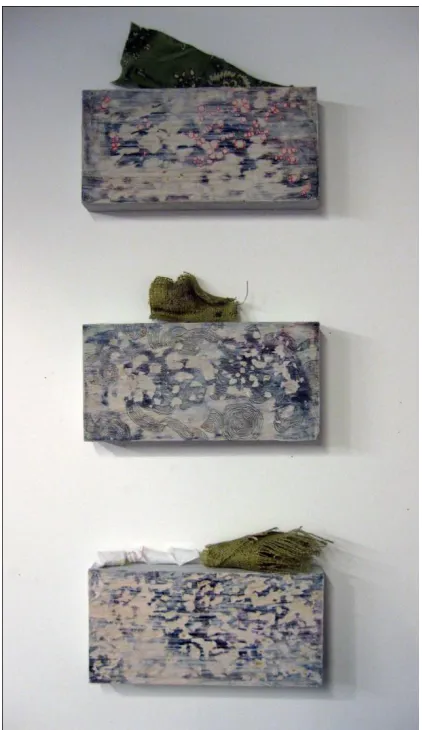
works had an identity and a past, I exploited a variety of my failed paintings from earlier years. My
old, failed paintings gave me a structure with an authentic past to work on, ultimately creating a new
painting. Artist, Christian Boltanksi greatly influenced my process. I saw him using groupings of dirty
found objects combined with photographs and his drawings to lend the work character and show its
history. So I began sanding down my old panels, painting over them again, and drawing on each one
2
Oscar Wilde, The Importance of Being Earnest, (1895), 2:11.
3
The American Heritage Medical Dictionary of the English Language. 4th ed. Boston: Houghton Mifflin Company, 2006.
4
John R. Gillis, “Memory and Identity: the History of a Relationship,” in Commemorations: The Politics of National Identity, ed. by John R. Gilles, (Princeton, NJ: Princeton University Press, 1994), 3.
5
and unchanging. I cut up clothing that held sentimental value to me. I dipped the fragments in clear
gel medium and placed them on top of each panel like a souvenir on a display shelf. This combination
signified my perceived memory of the event, malleable and metaphysically connected to the original
objective happening (the panel). These early works were concerned with individual memory, and my
[image:13.612.202.413.295.660.2]work continued on this trajectory into Cultural Memory.
3 CULTURAL MEMORY
While an individual maintains memory and identity, individuals also constitute and influence
other private identities, such as family. Individuals also comprise public identities, such as national and
cultural identity. Subsequently, this dynamic can cycle showing public memory and identity contributes
to the construction of individual memory and identity. Paul Connerton observes,
“Cultural memory is an act in the present by which individuals and groups constitute their iden-tities by recalling a shared past on the basis of common, and therefore often contested, norms, conven-tions, and practices. These transactions emerge out of a complex dynamic between past and present, individual and collective, public and private, recall and forgetting, power and powerlessness, history and myth, trauma, nostalgia, conscious and unconscious fears or desires.”6
Memories can be forgotten over time and even altered or distorted. The recollection of an
event can be interpreted in as many ways as the number of individuals giving an account. Memory and
identity are highly subjective and can be manipulated subconsciously or deliberately to maintain certain
interests and agendas. Many times societies hold beliefs about their pasts that are based on stories and
myths that change and develop over time, hardly resembling the events that gave rise to the preliminary
beliefs.7 This misremembering can have the dangerous effects, breeding sexism, elitism, racism, and
even genocide. As clearly observed in recent attempts by some erratic groups to deny the occurrence of
the Holocaust, memory distortion has the potential to eventually blot out catastrophic atrocities from a
society’s memory.8 While examining collective identity formation and considering memory distortion
with the possibility of omitting events from history, it is crucial to examine the agendas of the people
6
Paul Connerton, How Societies Remember, (New York: Cambridge University Press, 1989), 39.
7
Daniel Schacter, “History and Current Status,” in Memory Distortion: How Minds, Brains and Societies Reconstruct the Past, ed. by Daniel Schater (Cambridge, MA: Harvard University Press, 1997), 3-4.
8
generations.
3.1 Traditional Historical Documentation
For centuries societies relied on that historian’s interpretation of the past, and made that
histo-ry fundamental in educating future professionals.9 The historians have almost entirely been property
owning, heterosexual, white males writing in support of their social and political interests. Most
dissent-ing views and experiences by minorities and women have been ignored. Gender, along with race and
class mark identities in different ways and provide a means by which cultural memory is located in a
specific context rather than included into colossal and essentialist categories.10 Moreover, gender is an
inescapable dimension of differential power relations, and cultural memory is always about the
distribu-tion of and contested claims to power. What a culture remembers and what it chooses to forget are
intricately bound up with issues of power and domination, and thus with gender.
3.2 Non-Traditional Historical Documentation
Recently there has been a push for change in the approach to documenting history. Actually, in
relation to time, as Feminism has progressed, so has the shift in documenting the past. There has been
considerable interest in scholarship examining the images and uses of history in Western culture. A
wide variety of disciplines are now examining assorted ways in which the memories of a society are
formed, disseminated, and comprehended.11 Rather than characterizing a single group or institution’s
beliefs about the past, new studies are investigating correlations between different accounts of history
within the broader public arena. Individual memory is formed by group communication, intimately
9
David Glassberg, “Public History and the Study of Memory,” The Public Historian 18, 2 (1996): 8.
10
Tracy Kulba, “Feminist ‘Memory Work’ and the Production of REAL Womanhood,” Essays on Canadian Writing 80 (2003): 37.
11
linked to a collective memory of the community. For example, historian David Glassberg observes,
“His-torians working with community groups are in a good position to discover the relationship of the
memo-ries that circulate within families or among friends, as well as in towns, regions, nation, and mass
me-dia.”12 Now a broader range of credible types of institutions and ideas are being incorporated in
con-junction with traditional historical scholarship to construct collective memory. This liberal and
expan-sive documentation of history allows for a more truthful reflection of the past and is capable of more
accurately influencing community. Learning the importance of new forms of historical documentation is
exciting to me, and influenced me to consider my work as a type of artistic and historical archive.
3.3 Feminist Documentation
I continue to be encouraged with the route my art takes when I look to feminist studies.
Femin-ist studies and current memory studies invariably support each other. Both presuppose that the present
is defined by a past that is constructed and contested. Feminism and memory studies assume that the
public studies the past to meet the needs and concerns of the present time. Both fields emphasize the
uniqueness of the individual in his or her social and historical context and are therefore suspicious of
universal categories of experience.13 Developments in feminism and a number of Psychology studies on
cultural memory demonstrated that the content, sources, and experiences that are recalled, forgotten,
or suppressed are of profound political significance.14 What we know about the past, and thus, our
un-derstanding of the present, is shaped by the voices that speak to us out of history, making all
testimo-nies crucial for realizing an accurate identity.
12
Glassberg, 10.
13
Marianne Hirsch and Valerie Smith, “Feminism and Cultural Memory: An Introduction,” Signs: Jourrnal of Women in Cultureand Society 28, 1 (2002): 5.
14
I continue to observe that the accepted forms of legitimate historical archives are growing, due
in part to feminist art. From feminist and other varieties of social history, I have learned that public
me-dia and official archives memorialize the experiences of the powerful. To find the testimonies of the
oppressed, feminists have turned to alternate archives such as visual images, music, ritual, performance,
material and popular culture, oral history and silence. Feminist theory questions claims to the reliability
and bias of narrative, seeking to understand innovative ways in which truthfulness might be assessed
and used. Feminist scholars and particularly Feminist artists analyze and document the practices of
pri-vate everyday experiences, recognizing that they are as politically revealing as any event played out in
the public arena. Redefining culture from the perspective of women through the retrieval and inclusion
of women’s work, stories, and artifacts is an ongoing process, where I believe my art can be placed.
Ma-rianne Hirsch observes, “Feminist readings of autobiography and memoir, and feminist oral history have
struggled to define the gendered manifestations of these literary genres and therefore began to analyze
gender differentiations in acts of personal and cultural memory.”15 In the same vein, Glassberg
com-ments, “It seems that men narrate history as a succession of events, whereas women curate history as a
web of objects and places.”16 Essays on history, literature and psychoanalysis are supplemented by
poems, visual texts and art that are in themselves, acts of memory. Psychological and political structures
of forgetting or repression have disempowered women or enabled them to cover their own painful past.
Forgetting and suppression must be contested by active remembering. Therefore, the practice and
analysis of cultural memory can in itself be a form of political activism.
Art functions as an act of memory and is critical in developing collective identities, as well as
in-dividual identities. Hirsch articulates, “Always mediated, cultural memory is the product of fragmentary
15
Hirsch, 3.
16
personal and collective experiences articulated through technologies and media that shape even as they
transmit memory. So, acts of memory are acts of performance, representation, and interpretation.”17
Therefore art can be a form of memory transference, because both require communicators and specific
contexts.
This is certainly true for the recall of traumatic events. Art and other cultural artifacts such as
photographs and published texts of all kinds can mediate between the parties to the traumatizing scene
and between these and the reader or viewer. The recipients of the account perform an act of memory
that is potentially healing, as it calls for political and cultural solidarity in recognizing the traumatized
party’s predicament. Empathy between the teller and listener is required for this healing to take place.
Significantly, Empathetic Identification is considered by scholars to be gendered or more predominant in
women.
Clothing can function as a representation for the abstraction of the human body and other
hu-man qualities. Some women artists have employed clothing as a medium in contemporary art. The
con-tribution of early feminist theory to more recent clothing related work cannot be overestimated. Nina
Felshin documents, “In the celebration of women’s lives and experience- including “women’s work”-
1970s feminist artists recognized such traditionally feminine materials as fabric, methods of sewing, and
forms as clothing as viable subject matter and formal means for art.”18 Artists of the 1980s and 90s,
whose works acknowledge or adapt the feminist critique of representation with theories of sexual
dif-ference, theories of psychoanalysis, and theories of construction and deconstruction of sexual and
cul-tural identity are indebted to the formal precedent established by first generation feminists.
17
Hirsch, 5.
18
Miriam Schapiro is credited with establishing the movement called Pattern and Decoration (or P
& D). This art movement challenged traditional Western European art by foregrounding decorative
pat-terns and textiles from other cultures such as Chinese, Indian, Islamic, and Mexican. Schapiro is a
pio-neer in feminist art who reevaluates roles assigned to women in art and society. She embraces those
crafts traditionally associated with women, and uses them as a foundation for her art in an attempt to
give further authority and credibility to the role that women have played in the history of art. Schapiro
coined the term "Femmage," which stands for the female laborer's hand-sewn work (such as
embroi-dery, quilting, cross-stitching, etc.) that rivals and precedes the "high-art" collage. Schapiro is one of the
first artists in history to make art addressing the feminine experience. Women’s clothing used in
con-temporary art can evoke the owner of the clothing and comment on the shared experience of being
fe-male in society. Properties of the materials themselves dictate sculptural forms, the worn clothing, like
all recycled material, embodies histories and references that then become part of the meaning of the
pieces. Materials and such connective processes as the needle arts (and by extension, experiences) that
are associated with women become viable subject matter for art.
4.2 Artwork Description and Process
At the end of my 1st year in the MFA Program at Georgia State University, I focused on making
work that visually expressed the paralleling characteristics that clothing and memory have as protection
and comfort, constraint, sentimental attachment formed, power, energy, and the idea of individual and
collective memory. I embraced traditionally female materials and found objects as personal and cultural
archives by creating a series of fabric sculptures, fabric stacks and cut-out men’s shirt collars and pant
crotches. My new knowledge of “the archive” and Feminist Art influenced me to maintain a symbolic
I think of the fabric sculptures as loose portraits or archives. In constructing them, I began recalling
my own memories and stories others had shared with me, mixing parts of the two together and forming
a new version of the original events. Next, I compiled objects and clothes that seemed to fit with the
new portrait and its new story. I cut up the clothing into small fragments. Then, I joined all of the
ob-jects for the portrait with tape, string and glue to form the body of the sculpture. Lastly, I took the
clothing fragments and bound each one to cover the majority of the body, now giving the piece its own
clothes or skin. Although the materials and clothing of each sculpture were deliberately chosen, the
combination was a much more intuitive process.
Figure 2 Baseball, 2009, Mixed Figure 3 Drill Bits, 2009, Mixed Media
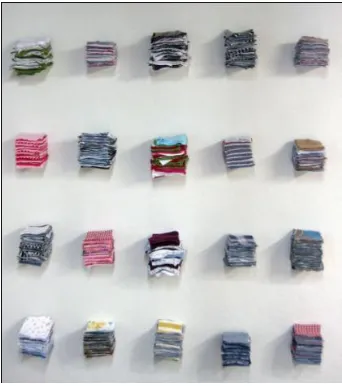
Around this same time, I started experimenting with stacking fabric in an effort to symbolically
indicate one’s memory of an event and the truth of the event. I began cutting squares and rectangles of
the same size and stacking them on top of each other forming 1-3” blocks for each piece. The fabric
cardi-the clothing references fragmented perceptions and cardi-the diverse layers of one’s memory of cardi-the event.
The clothing stacks are a way to give a voice to an experience that might be considered insignificant to
others, supporting a feminist archive.
Considering the personal and cultural archive, I am strongly influenced by Christian Boltanski’s
art. His installations with old clothes, lamps and recycled materials resonate with me visually and
con-ceptually. However, I work on a smaller scale. During my 2nd year, I began cutting out the collars of
men’s button down work shirts and the crotches out of pants and hung them in groupings of three.
Again, the collection of these shirts and crotches denote an archive. The number of shirts or crotches
was not so important to me. More so was the idea of their plurality in general. The collars were hung
on the wall in an oval shape that formally references a vagina, yet the form is made from men’s work
shirts. The crotches clearly have a gendered and sexual connotation. I wanted to hint at the complex
dynamics between men and women in private and in public spheres. The physical, emotional and
politi-cal power struggles rooted in and perpetuated by gender stereotypes or gendered expectations that I
have experienced inspired these pieces. However, I did not want to be too literal in connoting what
these shirts and crotches could mean. I left only enough information for the viewer to contribute their
5 EXISTENTIAL PSYCHOLOGY INFLUENCE
“The historical sense involves a perception, not only of the pastness of the past, but of its presence.” –
T.S. Eliot19
Through researching the formation of individual and cultural identities and memory, I became
interested in humanist theory and in Existential Psychology. At the end of my second year of graduate
school, I needed a way to move forward in my art and my personhood by using my memories, yet not
allowing them to trap me in the past. I found this pathway in my Christian faith and in Existential
Psy-chology. Existentialism derived from Danish philosopher Søen Kierkegaard’s studies. Kierkegaard was a
Christian who fused theology and philosophy. He was one of the first philosophers concerned with an
individual’s subjective history rather than a scientific, objective history. Thus, one should not only
be-lieve Christian theology, but one should put action to Christian doctrines for a closer relationship with
God20. Philosopher Matthew Gerhard Jacoby explains,
“Kierkegaard emphasizes the fact that it is empirical being that is the object of thinking, and that with this everything is placed into a ‘process of becoming’ since the object is unfinished. What en-sues from this is that truth is something that includes the thinking subject; it is the manner of the rela-tionship between the mode of the subject’s thinking and his/her concrete being.”21
I acknowledge if one can think, choose and is continually in the ‘process of becoming’, then one is
capa-ble of healing from past experiences.
German philosopher Martin Heidegger (1889-1976) expounds on Kierkegaard’s theories.
Hei-degger addresses the idea of an individual’s being, existing as his/her own subject. His studies looked at
events in terms of their meaning for the individual, phenomenological coordinates of time, space,
cau-sality, and materiality and how these are experienced in order to derive one’s total worldview.
19
T.S. Eliot, “Tradition and the Individual Talent,” in The Sacred Wood: Essays on Poetry and Criticism , (London: Me-thune, 1920), 1.
20
Columbia Electronic Encyclopedia, 6th Edition, s.v. “Søren Kirkegaard,”© 1994, 2000-2006, on Infoplease.
© 2000–2007 Pearson Education, publishing as Infoplease. http://www.infoplease.com/ce6/people/A0827614.html (accessed February 1, 2011).
21
ceiving the gift of Being, which he has not created.’22
Christian Existentialism has had a strong influence on my artistic journey. This theology allows
for revisiting memories and accepting validation through faith in order to heal. With Christian
Existen-tialism, an individual has the freedom to make choices and is held responsible for those choices.
With-out the freedom to decide, one cannot have true responsibility or authenticity. Natural consequences,
good or bad, will ensue. However, love is inherent to Christian principle and by extension forgiveness
for harmful choices made to oneself and to others, alike. Christian Existentialism explains an important
part of the healing process. Kierkegaard’s theory of the spheres of existence has a strongly influenced
the healing aspect of my art. The three spheres are the aesthetic, the ethical, and the religious. Most
people live an aesthetic life in which nothing matters but appearances, pleasures, and happiness. It is in
accordance with the desires of this sphere that people receive their validation from ever changing and
often morally corrupt social conventions. Kierkegaard also considered the pursuit of fame or having a
reputation for rebelliousness to be a personal aesthetic choice. The second group is the ethical sphere.
In this sphere, people try their best to do the right thing and are not concerned with social
achieve-ments. The third and highest sphere is the faith sphere. The people living in the faith sphere give
them-selves entirely to God out of choice. They have a personal relationship with Him and receive validation
from only Him. Living in the faith sphere and giving and receiving love and forgiveness are part of my
worldview and give me a place from which to create art.
5.1 Artwork Description and Process
“Life can only be understood backwards; but it must be lived forwards.” –Soren Kierkegaard
While concluding my second year of graduate school, the experience of healing and validation
through my faith began to influence my work. I continued to employ materials commonly associated
22
with feminism such as needles and thread. However, I wanted to symbolize a reassessment of
memo-ries and acknowledgment that perfection by other’s terms is impossible. I created a sememo-ries of work in
which I attempted to stitch multiple straight lines across an archival piece of paper by hand. Each piece
was time consuming and surprisingly labor intensive. As hard as I tried, my stitched lines were never
perfectly straight. The imperfect stitches represent my belief that perfection is not possible in any
ca-pacity. This implies redemption and forgiveness from God is a priceless gift. Living in Kierkegaard’s faith
sphere, one can pass the gift of forgiveness to others, as well as oneself. Forgiving does not erase past
actions but frees and heals one from mental angst attached to past memories, allowing for their healthy
[image:24.612.208.443.338.540.2]integration in one’s present life.
Figure 4 Perfection Stitching II, 2010, Paper and thread
Following that series of stitched works on paper, I began experimenting with a large scale
ture to give the viewer a visceral sense of inner healing. In retrospect, I recognize the size of the
sculp-ture I attempted correlates with the emotional impasse one can experience when only dwelling on the
Styro-viewer can enter the cocoon. The cocoon is wrapped in large strips of clothing, ranging from female
ba-by clothes to adult clothes. This piece signifies a woman’s use of her memories to build a more
shelter-ing environment. The openshelter-ing allows her to leave the wall she built up around herself –her protection
and constraint. The cocoon’s conceptually and physically engaging enormity forces the viewer to notice
its presence.
Through acknowledging the possibility of healing in Existentialism and Christianity, my art made
a significant shift, an impetus to communicate inner healing. The weight of emotional baggage can be
crippling, and I wanted to create pieces representing a counteraction to that. My next work (titled Life
Line) was made out of 4, 12 foot ropes. I thought of this piece as pulling someone emotionally higher,
out of their troubles to a place of weightlessness. I coiled large strips cut from old clothes around each
rope. One rope had only white clothing strips coiled around it. This rope symbolized the presence of a
pure, higher being. All four ropes were braided together for strength. The rope hangs vertically from
the ceiling, coiled at the bottom on the floor.
Figure 5 Lifeline, 2010, Rope and clothing Figure 6 Lifeline (Detail), 2010, Rope and clothing
6 POST MINIMALISM
In reviewing my art created during the last three years, Post Minimalism tendencies have
be-come apparent to me. I utilize simple, everyday objects as non-traditional art materials in visually
for-mal ways. Artists Eva Hesse and Tom Friedman emphasized the manufacturing of art using
unconven-tional materials encouraging the expansion of newly accepted issues and media in art, and have a great
aesthetic and conceptual influence on my art. The repetition of the visual elements in my art (square
and rectangle- individual fabric stacks, fabric stack installation, archival needle poked paper; circles-
col-lars and collar installation, sewing needle holes in archival paper; vertical and horizontal lines- ropes,
stacked sewing pattern cutouts, ect.) formally correspond to post modern influences. In addition, my
works are a product of my concern with personal and social memories, accurate history archiving, and
inner healing. My repetitive actions used to form work (cutting the same shape of fabric, stacking,
pok-ing holes in paper, buttonpok-ing-unbuttonpok-ing, stitchpok-ing without lookpok-ing and coilpok-ing) also function in
reflect-ing those concepts. Post Minimalist art highlights and exhibits the physical processes involved in creatreflect-ing
art, as my work does. Embracing my affinity to this art movement has helped me to understand my
work in the broader context of art history. Realizing the paralleling characteristics of Post Minimalism
and my art is important because now my work is more cohesive conceptually, philosophically, and
Figure 7 Matriarch, 2011, Fabric stack installation
7 CONCLUSIONS
During my thesis year I am focusing on how to assess what happens after healing takes place,
and how my art can shift to indicate a state of post-healing. Working from a new place, embracing more
succinct and universal concepts, results in my work being increasingly minimal and process oriented. I
focus on being mentally and physically present during the creation of each piece. Parameters and
guide-lines are established for this new work. I rely on these parameters, guideguide-lines and the repetition of
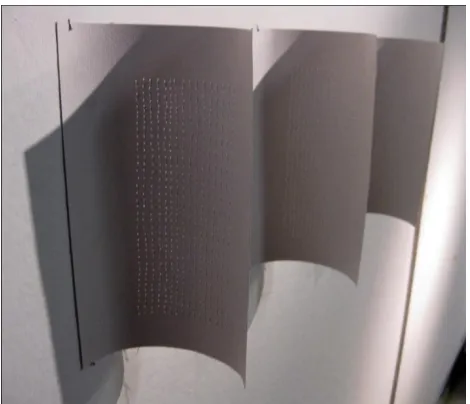
ac-tion to create my work. My materials are a fusion of archival paper, sewing needles, and thread. My
repetitive actions include punching holes through the paper for different durations of time without any
preconceived pattern. The hole-punching is intuitive and meditative. I stitch for stretches of time as
well, sewing off the paper and around it, enjoying rhythmic motions and interacting with the materials
in an instinctive way. The papers present and hold supple textures from the needles breaking their
sur-face time after time, referencing a slow decay. The more holes punched, the softer the paper appears,
and the pieces begin to suggest fabric. The stitching encourages this reference to fabric. I do not alter
the non-dyed papers. These stitches appear subtly in the translucent paper, implying surgical stitches,
giving the pieces a bodily reference. The holes punched create shadows on the walls behind each piece.
The clusters of shadows are faint, abstract and impermanent, ephemeral, blurring in many places and
distorted depending on each curve and crease of the papers. These shadows are important elements to
this series because they represent the nature of memory; subjective to each individual, yet created by a
physical event.
In all of my work throughout the last 3 years, I intentionally avoid revealing specific personal
memories. My art is premised on personal memory, but the details are not important to share with the
audience. By evading any anecdotal storytelling, my art becomes more universal and less about me.
The individual works are open for the viewer to project their own thoughts and memories onto. Through
my thesis work, I see the relations of Feminism, Post Modernism, healing and memory and how they are
The American Heritage Medical Dictionary of the English Language. 4th ed. Boston: Houghton Mifflin Company, 2006.
Baez, Joan, “Diamonds and Rust,” Diamonds and Rust, A & M Studios, 1975.
Columbia Electronic Encyclopedia, 6th Edition, s.v. “Søren Kirkegaard,”© 1994, 2000-2006, on Infop-lease.© 2000–2007 Pearson Education, publishing as Infoplease.
http://www.infoplease.com/ce6/people/A0827614.html (accessed February 1, 2011).
Connerton, Paul. How Societies Remember. New York: Cambridge University Press, 1989.
Eliot, T. S., “Tradition and the Individual Talent,” in The Sacred Wood: Essays on Poetry and Criticism , (London: Methune,1920).
Felshin, Nina, “Clothing as Subject,” Art Journal 54, 1, Clothing as Subject (1995): 20.
Felshin, Nina, “Women’s Work: A Lineage, 1966-94,” Art Journal 54, 1, Clothing as Subject (1995): 71.
Frisch,Michael. A Shared Authority: Essays on the Craft and Meaning of Oral and Public History. Albany: State University of New York Press, 1990.
Gillis, John R. “Memory and Identity: the History of a Relationship.” In Commemorations: The Politics of National Identity, edited by John R. Gilles, 3. Princeton, NJ: Princeton University Press, 1994.
Glassberg, David. “Public History and the Study of Memory.” The Public Historian 18, 2 (1996): 8.
Gouma-Peterson, Thalia. “Miriam Schapiro: An Art of Becoming.” American Art, 11, 1 (1997): 12.
Hirsch, Marianne and Valerie Smith. “Feminism and Cultural Memory: An Introduction.” Signs: Jourrnal of Women in Culture and Society 28, 1 (2002): 5.
Hyppolite, Jean. “A Chronology of French Existentialism.” Yale French Studies 16, Foray through Existen-tialism (1955): 100-102.
Jacoby, Matthew Gerhard. “Kierkegaard on Truth.” Religious Studies 38, 1 (2002): 27-44.
Kulba, Tracy. “Feminist ‘Memory Work’ and the Production of REAL Womanhood.” Essays on Canadian Writing 80 (2003): 37.
Mulvey, Laura. “Visual Pleasure and Narrative Cinema,” in The Critical and Cultural Theory Reader, edited by Neil Badmington and Julia Thomas, 206-208. New York and London: Routledge, 2008.
Schapiro, Miriam. “Women’s Work: A Lineage, 1966-94: Artist Statement.” Art Journal 54, 1 Clothing as Subject (1995): 75.
The American Heritage (R) Medical Dictionary Copyright 2007, 2004 ed., s. v. “Houghton Mifflin Compa-ny.”