89
A Multimodal Dialogue System for Learning Structural Concepts in
Blocks World
Ian Perera1, James F. Allen1,2, Choh Man Teng1, Lucian Galescu1
1Institute for Human and Machine Cognition, Pensacola, FL 32502 USA
2University of Rochester, Department of Computer Science, Rochester, NY 14627 USA
[email protected], [email protected], [email protected], [email protected]
Abstract
We present a modular, end-to-end dia-logue system for a situated agent to ad-dress a multimodal, natural language di-alogue task in which the agent learns complex representations of block struc-ture classes through assertions, demon-strations, and questioning. The concept to learn is provided to the user through a set of positive and negative visual exam-ples, from which the user determines the underlying constraints to be provided to the system in natural language. The sys-tem in turn asks questions about demon-strated examples and simulates new exam-ples to check its knowledge and verify the user’s description is complete. We find that this task is non-trivial for users and generates natural language that is varied yet understandable by our deep language understanding architecture.
1 Introduction
Current artificial intelligence systems, even dia-logue agents, tend to play the role of a tool in real-world or even simulated tasks. Often the human user must be given an artificial handicap to create a situation where the system can play a role as a collaborator rather than a tool with interface com-mands simply replaced by natural language equiv-alents (Brooks et al., 2012). We work towards a natural language dialogue agent that we hope will eventually become a collaborator rather than a tool by focusing on knowledge transfer through natural language and determining areas where a dialogue agent’s proactive nature is a benefit to learning. To this end, we apply deep language understanding techniques in the situated Blocks World environ-ment, where a user can teach the system physical,
possibly compositional concepts to aid in devel-opment of natural language understanding without significant existing domain knowledge needed.
2 The Structure Learning Task
Many natural language dialogue tasks in a Blocks World environment focus on querying the envi-ronment (Winograd, 1971), block placement (Bisk et al., 2016; She et al., 2014), or training visual classifiers and grounding perception (Matuszek et al., 2012; Mast et al., 2016; Perera and Allen, 2015). Reference resolution has also been ex-tensively studied in this environment and statisti-cal methods show strong performance in quickly learning referring expressions (Kennington et al., 2015). However, our focus is exploring collabora-tive concept transfer with the goal of having situ-ated agents learn from natural language dialogue and physical interaction to become better collabo-rators. With the goal of the system as a collabora-tor, we find it is important that the task carried out be non-trivial for the user. However, more diffi-cult tasks can have drawbacks – they involve larger amounts of background knowledge and reasoning, progress can be difficult to evaluate, and often the language and concepts learned do not extend eas-ily to other real world applications.
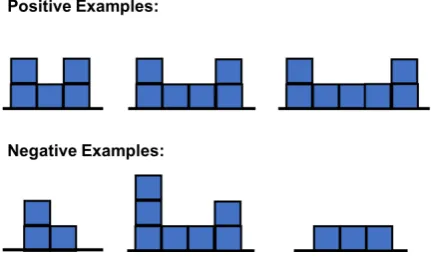
Figure 1: An example of the set of images pro-vided to a participant for teaching the system a “U” shape. The user is tasked with explaining the underlying concept to the system such that the system correctly identifies the positive examples while rejecting the negative examples.
to describe the structure. During this time, the sys-tem is able to ask questions, check its model with demonstrations, and ask for the user to present ex-amples. While this problem has been explored in the context of cognitive architectures (Foundalis, 2006) and reinforcement learning (Ramon et al., 2007), we are unaware of any prior work in the context of dialogue systems.
We believe this task addresses a number of is-sues with previous tasks in evaluating a system that can learn new concepts and structures. Partic-ipants typically spent two to three minutes going over the examples, showing that there was some thought required to correctly understand the struc-ture on their part. Furthermore, often the con-straints users provided were underspecified – they described what structures would be allowed, but sometimes failed to provide sufficient restrictions to avoid the negative examples. The system is then able to find gaps in the user’s description by pre-senting examples following the current description so far – bringing the system’s state in the dialogue from being solely a student to contributing to the task in a meaningful way.
In addition, this task can be scaled in diffi-culty or extended to other domains. Difficulty scaling can be achieved by using compositional constraints that build on existing knowledge (e.g., “Build a U shape, but make one column taller than the other”) or by creating more difficult structures to learn. The task could be adapted to other do-mains by augmenting the ontology and designing a new reasoning agent that could integrate
asser-tions into its model, while retaining similar inter-actions and the domain-generic modules.
2.1 Challenges
One of the primary challenges in this task is the wide variety of ways in which a user might de-scribe or teach a class of structures. For ex-ample, they might describe necessary features or prohibited features. They may view possibilities as movement, saying “The columns have a row between them wherever they move.” They may present negative examples for the system to avoid. Some users describe a particular arrangement of blocks that should or should not appear (e.g., “There is never two blocks on top of each other”), while others describe a more holistic conception (e.g. “The maximum height is one block”). While we do not succeed in interpreting all such de-scription modalities, we believe our current meth-ods handle a large range of possible explanations and are amenable to advancements to understand a greater number of explanation types in the future.
3 Environment and Apparatus
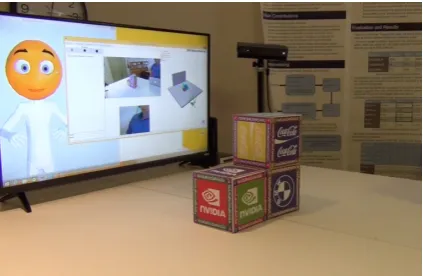
Our system operates in a Blocks World environ-ment consisting of 6-inch cubes placed on a ta-ble. Although the cubes have distinct images for identification and colored sides, we do not use this information in our current version – blocks can only be referred to using descriptions of their lo-cation in the environment. We use two Kinect 2.0’s to detect the blocks, with the separate per-spective aiding in avoiding issues with occlusion. On the opposite side of the user is a monitor with a 3D avatar that speaks the system’s generated text and also has non-verbal communication capabil-ities such as nodding, pointing, and other more complex gestures. The environment is calibrated such that these gestures can point to the location of a block for communicating about it. The appa-ratus with the avatar is shown in Figure 2.
Figure 2: The apparatus and the environment con-taining the blocks used, with the screen display-ing the avatar and 3D visualization of the environ-ment.
User input is currently carried out by keyboard entry by the user or dictation by an assistant. We are currently implementing speech recognition to enable more natural communication. Towards this end we focus on finite state machine language models given the nature of assertions our system understands, but we may have to consider more flexible corpus-based models in the future, aided by transcripts of previous trials.
4 System Architecture
The heart of the dialogue management is the TRIPS architecture (Allen et al., 2001), which connects a number of components through KQML message passing (Finin et al., 1994), with each component augmented with domain-specific knowledge to varying extents. This dialogue man-agement component, including parser, a generic ontology, and an API for interacting with a domain-specific module is open-source and avail-able for download 1. As opposed to other dia-logue management systems like OpenDial (Lison and Kennington, 2016) or POMDP dialogue sys-tems (Williams and Young, 2007), this dialogue management system is primarily suited for col-laborative tasks where there is little to no knowl-edge of what dialogue state typically follows from the previous one – the user can move from state-ments about goals to assertions to questions in any order, determined primarily by the speech act detected in their utterance. For semantic lan-guage understanding and speech act interpreta-tion of the user’s utterances, the domain-generic
[image:3.595.76.288.62.200.2]1https://github.com/wdebeaum/cogent
Figure 3: The TRIPS collaborative problem solv-ing architecture adapted to this task. Only the Be-havioral Agent and apparatus are specifically de-signed for this task – the other components are adapted only through additions to the ontology.
TRIPS parser (Allen et al., 2008) generates logi-cal forms and speech act possibilities backed by a domain-augmented ontology. The relevant speech act is then determined by the Interpretation Man-ager (IM), which also fills in remaining context-dependent references before sending this informa-tion to the Collaborative Problem Solving Agent (CPSA). The CPSA facilitates communication be-tween the parser/IM, Collaborative State Manager (CSM) and the Behavioral Agent (BA) as Collab-orative Problem Solving (CPS) Acts. These acts include adopting, selecting, proposing, and reject-ing goals, queries to the user or the system, and re-porting the current status of a given module. The overall architecture is shown in Figure 3.
4.1 Collaborative State Manager
The Collaborative State Manager stores and re-sponds to queries regarding the systems goal state and facilitates decisions based on goal context. As opposed to the CPSA, the CSM does not have a notion of dialogue context, but does re-spond to speech acts that require the system to generate a response based on the systems state and knowledge. It also is responsible for gen-erating the necessary clarification messages to continue with dialogue, and for managing initia-tive in mixed-initiainitia-tive tasks based on a changing domain-specific environment.
struc-ture model). The goal hierarchy consists of one or more top-level goals, with sub-goals, queries, and assertions added as child nodes to create a tree structure. With this structure, the user and the system can resolve sub-goals and blocking actions such as goal failures and rejected goals without losing the overall goal context. The system works with the user to ensure that there is a top-level goal when beginning the dialogue to ensure the proper context is available for the system, offering possi-ble top-level goals based on the action or assertion the user provides.
The CSM uses a light, domain-specific knowl-edgebase of top-level goals, subgoals, and related speech acts to infer the users intentions and goals based on the incoming speech acts. For example, the statement “The top block must be on the left-most column” would yield a proposed subgoal in a structure building task, but should be resolved as an assertion to be added to the BA’s model during the structure learning task. If there is no top-level goal, the system would ask the user about the top-level goal (e.g.“Are you trying to teach me some-thing?” in response to an assertion) to establish one. When the CSM is unable to resolve ambigu-ity given the information it has, it will generate a response that indicates the system needs more in-formation from the user, and will provide possible solutions such that other modules can generate re-sponses to try to provide efficient communication.
4.2 Behavioral Agent
The BA is the domain-specific aspect of the sys-tem dealing with interaction with and reasoning over the environment. In this system, we also relegate language generation to this component. To design a BA in this architecture, one creates a module that accepts a set of incoming messages, dealing with goal proposals, requests for execution status (i.e, finished a task, waiting for the user, or currently acting), queries about the environment or model, in addition to a “what-next” message that serves to provide dialogue initiative to the system. As the BA receives goals, it determines whether they are achievable and accepts them, and then proposes the next goal – for example, a teaching goal will be responded with a subgoal to describe an aspect of the structure. As assertions are pro-cessed, they will be added to the model, rejected if not understood in context, or clarified with a query in the case of ambiguous statements.
4.3 Goal Management
The base TRIPS architecture provides some means for the user to respond to errors through dialogue, and provides flexibility in goal manage-ment. For example, if the user wants to continue the dialogue in a different way, they can reject it by responding “No” to the BA’s goal proposal, or they can continue to provide assertions or ask ques-tions even when the system has proposed the goal. This flexibility is essential to reduce user frustra-tion when coming up against obstacles and ensure that the user feels a sense of control even when the BA is proactive in dialogue.
5 Constraint Processing
Constraints are processed as assertions that are in-terpreted as holding generally during the structure learning process, rather than relying on the iden-tity of any one particular block or group of blocks. Therefore, the utterance, “The top block has to be on the left” may or may not currently be true about a particular example, but nevertheless should hold in all positive instances of a structure class.
Constraints can be general properties about the structures, such as the maximum/minimum height or width, or they can refer to particular blocks or groups of blocks. All non-general constraints must contain a referring expression, which consists of a referred object or arrangement (i.e., blocks, rows, columns, or spaces) and optionally a location de-scription to pick out a particular object. The as-sertion can assert that such a referent exists in the structure, constrain a particular feature of the ref-erent, (e.g., width, height, the number of blocks it contains), or dictate its location relative to the rest of the blocks or a particular set of blocks denoted by another referring expression. We also have lim-ited support for compositional referents in refer-ring expressions, picking out certain aspects of a structure (e.g., “the ends of the row”).
“The leftmost column’s height is 3 blocks.” “The height is 3.”
“The height of the leftmost column is less than the height of the rightmost column.” “There is a column with at least 3 blocks.” “There is a space between the top 2 blocks.” “The bottom row is connected.”
“The top block is always on the left.” “The top block can be anywhere.”
Figure 4: Examples of understood constraints.
5.1 Constraint Extraction
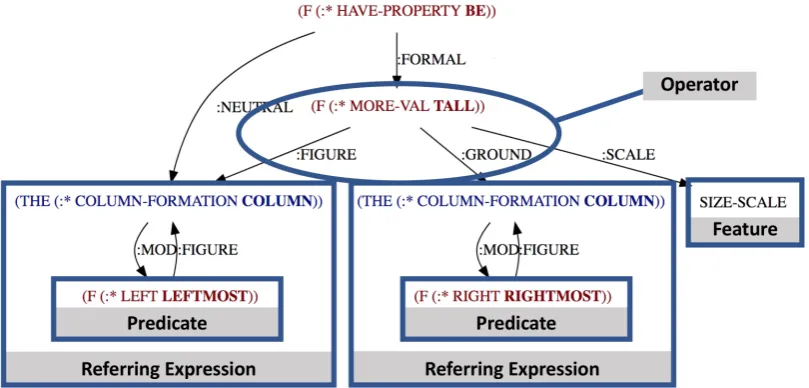
To extract constraints, we primarily depend upon the logical form structure of the TRIPS parser, which allows direct extraction of the types of con-straints we are interested in due to its argument structure of concepts. We first determine all re-ferring expressions by finding mentions of blocks or arrangements. Then we add any modifiers to their location. Once the referring expressions are found, we construct a constraint, which consists of the subject (the :figure argument in the TRIPS logical form), the reference object or property (the :ground argument), and the feature of compari-son (e.g., height, width, count) or a predicate con-straining the location of the subject relative to some reference set. Figure 5 shows an example of structures extracted from a logical form.
5.2 Constraint Evaluation
When the system is asked to evaluate an exam-ple or create its own, it evaluates all current con-straints by finding referents for each referring ex-pression according to the object type and predi-cate. Predicates are calculated using predefined rules, either specifying constraints that apply to individual blocks or using axis-aligned bounding boxes. These rules have built-in tolerances of a half-block width to account for noise or impre-cise placement. We then calculate the features and predicates in the constraint for the resolved refer-ence and return a value for each constraint.
Initial versions of the system primarily built up constraints from a sequence of user utterances. When performing Wizard of Oz studies, we found that an issue with this method is that it can some-times be difficult for users to formulate and de-scribe a concise, consistent model without any di-rection. This can lead to run-on sentences which are difficult to parse, or, if parsed, difficult to inter-pret as constraints. We believe one reason for this
is that, while the system provides affirmation at the end of an utterance entered by keyboard, it does not give non-verbal or verbal cues of understand-ing durunderstand-ing speech recognition. Therefore, the user sometimes continues explaining in various ways looking for a signal that the system understands.
To address this issue, we designed our system to take a more proactive role in conversation. While the system still takes a free-form description or constraint at the beginning of the conversation, it then begins to ask questions about the structure class, ask for examples, present examples, and re-spond to the user’s questions about examples. The system can choose a feature of the structure that has not been described (to ensure the user feels that the system has understood the structure so far) and generate a query to send to the user. An un-filled version of the constraint is sent to the CPSA to aid in resolving the query, and the TRIPS parser is able to handle user responses fragments to fill in the constraint. The strategies to generate these utterances are described in Section 5.3.
The system generates its own examples of struc-tures given its current knowledge as well. The BA will generate random arrangements of blocks in a grid structure until the current constraints have been satisfied, and then return a new structure as an example. This allows the user to see the re-sult of the constraints and refine their constraints, while also providing more evidence that the sys-tem is understanding what is being said.
At any time, the user can ask whether a particu-lar example is correct given the constraints pro-vided so far. The system enumerates the con-straints and can then state whether each constraint is satisfied and why or why not. If there are many constraints, the system will summarize the posi-tive constraints (e.g., “The width is right” rather than “The width is greater than 2”) while focusing on the negative constraints to avoid long-winded explanations and provide a more natural response.
5.3 Learning Strategies
Figure 5: An example of constraint extraction from the TRIPS logical form for the utterance “The left-most column is taller than the rightleft-most column”
descriptions that can overwhelm the parser and tend to be less structured. With a constraint learned, the system then asks for an example. While the system cannot currently learn from the block positions themselves, it uses the example to generate a pertinent referring expression (e.g., “the top block”) that can then be used to ask about a constraint. This query guides the user to thinking about the structure in a concrete and specific way to aid in generating descriptions.
Because the system likely has two or more con-straints at this point, it will then generate an exam-ple of its own based on its learned constraints and check for correctness. This allows the user to fo-cus on aspects that are explicitly disallowed, since the system’s random generation process often re-veals when constraints are underspecified. These learning strategies then continue until the user is satisfied that the system understands the structure. A sample dialogue showing the system’s abilities is given in Figure 6.
6 Wizard of Oz Experiments
Before developing our system, we carried out sev-eral Wizard of Oz experiments to aid in develop-ment of the TRIPS parser, ensure that our system had capabilities suited to the dialogue of a na¨ıve user, and determine which interaction strategies of the system would be most effective for learning and most natural for the user. So far we have con-ducted 3 tasks each with 3 participants who were unaware of the details of the project, yielding 90
user utterances. Two of the participants were fa-miliar with natural language processing research, while one was not.
User: I want to teach you a mountain shape. System: Okay. Can you describe an aspect of the structure?
U:Yes. The rightmost column has 3 blocks. S:Ok. What is the greatest the height can be? U:3.
S:Ok, got it. Can you show me an example? U:Yes. This is an example.〈shows example〉 S:Okay.
U:Is this right?〈shows example〉
S:I think so, because the height is less than or equal to 3 and the right column’s number is equal to 3.
U:The left column has 2 blocks. S:Ok.
U:Is this right?〈shows example〉
S:I don’t think so, because the height is less than or equal to 3 but the left column’s num-ber is not equal to 2 even though the right column’s number is equal to 3.
Figure 6: An example dialogue showing interac-tion with the system.
per-forming the dialogue and interpreting the user’s utterances, and the researcher was simply an assis-tant. In fact, the tablet served as a method for the researcher to respond with predetermined phrases, including acceptances, requests for examples, and questions about the structure. These phrases were then sent through the speech generation compo-nent of the system.
We found several advantages of users believ-ing that the system was actually engagbeliev-ing in di-alogue. First, the users used simpler language than they might have with a person, while still providing sufficient variation for exploring pos-sible utterances. Second, users sometimes pro-vided their own thoughts aside to the researcher, allowing a specific glimpse into users’ responses to certain utterances or tasks. For example, once when the system asked, “How tall can the struc-ture be?”, the participant said as an aside, “It can be any height,” and then responded to the system “At least two blocks.” Finally, we could evaluate how the dialogue might progress without being in-terrupted by failures of the system at the parsing or interpretation level. We processed the Wizard of Oz dialogues with the TRIPS parser and correctly parsed 89% of the utterances. 90% of these correct parses also yielded the correct constraint when in-terpreted by the current state of the system.
6.1 Description Modalities
We recognized several different description modalities participants used when describing the structure without responding to a particular feature query. When the system asked questions, typically the user responded directly to the ques-tion, reducing the utterance complexity. However, these variations on the expected descriptions reveal interesting insight into how users generate representations of the concepts they are provided.
Basic Constraints– “The height of the leftmost column is greater than 2” – These descriptions are the simplest to interpret and make up the majority of user utterances, especially when the system is proactive in dialogue.
Arrangement Constraint – “The column can be either second in the row or third in the row.” Here the definite article conveys that there should be a single instance of a column, and the ordinal reference to the row constrains its position – even though in certain cases a row might be considered to be a line of blocks only a single block high.
We handle such cases by inferring a sequence of columns left to right, and then processing ordinal references to enforce constraints.
Movement Modality – “This top block can move wherever.” – These descriptions, using movement as a surrogate for possibility, are slightly more difficult to interpret, but can often be handled by our loose interpretation of logical forms that focuses on referring expressions (“the top block”) and predicates (“wherever”) without focusing on the event term of “moving”.
Transformation Modality– “The left block is a column.” – The difficulty in parsing a constraint described in this way is that a particular type of ob-ject (“the left block”) is picked from the structure with the goal of changing it to another arrange-ment (“a column”, presumably with more than one block). This can also be viewed as an explicit bridge between the current and desired state to ful-fill the constraints. Currently we encourage users to describe the structure in a general way – how-ever, this type of utterance demonstrates an exam-ple where a specific error or instance applies gen-erally enough to serve as a constraint.
Procedural/Construction Modality – “No, you’re missing a row. Subtract by one every time you go up.” – Here the user is describing the struc-ture by providing the process for creating it. While our current system does not understand these types of utterances, we are working on a similar task in parallel with this environment that can be lever-aged to understand this modality (Perera et al., 2018). The key aspect of understanding this type of utterance is the compositionality of primitive concepts, namely a row, its length, and the se-quence of rows that will presumably be placed by the agent building the structure.
task which makes use of such modalities.
6.2 Preliminary Evaluations
Alongside adapting the system to handle our ex-isting Wizard of Oz dialogues, we have begun pre-liminary user evaluations, primarily for testing for robustness and unforeseen methods of communi-cating constraints to the system. An example dia-logue with a user is shown in Figure 7.
User: I want to teach you a shape.
System: Okay. Can you tell me something about the structure?
U:The bottom row must be at least 2. S:Hmm, I didn’t quite get that.
U:The bottom row has at least 2 blocks. S:Ok. What is the greatest the width can be? U:5.
S:Ok, got it. Can you show me an example? U:Yes. This is an example. 〈shows example〉 S:Okay. Where can the top block be? U:The top block is always on the left. S:Okay.
U:〈user builds example〉Is this right? S:I think so, because the bottom row’s num-ber is greater than or equal to 2 and the width is less than or equal to 5 and the top block is on the left.
Figure 7: A taken from initial runs of the eval-uation with the autonomous system and a user unfamiliar with the system.
Failures of the system are handled by the di-alogue manager, with unparsable user utterances causing the system to continue with a question where the response is easy for the system to han-dle, such as asking for the maximum height or width, or by asking the user to rephrase. In initial trials, users were often able to rephrase constraints in a way the system could understand. Further-more, users reported that the difficulty of the task made dialogue setbacks seem like a complemen-tary challenge of clearly expressing an idea rather than an obstacle to an otherwise simple task.
To track development of the system, we will evaluate according to several metrics along with user surveys. The first measure will be the num-ber of positive examples successfully recognized by the trained system and the number of nega-tive examples successfully rejected. Next, we plan to track robustness by determining the number of cancellations, undos, or restarts by user, as well
as the efficacy of extracting constraints from user assertions. In addition, a final task which ensures that communication is two-way will be to reverse roles and have the system explain the concept to the user based on what it has learned from prior interactions with a different user.
7 Conclusion
We believe our system shows promise in the task of teaching a system new concepts in Blocks World in an manner extendable to multiple types of descriptions and with applications to multiple domains. While our first priority is to handle the most common description modalities of users to ensure broader coverage, we also begin the pro-cess of using this system as a stepping stone for language understanding and dialogue in other do-mains by mapping our concepts and predicates into a database to be used by our collaborators in this and related projects. With multiple defi-nitions of features and predicates, we plan to use these concrete physical representations as proxies for more abstract and metaphorical reasoning ca-pabilities to be developed in other systems.
Because the rules and interpretation are hand-crafted, brittleness can be an issue but is partially mitigated through dialogue repair. Given the pri-marily symbolic nature of the system and the dif-ficulty of specifying composition with statistical models or neural networks, we focus our efforts on building rules to understand conceptual com-position rather than processing utterances using statistical techniques. However, development of a broader range of understood constraint modalities can extend this dialogue system to other domains that involve a direct or indirect spatial or temporal component – such as scheduling, building graphi-cal models, or directing scenes of a movie. Finally, we believe the compositionality inherent in the type of communication captured requires back-ground knowledge about the conceptual structures we inherently use in discussing complex ideas.
8 Acknowledgements
References
J. Allen, Mary Swift, and Will de Beaumont. 2008.
Deep Semantic Analysis of Text. InSymposium on
Semantics in Systems for Text Processing (STEP), pages 343–354, Morristown, NJ, USA. Association for Computational Linguistics.
James Allen, George Ferguson, and Amanda Stent. 2001. An architecture for more realistic
conversa-tional systems. In Proceedings of the 6th
interna-tional conference on Intelligent user interfaces - IUI ’01, pages 1–8.
Yonatan Bisk, Deniz Yuret, and Daniel Marcu. 2016. Natural Language Communication with Robots.
Proceedings of the 2016 Conference of the North American Chapter of the Association for Computa-tional Linguistics: Human Language Technologies, pages 751–761.
M. M. (Mikhail Moiseevich) Bongard, Joseph K.
Hawkins, and Theodore Cheron. 1970. Pattern
recognition. Spartan Books.
Daniel J Brooks, Constantine Lignos, Cameron Finu-cane, Mikhail S Medvedev, Ian Perera, Vasumathi Raman, Hadas Kress-gazit, Mitch Marcus, and Holly a Yanco. 2012. Make It So : Continuous , Flexible Natural Language Interaction with an
Au-tonomous Robot. InAAAI Workshop on Grounding
Language for Physical Systems.
N. Dahlb¨ack, A. J¨onsson, and L. Ahrenberg. 1993.
Wizard of Oz studies - why and how.
Knowledge-Based Systems, 6(4):258–266.
Tim Finin, Richard Fritzson, Don Mckay, and Robin Mcentire. 1994. KQML as an Agent
Communica-tion Language. In Proceedings of the Third
Inter-national Conference on Information and Knowledge Management. ACM Press.
Harry Foundalis. 2006. Phaeaco: A Cognitive
Archi-tecture Inspired By Bongard’s Problems. Ph.D. the-sis.
Casey Kennington, Livia Dia, and David Schlangen.
2015. A Discriminative Model for
Perceptually-Grounded Incremental Reference Resolution. In
Proceedings of the 11th International Conference on Computational Semantics, 2002, pages 195–205, Beijing, China.
Pierre Lison and Casey Kennington. 2016. OpenDial: A Toolkit for Developing Spoken Dialogue Systems
with Probabilistic Rules. Proceedings of the 54th
Annual Meeting of the Association for Computa-tional Linguistics, pages 67–72.
V Mast, Z Falomir, and D Wolter. 2016. Probabilis-tic Reference and Grounding with PRAGR for
Di-alogues with Robots. Journal of Experimental &
Theoretical Artificial Intelligence, 28(in press).
Cynthia Matuszek, N FitzGerald, Luke Zettlemoyer, Liefeng Bo, and Dieter Fox. 2012. A Joint Model of Language and Perception for Grounded Attribute
Learning. InProceedings of the International
Con-ference on Machine Learning (ICML).
Ian Perera and James Allen. 2015. Quantity, Contrast, and Convention in Cross-Situated Language
Com-prehension. Proceedings of the Nineteenth
Confer-ence on Computational Natural Language Learning, pages 226–236.
Ian Perera, James F. Allen, Choh Man Teng, and Lu-cian Galescu. 2018. Building and Learning Struc-tures in a Situated Blocks World Through Deep
Lan-guage Understanding. InSPLU 2018: Proceedings
of the HLT-NAACL Workshop on Spatial Language Understanding, New Orleans, Louisiana. Associa-tion for ComputaAssocia-tional Linguistics.
Jan Ramon, Kurt Driessens, and Tom Croonenborghs. 2007. Transfer Learning in Reinforcement Learning
Problems Through Partial Policy Recycling. Lecture
Notes in Computer Science, 4701:699–707.
Lanbo She, Shaohua Yang, Yu Cheng, Yunyi Jia,
Joyce Y Chai, and Ning Xi. 2014. Back to the
Blocks World: Learning New Actions through
Situ-ated Human-Robot Dialogue. InProceedings of the
SIGDIAL 2014 Conference, June, pages 89–97.
Erik Weitnauer and Helge Ritter. 2012. Physical
Bon-gard Problems. In IFIP Advances in Information
and Communication Technology, volume 381 AICT, pages 157–163.
Jason D. Williams and Steve Young. 2007. Partially observable Markov decision processes for spoken
dialog systems. Computer Speech and Language,
21(2):393–422.
A Supplemental Material
Concept Lemmas
ABOVE above
HIGHER higher
BELOW below, beneath, under,
underneath
LOWER lower
ADJACENT adjacent (to), next to, beside, by, contiguous (with), flush CONNECTED abut, adjoin, connect, touch
TOGETHER together
ON on, on top of
LEVEL level with
TOP-LOC... top
MIDDLE-LOC middle
BOTTOM-LOC bottom
BETWEEN (in) between
CENTER center
LEFT-LOC left, lefthand, leftmost RIGHT-LOC right, righthand, rightmost
[image:10.595.308.530.71.343.2]ANYWHERE anywhere
Table 1: The list of predicates understood by the system, with their concept in the ontology, and matching lemmas that can resolve to that concept.
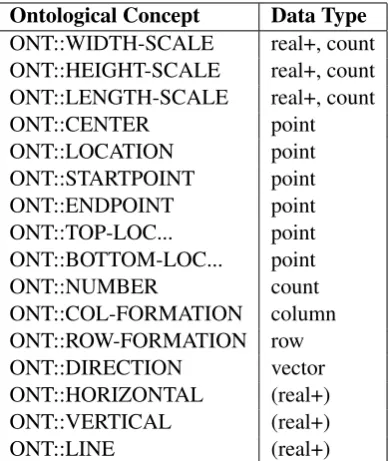
Ontological Concept Data Type
ONT::WIDTH-SCALE real+, count
ONT::HEIGHT-SCALE real+, count ONT::LENGTH-SCALE real+, count
ONT::CENTER point
ONT::LOCATION point
ONT::STARTPOINT point
ONT::ENDPOINT point
ONT::TOP-LOC... point
ONT::BOTTOM-LOC... point
ONT::NUMBER count
ONT::COL-FORMATION column
ONT::ROW-FORMATION row
ONT::DIRECTION vector
ONT::HORIZONTAL (real+)
ONT::VERTICAL (real+)
ONT::LINE (real+)
[image:10.595.320.515.425.656.2]